
Elemental Plane of Air — Infinite Sky of Breath, Wind and Storm
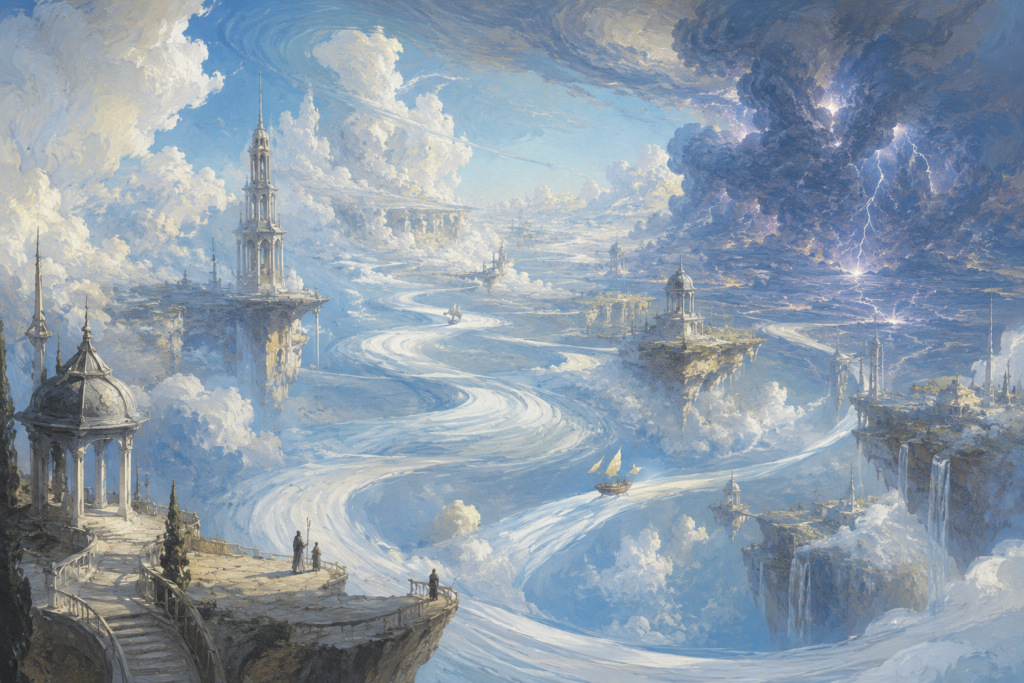
The Elemental Plane of Air is endless height: the first open distance, the breath between worlds, and the living sky where wind has memory.

- Planar Sigil: A silver feather spiral within a blue circle, crossed by four curling winds.
- Plane Type: Inner Plane; Elemental Plane
- Moral Gravity: Neutral; breath, motion, exposure, speech, freedom, storm, pressure, and balance shape consequence.
- Common Names: Elemental Plane of Air, the Infinite Sky, the First Blue, the Breath Between Worlds, the Upper Vastness, the Wind-Sea
- Primary Function: Source-plane of air, breath, wind, cloud, weather, sound, pressure, flight, storm, and the open space through which all moving things pass.
- Usual Arrival Point: Open sky near a drifting cloudbank, wind-current, djinni aerie, storm shelf, floating ruin, cloud-island anchorage, or border front between elements.
The Elemental Plane of Air is the oldest sky.
It stretches without a mortal horizon: blue distance, pearl cloud, silver vapour, violet storm, black thunderhead, cold high brilliance, warm mist, and roaring invisible current. Above is sky. Below is sky. Around the traveller, space itself moves.
Solid ground appears as an event rather than a rule. A floating island. A cloudland. A djinni palace. A stone ruin caught forever in an updraft. A wrecked airship turning slowly in the light. A thunderhead large enough to contain courts, prisons, and wars.
Air is the element of breath, sound, distance, storm, flight, and separation. It gives life its first inhalation, carries speech from mouth to ear, feeds flame, lifts vapour into cloud, wears stone into dust, and opens the space where movement can happen.
The plane is beautiful because it is free. It is dangerous for the same reason.
Travellers who arrive with wings, spells, or vessels may still be helpless if they cannot read the winds. A route can vanish. A cloudland can soften beneath the feet. A dead calm can swallow sound. A storm frontier can close like a wall. A careless word can travel ahead of its speaker and become evidence in a court of wind.
This is the home of air elementals, primal air elementals, djinn, sylphs, sylphides, aerial servants, invisible stalkers, belkers, anemoi, mihstus, Air Maidens of Ukko, cloud giants in rare settled regions, thunderbirds, storm giants in border realms, and sky-borne beings that have never touched earth.
Its people understand current as road, cloud as harbour, storm as border, breath as identity, and spoken oath as living force.
Cosmological Role
The Elemental Plane of Air belongs to the primal elemental order.
The Great Collision. The raw elemental roots awaken. Air exists as primal breath, pressure, motion, sound, cloud, and open distance. As cosmic structure stabilises, the Infinite Sky gathers into a coherent domain of cloudlands, djinni aeries, storm frontiers, dead calms, and living wind. The Astral Plane comes later. The Elder Gods come later. The Outer Planes come later. Titans come later still.
Air is one of the old physical truths of the campaign cosmos. It is an Inner Plane, older than divine borders and broader than any single pantheon. Gods of wind, storm, sky, thunder, weather, speech, messenger roads, and breath can reach it, bless through it, or send omens across it, but the Infinite Sky does not belong to them.
The plane touches the Material Plane wherever air becomes fate: mountain passes, high towers, sea winds, battlefield smoke, desert storms, sacred breathing rites, bird migrations, thunderheads, plague-still rooms, newborn cries, dying breaths, and the sudden silence before a storm breaks.
In play, Air is the plane of open possibility under constant pressure. It is useful when the story concerns freedom, flight, weather control, vanished cities, stolen breath, wind-borne messages, djinni bargains, storm warfare, sky piracy, elemental diplomacy, or a desperate journey across impossible distance.
The Nature of the Infinite Sky
The Elemental Plane of Air is open, but never empty.
Its substance is moving air in countless states: clear blue height, dense cloud, warm updraft, knife-cold jetstream, rolling fog, dust-laden gale, thunder corridor, sweet breathable breeze, crushing pressure, near-vacuum, storm-dark shelf, and living wind.
Direction is local. “Down” may mean the pull of a cloudland, the gravity of a djinni palace, the instinct of a falling body, the agreement of a ship’s deck, or the command of a ruling current. Guides describe routes by wind-name, temperature, pressure, cloud colour, thunder rhythm, bird behaviour, and the taste of the air.
Sound carries strangely. A song can mark distance. A thunderclap can announce a border. A whispered bargain can travel along the wrong current. A spoken oath released into a named wind may reach a court before the speaker does.
The plane rewards movement, preparation, etiquette, and attention. It punishes panic, arrogance, heavy thinking, and any plan that assumes there will be ground.
Major Regions and Campaign-Facing Areas
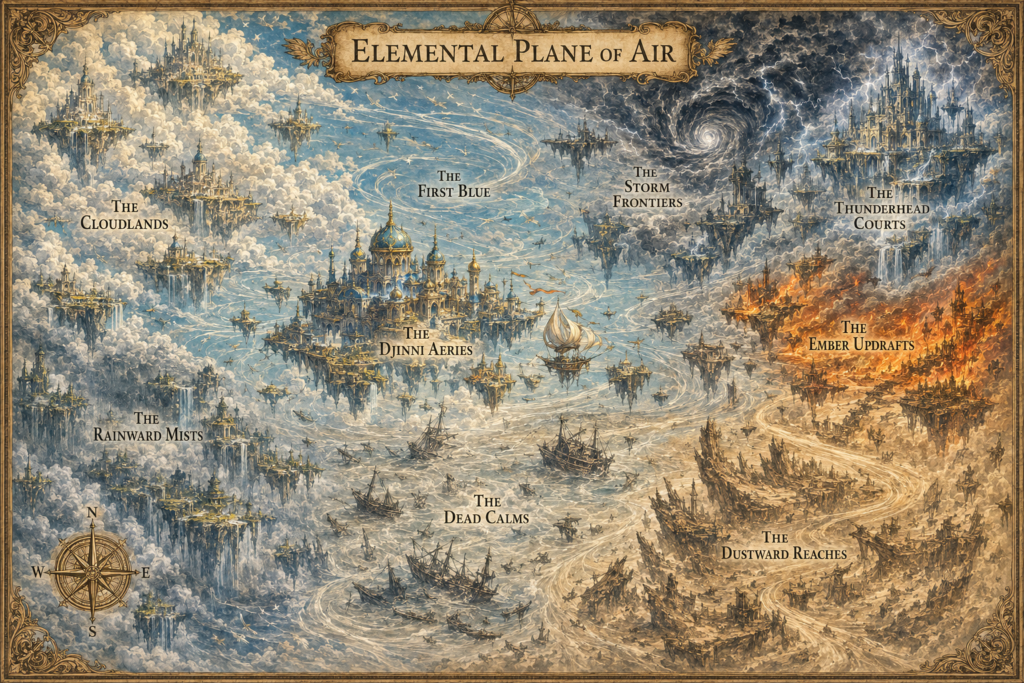
The First Blue
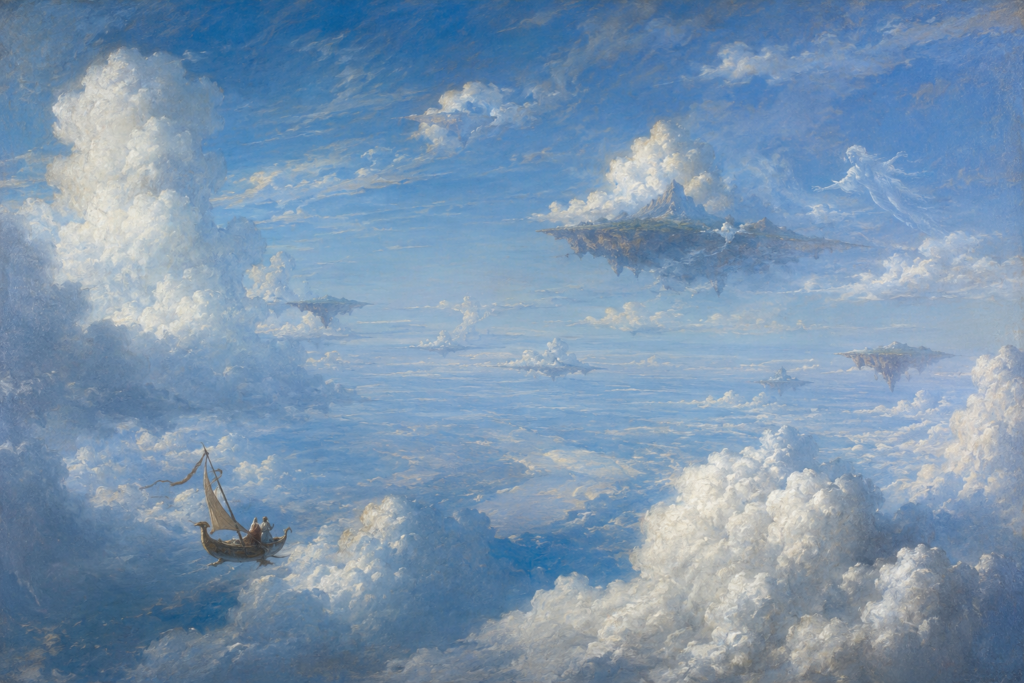
The First Blue is the broad, bright, apparently gentle sky where many travellers first arrive. It is open air, clean light, distant cloudbanks, and slow-moving currents.
This region is survivable by Air’s standards. That makes it dangerous to underestimate. A party without flight, anchoring magic, windcraft, or guidance can drift until thirst, exhaustion, panic, or predation becomes the real enemy. Air elementals cross the First Blue in long invisible streams. Djinni scouts watch its approaches for merchants, envoys, escaped servants, enemies, and useful strangers.
The First Blue is the best starting region for campaigns entering the plane for the first time. It gives wonder before terror.
The Cloudlands
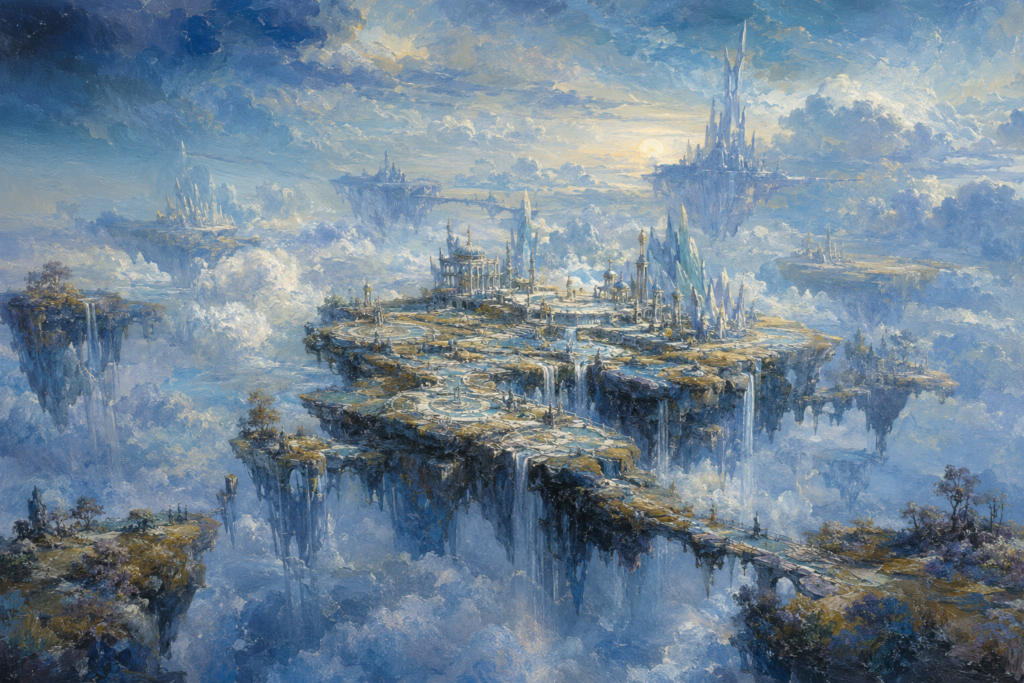
The Cloudlands are immense masses of condensed elemental vapour. Some are soft and luminous. Others are dense enough to support cities, forests of vapour-crystal, rainwater lakes, orchards of cloud-fruit, grazing sky-beasts, military platforms, rare cloud giant estates, and whole weather systems.
Their geography changes slowly. Valleys close. Towers sink. Roads blur. A camp pitched on firm cloud at dusk may stand knee-deep in mist by morning.
Cloudwrights, sylph architects, djinni engineers, and cloud giant builders know ways to stabilise cloud matter. Even then, cloudlands require tending. A neglected district softens, thins, and finally returns to sky.
Use the Cloudlands for settlements, courts, chases, sky markets, hidden monasteries, rare cloud giant strongholds, lost ruins, and adventures where the ground itself is a temporary agreement.
The Djinni Aeries
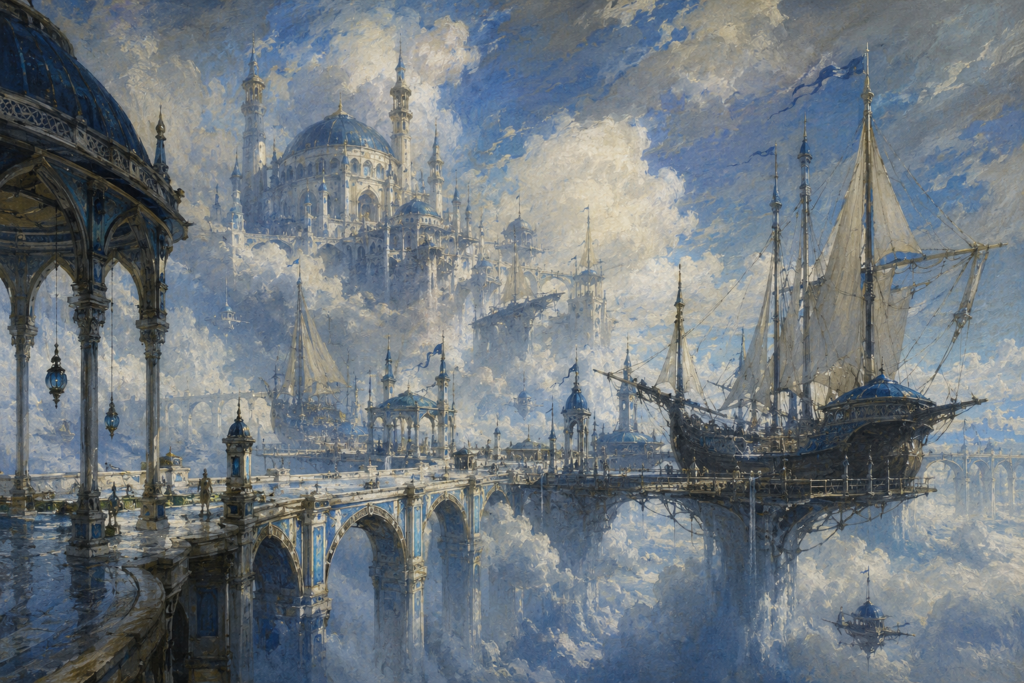
The Djinni Aeries are the plane’s most powerful civilised regions: palace clusters, trade platforms, military harbours, wind-borne cities, pleasure courts, embassy spires, and noble estates suspended in luminous air.
Djinni society prizes freedom, honour, magnificence, generosity, clever speech, guest-right, public promises, and the keeping of bargains. It also contains rival houses, debt politics, bound servants, old feuds, storm fleets, and sharp distinctions between honoured guest, debtor, prisoner, trespasser, and property.
A djinni court should feel socially dangerous before it becomes physically dangerous. The party may need introductions, gifts, witnesses, translators, safe-conduct, or a properly spoken reason for entering. A poor insult can close a harbour. A brilliant compliment can open a palace. A broken promise can follow the speaker across planes.
Use the Aeries for diplomacy, patronage, trade, luxury, political traps, elemental law, rescue missions, and bargains that sound generous until the wording is examined.
The Storm Frontiers
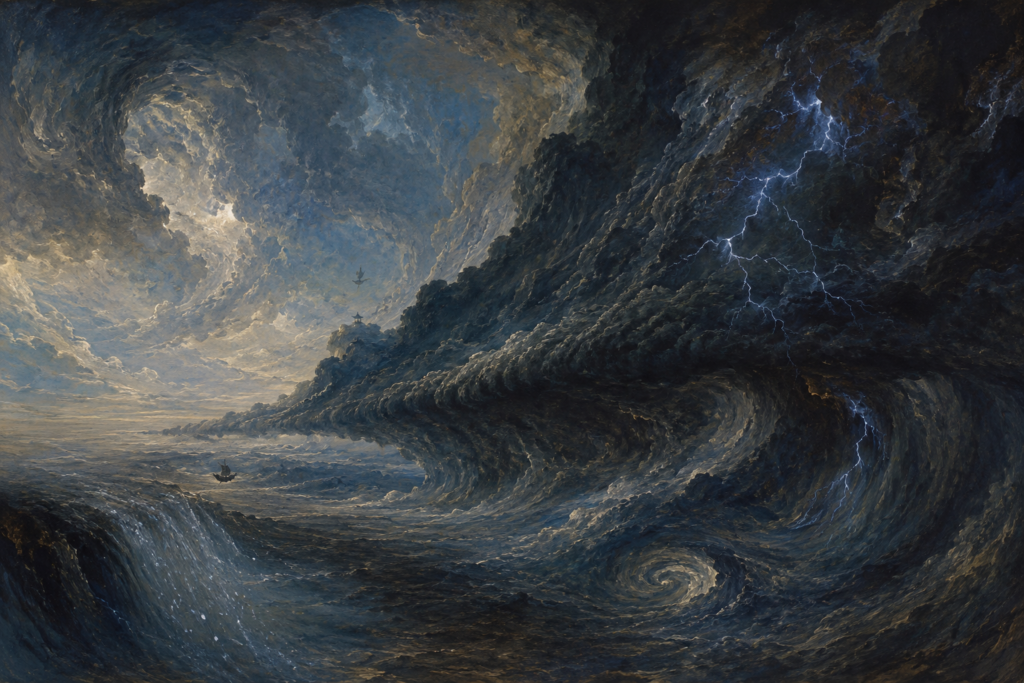
The Storm Frontiers are vast moving territories of thunderhead, lightning, hail, pressure, and violent crosswind. Some follow known cycles. Some are living weather. Others are battlefronts between storm sovereigns, djinni houses, bound elementals, storm giants, and ancient winds.
These regions are geography, border, prison, weapon, and sacred site at once. Thunderbirds hunt in the charged distances. Storm-priests listen for repeated names in the sky. Air elementals spiral through the thunderheads to breed, fight, remember, or dissolve into the plane.
A Storm Frontier should change the whole encounter. Visibility collapses. Sound becomes threat. Flight becomes labour. Ranged attacks become unreliable. Lightning reveals enemies for a heartbeat and hides them again.
Use the Storm Frontiers when the plane must feel powerful enough to humble high-level characters.
The Dead Calms
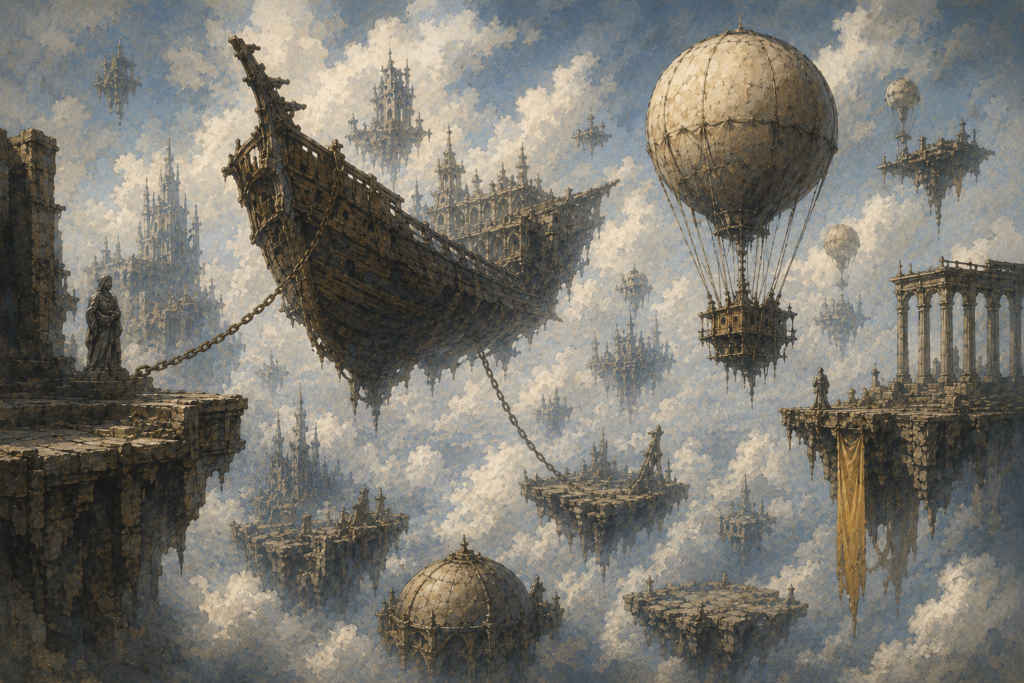
The Dead Calms are regions where Air pauses.
Wind slackens. Cloud hangs unmoving. Wings beat without lift. Sound becomes close and private. Wrecks, balloons, corpses, broken spelljammers, abandoned temples, and lost banners can remain suspended for centuries.
Some Dead Calms are natural pressure hollows. Some are ancient prisons. Some are wounds left by elemental weapons. A few are places where a named wind was chained, slain, or silenced.
The Dead Calms are excellent horror locations because the plane’s usual freedom disappears. Movement slows. Escape becomes uncertain. Every sound matters. Invisible stalkers, belkers, trapped aerial servants, and resentful winds make good inhabitants here.
The Thunderhead Courts
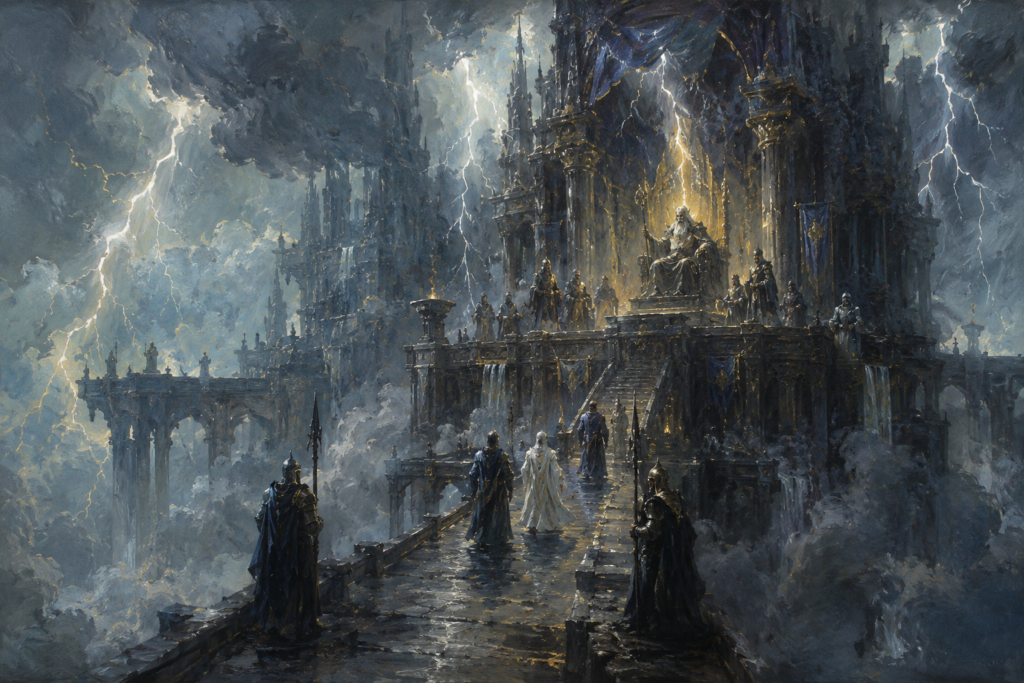
The Thunderhead Courts are semi-stable storm realms ruled by beings of lightning, cloud, pressure, and sound. They are more formal than wild storms and less hospitable than djinni aeries.
Here, thunder speaks. Lightning marks rank. Rain-veils serve as curtains, doors, and borders. Judgement may be delivered as a bolt from cloud to cloud. Silence may mean contempt, mercy, or the gathering of force.
Mortals who enter these courts need storm-wards, interpreters, offerings, or a reason powerful enough to be heard over the sky.
Use the Thunderhead Courts for elemental trials, storm bargains, weather prophecy, punishment, and scenes where the environment is also the judge.
The Rainward Mists
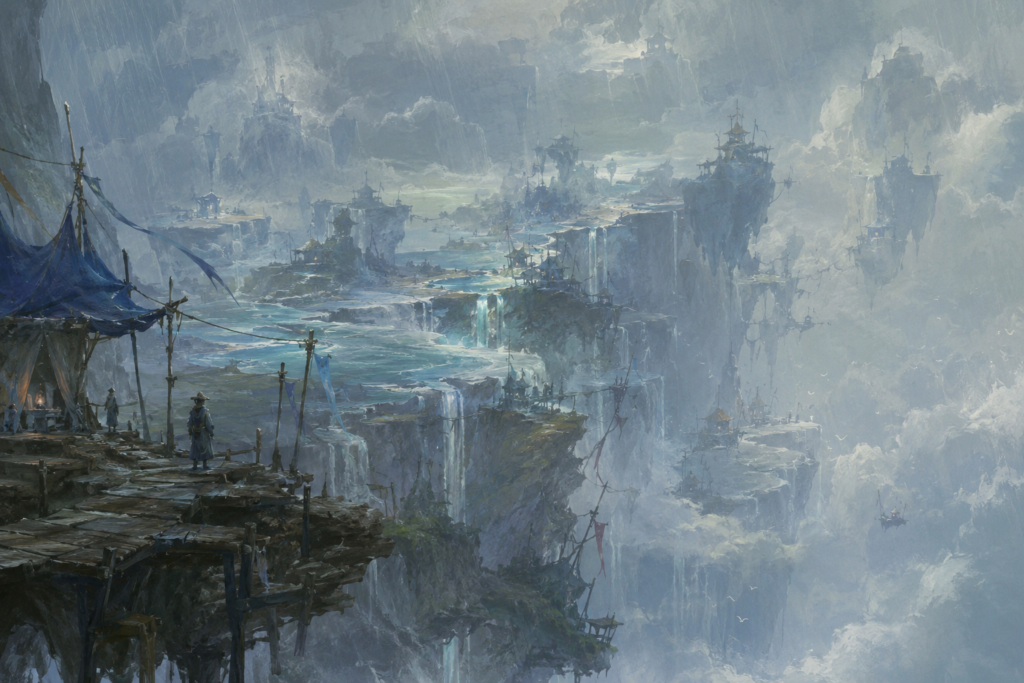
The Rainward Mists form where Air approaches Water. Mist, rain, sleet, fog, floating lakes, cloud-oceans, vertical seas, and rivers of vapour drift through this region.
Water elementals, marid envoys, ice elementals, weather spirits, and air powers all move through the Rainward Mists. Borders shift with temperature and pressure. A ship may sail into cloud and emerge falling through rain. A lake may hang above a city, held by treaty between Air and Water.
Use this region for monsoon bargains, rain theft, vanished fleets, drowned temples in the sky, marid-djinni diplomacy, and weather that carries political consequence.
The Ember Updrafts
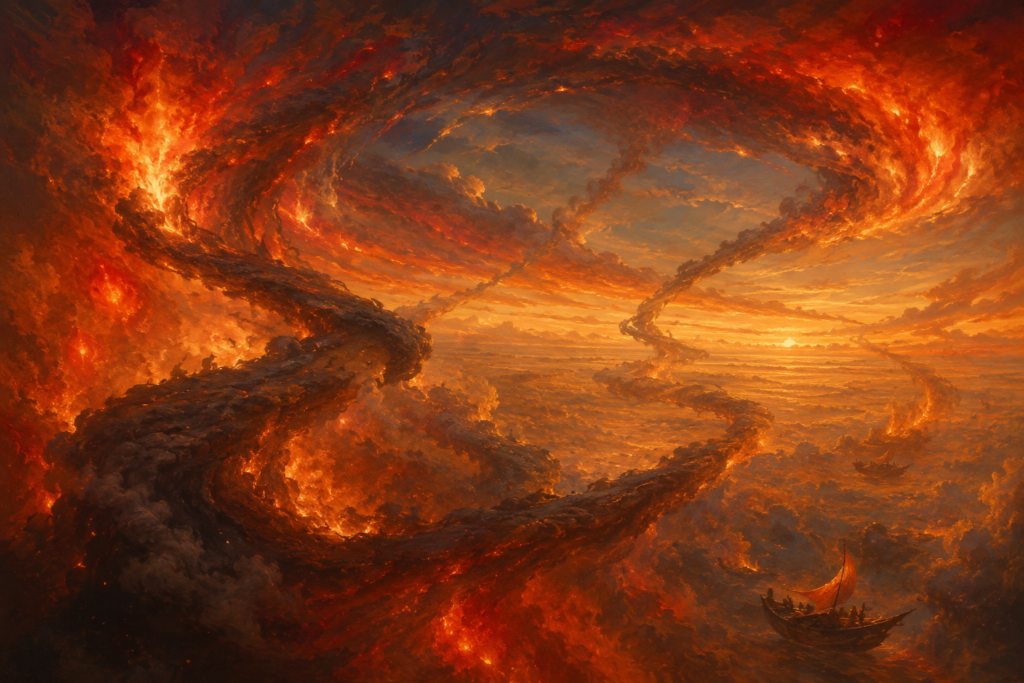
The Ember Updrafts form where Air approaches Fire. Hot winds, smoke rivers, ember storms, lightning-fire, choking haze, furnace currents, and volcanic clouds dominate the region.
Efreet influence reaches here through smoke embassies, fire barges, slave routes, war camps, and hostile trade. Djinni patrols watch the Ember Updrafts with care. A safe breeze can become a burning ascent. A cloudbank can ignite from within. A diplomatic mission can turn into a border incident in a single gust.
Use the Ember Updrafts for Fire-Air conflict, smoke-choked rescues, efreet schemes, burning sky battles, and dangerous routes into Fire-dominant territory.
The Dustward Reaches
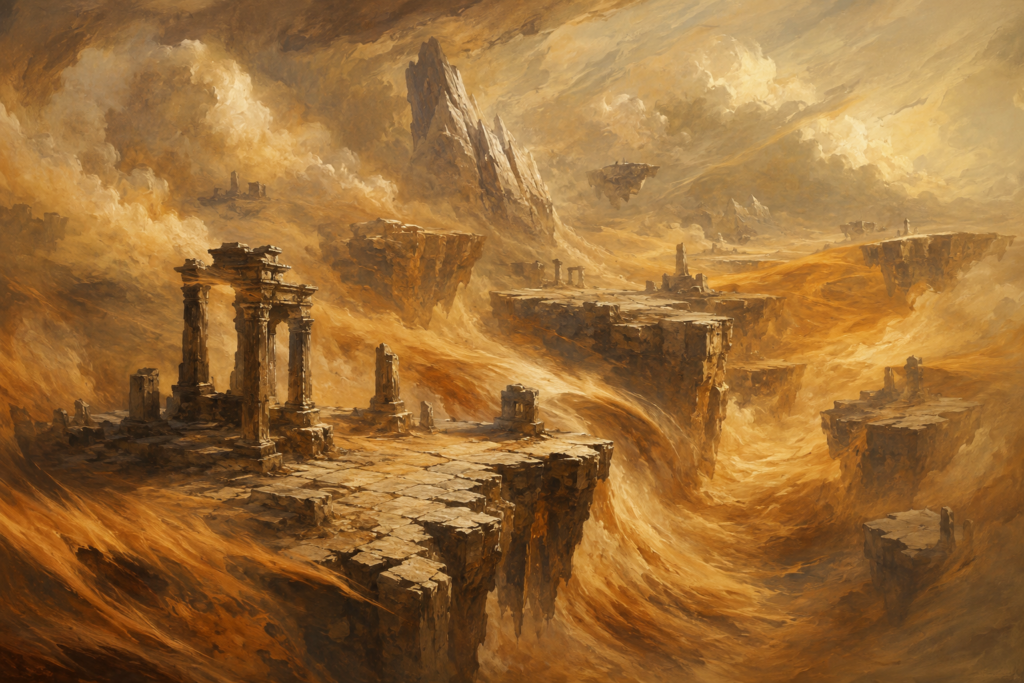
The Dustward Reaches form where Air approaches Earth. Sandstorms, gravel clouds, floating boulders, dust seas, pressure canyons, broken towers, and stone shards fill the sky.
Dao envoys, earth elementals, gargoyles, mineral spirits, cloud giants, and salvage crews all appear here. Ruins torn from the Material Plane often drift in the Dustward Reaches, preserved in grit and wind. Some still contain sleeping armies, sealed tombs, or cities that never understood they left the world.
Use this region for salvage, ambushes, earth-air diplomacy, dust storms, lost cities, and routes toward the Elemental Plane of Earth.
Laws of the Elemental Plane of Air
Breath Is Sacred Substance
Breath is life, identity, speech, and permission.
Air powers recognise breath as more than a bodily function. Some elementals know a creature by its breathing pattern. Some djinni contracts use a willing exhalation as witness. Some storm courts accept a final breath as testimony. A stolen breath can be evidence, ransom, curse, inheritance, or soul-sign.
Magic that steals breath, seals mouths, suffocates captives, or binds living wind carries serious consequence in many Air regions. It may be legal in one court, forbidden in another, and treated as enslavement by a named wind.
Weather Is Geography
A storm can be a country. A cloudbank can be a harbour. A current can be a road. A pressure wall can be a fortress. A wind shear can be a border.
Maps of Air record cycles rather than fixed ground: ruling winds, recurring storms, court territories, safe cloudlands, dead calms, pressure shelves, and seasonal routes. A good map is less a picture of place than a record of behaviour.
Falling Is Movement
Falling is travel under poor control.
In the Infinite Sky, a fall may last minutes, hours, or days. The danger is usually exposure, separation, panic, predators, hostile currents, or arrival in a worse region. Impact matters only when solid matter appears.
Prepared travellers treat falling as a navigation emergency. Unprepared travellers treat it as death and make bad choices.
Speech Has Weight
Air carries words.
A voice can become message, insult, oath, spell, evidence, song, password, curse, or signal. Spoken words released into named currents may travel with supernatural reliability. Lies told in listening winds can arrive before the liar. Thunder may repeat what the plane considers important.
Written contracts matter in djinni courts, but spoken promises have special force. A bargain said aloud before the right wind can bind reputation across regions.
Bound Air Remembers
Air can be shaped, ridden, sung through, summoned, persuaded, and blessed. Air can also be trapped in bottles, engines, lungs, rooms, prisons, and spells.
Ordinary use of air is part of life. Sails, flutes, breath, bellows, and windmills all work with moving air. Offence begins when living wind, sapient elementals, djinn, sylphs, stolen breaths, or named currents are bound against recognised custom.
A character who treats Air as an expendable resource may survive one encounter and earn enemies in the next.
Divine Powers, Wind Gods, and Sacred Winds
The Infinite Sky is older than the divine courts, but the gods have always listened to it.
No single pantheon rules the Elemental Plane of Air. The plane is too old, too wide, and too elemental to belong to a throne. Divine powers enter it by affinity: through a named wind, a storm front, a cloud shrine, a thunderhead court, a sacred bird, a messenger current, a sky-road, a rain-bearing border, or a breath carried between worlds.
Enlil has the strongest divine claim upon Air. He is Lord Wind and Lord Storm, a power of wind, air, space, storm, kingship, order, and the separation of heaven and earth. His shrines appear on high cloudlands, storm shelves, ziggurat-like aeries, and wind-roads where law must be spoken aloud. His servants may appear as the Four Winds, storm heralds, eagle-omens, thunder-bearing priests, or judges who arrive with pressure and clear sky after violence.
Ninlil touches the gentler and more fertile face of Air. Her presence belongs to scented winds, warm valley currents, grain-bearing breezes, spring air, and the soft movement of life through households and fields. Where Enlil’s wind commands, Ninlil’s wind sustains.
Shu is the great Pharaonic Air power: the upholder, the god of air and sunlight, and the divine force that holds sky and earth apart. His shrines belong on cloud-pillars, clear upper winds, sunlit aeries, and places where the plane’s open distance becomes sacred order. His presence is calm, bright, immense, and architectural: Air as the space that lets the world exist.
Ukko reaches the Infinite Sky through thunder, storm, northern weather, and the high vault of heaven. His signs are blunt and powerful: darkening sky, hammering thunder, sudden rain, charged air, and the feeling that the heavens have leaned close to listen. In Air-plane stories, his influence suits thunderhead courts, storm trials, sky-oaths, and weather that answers insult with force.
Asiaq belongs to the cold weather face of Air. Her power fits the Rainward Mists, snow-bearing cloudlands, Arctic winds, ice shelves, and storm routes where survival depends on the timing of weather. Her shrines are small, practical, and deeply respected: snowflake charms tied to cloud-docks, hunter offerings before a cold crossing, and weather-prayers spoken before a dangerous current opens.
Zephyrus and the named wind traditions belong to routes, borders, and seasonal currents. They are best used as keepers of directional winds, wardens of storm gates, patrons of favourable passage, or powers who must be honoured before a wind-road can be ridden safely. Their influence makes the plane feel mapped by temperament rather than stone.
Aether touches the uppermost, brightest face of Air: high clarity, upper sky, radiant distance, and the clean space above storm. His influence suits rarefied cloud temples, scholar-observatories, silent upper winds, and places where Air becomes luminous rather than violent.
Hermes belongs where Air becomes speed, message, road, boundary, and safe passage. His shrines are small and practical: wing-marked stones on cloud docks, courier bells in djinni markets, and offerings made before taking a wind-road whose destination may shift.
Other divine powers touch the plane at its borders and crossroads. Tefnut and Tlāloc matter where Air becomes rain, mist, and storm-water. Messenger, thunder, and weather powers may be honoured in local courts when their own traditions support that role. These powers add sacred pressure without making the Infinite Sky their home.
The strongest native powers of the Infinite Sky remain elemental: ancient winds, storm sovereigns, elder air elementals, djinni rulers, thunderhead courts, cloud thrones, and named currents worshipped by those who live within them. A god may bless a current, claim a shrine, command a storm, or send servants through the sky, but the plane itself remains Air first: breath, motion, sound, storm, distance, and exposure.
Inhabitants
Air Elementals
Air elementals are primary natives of the plane. They are living wind, pressure, current, storm, whisper, and motion.
Some are barely person-like. Others are ancient, named, intelligent, territorial, and capable of oath, memory, and revenge. They do not need cities to have society. They gather in spirals, fronts, flocks, seasonal routes, storm congresses, and pressure patterns.
A summoned air elemental may be a temporary servant at the table, but in the plane itself such beings have origin, status, and consequence. A careless summoner can create an enemy that arrives years later with witnesses.
Primal Air Elementals
Primal air elementals are older, greater, and less person-shaped expressions of the plane. They belong to vast currents, storm frontiers, pressure walls, and the spaces where the sky remembers its first motion.
Use them as regional powers rather than routine encounters. A primal air elemental can be a living border, a court witness, a storm ancestor, a current that chooses whom it carries, or the reason a whole region moves.
Djinn
Djinn are the strongest organised people of the Infinite Sky.
Their courts, fleets, palaces, markets, marriage alliances, debt laws, and guest customs give the plane much of its visible civilisation. A djinni noble may be patron, host, rival, creditor, liberator, collector, slaver, artist, admiral, or enemy.
They should feel politically powerful as well as magically powerful. A party may defeat one djinni warrior and still lose to a house contract, harbour closure, witness rule, or insult carried to the wrong court.
Sylphs and Sylphides
Sylphs and sylphides are air-touched people and useful intermediaries between mortal concerns and elemental politics.
Some live in djinni cities. Others dwell in cloudlands, sky monasteries, high mortal mountains, border settlements, or travelling wind caravans. Sylph guides understand why mortals need food, sleep, maps, and reassurance. They also know which winds can be trusted, which courts demand gifts, and which clouds are pretending to be land.
Use them as guides, spies, diplomats, rivals, messengers, scouts, and characters caught between mortal and elemental loyalties.
Aerial Servants and Invisible Stalkers
Aerial servants and invisible stalkers are useful Air-plane agents because they turn unseen movement into threat.
Some are bound to courts, spells, debt, old orders, or named winds. Others move through dead calms and pressure hollows like silent predators. Aerial servants make good messengers, kidnappers, palace enforcers, and oath-collectors. Invisible stalkers make good hunters, assassins, scouts, and consequences for careless summoning.
Use them when the party needs to remember that seeing forever is not the same as seeing everything.
Belkers
Belkers belong in smoky, stormy, or corrupted Air regions, especially near the Ember Updrafts, dead calms, old battle-smoke, and polluted cloudlands.
They are excellent threats where breath, smoke, and suffocation matter. They also give the plane a darker edge without turning it into a fiend realm. A belker encounter should feel like the air itself has learned malice.
Anemoi and Named Winds
Anemoi and other named winds are the plane’s bridge between creature, spirit, geography, and myth.
Some are person-like. Some are seasonal powers. Some are court officers. Some are storms with names. Some are old directional winds that move between Material myth and elemental reality. They are useful when the party needs to negotiate with weather rather than merely survive it.
A named wind should have direction, temperament, memory, and consequence.
Mihstus
Mihstus belong in fog banks, pressure hollows, dead calms, and places where air becomes predatory vapour.
They work well as ambush threats, haunted weather, old failed summonings, or living mist that feeds where travellers think they have found shelter. Use them when visibility, breath, and fear need to become the same problem.
Air Maidens of Ukko
The Air Maidens of Ukko belong to thunder roads, northern currents, high storm shrines, and weather courts where Ukko’s influence is honoured.
They may appear as storm attendants, omen-bearers, cloud-dancers, or sacred messengers. They are best used as divine-adjacent Air beings rather than ordinary monsters.
Thunderbirds and Sky-Beasts
Thunderbirds, giant eagles, flying beasts, and grazing sky-creatures give the plane scale.
They should appear in regions where there is enough cloud matter, storm energy, or open hunting ground to sustain them. Thunderbirds belong where storm, omen, and old sky-law matter. Giant eagles and similar sky-beasts make the First Blue, Cloudlands, and Storm Frontiers feel alive beyond their courts.
Cloud Giants
Cloud giants can appear in the Cloudlands, but they do not define the whole plane.
They work best as rare estate-holders, palace-builders, exiles, mercenary lords, sky-herders, or proud dynasts who have learned to live on stabilised cloud. Some maintain cloud castles. Some hire djinni engineers. Some feud with storm giants. Some treat mortals as visitors too small to notice until etiquette is breached.
Use them sparingly, as major residents of specific cloudlands rather than as the default civilisation of Air.
Storm Giants
Storm giants belong at the edge of the Air plane’s storm life: thunderhead courts, Rainward Mists, high storm shelves, and border territories where sky, sea, and lightning meet.
They are not the main people of the Infinite Sky, but they make powerful judges, exiles, hermits, warlords, or ancient treaty-keepers. Use them where a giant presence should feel old, weather-bound, and politically serious.
Visitors and Exiles
Visitors include mortal wizards, weather-priests, flying ship crews, sky pirates, cloud hermits, marid envoys, dao negotiators, efreet agents, elemental scholars, escaped servants, pilgrims, and creatures swept here by broken portals.
Anyone who survives long enough becomes careful, indebted, air-touched, or claimed.
Personhood, Law, and Consequence
Law on the Elemental Plane of Air is local, political, and status-based.
Djinn, sylphs, recognised envoys, oath-bearing spirits, cloud-city citizens, protected guests, named elementals, court witnesses, and certain named winds usually have standing. Killing them can trigger feud, ransom, trial, debt, retaliation, harbour closure, or diplomatic consequence.
Wild hazards, mindless storm fragments, unthinking gusts, and hostile summoned forces are treated as dangers by most communities. Destroying them carries immediate risk rather than legal weight.
Named winds require caution. Some are weather. Some are persons. Some are both. Before binding, bottling, banishing, or destroying one, wise travellers ask three questions:
- Who names this wind?
- Who speaks for it?
- Who will hear if it is harmed?
Surrender has force in djinni courts, cloud cities, civilised aeries, and recognised patrol zones. In storm frontiers, predator currents, and ancient elemental regions, survival depends on whether the local power recognises the party as people, intruders, prey, or passing weather.
Travel and Arrival
Most travellers arrive in open air.
The first problem is orientation. The second is movement. The third is status.
A party with flight but no guide may still be lost. A party with a guide but no anchor may be scattered. A party with strong magic but poor manners may survive the sky and lose the court.
Useful travel methods include winged mounts, flight magic, airships, cloud skiffs, wind-current navigation, djinni escort, storm charts, feather tokens, breathing cords, cloud anchors, elemental compasses, and spoken route-oaths.
Travel takes time. The plane is immense. Courts move. Storms close. Currents shift. A safe route from last season may now pass through war, fire-border, dead calm, or a court that remembers an insult.
Use journeys to create choices rather than delay. The road is the wind. The adventure is what the wind reveals.
Planar Effects
The Elemental Plane of Air affects creatures through breath, height, sound, weather, exposure, and motion.
A creature without flight, anchoring, or local support is always at risk of drifting or falling. A creature without storm protection can be battered, deafened, blinded, chilled, burned by lightning, or driven across a border. A creature without breathable air can die in a plane made of air, because not every wind is fit for mortal lungs.
Air, wind, sound, thunder, lightning, cloud, flight, levitation, feather fall, weather, and breath magic resonate strongly here. Earth, burial, heavy stone, rooted plant, and immobility magic requires suitable matter or special preparation.
The plane can be gentle. It is never tame.
Mechanics Tabs
The rules below are mechanics compatible for different game editions.
Elemental Plane of Air 5.5e
Elemental Plane of Air Pathfinder 1e / 3.5e
Elemental Plane of Air 5.5e-Compatible Rules
Use these rules when characters physically enter the Elemental Plane of Air, cross an Air-dominant border region, or face a major Air breach on the Material Plane.
Baseline Planar Traits
- Gravity: Subjective or local. Floating islands, cloudlands, vessels, palaces, and storm courts may create their own local “down.”
- Breath: Breathable in settled regions, open-blue routes, and stable cloudlands. Hazardous air appears in thin-air shelves, smoke borders, dust belts, poison vapours, pressure pockets, and vacuum hollows.
- Terrain: Open sky, cloud matter, storm walls, floating islands, wind-currents, pressure shelves, sky ruins, and aerial settlements.
- Visibility: Clear in the First Blue; heavily obscured in cloud, storm, dust, smoke, hail, mist, or rain.
- Sound: Carries unusually far in clear air; distorts in storms; dies quickly in dead calms and pressure hollows.
Arrival Table
When the party arrives without a fixed destination, choose or roll.
| d10 | Arrival Point |
|---|---|
| 1 | The First Blue near a stable cloudbank |
| 2 | Open sky with no visible landmark |
| 3 | A djinni patrol route |
| 4 | A cloudland above a storm shelf |
| 5 | The edge of a Storm Frontier |
| 6 | A Dead Calm filled with floating wreckage |
| 7 | The Rainward Mists |
| 8 | The Ember Updrafts |
| 9 | The Dustward Reaches |
| 10 | Territory claimed by a Thunderhead Court |
Falling Without a Floor
A creature that cannot fly, hover, anchor, grab support, or control its descent begins falling through the plane.
At the end of each of its turns, the falling creature can attempt a DC 15 Dexterity saving throw if there is any usable support nearby: cloud matter, rope, rigging, wreckage, creature, sail, current, platform, spell effect, or carried object.
- Success: The creature catches, redirects, slows, or stabilises itself.
- Failure: The creature continues falling and suffers a complication.
- Failure by 5 or More: The creature is separated from nearby allies or pushed into a worse current.
A fall in the Infinite Sky usually threatens through helpless movement rather than impact. If the creature eventually strikes solid matter, use normal falling damage.
Falling Complications
| d8 | Complication |
|---|---|
| 1 | The creature drifts out of normal speaking range. |
| 2 | A loose item falls away or becomes hard to recover. |
| 3 | The creature enters strong wind or storm. |
| 4 | A predator, patrol, or elemental notices the fall. |
| 5 | The creature crosses into thin or bad air. |
| 6 | The creature falls toward a border region. |
| 7 | The creature becomes disoriented and has disadvantage on its next check to navigate. |
| 8 | The creature hears a voice, oath, or warning carried by the current. |
Wind States
Use one active wind state for the scene.
| Wind State | Table Effect |
|---|---|
| Calm | Flight and sound behave normally. |
| Strong Wind | Ranged weapon attacks beyond normal range have disadvantage; Tiny unsecured objects blow away. |
| Gale | Nonmagical flight costs double movement unless the creature has hover or a natural fly speed; ranged weapon attacks have disadvantage. |
| Storm | A flying creature without hover must succeed on a DC 15 Strength saving throw at the start of its turn or be pushed 30 feet with the wind. |
| Cyclone | As Storm, but the push is 60 feet. A creature that fails by 5 or more is also knocked prone, spun, or disoriented until the start of its next turn. |
Breath Hazards
Use four simple categories.
| Hazard | Effect |
|---|---|
| Thin Air | At the end of each hour of travel, exposed creatures make a DC 13 Constitution saving throw or gain 1 level of exhaustion. |
| Bad Air | Smoke, poison vapour, dust, or choking cloud. At the end of each minute, exposed creatures make a DC 15 Constitution saving throw or gain 1 level of exhaustion, become poisoned, or begin coughing loudly, as appropriate. |
| Vacuum Hollow | A creature without protection begins suffocating immediately. |
| Pressure Pocket | At the end of each minute, exposed creatures make a DC 15 Constitution saving throw or take bludgeoning damage, become deafened, or gain 1 level of exhaustion, depending on severity. |
Protective magic, sealed breathing gear, elemental adaptation, local shelter, or a proper breathing charm may negate the hazard.
Cloud Terrain
Cloud matter has three common states.
| Cloud State | Effect |
|---|---|
| Soft Cloud | Difficult terrain. A prone creature may sink partially into it. |
| Firm Cloud | Supports weight like soft earth or snow. |
| Unstable Cloud | A creature that starts its turn on it must succeed on a DC 13 Dexterity saving throw or slip, sink, or fall through. |
Cloudwright tools, djinni craft, sylph architecture, cloud giant masonry, or stabilising magic can make cloud terrain safe for buildings, streets, and harbours.
Air-Resonant Magic
Air, wind, breath, weather, sound, thunder, lightning, cloud, flight, levitation, feather fall, and similar effects resonate with the plane.
Once per turn, when a creature casts a clearly air-resonant spell, the DM may allow one minor benefit:
- Increase a push, pull, lift, movement, sound, or flight distance by 10 feet.
- Give advantage on one concentration check caused by ordinary wind.
- Allow a sound, signal, or message to carry farther than normal.
- Make a cloud, mist, or wind effect slightly easier to shape.
Use this as environmental resonance, not a permanent power increase.
Earth-Impeded Magic
Magic requiring natural earth, stone, soil, rooted plants, burial ground, or stable ground needs suitable matter.
If the caster lacks suitable matter, the spell fails or produces only a limited effect at the DM’s discretion. Magic that creates its own stone or earth can function, but the created matter immediately becomes subject to local gravity, wind, and drift.
Spoken Oaths in Living Wind
When a creature swears an oath, curse, bargain, or formal message into a named current, the wind may become a witness.
A creature that knowingly breaks such an oath has disadvantage on Charisma checks with djinn, sylphs, air elementals, wind-court officials, and oath-aware Air natives until it makes restitution.
Use this for major bargains, court scenes, sacred winds, and memorable consequences.
Sample Air Complications
| d10 | Complication |
|---|---|
| 1 | A storm front cuts the party off from its guide. |
| 2 | A djinni patrol demands proof of guest-right. |
| 3 | A cloudland district begins to soften. |
| 4 | A wind-token, anchor charm, or route feather tears loose. |
| 5 | A falling ruin crosses the party’s path. |
| 6 | Thunder repeats one character’s name. |
| 7 | A Dead Calm swallows sound and lift. |
| 8 | A current carries the party toward Fire, Water, or Earth. |
| 9 | A named elemental recognises a summoning mark. |
| 10 | A spoken lie reaches the destination first. |
Elemental Plane of Air Pathfinder 1e / 3.5e-Compatible Rules
Use these traits for physical travel through the Elemental Plane of Air or major Air-dominant breaches.
Baseline Planar Traits
- Gravity: Subjective directional gravity in open regions; normal or objective directional gravity near cloudlands, vessels, djinni structures, floating islands, and stable settlements.
- Time: Normal.
- Size: Immeasurable.
- Morphic: Alterable. Cloud, vapour, and wind structures respond strongly to elemental magic and local powers.
- Elemental Dominance: Air-dominant.
- Alignment: Mildly neutral-aligned.
- Magic: Air, electricity, sonic, weather, cloud, and flight magic may be enhanced. Earth-heavy magic may be impeded without suitable matter.
Air-Dominant Movement
Creatures with the air subtype, natural flight, hover, or suitable elemental adaptation function normally.
A creature without flight, anchoring, or magical support must succeed on a DC 15 Reflex save when exposed to sudden wind, planar arrival, combat turbulence, or hazardous travel. On a failure, it is moved by the prevailing current and may become separated, fall, or enter a hazardous area.
Wind Severity
Use the edition’s normal wind rules, but treat wind as terrain and encounter pressure.
- Strong winds interfere with ranged attacks and unsecured gear.
- Severe winds check or move smaller creatures.
- Windstorms, hurricanes, and tornado-strength currents serve as major hazards, borders, or encounter features.
Breath and Pressure Hazards
Breathable regions require no special checks.
Hazardous regions require Fortitude saves. Suggested DCs:
| Hazard | Suggested DC |
|---|---|
| Thin air | DC 13 |
| Smoke, dust, or choking cloud | DC 15 |
| Poison vapour or supernatural bad air | DC 17 |
| Vacuum hollow or crushing pressure | DC 20+ |
Failure may cause fatigue, exhaustion, nonlethal damage, suffocation, ability damage, deafness, or direct damage depending on the hazard.
Enhanced Magic
Spells and spell-like abilities with the air, electricity, sonic, weather, cloud, or flight theme may be enhanced.
Suggested simple enhancement: increase caster level by +1 for range, duration, dispel checks, and effect checks when the spell clearly draws on local Air.
Impeded Magic
Spells and spell-like abilities with the earth descriptor, effects requiring natural soil or stone, and magic that assumes stable ground may be impeded in open sky.
To cast an impeded spell, the caster must succeed on the edition’s usual impeded-magic check, such as a Spellcraft check or caster level check. If the caster stands on a floating island, imported earth, stable cloud-earth, or suitable created matter, the spell may function normally.
Cloud Matter
| Cloud State | Effect |
|---|---|
| Soft Cloud | Treat as deep snow, soft sand, or yielding terrain. |
| Firm Cloud | Treat as ordinary ground. |
| Unstable Cloud | A creature moving faster than half speed must succeed on a DC 15 Reflex save or fall through. |
Magic, cloudwright craft, djinni architecture, cloud giant masonry, or elemental stabilisation can make cloud matter suitable for streets, towers, docks, and fortifications.
Auran, Sound, and Oaths
Auran speech carries especially well. Sonic effects may travel farther than expected. Thunder may alert creatures across great distances.
In formal wind-courts, a spoken oath made before a named current can be magically witnessed. Breaking such an oath may impose social penalties, curses, loss of safe passage, hostile winds, or court sanction.
Running the Elemental Plane of Air
Run Air as freedom under pressure.
The plane should feel open, bright, and intoxicating, then remind the party that freedom without support becomes exposure. The characters can see forever, but may have nowhere to land. They can fly, but storms decide the cost. They can speak, but the wind chooses who hears.
Strong Air scenes usually combine three pressures:
- Movement Pressure: The party must fly, anchor, ride a current, catch a cloud, escape a storm, or avoid being scattered.
- Social Pressure: Djinn, sylphs, named winds, storm courts, or air-touched guides decide whether the party is guest, trespasser, debtor, envoy, prey, or fool.
- Environmental Pressure: Weather changes the battlefield, route, visibility, sound, timing, and stakes.
Use routes as infrastructure rather than the centre of the story. The wind-road matters because of what it carries: a stolen breath, a chained storm, a moving court, a debt, a vanished city, a weather weapon, a false oath, or a storm that has learned someone’s name.
Adventure Hooks
The Stolen Breath
A noble child, saint, prophet, or plague survivor lives but cannot breathe without magic. Their final natural breath has been stolen and carried to a djinni court as evidence in an inheritance dispute. The party must enter the Infinite Sky, prove who owns a breath, and recover it before the body fails.
The Chain Around the Monsoon
A mortal kingdom’s rains have stopped. The monsoon wind has been chained in the Ember Updrafts by efreet agents and sold as leverage in a war between Fire and Air. Freeing it risks open conflict with the efreet, but leaving it bound will starve cities, ruin crops, and turn weather into a weapon of empire.
The Falling City
A city torn from the Material Plane centuries ago drifts through the Infinite Sky. Its people survived by binding a living wind beneath their foundations. Now the wind is dying, the city is falling toward a Storm Frontier, and three factions want different outcomes: release the wind, save the city, or claim the ancient magic holding both together.
Historic and Mythic Context
Air is one of the oldest sacred images in human thought because it is invisible, necessary, and powerful. It is breath, speech, weather, spirit, distance, storm, and the open space between earth and sky. A fantasy Elemental Plane of Air works best when it draws on that deep pattern: air as life, air as movement, air as freedom, and air as the dangerous height that makes flight possible.
Classical Greek philosophy gives one important source for the four-element structure. Empedocles described the world as shaped from four enduring roots: earth, air, fire, and water, moved by forces of union and separation. For campaign use, this supports the Elemental Plane of Air as one of the old physical roots of creation. See the Stanford Encyclopedia of Philosophy entry on Empedocles.
Greek myth preserves the winds as divine or semi-divine powers. The Anemoi are directional winds associated with seasons, weather, and the character of the air that arrives from each quarter of the world. This is useful at the table because it makes wind personal without requiring every wind to be a full god. A named current, storm, or seasonal wind can become messenger, border, omen, enemy, or witness. See the Theoi source collection on the Anemoi.
Egyptian myth gives another powerful image: Shu, the god of air, raising and holding the sky apart from the earth. Air becomes the living space that allows the world to exist, the breath of life, and the separation between above and below. For this plane, that image supports Air as the element of space, height, breath, and cosmic distance. See the Metropolitan Museum of Art’s Shu amulet entry.
Indo-Iranian traditions give air a deep sacred range. Vāyu / Vayu can mean wind, atmosphere, and space, and related traditions connect wind with life, force, battle, breath, and the region between worlds. For campaign use, this supports Air as a power with two faces: the breath that sustains life and the gale that takes it away. See the Encyclopaedia Iranica on Vāyu.
In this campaign cosmology, the Elemental Plane of Air belongs to the ancient elemental order. The Great Collision comes first. The raw elemental roots awaken. Air exists first as breath, pressure, movement, sound, cloud, and storm. As cosmic structure stabilises, the Infinite Sky gathers into a coherent domain of cloudlands, djinni aeries, storm frontiers, dead calms, and living wind. The Astral Plane comes later. The Elder Gods come later. The Outer Planes come later. Titans come later still.
Wind gods, sky gods, storm powers, messenger gods, thunder gods, and breath spirits can all reach the Infinite Sky, but the plane itself is older and broader than any single pantheon. Enlil, Shu, Ukko, Asiaq, Zephyrus, Aether, Hermes, and other relevant powers are best used as divine influences whose winds, omens, messages, storms, and shrines cross the plane rather than as owners of the elemental sky.
The Elemental Plane of Air is therefore the living elemental vastness where freedom, storm, speech, and exposure are all part of the same sacred danger.
Keep this reference growing
If this page helped with your reading or game, you can support its upkeep or explore the curated books.
Explore the Bookshop — epics, classics and stories behind imagined worlds.