
Plague, Labour and Broken Authority, 1347–1380
Plague, Labour and Broken Authority, 1347–1380
Between 1347 and 1380, the Black Death kills across connected parts of Eurasia and North Africa while war, famine and political division magnify its damage. Some plague victims return through the Red Death, local hordes overwhelm weakened settlements and places of mass suffering become haunted. Labourers demand better terms, families fight over abandoned property and communities learn to survive without the authorities that claimed to protect them.
The period follows the Black Death, the greatest upturn in undead and haunted activity for centuries, the dwarven Stone-Chains, struggles over labour and inheritance, the collapse of the Eastern Fang court in China and the human conqueror Timur’s rise through territories fractured by the Red Fang Reach.
| Period | 1347–1380 CE |
|---|---|
| Parent age | The Age of Severed Crowns |
| Previous period | Successor Empires and Connected Worlds, 1260–1346 |
| Next period | Artillery, Colonies and Rival Powers, 1381–1454 |
| Defining crisis | The Black Death, recurrent plague, war, depopulation and the collapse of confidence in inherited authority |
| Supernatural upturn | Red Death cases, local undead hordes, haunted plague sites and expanding necromantic activity |
| Principal transformation | Labour scarcity, disputed inheritance, migration, revolt and community self-defence alter the balance between rulers, landholders and survivors |
| Orc transformation | Ming victory drives the Eastern Fang court from China’s imperial heartland while rivalry deepens across all four successor powers |
| Period endpoint | By 1380, the first great plague wave has passed, but guarded burial grounds, haunted districts and surviving undead sites remain part of the world |
The World in 1347
The connected world that prospered during the previous period now reveals its vulnerability. Ships, armies, markets, grain stores and animal populations bind distant communities together, but neither connection nor catastrophe produces one uniform experience.
Europe and the Mediterranean
- Plague has reached the Black Sea and Mediterranean worlds.
- Ports and inland markets receive frightened travellers, sick crews and contradictory reports from places already overwhelmed.
- The Hundred Years’ War has begun, and the victory at Crécy in 1346 has not settled the dynastic struggle between England and France.
- Military taxation, grain disruption and displacement continue while pestilence approaches.
The Orc Successor Powers
- The Eastern Fang Host still commands China’s imperial court, but flood, hunger, rebellion and rivalry expose weakness beneath its wealth.
- The Ash-Standard Host, Red Fang Reach and Black Anvil Realm remain uneven coalitions of tribes, settlements, cities and subject rulers.
- No claimant can compel the other three powers to accept one successor to Mhurak Stone-Blood.
Africa and the Indian Ocean
- Catfolk Kemet remains independent more than eighty years after the Hidden Springs.
- Kemet’s Nile cities and Mediterranean ports face disease, disrupted trade and pressure upon burial systems rather than immediate orc invasion.
- Mali, Great Zimbabwe and the Swahili coast remain major centres of wealth, craft and long-distance exchange.
- Vijayanagara is rising in southern India, Bengal has asserted independence and the Bahmani state forms in the Deccan during 1347.
Asia, the Americas and Pacific
- Majapahit expands its influence across maritime Southeast Asia.
- Japan remains divided between rival courts, while the kaiju that helped break earlier invasions remain dangerous powers rather than obedient guardians.
- Maya kingdoms, Mississippian communities, the Chimú realm and emerging Mexica power continue distinct histories.
- The peoples of Aotearoa and Terra Australis follow histories shaped by their own lands, migrations and political struggles.
An unequal pandemic: the Black Death does not cross every ocean or strike every region in the same way. The plague-driven undead upturn is concentrated in affected regions rather than imposed upon the entire world.
The Character of the Period
Period III is not only an account of mortality. It is an account of what happens when familiar authority survives on paper while the people who made it function are dead, absent or unwilling to return on the old terms.
Courts can issue wage limits, lords can demand customary labour and cities can order burial, but commands fail when there are too few workers, too many bodies and too few trusted officials left to enforce them.
The crisis is regionally unequal. Some cities lose whole neighbourhoods; some villages disappear; other districts suffer lighter waves or recover more quickly. Later outbreaks revisit communities that believed the danger had passed. Trade contracts, military campaigns and royal ceremonies continue beside abandoned farms and crowded graveyards.
Fear creates enemies. Foreign merchants, migrants, healers, undertakers, minorities and nonhuman neighbours are accused of poisoning water, withholding cures or profiting from death. Some rulers resist persecution. Others encourage it to seize workshops, cancel debts, confiscate land or redirect anger away from failed government.
The supernatural danger grows from the scale of death and suffering. Some plague victims return through the Red Death. Large burial grounds and abandoned settlements can produce groups of undead, while sites of terror, confinement, starvation and violent abandonment develop haunts.
Necromancers, corpse thieves, grave cults and established undead exploit the weakened world. They steal bodies, occupy deserted strongholds and gather lesser undead. They do not cause the historical pandemic or the Red Death.
Historical disease, campaign consequences: the Black Death is a specific historical plague. The Red Death is a recurring phenomenon found throughout history in which some people killed by plague return as undead. The pandemic’s immense death toll turns an uncommon danger into a major regional crisis.
The Black Death and the Red Death
The Black Death
The Black Death is the historical plague pandemic that reaches the Mediterranean world in 1347 and kills across much of Eurasia and North Africa.
Animal reservoirs, fleas, human movement, grain, shipping, warfare and crowded settlement contribute to its spread. Its timing and severity differ sharply between regions.
The Red Death
The Red Death is a recurring supernatural phenomenon found throughout history. Some people killed by plague return as undead.
Most plague victims remain dead. The immense mortality of the Black Death produces many Red Death cases, but the Red Death is not a separate disease and is not unique to the Black Death.
Burial Becomes a Material and Military Emergency
Families must identify bodies, protect graves, preserve names and decide who may handle the dead while labour and space run out. Local gods, ancestors and funerary traditions recognise different rites. No single universal burial law replaces those regional customs.
Most plague victims remain dead, but communities must prepare for the possibility that some will rise through the Red Death. Corpse watches, guarded graveyards and rapid responses to movement among the dead become practical parts of plague control.
Necromancers and intelligent undead exploit some outbreaks, but neither they nor the Red Death cause the plague itself.
The Great Upturn in Undeath
The Black Death creates the greatest rise in undead activity for many centuries. The Red Death affects only some plague victims, but the pandemic kills on such a vast scale that even a minority of returning corpses produces thousands of incidents across affected regions.
Most incidents begin inside households, hospitals, corpse houses or burial parties. A single risen body may be destroyed quickly. Several rising together can kill exhausted carers and guards before an alarm is raised.
The worst outbreaks occur where large numbers of bodies have been gathered faster than they can be watched or buried. Plague pits, abandoned hospitals, besieged cities, collapsed mines and deserted villages sometimes release enough undead to overwhelm surviving communities.
Local Hordes
Some districts experience genuine zombie hordes. These are regional catastrophes rather than one universal apocalypse. A horde may seize an abandoned village, break from a plague field, fill a sewer system or trap survivors behind city walls.
Most hordes are eventually destroyed by militias, soldiers, gravekeepers, healers, spellcasters and local communities. Others are sealed beneath collapsed buildings, driven into wilderness or left wandering through depopulated country.
By 1380, the largest risings have been defeated, but isolated groups and dormant burial sites survive. Some remain dangerous in 1454.
Older Undead Exploit the Plague
The Red Death does not account for every undead creature found in plague country. Existing monsters and ancient undead use the catastrophe for their own purposes.
- Corpse-eating undead gather around unguarded graves and abandoned settlements.
- Ghosts, spectres, wraiths and wights appear around places of massacre, betrayal and violent abandonment.
- Necromancers steal corpses from carts, pits and deserted hospitals.
- Intelligent undead seize emptied estates, ruined fortresses, libraries and underground districts.
- Grave cults recruit among survivors who believe undeath offers protection from the next outbreak.
These beings exploit plague conditions. Their older forms of undeath remain distinct from the Red Death.
The Plague Creates Haunted Landscapes
The haunts that emerge during the Black Death are not necessarily animated corpses. They are places infused by extreme suffering, fear and despair.
A single hospital, manor or city street may contain several separate haunts because different people suffered and died there in different ways. Undead can also inhabit the same places, creating sites where physical monsters and recurring supernatural events overlap.
Unnamed Graves and Destroyed Records
Places where names are erased, burial registers burned or families deliberately denied recognition may repeatedly manifest the names, voices or accusations of the forgotten dead.
Hospitals and Quarantine Houses
Rooms where healers, patients and carers endured repeated terror may preserve voices, visions, compulsions and scenes of failed treatment.
Violated Burial Grounds
Graves opened by thieves, necromancers or landowners can produce violent manifestations that defend the dead or punish trespassers.
Abandoned Settlements
Houses, mills, tunnels and streets can preserve repeated scenes of panic, confinement, starvation or failed escape long after every body has been removed.
Driving away an undead creature does not necessarily end a haunt. A haunt may return until the underlying wrong is discovered and addressed: names restored, bodies recovered, stolen property returned, murder revealed or the dead properly honoured.
New Defences among the Living
Settlements develop permanent institutions in response to the plague dead and haunted sites:
- armed corpse watches and guarded burial parties;
- graveyard walls, watch posts and controlled entrances;
- burial registers copied and stored in separate locations;
- marked plague fields that may not be ploughed, built upon or opened without authority;
- specialists trained to identify undead activity and investigate haunts;
- laws against corpse theft, concealed burial and unauthorised necromancy;
- sealed tunnels, charnel houses and abandoned districts recorded on civic maps;
- rewards for destroying wandering undead or reporting disturbed graves.
These measures vary by region. Some communities organise careful watches and preserve names. Others burn bodies indiscriminately, destroy neighbourhoods or use accusations of undeath to persecute rivals.
No universal zombie apocalypse: the Black Death produces major undead outbreaks, local hordes and a lasting haunted landscape. It does not leave every plague-stricken kingdom permanently overrun. The living survive, adapt and reclaim most settlements, but they never recover every grave, village or sealed district.
The Stone-Chains
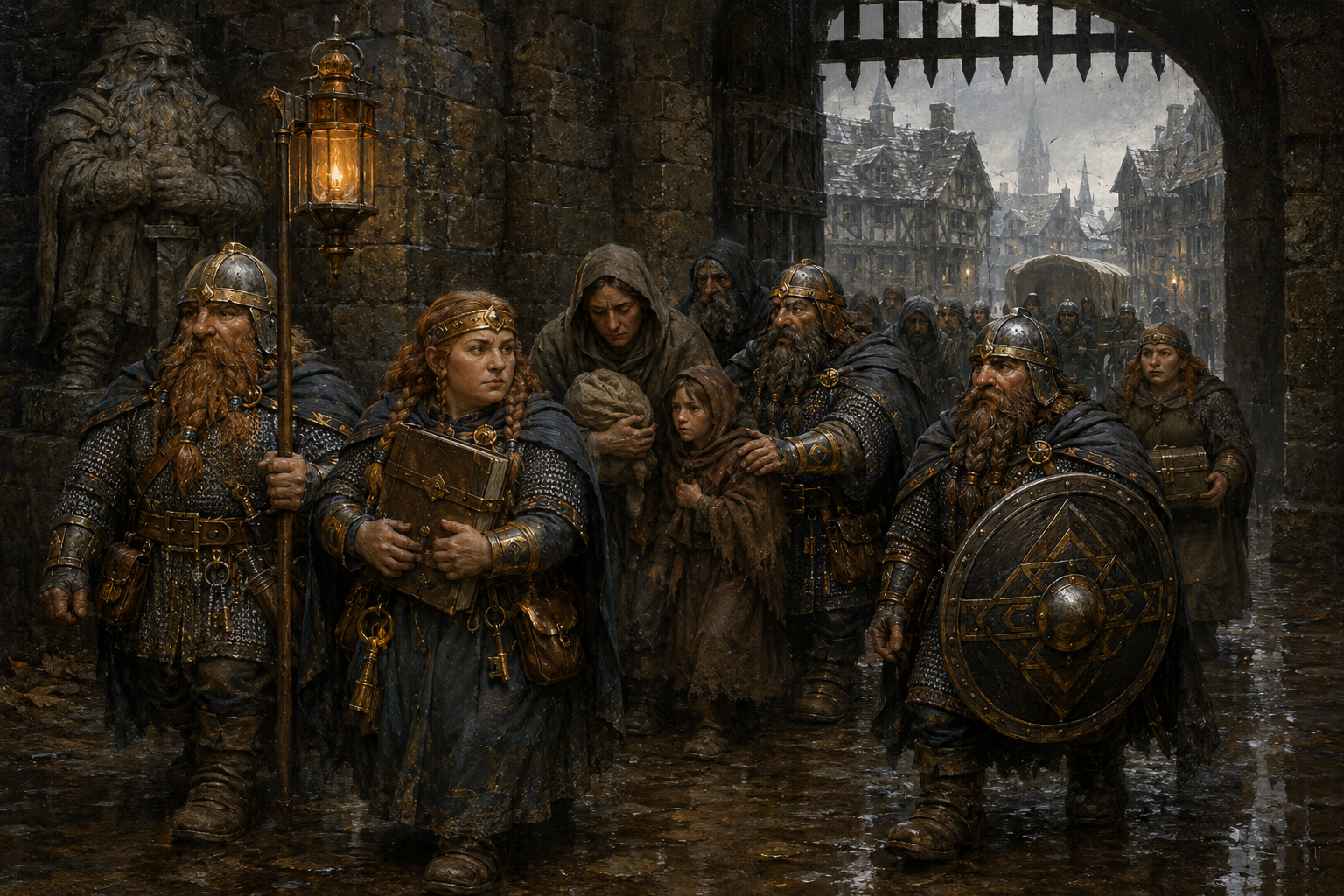
Dwarves possess no single homeland or central ruler. During the plague, scattered communities survive through practical cooperation rather than the creation of a new dwarven state.
Dwarves live in mountain holds, mining towns, foundry districts, fortified villages, travelling families and urban craft quarters. Some communities reduce infection through controlled water, isolation of the sick, durable food stores and disciplined sanitation. Neighbours sometimes interpret survival as evidence of secret guilt.
Accusations of poisoned wells, hidden grain, clipped coin and deliberate tunnel collapse spread during famine and panic. Most are false. Officials and creditors sometimes promote them to seize workshops, erase obligations or remove competitors.
A small number of real underground attacks are committed by duergar cells that sabotage mines, steal captives or contaminate water. Surface dwarves are often their first victims and the first people able to recognise their work. Duergar crimes do not make collective persecution accurate or just.
What the Stone-Chains Are
The Stone-Chains are voluntary compacts linking independent dwarven families, guilds and enclaves. Members pool emergency funds, duplicate records, escort threatened families, share quarantine practices, replace lost tools and provide witnesses when local authorities attempt to erase property or apprenticeship rights.
Stone-Chains also preserve maps of sealed mines, plague tunnels, buried chambers and abandoned districts. Their members escort corpse parties, inspect damaged underground graves and warn other communities when undead have been contained rather than destroyed.
The name describes mutual dependence: when one community is attacked, another preserves its names, contracts and survivors. The compacts have no universal commander and do not turn dispersed dwarves into one kingdom.
Some Stone-Chains admit non-dwarven dependants, spouses and apprentices. Others defend only recognised member families. Their decisions reveal the same generosity, suspicion, rivalry, courage and self-interest found in any people under pressure.
Labour, Land and Inheritance
Mass mortality leaves farms, workshops, ships, mines and public offices without enough experienced hands. Surviving workers can demand higher wages, shorter obligations, better food, freedom of movement or access to abandoned land.
The advantage is real but uneven. Bargaining power depends upon local law, gender, occupation, military force and the ability to leave.
Landholders and governments attempt to preserve pre-plague conditions through wage limits, compulsory service, travel restrictions and renewed claims over tenants. Enforcement often fails or drives workers towards towns, rival estates and regions willing to offer better terms.
Families confront uncertain sequences of death, missing bodies, remarriage, orphaned children and estates with several plausible heirs. Merchants die while goods are in transit. Guild masters leave no qualified successor. Villages cultivate land whose legal owner is unknown.
Settled halfling communities gain influence where their knowledge of crops, mills, orchards, livestock and river trade becomes essential to recovery. Itinerant companies fill shortages in harvesting and transport. Their mobility also makes them targets for towns attempting to control movement or identify outsiders as plague-bringers.
Undead danger creates new forms of paid work. Grave watchers, corpse escorts, cemetery guards, ruin-clearers and haunt investigators become necessary in many towns. Their work is dangerous, stigmatised and often poorly rewarded despite its importance.
Survival does not produce one social revolution: some workers obtain lasting freedom and property. Others face violent repression, renewed bondage or taxes designed to recover elite losses. The plague weakens inherited relationships without deciding in advance what will replace them.
Connected Worlds beyond the Plague Core
The period remains global without pretending that every region experiences the same epidemic, chronology or political crisis.
Mali, the Sahel and the Swahili Coast
Mali remains a powerful state after Mansa Musa. Mansa Sulayman’s court receives Ibn Battuta in 1352–1353, revealing a world of royal authority, scholarship, trade and local custom rather than a kingdom frozen at the moment of one famous journey.
Great Zimbabwe reaches its fourteenth-century height, while Kilwa and other Swahili ports connect inland wealth to Indian Ocean exchange.
Kemet and the Nile
Catfolk Kemet confronts plague through Nile transport, harbour controls, neighbourhood pride networks and regional funerary traditions.
Burial guards and temple patrols respond to Red Death cases without abandoning older Kemetite rites. The memory of the Hidden Springs still shapes defence against the Black Anvil Realm, but infection, food supply and undead containment now demand more attention than immediate invasion.
India
The Bahmani state forms in the Deccan in 1347 and competes with Vijayanagara, while Bengal maintains its independence and Delhi attempts to recover from earlier overreach.
Courts, temples, villages, merchant communities and regional powers negotiate authority through distinct legal and sacred traditions. The political map is not one northern empire with passive provinces.
Southeast Asia
Ayutthaya rises around 1350–1351 as a river and maritime power. Majapahit reaches a period of exceptional influence under Hayam Wuruk, with Gajah Mada shaping court ambition until his death in 1364.
Ports, rice lands, island rulers and local sacred relationships remain active participants rather than scenery surrounding a single court.
Japan and Korea
Ashikaga rule and the rivalry of Japan’s northern and southern courts continue. Earlier resistance to Eastern Fang invasions remains part of political memory, as do the destructive appearances of Mogaru and other kaiju. None serves the court as a tame national weapon.
In Korea, established traditions of paper, woodblock printing and metal type culminate in the surviving Jikji of 1377.
The Americas and Pacific
Maya successor kingdoms, Mississippian societies, the Chimú realm and emerging Mexica communities continue their own wars, alliances, migrations and sacred histories.
Polynesian settlement develops across Aotearoa, while the peoples of Terra Australis maintain ancient custodianship of their lands.
Period III does not impose the Black Death or its plague-driven undead upturn upon these regions without established historical or campaign evidence.
The Orc Successor Powers
Plague and rebellion do not affect one unified orc nation. Each successor power contains different tribes, families, subject peoples, settlements and rival leaders.
Eastern Fang Host
The Eastern Fang court possesses immense cities and agricultural wealth but cannot turn court ritual into the personal authority once exercised by Mhurak Stone-Blood.
Rebellion, hunger, factional struggle and Ming warfare destroy its hold upon China’s imperial heartland in 1368.
Court families, herders, artisans and soldiers retreat north in different groups. Many orcs remain within Ming territory, change allegiance or disappear into local communities rather than joining one clean migration.
Ash-Standard Host
Plague kills through river towns, camps and grassland settlements, worsening succession disputes and weakening relationships with some Rus rulers.
Chiefs respond differently: some reduce demands to preserve communities, while others raid neighbours to replace lost wealth and labour.
Red Death outbreaks among camps and river settlements produce local undead emergencies, but no single ruler coordinates a response across the whole Host.
Red Fang Reach
The Reach remains a divided world of oasis cities, pasture, mountain districts and ambitious clan leaders. No single claimant can command all of it.
In 1370, Timur rises within territories fractured by the Reach. The human conqueror recruits Red Fang chiefs alongside settled commanders, merchants and regional allies.
His coalition is not itself one of Mhurak’s successor powers. Its authority depends upon Timur’s victories, rewards and ability to intimidate rivals. His greatest campaigns belong to the following period.
Black Anvil Realm
The Black Anvil Realm remains powerful across parts of Iran, Mesopotamia, the Caucasus and neighbouring uplands, but local dynasties and rival chiefs exploit every succession dispute.
Plague losses and urban revolt weaken some rulers. Others seize abandoned foundries, mines and fortified districts, sometimes discovering that undead or haunts already occupy them.
Eastern Fang Houses after 1368
After 1368, rival Eastern Fang houses that retreat beyond the Ming heartland become known collectively as the Broken Dragon Standards. The name describes a political claim: each house says that it preserves the true eastern inheritance while blaming the others for its loss.
They do not form one refugee nation or a restored Eastern Fang state. Their camps, settlements and alliances divide according to family, region, wealth and the strength of particular leaders.
Chronology, 1347–1380
The Bahmani State Forms in the Deccan
The Bahmani state breaks from Delhi’s effective control and becomes a major rival to Vijayanagara.
Persianate court traditions, military households, Deccan elites, merchant networks and local landholding interests shape the new power. Its foundation demonstrates that the period begins with political creation as well as collapse.
The Black Death Devastates Connected Regions
Plague reaches Mediterranean ports in 1347 and spreads through shipping, markets, armies, grain systems and inland movement.
Mortality is immense across many parts of Europe, western Asia and North Africa, although the timing and severity differ sharply between regions.
Governments confront nursing, burial, food supply and public order. No ruler, sacred institution or magical college commands the pandemic as a whole.
The Black Death Produces Red Death Cases
Throughout history, some people killed by plague have returned as undead. These incidents are known as the Red Death.
The immense mortality of the Black Death produces many Red Death cases. Most victims remain dead, but the number that rise is sufficient to create emergencies across plague-stricken regions.
Plague Pits and Abandoned Settlements Produce Local Hordes
Large burial grounds, deserted villages, overwhelmed hospitals and sealed urban districts become centres of undead activity.
Some risings are destroyed within hours. Others form zombie hordes that overwhelm weakened settlements, seize ruins or wander through depopulated countryside.
The living eventually defeat most large hordes, but many burial sites are sealed rather than cleared.
Haunted Plague Sites Multiply
Hospitals, quarantine houses, plague streets, starvation cellars and mass graves develop haunts born from intense suffering and despair.
Some sites contain both haunts and physical undead. Destroying the creatures does not end the haunt unless the underlying wrong is also resolved.
Persecution Produces the Stone-Chains
Dwarven quarters are accused of poisoning water, hiding grain and profiting from plague. Violence, expulsion and confiscation follow in some towns.
Independent dwarven communities create the Stone-Chains to move refugees, preserve records, share funds and defend threatened families.
The compacts also exchange maps and warnings concerning sealed tunnels, abandoned mines, undead outbreaks and haunted burial sites.
Labour, Land and Inheritance Are Renegotiated
Survivors demand higher wages, freedom of movement and better access to land. Governments and landholders answer with wage controls, compulsory work and renewed claims over tenants.
Courts confront extinct households, missing bodies, remarriage, orphaned heirs and property occupied before ownership can be proved.
Ayutthaya Rises
Ayutthaya becomes a major mainland Southeast Asian centre built around river agriculture, maritime access, warfare and diplomacy.
Thai, Khmer, Mon and other peoples contribute to a political world that grows through both competition and exchange.
Majapahit Reaches a Period of Exceptional Influence
Under Hayam Wuruk, Majapahit expands court influence across Java and wider maritime relationships. Gajah Mada remains central to its ambitions until his death in 1364.
Island rulers, ports and trading communities negotiate, resist or cooperate rather than disappearing beneath one uniform empire.
Ibn Battuta Visits Mali
Ibn Battuta’s visit to Mansa Sulayman’s court records Mali as a living political and commercial world after Mansa Musa.
Royal ceremony, regional custom, scholarship, river movement and trans-Saharan exchange coexist with traditions preserved through oral performance and descendant memory.
A Captured King and a Negotiated Empire
English forces defeat a larger French army at Poitiers and capture King John II. Ransom, taxation and regency deepen the French political crisis.
In the Empire, the Golden Bull formalises the role of prince-electors, confirming that imperial power depends upon negotiation among princes, cities and dynasties rather than the will of one hereditary ruler.
The Jacquerie Is Crushed
Rural communities in northern France rise amid taxation, war, displacement and aristocratic violence.
Noble forces suppress the revolt with severe reprisals. Its defeat does not erase the knowledge that peasants and towns can organise against inherited authority.
Permanent Grave Watches and Undead Hunters Appear
Cities, towns and rural districts establish guarded burial grounds, corpse watches and paid specialists responsible for destroying the risen dead.
Some institutions protect communities. Others become corrupt authorities able to seize bodies, extort families or accuse rivals of concealing undead.
Ming Victory Breaks the Eastern Fang Court
Ming armies seize the imperial heartland and drive the Eastern Fang court north. Chinese rebels, commanders, officials and local communities have already weakened the court before its final retreat.
Ming rulers present their victory as restoration. Eastern Fang houses divide over blame, succession and whether to recover China, settle in northern territories or follow new leaders.
Timur Rises through the Red Fang Divisions
Timur establishes personal dominance around Samarkand through victory, alliance, calculated fear and the distribution of wealth.
Red Fang chiefs, subject warriors, Persian administrators, merchants and captured specialists contribute to his coalition.
It uses the Reach’s divisions without becoming a restored Great Muster or a direct continuation of any one successor power.
The Jikji Is Printed with Movable Metal Type
Korean printers produce the surviving Jikji with movable metal type. The achievement belongs to an established East Asian history of paper, woodblock printing and movable type.
It demonstrates that technical innovation in the age is not a story beginning in fifteenth-century Europe.
The Rival Roman Custodians Divide Western Sacred Authority
Disputed elections produce rival western Roman custodians based at Rome and Avignon. Kings, cities and sacred colleges choose between them according to law, debt, local loyalty and political advantage.
The division concerns participating western institutions. It does not place the world’s independent gods, priesthoods and sacred traditions beneath one universal dispute.
The World at the Threshold of 1380
The Dead Have Not Restored the Old Order
By 1380, the first catastrophic plague wave lies in the past, but recurrent disease, labour conflict, undead sites and disputed authority continue. The population has not simply returned to its former duties, and rulers have not recovered the certainty they possessed before mass death.
- Workers and tenants continue contesting wages, movement and inherited obligations.
- Land, offices and titles remain disputed after the extinction or dispersal of whole households.
- Stone-Chains preserve dwarven families, legal memory and maps of sealed underground dangers.
- Red Death incidents remain a risk wherever plague returns.
- Most large zombie hordes have been destroyed, but some burial sites and abandoned settlements remain infested.
- Haunted hospitals, quarantine houses, plague streets and mass graves persist after the bodies are removed.
- Necromancers and older undead have seized some ruined estates, tunnels and depopulated districts.
- Corpse watches, grave wardens and undead hunters have become permanent occupations.
- Ming rule commands China’s imperial heartland while rival Eastern Fang houses survive beyond it.
- Timur has become the strongest leader to exploit divisions around the Red Fang Reach, but his greatest campaigns still lie ahead.
- The Ash-Standard Host and Black Anvil Realm endure through regional bargains and rival chiefs rather than restored unity.
- The Hundred Years’ War continues despite truces, plague and captured kings.
- Mali, Great Zimbabwe, Kemet, Vijayanagara, the Bahmani state, Majapahit, Ayutthaya, Japan, the Americas and the Pacific continue distinct regional histories.
The English Peasants’ Revolt of 1381 opens the next period by turning decades of labour restriction, taxation and broken promises into a direct challenge to royal government.
Continue to Period IV: Artillery, Colonies and Rival Powers, 1381–1454 →What This Period Changes
Mortality Becomes a Political Fact
Rulers can command ceremonies and punishments but cannot compel the dead to work, inherit or obey.
Labour Gains Leverage
Scarcity allows some workers, tenants and craftspeople to demand terms that would previously have been refused.
Inheritance Loses Certainty
Missing bodies, extinct households and disputed sequences of death turn property into a source of prolonged conflict.
Persecution Creates New Solidarities
Attacks on alleged plague-bringers produce durable mutual-aid networks, including the dwarven Stone-Chains.
Undeath Becomes a Public Threat
Red Death cases and local zombie hordes force communities to treat corpse security and undead response as permanent civic responsibilities.
Haunted Landscapes Outlive the Plague
Hospitals, plague pits, abandoned streets and ruined settlements retain supernatural dangers long after their populations recover.
Necromancers Gain New Opportunities
Mass death, abandoned property and weakened government allow corpse thieves, grave cults and intelligent undead to expand.
The Eastern Fang Court Loses China
Ming victory ends the court’s command of the imperial heartland without erasing orc communities or producing one united northern successor.
Timur Exploits Red Fang Division
A human conqueror binds several Red Fang chiefs into a broader personal coalition whose strength depends upon victory, fear and reward.
Sacred Authority Divides Publicly
Rival Roman custodians reveal that even institutions claiming ancient continuity can fracture through politics, debt and competing law.
Historical and Mythic Context
This entry combines documented history with established SpiralWorlds campaign canon. The Black Death, post-plague labour legislation, the Hundred Years’ War, the Jacquerie, the Bahmani state, Ayutthaya, Majapahit, Mali, the Ming foundation, the Jikji and the division of western Roman authority provide the principal historical framework.
The Red Death, plague-driven undead risings, Stone-Chains, catfolk Kemet and the four orc successor powers belong to SpiralWorlds. They are integrated into the chronology without replacing material causes, documented peoples or regional agency.
The Black Death remains an infectious pandemic of the Material Plane. Evidence from Central Eurasia is important, but no single caravan route or political power should be treated as the sole cause of a pandemic shaped by animal reservoirs, ecology, commerce, warfare and human movement.
Evidence is uneven outside the best-documented regions. This page does not assume that the Black Death strikes the Americas, Pacific or every part of Africa and Asia simply because those regions belong to the same global period.
The Red Death is a recurring supernatural phenomenon in which some people killed by plague return as undead. It has occurred during plagues throughout history and is not a separate disease. The scale of the Black Death produces many Red Death cases and occasional local hordes, but most plague victims remain dead.
Haunts are distinct from the Red Death. They arise from places of intense suffering and may persist even when no corpse rises. Undead often inhabit the same locations, and a single plague site can contain several separate haunts.
The Stone-Chains arise through dwarven persecution and mutual defence. They do not create a unified dwarven government, kingdom or homeland. Each compact remains accountable to its own members and local circumstances.
Historical steppe chronology supplies part of the geographical setting around the four orc successor powers. The Eastern Fang Host, Ash-Standard Host, Red Fang Reach, Black Anvil Realm and Broken Dragon Standards follow SpiralWorlds canon rather than reproducing historical successor states.
Timur remains a human historical conqueror. His coalition exploits the divisions of the Red Fang Reach and recruits some Red Fang chiefs alongside human and half-orc commanders, administrators, merchants, engineers and regional allies.
Gods, ancestors, spirits and supernatural creatures influence local responses without erasing mortal responsibility. Rulers, creditors, officials, mobs and communities remain responsible for persecution, relief, confiscation, concealment and mutual aid.
Frequently Asked Questions
What is the Black Death in SpiralWorlds?
It is the historical plague pandemic caused by infection in the Material Plane. Magic and supernatural creatures may affect particular outbreaks or their aftermath, but they do not replace its ecological and material causes.
What is the Red Death?
The Red Death is a recurring phenomenon found throughout history in which some people killed by plague return as undead. It is not a separate disease and is not unique to the Black Death.
Does every plague victim return as undead?
No. Most plague victims remain dead. The Black Death produces many Red Death cases because it kills on an exceptional scale.
Does the Black Death create zombie hordes?
Yes, in some places. Plague pits, abandoned villages and overwhelmed urban districts occasionally produce enough risen victims to form local hordes. These are severe regional disasters rather than one worldwide zombie apocalypse.
Are all plague-era undead created by the Red Death?
No. The Red Death accounts for plague victims who return as undead. Older ghosts, ghouls, wights, wraiths, spectres, vampires, liches and other undead retain their own origins and may exploit plague-stricken regions.
Why do haunts multiply during the Black Death?
Haunts arise from intense suffering and despair. Hospitals, locked houses, plague pits, starvation sites and abandoned streets create many such locations. A haunt can persist even when every corpse remains buried.
Are plague haunts destroyed by killing the undead?
Not necessarily. A haunt may return until its underlying cause is resolved, such as restoring lost names, recovering bodies, exposing a murder or returning stolen property.
Do undead plague sites still exist in 1454?
Yes. Most large hordes have been destroyed, but sealed plague fields, charnel tunnels, ruined hospitals, abandoned villages and haunted districts remain dangerous campaign locations.
What are the Stone-Chains?
They are voluntary dwarven mutual-aid compacts that preserve people, records, tools, funds and legal claims across independent communities. They also share warnings and maps concerning sealed underground plague sites.
Were dwarves responsible for plague or poisoned wells?
No. Most accusations are false and often serve confiscation, debt cancellation or political scapegoating. Isolated duergar crimes do not justify punishment of surface dwarves.
What happened to the Eastern Fang Host in 1368?
Ming armies drove its court from China’s imperial heartland. Rival court houses retreated north, while many orcs remained, changed allegiance or became part of local communities.
Is Timur a direct successor to Mhurak Stone-Blood?
No. Timur is human. He rises through territories and alliances shaped by the divided Red Fang Reach, but his coalition is distinct from Mhurak’s four successor powers and depends upon Timur’s continued success.
Why does the period end in 1380?
The boundary keeps the English Peasants’ Revolt of 1381 as the opening challenge of Period IV, where labour unrest, artillery, maritime expansion and rival conquest powers develop across the final decades of the age.
Selected Historical and Campaign References
Historical and Archaeological References
- Nature — The Source of the Black Death in Fourteenth-Century Central Eurasia
- The National Archives — Plague and Labour Legislation
- The Metropolitan Museum of Art — Ming Dynasty, 1368–1644
- UNESCO Memory of the World — The Jikji
- UNESCO — Historic City of Ayutthaya
- UNESCO — Great Zimbabwe National Monument
- UNESCO — Kilwa Kisiwani and Songo Mnara
- The Metropolitan Museum of Art — The Trans-Saharan Gold Trade
SpiralWorlds Campaign References
Continue the Age
Keep this reference growing
If this page helped with your reading or game, you can support its upkeep or explore the curated books.
Explore the Bookshop — epics, classics and stories behind imagined worlds.