
Monster, Dwerg, Keeper of the Buried Claim
Dwerg, Keeper of the Buried Claim
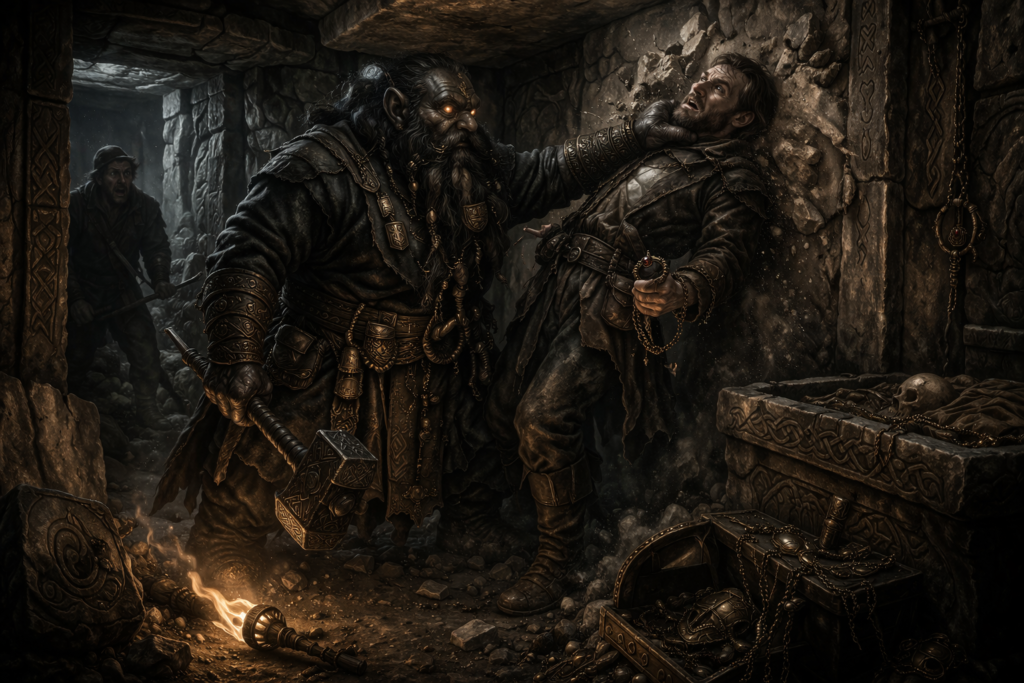
The dwerg is the buried will of stone, craft, and possession made flesh — a chthonic keeper of tomb-wealth, sealed halls, and ancient workmanship that judges the living by what they dare to take from the earth.
Lore
A dwerg is an under-earth being of burial depth, hidden wealth, and dangerous workmanship: one of the old powers that dwell beneath barrows, mines, vaults, and forgotten halls. It is bound to the long memory of worked stone and metal, and to the ancient truth that what is buried with the dead is not ownerless simply because the dead no longer speak.
Dwergs belong to places where treasure and memory are entombed together. They are found where forgotten kings were buried with crowns and blades, where old regalia passed from grave to thief to noble hall, where miners cut too deep into the earth, and where sacred wealth was hidden beneath stone against war, conquest, or desecration. They are custodians of under-earth inheritance, but never in a comforting sense. A dwerg does not guard treasure because it loves gold for its own sake. It guards because buried things still belong to someone, because workmanship remembers its maker, and because the living too easily mistake survival for rightful possession.
That makes the dwerg accusatory by nature. It is drawn toward the misuse of heirlooms, the theft of grave-goods, the wearing of ancient regalia by unworthy hands, and the breaking, melting, or repurposing of objects that once carried lineage, oath, rank, or sacred meaning. A lord may believe he owns the torque displayed in his hall. A dwerg may know it was cut from a barrow three centuries ago, and that the bloodline which paid for it ended in betrayal. To a dwerg, history is not abstract. It is embedded in objects, and objects are never innocent.
For that reason, the dwerg works best not simply as a thing lurking underground, but as the embodied claim of the under-earth upon things the surface world believes it owns.
Appearance
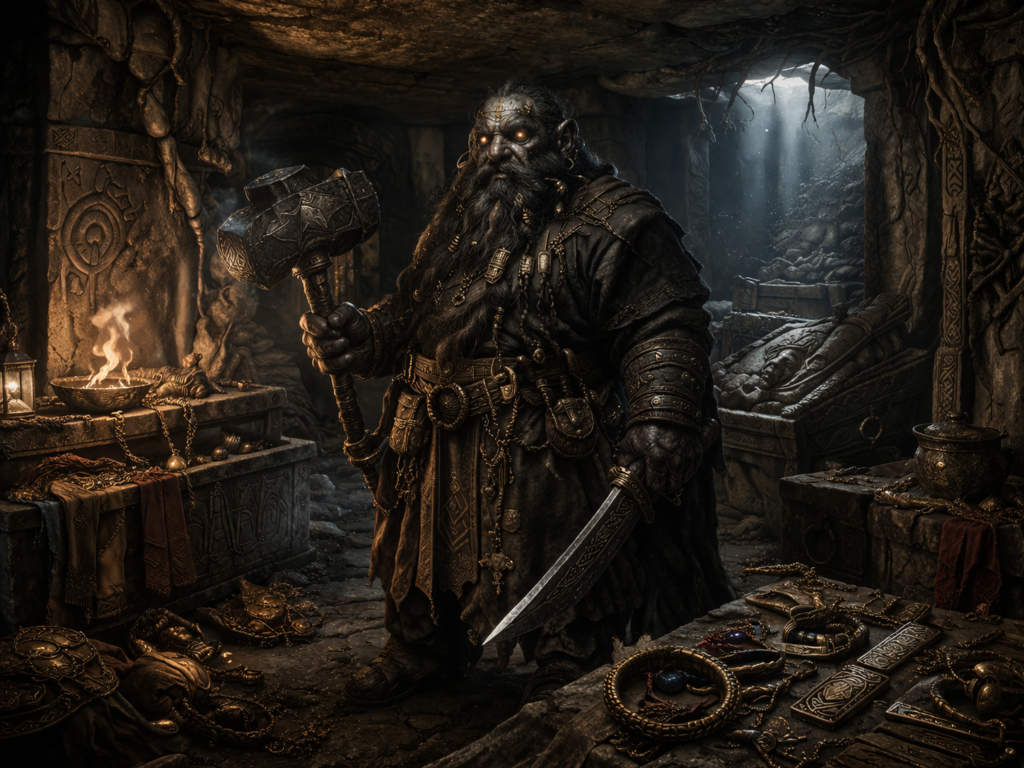
A dwerg is manlike, but never comfortably human. Some are short and powerfully built, thick through the shoulders and limbs, as if compressed by the weight of the earth itself. Others stand nearer human height, but are so dense and heavy in frame that they seem quarried rather than born. Their proportions often feel subtly wrong: hands too broad, forearms too long, shoulders too square, movement too deliberate.
Its skin may resemble soot-blackened iron, pale mineral clay, slick cave-grey stone, or weathered granite darkened by centuries of smoke. Even where it is living flesh, it gives the impression of worked matter rather than mortal skin. The face is often broad and stern, with a heavy brow, deep-set eyes, and the severe stillness of a funerary carving. The eyes themselves are among its most disturbing features: ember-red, forge-orange, old gold, or lamplight-yellow, as though light were trapped behind stone.
Many dwergs wear beards, but these are not signs of warmth or homely age. They are often thick with soot, braided with metal wire, powdered with gold dust, or clotted with ash and cave residue. Others have only sparse mineral-like hair along jaw or brow, making them look even more like animate statuary. Their clothing tends toward heavy leather, scale, dark wool, smoked linen, aprons, tool belts, iron rings, grave-clasps, and old regalia incorporated into practical wear. They often appear draped in the remains of older worlds: burial gold, corroded bronze, broken crown-work, and worked metal no modern smith could easily replicate.
A dwerg should look like something shaped by a forge below a tomb.
Behaviour
Dwergs are patient, exacting, and deeply territorial. They do not waste words, movement, or effort. They are creatures of long memory and slow grievance, capable of holding a wrong for generations before answering it. A dwerg is rarely impulsive. Even its anger usually arrives as a cold, measured certainty rather than a loss of control.
They sort, preserve, arrange, and maintain. A dwerg’s chambers are rarely chaotic. Tools hang in order. Treasure is catalogued by age, origin, material, or meaning. Doors remain balanced. Hinges remain functional. Locks still turn cleanly centuries after mortal hands forgot them. Even where a lair has half-collapsed, the inhabited parts feel maintained with ritual precision.
In conversation, a dwerg is literal, careful, and often contemptuous of careless speech. It respects exact promises, skilled workmanship, and those who understand the value of an object beyond its price. It loathes boastfulness, breakage, grave-robbing, inherited arrogance, and the assumption that buried wealth is free for the taking. It may bargain, but always as something that measures words as precisely as a master smith measures a casting. Cleverness may impress it. Frivolity will not.
A dwerg is not mindlessly hostile. It can speak, threaten, test, negotiate, or accuse before violence begins. But once it decides that a trespass, theft, or insult is real, it becomes relentless.
Habitat
Dwergs dwell in meaningful depths, not generic underground tunnels. Their homes are places where stone, memory, and worked wealth meet: sealed barrows, royal tombs, collapsed mine galleries, volcanic chambers, undercrofts beneath ruined temples, burial vaults, hidden treasury rooms, and lost halls cut into hills or mountains in ages now forgotten.
Their lairs are often cramped, layered, and deliberately defensive. Passageways narrow where intruders must stoop or enter single file. Hidden side chambers hold moulds, tally stones, ingots, bone boxes, tablets, unfinished regalia, and tools preserved in near-sacred order. Workrooms smell of ash, old metal, damp stone, tallow, and sealed antiquity. Treasure is usually arranged, wrapped, sorted, or displayed, not simply heaped. Even where wealth is abundant, the dominant impression should be custody rather than greed.
In a world rooted in the real landscapes and old cultures of Europe, dwergs fit naturally in Scandinavia, Icelandic lava regions, German uplands, British and Irish barrow-country, ore-rich hills, prehistoric tomb landscapes, ancient hill-forts, and any region where old sacred or royal wealth lies literally beneath later civilization. They are especially strong in places where pagan burial, metalworking, and stone memory survive beneath later religious or royal layers.
Modus Operandi
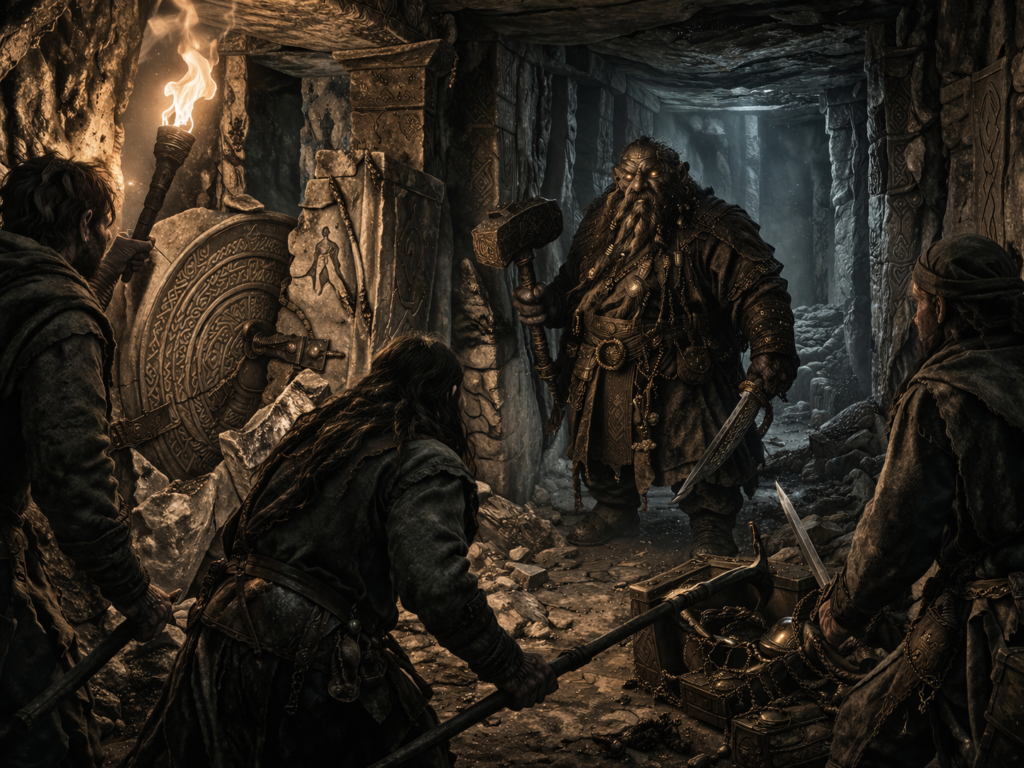
A dwerg prefers control to open confrontation. In its own domain, it fights through the environment first and direct violence second. It bars doors, seals exits, manipulates light and smoke, triggers collapses, uses false treasure as bait, and attacks where terrain denies numbers and mobility to its enemies. It knows every threshold, weight point, echo chamber, blind bend, and unstable support in its lair.
When battle comes, a dwerg favors close, brutal engagements in confined space. It is strongest where ceilings are low, footing is uneven, and only one or two foes can engage it at once. It often wields hammers, hooked tools, chisels, tongs, short stabbing blades, or heavily made weapons of its own craft. These are not elegant battlefield arms. They are practical, punishing instruments suited to stone halls, workshops, and execution spaces.
Many dwergs are trap-minded even when not presented as formal trap-builders in mechanical terms. They think in pressure, confinement, attrition, separation, and punishment. The greedy are lured forward. The impatient are cut off. The strongest are stalled in choke points. The weakest are driven into smoke or darkness. A dwerg encounter should feel like being fought by both a creature and a place that obeys it.
Outside its lair, a dwerg may act through sabotage, reclamation, secret entry, or targeted murder. It may break into a hall to recover a stolen relic, kill only the heir who wears a stolen crown, poison the work of miners who breached its chamber, or follow grave-plunderers back to the surface and destroy them one by one until the objects are returned.
Motivation
A dwerg is driven by possession, memory, workmanship, and grievance.
It wants to keep what is buried where it belongs, preserve what it has made, reclaim what has been stolen, and punish those who misuse old things they do not understand. It may be bound to a tomb, a dynasty, a treasury, a forge, a regalia-set, or an ancient oath attached to a single object. It may continue a work for centuries, not because time means little to it, but because completion matters more than mortal urgency.
Some dwergs are motivated by pure custody: they remain because something must remain guarded. Others are driven by bitterness and old injustice. A stolen sword, a melted torque, a broken burial seal, a usurper wearing grave-gold in a feast hall, a monastery recasting pagan treasure, or a noble house growing rich on plundered tomb wealth — any of these can provoke a dwerg into prolonged, calculated retaliation.
What makes the creature compelling is that its motives are often understandable even when its methods are monstrous. It is not simply greedy. It is possessive in a sacred, punitive, ancient way. It believes the living have forgotten the cost of what lies below them, and it exists to remind them.
Dwerg 5.5
Dwerg, Pathfinder
Dwerg 3.5
Dwerg
Medium fey, lawful evil
Armor Class 17 (natural armor)
Hit Points 136 (16d8 + 64)
Speed 25 ft.
| STR | DEX | CON | INT | WIS | CHA |
|---|---|---|---|---|---|
| 18 (+4) | 12 (+1) | 18 (+4) | 14 (+2) | 15 (+2) | 13 (+1) |
Saving Throws Con +8, Wis +6
Skills Athletics +8, History +6, Perception +6, Stealth +5, smith’s tools +10, mason’s tools +6, thieves’ tools +5
Damage Resistances poison; bludgeoning, piercing, and slashing from nonmagical attacks
Senses darkvision 120 ft., tremorsense 30 ft., passive Perception 16
Languages Common, Dwarvish, Terran, plus one ancient regional tongue
Challenge 8 (3,900 XP)
Proficiency Bonus +3
Traits
Stone Memory. If the dwerg spends 1 minute touching a worked object or stone surface, it learns whether that object or surface has been moved, opened, stolen from, damaged, repaired, or altered within the last 100 years. This trait reveals no more than the fact of the change and its approximate age. The dwerg has advantage on Intelligence checks related to worked stone, mines, vaults, tombs, metalwork, regalia, locks, and crafted objects.
Under-Earth Custodian. The dwerg ignores difficult terrain composed of stone, rubble, worked masonry, mine spoil, or collapsed passages. While underground or in rocky terrain, it has advantage on Dexterity (Stealth) checks and can’t be surprised except by magical means.
Master of the Confined. While in a space with a ceiling 15 feet high or lower, or while within 5 feet of a wall, pillar, doorway, or other substantial stone structure, the dwerg gains a +2 bonus to the damage rolls of its melee weapon attacks.
Accusing Gaze. A creature that starts its turn within 30 feet of the dwerg while carrying treasure taken from a tomb, barrow, vault, shrine, or other guarded resting place must succeed on a DC 14 Wisdom saving throw or have disadvantage on the first attack roll it makes before the start of its next turn. A creature that succeeds on the saving throw is immune to this dwerg’s Accusing Gaze for 24 hours.
Legendary Smith. The dwerg is proficient with smith’s tools, mason’s tools, and thieves’ tools. Locks, chains, manacles, bars, seals, and door mechanisms made by the dwerg have double the normal hit points. Opening, breaking, or forcing such an object requires a successful DC 18 Strength check or DC 18 Dexterity check made with thieves’ tools, unless a higher DC would normally apply.
Actions
Multiattack. The dwerg makes three attacks: two with its Barrow Hammer and one with its Seax, or two with its Barrow Hammer and uses Crushing Grip.
Barrow Hammer. Melee Weapon Attack: +8 to hit, reach 5 ft., one target. Hit: 13 (1d10 + 4 plus 1d6 + 3) bludgeoning damage.
Seax. Melee Weapon Attack: +8 to hit, reach 5 ft., one target. Hit: 9 (1d8 + 5) piercing damage.
Crushing Grip. Melee Weapon Attack: +8 to hit, reach 5 ft., one creature. Hit: 11 (2d6 + 4) bludgeoning damage, and the target is grappled (escape DC 16). Until the grapple ends, the target is restrained if it is Medium or smaller. The dwerg can grapple only one creature at a time.
Seal the Way (Recharge 5–6). The dwerg strikes a floor, wall, pillar, doorway, or similar stone structure within 10 feet of itself, twisting the surrounding masonry. Each creature in a 10-foot-square area adjoining that structure must make a DC 16 Dexterity saving throw. On a failed save, a creature takes 18 (4d8) bludgeoning damage and falls prone. On a successful save, a creature takes half as much damage and doesn’t fall prone. The affected area becomes difficult terrain until cleared. If the dwerg targets a doorway, passage mouth, or similar opening, that opening is also jammed shut or partially collapsed. Clearing the obstruction requires a successful DC 18 Strength check, a successful DC 18 Intelligence check using mason’s tools, or 25 points of damage dealt to the obstruction.
Smoke of the Deep Forge (Recharge 6). The dwerg exhales or releases choking black forge-smoke in a 15-foot cone. Each creature in that area must make a DC 16 Constitution saving throw. On a failed save, a creature takes 22 (4d10) poison damage and is blinded until the end of its next turn. On a successful save, a creature takes half as much damage and isn’t blinded.
Bonus Actions
Step Through Stone. The dwerg moves up to 10 feet without provoking opportunity attacks, provided it starts and ends this movement within 5 feet of a wall, pillar, sarcophagus, forge, or similar stone structure.
Reactions
Turn the Blow. When the dwerg is hit by a melee attack while within 5 feet of a wall, doorway, pillar, or other substantial stone structure, it reduces the damage by 10 (1d10 + 5).
Lair Actions
On initiative count 20 (losing initiative ties), the dwerg takes one lair action to cause one of the following effects; the dwerg can’t use the same effect two rounds in a row:
- Bar the Door. One doorway, hatch, portcullis, or stone threshold the dwerg can see within 60 feet slams shut, locks, or jams. Opening it requires a successful DC 18 Strength check or DC 18 Dexterity check made with thieves’ tools.
- Shift the Rubble. Dust and loose stone churn in a 15-foot-square area the dwerg can see within 60 feet. That area becomes difficult terrain and lightly obscured until initiative count 20 on the next round.
- Echo of the Forge. Hammering resonance rolls through a 20-foot-radius sphere centered on a point the dwerg can see within 60 feet. Each creature of the dwerg’s choice in that area must succeed on a DC 14 Wisdom saving throw or be unable to take reactions until initiative count 20 on the next round.
Treasure
A dwerg rarely carries loose coin except while traveling. Its hoard should usually be worth 2,000–6,000 gp in total, mostly in worked goods rather than simple currency: grave-gold, torcs, oath-rings, burial silver, seal-rings, reliquary fittings, regalia fragments, ancient ingots, carved lockplates, antique weapon mounts, and iron strongbox keys. In addition, a dwerg often keeps 1–3 crafted objects of real adventure value, such as a barrow-key, a crown fragment tied to a disputed inheritance, a chain once used to bind something dangerous, or a masterwork weapon or wondrous item with troubling provenance.
Treasure
A dwerg does not keep treasure as a miser keeps coin. Its hoard is ordered, remembered, and burdened with claim. Every object has a place, a maker, a burial, a theft, an oath, or a grievance attached to it. A dwerg’s wealth should never feel like a random heap of dungeon loot. It should feel like custody.
Most of a dwerg’s treasure appears as worked goods rather than loose currency. Torcs, oath-rings, seal-rings, burial silver, reliquary fittings, regalia fragments, ancient ingots, lockplates, masterwork keys, weapon fittings, funerary gold, chain links, and carved stone tokens are all more fitting than sacks of minted coin. When coin is present, it is usually old, mixed, and culturally layered: hacked silver, grave coin, obsolete royal issues, and pieces taken from burial or treasury contexts rather than ordinary trade.
A typical dwerg hoard should contain 2,000 to 6,000 gp in total value, though much of that value is difficult to sell openly without inviting questions of origin, ownership, sacrilege, or inheritance. The danger of the hoard lies not only in its worth, but in the claims that cling to it.
Alongside its wealth, a dwerg almost always keeps 1 to 3 crafted objects of real adventure importance. These should not feel like filler magic items or convenient resale pieces. They should be objects with history, consequence, and the power to drive further play. Good examples include:
- A barrow-key of black iron. This heavy, rune-cut key opens a sealed chamber in an ancient mound, crypt, or royal vault. Possessing it may itself be evidence that the bearer has entered into an older and darker claim than any local ruler understands.
- A broken crown-fragment. Set with old garnets, amber, or river pearls, this piece is recognizably part of a lost regalia-set and may support or destroy a disputed succession.
- A chain once used to bind something terrible. Whether its old purpose was holy, royal, infernal, or monstrous, the chain remains functional and feared by those who know what it once held.
- A masterwork weapon with troubling provenance. This may be a barrow sword, seax, spearhead, warhammer, or ceremonial axe of extraordinary workmanship, tied to betrayal, sacrilege, dynastic murder, or a broken burial oath.
- A seal-ring of forgotten authority. The ring still carries legal, priestly, dynastic, or funerary force in some hidden, local, or half-remembered context.
- A reliquary fitting or shrine ornament. Precious, beautiful, and dangerous to display, it may matter as much to local religion and politics as to treasure-hunters.
- A strongbox key-set. Several old iron keys, tagged or marked in ways only the dwerg fully understands, leading to treasury chests, funerary locks, sealed archives, or hidden doors below the earth.
A dwerg’s hoard should also reflect its character. A purely custodial dwerg keeps objects clean, sorted, wrapped, and ritually maintained. A bitter dwerg may lay stolen regalia out like evidence against the living. A tomb-smith may preserve unfinished grave goods, moulds, tools, repair-work, and fitted gold pieces beside completed treasures. A vengeful dwerg may display recovered items taken back from thieves, each still bearing the marks of damage done in the taking.
The most important principle is this: a dwerg’s treasure should create pressure after it is found. The party should not merely ask what it is worth. They should ask who buried it, who stole it first, who still claims it, and what will follow them now that they have touched it.
Dwerg CR 8
XP 4,800
LE Medium fey
Init +5; Senses darkvision 120 ft., tremorsense 30 ft.; Perception +14
Defense
AC 22, touch 11, flat-footed 21 (+1 Dex, +11 natural)
hp 95 (10d6+60)
Fort +9, Ref +8, Will +9
DR 10/cold iron; Immune sleep; Resist poison 10; SR 19
Offense
Speed 20 ft.
Melee barrow hammer +16/+11 (1d8+11), seax +15/+10 (1d6+7/19–20), or crushing grip +16 (1d6+6 plus grab)
Special Attacks accusing gaze, seal the way, smoke of the deep forge
Statistics
Str 22, Dex 13, Con 22, Int 15, Wis 14, Cha 13
Base Atk +5; CMB +11 (+15 grapple); CMD 22 (26 vs. bull rush, drag, reposition, and trip)
Feats Combat Reflexes, Improved Initiative, Improved Unarmed Strike, Power Attack, Weapon Focus (barrow hammer)
Skills Appraise +15, Craft (armor) +15, Craft (metalwork) +18, Craft (stonemasonry) +18, Disable Device +14, Knowledge (dungeoneering) +15, Knowledge (history) +15, Perception +14, Sense Motive +14, Stealth +10
Languages Common, Dwarven, Terran, one ancient regional tongue
SQ legendary smith, master of the confined, step through stone, stone memory, under-earth custodian
Ecology
Environment barrows, deep mines, tombs, vaults, and old stone places
Organization solitary or pair
Treasure double (plus 1–3 significant crafted relics or heirlooms)
Special Abilities
Accusing Gaze (Su) A creature that begins its turn within 30 feet of a dwerg while carrying treasure taken from a tomb, barrow, vault, shrine, or other guarded resting place must succeed at a DC 17 Will save or take a –2 penalty on attack rolls, saving throws, skill checks, and ability checks until the start of its next turn. This is a mind-affecting fear effect. A creature that succeeds at its save is immune to that dwerg’s accusing gaze for 24 hours. The save DC is Charisma-based.
Crushing Grip (Ex) A dwerg that hits with its crushing grip attack can attempt to start a grapple as a free action without provoking an attack of opportunity. A creature grappled by the dwerg is entangled as long as the grapple continues. If the dwerg pins a creature while adjacent to a wall, pillar, doorway, sarcophagus, forge, or similar substantial stone structure, that creature is restrained instead of merely pinned until it escapes.
Legendary Smith (Ex) A dwerg gains a +4 racial bonus on Craft checks involving stone or metal and on Disable Device checks involving locks, seals, bars, or ancient mechanisms. Any lock, chain, manacle, bar, seal, or door mechanism fashioned by a dwerg has double normal hit points, and its break DC and Disable Device DC each increase by 4.
Master of the Confined (Ex) While in an enclosed space with a ceiling 15 feet high or lower, or while adjacent to a wall, pillar, doorway, or other substantial stone structure, a dwerg gains a +2 bonus on melee damage rolls and a +4 bonus to CMD against bull rush, drag, reposition, and trip attempts.
Seal the Way (Su) As a standard action once every 1d4 rounds, a dwerg can strike a floor, wall, pillar, doorway, or similar stone structure within its reach, twisting the surrounding masonry. This affects one contiguous 10-foot-square area adjacent to the struck structure. Creatures in the area must succeed at a DC 18 Reflex save or take 4d8 points of bludgeoning damage and fall prone. A successful save halves the damage and negates the prone condition. The area becomes difficult terrain. If the dwerg uses this ability on a doorway, corridor mouth, or similar opening, it can also jam or partially collapse that opening. Clearing the obstruction requires a DC 22 Strength check, a DC 22 Craft (stonemasonry) check, or 25 points of damage dealt to the blockage. The save DC is Constitution-based.
Smoke of the Deep Forge (Su) Once every 1d4 rounds as a standard action, a dwerg can exhale choking black forge-smoke in a 15-foot cone. Creatures in the area take 4d10 points of poison damage and are blinded for 1 round; a successful DC 18 Fortitude save halves the damage and negates the blindness. This is a poison effect. The save DC is Constitution-based.
Step Through Stone (Ex) As a swift action, a dwerg can move up to 10 feet without provoking attacks of opportunity, provided it begins and ends this movement adjacent to a wall, pillar, sarcophagus, forge, or similar stone structure.
Stone Memory (Su) By touching a worked object or stone surface for 1 minute, a dwerg learns whether it has been moved, opened, stolen from, damaged, repaired, or altered within the past 100 years, as well as the approximate age of the most recent such change. This ability reveals only the fact of disturbance and its relative age, not identities or visions of the event.
Under-Earth Custodian (Ex) A dwerg ignores difficult terrain caused by stone, rubble, worked masonry, mine spoil, or collapsed passages. While underground or in rocky terrain, it gains a +4 racial bonus on Stealth checks and cannot be caught flat-footed except by magical effects or supernatural means.
Combat
A dwerg fights as a territorial under-earth custodian, shaping the battlefield before committing to close combat. It prefers to begin with seal the way to break formations or close escape routes, then uses smoke of the deep forge against clustered enemies in confined areas. It targets grave-robbers, relic-bearers, and lightly armored foes first, using accusing gaze to unnerve trespassers and crushing grip to pin enemies against stonework while finishing others with its barrow hammer.
Treasure
A dwerg does not keep treasure as a miser keeps coin. Its hoard is ordered, remembered, and burdened with claim. Every object has a place, a maker, a burial, a theft, an oath, or a grievance attached to it. A dwerg’s wealth should never feel like a random heap of dungeon loot. It should feel like custody.
Most of a dwerg’s treasure appears as worked goods rather than loose currency. Torcs, oath-rings, seal-rings, burial silver, reliquary fittings, regalia fragments, ancient ingots, lockplates, masterwork keys, weapon fittings, funerary gold, chain links, and carved stone tokens are all more fitting than sacks of minted coin. When coin is present, it is usually old, mixed, and culturally layered: hacked silver, grave coin, obsolete royal issues, and pieces taken from burial or treasury contexts rather than ordinary trade.
A typical dwerg hoard should contain 2,000 to 6,000 gp in total value, though much of that value is difficult to sell openly without inviting questions of origin, ownership, sacrilege, or inheritance. The danger of the hoard lies not only in its worth, but in the claims that cling to it.
Alongside its wealth, a dwerg almost always keeps 1 to 3 crafted objects of real adventure importance. These should not feel like filler magic items or convenient resale pieces. They should be objects with history, consequence, and the power to drive further play. Good examples include:
A barrow-key of black iron. This heavy, rune-cut key opens a sealed chamber in an ancient mound, crypt, or royal vault. Possessing it may itself be evidence that the bearer has entered into an older and darker claim than any local ruler understands.
A broken crown-fragment. Set with old garnets, amber, or river pearls, this piece is recognizably part of a lost regalia-set and may support or destroy a disputed succession.
A chain once used to bind something terrible. Whether its old purpose was holy, royal, infernal, or monstrous, the chain remains functional and feared by those who know what it once held.
A masterwork weapon with troubling provenance. This may be a barrow sword, seax, spearhead, warhammer, or ceremonial axe of extraordinary workmanship, tied to betrayal, sacrilege, dynastic murder, or a broken burial oath.
A seal-ring of forgotten authority. The ring still carries legal, priestly, dynastic, or funerary force in some hidden, local, or half-remembered context.
A reliquary fitting or shrine ornament. Precious, beautiful, and dangerous to display, it may matter as much to local religion and politics as to treasure-hunters.
A strongbox key-set. Several old iron keys, tagged or marked in ways only the dwerg fully understands, leading to treasury chests, funerary locks, sealed archives, or hidden doors below the earth.
A dwerg’s hoard should also reflect its character. A purely custodial dwerg keeps objects clean, sorted, wrapped, and ritually maintained. A bitter dwerg may lay stolen regalia out like evidence against the living. A tomb-smith may preserve unfinished grave goods, moulds, tools, repair-work, and fitted gold pieces beside completed treasures. A vengeful dwerg may display recovered items taken back from thieves, each still bearing the marks of damage done in the taking.
For play, it helps to divide a dwerg’s treasure into three layers:
Immediate loot: the weapon at its side, a few rings, keys, chain lengths, worked silver pieces, and perhaps one clearly valuable portable heirloom.
Hoard wealth: the main store of grave-gold, ingots, regalia fragments, ceremonial fittings, antique worked metal, and old silver.
Story treasure: one to three objects capable of driving inheritance disputes, tomb expeditions, accusations of sacrilege, church conflict, noble claims, or the release of something long sealed.
Dwerg
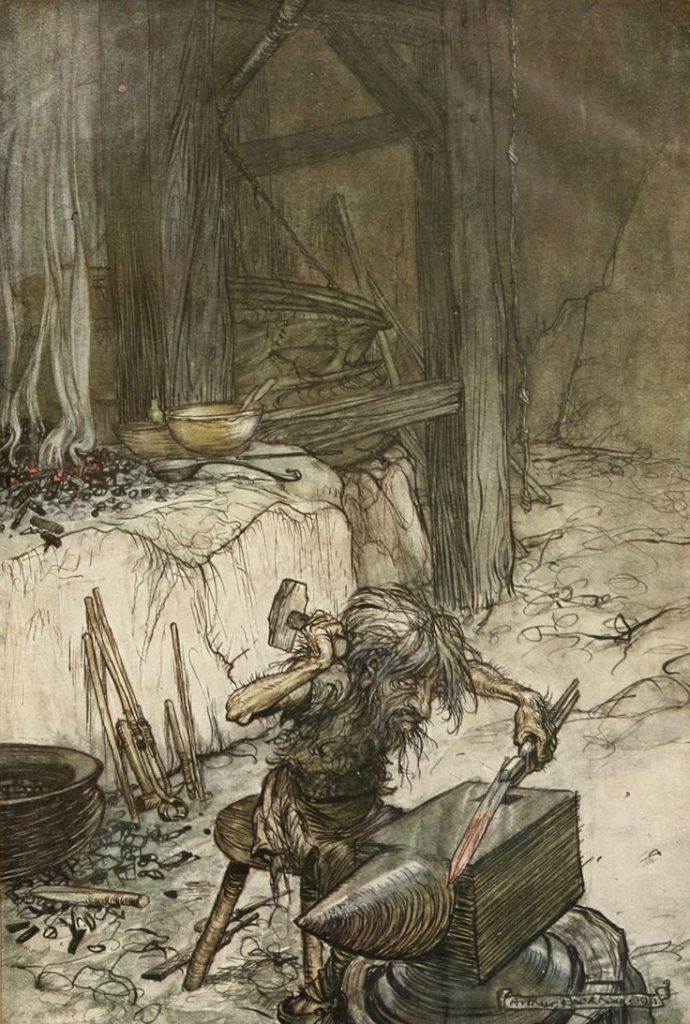
These stunted humanoids appear as dwarves, but their grey wrinkled skin and blank eyes indicate a much longer time of living underground. They come towards you staring uncomprehendingly, then begin a mad, senseless gibbering and raise their small weapons in an obviously hostile, if rather barmy, attitude.
Monster Encyclopaedia II: The Dark Bestiary
Author J. C. Alvarez
Series Monster Encyclopaedia
Publisher Mongoose Publishing
Publish date 2005
Dwergs are the most primitive strain of dwarves, much less intelligent and evolved than their modern relatives. They are in fact nearly mindless creatures, roaming the underdark attacking whatever they do not understand (which includes virtually everything). Dwergs look like small, hunched, dwarf-like creatures, much lankier than common dwarves, with grey skin and blind, featureless eyes. In typical idiot savant fashion, they are masterful craftsmen despite their limited Intelligence, so they are often seen carrying weapons, armour and other magical items of excellent quality.
Dwergs speak their own dialect of Dwarven and Undercommon.
| Dwerg, 1st Level Warrior | |
| Small Humanoid | |
| Hit Dice | 1d8+1 (5 hp) |
| Initiative | +2 |
| Speed | 20 ft. (4 squares) |
| AC | 16(+1 size,+2 Dex,+3masterwork studded leather armour), touch 13, flat-footed 14 |
| Base Attack/Grapple | +1/-4 |
| Attack | masterwork light pick +5 melee (1d3- 1/x4) or masterwork light crossbow +5 ranged (1d6/19-20) |
| Full Attack | masterwork light pick +5 melee (1d3-1/x4) or masterwork light crossbow +5 ranged (1d6/19-20) |
| Space/Reach | 5 ft. /5 ft. |
| Special Attacks | Dwerg traits |
| Special Qualities | Dwerg traits |
| Saves | Fort +3, Ref +2, Will +1 |
| Abilities | Strength 8, Dexterity 15, Constitution 13, Intelligence 6, Wisdom 12, Charisma 5 |
| Skills | Appraise +3, Craft (weaponsmithing) +4, Hide +6, Move Silently +3 |
| Feats | Weapon Finesse |
| Environment | Any underground |
| Organisation | Solitary, team (2-4), gang (4-24 plus one 3rd level leader) or tribe (20-80 plus one 3rd level leader and a 6th level chieftain) |
| Challenge Rating | 1/2 |
| Treasure | Double standard plus masterwork light pick, masterwork light crossbow and masterwork studded leather armour |
| Alignment | Usually neutral evil |
| Advancement | By character class |
| Level Adjustment | +1 |
Combat
Dwergs are nothing like their brave and warlike relatives, instead preferring to use underhand tactics such as flanking and surprise attacks, or the good old fashioned technique of ganging up on a single enemy. They are otherwise very cowardly and usually flee as soon as they realise they do not have an overwhelming advantage.
Dwergs always use at least masterwork quality weapons and armour, with some of their leaders using magical weapons of various types. They usually prefer light crossbows, picks and hammers; and light armour types such as studded leather.
- Dwerg Traits: Dwergs have all of a dwarf’s racial traits, except as follows:
- +2 Dexterity, +2 Constitution, -4 Intelligence, -4 Charisma.
- Small size. Dwerg characters receive a +1 size modifier to Armour Class and a +1 size modifier on all attack rolls. They receive a +4 size modifier on Hide checks and a -4 size modifier on grapple checks.
- Blindness (Ex): Dwergs cannot use any ability relying on normal sight. Conversely, they are immune to illusions, gaze attacks and other effects relying on the target’s sight.
- Blindsight out to 60 feet. Dwergs are naturally accustomed to living in darkness.
- +2 racial bonus on saves against spell and spell-like effects. Dwergs receive no special bonus to saves against poison.
- Improved stonecunning: Dwergs receive the stonecunning ability but the bonuses they gain from it are twice those of other dwarves (+4 instead of +2).
- +1 on all attack rolls made against a flanked or flatfooted opponent: Dwergs are innately treacherous. This replaces a hill dwarf’s attack bonus against orcs and goblinoids.
- Dwergs do not receive racial bonuses to Armour Class against giants.
- +4 on all Appraise and Craft checks. This replaces a hill dwarfs bonus on Appraise and Craft checks.
- Free item creation Feat: All Dwerg characters count as 12th level spellcasters for the purpose of taking item creation feats. This only allows a Dwerg to choose any item creation feat he wishes since 1st level; he must still fulfil a specific items prerequisites before crafting it and must abide by all other rules and limitations on item creation.
- Automatic languages: Dwarven, Undercommon. Bonus languages: Common, Elven, Gnome, Giant, Goblin, Terran.
- Favoured class: Rogue.
The Dwerg warrior presented above was created using the following ability score array: Strength 9, Dexterity 13, Constitution 11, Intelligence 10, Wisdom 12, Charisma 8.
Using the Dwerg in a Campaign
A dwerg works best when introduced through signs of maintenance, inheritance, theft, and pressure before the creature itself appears. The crypt is too intact. The mine-breach opens into masonry older than the kingdom. The treasure in the lord’s hall bears the same marks as the goods missing from a nearby barrow. Locks in a ruined hill-fort still function flawlessly. Grave-robbers begin dying with soot under their fingernails and broken gold clasps in their mouths.
Good roles for a dwerg include a tomb-smith still tending a dead king’s regalia, the hidden maker of a famous relic now held by the wrong dynasty, a hoard-custodian beneath a hall built on stolen burial wealth, a saboteur haunting miners who broke into its chambers, or a collector quietly reclaiming barrow-plunder sold across a kingdom.
Used properly, the dwerg is an old under-earth claim made flesh: a being of stone pressure, burial right, dangerous craft, and memory hammered into metal. It does not merely live beneath the earth. It makes the earth remember.