
Achilles, Fury of the Myrmidons
He can break the Trojan line. Grief has made every victory feel too small.
Achilles is the swiftest and most feared warrior before Troy. Born of the mortal king Peleus and the sea-goddess Thetis, he commands the Myrmidons not because of a royal decree but because men have seen what happens when he decides to fight. The troops under his command respect his courage, dread his temper and follow him through fire without believing him easy to please.
His quarrel with Agamemnon has already cost the Achaeans dearly. Achilles refused the king’s demand for obedience after Agamemnon took Briseis from his household. Patroclus, seeking to relieve the army, took up Achilles’ arms and led the Myrmidons into battle. Hector took those arms when Patroclus fell. Thetis has secured new armour from Hephaestus; Achilles now means to take the field himself. His ferocity is not a magical condition that excuses him. It is a choice fed by grief, pride and the knowledge that victory will not restore his companion.
At a Glance
- Identity: Achilles (Achilleus), son of Peleus and Thetis
- People: Human of divine descent; prince of Phthia
- Role: Champion of the Achaeans, commander of the Myrmidons
- Alignment: Chaotic Good
- Region: Phthia and the Achaean encampment outside Troy
- Mother: Thetis, sea-goddess of the Nereids; Father: Peleus, king of Phthia
- Companion: Patroclus, whose loss governs his every decision
- Allies: The Myrmidons, Antilochus, Ajax and the Achaean fighting men
- Opponents: Hector, the Trojan command, and Agamemnon when kingship demands obedience without respect
- Arms: The Pelian ash spear, divine bronze panoply and shield forged by Hephaestus; horses Xanthus and Balius
Game Statistics
Achilles is a commander, duellist and charioteer whose divine arms reward a direct fight. The horses take their own turns and count separately when assembling an encounter.
Achilles — D&D 2024
Medium Humanoid (Human), Chaotic Good
AC 24 (Armor of Achilles and Shield of Peleus); Initiative +7 (17)
HP 432 (32d8 + 288)
Speed 50 ft.
| Ability | Score | Modifier | Save |
|---|---|---|---|
| STR | 26 | +8 | +17 |
| DEX | 24 | +7 | +16 |
| CON | 28 | +9 | +18 |
| INT | 14 | +2 | +2 |
| WIS | 18 | +4 | +13 |
| CHA | 24 | +7 | +7 |
Skills Athletics +26, Insight +13, Intimidation +16, Perception +13, Survival +13; Resistances bludgeoning, piercing and slashing; fire while wearing his armour; Immunities petrified; Senses Passive Perception 23; Languages Greek; CR 29 (135,000 XP; PB +9).
Traits
Divine Blood. Achilles does not age or need food, sleep or breath. His ability scores and Hit Point maximum cannot be reduced, and he cannot be transformed against his will. He can be slain by damage. He has Advantage on saving throws against spells and magical effects, and against poison, disease, paralysis and effects that kill without dealing damage or disintegrate him.
Stygian Skin. His physical damage resistances apply to magical and nonmagical attacks. He takes no extra damage from Critical Hits or Sneak Attack. An attacker may declare a strike at his left heel before a weapon attack and take a −10 penalty to that attack roll. On a hit, that attack ignores this trait’s resistances and its protection against Critical Hits and Sneak Attack. It does not bypass his armour, fire resistance or any other defence.
Legendary Resistance (3/Day). If Achilles fails a saving throw, he can choose to succeed instead.
Indomitable (3/Day). When Achilles fails a saving throw, he can reroll it and must use the new result. This does not restore Legendary Resistance.
Battle Fortune (3 Uses; Recharge after a Short or Long Rest). After rolling an attack, ability check or saving throw, but before its result is resolved, Achilles may expend one use to reroll one of its d20s and must use that new die. Alternatively, when an attack hits him, he may expend a use and his Reaction to force the attacker to reroll its attack; the attacker must use the new roll. Only one use may affect a roll.
Superior Critical. His weapon attacks score a Critical Hit on an unmodified roll of 18–20.
Survivor. At the start of his turn, if he has at least 1 Hit Point and no more than 216 Hit Points, he regains 7 Hit Points.
Mobile Warrior. Difficult Terrain costs him no extra movement while he Dashes. After he moves at least 20 feet on his turn, Opportunity Attacks against him have Disadvantage for the rest of that turn. After he makes a melee attack against a creature, that creature cannot make Opportunity Attacks against him for the rest of that turn. A creature hit by his Opportunity Attack has Speed 0 until the end of its current turn; Disengage does not prevent that Opportunity Attack.
Warrior Resolve. He has Advantage on saving throws against being Frightened, including nonmagical fear.
Athletic Grace. He adds 3 to Strength, Dexterity and Constitution ability checks that do not already include his Proficiency Bonus. A running long jump covers 4 additional feet.
Helm of Arrow Deflection. While conscious and able to see the attacker, he can turn aside up to four ranged weapon attacks that would hit him, without spending an action. All damage from each deflected attack is prevented. The helm cannot stop spell attacks, siege projectiles or projectiles thrown by Huge or Gargantuan creatures. All four deflections return at the start of his turn.
Shield of Peleus — Freedom. While carrying his shield, magical effects cannot reduce his Speed or give him the Paralyzed or Restrained condition. He ignores Difficult Terrain and underwater movement and attack penalties. He can spend 5 feet of movement to escape a nonmagical grapple or restraint.
Shield of Peleus — Dread. An enemy that starts its turn within 30 feet and can see the shield must succeed on a DC 20 Wisdom saving throw or be Frightened for 1 minute. While Frightened, it uses its movement to retreat from Achilles by a safe route. It repeats the save at the end of each turn, ending the effect on a success. A successful save gives immunity to this shield’s dread for 24 hours.
Actions
Multiattack. Achilles makes three attacks with his Pelian Spear or Sword of Peleus, in any combination. A spear he has thrown is no longer in his hand; it does not return on its own.
Pelian Spear. Melee or Ranged Attack Roll: +20, reach 10 ft. or range 30/120 ft., one target. Hit: 27 (3d10 + 11) Piercing damage. This magical +3 artifact weapon can be used one-handed by Achilles.
Sword of Peleus. Melee Attack Roll: +20, reach 5 ft., one target. Hit: 21 (3d6 + 11) Slashing damage. This is a magical +3 artifact shortsword.
Myrmidon Charge (Recharge 5–6). Achilles moves up to his Speed without provoking Opportunity Attacks and makes one Pelian Spear attack. On a hit, the target must succeed on a DC 25 Strength saving throw or fall Prone. This is an alternative to Multiattack.
Action Surge (2 Uses; Recharge after a Short or Long Rest). On his turn Achilles can expend one use to take one additional Action. He cannot expend both uses on the same turn. The additional action cannot be the Magic action.
Words of the Captain. After 10 minutes of speech, up to six willing creatures within 30 feet that can hear and understand him, including himself if chosen, gain 19 Temporary Hit Points. Each recipient can benefit only once between its own Short or Long Rests. These points do not stack with other Temporary Hit Points.
Bonus Actions
Speed of the Sword. While wielding the Sword of Peleus, Achilles makes one attack with it. This property does not grant a spear attack.
Second Wind (Recharge after a Short or Long Rest). Achilles regains 23 (1d10 + 18) Hit Points.
Command the Line (1/Day). Up to three willing allies within 60 feet that can hear him gain 12 Temporary Hit Points each and may immediately move up to 10 feet without provoking Opportunity Attacks.
Reactions
Shield of Many Worlds. When an attacker he can see hits him, Achilles adds 4 to his AC against that attack, potentially making it miss. He must be carrying his shield.
Guard the Line. When a creature within 5 feet of Achilles attacks someone other than him, Achilles makes one melee weapon attack against that creature.
Spell Turning (3/Day). When a spell of 7th level or lower targets only Achilles, he can reflect it at its caster instead, provided that caster is within the spell’s range measured from Achilles and is a legal target. The spell uses its original attack bonus and save DC. Spells with range Touch or Self, areas, and spells of 8th or 9th level cannot be reflected. The reflected spell cannot be reflected again. He must be carrying the Shield of Peleus.
Legendary Actions
Legendary Action Uses: 3. Immediately after another creature’s turn, Achilles can expend one use for one option below. He cannot do so while Incapacitated. He regains all uses at the start of his turn. Between the starts of his turns he can use only one attack-granting option: Pelian Thrust or Rally the Myrmidons.
Relentless Pursuit. He moves up to half his Speed without provoking Opportunity Attacks.
Pelian Thrust. He makes one Pelian Spear attack. He cannot then use this option or Rally the Myrmidons again until the start of his next turn.
Rally the Myrmidons. One willing ally within 30 feet that can hear him may use its Reaction to make one weapon attack or move up to half its Speed. Achilles cannot then use this option or Pelian Thrust again until the start of his next turn.
Equipment and Chariot
Divine Panoply. The Armor of Achilles is a +3 breastplate (AC 14 + Dexterity modifier, maximum +2, +3 magic). The Shield of Peleus is a +3 shield (+5 AC). The breastplate grants fire resistance. Breastplate, helm and shield form one artifact set requiring one Attunement; the spear and sword each require one further Attunement. The corresponding benefits require the relevant piece to be worn or carried. Achilles has three attuned artifacts. He has no innate spell list or spell slots.
Golden Chariot. Large vehicle; AC 18, 80 Hit Points, Damage Threshold 10; immune to Poison and Psychic damage. It carries one driver and one passenger and uses the harnessed team’s movement, not a separate movement allowance. Its driver gains +5 on Wisdom (Animal Handling) checks to control that team and +2 on other Strength or Dexterity checks directly related to driving. The bonuses stack if both apply to the same check. The chariot itself grants no attacks. The driver must hold the reins; releasing them leaves the intelligent horses choosing their own course.
Xanthus and Balius
Each horse uses this profile: Large Celestial, Neutral Good.
AC 16; Initiative +3 (13); HP 95 (10d10 + 40); Speed 80 ft.
| Ability | Score | Modifier | Save |
|---|---|---|---|
| STR | 20 | +5 | +7 |
| DEX | 16 | +3 | +3 |
| CON | 18 | +4 | +6 |
| INT | 8 | -1 | -1 |
| WIS | 14 | +2 | +2 |
| CHA | 12 | +1 | +1 |
Saving Throws Str +7, Con +6; Skills Perception +4; Senses Passive Perception 14; Languages Greek; CR 4 (1,100 XP; PB +2).
Deathless Blood. The horse does not age. It can be wounded and slain in combat; this trait does not return it to life or prevent death saving throws.
Sure-Footed. The horse has Advantage on Strength and Dexterity saving throws against being knocked Prone.
Actions — Multiattack. The horse makes two Hooves attacks.
Hooves. Melee Attack Roll: +7, reach 5 ft., one target. Hit: 12 (2d6 + 5) Bludgeoning damage.
Trampling Charge. If the horse moves at least 20 feet straight toward a creature and hits it with Hooves on the same turn, the target must succeed on a DC 15 Strength saving throw or fall Prone. This grants no extra attack.
Harness and Turn. A harnessed horse retains its own turn and actions. Pulling the chariot does not give Achilles the horse’s attacks, movement or extra turns. Both horses must move together while yoked.
Achilles — D&D 2014
Medium humanoid (human), chaotic good
Armor Class 24 (Armor of Achilles and Shield of Peleus); Hit Points 432 (32d8 + 288); Speed 50 ft.
| STR | DEX | CON | INT | WIS | CHA |
|---|---|---|---|---|---|
| 26 (+8) | 24 (+7) | 28 (+9) | 14 (+2) | 18 (+4) | 24 (+7) |
Saving Throws Str +17, Dex +16, Con +18, Wis +13.
Skills Athletics +26, Insight +13, Intimidation +16, Perception +13, Survival +13; Damage Resistances bludgeoning, piercing and slashing; fire while wearing his armour; Condition Immunities petrified; Senses passive Perception 23; Languages Greek; Challenge 29 (135,000 XP).
Traits
Divine Blood. Achilles does not age or need food, sleep or breath. His ability scores and Hit Point maximum cannot be reduced, and he cannot be transformed against his will. He can be slain by damage. He has advantage on saving throws against spells and magical effects, and against poison, disease, paralysis and effects that kill without dealing damage or disintegrate him.
Stygian Skin. His physical damage resistances apply to magical and nonmagical attacks. He takes no extra damage from Critical Hits or Sneak Attack. An attacker may declare a strike at his left heel before a weapon attack and take a −10 penalty to that attack roll. On a hit, that attack ignores this trait’s resistances and its protection against Critical Hits and Sneak Attack. It does not bypass his armour, fire resistance or any other defence.
Legendary Resistance (3/Day). If Achilles fails a saving throw, he can choose to succeed instead.
Indomitable (3/Day). When Achilles fails a saving throw, he can reroll it and must use the new result. This does not restore Legendary Resistance.
Battle Fortune (3 Uses; Recharge after a Short or Long Rest). After rolling an attack, ability check or saving throw, but before its result is resolved, Achilles may expend one use to reroll one of its d20s and must use that new die. Alternatively, when an attack hits him, he may expend a use and his reaction to force the attacker to reroll its attack; the attacker must use the new roll. Only one use may affect a roll.
Superior Critical. His weapon attacks score a Critical Hit on an unmodified roll of 18–20.
Survivor. At the start of his turn, if he has at least 1 Hit Point and no more than 216 Hit Points, he regains 7 Hit Points.
Mobile Warrior. Difficult Terrain costs him no extra movement while he Dashes. After he moves at least 20 feet on his turn, Opportunity Attacks against him have Disadvantage for the rest of that turn. After he makes a melee attack against a creature, that creature cannot make Opportunity Attacks against him for the rest of that turn. A creature hit by his Opportunity Attack has Speed 0 until the end of its current turn; Disengage does not prevent that Opportunity Attack.
Warrior Resolve. He has advantage on saving throws against being Frightened, including nonmagical fear.
Athletic Grace. He adds 3 to Strength, Dexterity and Constitution ability checks that do not already include his Proficiency Bonus. A running long jump covers 4 additional feet.
Helm of Arrow Deflection. While conscious and able to see the attacker, he can turn aside up to four ranged weapon attacks that would hit him, without spending an action. All damage from each deflected attack is prevented. The helm cannot stop spell attacks, siege projectiles or projectiles thrown by Huge or Gargantuan creatures. All four deflections return at the start of his turn.
Shield of Peleus — Freedom. While carrying his shield, magical effects cannot reduce his Speed or give him the Paralyzed or Restrained condition. He ignores Difficult Terrain and underwater movement and attack penalties. He can spend 5 feet of movement to escape a nonmagical grapple or restraint.
Shield of Peleus — Dread. An enemy that starts its turn within 30 feet and can see the shield must succeed on a DC 20 Wisdom saving throw or be Frightened for 1 minute. While Frightened, it uses its movement to retreat from Achilles by a safe route. It repeats the save at the end of each turn, ending the effect on a success. A successful save gives immunity to this shield’s dread for 24 hours.
Actions
Multiattack. Achilles makes three attacks with his Pelian Spear or Sword of Peleus, in any combination. A spear he has thrown is no longer in his hand; it does not return on its own.
Pelian Spear. Melee or Ranged Weapon Attack: +20 to hit, reach 10 ft. or range 30/120 ft., one target. Hit: 27 (3d10 + 11) piercing damage. This magical +3 artifact weapon can be used one-handed by Achilles.
Sword of Peleus. Melee Weapon Attack: +20 to hit, reach 5 ft., one target. Hit: 21 (3d6 + 11) slashing damage. This is a magical +3 artifact shortsword.
Myrmidon Charge (Recharge 5–6). Achilles moves up to his Speed without provoking Opportunity Attacks and makes one Pelian Spear attack. On a hit, the target must succeed on a DC 25 Strength saving throw or fall Prone. This is an alternative to Multiattack.
Action Surge (2 Uses; Recharge after a Short or Long Rest). On his turn Achilles can expend one use to take one additional action. He cannot expend both uses on the same turn.
Words of the Captain. After 10 minutes of speech, up to six willing creatures within 30 feet that can hear and understand him, including himself if chosen, gain 19 Temporary Hit Points. Each recipient can benefit only once between its own Short or Long Rests. These points do not stack with other Temporary Hit Points.
Bonus Actions
Speed of the Sword. While wielding the Sword of Peleus, Achilles makes one attack with it. This property does not grant a spear attack.
Second Wind (Recharge after a Short or Long Rest). Achilles regains 23 (1d10 + 18) Hit Points.
Command the Line (1/Day). Up to three willing allies within 60 feet that can hear him gain 12 Temporary Hit Points each and may use their reactions to move up to 10 feet without provoking Opportunity Attacks.
Reactions
Shield of Many Worlds. When an attacker he can see hits him, Achilles adds 4 to his AC against that attack, potentially making it miss. He must be carrying his shield.
Guard the Line. When a creature within 5 feet of Achilles attacks someone other than him, Achilles makes one melee weapon attack against that creature.
Spell Turning (3/Day). When a spell of 7th level or lower targets only Achilles, he can reflect it at its caster instead, provided that caster is within the spell’s range measured from Achilles and is a legal target. The spell uses its original attack bonus and save DC. Spells with range Touch or Self, areas, and spells of 8th or 9th level cannot be reflected. The reflected spell cannot be reflected again. He must be carrying the Shield of Peleus.
Legendary Actions
Achilles has 3 legendary actions, taking one option at a time at the end of another creature’s turn, and regains spent actions at the start of his turn. He cannot use them while incapacitated.
Relentless Pursuit (Costs 1 Action). He moves up to half his speed without provoking opportunity attacks.
Pelian Thrust (Costs 2 Actions). He makes one Pelian Spear attack.
Rally the Myrmidons (Costs 2 Actions). One willing ally within 30 feet that can hear him may use its reaction to make one weapon attack or move up to half its speed.
Equipment and Chariot
Divine Panoply. The Armor of Achilles is a +3 breastplate (AC 14 + Dexterity modifier, maximum +2, +3 magic). The Shield of Peleus is a +3 shield (+5 AC). The breastplate grants fire resistance. Breastplate, helm and shield form one artifact set requiring one Attunement; the spear and sword each require one further Attunement. The corresponding benefits require the relevant piece to be worn or carried. Achilles has three attuned artifacts. He has no innate spell list or spell slots.
Golden Chariot. Large vehicle; AC 18, 80 Hit Points, Damage Threshold 10; immune to Poison and Psychic damage. It carries one driver and one passenger and uses the harnessed team’s movement, not a separate movement allowance. Its driver gains +5 on Wisdom (Animal Handling) checks to control that team and +2 on other Strength or Dexterity checks directly related to driving. The bonuses stack if both apply to the same check. The chariot itself grants no attacks. The driver must hold the reins; releasing them leaves the intelligent horses choosing their own course.
Xanthus and Balius
Each horse uses this profile: Large Celestial, Neutral Good.
Armor Class 16; Initiative +3 (13); HP 95 (10d10 + 40); Speed 80 ft.
| STR | DEX | CON | INT | WIS | CHA |
|---|---|---|---|---|---|
| 20 (+5) | 16 (+3) | 18 (+4) | 8 (-1) | 14 (+2) | 12 (+1) |
Saving Throws Str +7, Con +6; Skills Perception +4; Senses Passive Perception 14; Languages Greek; CR 4 (1,100 XP; PB +2).
Deathless Blood. The horse does not age. It can be wounded and slain in combat; this trait does not return it to life or prevent death saving throws.
Sure-Footed. The horse has advantage on Strength and Dexterity saving throws against being knocked prone.
Actions — Multiattack. The horse makes two Hooves attacks.
Hooves. Melee Weapon Attack: +7 to hit, reach 5 ft., one target. Hit: 12 (2d6 + 5) bludgeoning damage.
Trampling Charge. If the horse moves at least 20 feet straight toward a creature and hits it with Hooves on the same turn, the target must succeed on a DC 15 Strength saving throw or fall prone. This grants no extra attack.
Harness and Turn. A harnessed horse retains its own turn and actions. Pulling the chariot does not give Achilles the horse’s attacks, movement or extra turns. Both horses must move together while yoked.
Achilles — Pathfinder 1e
Achilles CR 35 (unofficial epic estimate); XP 52,428,800 (extrapolated)
Male human barbarian 17/fighter 17; CG Medium humanoid (human)
Init +11; Senses Perception +29
Defense
AC 37, touch 18, flat-footed 37 (+11 armour, +8 shield, +7 Dex, +1 dodge; uncanny dodge)
hp 464 (17d12+17d10+255; first barbarian Hit Die maximised)
Fort +26, Ref +17, Will +13; bravery +4 vs. fear
Defensive Abilities improved uncanny dodge, Divine Blood, Stygian Skin; DR 19/epic, or 4/— against epic weapons or a heel strike; Resist fire 30; SR 25; Immune forced form changes, petrification, negative levels, energy drain, ability damage and drain
Offense
Speed 40 ft.; Melee Pelian Spear +58/+53/+48/+43 (1d8+26/19–20/×3), or Sword of Peleus +52/+52/+47/+42/+37 (1d6+18/17–20/×2), or shield bash +44/+39/+34/+29 (1d4+10)
Ranged Pelian Spear +55 (1d8+26/19–20/×3; range increment 30 ft.; +1 attack and damage within 30 ft.)
Space/Reach 5 ft./5 ft.; Special Attacks greater rage 42 rounds/day, rage powers, critical feats, Headlong Assault
Statistics
Str 30, Dex 24, Con 23, Int 14, Wis 12, Cha 25
Base Atk +34; CMB +44; CMD 62
Feats Combat Expertise, Cleave, Combat Reflexes, Critical Focus, Dreadful Carnage, Far Shot, Furious Focus, Great Cleave, Greater Weapon Focus (spear), Greater Weapon Specialization (spear), Improved Bull Rush, Improved Critical (spear), Improved Initiative, Improved Shield Bash, Improved Unarmed Strike, Intimidating Prowess, Iron Will, Lunge, Penetrating Strike, Point-Blank Shot, Power Attack, Quick Draw, Staggering Critical, Stunning Critical, Toughness, Weapon Focus (spear), Weapon Specialization (spear); Quickfoot bonus feats Dodge, Mobility, Spring Attack
Skills Acrobatics +39 (+43 jumping), Climb +37, Handle Animal +30, Intimidate +54, Knowledge (religion) +9, Perception +29, Perform (string instruments) +17, Ride +33, Survival +13, Swim +32; Languages Greek, Colchian, Thracian
SQ armour training 4, bravery +4, fast movement, trap sense +5, tireless rage; weapon training spears +4, light blades +3, heavy blades +2, bows +1
Special Abilities and Combat
Greater Rage (Ex). Free action on his turn; 42 total rounds/day. While raging: Str 36, Con 29; hp 566; AC 35, touch 16; Fort +29, Ref +17, Will +16; CMB +47, CMD 63; spear +61/+56/+51/+46 (1d8+29); sword +55/+55/+50/+45/+40 (1d6+21). Str-based checks and Intimidate rise by 3. He can end rage as a free action and is not fatigued afterwards. Ending rage removes 102 current and maximum hit points; it does not heal him. Indomitable will adds +4 to Will saves against enchantments during rage, stacking with the rage bonus.
Rage Powers (Ex). Intimidating Glare: move action to demoralise one adjacent foe; on success it is shaken for 1d4 rounds, plus 1 round per 5 by which the check exceeds the DC. Powerful Blow: swift action before an attack for +5 damage on that attack, once/rage. Surprise Accuracy: swift action before an attack for +5 to that attack, once/rage. Strength Surge: immediate action for +17 on one Strength check, combat-manoeuvre check or CMD against one manoeuvre, once/rage. Clear Mind: immediate action to reroll a Will save before its result is revealed, once/rage; use the second result. Fearless Rage: immune to shaken and frightened while raging. Renewed Vigor: standard action to heal 4d8+9 hp while raging, once/day. Unexpected Strike: once/rage, an attack of opportunity against a foe entering a threatened square even if that movement would not normally provoke. These are the eight selected powers, not extra feat slots.
Quickfoot (Su). Divine agility grants Dodge, Mobility and Spring Attack as three bonus feats without prerequisites. Dodge is already in AC and CMD. The normal 27 feats come from 17 level feats, one human feat and nine fighter feats. He has up to eight ordinary attacks of opportunity each round from Combat Reflexes; Unexpected Strike supplies a trigger, not unlimited reactions.
Divine Blood (Su). He does not age or need food, sleep or breath, but can be slain in battle. He is immune to forced changes of form, petrification, negative levels, energy drain, ability damage and ability drain. He gains +10 on saves against disease, poison, paralysis, death effects and disintegration; +5 against binding, soul bind, temporal stasis and trap the soul. These conditional bonuses are not in the ordinary saves. Spell resistance 25 is a separate defence. These are the listed Divine Blood benefits; he has no spell slots, domain spells or additional outsider Hit Dice.
Stygian Skin (Su). The inherited blessing gives DR 15/epic and specifically stacks with his barbarian DR 4/—. An attacker may declare a left-heel weapon attack before rolling and take −10 on that attack. That hit bypasses only the Stygian portion, leaving DR 4/—. Epic weapons likewise leave only DR 4/—. The reductions are alternatives, not cumulative entries.
Headlong Assault (Ex). On a charge using Power Attack, he may apply its −9 attack penalty to AC instead of his melee attack rolls until the start of his next turn. The charge’s normal +2 attack and −2 AC still apply. Power Attack normally gives −9 attack and +18 damage with his one-handed spear; neither is in the ordinary attacks. This does not grant a full attack on a charge. When using a weapon in two hands, Furious Focus removes Power Attack’s attack penalty from the first attack of the turn; it does not remove an AC penalty chosen for Headlong Assault.
Critical Feats. Critical Focus adds +4 on confirmations. On a confirmed critical he may apply either Stunning Critical (Fort DC 44: stunned 1d4 rounds; success staggers 1d4 rounds) or Staggering Critical (Fort DC 44: staggered 1d4+1 rounds; success staggers 1 round), not both. Dreadful Carnage allows a free demoralise check against foes within 30 feet when he reduces a foe to 0 or fewer hp. Lunge can extend his melee reach by 5 feet during his turn at −2 AC until his next turn. Penetrating Strike ignores 5 points of typed damage reduction with a weapon selected for Weapon Focus; it does not ignore DR/—.
Rank and Armour Accounting. His 204 ranks are Acrobatics 30, Climb 25, Handle Animal 20, Intimidate 34, Knowledge (religion) 7, Perception 25, Perform 10, Ride 24, Survival 9 and Swim 20. The shield’s −1 penalty is included in physical skills; armour training removes the breastplate’s penalty. Toughness contributes 34 hp and 17 barbarian favoured-class choices contribute 17 hp. The attack sequence uses four BAB attacks even though BAB is +34; sword speed supplies its own fifth attack. A thrown spear is one attack unless recovered. No armour mastery or weapon mastery is claimed at fighter 17.
Tactics. He first identifies the opposing commander and a route back to his men. Rage and an exposed charge can break a line, but choosing Headlong Assault leaves him open to retaliation. He uses his shield’s protection against hostile spellcasters and the sword when close opponents deny the spear’s line. His horses obey voices and terrain, not an unlimited supply of rider actions.
Divine Equipment
Armor of Achilles. A major-artifact +5 breastplate with greater fire resistance 30. Its maximum Dexterity bonus is +6 before class adjustments; armour check penalty −3 and weight 30 lb. Its AC bonus is 11. Armour training 4 increases its Dexterity limit to +10 and removes its check penalty. The helm belongs to the panoply.
Helm of Arrow Deflection. Up to four times between the starts of his turns, an aware wearer can negate a ranged weapon hit without an action or free hand. It cannot stop spell attacks, siege weapons or unusually massive projectiles such as a giant’s boulder. It does not require the Deflect Arrows feat.
Shield of Peleus. A major-artifact +6 heavy bronze shield: +8 shield bonus to AC, check penalty −1, weight 40 lb.; CL 20th. While carried it provides continuous freedom of movement. Three times per day, a command word and standard action activate spell turning on the bearer: 1d4+6 spell levels, lasting 200 minutes or until expended. Targeted spells are reflected; touch spells and areas are excluded. Use the spell’s native partial-turning and resonance rules when relevant. A visible enemy within 30 feet seeing the shield for the first time that day must succeed on a DC 20 Will save or be panicked for 1d4 rounds; this is a mind-affecting fear effect. The shield’s enhancement protects AC and does not add to shield-bash attack or damage.
Pelian Spear. A major-artifact +8 keen throwing spear; CL 20th, weight 4 lb.; 1d8 piercing, 19–20/×3. Divine Wielding lets Achilles, or another wielder with Strength 25 or higher, use this particular spear one-handed; otherwise it requires two hands. Its range increment is 30 feet. It has no returning property. Keen and Improved Critical do not stack. The +8 enhancement and its other properties are part of this unique artifact, not a normal crafted +5 weapon.
Sword of Peleus. A +5 keen speed shortsword; CL 18th, weight 4 lb.; 1d6 piercing, 17–20/×2. Speed grants one extra attack with this sword during a full attack at its highest attack bonus. It does not grant an extra spear attack and does not stack with haste for that extra attack.
Golden Chariot. Large magic object; AC 4, hardness 10, 120 hp; CL 23rd; saves +13 or the attending driver’s save, whichever is better. One driver and one passenger; use the harnessed team’s speed and movement. Treat controlling the team as a Ride check, with a +5 competence bonus. Strength- or Dexterity-based checks directly related to driving also receive +2 circumstance; the bonuses stack on a Ride check to control the team. It supplies no extra attacks or actions. The driver must hold the reins. Damage and loss of a horse can halt the team; the chariot does not fly.
Xanthus and Balius — each horse
CR 6; XP 2,400; NG Large magical beast
Init +3; Senses darkvision 60 ft., low-light vision; Perception +19
AC 20, touch 12, flat-footed 17 (−1 size, +3 Dex, +8 natural); hp 95 (10d10+40); Fort +11, Ref +10, Will +7
Speed 80 ft.; Melee 2 hooves +14 (1d8+5) and bite +9 (1d4+2); Space/Reach 10 ft./5 ft.
Str 20, Dex 16, Con 18, Int 8, Wis 14, Cha 12; Base Atk +10; CMB +16; CMD 29
Feats Alertness, Endurance, Improved Natural Attack (hooves), Iron Will, Run; Skills Perception +19 (10 ranks); Sense Motive +4 untrained; Languages Greek.
Deathless Blood (Su) The horse does not age but can be slain. It has no rider-derived class bonuses, barding or animal-companion advancement. Its natural attacks are not automatically epic weapons. Each horse takes its own turn; count its CR separately from Achilles.
Achilles — D&D 3.5e
Medium Humanoid (Human); male human barbarian 17/fighter 17, divine blood
Hit Dice: 17d12+17d10+204 (413 hp; first barbarian Hit Die maximised)
Initiative: +11
Speed: 40 ft. (8 squares)
Armor Class: 34 (+10 armour, +6 Dex, +8 shield), touch 16, flat-footed 34 (uncanny dodge); Dodge adds +1 against the chosen foe
Base Attack/Grapple: +20 plus +7 epic attack/+37
Attack: Pelian Spear +49 melee (1d8+20/19–20/×3), Sword of Peleus +45 melee (1d6+15/17–20/×2), shield bash +40 melee (1d4+10), or Pelian Spear +46 ranged (1d8+20/19–20/×3; range increment 30 ft.; +1 attack and damage within 30 ft.)
Full Attack: Pelian Spear +49/+44/+39/+34 melee, Sword of Peleus +45/+45/+40/+35/+30 melee, shield bash +40/+35/+30/+25 melee, or one Pelian Spear +46 ranged; damage as above
Space/Reach: 5 ft./5 ft.
Special Attacks: greater rage 5/day, Devastating Critical, Overwhelming Critical, Improved Whirlwind Attack, Shock Trooper
Special Qualities: Divine Blood, Stygian Skin, Quickfoot, fast movement, improved uncanny dodge, indomitable will, trap sense +5, tireless rage, SR 25, fire resistance 30
Saves: Fort +26, Ref +20, Will +14
Abilities: Str 30, Dex 24, Con 23, Int 14, Wis 12, Cha 25
Skills: Climb +36, Handle Animal +27, Intimidate +37, Jump +40, Knowledge (religion) +9, Listen +31, Perform (string instruments) +17, Ride +30, Survival +2, Swim +27
Feats: Cleave, Combat Expertise, Far Shot, Great Cleave, Improved Bull Rush, Improved Critical (spear), Improved Initiative, Improved Shield Bash, Improved Unarmed Strike, Point Blank Shot, Power Attack, Shock Trooper, Two-Weapon Fighting, Weapon Focus (spear), Weapon Specialization (spear), Whirlwind Attack, Devastating Critical (spear), Epic Prowess (three selections), Improved Whirlwind Attack, Overwhelming Critical (spear); Quickfoot bonus feats: Dodge, Mobility, Spring Attack
Environment: Achaean camp and the Trojan coast
Organization: unique, with Patroclus’s companions, Myrmidons or his chariot team
Challenge Rating: 38 (original epic encounter estimate)
Treasure: divine equipment below
Alignment: Chaotic Good
Advancement: by character class
Level Adjustment: —
Combat
Greater Rage (Ex; 5/Day). Free action on his turn; up to 12 rounds per use. Str becomes 36 and Con 29: hp 515, AC 32, touch 14, spear +52/+47/+42/+37 (1d8+23), sword +48/+48/+43/+38/+33 (1d6+18), grapple +40, Fort +29, Ref +20, Will +17. Indomitable will adds a further +4 against enchantments during rage. Ending rage removes 102 current and maximum hp; tireless rage prevents fatigue afterwards. Mental concentration and nonphysical skill use remain subject to the barbarian’s rage restrictions.
Quickfoot (Su). Divine agility supplies Dodge, Mobility and Spring Attack without prerequisites, in addition to the 22 ordinary human, level and fighter feats. Dodge’s conditional +1 is not included in ordinary AC. Improved uncanny dodge prevents flanking unless the attacker’s rogue level is at least 21; uncanny dodge preserves his Dexterity bonus while flat-footed or attacked invisibly, but not while immobilised.
Divine Blood (Su). He does not age or need food, sleep or breath, but can be slain in battle. He is immune to forced changes of form, petrification, negative levels, energy drain, ability damage and ability drain. He gains +10 on saves against disease, poison, paralysis, death effects and disintegration; +5 against binding, soul bind, temporal stasis and trap the soul. These conditional bonuses are not in the ordinary saves. Spell resistance 25 is a separate defence. These are the listed Divine Blood benefits; he has no spell slots, domain spells or additional outsider Hit Dice.
Stygian Skin (Su). His DR 15/epic specifically stacks with barbarian DR 4/—, giving DR 19 against non-epic weapons and DR 4 against epic weapons. A declared left-heel attack takes −10 to its attack roll and bypasses only the Stygian reduction, leaving DR 4. This is a defined house blessing; no additional deity-template defences are assumed.
Epic Progression. The level order is barbarian 17 followed by fighter 17. At level 20 his base attack is +20 and base saves are +13/+6/+6; levels 21–34 add +7 epic attack and +7 epic saves. Epic Prowess is selected three times and adds +3 to attack rolls. It does not create extra iterative attacks or increase the base-attack value used for Power Attack. Weapon Focus and Weapon Specialization apply only to the spear. Keen and Improved Critical do not stack.
Devastating and Overwhelming Critical. A confirmed spear critical deals its normal triple damage plus 2d6 from Overwhelming Critical. A target susceptible to critical hits must also make a Fortitude save, DC 37 (40 during rage), or die. This death effect is not applied to targets immune to critical hits.
Improved Whirlwind Attack. As a standard action he makes up to five melee attacks, each against a different foe he threatens. These attacks and his other attacks until the start of his next turn take −4. He gains no speed, Cleave or other bonus attacks from this action. Ordinary Whirlwind Attack remains a separate full-attack option.
Power Attack and Shock Trooper. He may trade up to 27 points of melee attack for the same bonus to damage with the one-handed spear, or twice that bonus when wielding it in two hands without his shield. On a charge with a Power Attack penalty of at least −5, Heedless Charge may move some or all of that penalty to AC instead of the attack rolls; the charge’s usual +2 attack and −2 AC still apply. Directed Bull Rush: after a successful charging bull rush, each 5 feet he pushes a foe backwards also allows 5 feet to either side. Domino Rush: pushing one foe into another foe’s square allows a free trip attempt against each; neither receives a retaliatory trip attempt if he fails. No Power Attack or charge adjustment is in the printed attacks.
Weapons and Hands. The artifact spear’s Divine Wielding property permits one-handed use beside his shield. Using the sword’s speed property gives an extra sword attack only. With spear and heavy shield as two-weapon attacks, use spear +45/+40/+35/+30 (1d8+20) and one off-hand shield bash +36 (1d4+5); Improved Shield Bash keeps the shield’s AC. His magic shield has no separate weapon enhancement. A thrown spear does not return, so its ranged full attack contains one throw.
Skill and Feat Accounting. His 225 skill points buy Climb 30, Handle Animal 20, Intimidate 30, Jump 30, Listen 30, Ride 25, Swim 25 and Survival 1 ranks, plus cross-class Knowledge (religion) 7 ranks and Perform 10 ranks. The combined −4 armour/shield penalty, doubled for Swim, is included. Jump includes +4 for 40-foot speed; Ride includes +2 synergy from Handle Animal. The 22 selected feats use 12 character-level slots, one human slot and nine fighter slots; Quickfoot supplies its three named bonus feats. Intelligence 14 meets Combat Expertise’s prerequisite. A fighter bonus slot gained after character level 20 supplies one of the epic selections.
Tactics. He can fight from a guarded position, open a lane with a bull rush, or expose himself in a reckless charge. He cannot combine every attack option: spear, sword speed, Whirlwind and two-weapon fighting have different actions and hand requirements. The helm and shield offer real protection, but a foe who forces him to turn away from his men can change the battle without defeating him in a duel.
Divine Equipment
Armor of Achilles. A major-artifact +5 breastplate with greater fire resistance 30. Its maximum Dexterity bonus is +6 before class adjustments; armour check penalty −3 and weight 30 lb. Its AC bonus is 10. The helm belongs to the panoply.
Helm of Arrow Deflection. Up to four times between the starts of his turns, an aware wearer can negate a ranged weapon hit without an action or free hand. It cannot stop spell attacks, siege weapons or unusually massive projectiles such as a giant’s boulder. It does not require the Deflect Arrows feat.
Shield of Peleus. A major-artifact +6 heavy bronze shield: +8 shield bonus to AC, check penalty −1, weight 40 lb.; CL 20th. While carried it provides continuous freedom of movement. Three times per day, a command word and standard action activate spell turning on the bearer: 1d4+6 spell levels, lasting 200 minutes or until expended. Targeted spells are reflected; touch spells and areas are excluded. Use the spell’s native partial-turning and resonance rules when relevant. A visible enemy within 30 feet seeing the shield for the first time that day must succeed on a DC 20 Will save or be panicked for 1d4 rounds; this is a mind-affecting fear effect. The shield’s enhancement protects AC and does not add to shield-bash attack or damage.
Pelian Spear. A major-artifact +8 keen throwing spear; CL 20th, weight 4 lb.; 1d8 piercing, 19–20/×3. Divine Wielding lets Achilles, or another wielder with Strength 25 or higher, use this particular spear one-handed; otherwise it requires two hands. Its range increment is 30 feet. It has no returning property. Keen and Improved Critical do not stack. The +8 enhancement and its other properties are part of this unique artifact, not a normal crafted +5 weapon.
Sword of Peleus. A +5 keen speed shortsword; CL 18th, weight 4 lb.; 1d6 piercing, 17–20/×2. Speed grants one extra attack with this sword during a full attack at its highest attack bonus. It does not grant an extra spear attack and does not stack with haste for that extra attack.
Golden Chariot. Large magic object; AC 4, hardness 10, 120 hp; CL 23rd; saves +13 or the attending driver’s save, whichever is better. One driver and one passenger; use the harnessed team’s speed and movement. Treat controlling the team as a Ride check, with a +5 competence bonus. Strength- or Dexterity-based checks directly related to driving also receive +2 circumstance; the bonuses stack on a Ride check to control the team. It supplies no extra attacks or actions. The driver must hold the reins. Damage and loss of a horse can halt the team; the chariot does not fly.
Xanthus and Balius — each horse
Large Magical Beast, Neutral Good
Hit Dice: 10d10+40 (95 hp)
Initiative: +3
Speed: 80 ft. (16 squares)
Armor Class: 20 (−1 size, +3 Dex, +8 natural), touch 12, flat-footed 17
Base Attack/Grapple: +10/+19
Attack: hoof +14 melee (1d8+5)
Full Attack: 2 hooves +14 melee (1d8+5) and bite +9 melee (1d4+2)
Space/Reach: 10 ft./5 ft.
Special Attacks: —
Special Qualities: darkvision 60 ft., low-light vision, deathless blood
Saves: Fort +11, Ref +10, Will +5
Abilities: Str 20, Dex 16, Con 18, Int 8, Wis 14, Cha 12
Skills: Listen +9, Spot +12
Feats: Alertness, Endurance, Improved Natural Attack (hooves), Run
Environment: Achilles’s camp and the Trojan coast
Organization: unique pair
Challenge Rating: 5 each
Treasure: harness only
Alignment: Neutral Good
Advancement: —
Level Adjustment: —
Deathless Blood (Su). The horse does not age but can be slain. It speaks Greek. Listen has 5 ranks and Spot 8; Alertness is included. Its 13 skill points and four feats come from 10 magical-beast Hit Dice. No rider-derived class bonuses, barding or animal-companion advancement are assumed; count each horse separately.
What Is Happening Right Now?
A fresh suit of bronze stands inside Achilles’ shelter, its great shield reflecting campfires like a distant constellation. Thetis has warned him that pursuing Hector binds his own fate more tightly. Achilles has ordered the Myrmidons to ready the horses. The army’s captains want a decisive charge. Those who remember how long he refused the battlefield fear that he will now go too far in the opposite direction.
A Trojan herald waits just beyond the ditch under a white branch. He carries information about the prisoners seized during the last raid, but no captain dares disturb Achilles during the mourning. A group of displaced families has also reached the Achaean lines. Some know where Hector’s chariots are mustering; some are afraid that naming the place will condemn the people sheltering there. Achilles is willing to hear true testimony, but he has little patience for an argument disguised as mercy.
Appearance and Bearing
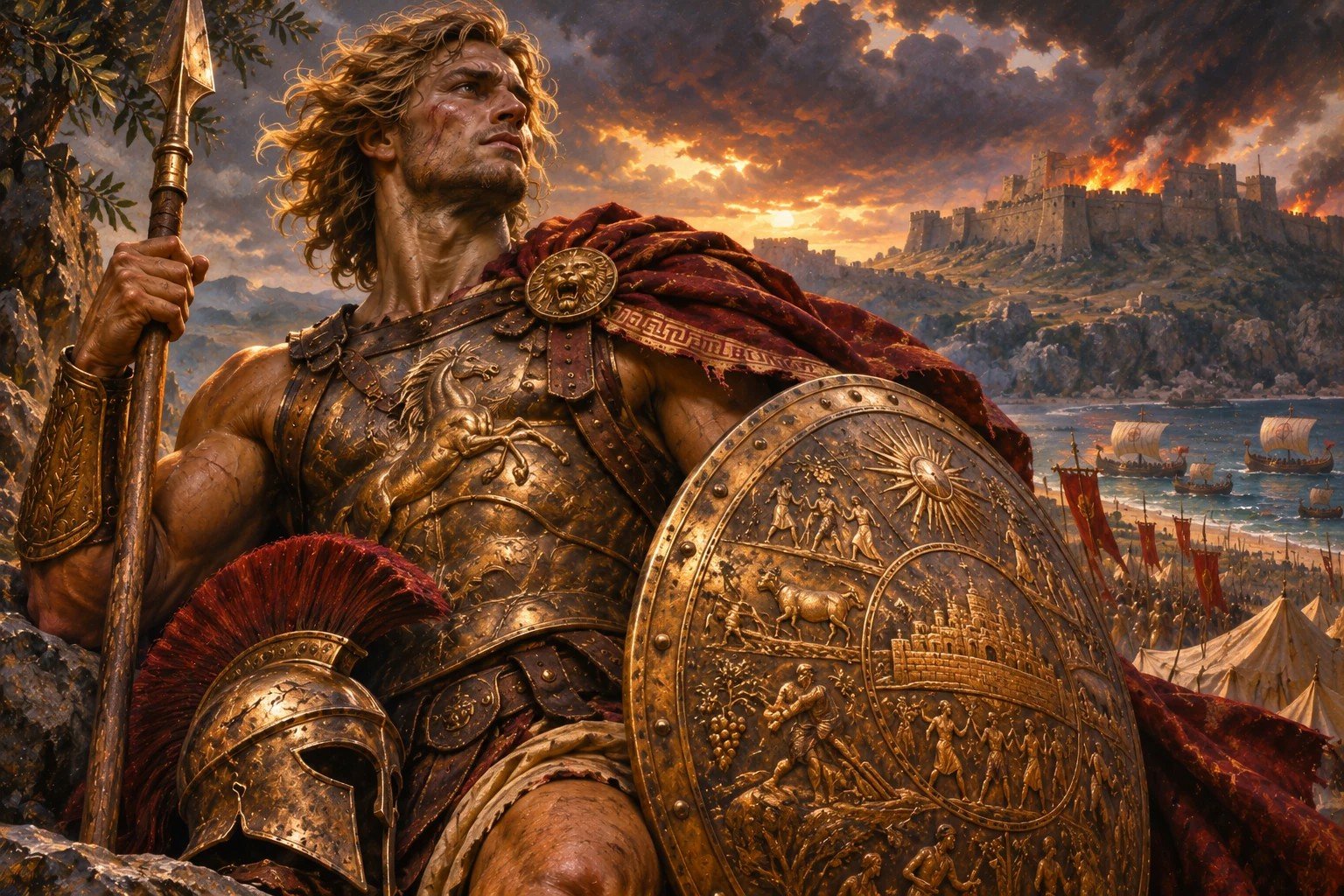
Achilles is broad-shouldered, golden-haired and lighter on his feet than his heavy panoply would suggest. His gaze is startlingly steady until an insult strikes home. He wears bronze greaves, a burnished cuirass, a scarlet cloak and a crested helmet that he removes to address an ordinary soldier. His shield carries scenes of cities, harvests, stars, feasts, cattle and war: a whole human world depicted on the weapon he brings to destroy part of it.
He speaks without the elaborate courtesy of court. He asks about a man’s courage and keeps his own promises once they have been freely given. His anger can freeze the space around a campfire; his rare laughter makes him seem for an instant like the young prince sent to learn from Chiron on Mount Pelion.
Purpose, Loyalties and Contradictions
He will risk himself for his companions and hear a protected herald from the enemy camp. His grief is eroding that discipline; the men who love him can condemn a cruel order without ceasing to love him.
Wants: to honour Patroclus, humble Hector, protect the Myrmidons and prove that a king cannot command genuine honour. Fears: meaningless death, failing his own people, losing a companion through pride and being remembered only as an instrument of slaughter. Methods: sudden decisive action, public challenges, personal gifts, harsh refusals and the spear when speech has failed.
Achilles is not merely a berserker. He understands hospitality, music, kinship, friendship and the shared misery of warfare. He can be extraordinarily tender with the bereaved and merciless toward an enemy he has reduced to a symbol. His deepest conflict is whether grief justifies denying other families the burial and dignity he demands for Patroclus.
Portraying Achilles
Answer questions directly, with long silences when someone speaks dishonestly. Achilles will make a captain repeat an insult before witnesses. He listens more closely to a veteran carrying wounded men than to a herald citing a distant king. Do not have him continually boast; let the strength of his choices make the point. When the party resists his order, he asks what they are prepared to lose for their convictions.
He does not need to announce that he is heroic. Characters earn his respect by keeping faith under pressure, helping the helpless without expecting songs, or presenting evidence he cannot simply dismiss.
Relationships and Tensions
- Patroclus: the companion whose kindness, courage and death define Achilles’ private grief. Achilles keeps his place in the camp unoccupied.
- Thetis: a mother whose warnings are both gifts and burdens. Achilles loves her but will not surrender the freedom to choose a dangerous fate.
- Agamemnon: commander of the Achaeans, still lord of the coalition but never of Achilles’ conscience. Their reconciliation does not erase the insult.
- Hector: Troy‘s foremost defender and the object of Achilles’ pursuit. The two can respect each other’s courage and still mean to kill one another.
- Briseis: a captive whose own grief and wishes have repeatedly been disregarded by rulers claiming honour. Do not treat her as a reward to be reassigned.
- Phoenix and Odysseus: counsellors who can sometimes remind Achilles of what his power costs others.
- Xanthus and Balius: the wind-swift horses yoked to his chariot; a bond to Thetis’s divine kindred and to the price of war.
Meeting Achilles
The characters arrive to find a wounded Myrmidon refusing to let go of a bloodied spear. Achilles sits beside him, listening as carefully as a physician, although he has not slept. When the soldier falls quiet, Achilles turns to the adventurers: “You came by the southern ford. Who holds it now?” Their answer may save a village—or send the world’s most dangerous champion toward it.
Achilles serves best as a powerful ally who creates difficult choices rather than an adventuring companion who solves every battle. He can break a siege line or hold an impossible breach. He cannot judge the truth of every rumour, be in two places at once or win back trust that he has chosen to throw away.
Use at the Table
Achilles begins a confrontation by asking a direct question and believing he knows when the answer is false. His swift movement means a delaying action must involve terrain, hostages, false information, shared obligations or a cost he cannot ignore. He is a dangerous combatant, but he is not omniscient, cannot be everywhere and will not abandon every personal commitment merely because an adventurer asks him to.
Five Encounters
- The shield‘s reflection. A smith’s boy sees scenes from his own village etched on Achilles’ shield and begs the warrior not to march. Achilles demands proof that the village lies along the route he plans to take.
- A commander without a king. Myrmidon veterans will follow Achilles but refuse Agamemnon‘s officers. The party must escort wounded men through a gap between camps while the two leaders quarrel over precedence.
- The lying herald. A messenger brings evidence about Hector‘s position. The parchment is genuine, but its bearer has been bribed to make Achilles pass a camp full of civilians.
- The captured charioteer. A young Trojan who knows the route to Hector’s encampment offers to talk only if his family is guaranteed protection. Achilles’s lieutenants argue over whether honour binds an oath to an enemy.
- Thirteen unburied men. The battlefield dead are still awaiting rites when Achilles orders a dawn pursuit. A companion can persuade him to pause, but each hour allows the enemy to fortify the ford.
Six Adventure Hooks
- The lost ash spear. The shaft of the Pelian spear is stolen from Achilles’s tent. The thief is not a Trojan spy but a frightened servant seeking to prevent a massacre.
- Two oaths to the same dead. A Myrmidon and a Trojan each claim the same fallen warrior as kin. Achilles orders the party to determine who may carry the body home.
- Briseis speaks. Briseis brings the party a list of prisoners whose names have been erased from both camps. Their relatives are still searching for them.
- Thetis‘s tide. A sea-borne message from Thetis warns of a crossing that will soon vanish beneath unnatural water. The party must decide whether to warn Achilles or save a nearby fishing village first.
- Hector‘s honour. A Trojan envoy offers safe release of Achaean captives in exchange for a pledge Achilles refuses to grant. The characters may broker an agreement neither champion dares propose openly.
- One night’s command. Achilles will let the adventurers lead one Myrmidon detachment to rescue injured scouts. The detachment is experienced and proud; its veterans insist on protecting noncombatants even when that costs them the raid.
Arms, Horses and Rewards
The Armor of Achilles includes an arrow-turning helm. The Shield of Peleus sets cities, fields, weddings and the stars beside the violence of battle. Chiron fashioned the Pelian ash spear for Peleus, who passed it to his son with the Sword of Peleus. Poseidon’s wedding gift, the Golden Chariot, carries the wind-born horses Xanthus and Balius, children of Zephyrus and Celaeno; Hera has given the team the gift of speech. These companions choose and speak as individuals. They are not expendable equipment.
The earlier arms worn by Patroclus are in Hector’s possession. Their loss matters to Achilles beyond their price: he entrusted them to the person whose judgement he trusted most.
The Pelian ash spear comes from the slopes of Mount Pelion; Achilles’ bronze panoply and shield are gifts of divine craft, not common military property. The shield shows human work as well as destruction. The horses Xanthus and Balius are not ordinary war animals to be traded or loaned casually. Achilles grants worthy allies armourers, experienced Myrmidon guides, rights of safe passage, fine weapons and a share of plunder lawfully won. He does not surrender his famous equipment as a routine adventure reward.

Sources and Licensing
Homer’s Iliad anchors the quarrel with Agamemnon, grief for Patroclus, the armour forged by Hephaestus and the confrontation with Hector. Later traditions add details of Achilles’ childhood, vulnerability and fate. The Iliad does not give the later Stygian heel story. The declared heel shot in the profiles adapts that later tradition; it is not a rule from Homer. The encounter profiles and conversions here are original. Their ratings are design estimates awaiting table playtest. The 3.5e profile preserves the 34 class levels and CR 38 of the earlier epic treatment; the Pathfinder CR and XP above 30 are expressly unofficial extrapolations. The defined Divine Blood trait grants its listed benefits, rather than importing unlisted outsider Hit Dice or a generic deity template. Earlier treatments acknowledged in the source credits include Aaron Rosenberg’s Trojan War: Roleplaying in the Age of Homeric Adventure (Mythic Vistas, Green Ronin) and an independent EN World adaptation; no third-party stat block has been reproduced.
Further reading: EN World, Mythological Figures: Achilles (5E) (a separate interpretation previously linked from this entry); Barbara Carè on the tradition of Achilles’ vulnerable ankle and heel.
The new painted portrait is original digital artwork. The credited Bénouville illustration is preserved above. Earlier Midjourney portrait studies remain available: study 1, study 2, study 3.


Primary narrative: Homer’s Iliad, Books 16–19 and 22–24, including the armour, shield, horses, Patroclus, Hector and Priam. Perseus text, Book 18. The spear’s inheritance and the later heel tradition are distinguished from the new divine panoply.
Rules references: Wizards of the Coast’s SRD 5.2.1 and SRD 5.1, under CC BY 4.0; Pathfinder’s barbarian, fighter, advanced feats and beyond-20 guidance; the D&D 3.5e epic rules and epic feats. The earlier source credits to Aaron Rosenberg, Trojan War: Roleplaying in the Age of Homeric Adventure (Green Ronin), and Paolo’s Dicefreaks treatment are retained as provenance. Epic Level Handbook, “Adding a Second Class,” informs epic fighter bonus-feat selection; Complete Warrior, p. 112, is the source of Shock Trooper. No earlier third-party stat block is reproduced verbatim.
The four profiles, horse interpretations, bounded item activations and encounter ratings are original conversions. Stygian Skin, Divine Blood, Quickfoot and the named equipment retain their distinctive inherited functions. The 2024 legendary-action uses and the 2014 action costs are kept separate. The Pelian Spear’s +8 enhancement is preserved in its artifact profiles, with hand use and critical rules stated. Generic spell and feat names are references to their native rules, not claims that this NPC is an official published character.
Related Entries
Keep this reference growing
If this page helped with your reading or game, you can support its upkeep or explore the curated books.
Explore the Bookshop — epics, classics and stories behind imagined worlds.