
Breastplate
A breastplate is a shaped metal defence for the torso, protecting the vital chest without enclosing the whole body in plate. Fitted straps, the clothing underneath and the rest of the armour determine how well it moves with its wearer. In the games, the name conceals an important rules difference: D&D 2024 and 2014 set an AC calculation, while Pathfinder 1e and D&D 3.5e add different armour bonuses.
Breastplate at a Glance
- Coverage: a shaped steel chest defence; a backplate, straps and associated components may form part of the harness depending on its construction.
- Who wears it: well-equipped soldiers, guards, mercenaries and mounted retainers who can afford fitted metal protection.
- Advantage: protects the vital torso while leaving the limbs freer than a complete plate harness.
- Costs: fitting, maintenance and keeping the armour securely fastened, as well as the edition’s own price and weight.
- In the rules: a medium-armour AC calculation in D&D 2024/2014, but a +6 or +5 additive armour bonus in Pathfinder 1e/3.5e.
Four-edition rules · In play · Original Pathfinder reference
Breastplate Rules by Edition
The same armour name is used by four game systems. Select yours before using its armour bonus, AC calculation, price, movement or casting restrictions.
Breastplate — D&D 2024
Category: Medium Armor.
| Armor | Armor Class (AC) | Strength | Stealth | Weight | Cost |
|---|---|---|---|---|---|
| Breastplate | 14 + Dex modifier (max 2) | — | — | 20 lb. | 400 GP |
Edition-specific rules:
- Training: Medium Armour Training; without it, Disadvantage on D20 Tests involving Strength or Dexterity and no spellcasting.
- Don / Doff: 5 minutes to don and 1 minute to doff.
- Shield: An ordinary Shield supplies a separate +2 AC benefit only with Shield Training.
At the table: A Dexterity modifier of +2 produces AC 16 before a separate trained shield. A sneaking character does not gain automatic Stealth Disadvantage from the breastplate alone.
Rules: D&D 2024 equipment.
Breastplate — D&D 2014
Category: Medium armor.
| Armor Name | Cost | Armor Class (AC) | Strength | Stealth | Weight |
|---|---|---|---|---|---|
| Breastplate | 400 gp | 14 + Dex modifier (max 2) | — | — | 20 lb. |
Edition-specific rules:
- Proficiency: Medium Armour proficiency. Without it, Disadvantage on Strength/Dexterity ability checks, saves and attacks, and no spellcasting.
- Don / Doff: 5 minutes to don; 1 minute to doff.
- Shield: An ordinary wielded Shield adds +2 AC, with the usual proficiency penalties if not proficient.
At the table: This breastplate is a useful medium-armour choice for a character who wants better AC without the built-in Stealth penalty of scale mail or half plate.
Rules: D&D 2014 equipment.
Breastplate — Pathfinder 1e
Category: Medium armor.
| Armor | Cost | Armor/Shield Bonus | Maximum Dex Bonus | Armor Check Penalty | Arcane Spell Failure Chance | Speed (30 ft.) | Speed (20 ft.) | Weight |
|---|---|---|---|---|---|---|---|---|
| Breastplate | 200 gp | +6 | +3 | −4 | 25% | 20 ft. | 15 ft. | 30 lb. |
Edition-specific rules:
- Donning: Use Pathfinder’s medium-armour donning and hasty-donning rules.
At the table: A stealth-focused character still faces the Pathfinder armour-check penalty on applicable skills, even though fifth edition gives this armour no inherent Stealth Disadvantage.
Rules: Pathfinder 1e equipment.
Breastplate — D&D 3.5e
Category: Medium armor.
| Armor | Cost | Armor/Shield Bonus | Maximum Dex Bonus | Armor Check Penalty | Arcane Spell Failure Chance | Speed (30 ft.) | Speed (20 ft.) | Weight |
|---|---|---|---|---|---|---|---|---|
| Breastplate | 200 gp | +5 | +3 | −4 | 25% | 20 ft. | 15 ft. | 30 lb. |
Edition-specific rules:
- Donning: Use the D&D 3.5e medium-armour dressing, hasty-donning and removal rules.
At the table: The old 3.5e suit is still strong medium armour, but one point of armour bonus lower than the Pathfinder 1e breastplate.
Rules: D&D 3.5e equipment.
Wearing a Breastplate in Play
The approach to a watchtower. A sentry patrol comes into view as the party crosses an exposed ridge. A breastplate protects the fighter’s body if the alarm is raised, but the group also has a chance to get close quietly. In D&D 2014 or 2024, a breastplate has no automatic Stealth Disadvantage; the player’s proficiency, terrain and actions determine the check. In Pathfinder 1e or D&D 3.5e, consult the armour-check penalty on the appropriate skills. Do not apply both systems’ penalties at once.
After a hard blow: a deep dent, broken strap or loosened fitting matters at the level of the story before it becomes a rules penalty. An armourer can rework buckles and rivets, but a poorly fitted captured cuirass may chafe or shift when its wearer runs, climbs or mounts a horse. Use the edition’s repair and equipment-size provisions instead of inventing penalties as automatic rules.
Construction and Historical Context
Breastplates changed enormously in shape across the late medieval and early modern periods. Many were forged to sit above the waist and turn blows away from the centre of the chest; others formed part of a cuirass with a matching backplate, or were integrated into more extensive harnesses. A single surviving breastplate is not the same as every game’s entire equipment package.
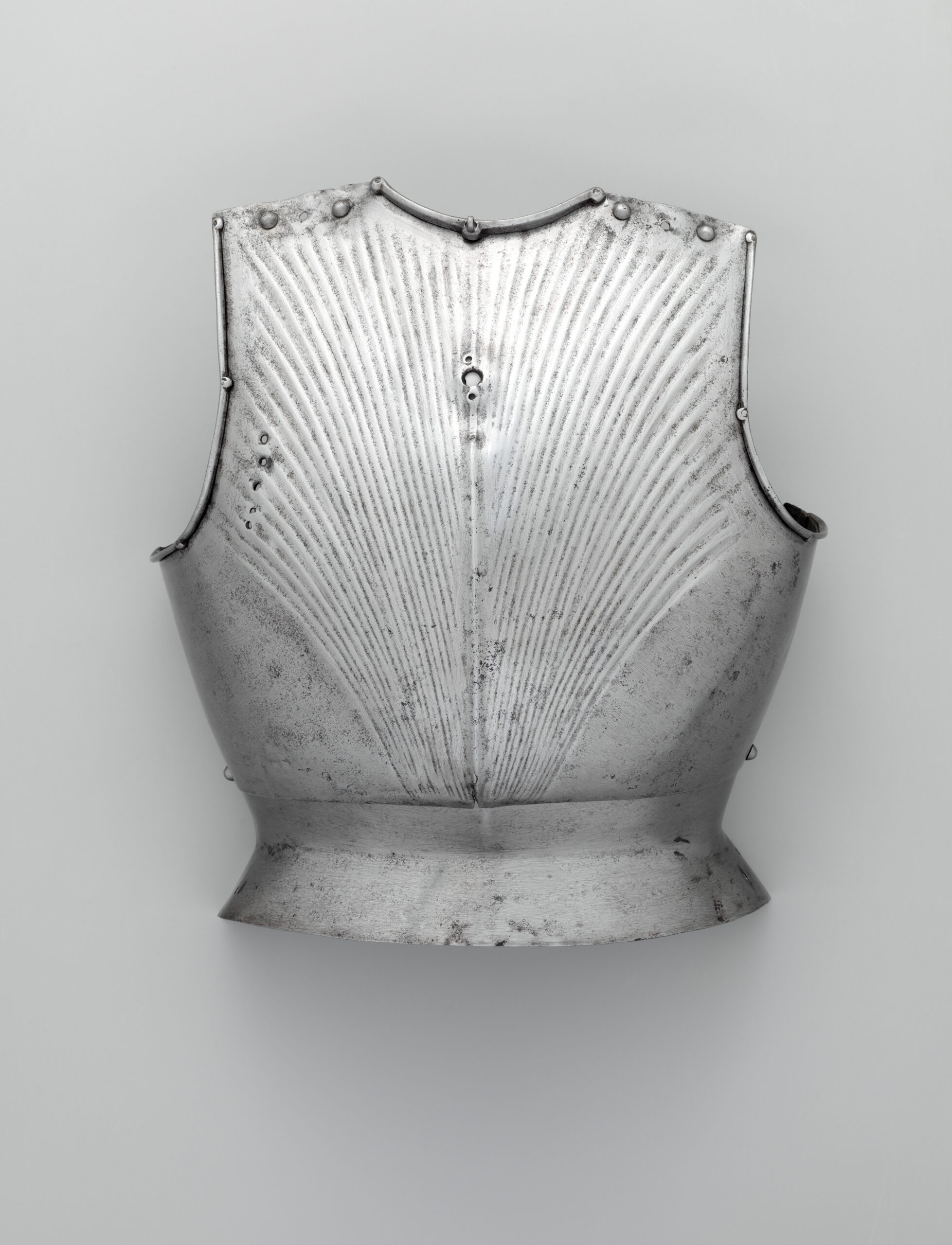
The German breastplate shown above dates to around 1450, during the growth of highly specialised armour-making workshops. It illustrates how shaped steel could cover the torso without needing to represent a complete, fully articulated suit. Compare the additional limb coverage of Half Plate and Full Plate.
Later historical illustration — Géricault’s mounted carabinier
Jean-Louis-André-Théodore Géricault portrayed a mounted French carabinier around 1814. This is a much later use of metal torso armour, kept as a secondary comparison rather than as an illustration of typical medieval breastplates.

Original Pathfinder 1e Reference
The original catalogue entry listed the Pathfinder medium breastplate at 200 gp, a +6 armour bonus, maximum Dexterity +3, armour-check penalty –4, 25% arcane spell failure, 20/15-foot reduced speeds, and a 30 lb. weight. That is a Pathfinder table, not the official D&D 2014 or 2024 table.
Show preserved Pathfinder 1e breastplate statistics
| Armour | Cost | Armour bonus | Max Dex | Check penalty | Arcane failure | Speed (30 ft. base) | Speed (20 ft. base) | Weight |
|---|---|---|---|---|---|---|---|---|
| Breastplate (medium) | 200 gp | +6 | +3 | –4 | 25% | 20 ft. | 15 ft. | 30 lb. |
Original text: covering the torso, a breastplate is formed from shaped metal. The original Pathfinder/Core Rulebook numerical entry is reproduced here for archival reference, but each edition panel above is authoritative for its own game.
Related Equipment and Sources
Armour & Shields directory · Half Plate · Full Plate · Chainmail. Original rules: D&D 2024, D&D 2014, Pathfinder 1e and D&D 3.5e.
Rules Credits
Legacy Pathfinder reference: Pathfinder Roleplaying Game Core Rulebook, Copyright 2009, Paizo Publishing, LLC; author Jason Bulmahn, based on material by Jonathan Tweet, Monte Cook and Skip Williams. Related credits: System Reference Document, Copyright 2000, Wizards of the Coast, Inc., and Open Game License v1.0a, Copyright 2000, Wizards of the Coast, Inc. See the OGL text. D&D fifth-edition SRD material is credited to Wizards of the Coast LLC under CC BY 4.0. These notices should not be mistaken for independent legal certification of the entire license chain.
Keep this reference growing
If this page helped with your reading or game, you can support its upkeep or explore the curated books.
Explore the Bookshop — epics, classics and stories behind imagined worlds.