
James II of Scotland — King Against the Black Douglases
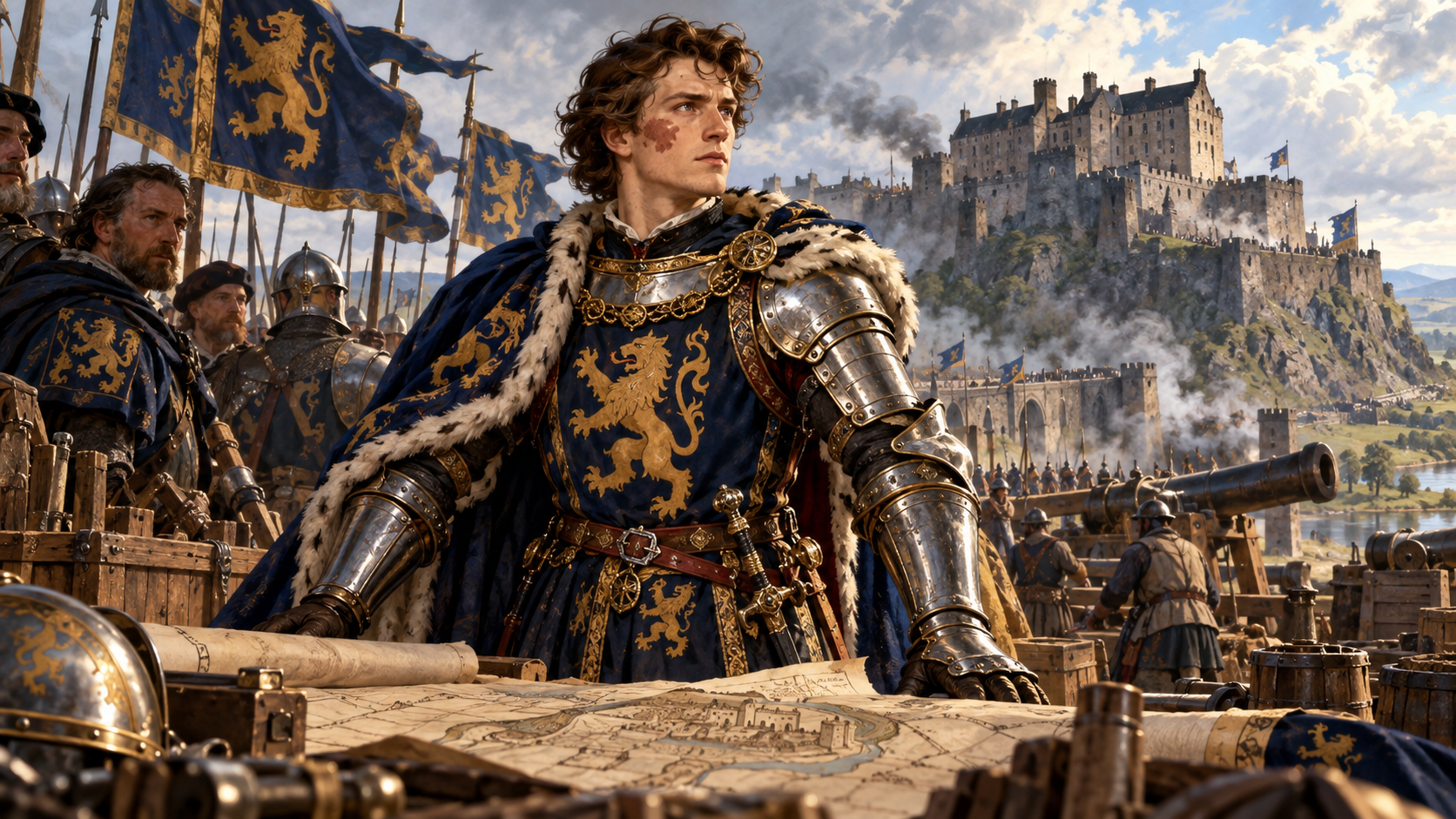
A young king determined to make royal authority mean something in every part of his realm, James II is already locked in a dangerous struggle with magnates powerful enough to behave like princes.
James does not merely inherit the Scottish Crown; he is actively trying to make it stronger. For adventurers, that means royal service can involve far more than guarding a palace. The king may need scouts, messengers, discreet investigators, siege specialists or outsiders who do not belong to a magnate’s affinity.
At a Glance
- Name: James II
- Title: King of Scots
- Species: Human
- Age: 23–24
- Household: Husband of Mary of Guelders; supported by royal officers, household knights and a growing artillery establishment
- Role: King, military commander, central figure in the Crown–Douglas struggle
- Base: The royal court, with Stirling and Edinburgh among the key centres of power
- Campaign use: Royal patron, battlefield sovereign, source of warrants, dangerous ally, target of plots and magnate resistance
- Reputation: To supporters, the king finally making royal commands bite; to opponents, a young sovereign willing to break magnate power by force
- Immediate pressure: The Black Douglases remain powerful, western allegiance is uncertain, and every royal summons tests who will actually obey
- Key connections: British Isles NPCs, Scotland, Stirling, Edinburgh
Game Statistics
James II, King of Scots
Medium Humanoid (Human)
AC 18; Initiative +2 (12)
HP 119
Speed 30 ft.
Skills Animal Handling +5, Athletics +7, History +5, Intimidation +6, Persuasion +6
Senses Passive Perception 12
Languages Scots, French, court Latin
CR 6 (XP 2,300; PB +3)
Gear plate armour, longsword, shield, destrier, royal seals and written warrants
Traits
Royal Resolve. James has Advantage on saving throws against being Frightened while at least one loyal retainer can see him.
Break the Magnate. Once per turn, when James hits a creature that has one of James’s allies within 5 feet of it, the target takes an extra 7 (2d6) damage.
Actions
Multiattack. James makes two Longsword attacks.
Longsword. Melee Attack Roll: +7, reach 5 ft. Hit: 9 (1d10 + 4) Slashing damage.
Royal Command. One allied creature within 30 feet that can hear James may use its Reaction to move up to its Speed or make one weapon attack.
Reactions
Close the Gate. When a creature James can see moves away from one of his allies, that ally may make an Opportunity Attack without using its Reaction.
James II, King of Scots CR 7
XP 3,200
Male human aristocrat 2/fighter 6
Init +2; Senses Perception +10
Defense
AC 21, touch 12, flat-footed 19
hp 92
Fort +10, Ref +6, Will +8
Offense
Speed 20 ft. in plate
Melee masterwork longsword +14/+9 (1d8+7/19–20)
Statistics
Str 18, Dex 14, Con 16, Int 13, Wis 14, Cha 16
Base Atk +7; CMB +11; CMD 23
Feats Leadership, Power Attack, Iron Will, Weapon Focus (longsword), Weapon Specialization (longsword), Toughness, Mounted Combat
Skills Diplomacy +13, Intimidate +14, Knowledge (nobility) +12, Perception +10, Ride +12, Sense Motive +10
James II, King of Scots
Medium Humanoid (Human)
| Hit Dice | 8 class levels (76 hp) |
|---|---|
| Initiative | +2 |
| Speed | 20 ft. in plate |
| Armor Class | 21, touch 12, flat-footed 19 |
| Base Attack/Grapple | +7/+11 |
| Attack | Masterwork longsword +13 melee (1d8+6/19–20) |
| Full Attack | Masterwork longsword +13/+8 melee (1d8+6/19–20) |
| Saves | Fort +9, Ref +5, Will +7 |
| Abilities | Str 18, Dex 14, Con 16, Int 13, Wis 14, Cha 16 |
| Skills | Diplomacy +13, Intimidate +14, Knowledge (nobility and royalty) +12, Ride +12, Sense Motive +10 |
| Feats | Leadership, Power Attack, Iron Will, Weapon Focus (longsword), Weapon Specialization (longsword), Toughness, Mounted Combat |
| Challenge Rating | 7 |
What Is James II of Scotland Doing Now?
James is pressing the Crown’s contest with the Black Douglases while trying to keep other powerful regional lords from turning that conflict into a wider coalition against him. Every castle, marriage bond, private alliance and armed retinue matters. He wants obedience, but he also needs proof: which lords will answer a royal summons, which are quietly supplying Douglas, and which intend to wait until one side weakens.
Encounters
- The Royal Summons: A magnate claims he never received the king’s order to attend court. James wants the original messenger found before the excuse becomes a precedent.
- Stirling’s Memory: Someone is circulating a detailed account of the killing of William Douglas at Stirling. The king wants to know who is paying for copies.
- The Artillery Road: Heavy royal guns must reach a threatened castle before a rival force can block the route.
- The Hostage at Court: A young heir sent as surety disappears from the royal household. If James moves openly, the family may claim the Crown broke faith first.
- The Western Seal: A sealed letter attributed to John of Islay promises support to Douglas. James wants proof that the seal is genuine before he acts on it.
Using James at the Table
James should feel like a young sovereign who has already learned that a royal command matters only when somebody can enforce it. He is most useful when the party is caught between lawful royal authority and magnates who possess enough men, castles and kinship ties to resist it.
- Private audience: James is direct, impatient with evasions and interested in what can be proved rather than what everybody suspects.
- Council scene: he tests who will commit themselves in public and remembers who tries to hide behind procedure.
- Field or siege command: he stays close enough to the action to see whether officers obey, uses Royal Command aggressively and treats delay as a political problem as much as a military one.
Personality
James is forceful, impatient with divided sovereignty and sensitive to challenges to royal authority. He rewards useful service quickly, but a party working for him should understand that he expects orders to be obeyed once a decision is made. He can listen, bargain and wait when necessary, but once he concludes that a rival is using negotiation merely to gain time his patience ends abruptly.
Appearance and Manner
James is a young king with a vigorous military bearing and a distinctive red facial mark that makes him immediately recognisable at court. In council he dresses richly but practically, surrounded by officers, clerks and armed household men. In the field he favours excellent armour, a strong horse and the visible machinery of kingship: standards, seals, heralds and written orders. His manner is energetic rather than ceremonial; he asks who holds a castle, how many men can be raised and how quickly a command can reach them.
Ambition, Pressure and Private Truth
James wants a Scotland in which no magnate can treat royal government as optional. His immediate problem is that destroying one over-mighty affinity can frighten every other great lord into imagining that he intends to destroy them next. Privately, he knows that force alone cannot solve this: the Crown needs reliable sheriffs, messengers, treasurers, garrisons and allies, or every victory simply creates another region that must be coerced again.
Relationships
James, 9th Earl of Douglas: Head of the Black Douglas power whose survival threatens the king’s project of stronger royal rule.
John of Islay: Lord of the Isles and Earl of Ross, too powerful in the west to ignore and too independent to assume loyal.
Mary of Guelders: James’s queen and an important dynastic partner with her own household, foreign connections and political value.
Royal officers: Sheriffs, keepers, household knights, clerks and messengers whose effectiveness determines whether the Crown’s authority exists beyond court.
Equipment and Resources
Excellent plate armour, a longsword, shield, destrier, royal banners, seals and warrants, household guards, siege engineers and growing access to gunpowder artillery. James’s greatest resource is the Crown’s ability to turn a private quarrel into a royal summons backed by law, castles, money and force. A sealed packet of contradictory magnate promises gives him leverage over several lords, but becomes dangerous if copied.
Adventure Hooks
- The Safe-Conduct: A Douglas envoy enters royal territory under written protection. Someone intends to kill him and blame the Crown.
- The Unquiet Castle: A royal garrison commander is secretly negotiating with Douglas. James needs proof before acting.
- The Western Answer: A messenger from the Lord of the Isles arrives with deliberately ambiguous terms. The party must escort him through territory where both Crown and Douglas agents want the message.
- The Forged Seal: Men are requisitioning horses and grain with a royal warrant that appears genuine. James wants the document recovered before obedience to his real orders collapses.
- The Douglas Bond: A written alliance among several magnates may prove a conspiracy—or may have been planted to provoke the king into acting too soon.
- The Missing Gunner: A specialist attached to the royal artillery disappears on the eve of a siege, taking measurements and powder accounts with him.
Connected Places and People
- British Isles NPCs
- Scotland
- Stirling
- Edinburgh
- Scottish Borders
- Lordship of the Isles
- James, 9th Earl of Douglas
- John of Islay
Historical Context
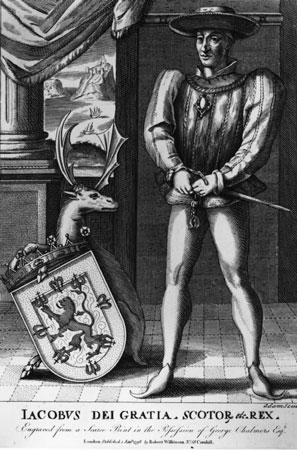
James II inherited the throne as a child and reached personal rule in a kingdom where the greatest magnate affinities could rival royal power. The killing of William, 8th Earl of Douglas at Stirling turned the Crown–Douglas struggle into an open political wound. Historic Environment Scotland traces that conflict and its eventual destruction of Black Douglas power. See James II and the Black Douglases.
Sources and Adaptation
The royal office, marriage to Mary of Guelders, conflict with the Black Douglases, association with Stirling and interest in artillery are grounded in the historical record. The exact private conversations, sealed documents, encounter situations and adventure hooks are campaign adaptations created for play. The page treats the Crown–Douglas conflict as unresolved in the campaign present rather than writing backward from its later outcome.
Rules and Image Licensing
The 5.5e / 2024 monster-format NPC block and the Pathfinder 1e and D&D 3.5e builds are original game adaptations using the open rules conventions of their respective systems. The painted campaign hero is original site artwork. The separate historical portrait is retained lower on the page as documentary reference imagery.
Keep this reference growing
If this page helped with your reading or game, you can support its upkeep or explore the curated books.
Explore the Bookshop — epics, classics and stories behind imagined worlds.