
A House at War with its King — James Douglas, the great magnate whose loyalty cannot be bought cheaply.
At a Glance
- Name: James Douglas
- Title: 9th Earl of Douglas
- Species: Human
- Age in the campaign: Approximately late twenties; the exact birth year is uncertain
- House: Douglas, the senior branch often called the Black Douglases by later historians
- Immediate danger: The Crown is gathering support against his castles, while every ally must decide whether Douglas is worth the risk
- Role: Magnate, border lord, head of the Black Douglas affinity
- Base: Douglas territories and castles across southern Scotland
- Campaign use: Rival patron, rebel magnate, protector of clients, source of armed retainers and disputed authority
- Key connections: British Isles NPCs, Scotland, Stirling, Scottish Borders

The Black Douglas inheritance is not merely land and castles: it is an armed political network strong enough that the Crown cannot safely ignore it and too proud to accept reduction without resistance.
James inherited a feud already stained by his brother William’s death at Stirling in 1452. The killer was James II of Scotland, the very king to whom his household owes allegiance. He enters the campaign with almost no room to retreat without losing face, followers or land. Adventurers meeting him are dealing with a man surrounded by relatives, retainers, messengers and clients who know that the fate of their homes is tied to his decisions.
First Meeting: A Lord Who Wants an Answer
A Douglas chamberlain brings the party into a hall packed with armed men and wet cloaks. James does not ask whether they like him. He asks whether they will escort a threatened household, carry a letter past royal patrols or witness a disputed oath. He will pay well and remember loyalty; he will also remember evasions. The dangerous part is not the journey but whose version of events the party agrees to certify.
Run this first: Give the party a choice between a signed Douglas safe-conduct, a royal passage permit or no patron at all. Each opens one road and closes another. The adventurers can refuse James; they cannot make the feud cease to matter.
Game Statistics
5.5e / 2024
James, 9th Earl of Douglas
Medium Humanoid
Armour Class 18 (plate)
Initiative +2
Hit Points 105
Speed 30 ft.
Proficiency Bonus +3
Saving Throws Str +7, Con +7, Wis +5, Cha +6
Skills Athletics, Insight, Intimidation, Persuasion and Survival (+7, +5, +6, +6, +5 respectively)
Senses passive Perception 12
Languages Scots, French
Challenge 6 (2,300 XP; PB +3)
Gear plate armour, longsword, signet, household seals and a warhorse
| STR | DEX | CON | INT | WIS | CHA |
|---|---|---|---|---|---|
| 18 (+4) | 14 (+2) | 18 (+4) | 13 (+1) | 14 (+2) | 16 (+3) |
Traits
Black Douglas Affinity. Douglas retainers within 30 feet gain a +2 bonus to damage rolls while James is conscious.
Border Lord. James and allied creatures ignore nonmagical difficult terrain caused by hills, heather, mud and broken roads during the first round of combat.
Household morale. His followers rely on the presence of their commander; without a visible standard or trusted lieutenant, they may lose cohesion even if James is still alive.
Actions
Multiattack. James makes two Longsword attacks.
Longsword. Melee Attack Roll: +7, reach 5 ft. Hit: 9 (1d10 + 4) Slashing damage (used in two hands).
Call the Household. One allied retainer within 30 feet may use its reaction to make one weapon attack.
Reaction
Close Ranks. When James is hit by an attack while an ally is within 5 feet, he reduces the damage by 5.
James, 9th Earl of Douglas — 5e / 2014
Medium humanoid (human), lawful neutral
Armor Class 18 (plate); Hit Points 105; Speed 30 ft.; Challenge 6 (2,300 XP; proficiency bonus +3)
STR 18 (+4), DEX 14 (+2), CON 18 (+4), INT 13 (+1), WIS 14 (+2), CHA 16 (+3)
Saving Throws Str +7, Con +7, Wis +5, Cha +6; Skills Athletics +7, Insight +5, Intimidation +6, Persuasion +6, Survival +5; Senses passive Perception 12; Languages Scots, French
Traits
Black Douglas Affinity. Douglas household retainers within 30 feet of James add +2 to weapon damage rolls while he is conscious.
Border Lord. James and allies within 30 feet ignore nonmagical difficult terrain caused by hills, mud, heather and broken roads during the first round of combat.
Actions
Multiattack. James makes two longsword attacks.
Longsword. Melee Weapon Attack: +7 to hit, reach 5 ft., one target. Hit: 9 (1d10 + 4) slashing damage while wielded with both hands.
Call the Household. One allied retainer within 30 feet who can hear James may use its reaction to make one weapon attack.
Reaction
Close Ranks. When James is hit by an attack while an ally is within 5 feet of him, he reduces the damage by 5.
Pathfinder 1e
James, 9th Earl of Douglas CR 7; XP 3,200
Male human aristocrat 2/fighter 6; Medium humanoid (human); LN or N, depending on his treatment of oaths
Init +2; Senses Perception +10
Defense
AC 22, touch 11, flat-footed 21 (masterwork full plate, heavy steel shield, Dex); hp 88 (8 HD; campaign build)
Fort +8, Ref +4, Will +9
Offense
Speed 20 ft.
Melee masterwork longsword +13/+8 (1d8+6/19–20)
Ranged light crossbow +9 (1d8/19–20)
Special tactics Power Attack, Cleave, mounted charge, household shieldwall; see the Fighter class and longsword references
Statistics
Str 18, Dex 14, Con 16, Int 13, Wis 14, Cha 16
Base Atk +7; CMB +11; CMD 23
Feats Leadership, Power Attack, Iron Will, Weapon Focus (longsword), Weapon Specialization (longsword), Toughness, Mounted Combat, Cleave, Combat Reflexes
Skills Diplomacy +13, Intimidate +14, Knowledge (local) +11, Knowledge (nobility) +12, Perception +10, Ride +12, Sense Motive +10
Languages Scots, French
Combat Gear masterwork full plate, heavy steel shield, masterwork longsword, light crossbow, bolts; Other Gear signet, sealed writs, warhorse and household retainers
In play: The Leadership feat represents his network of sworn followers rather than a license to spawn unbounded combatants. Determine household troops before the encounter.
D&D 3.5e
James, 9th Earl of Douglas
Male human aristocrat 2/fighter 6
Medium Humanoid (Human); CR 7
Hit Dice 2d8+6d10+27 (72 hp, campaign build, including Toughness); Initiative +2; Speed 20 ft. in full plate
Defenses
Armor Class 21, touch 11, flat-footed 20 (masterwork full plate, heavy steel shield, Dex)
Fort +8, Ref +4, Will +9
Attacks
Base Attack/Grapple +7/+11
Attack masterwork longsword +13 melee (1d8+6/19–20)
Full Attack masterwork longsword +13/+8 melee (1d8+6/19–20)
Ranged light crossbow +9 (1d8/19–20); Space/Reach 5 ft./5 ft.
Abilities and Resources
Abilities Str 18, Dex 14, Con 16, Int 13, Wis 14, Cha 16
Feats Leadership, Power Attack, Iron Will, Weapon Focus (longsword), Weapon Specialization (longsword), Toughness, Mounted Combat, Cleave
Skills Diplomacy +13, Intimidate +14, Knowledge (local) +11, Knowledge (nobility and royalty) +12, Ride +12, Sense Motive +10
Possessions masterwork full plate, heavy steel shield, masterwork longsword, light crossbow, signet ring and written bonds
Tactics: James fights behind trusted knights, prefers a charge on horseback in open ground and never commits his entire household to a quarrel that can be settled with hostages or leverage.
What Is James, 9th Earl of Douglas Doing Now?
James is keeping the Douglas castles supplied, weighing the loyalties of his kin and testing the armed support behind every written promise. His brother William was killed at Stirling in February 1452; reconciliation and renewed conflict have left nobody certain whether royal assurances can be trusted. James’s authority is real, but it must be demonstrated again whenever a sheriff refuses him or an ally hesitates to answer a summons.
His household looks towards the western power of John of Islay and the northern alliances inherited from William. Neither Ross nor Crawford is a piece on James’s gameboard. A demand for men today may buy him a dangerous obligation tomorrow. The surviving evidence does not establish every movement of the earl in 1454; individual missions here are plausible campaign situations, not documented incidents.
Three Decisions Before the Winter Muster
- Which castle receives the grain? Supply Threave in Galloway, reinforce a threatened Borders garrison or keep a reserve near the earl’s travelling household.
- Whose oath is worth believing? Require a public bond from wavering men, accept private support or let a lord depart without humiliation.
- How far to test the king? Petition for redress, defy a royal sheriff or call the household to arms. Each choice costs political capital.
Campaign clock: After each significant mission, advance one pressure: an ally delays his reply; a supply road is closed; a royal warrant seizes a client; a garrison demands pay. A fourth unanswered pressure causes a local commander to act without James’s permission.
Encounters
- The Douglas Safe House: The party finds a wounded courier carrying letters to several magnates. He asks them to finish the route without reading them.
- The Castle Stores: Grain purchased for a Douglas garrison has vanished. Theft, royal seizure and deliberate sabotage are all plausible.
- Blood at Stirling: A man claims to possess eyewitness testimony about William Douglas’s death that could be used to inflame the feud.
- The False Livery: Riders wearing Douglas colours raid a neutral manor. James demands the raiders alive; someone wants every nearby laird to believe the earl can no longer control his men.
- The Oath at the Ford: A lesser knight will support the earl only if Douglas men return his captured kin. A royal captain is bringing the prisoners through the same ford at dawn.
Encounter Escalation
Start with one messenger or disputed seal. Put a named Douglas retainer and a named royal officer in the next scene. By the third scene, let the conflict affect a household the party has already met. Failure should change who trusts the adventurers, not simply trigger another fight.
Personality
James is proud, wary of public humiliation and painfully conscious of what he owes his kin. He understands that an earl’s authority lasts only while lesser men believe his protection means something. An attack on a dependent is therefore an attack on the honour of Douglas. He can be unexpectedly patient in private, but will not thank someone for forcing him to look weak in front of his household.
Appearance and Manner
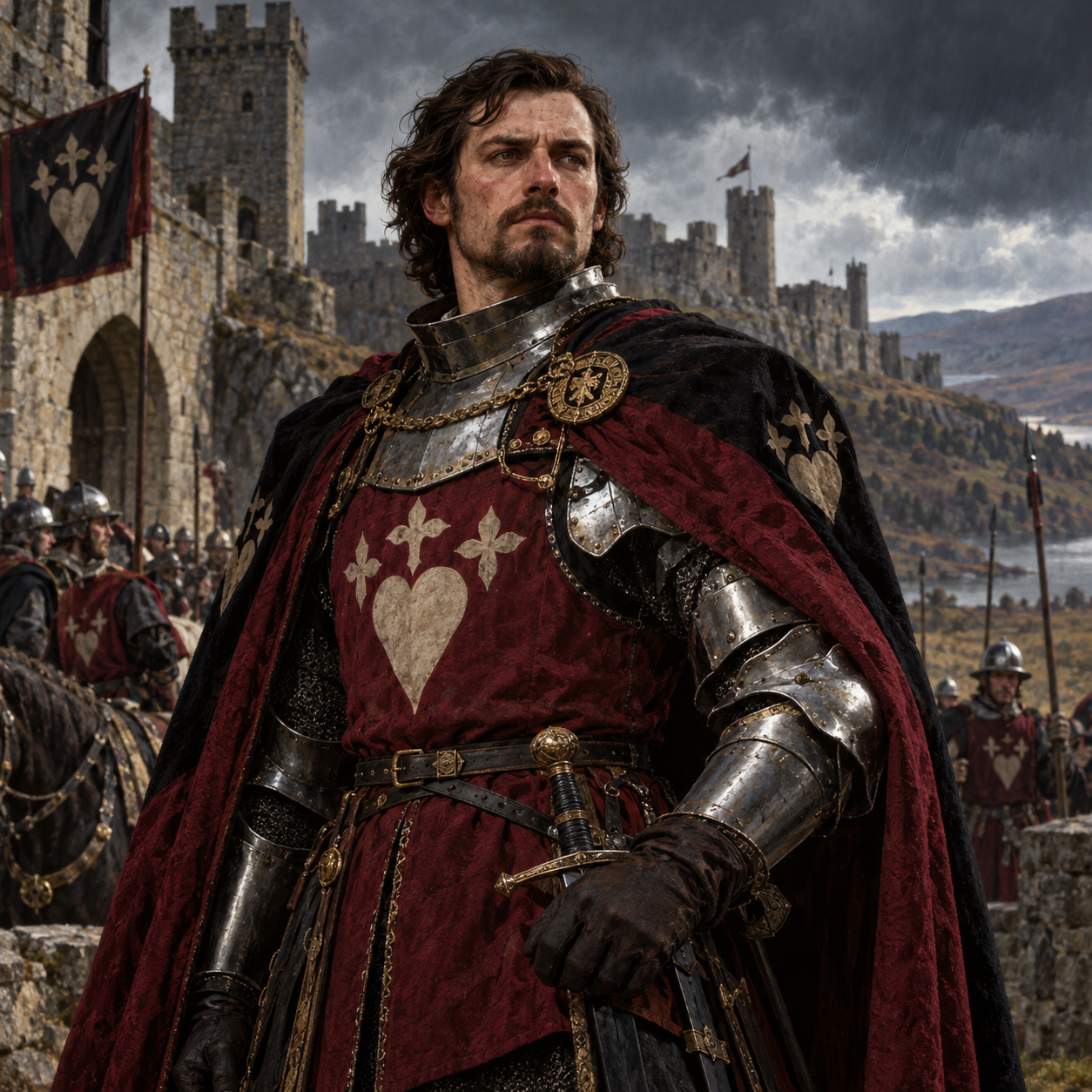
In his late twenties, James cuts the figure of a campaigning magnate: heavy wool and costly fur indoors, armour and a weather-stained riding cloak on the road. His seal, household colours and the men who step aside when he enters a room reveal his rank before he speaks. The exact features of his face are unknown; the painted portrait is an imaginative reconstruction rather than a surviving likeness.
He rarely raises his voice. Instead he lets a silence settle after a question, obliging the other person to fill it. He remembers names, landholdings and family obligations, and asks after an injured retainer before asking about the fight.
Ambition, Pressure and Private Truth
He wants a house powerful enough that the Crown must negotiate rather than dictate. He fears being remembered as the earl who allowed the inheritance to be dismantled. He needs allies who will stand by their oaths when the royal host assembles. His private weakness is confusing the survival of his wider household with the preservation of every privilege claimed in its name.
At the table: Play James as a political rival with genuine duties, not a simple villain. His protection may save villagers from raiders even as his demand for labour, horses and supplies ruins another village. He always offers the party something tangible and asks for loyalty in return.
Battlefield Behaviour
He arrives with retainers, keeps a standard close to him, uses couriers before battle and avoids single combat unless honour or escape requires it. In 5.5e he commands nearby allies first, commits with his longsword only if the line will hold, and withdraws to protect the household seal if outflanked. A bargain, hostage or recovered banner is often a better victory condition than killing him.
Relationships
James II of Scotland: The king whose killing of William made the breach between Crown and Douglas personal. James must either secure a settlement or prove the king cannot cow his house.
William, 8th Earl of Douglas: James’s elder brother, killed at Stirling in 1452; he remains the absent presence at every council.
Archibald Douglas, Earl of Moray: James’s twin and military kinsman. Where James must weigh oaths and estates, Archibald is better placed to speak for men ready to fight.
Hugh Douglas, Earl of Ormonde: Brother and valuable family commander, with lands and followers of his own.
John Douglas, Lord of Balvenie: A younger brother whose northern connections are an asset, but who also has his own household to protect.
John of Islay, Earl of Ross: A powerful western magnate linked to Douglas’s inherited alliance network; his help cannot be presumed.
James Hamilton, Lord Hamilton: An important magnate whose support must be earned, watched and renewed. In 1454 no one can take his later choices for granted.
George Douglas, Earl of Angus: A Douglas cousin aligned more closely with the Stewart monarchy; kinship does not guarantee political allegiance.
Margaret Douglas, Maid of Galloway: A dynastic link to Galloway whose rights and disputed marital position have enormous political significance.
Equipment and Resources
James can draw on excellent armour, swords, crossbows, riding horses, household knights, sworn border retainers, messengers, fortifications, coin, stored grain and the more elusive wealth of bonds and obligations. Threave Castle in Galloway is an especially valuable stronghold; its tower and advanced gun-defence works make it a formidable symbol of the house’s resources. Balvenie links the northern sphere to his family’s power. No castle guarantees a loyal garrison, and no roll of names proves every tenant will actually march.
Objects adventurers can handle: a signet whose impression would persuade a suspicious garrison; a half-paid wage roll; the key to a grain store; a letter promising twenty horsemen; and a heraldic banner which becomes dangerously valuable once somebody claims to have captured it.
Adventure Hooks
- The Empty Muster: A Douglas captain calls out his men and discovers a third have not appeared. Are they frightened, bribed or waiting for royal protection?
- The Captive Sheriff: A royal officer is held by Douglas retainers after entering disputed lands. Both sides want outsiders to negotiate.
- The Bond: The party is offered good money to carry a sealed copy of a private alliance. They are warned that merely possessing it may be treated as treason.
- The Bridge Toll: A Douglas-appointed collector is taking more than his grant allows. James will punish him only if the party can prove corruption without making the entire lordship look lawless.
- Three Brothers: Archibald, Hugh and John have given three different orders to a castle keeper. The adventurers must determine which instructions came from James before a divided garrison tears itself apart.
- The Western Bargain: An agent of the Earl of Ross wants concessions before supplying ships or men. A rival delegation is on the road to the king.
- The Price of Mercy: A royal scout captured near Douglas territory knows the strength of an approaching force. Releasing him may bring down a raid; killing him will stain the earl’s reputation.
Running a Political Victory
The strongest resolutions do not require defeating James in combat. Secure safe passage for refugees, prevent a massacre, keep a bond from being forged, win the release of prisoners or persuade an important client to stay neutral. James may owe the characters a favour and still oppose their larger cause.
Connected Places and People
- British Isles NPCs
- Scotland
- Stirling
- Scottish Borders
- James II of Scotland
- John of Islay
- Edinburgh — Royal Burgh
- Lordship of the Isles
Historical Context
James inherited the ninth earldom after King James II killed his brother William at Stirling on 22 February 1452. The Douglas estates and castle network made the family a power that could bargain with kings. Historic Environment Scotland identifies Balvenie, Bothwell and Threave among the strongholds and explains the inherited alliance between Douglas, the Earl of Ross and the Earl of Crawford. Castles of the Black Douglases.
Some details of James’s personal movements and the dates of reconciliations are contested or unevenly recorded. The designation “Black Douglases” is a later way to distinguish the senior Douglas line from the Angus branch; it need not be what the earl’s own companions call themselves.
Beyond the campaign present: The historical defeat and forfeiture of the senior Douglas line occurred in 1455, including the Battle of Arkinholm and the eventual surrender of Threave. Those are later historical outcomes, not events already completed in this campaign. A game may follow them, avert them or complicate them through its own consequences.
Historical Sources
- Historic Environment Scotland — Castles of the Black Douglases: the conflict, dynasty, castles and artillery improvements at Threave.
- Douglas Heritage Museum — The Douglas Family: the senior and Angus branches and the late-medieval struggles.
- Dictionary of National Biography — James Douglas: an older biographical account; some dates and interpretations differ from later research.
Rules Notes
The three rules presentations are separate original game adaptations: D&D 5.5e/2024 uses a monster-style NPC; Pathfinder 1e and D&D 3.5e use class-based builds. They are not official historical or published character statistics and are not interchangeable across editions. The retainers, private letters, encounters, dialogue, battlefield effects and pressure clock are fictional play material. Historical sources are named above. The heraldic image depicts family symbolism rather than an authenticated likeness of James; any painted character portrait is an imaginative reconstruction.
Keep this reference growing
If this page helped with your reading or game, you can support its upkeep or explore the curated books.
Explore the Bookshop — epics, classics and stories behind imagined worlds.