
Hollow Earth
At a Glance
| Region | The deep interior of Earth |
|---|---|
| Campaign Present | 1454 CE |
| Political Status | No single government. Hollow Earth contains rival kingdoms, city-states, enclaves, wildernesses and ancient territories. |
| Major Known Power | Agartha, alongside numerous independent subterranean powers |
| Known Peoples | Humans, dwarves, gnomes, Derro, Dero, Xulgath, Illithids and many peoples whose surface relatives vanished long ago |
| Environment | Immense caverns, subterranean seas, ancient river valleys, fungal forests, geothermal lands, ruins and prehistoric wilderness |
| Surface Access | Rare polar approaches, deep tunnels, mines, buried ruins, flooded passages and unstable ancient gates |
| Primary Dangers | Predators, hostile states, psychic powers, poisonous ecologies, unstable passages, ancient machines, kaiju territories and getting permanently lost |
Inner World
This is an atlas symbol for the Inner World, not a national flag or coat of arms. No authority rules all of Hollow Earth.
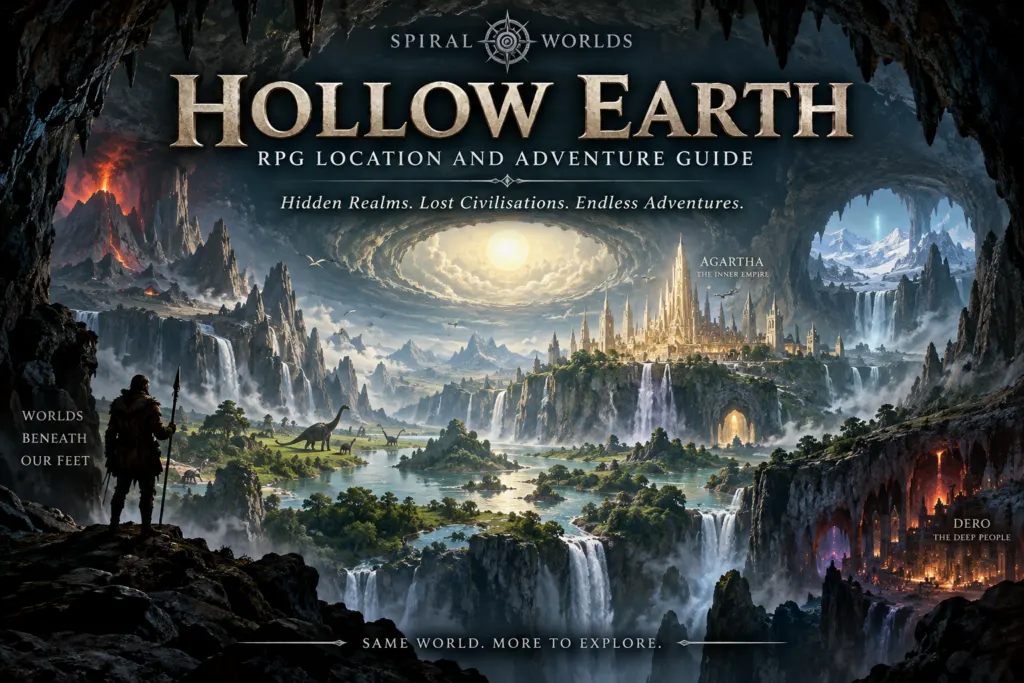
Hollow Earth is not a rumour, philosophical theory or distant plane. It is part of the physical Earth: an enormous system of habitable inner regions reached only after travellers have passed far beyond ordinary caves, mines and natural caverns.
Surface kingdoms know almost nothing reliable about its true scale. A miner may spend a lifetime underground without approaching it. An expedition may descend for weeks through ruined roads, vertical faults and black rivers before emerging beneath a sky that should not exist: a cavern so immense that its ceiling disappears into luminous haze, with mountains, forests and inland seas spreading beyond sight.
Some regions preserve ecosystems lost from the surface millions of years ago. Others contain cities whose political histories are as complicated as those of Europe or Asia. Still others were abandoned long before human civilisation began.
What Is Happening Right Now?
What Hollow Earth Actually Is
The name Hollow Earth is a surface expression for a vast collection of deep environments rather than one simple empty sphere inside the planet. Some regions are immense natural cavities. Others were enlarged, stabilised or transformed by ancient peoples. Great faults, subterranean seas and passages connect parts of the Inner World, while other territories remain isolated for geological ages.
Gravity, heat, water and light do not behave identically everywhere. Most regions obey normal natural laws, although their scale produces conditions unknown at the surface. Other places have been altered by magic, deep-time engineering, alien intervention or surviving machines whose original builders are forgotten.
There is no universal inner sun. Illumination comes from many sources: vast luminous mineral formations, geothermal activity, fungal and biological light, magical radiance, reflected fire, artificial systems and in a few extraordinary chambers phenomena that resemble distant suns or star-filled skies.
The result is not one biome. Hollow Earth contains worlds within the world.
Caves, Deep Earth and the True Inner World
An important distinction is often lost in surface legends: descending underground does not automatically mean entering Hollow Earth.
| Depth of Exploration | Typical Environment | What Adventurers Encounter |
|---|---|---|
| Surface Underground | Cellars, mines, tombs, caves and sewers | Human works, ordinary cave life, local monsters, smugglers and buried ruins |
| Deep Earth | Vast cave systems, forgotten mines, subterranean rivers and abandoned roads | Derro warrens, dwarven works, ancient ruins, underground peoples and dangerous ecosystems |
| Threshold Depths | Ancient engineered passages, enormous faults, drowned roads and sealed gates | Lost infrastructure, gatekeepers, expedition camps and creatures displaced from deeper regions |
| Hollow Earth | Immense habitable basins, inland seas, mountain systems, forests and independent civilisations | Entire states, prehistoric ecosystems and territories with histories largely unknown to the surface |
Great Regions of the Inner World
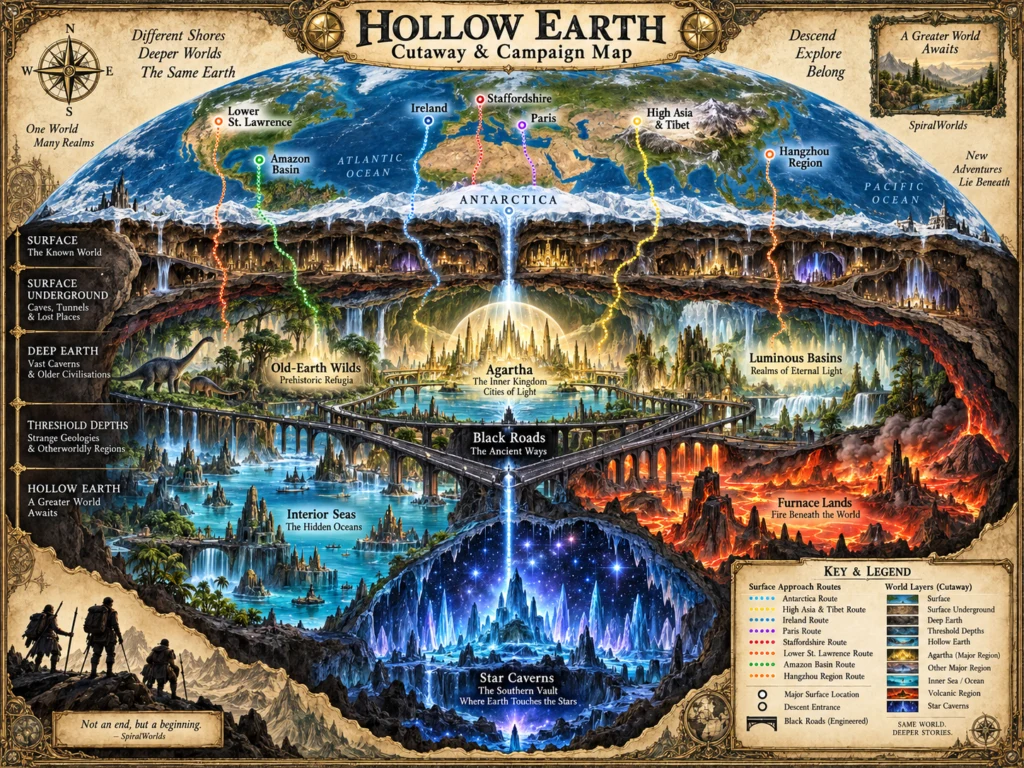
No complete map exists. The following regions describe broad environments repeatedly encountered by explorers and Inner World travellers rather than fixed political provinces.
The Luminous Basins
Vast valleys lit by mineral, biological and magical radiance. Forests can grow here beneath ceilings too distant to see clearly. Rivers descend from cracks in higher strata and vanish again into lower worlds.
The Interior Seas
Great bodies of fresh, saline and chemically strange water divide entire regions. Some are crossed by ships. Others are dominated by aquatic monsters, drowned ruins or peoples who rarely approach dry land.
The Old-Earth Wilds
Ecological refuges preserve lineages long vanished from ordinary surface environments. These are not uniform prehistoric theme parks: different basins preserve different periods, climates and evolutionary histories.
The Black Roads
Artificial causeways and tunnels run for impossible distances through the deep rock. Some remain intact. Others terminate in collapses, sealed gates or cities that no longer recognise the people who built the road.
The Furnace Lands
Geothermal rifts create volcanic valleys, mineral terraces, hot rivers and forge-rich territories. Settlements here exploit ores and heat unavailable in safer regions.
The Star Caverns
Rare chambers appear beneath luminous vaults resembling night skies. The famous southern route sought by the Hell Knights reaches one such region. Whether every apparent star is natural, magical or artificial remains an open question to its inhabitants.
Peoples, Kingdoms and Powers
Hollow Earth has no emperor, parliament, capital or common law. Political authority belongs to individual kingdoms, cities, councils, military enclaves, clans and older territorial powers.
Agartha
A major Inner World civilisation connected to ancient approaches beneath the Himalayan world. Its Crown, Council, Great Library and Iron Citadel form powerful but distinct institutions.
Illithid Elder-Brain Cities
Independent psychic city-complexes whose politics revolve around knowledge, captives, controlled territory and hidden routes. Their existence does not imply one unified Illithid empire.
Enlightened Xulgath Tyrant-Cities
Ancient subterranean urban traditions survive in several isolated centres. Rival tyrants, priesthoods and military elites compete with one another as readily as they fight outsiders.
Derro Hidden Warrens
Derro communities dominate many Deep-Earth approaches and occasionally maintain routes descending toward the Inner World. They are not the Dero.
The Dero
A separate subterranean people associated with ancient machinery and older Inner World traditions. Surface accounts often confuse them with Derro because of the similar name, but they are different peoples with different histories.
Independent Holds and Enclaves
Dwarven holds, isolated human communities, gnomish workshops, caravan settlements, hermit orders and peoples unknown to surface scholars occupy the enormous spaces between the better-known powers.
Agartha
Agartha is one of the best-known Inner World states, but it is neither the capital of Hollow Earth nor proof that the entire Inner World shares one civilisation.
Its strategic position gives it influence over important passages, while the Great Library attracts scholars and seekers of ancient knowledge. The Iron Citadel protects approaches that Agarthan authorities consider too dangerous to leave open. Political disagreements between court, advisors, scholars and military authorities can be as important to visitors as the monsters beyond the walls.
Shambhala, Agharti and Confused Surface Traditions
Surface accounts often merge Agartha, Agharti and Shambhala into a single legendary underground kingdom. SpiralWorlds treats those traditions more carefully.
Agartha is a real Inner World state. Shambhala belongs to the wider body of hidden-realm traditions and is not automatically another name for Agartha. Agharti survives in surface manuscripts as a variant, translation, exonym or confused account whose meaning depends on the source.
This allows contradictory historical traditions to exist without requiring every similar legendary name to describe one place.
Entrances from the Surface
There is no ordinary road marked To Hollow Earth. Entrances are rare, dangerous and frequently misunderstood. Some open into Deep Earth rather than the Inner World itself, while others form only one stage of a much longer descent.
| Surface Region | Nature of the Route | Campaign Use |
|---|---|---|
| Antarctica | Buried systems beneath the southern ice descend through enormous caverns toward the Star Caverns and deeper Inner World routes. | The most strategically important currently contested approach. |
| High Asia and Tibet | Ancient passages beneath the Himalayan world connect eventually with Agarthan territory. | Protected, watched and considerably more complicated than surface legends suggest. |
| Ireland | Some underground passages connect only with caves or Deep Earth; others intersect supernatural roads. | Surface tradition sometimes confuses physical descents with routes into Faerie and the sídhe. |
| Paris | Old subterranean works and deeper natural systems hide fragments of routes whose full extent is unknown. | Ideal for urban-to-Deep-Earth expeditions without implying a convenient direct tunnel. |
| Staffordshire | Mines, caves and older passages form a dangerous chain of descents. | A useful English approach associated with mining legends and lost workings. |
| Lower St Lawrence region | Ancient underground passages exist in the region later associated with Montréal. | The route exists in 1454 without importing the later city or modern Canadian state into the period. |
| Hangzhou region | Deep passages and old artificial works beneath the wider region connect with poorly mapped eastern systems. | Surface accounts preserve only fragments of a much older route. |
| Amazon basin | Sinkholes, river caverns, drowned passages and ancient works penetrate far below the rainforest. | Several routes probably exist rather than one legendary entrance. |
The Irish Passages and the Tuatha Dé Danann
Older accounts sometimes claim that the Tuatha Dé Danann emerged from Hollow Earth and brought Druidism into Ireland. That is not the SpiralWorlds chronology.
The Tuatha Dé Danann came to Ireland from the four Otherworld cities of Falias, Gorias, Murias and Finias. Their roads belong to the history of Faerie and the Otherworld rather than to Agartha or the Inner World.
The confusion persists because some Irish mounds, caves and underground roads are physically subterranean while others become supernatural crossings. A traveller can therefore enter what appears to be one buried passage and eventually find a route that belongs to an entirely different cosmological destination.
The Rise of Kingdoms records the established SpiralWorlds arrival of the Tuatha Dé Danann, while the Cities of Danu preserve their Otherworld context.
Creatures of the Lost Ages
Hollow Earth is one of the great biological refuges of Earth. Entire lineages that vanished from ordinary surface ecosystems survive below in isolated basins, enclosed valleys, interior seas and ancient wildernesses.
These refuges do not form one impossible mixed-age zoo. Different regions preserve different climates, geological histories and animal communities. A Jurassic basin may lie hundreds or thousands of miles from an Ice-Age valley. A subterranean sea containing marine reptiles need not connect with a later ocean refuge inhabited by Megalodon.
Some populations have remained comparatively stable. Others have changed during millions of years of isolation. Still others were deliberately moved, bred or preserved by ancient civilisations.
The Great Refuge Worlds
| Refuge | Typical Life | Campaign Character |
|---|---|---|
| Palaeozoic Depths | Giant arthropods, enormous amphibians, ancient fishes and other survivors of Earth’s earliest great terrestrial ecosystems. | Humid coal-forest chambers, black wetlands, giant fungal growth and ecosystems unfamiliar even to experienced dinosaur hunters. |
| Jurassic Basins | Sauropods, stegosaurs, Allosaurus, Dilophosaurus and many smaller dinosaurs. | Vast fern valleys, conifer forests, floodplains and herd routes capable of reshaping whole landscapes. |
| Cretaceous Refuges | Tyrannosaurs, ceratopsians, ankylosaurs, hadrosaurs, titanosaurs and other late dinosaur lineages. | Flowering forests, broad rivers, coastal plains and regional ecosystems dominated by heavily specialised giants. |
| Sky Territories | Pteranodon, Quetzalcoatlus and other pterosaurs. | Cliff nests, inland seas and enormous cavern vaults where flying reptiles can migrate for hundreds of miles without approaching the surface. |
| Mesozoic Interior Seas | Mosasaurs, plesiosaurs, marine crocodilians, ammonites, ancient sharks and enormous predatory fishes. | Black-water channels, luminous reefs, drowned ruins and seas whose far shores may be beyond the horizon. |
| Later Ancient Seas | Megalodon and other later marine giants. | Deep trenches, volcanic waters and isolated ocean refuges separate from the older Mesozoic marine ecosystems. |
| Paleogene Riverlands | Andrewsarchus, Brontotherium and other Eocene mammal lineages. | Warm river valleys, reed-filled floodplains, open woodland and scrub preserved in isolated inner-world refuges, especially beneath Asia. |
| Ice-Age Valleys | Mammoths, mastodons, woolly rhinoceroses, elasmotherium, giant deer, cave lions, sabre-toothed cats and great bears. | Cold illuminated caverns, tundra basins, frozen lakes and grasslands beneath ceilings glittering with mineral light. |
| American Refuges | Smilodon, Arctodus, dire wolves, giant ground sloths, glyptodonts and other Pleistocene megafauna. | Open woodland, savannah-like cavern plains, wetlands and migration corridors connecting enormous feeding grounds. |
| Sahul Refuges | Megalania, Thylacoleo, Diprotodon and immense flightless birds. | Dry forests, scrub, cave-grassland and isolated warm basins with ecosystems unlike those of Eurasian Hollow Earth. |
The Jurassic Basins
The greatest Jurassic refuges are landscapes on a scale that makes ordinary wilderness seem small. Sauropod herds create broad feeding corridors through fern prairies and conifer woodland. Their movements flatten vegetation, change riverbanks and create paths used by smaller animals and the predators that follow them.
Allosaurus hunts in several such territories, especially where stegosaurs and sauropods provide large prey. Dilophosaurus survives in other ancient river systems and broken woodland.
Stegosaurs and immense sauropods can be more dangerous to travellers than predators simply because frightened herds do not recognise a wagon, camp or adventuring party as something worth avoiding.
The deeper history of these ecosystems can be followed through The Age of Giants.
The Cretaceous Refuges
Cretaceous Hollow Earth does not merely continue the Jurassic. These refuges contain different forests, different herbivores and different apex predators.
Ceratopsians move in powerful herds. Ankylosaurs occupy feeding territories that even major predators approach carefully. Hadrosaurs gather in great numbers along river systems and wetlands. Tyrannosaurs dominate some regions, while titanosaurs maintain enormous migratory ranges elsewhere.
Above them fly pterosaurs rather than birds alone. Pteranodon follows lakes and interior coastlines, while the enormous Quetzalcoatlus can cross great stretches of open country.
The surface history behind these refuges appears in The Flowering World.
The Skies Beneath the Earth
Some Hollow Earth chambers are so vast that flight becomes a major form of migration.
Pterosaurs nest on inaccessible cliffs and follow interior rivers and seas. Smaller species hunt fish, insects and small terrestrial animals. Larger forms patrol huge territories and may regard a caravan, riding animal or isolated humanoid as potential prey.
Quetzalcoatlus is especially impressive on the ground. Its height and reach make it dangerous in open country even before it launches into flight.
Explorers who assume that danger lies only in the forest or water learn quickly to watch the cavern roof.
Ancient Interior Seas
Some of the greatest Hollow Earth refuges are oceans.
The oldest interior seas contain lineages preserved from vanished marine worlds. Plesiosaurs move through open water and around archipelagos. Mosasaurs dominate some Cretaceous refuges. Ancient sharks, giant fishes, marine crocodilians and immense cephalopods occupy other territories.
These populations should remain ecologically separated where appropriate. A Cretaceous sea dominated by mosasaurs is not automatically the same environment as a younger refuge in which Megalodon hunts.
Megalodon
Megalodon survives in selected later deep-ocean refuges, volcanic channels and immense interior seas. It is not a dinosaur-age animal and should not simply be inserted into every Mesozoic marine ecosystem.
Within its own territories, however, it represents one of the most frightening natural predators in Hollow Earth. An interior vessel may never see the animal itself before the first impact against its hull.
Marine Roads
Waterways can connect refuges that are otherwise separated by hundreds of miles of impassable stone. Ancient peoples therefore built ports, fortresses and warning towers along subterranean straits much as surface kingdoms defend mountain passes.
A flooded Black Road may be a trade route, a lost imperial canal or the hunting corridor of something too large for present-day inhabitants to challenge.
The Ice-Age Valleys
Not every lost world below is tropical.
High, cold or magically illuminated basins preserve ecosystems descended from the Pleistocene. Mammoths and mastodons move through broad valleys. Woolly rhinoceroses graze open country. Elasmotherium and giant deer occupy regions of steppe and woodland edge.
Cave lions, sabre-toothed cats, dire wolves, Homotherium and great bears follow the herds. These animals are not monsters merely because they are extinct on the surface. They are predators and prey inside functioning ecosystems.
Some Inner World peoples hunt mammoths, follow their migrations or use enormous herbivore trails as seasonal roads. Others protect particular herds through ancient law, taboo or religious obligation.
The wider deep-time context appears in The Shattered Crown.
The Americas Below
Separate refuges preserve American Ice-Age giants: Smilodon, Arctodus, dire wolves, glyptodonts, giant ground sloths and other megafauna.
These territories are useful reminders that Hollow Earth is global. It should not feel as though every deep ecosystem ultimately belongs beneath Europe or Asia.
Sahul Below
Other isolated basins preserve the extraordinary megafauna of Sahul. Diprotodon browses open woodland while Thylacoleo hunts broken country. Megalania occupies warm territories where a gigantic predatory lizard can dominate the food chain.
These regions may be almost unknown even to Agarthan scholars because the Inner World is too large for any single civilisation to catalogue completely.
Kaiju Below the World
Beyond the prehistoric refuges lie territories shaped by creatures on an entirely different scale.
Not every enormous animal is a kaiju. A huge sauropod, Megalodon or tyrannosaur remains part of an ecosystem. A true kaiju is a singular or exceptionally rare power capable of changing ecosystems, destroying settlements and forcing entire nations to react to its movements.
Kaiju Territories
Hollow Earth contains spaces vast enough for beings of extraordinary size to remain unseen by most surface civilisation.
A sleeping kaiju may occupy a volcanic chamber larger than a kingdom. Another may roam an interior ocean whose shores are hundreds of miles apart. Forests can grow upon ground abandoned because local peoples know that something beneath the mountains wakes every few centuries.
Settlements near kaiju territory rarely build without planning an evacuation route.
Kaiju Corridors
Some of the broadest Hollow Earth passages are not roads built for humanoids at all.
They are migration corridors.
Colossal tracks through stone valleys, shattered gates and tunnels hundreds of feet across may indicate ancient routes used by kaiju moving between feeding grounds, nesting territories, volcanic chambers, ocean trenches or surface emergence points.
Smaller creatures often respond first. Herds flee. Predators abandon territories. Birds and pterosaurs alter their migrations. Underground rivers change colour as sediment is disturbed. Weeks later the cause may finally arrive.
Surface Emergence
Hollow Earth offers one explanation for some kaiju appearances on the surface without making the Inner World the origin of every kaiju.
Deep volcanic systems, ocean trenches, enormous faults and polar passages can connect kaiju ranges with surface territories. A creature may spend centuries below and appear above only when migration, territorial conflict, magical disturbance or another kaiju forces it from its established range.
Japan’s long history of kaiju encounters can therefore include beings rising through Pacific trenches and deep volcanic routes. Other kaiju have entirely different origins—divine, cosmic, magical, extraterrestrial or unique.
Godzilla
Godzilla is not simply a gigantic dinosaur hidden beneath the Earth. SpiralWorlds treats him as an ancient, singular kaiju power whose existence reaches back beyond human civilisation.
His oceanic nature makes deep marine systems, trenches and immense flooded corridors relevant to his movements, but Hollow Earth should not reduce him to an animal native to one subterranean ecosystem.
Mothra
Mothra likewise belongs to the kaiju order of beings rather than to ordinary prehistoric ecology. Her divine and cosmic associations distinguish her sharply from the giant insects and arthropods that may inhabit ancient refuges.
When a Kaiju Moves
The most useful kaiju encounter may occur long before the adventurers ever see the creature.
A campaign can begin with displaced dinosaurs moving into Agarthan farmland, an abandoned fortress crushed beneath an enormous footprint, fishermen reporting that an interior sea has suddenly emptied of whales, or refugees insisting that an entire mountain moved during the night.
The adventurers’ problem may be to discover the migration route, evacuate settlements, prevent a rival power from provoking the creature, recover something before the territory is destroyed or determine why a dormant kaiju has awakened.
Creature Routes Across Hollow Earth
The Inner World is therefore crossed by overlapping systems of movement at very different scales.
| Route | Typical Travellers | Signs |
|---|---|---|
| Herd Roads | Sauropods, hadrosaurs, mammoths and other large herbivores | Trampled vegetation, broad river crossings, dung fields and predator trails |
| Predator Ranges | Allosaurus, tyrannosaurs, sabre-toothed cats and other territorial hunters | Carcasses, scent marks, nesting grounds and sudden absence of smaller predators |
| Sky Routes | Pteranodon, Quetzalcoatlus and other flying creatures | Cliff colonies, guano fields, fish remains and seasonal mass flights |
| Marine Corridors | Mosasaurs, plesiosaurs, Megalodon and migrating marine life | Damaged ships, empty fisheries, shed teeth and changes in prey movement |
| Kaiju Corridors | Singular colossal powers | Broken terrain, mass animal flight, seismic disturbances and settlements built deliberately away from the route |
Food, Water and Ecology
Inner World food webs must support themselves. Great forests grow in illuminated basins; fungal ecologies dominate dark territories; rivers carry nutrients from higher strata; geothermal zones sustain unusual ecosystems; and subterranean seas contain entire marine communities.
Travellers should never assume that an apparently familiar plant or animal is safe. Isolation produces local poisons, diseases, defensive chemistry and predators adapted to prey found nowhere on the surface.
Water is abundant in many regions but scarcity can become lethal between basins. Some underground lakes contain dissolved minerals or organisms dangerous to surface travellers. Local guides test water before drinking it.
Light and the Inner Sky
No single explanation accounts for light throughout Hollow Earth.
Some chambers glow from crystal formations or magical minerals. Others are illuminated by vast fungal forests, geothermal activity or artificial systems. Certain ancient cities maintain their own lighting networks. A few enormous regions possess luminous atmospheric phenomena bright enough to produce something resembling day and night.
The famous Star Caverns are stranger. Their high vaults appear filled with points of light like a night sky. Scholars disagree over whether those lights are biological, mineral, magical, mechanical or openings into something still deeper.
Ancient Science, Magic and Machines
Hollow Earth contains technology from many periods and peoples. That does not make every Inner World civilisation technologically superior to the surface.
A community may possess a functioning machine whose makers vanished millions of years ago while lacking the knowledge to reproduce it. Another state may excel at crystal engineering, metallurgy, psychic architecture or magical transport while using ordinary tools for agriculture and daily life.
The Dero are particularly associated with inherited machinery. Some devices still function. Others have been repaired so many times that no part remains as its builders intended. Surface stories claiming that every inexplicable event is caused by a Dero machine should be treated as rumour rather than automatic fact.
Travel Through Hollow Earth
Distance underground is deceptive. A destination geographically beneath a surface city may be inaccessible from it because thousands of miles of solid rock intervene. Meanwhile, an ancient road may make two apparently distant regions surprisingly easy to connect.
Good Inner World expeditions depend on guides, water, food, climbing equipment, boats, ropes, replacement light sources, translators and knowledge of which territorial markers must never be crossed.
Compasses are unreliable in some mineral-rich regions. Surface latitude becomes almost useless once travellers move through winding passages and vertical routes. Maps commonly describe journeys by rivers, gates, ruins, stone formations, settlement territories and travel time rather than surface coordinates.
The Antarctic Route
Antarctica contains some of the most important known gateways descending toward Hollow Earth. The approaches are difficult enough that even discovering the correct fissure may require a dedicated expedition.
Ice tunnels give way to black rock, geothermal chambers and enormous buried passages. Farther below, travellers report a spherical cavern whose high reaches appear star-filled. The route has become one of the most dangerous points of contact between surface powers and the Inner World.
The Hell Knights
The Hell Knights interested in Hollow Earth are not neutral guardians of law and order. They belong to the evil Teutonic power centred in the Teutonic States.
Hell Knight Antarctic Command sends soldiers, engineers, occult specialists, captives and hired experts south in search of a reliable entrance. Their objectives include controlling passages, obtaining ancient weapons, locating strategic metals, discovering unknown civilisations and preventing rivals from reaching the same resources first.
The expeditionary force has not conquered the Antarctic routes. Cold, distance, monsters, rival claimants and the sheer scale of the underground world make permanent control extraordinarily difficult.
A surviving Hell Knight camp can therefore become almost anything in play: enemy fortress, besieged refuge, abandoned massacre site, source of stolen maps or temporary ally against something even worse beneath the ice.
Surface Knowledge
Very few surface rulers possess reliable information about Hollow Earth. Scholars collect contradictory mining stories, sailors’ accounts, religious traditions, travellers’ tales and reports of impossible creatures. Most contain some error. A few preserve fragments of genuine routes.
Knowledge is especially fragmented because organisations that confirm an entrance usually have reasons not to advertise it. A kingdom fears invasion. A merchant wants monopoly access. A cult considers the gate sacred. A military order wants a strategic advantage. An Inner World state simply wants surface people to stay away.
As a result, the sceptic and the believer can both find evidence supporting their position without the setting itself being uncertain about the truth.
Dangers
Getting Lost
A wrong turning can add weeks to a journey or lead into a sealed ecosystem from which no known route returns.
Territorial Borders
Many Inner World powers mark boundaries in ways surface travellers do not recognise until they have already crossed them.
Prehistoric Predators
Large predators are not wandering curiosities. They occupy territories shaped by functioning food webs.
Ancient Infrastructure
Doors, bridges and machines may still operate after their makers have disappeared. Understanding their purpose is not required to trigger them.
Psychic Powers
Illithid territories and other deep civilisations make mental defence as important as armour in some regions.
The Environment Itself
Gas, heat, cold, flooding, unstable ceilings, vertical drops, mineral contamination and unfamiliar spores kill as efficiently as monsters.
Rumours Heard on the Surface
- A wounded knight returned from Antarctica carrying a metal map that becomes warm when pointed south.
- A mine in Staffordshire has broken into a stone road wider than any Roman road and running directly into untouched rock.
- A merchant possesses fresh fruit from a tree whose species has been dead on the surface for millions of years.
- The Great Library of Agartha contains a map showing surface coastlines from an age before humans existed.
- A caravan has disappeared from a known Agarthan road. The guards found its tracks continuing straight into a wall.
- Someone in Paris is buying every manuscript that mentions wells, catacombs and roads beneath the city.
- A Hell Knight commander is offering pardons, gold and titles to anyone who can guide an expedition beyond the southern Star Cavern.
- A Derro settlement has been abandoned. Its inhabitants fled upward rather than deeper.
- An Inner World river has changed course, forcing an entire population of prehistoric predators toward an inhabited frontier.
- A surface noble secretly possesses an Agarthan envoy and is trying to force the captive to reveal a permanent route below.
Adventure Hooks
The Road Beneath the Mine
A newly opened mine breaks into a perfectly engineered passage. Within days something begins following the miners back toward the surface.
The Antarctic Map
The party obtains part of a Hell Knight route map. Three different factions want it, and none agrees on what lies at the final marked location.
The Lost Agarthan Embassy
An Agarthan delegation disappears before reaching the surface. Recovering it could determine whether a major Inner World power closes its routes completely.
The Broken Refuge
A prehistoric ecosystem is collapsing after a river diversion. Saving a nearby settlement means discovering what altered the watercourse.
The Dero Machine
A device begins affecting dreams in a surface village. The machine is real, but the people operating it may not understand what it was built to do.
The City Without a Road
An old map names a major settlement that no living guide has ever seen. Every known route toward it ends at the same sealed stone wall.
Historical and Mythic Context
Human cultures have long imagined worlds below the familiar surface: lands of the dead, divine realms, hidden kingdoms, cavern civilisations and routes into supernatural otherworlds. SpiralWorlds does not treat all of these traditions as descriptions of the same destination.
Some myths concern actual underground places. Others describe the planes, Faerie, divine realms, the dead or hidden magical lands. Similar imagery does not require identical geography.
The specifically physical idea of a hollow or internally inhabited Earth also developed much later in scientific speculation and fantastic literature. Those later writers did not create the Inner World within SpiralWorlds; they produced surface theories and fictionalised accounts that occasionally resemble fragments of the real thing.
William R. Bradshaw and Atvatabar
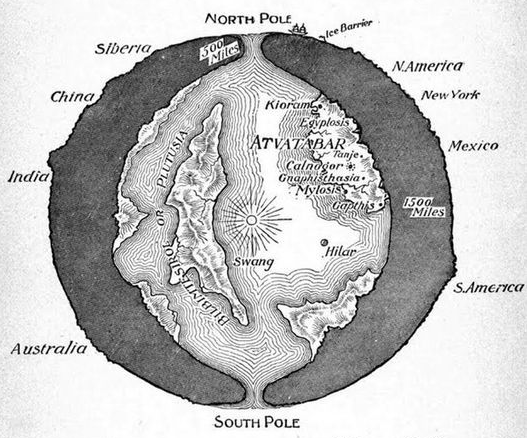
Bradshaw’s The Goddess of Atvatabar imagined a polar expedition entering an inhabited Interior World. The illustration is useful because it shows how later surface writers visualised the idea, but its geography should not be read as a literal SpiralWorlds map.
Using Hollow Earth in a Campaign
Hollow Earth works best when descent changes the scale of the campaign.
The first stage may resemble an ordinary underground adventure: a mine, ruin or cave. Then the passages become older, larger and less familiar. Eventually the party discovers that it has not entered a dungeon at all. It has reached another inhabited geography whose kingdoms, wars, trade routes and wildernesses existed before the adventurers arrived.
The strongest Hollow Earth adventures do not ask only, “What monster lives down here?” They ask:
- Who claims this territory?
- Who built this road?
- Why was the route sealed?
- What does the surface want from this place?
- What does this place want from the surface?
- What happens when an isolated ecosystem or civilisation suddenly becomes connected to the wider world?
Related SpiralWorlds Entries
Videos: Hollow Earth, Prehistoric Giants and Kaiju
These three videos serve different purposes: historical context for the Hollow Earth idea, real prehistoric scale for the lost-world ecosystems, and visual inspiration for the kaiju material. They are supporting references, not statements of SpiralWorlds canon.
Why Scientists Briefly Thought the Earth Was Hollow — SciShow. Useful context for the real history of Hollow Earth speculation without treating later theories as SpiralWorlds geography.
The Biggest Thing That Ever Flew — PBS Eons. A real-world reference for the extraordinary scale of giant pterosaurs such as Quetzalcoatlus.
GODZILLA (MonsterVerse Creatures) EXPLAINED provides scale and atmosphere for portraying kaiju as regional catastrophes rather than simply oversized combat encounters. It is inspiration; the SpiralWorlds Godzilla entry defines the campaign version.
Sources and Setting Notes
SpiralWorlds: Hollow Earth, its inhabited regions, surviving prehistoric ecosystems, Agarthan politics, surface expeditions, kaiju corridors and 1454 campaign situation are setting material for SpiralWorlds.
Internal continuity: Hollow Earth is treated as a collection of independent territories rather than one state. The Agarthan Crown, Council of Advisors, Great Library, Iron Citadel, Illithid elder-brain cities, Xulgath tyrant-cities and Derro warrens are separate institutions or powers.
Deep-time continuity: Jurassic, Cretaceous and Pleistocene refuge populations are built from the established SpiralWorlds deep-time timeline. Hollow Earth preserves separate ecosystems rather than combining every extinct creature into one undifferentiated prehistoric world.
Kaiju continuity: True kaiju are distinct from ordinary giant animals and prehistoric beasts. Godzilla, Mothra and other kaiju retain their individual SpiralWorlds origins, identities and supernatural significance; Hollow Earth provides territories and migration routes for some kaiju without becoming the universal origin of all kaiju.
Tuatha Dé Danann: SpiralWorlds chronology places their arrival from Falias, Gorias, Murias and Finias. They are not recast here as a civilisation originating in Hollow Earth.
Derro and Dero: These are separate subterranean peoples despite their similar names.
Historical artwork: William R. Bradshaw, The Goddess of Atvatabar (1892). The surviving nineteenth-century illustration is used as historical and literary context and is not presented as canonical Inner World cartography.
Keep this reference growing
If this page helped with your reading or game, you can support its upkeep or explore the curated books.
Explore the Bookshop — epics, classics and stories behind imagined worlds.