
Successor Empires and Connected Worlds, 1260–1346
The Great Muster Breaks into Rival Orc Powers
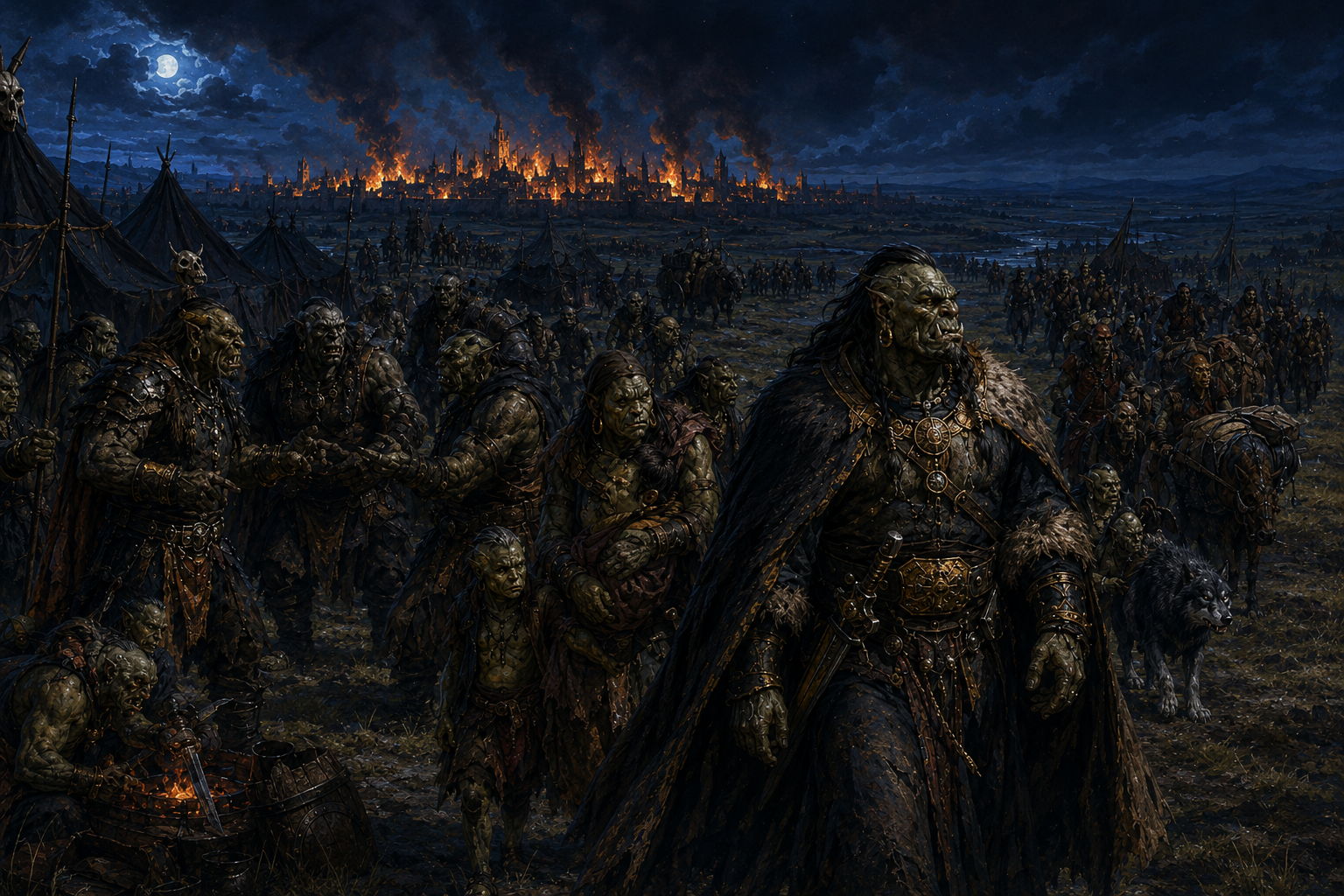
The Battle of the Hidden Springs closes the first age of Mhurak Stone-Blood’s conquests. Between 1260 and 1346, the chiefs who survive him gather tribes, families, conquered cities and subject rulers into four rival powers. None inherits Mhurak’s authority whole.
Across the same decades, Roman rule returns to Constantinople, Japan and Đại Việt repel Eastern Fang expeditions, Mansa Musa carries Mali’s wealth into international politics, and new states rise from Majapahit and Vijayanagara to Tenochtitlan.
| Period | 1260–1346 CE |
|---|---|
| Parent age | The Age of Severed Crowns |
| Previous period | Crowns Broken by Conquest, 1200–1260 |
| Next period | Plague, Labour and Broken Authority, 1347–1380 |
| Opening condition | The south-western coalition retreats from the Hidden Springs while Mhurak’s heirs and former companions pursue separate ambitions |
| Principal transformation | The Great Muster’s remaining unity gives way to four rival successor powers with overlapping territories and distinct regional cultures |
| Successor powers | The Eastern Fang Host, Ash-Standard Host, Red Fang Reach and Black Anvil Realm |
| Defining forces | Succession, shifting allegiance, regional resistance, long-distance trade, famine, credit, gunpowder and new dynastic states |
| Period endpoint | Dynastic war has opened in western Europe and the plague lineage is moving towards the Black Sea approaches |
The World in 1260
Mhurak Stone-Blood is dead. The tribes he united still remember the victories of the Great Muster, but no heir can compel every chief to answer the same summons.
The Broken Muster
- The south-western coalition withdraws from the Hidden Springs.
- Its surviving chiefs blame one another and return towards Iran, Mesopotamia and the Caucasus with rival claims intact.
- Eastern chiefs hold northern Chinese garrisons, pasture and captured cities, but their alliances have not yet hardened into one recognised Eastern Fang Host.
- Western chiefs compete over river strongholds, wintering grounds, tributary princes and grassland routes.
- Central clans contest mines, wells, mountain passes and caravan cities between the Altai, Tarim Basin and Pamirs.
Kemet and Constantinople
- Catfolk Kemet has stopped the immediate invasion of the Nile realm.
- Kemet strengthens its northern approaches without adopting the conquerors’ mounted methods as its own.
- Roman rulers at Nicaea prepare to recover Constantinople from the Empire of the Broken Eagle.
Asia and the Indian Ocean
- Đại Việt, Champa, Japan and other eastern states prepare for further expeditions launched from conquered northern China.
- Delhi remains a major northern Indian military state while regional kingdoms preserve competing traditions of rule.
- Pagan, Angkor and the maritime states of Southeast Asia command river valleys, temple lands and sea passages.
- Mali and Great Zimbabwe are rising powers connected to gold, cattle, rivers and long-distance commerce.
The Americas and Atlantic
- Maya successor kingdoms remain active, and the Mexica have not yet founded Tenochtitlan.
- Norse Greenland and Vinland preserve established Atlantic crossings and permanent communities.
- Those settlements exist beside powerful Indigenous societies with their own governments, territories and sacred landscapes.
The Character of the Period
The Hidden Springs has already proved that an army descended from the Great Muster can be defeated. Period II begins with the consequences: Kemet survives, the south-western chiefs retreat, and every important orc leader measures what the defeat reveals about rivals as well as enemies.
Mhurak’s death removed the only person capable of forcing distant tribes to pursue one purpose. The four successor powers emerge gradually from later choices. They are not orderly provinces waiting for new governors, and their borders do not divide Mhurak’s conquests into four clean historical copies.
Each power contains dominant tribes, lesser clans, adopted companions, subject communities, conquered cities and local rulers whose interests rarely align for long. A powerful chief may change allegiance without moving his family or settlement. A city may pay one claimant while supplying another. Outlying camps can recognise a distant ruler in one war and ignore that ruler in the next.
Relationships remain more varied than obedience through fear. Kinship, marriage, fosterage, admiration, shared danger, profit and genuine affection preserve some alliances for decades. Rivalries and humiliations can last just as long.
Beyond the orc successor powers, distant courts become more closely connected through commerce, diplomacy, warfare and migration. Merchants, physicians, mercenaries, scholars, artisans and captives move between societies that once seemed remote from one another.
Regional powers answer conquest in ways suited to their own lands. Đại Việt relies upon evacuation, river warfare and delayed battle. Japan combines coastal preparation with kami and kaiju. Majapahit rises by turning an invading coalition against itself.
The same connections that carry knowledge and wealth also transmit danger. Famine weakens northern Europe, gunpowder enters western warfare and disease moves west through Central Eurasia.
After Mhurak Stone-Blood
One Conqueror Leaves Many Inheritances
Mhurak Stone-Blood did not leave a central state capable of appointing one unquestioned successor. He left famous descendants, adopted companions, powerful chiefs, victorious tribes and conquered lands rich enough to support several competing rulers.
Each claimant offers a different future: renewed continental conquest, wealth drawn from cities, freedom for distant clans, vengeance against old enemies or the defence of territories that have become home. The successor powers form around those choices.
Tribes and Households
The tribe remains the principal political community. It contains related families, adopted companions, dependants, servants, captives and allied households.
Tribal identity can survive migration, settlement and service beneath several different rulers.
Chiefs and Companions
Chiefs are judged by courage, judgement, generosity and the fortunes of the people who follow them.
A celebrated warrior may rise above an older bloodline, while an heir who repeatedly fails can lose influence and followers.
Camps and Settlements
Some communities move seasonally with their animals. Others live in permanent villages, fortified valleys, market towns or districts that have grown around former camps.
Mountain, forest, grassland and urban orcs develop visibly different habits and priorities.
Work and Craft
Herding, hunting, fishing, farming, hide-working, smithing, animal care and food preservation occupy most households.
Rulers compete for skilled healers, singers, hunters, smiths and animal trainers as eagerly as they compete for celebrated warriors.
Feasts and Rivalries
Wrestling, racing, hunting contests, music and competitive storytelling allow individuals and clans to display skill and reputation.
Great gatherings reward followers, arrange marriages, settle some disputes and create new ones.
Conquered Communities
Subject towns and kingdoms retain local crafts, leaders and customs where a ruler finds them useful, admirable or profitable.
Others face confiscation, enslavement, forced migration or destruction when their survival conflicts with a conqueror’s ambition or revenge.
Life within the Successor Powers
Most orcs within the successor powers are not campaigning every season. Their lives are shaped by family, food, work, settlement, pleasure, danger and the local consequences of conquest.
Children learn clan histories, animal care, local dangers and the names of relatives who must be honoured or avenged.
Permanent settlements grow around river crossings, mines, markets, captured fortresses and winter camps that families no longer wish to abandon.
Foods, clothing, architecture and celebrations change through contact with Chinese, Iranian, Rus, Turkic, Central Asian and Caucasian communities.
Families care for injured relatives, remember admired ancestors and preserve stories of migrations, victories, betrayals and ridiculous mistakes.
Conquered artisans may gain wealthy patrons without becoming free, while subject rulers can preserve local authority by manipulating rival chiefs.
The same household may display fierce affection within its own circle and devastating indifference towards communities placed outside it.
The Four Orc Successor Powers
Foreign historians use the language of successor empires because these powers dominate immense territories and subject populations. Internally, each is a shifting gathering of tribes, chiefs, conquered lands and regional alliances.
The Eastern Fang Host
Muzg Eastern-Fang gathers chiefs whose families hold northern Chinese garrisons, Manchurian pasture, Ordos camps and wealthy cities inherited from Mhurak’s eastern conquests.
Eastern Fang rulers pursue magnificence. Their courts contain silk, lacquer, rare animals, astronomers, armourers, musicians and performers drawn from conquered lands.
Chinese officials keep taxation, irrigation and grain distribution functioning. Orc chiefs compete for estates, expeditions and influence over the ruler rather than becoming a uniform administrative class.
The Host controls strong corridors and major centres while mountain, forest, marsh and coastal districts remain contested. Outlying chiefs regularly pursue private wars beyond the court’s immediate command.
The Ash-Standard Host
Ruzga Ash-Standard gathers western tribes, displaced households and defeated rivals beneath leadership built through daring, generosity and success against competing chiefs.
The Host commands scattered river strongholds along the Volga, Don and Dnieper, seasonal territories across the western grasslands and unequal relationships with Rus princes.
Ash-Standard gatherings are known for hunting, racing, river markets, competitive feasting and alliances sealed through marriage and fosterage.
Its strength rests upon relationships between widely separated peoples. There is no continuous border enclosing every camp, tributary town or allied ruler.
The Red Fang Reach
Khurz Red-Fang gathers clans from the Altai and Sayan approaches, Dzungaria, the Tarim Basin, Pamir passages and parts of the upper Oxus.
Red Fang peoples value independence, ancestral pride, difficult journeys, hunting and the freedom to pursue personal ambitions and inherited enemies.
Individual chiefs control valleys, pasture, mines, wells and caravan cities while acknowledging Khurz when the relationship remains useful.
The Reach overlaps the interests of eastern, western and south-western powers. Its chiefs change allies often enough that no map can present its full authority as one stable block.
The Black Anvil Realm
Drazh Black-Anvil gathers mountain clans, heavily armed households, smiths and captured siege specialists after the south-western coalition’s retreat from the Hidden Springs.
Black Anvil culture admires difficult craft and spectacular feats of destruction. Resistant fortresses become challenges capable of occupying rulers for years.
Successful smiths, miners, physicians and engineers receive wealth and protection because their achievements increase the reputation of their patrons.
The Realm forms a broken chain of mountain territories, foundry cities, mining districts and subject settlements across parts of the Caucasus, northern Mesopotamia and western Iran.
No successor commands them all. Descent from Mhurak Stone-Blood strengthens a claim but never settles it. Each ruler must win allies, reward chiefs, survive humiliation and produce victories worth following. None gathers enough authority to compel the other three powers during this period.
Chronology, 1260–1346
The Aftermath of the Hidden Springs
The surviving south-western orc chiefs withdraw north after their defeat by catfolk Kemet. They carry incompatible accounts of who pursued too far, who withheld support and who allowed a rival clan to be cut apart.
Kemet’s catfolk secure the approaches to the Nile realm with Kemetite bows, spears, khopeshes and maces. Their victory becomes a model of how terrain, senses and local methods of war can overcome a larger mounted host.
The defeat does not create the Black Anvil Realm by itself. It accelerates the quarrels from which Drazh Black-Anvil later gathers one of the principal successor powers.
Roman Rule Returns to Constantinople
Forces from Nicaea recover Constantinople from the Empire of the Broken Eagle. The restored Roman state inherits a damaged city, reduced resources and a weakened Mediterranean position.
Ancient offices and ceremonies return, while relics, seals and public treasures taken in 1204 leave gaps in the city’s sacred memory.
The Successor Powers Take Shape
Mhurak Stone-Blood’s children, adopted war-heirs, surviving companions and greatest chiefs compete for followers and conquered wealth.
Some alliances survive through affection, fosterage and shared victory. Others collapse over old injuries, incompatible ambitions or the division of cities, herds and captives.
The Eastern Fang Host, Ash-Standard Host, Red Fang Reach and Black Anvil Realm emerge gradually. Chiefs and settlements can remain contested between them for generations.
Eastern Fang Chiefs Fight beyond the Northern Cities
Chiefs who later gather beneath Muzg Eastern-Fang campaign into forest, marsh and coastal frontiers north and east of the main Chinese centres.
They seek timber, metals, hunting grounds, ports and enemies who sheltered refugees from earlier conquests. The wars create scattered camps and tributary settlements rather than one clean frontier.
Several chiefs become powerful enough to bargain with Muzg as allies rather than servants, shaping the Eastern Fang Host as a coalition from its beginning.
Đại Việt and Champa Resist Eastern Fang Expeditions
Pressure from northern China begins before 1260 and continues through several expeditions led by different Eastern Fang chiefs and subject commanders.
The invaders seek tribute, prestige and access to southern ports. Their armies depend upon subject infantry, captured vessels and supplies vulnerable to climate and deliberate devastation.
The Trần rulers of Đại Việt use evacuation, scorched supplies, river warfare and delayed battle. Champa combines resistance, diplomacy and movement through country hostile to northern mounted forces.
In 1288, Trần Hưng Đạo destroys an invading fleet on the Bạch Đằng River using concealed stakes, tidal knowledge and coordinated attack.
A Royal Restoration in the Ethiopian Highlands
Yekuno Amlak overthrows the Zagwe dynasty and establishes a new royal line claiming ancient Aksumite inheritance.
Authority rests upon highland ancestry, celestial powers, regional nobles, ancient stelae and royal regalia. Rock-hewn sanctuaries remain centres of power beyond the court.
Nubian kingdoms continue along the Nile beneath pressure from Kemet, desert powers and internal rivalry.
The Eastern Fang Conquest of Southern Song
Eastern Fang rulers, Chinese allies and ambitious subject commanders complete the conquest of Southern Song, seizing cities, shipyards, river crossings and granaries.
Chinese officials keep irrigation, taxation and grain distribution functioning. Orc chiefs compete for estates, influence and the prestige of future expeditions.
Some cities receive powerful patrons who admire their artisans, scholars or entertainments. Resistant districts face enslavement, confiscation and destruction.
Mountain, marsh and coastal regions preserve local agreements, rebellions and sacred authorities beyond complete Eastern Fang control.
A First Eastern Fang Coalition Reaches Japan
A coalition of Eastern Fang chiefs compels conquered shipyards and subject sailors to carry an orc-led force towards northern Kyushu.
The expedition promises wealth and renown, but its commanders disagree over landings and the division of expected spoils. Japanese defenders exploit difficult shores and strained supply.
During the withdrawal, the sea kaiju Mizuchi-no-Arashi rises beneath the fleet, overturning ships and damaging Japanese villages and sacred shores as well as the invaders.
The Great Kaiju Storm Destroys the Second Invasion
Muzg’s court supports a larger invasion assembled from separate clan-hosts, subject fleets and commanders pursuing different rewards.
Japanese coastal walls and prolonged resistance prevent a rapid victory. Rival chiefs delay cooperation while arguing over command and the order of landings.
Raijin, Susanoo, coastal kami and kaiju act through a devastating storm that scatters the fleets.
The invasion also awakens Mogaru. The Final King enters the coastal waters as an enemy of the invading fleet, but not as an obedient guardian of Japan. Ships, shoreline camps and nearby settlements all lie within the path of his destructive advance.
The defeat destroys ships, equipment and the reputations of several leading chiefs, making another united expedition harder to assemble.
Pagan Loses Command of the Irrawaddy Plain
Eastern Fang-aligned war-hosts exploit regional revolt and weakening central authority to seize wealth, elephants and specialists from the Irrawaddy plain.
The participating chiefs pursue private gains and establish no lasting unified occupation beyond defended settlements and negotiated allies.
Temple estates, villages and regional rulers survive the loss of the capital’s dominance. Local nat spirits continue enforcing older obligations of land and water.
Majapahit Rises through an Eastern Fang Defeat
Raden Wijaya manipulates a court-backed Eastern Fang expedition to Java, uses it against a rival and then turns upon the exhausted invaders.
The expedition’s chiefs pursue different rewards and local alliances. Wijaya exploits their separation before they can establish a permanent position.
Majapahit develops into a powerful Javanese court whose influence spreads through warfare, marriage, ports, tribute and maritime relationships.
The Ottoman Frontier State Emerges
Osman establishes a frontier principality in north-western Anatolia. The new state gathers Turkic warriors, local communities, subject cavalry, administrators and ambitious military households.
Its rulers expand through raids, negotiated submission, marriage, taxation and the absorption of neighbouring strongholds.
Ottoman growth brings increasing contact with the Ninefold Dominion. Ottoman rulers accept useful support while guarding their own dynastic authority.
The Ninefold Dominion Advances West
The Ninefold Dominion establishes fortified colonies, arsenals and strongholds across parts of Anatolia, the Caucasus approaches and the eastern Balkans.
Dominion commanders seize strategic passes, workshops, mines and river crossings, then connect their conquests through client rulers, tribute agreements and military settlements.
Its recorded Lawful Evil order contrasts with the personal alliances and regional cultures shaping the orc successor powers.
North American Nations and Atlantic Crossings
North America remains a continent of numerous Indigenous nations, confederacies, towns, hunting territories, farming communities and sacred landscapes.
Arctic peoples maintain coastal connections with Greenland. Northwest Coast societies command fisheries, river mouths, cedar forests and sea passages. Eastern Woodlands and Great Lakes communities sustain agriculture, trade, councils and diplomacy.
Norse settlements in Greenland and Vinland preserve long-established Atlantic crossings. Trade, intermarriage, warfare and negotiated coexistence connect some settlers with neighbouring Indigenous communities.
The larger colonial network develops during the later decades of the Age of Severed Crowns.
Banking, Universities and Measured Time Expand
Merchant houses develop bills of exchange, account books, public debt and international credit capable of financing trade and war across several jurisdictions.
Universities, court schools, temple colleges and guild workshops expand the organised teaching of law, medicine, philosophy, mathematics and languages.
Eyeglasses extend the working lives of scribes and craftspeople. Mechanical clocks increasingly regulate markets, courts and labour.
Mansa Musa and Mali’s Wealth
Mansa Musa rules Mali at the height of its wealth and international reputation.
In 1324, he undertakes the Great Circuit through catfolk Kemet and the western sanctuaries of the Seven Wells world with an immense retinue and quantities of gold capable of disturbing distant markets.
The journey strengthens diplomatic relationships with Kemet’s catfolk court and draws scholars, architects and legal specialists towards Mali.
The Great Famine
Persistent rain, flooding, failed harvests and livestock disease create a severe food crisis across much of northern Europe.
Seed grain is eaten, draft animals are slaughtered and prices rise beyond the reach of many households. Communities migrate, poach, raid storehouses and challenge obligations that no longer keep them alive.
Famine spirits gather around starvation, hoarded grain and broken relief oaths after the material crisis has begun.
Tenochtitlan Is Founded
Mexica settlers establish Tenochtitlan upon an island in Lake Texcoco beneath the sign of Huitzilopochtli.
Causeways, canals, chinampas, tribute and military organisation transform a difficult position into a growing city.
Gunpowder Weapons Enter Western War
Gunpowder knowledge reaches western Eurasian workshops and military courts. Early guns remain expensive, unreliable and difficult to transport.
Their noise, smoke and impact matter before their accuracy. Artillery develops beside longbows, crossbows, cavalry, infantry, mining and traditional siege engines.
Kamakura Falls and Ashikaga Rule Begins
The Kamakura shogunate collapses after rebellion and failed imperial restoration. Ashikaga Takauji establishes a new military government in Kyoto.
Japan enters an age of overlapping authority among the imperial court, shogunate, provincial warrior houses, estates and Shinto shrine networks.
Vijayanagara Is Founded
Vijayanagara grows into a major southern Indian kingdom centred upon a fortified sacred and commercial landscape.
Its rulers support temples, irrigation, markets, armies and international trade while employing people from several sacred and linguistic communities.
The Hundred Years’ War Begins
Rival claims to the French crown draw England, France and their allies into prolonged dynastic warfare.
The opening struggle includes battles, sieges, naval war, taxation, mercenary companies and devastation of the countryside.
Bengal Consolidates Its Independence
Bengal consolidates as an independent sultanate after breaking from Delhi’s effective control.
Persianate court traditions and Seven Wells institutions operate beside Indian revenue systems and regional agreements with temples, villages, rivers, nagas and ancestral powers.
The formation of the Bahmani Sultanate in 1347 belongs to the opening of the next period.
The Plague Lineage Moves West
Deaths recorded around Lake Issyk-Kul in 1338 and 1339 mark an early outbreak connected to the lineage that becomes the Black Death.
Infection moves through wild reservoirs, caravans, military movements and densely connected settlements across Central Eurasia.
By 1346, the disease has reached the western grasslands and the approaches to the Black Sea. Its Mediterranean pandemic phase belongs to the next period.
The World at the Threshold of 1346
Connection Enriches the World and Exposes Its Weaknesses
By 1346, ports, caravans, military movements and credit networks bind distant regions more closely than at the beginning of the age. The same connections capable of carrying scholars, gold, grain and diplomatic messages now carry war, famine and infection.
- The Eastern Fang Host has conquered Southern Song but suffered major defeats in Japan, Đại Việt, Champa and Java.
- The Ash-Standard Host commands western grasslands, river strongholds and scattered tributary relationships.
- The Red Fang Reach remains a varied world of clans, caravan cities and ambitious chiefs.
- The Black Anvil Realm holds mountain and foundry centres but has never overturned catfolk Kemet.
- Roman rule has returned to Constantinople.
- Ottoman and Ninefold Dominion ambitions increasingly overlap across Anatolia.
- Mali possesses immense wealth and international prestige.
- Majapahit, Vijayanagara and Tenochtitlan have entered the political histories of their regions.
- The Hundred Years’ War has begun.
- The plague lineage has reached the approaches to the Black Sea.
Plague, Labour and Broken Authority begins with the military crisis of 1346 and the Mediterranean arrival of plague in 1347.
Continue to Period III: Plague, Labour and Broken Authority, 1347–1380 →What This Period Changes
One Muster Becomes Four Rival Powers
Mhurak’s former followers gather around different leaders, territories and ambitions without accepting one universal successor.
Successor Geography Remains Uneven
Strongholds, camps, tributary cities and allied rulers overlap. None of the four powers forms a neat copy of a historical successor state.
Regional Orc Cultures Diverge
Eastern Fang, Ash-Standard, Red Fang and Black Anvil peoples change through local environments, conquered populations and the personalities of their rulers.
Allegiance Remains Negotiable
Kinship, affection, reward, rivalry and self-interest shape the relationships between rulers, chiefs and subject communities.
Regional Resistance Gains Models
The Hidden Springs, Bạch Đằng, Japan and Majapahit demonstrate that terrain, logistics, local knowledge and divided enemy command can defeat orc war-hosts.
Connection Carries New Dangers
War, grain failure, gunpowder and infection spread through the same commercial and military networks that create wealth.
Historical and Mythic Context
This page combines documented history, archaeology, oral tradition and approved SpiralWorlds campaign canon. Roman restoration, the conquest of Southern Song, the invasions of Japan, resistance in Đại Việt and Champa, Majapahit, Mansa Musa, the Great Famine, Tenochtitlan, Ashikaga rule, Vijayanagara and the opening of the Hundred Years’ War provide the principal historical framework.
The historical Battle of Ayn Jalut took place in 1260. In SpiralWorlds, the corresponding campaign turning point is the Battle of the Hidden Springs, fought by catfolk Kemet and concluded at the end of Period I. This page begins with its aftermath rather than replaying the battle.
Historical Mongol-era chronology provides loose background for several Asian conflicts. Mhurak Stone-Blood, Muzg Eastern-Fang, Ruzga Ash-Standard, Khurz Red-Fang, Drazh Black-Anvil and the four orc successor powers belong to SpiralWorlds canon.
The four powers do not reproduce the borders, institutions or full campaigns of the Yuan dynasty, Golden Horde, Chagatai Khanate or Ilkhanate. Their territories remain fragmented and overlapping, and individual chiefs frequently pursue private wars.
The Eastern Fang conquest of China depends upon Chinese cities, agriculture, irrigation and administration while military leadership remains concentrated among allied orc tribes. Its expeditions to Japan, Southeast Asia and the forest frontiers are coalitions whose chiefs do not always share one purpose.
Kemet is an ancient catfolk civilisation. Its warriors use Kemetite bows, spears, khopeshes, maces and axes while adapting them to catfolk senses, balance, climbing and rapid local coordination.
Japan’s survival results from fortification, prolonged resistance, difficult supply, divided invader command, storms, kami coalitions and kaiju. Mogaru is remembered as the most destructive of these interventions: a threat to the invasion fleets and to every coastal community caught near his path.
The Ottoman frontier state remains a dynastic territorial power. The Ninefold Dominion is a separate Lawful Evil hobgoblin civilisation whose fortified expansion increasingly overlaps with Ottoman ambitions.
North American contact and settlement develop from established Norse Atlantic crossings within deliberate alternative-history canon. Indigenous nations remain the principal territorial and political powers across most of the continent during this period.
The plague outbreak recorded near Lake Issyk-Kul belongs to an infectious lineage of the Material Plane. Trade and military movement carry that infection westwards before the Mediterranean pandemic begins.
Frequently Asked Questions
Why is the page called Successor Empires?
Foreign historians use the term because the four powers dominate immense territories and subject populations. Their internal politics remain rooted in tribes, clans, regional alliances and personal leadership.
Do all four successor powers exist in 1260?
No. The Great Muster is already dividing, but the Eastern Fang Host, Ash-Standard Host, Red Fang Reach and Black Anvil Realm take shape gradually through the following decades.
What are the four principal successor powers?
They are the Eastern Fang Host, Ash-Standard Host, Red Fang Reach and Black Anvil Realm.
How are the successor powers related?
All four descend from Mhurak Stone-Blood’s Great Muster. They share parts of orc ancestry and military memory while developing separate cultures and political interests.
Are the successor powers renamed Mongol states?
No. Historical Mongol-era events provide part of the surrounding chronology, but the four powers possess their own rulers, cultures, overlapping territories and campaign histories.
What happened at the Hidden Springs?
Catfolk Kemet defeated the south-western orc coalition at the end of Period I. Period II begins as the survivors retreat and their accusations deepen the struggle among Mhurak’s heirs.
How is Japan protected from the Eastern Fang invasions?
Coastal fortification, prolonged resistance, difficult supply, divided invader command, kami, storms and kaiju combine to destroy the invasion fleets. Mogaru joins the destruction without distinguishing reliably between invaders, defenders and nearby settlements.
How developed are the Atlantic settlements by 1346?
Norse crossings, settlements and permanent contact are established. The larger formal colonial network develops during the later part of the age.
Why does the period end in 1346?
By 1346, dynastic war has opened in western Europe and the plague lineage has reached the western grasslands and Black Sea approaches. The Mediterranean pandemic begins the next period.
Selected Historical and Archaeological References
Use of Historical Sources
These sources support the documented chronology surrounding the campaign setting. The orc rulers, tribes, territories and cultures are SpiralWorlds canon.
- Encyclopaedia Britannica — Battle of Ayn Jalut
- The Metropolitan Museum of Art — The Legacy of Genghis Khan
- The Metropolitan Museum of Art — Yuan Dynasty, 1271–1368
- National Archives of Japan — Japan and the Mongol Invasions
- Vietnam National Museum of History — Bạch Đằng Wooden Stakes
- UNESCO — Trowulan, Former Capital of Majapahit
- UNESCO — Historic Areas of Istanbul
- The Metropolitan Museum of Art — The Trans-Saharan Gold Trade
- UNESCO — Group of Monuments at Hampi
- Instituto Nacional de Antropología e Historia — The Mexica and Tenochtitlan
- Royal Armouries — The Hundred Years’ War, 1337–1453
- Communications Earth & Environment — The Great Famine of 1315–1317
- Nature — The Source of the Black Death in Central Eurasia
- UNESCO — Cahokia Mounds State Historic Site
- UNESCO — Angkor
Continue the Age
Keep this reference growing
If this page helped with your reading or game, you can support its upkeep or explore the curated books.
Explore the Bookshop — epics, classics and stories behind imagined worlds.