
Antarctica — The Shrouded Dominion
At a Glance
| Campaign present | 1454 CE |
|---|---|
| Region | The polar continent beyond the Southern Ocean |
| Rule | No single sovereign power; isolated refuges, expedition camps and contested ancient passages |
| Major threat | Hell Knight expeditions trying to secure a southern route into the Hollow Earth |
| Inhabitants | Penguins, seals and seabirds near the coast; rare explorers, gnomish and dwarven smiths, ice trolls, frostwyrms and hidden cavern beings |
| Places | The White Barrier, Fire Mountain, Gamburspire Passes, the Red Weeping, Erebus Watch and Vostaryn Cache |
| Travel | Ships, sledges, ropes, sheltered ice routes and remote landing grounds; no dependable inland road |
| Greatest perils | Exposure, breaking sea ice, crevasses, failing supplies, hostile patrols and the passages below the glaciers |
Emblem: Antarctica has no national coat of arms. This regional emblem represents the frozen continent, the southern lights and the hidden gateways beneath the ice.

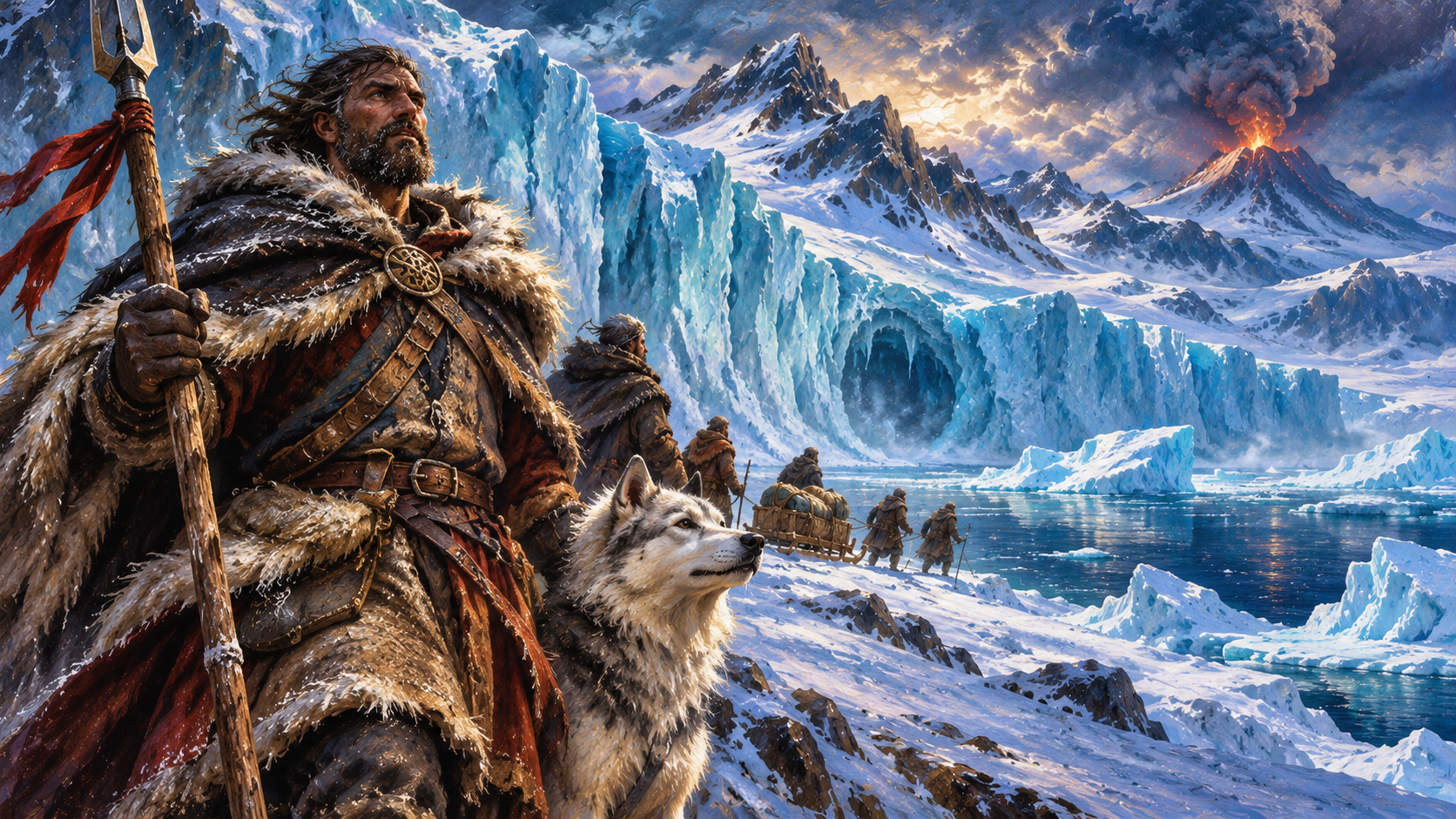
The ship has spent three days grinding against pack ice. At dawn, blue-white cliffs rise beyond a narrow lead. A lookout spots boot prints disappearing inland. They are fresh. No vessel has landed here in a month.
The southern continent is almost entirely buried beneath glaciers, broken only by mountain peaks, bare rock and rare volcanic refuges. It has no ports, cities or welcoming roads. The small expeditions that survive here know that an extra day’s food, a guide’s warning or a dry rope can be worth more than gold. Beneath the ice, somebody is opening passages into the Inner World.
Antarctica on the Map
Great ice shelves rim the coasts. The Transantarctic Mountains divide the ancient eastern ice cap from the smaller volcanic and mountainous western lands. The Antarctic Peninsula stretches towards the waters south of South America, while the Ross and Weddell seas give other perilous approaches. The real-world place names below serve the game master; travellers of 1454 use their own names.
| Campaign name | Geographical anchor | What adventurers find |
|---|---|---|
| The White Barrier | Great coastal ice shelves | Towering ice cliffs and shifting routes to shore |
| Gamburspire Passes | Transantarctic Mountains | Wind-cut rock, high passes and deep faults |
| Fire Mountain | Active volcanic heights of Mount Erebus | Steam, unstable ground and hidden forges |
| The Red Weeping | Iron-rich brine at Taylor Glacier, later called Blood Falls | A red-stained glacier and a concealed fracture |
| The Buried Water | Subglacial lake basins, including the one later named Lake Vostok | Sealed dark water and old watch chambers |
| Sea of Silence | A fictional western coastal inlet | A temporary landing ground used by Aurora Point |
Continue across the Southern Ocean or follow the separate Hollow Earth campaign map into the deep interior. Neither is a guaranteed road from the coast to the Star Caverns.
What Is Happening Right Now?
The Knights have found a descent. A Hell Knight scouting column has reached an ancient break in the rock below the Gamburspire ice. Its commander wants to fortify the entrance and march towards the Star Caverns of Hollow Earth. Captives and hired porters have begun disappearing from the coastal camps.
The volcanic refuge is divided. The smiths of Fire Mountain need imported iron but refuse to forge shackles for the Knights. Their forge-master knows a narrow route past the patrols; one apprentice is frightened enough to betray her.
The Red Weeping is open. A new fissure beside the iron-red brine exposes worked stones older than any surface expedition. One group wants to seal the breach, another to explore it. Neither has brought its scouts home.
Expedition Shelters and Strongholds
Endurance Refuge
Two stone huts and leather-covered stores stand behind an exposed coastal headland. Here travellers dry clothing, mend sledges and wait for a passable sea lead. Keeper Sera Vald shelters the shipwrecked but refuses the Knights fresh guides. Her rule is simple: a guest who steals provisions or abandons an injured companion is no longer welcome.
Aurora Point
A movable camp of hides, sledges and rune-marked poles follows the changing coastal ice. Ilse Morgenstern, an exiled scholar of natural philosophy, watches unusual aurora displays for signs of movement underground. A stolen notebook has already led the Knights to one sealed entrance.
Erebus Watch
Built against the warm rock of Fire Mountain, a small forge repairs iron, ice spikes, crampons and stove fittings. Orin Brasshand, a gnome smith, trades heating stones and tools for charcoal, metal and food. He will not make chains for prisoners. His stores are precious and the nearby steam vents are deadly.
Vostaryn Cache
Above an ancient subterranean lake lies a hidden watch chamber accessible only by a fault through the threshold depths. A stone-and-metal guardian admits bearers of an old mark but prevents anything from the water escaping. It cannot explain who gave the order.
The Black-Ice Redoubt
Komtur Dietrich von Eis commands the Hell Knight expedition at a buried gate. He offers protection and employment, then keeps guides, maps and food as leverage. His discipline is exacting and his cruelty deliberate. The distant Teutonic States hold no universally accepted sovereignty here.
Names Carried by Travellers
The White Wilderness is the most common seafarers’ name. Expedition journals also call it the Bottomless Silence. The Shrouded Dominion is a poetic name for the land, not a political title: no king claims or governs the whole continent.
Ice, Volcanoes and Living Shores
Steep ice cliffs line much of the coast. Inland, glaciers conceal great valleys, fractures and mountain chains. The open plateau is dry, high, bitterly cold and sparsely supplied with life. Fierce downhill winds may prevent even experienced travellers from pitching a tent. Winter darkness can last for months; summer brings long light, not dependable warmth.
Penguins, seals, whales and seabirds depend on the ocean and its seasonal ice. The remote plateau is not a land of ordinary hunting villages. Strange creatures survive in sheltered supernatural pockets, old geothermal refuges and ancient passages below the glaciers. The immense buried waters and the surviving roots of old mountains are real features; their hidden gates and guardians belong to the world’s deeper history.
Who Controls the Approaches?
The Hell Knight column seeks a permanent armed route into the Inner World. Its commanders record orders, conserve supplies and claim territory by occupation rather than legal right. Some soldiers are ruthless mortals; a Knight need not be an actual devil. The Hell Knight entry provides an individual adversary.
The scattered refuge-keepers share practical information, food and tools when they can, but owe no allegiance to a continental leader. They are suspicious of anyone claiming to own the passages under their camps.
The older guardians watch the thresholds for reasons rarely understood by surface visitors. Some protect what is below from intruders; some prevent what is below from reaching the surface. Their duties are not identical and their opposition to the Knights does not make them automatic allies.
Marks on the Ice
Antarctica has no crown, banner or national coat of arms. The Hollow Gate Mark, a dark spiral cut in pale rock, warns of ancient underground passages. The Erebus Flame, a black flame within a ring, identifies the volcanic forge. The Knight’s Rune marks the Black-Ice Redoubt and its patrol routes. These are local and factional signs, not symbols of a common government.
Getting Here and Getting Home
A southbound ship must cross the rough Southern Ocean, find an open lead through sea ice and land on safe rock or a temporary ice edge. A coastal camp is not a permanent port. Inland travel demands sledges, ropes, strong boots, shelters, fuel and food for the return journey. The safest routes change with weather and moving ice. An experienced navigator is more useful than a fine map copied from someone who never made the crossing.
There is no continent-wide law. Each refuge protects its own provisions and guests; the Knights impose military commands inside their redoubts; ancient wardens obey obligations older than any expedition. Travellers do not gain safe passage by presenting a royal charter to a glacier.
Behaviour, Loyalty and Consequences
Survival does not make everyone morally alike. Keeper Sera protects the weak because abandoning an injured traveller is a betrayal; those who earn her trust can ask for shelter in an emergency. Orin accepts difficult bargains but refuses to profit from slavery. Dietrich punishes disobedience, rewards efficient cruelty and sacrifices strangers for a safer military road. He is a disciplined commander, not merely a solitary marauder.
These beliefs shape decisions when supplies run short. A refuge might give its last dry blankets to wounded strangers, or refuse to admit a Knight patrol that has just brought captives through a storm. The Knights may offer food to starving travellers in return for oaths and forced labour. None of the continent’s inhabitants shares one universal alignment or law.
Ancient Passages and Strange Lights
The dancing southern lights sometimes illuminate carvings otherwise invisible in buried stone. Some explorers read those lights as warnings from beings below; others use the patterns to predict whether a magical threshold is active. At the Red Weeping, an iron-red brine seeps through the ice. Visitors leave tokens for companions lost on the crossing, though no rite can replace a search party.
The Hollow Gates are not one convenient portal. A route descends through crevasses, natural faults, engineered thresholds and guarded roads, first into the Deep Earth and then, only along particular passages, towards the true Inner World. Some routes end in a collapsed gallery. Others open to the Star Caverns, whose origins are debated by their inhabitants. Old carvings warn travellers that some of the sealed passages are still watched.
Rumours and Adventure Hooks
The Last Boat
A merchant ship cannot remain at the ice edge. Its captain will wait one more day for a stranded exploring party. The lost travellers include a Hell Knight deserter carrying a route map the commander wants returned.
The Captive Guide
A Knight officer has taken Sera Vald’s apprentice inland to read coastal marks. The apprentice is alive, but freeing him may close the only known passage past the patrols. Sera offers supplies and her own help, not a pile of coin.
Iron for the Redoubt
Orin asks the party to intercept a sledge carrying prisoners to the mountains. The released captives know part of the road, but there is not enough food for everyone to continue inland without a hard choice.
Below the Buried Water
Ilse believes a seal at Vostaryn is failing. Dietrich wants the mechanism for himself; the ancient guardian will let neither scholar nor knight touch it. The party must learn what lies below before deciding whether to open or repair the seal.
People Whose Decisions Matter
Sera Vald will lead a rescue even when retreat would be safer. Orin Brasshand offers practical tools and shelter but risks reprisal for refusing to supply the Knights. Ilse Morgenstern knows more about the aurora and ancient inscriptions than she admits; she fears her notes will help open the wrong gate. Komtur Dietrich von Eis sees the southern descent as the first step towards controlling a permanent military route into Hollow Earth. His interest is territorial and occult, not an attempt to rule all of Antarctica.
Inhabitants and Creatures
Coastal life. Penguins, seals, seabirds and the whales of neighbouring waters provide the natural ecology close to the sea. They do not populate the distant plateau. A landing site may be crowded with life even when the ice a day’s walk inland is empty.
Ice trolls and frostwyrms. Rare monsters hunt in sheltered passes and supernatural refuges. Their presence is a sign of a particular lair, not evidence that every mile of Antarctic ice teems with creatures.
Hollow Shades. The restless remnants of lost travellers haunt some sealed passages. They are most dangerous where fear and poor light lead living companions to lose one another.
Older guardians. The Vostaryn sentinel is a creature of construction and forgotten commands. Deeper down, certain chambers show traces associated with the Elder Things and other ancient inhabitants. Descending to one protected refuge does not put every creature of the Lost World Bestiary within walking distance.
Magic, Services and Equipment
Endurance Refuge offers food when available, repairs to tents, sledges and ropes, and advice on landfall. Erebus Watch makes iron spikes, crampons, stove fittings and alchemical warming stones. Aurora Point offers rare interpretation of runes and lights. No camp has unlimited stores or modern laboratories. A spell that warms a traveller is valuable, but it will not navigate shifting sea ice or repair a broken sledge runner without the right labour and tools.
Across the Ice: Dangers and Discoveries
The greatest threats often arrive before a monster. A coastal wind closes the ship’s lead. A crust conceals a forty-foot drop into blue ice. Supplies freeze or disappear, an unroped traveller vanishes in a whiteout, and a camp must decide whether to risk the next shelter or retreat. The open interior offers little natural food; most expeditions carry provisions from the sea.
Ice and cold. The interior is far colder than the coast. High winds strip warmth quickly, while shelter behind stone or in a protected cave may mean the difference between rest and exhaustion. Geothermal refuges offer warmth but also dangerous steam, fumes and unstable ground.
Travel by light. Summer brings long daylight; winter brings prolonged darkness. A misplaced landmark or a damaged lamp can turn a familiar trail into a deadly search. Strange aurora displays may illuminate old runes near sealed underground works, but they do not automatically disable spells.
Polar Hazards — Game Rules
Cold, visibility, difficult terrain, wind and falls are constant concerns. The following local hazards are separate encounters: a collapsing snow bridge, an erupting steam vent and a magical gateway inscription.
Antarctic Hazards — D&D 2024
Ordinary exposure. Apply the 2024 Dungeon Master’s Guide rules for extreme cold, wind, heavy obscurement, difficult terrain, falling and Exhaustion. Neither an ordinary snowstorm nor the continent as a whole is sentient.
Hidden crevasse. A creature crossing untested snow must make a DC 15 Dexterity saving throw when the crust breaks. A failure means a 30-foot fall, 3d6 Bludgeoning damage and the Prone condition at the bottom. A successful save catches the edge. A secured rope, probing pole or an established safe route can prevent the check.
Volcanic steam vent. A vent erupts in a 10-foot-radius area. A DC 15 Dexterity saving throw avoids half of 4d6 Fire damage. Heavy Obscurement from steam remains until the end of the next round.
Aurora gate. A creature trying to interpret a magically shifting inscription at a Hollow Gate makes a DC 14 Wisdom saving throw. On a failure it mistakes one route sign. Ordinary spells and magic items away from this inscription are unaffected.
Antarctic Hazards — D&D 2014
Ordinary exposure. Use the 2014 Dungeon Master’s Guide rules for extreme cold, strong wind, heavy obscurement, difficult terrain, falling and exhaustion. Cold exposure is not replaced with automatic damage each minute.
Hidden crevasse. A creature on untested snow must succeed on a DC 15 Dexterity saving throw or fall 30 feet, take 3d6 bludgeoning damage and land prone. On a success it catches the rim. Rope precautions and probing may prevent a fall.
Volcanic steam vent. A burst in a 10-foot radius deals 4d6 fire damage, or half with a DC 15 Dexterity saving throw. Steam heavily obscures the area until the end of the next round.
Aurora gate. Reading a magically shifting inscription calls for a DC 14 Wisdom saving throw. On a failed save the traveller misreads one route symbol; the effect does not suppress normal spellcasting.
Antarctic Hazards — Pathfinder 1e
Ordinary exposure. Apply the Pathfinder Roleplaying Game environmental rules for severe or extreme cold, wind, falling and visibility. The relevant Fortitude saves and nonlethal or lethal cold damage depend on the severity of actual exposure and protection.
Hidden crevasse. A DC 15 Reflex save lets a traveller grab the edge of a broken snow bridge. Failure causes a 30-foot fall and 3d6 falling damage. Roped parties and careful probing may avoid the hazard; climbing out requires suitable gear and a Climb check.
Volcanic steam vent. A 10-foot-radius burst deals 4d6 fire damage (Reflex DC 15 half). The dense steam provides concealment for approximately 1 round.
Aurora gate. A DC 14 Will save is required to read a shifting magical route symbol. Failure leads to one wrong route choice; it does not impose an arbitrary caster-level penalty.
Antarctic Hazards — D&D 3.5e
Ordinary exposure. Use the Dungeon Master’s Guide rules for cold dangers, extreme cold, severe wind, visibility, difficult terrain, falling and fatigue. Apply Fortitude saves and cold damage appropriate to the weather and equipment.
Hidden crevasse. A DC 15 Reflex save lets a character catch the lip of a collapsing snow bridge. Failure causes a 30-foot fall and 3d6 damage. A proper rope line or careful sounding can avert it; climbing out requires Climb and equipment.
Volcanic steam vent. A 10-foot-radius eruption deals 4d6 fire damage (Reflex DC 15 half). Dense steam grants concealment for approximately 1 round.
Aurora gate. A creature deciphering a magically shifting passage marker must succeed on a DC 14 Will save or misidentify one route symbol. Ordinary spells and gear continue to function normally.
Deeper History
The stone beneath the ice is older than any surface kingdom. Antarctica was once joined to other southern lands in Gondwana, and its ancient rock preserves evidence of vanished forests and animals. Most of that landscape is now buried, but the old fault systems give routes into deeper regions.
Ancient builders left steps, causeways and guarded thresholds that do not belong to ordinary geology. In 1454 only scattered expedition camps, older subterranean peoples and the guardians of these passages know anything reliable about them. The Knights intend to turn one such secret approach into a permanent military road towards the Star Caverns.
Continue the Journey
Cross the Southern Ocean, explore the greater Oceans atlas, descend into Hollow Earth and towards Agartha, or follow the Hell Knights back to the Teutonic States. See the wider world atlas for other regions.
Sources and Artwork
Geographical and geological references: Australian Antarctic Program: Geography, Australian Antarctic Program: Geology, and British Antarctic Survey: Antarctica. Modern geographical names are used as a map reader’s reference; magical passages, named expedition camps and monsters are campaign fiction. All four local hazards are original compatible encounter rules, not official published rules.
Keep this reference growing
If this page helped with your reading or game, you can support its upkeep or explore the curated books.
Explore the Bookshop — epics, classics and stories behind imagined worlds.