
Dawn of the Outsiders
Eon XVI · The Planes Awaken as Peoples. The planes are already ancient. Now their native intelligences become enduring peoples, rulers, armies and civilisations: demons rise through an older Abyss, infernal and celestial societies organise, Primus awakens within the Great Mechanism, and genie courts establish power across the elemental realms.
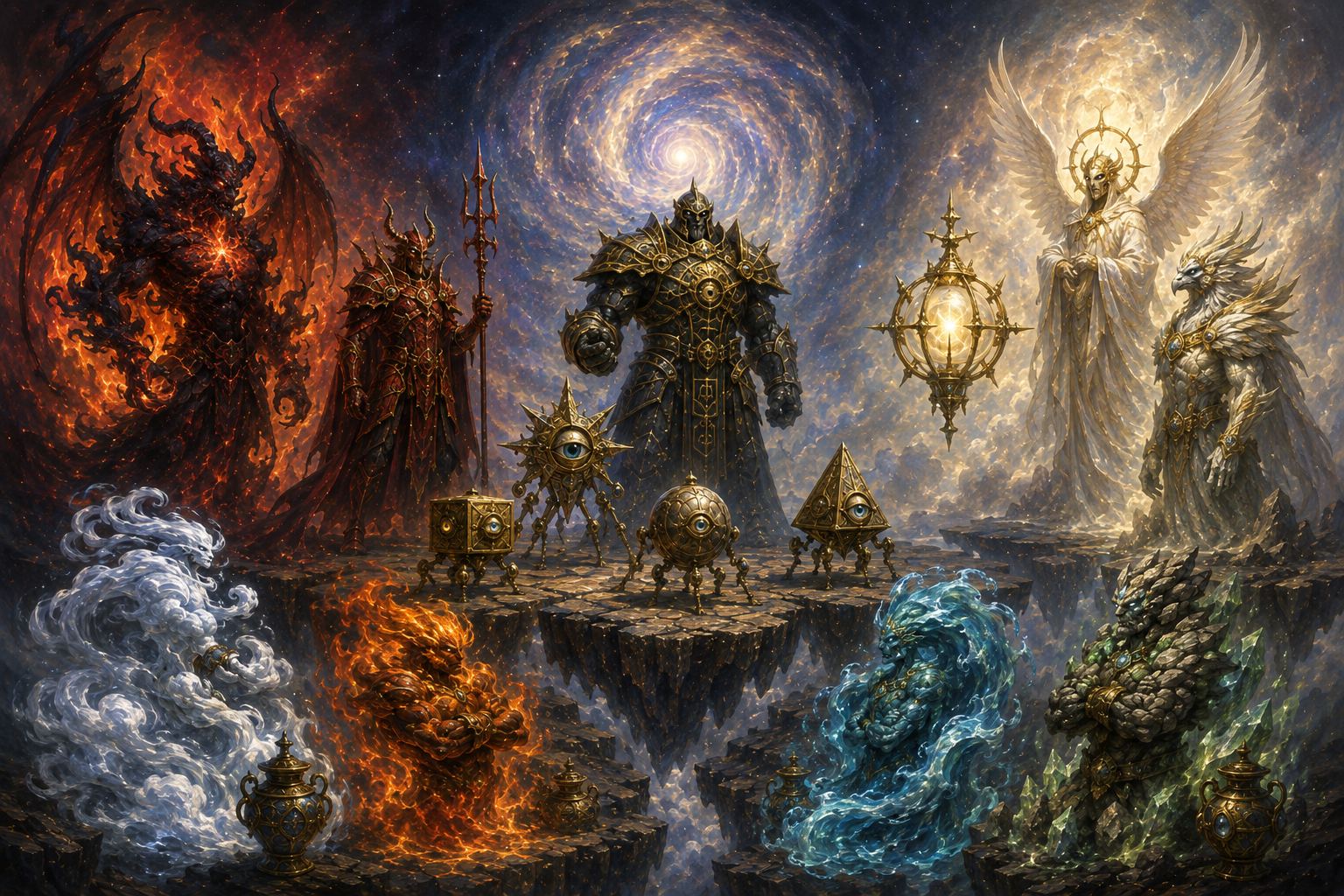 Eon XVI is the age in which the ancient planes acquire enduring peoples,
institutions and political histories. Click the image to enlarge or close.
Eon XVI is the age in which the ancient planes acquire enduring peoples,
institutions and political histories. Click the image to enlarge or close.
The Realms Inherit Themselves
Eon XVI is the age in which ancient planar intelligences become stable populations capable of memory, organisation, lineage, construction, diplomacy and sustained political conflict.
It is not the creation of the planes. It is the beginning of their durable political history.
The Planes of Existence already possess landscapes, laws, wounds, routes and primordial inhabitants. Magic already moves through the Living Weave. The Cosmic Leylines already hold together regions damaged during the Elder Wars and Great Retreat.
What changes is continuity. Broods become lineages. Gatherings become institutions. Strongholds become cities. Ranks survive individual rulers. Treaties can be remembered. Wars can outlive those who began them.
Eon XVI Begins inside an Already Inhabited Multiverse
The Great Retreat ends common rule by the Elder Gods, but it does not empty the cosmos.
Eon XVI inherits ancient intelligences, primordial powers, surviving war-engines and wounded realms whose histories reach far deeper than the new outsider civilisations.
The Six Primal Titans
Flame, Tide, Stone, Gale, Dream and Dusk remain immense independent intelligences associated with the elemental and mirror realms.
They are individual primordial powers, not universal ancestors from whom every creature associated with their realm descends. Flame does not create all fire creatures, Tide all water creatures, Stone all earth creatures or Gale all air creatures. Elemental life already possesses multiple independent origins within the ancient planes.
Ancient Elementals
Discrete elementals already inhabit Air, Earth, Fire and Water, alongside older living storms, sentient seas, elemental masses and primal concentrations.
Astral Remnants
Deep within the Astral Plane, remnants of the First Sentient Ripples and dormant Astral Embers persist among the oldest currents.
Divine Fragments and Engines
Elder God remains, unfinished commands, sealed weapons, watch-engines and broken divine authorities continue to operate throughout the repaired multiverse.
Apsu
Apsu remains a primordial freshwater power whose manifestation is explicitly draconic.
Kishar
Kishar remains a primordial power of foundation, stability, endurance and coherent Earth.
Mummu
Mummu persists as a primordial Water power of turbulence, chaos and unrealised possibility.
Qlippoths
The Qlippoths remain the oldest established intelligent population of the Abyss, though their supremacy is increasingly contested.
Nihros
Nihros remains confined beyond the ordered multiverse. Her imprisonment continues through the rise of the planar civilisations.
Far Realm Powers
The Far Realm remains inhabited by Uvuudaums and other alien powers. Azathoth continues to exist within that alien reality.
How a Plane Becomes a People
No single event creates every outsider population.
Each realm produces or organises intelligence through its own combination of native law, sustained intention, elemental concentration, construction, lineage, inherited purpose and conflict. Similar classifications therefore do not imply one ancestry or one relationship with choice.
Native Convergence
Recurring planar pressures produce stable centres of memory, preference and identity. Beings that were once temporary expressions of a realm can become recognisable individuals capable of remembering earlier encounters and maintaining continuing relationships.
Conscious Embodiment
Mercy, tyranny, freedom, destruction, order, change and other enduring principles acquire beings capable of judgement, intention and individual interpretation within the nature that shaped them.
Deliberate Making
Some peoples are constructed through lawful hierarchies, engines, decrees and self-maintaining systems. Defined functions do not prevent later institutions from developing their own histories.
Lineage and Continuity
Stable forms develop broods, ranks, castes, dynasties or other methods by which identity and institutions persist across generations of rule.
Celestial Agency before Mortal Free Will
Celestial peoples develop personality, judgement, loyalty, attachment, disagreement and differing interpretations of duty. Yet the earliest celestial orders do not possess free will in the same sense later encountered among mortal peoples.
Their choices operate inside profound inherited purposes and cosmic obligations. A celestial may decide how best to fulfil a duty without yet possessing the mortal capacity to reject the foundations of its own nature simply because it chooses to do so.
This distinction will matter enormously in the following eon. Older inhabited worlds eventually expose celestial beings to mortal peoples whose freedom includes the ability to question inherited purpose itself.
Demonkind Rises within an Older Wound
The Abyss is already ancient.
Its deepest regions remain Qlippothic territory: broods, hunting grounds, primordial lairs and wounds whose histories reach back to the First Cosmic Schism.
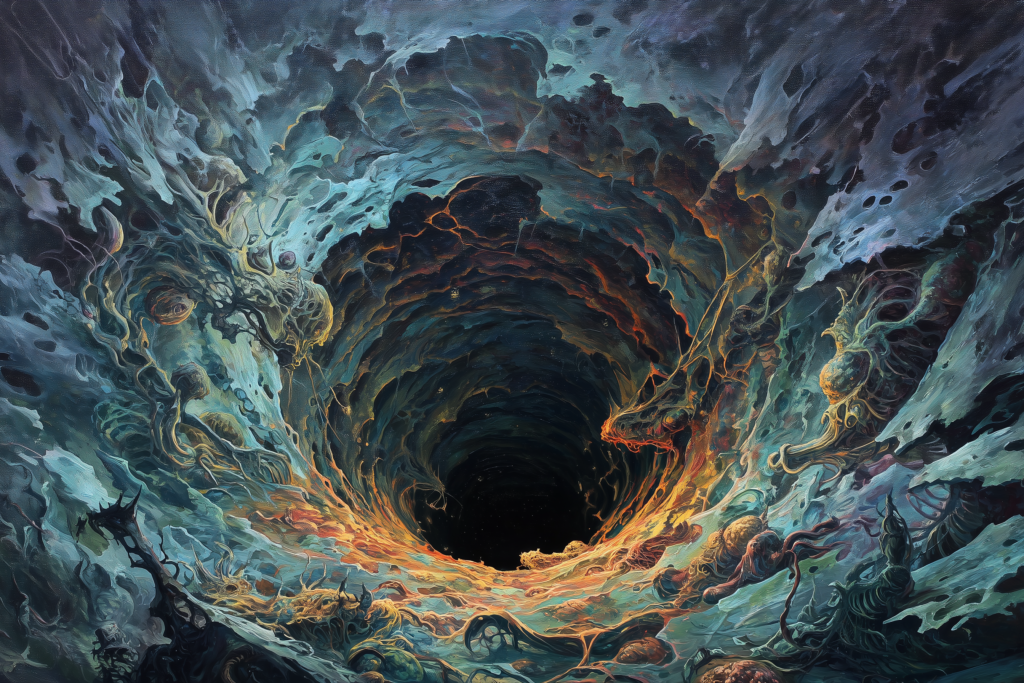 Demonkind rises within an Abyss whose oldest depths remain Qlippothic.
Click the image to enlarge or close.
Demonkind rises within an Abyss whose oldest depths remain Qlippothic.
Click the image to enlarge or close.
Predatory Forms Stabilise
Violent Abyssal intelligences begin retaining memory, intention and recognisable individual identity.
Broods Become Lineages
Demonic populations multiply and diversify around hunger, predation, domination, deceit, fury, corruption and ruin.
Qlippoth Supremacy Fractures
The ancient Qlippothic order breaks under internal rivalry and the expanding power of demonkind.
Demonic Dominions Endure
Powerful demons hold layers long enough for territory, inhabitants and magical conditions to reflect the will of their sovereigns.
Obox-ob and Mazmezz
Surviving Qlippoth traditions remember Obox-ob as one of the greatest powers of the old Abyssal order.
His rival Mazmezz defeats him during the struggles of that divided order and subsequently abandons the Qlippoths for demonkind.
Her defection does not create demons. It becomes one of the remembered fractures by which the old Qlippothic supremacy weakens while demonic lineages expand through contested layers.
The First Enduring Demonic Sovereigns
Demogorgon
Demogorgon becomes one of the great enduring sovereigns of the demonic Abyss and holds the Gaping Maw as a lasting realm of domination, mutation and predatory power.
His supremacy is immense without becoming universal rule over the whole Abyss.
Abraxas
Abraxas establishes himself among the enduring powers of the new Abyssal order and claims Pleroma.
His dominion gathers dangerous knowledge, occult formulae, forbidden revelation and magical secrets pursued without restraint.
Demonkind Inherits the Visible Abyss
The Qlippoths are not exterminated.
Demon peoples reproduce, diversify and occupy increasing numbers of contested layers, while surviving Qlippoth broods retreat into ancient strata, sealed regions and places where ordered reality remains weakest.
The Abyss therefore develops two overlapping histories: the visible demonic dominions and the older Qlippothic depths beneath them.
Infernal Hierarchies and Celestial Hosts
The great moral and philosophical planes now possess peoples capable of institutions, territorial defence, diplomacy and organised interpretations of authority.
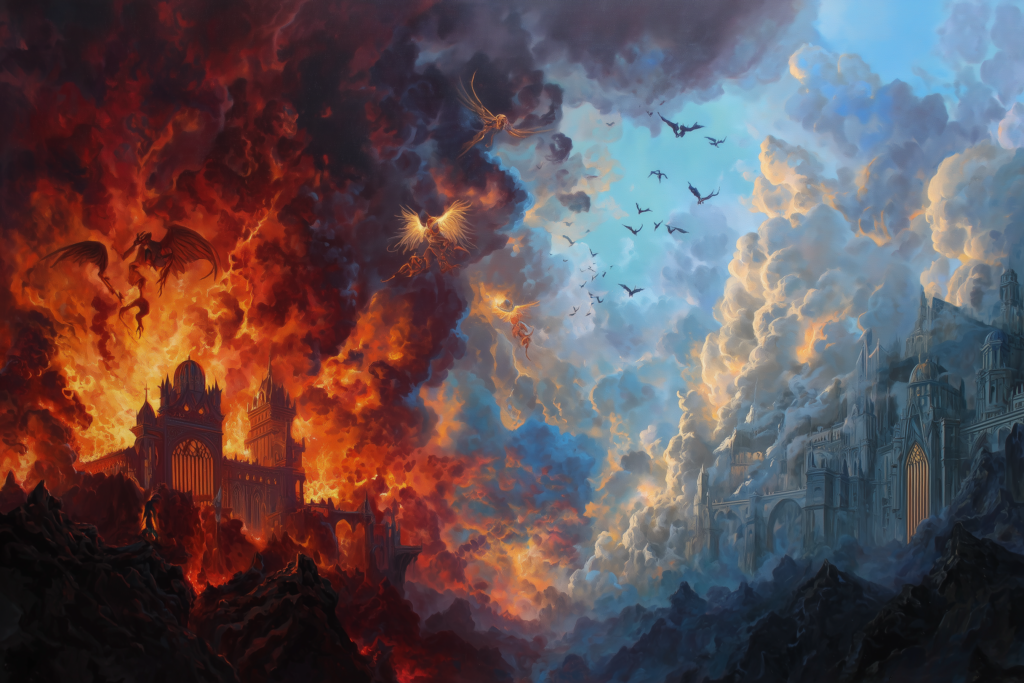 Infernal and celestial societies emerge as competing answers to authority,
obligation, protection and rule. Click the image to enlarge or close.
Infernal and celestial societies emerge as competing answers to authority,
obligation, protection and rule. Click the image to enlarge or close.
Hell — Law Made into Dominion
Hell is already an ancient Outer Plane. Eon XVI is not its creation. It is the age in which recognisable devil civilisation becomes durable.
- Legions replace temporary war bands.
- Offices survive individual office-holders.
- Citadels become administrative centres.
- Contracts become political and territorial weapons.
- Promotion and punishment become systems of obedience.
- Territorial jurisdictions acquire lasting governments.
Devils are native infernal peoples. They are not fallen angels, and the later Great Fall does not create devilkind.
The Malefircareim
The oldest infernal traditions remember extraordinarily powerful early fiends known as the malefircareim. They belong to the violent consolidation of organised Hell and stand among its earliest remembered great powers.
Some survive the struggles that establish infernal civilisation. Others disappear through destruction, exile or political defeat.
Lucifer and the First Securely Remembered Infernal Regime
The first securely remembered sovereign regime of organised Hell belongs to the infernal ruler bearing the title Lucifer. Lucifer is a genuine earlier sovereign, not another name for Asmodeus and not an avatar concealing some more ancient ruler.
The Wars of Dominance belong to the violent consolidation of this Luciferian order. Older infernal powers resist the emerging regime, including the great malefircareim resistance associated with Verrier. Lucifer ultimately prevails, but the wars leave defeated, imprisoned and displaced powers whose consequences continue into later infernal history.
Under the Luciferian settlement, Astaroth, Dispater, Mammon, Adrammelek, Leviathan, Lilith, Sammael and Mephistopheles are remembered among the great territorial powers beneath the sovereign throne.
The Battles of Light and Greed
A later succession crisis comes from within organised devil civilisation itself. Asmodeus gathers infernal powers dissatisfied with Luciferian rule and powers that expect to profit from a new sovereign. The conflict is remembered as the Battles of Light and Greed. The exact sequence of battles remains unresolved.
Lucifer is displaced and Asmodeus takes the infernal throne. The change is political rather than cosmological: Hell remains Hell and devilkind remains devilkind; what changes is the sovereign of the organised infernal state.
By the end of the succession, Asmodeus already rules Hell. His accession therefore predates the Great Fall.
For the full infernal chronology, see History of Hell.
The Celestial Answers
Celestial civilisation develops through several distinct peoples rather than one universal host.
Angels
Angels act as messengers, guardians and agents of great cosmic obligations.
Archons
Archons unite ordered benevolence with protection, discipline and just restraint.
Guardinals
Guardinals defend refuge, living flourishing and freedom from predation.
Azatas
Azatas embody liberating benevolence, creative possibility and resistance to tyranny.
The Celestial Limitation
These peoples possess individual identity, judgement, emotion and differing interpretations of duty. They are not mindless instruments.
Yet their deepest purposes remain intrinsic to what they are. They have not yet encountered or acquired the mortal form of free choice that allows a being to stand outside inherited purpose and question whether it should obey at all.
Abaddon — Daemon Powers
Daemon peoples establish enclaves, fortresses and domains centred on ruin, annihilation, predation and the deliberate ending of what other powers seek to preserve.
Yugoloths and Mercenary Power
Yugoloths establish companies, enclaves, transport routes and intelligence networks across hostile planar frontiers.
Their loyalties can be purchased, but rarely mistaken for friendship. They become brokers, spies, mercenaries and profiteers in an age when planar war acquires logistics and diplomacy.
The First Infernal–Abyssal Fronts
Demonic expansion and infernal dominion collide along routes, gateways and strategic borders.
The conflict grows from incompatible systems of predation and control. Hell seeks hierarchy that can be administered and territory that can be held. The Abyss produces powers whose appetite, mutation and violence resist reliable subordination.
Fortresses, supply routes and permanent military commands turn these early clashes into enduring fronts. Later ages know the immense continuation of this struggle as the Blood War.
Celestial hosts oppose both predatory chaos and organised tyranny, while existential threats such as Qlippothic resurgence or renewed Far Realm contamination can still force temporary cooperation among enemies.
Primus and the Great Mechanism
The Great Mechanism is older than its organised population.
During Eon XVI its lawful processes acquire central consciousness, recognisable administrators and institutions capable of acting beyond automatic cycles.
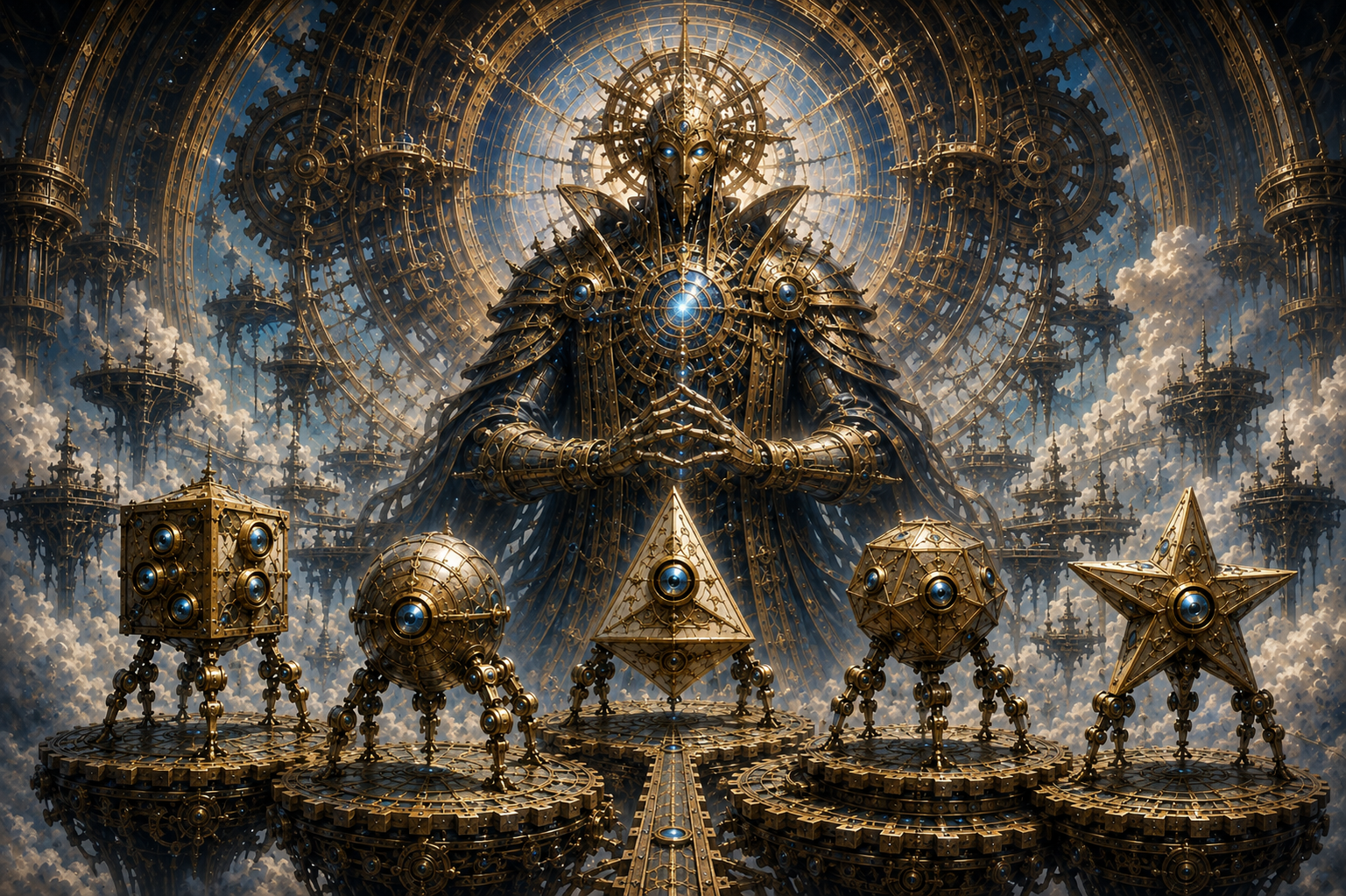 Primus and the modron hierarchy give conscious administration to an ancient plane
of absolute structure. Click the image to enlarge or close.
Primus and the modron hierarchy give conscious administration to an ancient plane
of absolute structure. Click the image to enlarge or close.
Primus
Primus awakens where innumerable lawful processes converge.
Some records preserve a first command from which the modron hierarchy is organised. Others describe Primus and the hierarchy becoming self-aware as parts of one great lawful system.
In either account, Primus becomes the principal conscious administrator of the Great Mechanism.
The Modron Hierarchy
Modrons maintain roads, measures, schedules, records, repairs, exchanges and ranked functions.
Their hierarchy allows duties to survive the loss or replacement of individual members.
The Earliest Inevitables
Inevitables emerge as specialised agents capable of pursuing defined violations across planar boundaries.
Their earliest concerns are foundational: protected boundaries, recognised covenant, lawful passage and deliberate disruption of established cosmic order.
The Limits of Primus
Primus administers the Great Mechanism and exercises enormous lawful influence.
Primus does not create the Codices, the Living Weave, fate, time or the cosmic laws inherited from earlier eons.
The First Great Genie Realms
The Elemental Planes are already ancient and inhabited by elementals, Primal Titans and primordial powers.
Eon XVI adds political continuity: genie peoples establish courts, dynasties, cities, roads, rivalries and recognised territories inside those older worlds.
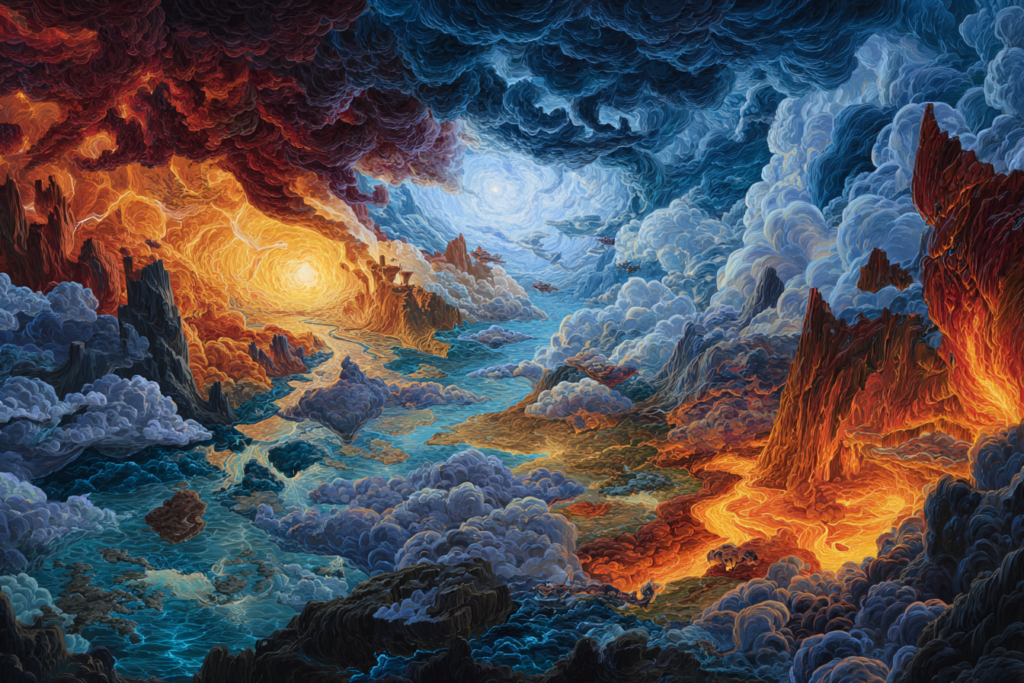 Genie states rise inside elemental realms that already possess immense native powers
and intelligent inhabitants. Click the image to enlarge or close.
Genie states rise inside elemental realms that already possess immense native powers
and intelligent inhabitants. Click the image to enlarge or close.
Djinn · Air
Djinn establish moving courts, storm routes, high citadels and confederations whose borders shift with current, allegiance and recognised passage.
Efreet · Fire
Efreet build furnace cities, foundries and fortified realms around heat, craft, tribute and command of stable ground.
Marids · Water
Marids govern current-bound territories, palace reefs and oceanic courts where prestige, rivalry and memory travel across immense depths.
Dao · Earth
Dao organise mineral dominions, vault roads and fortified holds around ownership, extraction, stonecraft and passage.
Abasheens of the Infinite Skies
Abasheens participate in the expanding Air courts as emissaries, couriers, informants and subtle agents of djinni nobility.
Their role reflects an important change in Eon XVI: elemental power now requires diplomacy and information as well as raw force.
Shaitan Jurisdictions
Within the Plane of Earth, Shaitans establish powerful jurisdictions built around stonecraft, title, wealth, pressure, roads, markets and enforceable contract.
Their political traditions coexist and compete with dao dominions, ancient elementals and primordial Earth powers.
Hawanar Houses
As Air and Fire courts maintain durable contact, Hawanar lineages occupy the contested cultural ground between djinn and efreet.
Their mixed elemental heritage gives them natural roles in diplomacy, border politics and rival noble houses connected to both realms.
Eblis, the Destructive Shadow
The Div tradition preserves Eblis as a destructive intelligence accompanying the emergence of organised geniekind.
He is not the creator of the Elemental Planes and not the creator of the genie peoples.
Eblis embodies negation beside their creative power: the impulse to ruin, corrupt or pervert what intelligent elemental civilisation can build.
The Older Powers Remain
Genie civilisation does not replace the ancient elemental order.
Flame, Tide, Stone and Gale remain Primal Titans. They are individual primordial intelligences rather than progenitors of every fire, water, earth or air creature. Apsu, Kishar and Mummu remain primordial powers, while discrete elementals, living storms, sentient seas, ancient fires and immense earth intelligences continue to inhabit the elemental realms alongside the new states.
The elemental planes therefore contain overlapping origins: native elemental life, primordial intelligences, Primal Titans, genie peoples and other beings whose similarities do not require descent from one universal ancestor.
Other Peoples of the Outsider Dawn
Demons, devils, celestials, modrons and genies do not exhaust the intelligent populations of Eon XVI.
Proteans
Within Limbo and other regions of unconstrained possibility, proteans preserve identity without accepting permanent form.
Aeons
Aeons gather around cosmic tensions and intervene where opposed forces threaten the relationship that permits both sides to remain part of creation.
Axiomites
Lawful intelligences translate principles into diagrams, engines and constructed forms. Their commitment to order does not require submission to Primus.
Planar Asuras
Planar asuras develop as disciplined destructive powers hostile to sacred order, imposed authority and doctrinal structures.
Native Planar Nations
Many realms produce peoples whose names never become universal categories. They form clans, custodial orders, monasteries, trading houses, cities and local nations.
Ancient Local Intelligences
Embryonic and local intelligences already present within older planes acquire neighbours, rivals and political relationships as the new civilisations expand.
From Inhabitants to Civilisations
The defining achievement of Eon XVI is continuity.
Institutions begin surviving the beings who founded them.
Languages and Records
Names, ranks, territorial claims, treaties and remembered betrayals survive changes of ruler.
Cities and Strongholds
Infernal citadels, radiant refuges, furnace cities, moving courts and clockwork avenues become permanent centres of power.
Routes and Embassies
Astral wakes, ley junctions and planar gates become recognised roads supporting trade, espionage, diplomacy and organised war.
Offices and Succession
Infernal ranks, celestial obligations, modron functions, Abyssal dominions and genie thrones become institutions rather than temporary gatherings.
Planar Warfare
Armies fight for gates, anchors, prisons, roads, foundries and fortresses whose capture can alter movement between realms.
Inherited Ruins
Defeated powers leave fortresses, archives, engines and abandoned jurisdictions preserving older forms of planar order.
Recognition without Peace
Repeated conflict teaches the planar powers that some boundaries, routes and diplomatic identities must be recognised if movement and warfare are to remain possible at all.
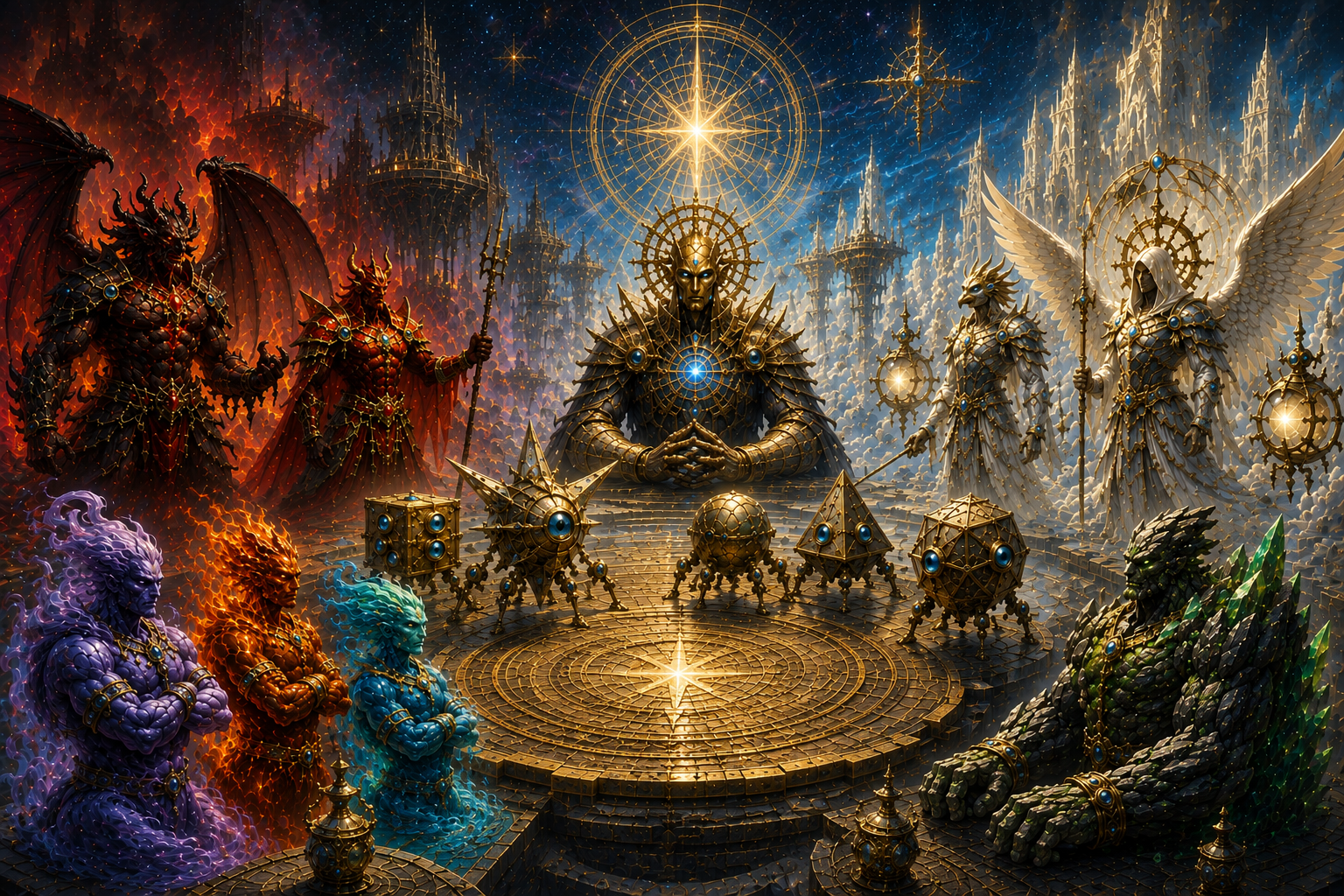 Early planar accords establish recognised envoys, guarded routes and temporary
common action without ending ancient rivalry. Click the image to enlarge or close.
Early planar accords establish recognised envoys, guarded routes and temporary
common action without ending ancient rivalry. Click the image to enlarge or close.
The earliest surviving accords are narrow and practical.
- Selected Astral and ley routes receive recognised protections.
- Envoys are distinguished from invading armies.
- Prisoner and hostage exchange becomes possible.
- Jurisdiction over some gates and anchors is formally recognised.
- Major Far Realm breaches and uncontrolled Qlippothic resurgence can trigger temporary common action.
The agreements are frequently violated.
Their importance lies in memory. An agreement can be inherited. A betrayal can survive the ruler who committed it. A border can be disputed because two peoples remember the same compact differently.
The planes now possess political history.
The Dawn of the Outsiders in Order
Events overlap between planes and cannot be reduced to one universal calendar, but the broad historical development is clear.
| Stage | Development | Permanent Result |
|---|---|---|
| 1 · Inheritance | The planes continue after the Great Retreat with ancient powers, elementals, Astral remnants, Qlippoths, engines and primordial beings still present. | The emerging peoples inherit realms whose histories predate them. |
| 2 · Stable Peoples | Planar intelligences develop persistent forms, lineages, ranks and methods of continuation. | Recognisable extraplanar peoples acquire durable identity. |
| 3 · Abyssal Succession | Demonic lineages expand while the divided Qlippothic order loses broad control of the visible Abyss. | Demonic dominions coexist with deeper Qlippothic strata. |
| 4 · Organised Planar Powers | Devils, celestials, daemons, yugoloths, modrons and other peoples establish strongholds, offices, armies and lasting political institutions. | Planar institutions begin surviving individual rulers. |
| 5 · Luciferian Hell | Native devil civilisation consolidates beneath the sovereign bearing the title Lucifer and the first securely remembered infernal regime. | Hell becomes a durable territorial state whose civilisation predates the Great Fall. |
| 6 · Asmodean Succession | The Battles of Light and Greed displace Lucifer and establish Asmodeus as sovereign of Hell. | The Asmodean state exists before celestial exiles later enter infernal politics. |
| 7 · Elemental Sovereignties | Djinn, efreet, marids, dao, Shaitans, Abasheens and other genie peoples establish courts and political networks. | Elemental diplomacy, trade, rivalry and dynastic power become enduring features of the Inner Planes. |
| 8 · Planar Civilisation | Languages, recognised routes, embassies, fortresses, wars and accords connect the emerging societies. | The multiverse acquires continuous political history. |
What Eon XVI Leaves Behind
Pre-Pantheon Strongholds
Fortresses and jurisdictions preserve planar law and allegiance rooted in powers older than most later divine courts.
Ancient Planar Wars
Infernal–Abyssal fronts, demon–Qlippoth hatred and rival planar claims acquire histories longer than many worlds. The infernal–Abyssal struggle develops into the ancient foundation of the later Blood War.
An Infernal State before the Fallen
Hell enters the following eon as an existing civilisation rather than an empty realm waiting for rebellious celestials. It already possesses native devils, armies, territorial government, ancient powers, bureaucracy, contracts and a sovereign state ruled by Asmodeus.
The Celestial Orders
Angels, archons, guardinals and azatas inherit durable identities, relationships and institutions while remaining bound to profound celestial purposes.
They do not yet understand the full implications of mortal free will.
First Genie Dynasties
Elemental courts preserve old claims to roads, mines, foundries, currents, gates and tribute.
Modron Records
The Great Mechanism retains schedules, maps, duties and agreements whose original participants may no longer exist.
Ancient Accords
Old treaties continue to define recognised passage, diplomatic status and obligations between hostile realms.
Older Powers beneath New States
Primal Titans, elementals, primordial beings, Qlippoths, divine fragments and alien wounds remain beneath the political order created during the Outsider Dawn.
The Question Waiting beyond Eon XVI
The outsider civilisations have learned how to preserve institutions across immense spans of time. They have not learned what happens when beings created around inherited cosmic purpose encounter mortals who can question that purpose itself.
That question belongs to the next eon.
Adventures in the First Planar Civilisations
The Qlippoth Claim
An ancient Abyssal territory claimed by demonkind contains an older Obox-ob seal proving the layer belonged to a Qlippoth brood before demonic conquest.
The Empty Modron Office
A vacant function within the Great Mechanism begins appointing temporary agents to repair a route claimed by several hostile powers.
The Shaitan Contract
A forgotten Earth-plane accord grants safe passage through a crucial vault road, but the surviving contract demands payment in a form no current ruler understands.
The Shadow of Eblis
An elemental archive preserves evidence that an act of destruction attributed to an entire genie court was actually the work of Eblis.
The Broken Accord
A protected diplomatic route collapses because two planar powers preserve incompatible copies of the same Eon XVI treaty.
The Common Peril
A sealed Far Realm wound activates an ancient accord requiring fiends, celestials, modrons and elemental envoys to cooperate until the breach is contained.
What the Outsider Dawn Establishes
The Planes Are Older than Their Civilisations
Eon XVI does not create the Abyss, Hell, the flourishing planes, the Elemental Planes, the Great Mechanism, the Astral Plane or the mirror realms.
It records the emergence of durable peoples and political histories within those already ancient realities.
Qlippoths and Demons Are Distinct
Qlippoths possess an Abyssal history older than demonkind. Demons become the more visible population across much of the Abyss without eliminating the ancient Qlippothic depths.
Devils and Fallen Celestials Are Distinct
Devils are native inhabitants of an infernal civilisation whose durable political history begins in Eon XVI. Fallen celestials belong to a later event.
Lucifer Precedes Asmodeus
Lucifer is the title borne by a genuine earlier sovereign of organised Hell. Asmodeus later displaces that ruler during the Battles of Light and Greed and therefore rules Hell before the Great Fall.
Celestial Identity Is Not Yet Mortal Free Will
Early celestials possess identity, judgement, emotion and the ability to interpret duty. Those qualities do not yet amount to the mortal capacity to reject inherited celestial purpose.
Primal Titans Are Not Universal Creature Ancestors
Flame, Tide, Stone, Gale, Dream and Dusk are ancient individual powers. Their existence does not mean every creature associated with fire, water, earth, air, dream or shadow descends from them.
Primus Administers; Primus Does Not Create Cosmic Law
The Great Mechanism and the cosmic laws it expresses are older than Primus as a conscious ruler. Primus gives organised administration to ancient lawful structures.
Eblis and Geniekind
Eblis belongs to the destructive shadow surrounding the emergence of organised genie civilisation. He does not create the elemental realms or the genie peoples.
Ancient Draconic Presence
Apsu remains present within the elemental cosmology as a primordial freshwater power with an explicitly draconic manifestation. His presence establishes a named primordial draconic power, not the universal origin of dragonkind.
Far Realm Powers Remain Separate
Uvuudaums, Azathoth and other alien powers belong to the Far Realm rather than to the outsider peoples organising within the familiar planes.
They nevertheless affect Eon XVI whenever breaches, corrupted routes or ancient wounds bring them into contact with planar civilisation.
Chronology at a glance
- The planes predate the organised outsider civilisations.
- The Cosmic Leylines remain active throughout Eon XVI.
- Flame, Tide, Stone, Gale, Dream and Dusk remain active Primal Titans.
- The Primal Titans are not universal ancestors of creatures associated with their realms.
- Discrete elementals already inhabit the Elemental Planes.
- Astral Ripple remnants and dormant Embers continue within deep Astral regions.
- Apsu, Kishar and Mummu remain primordial elemental powers.
- Apsu possesses an explicitly draconic manifestation.
- Qlippoths predate demonkind within the Abyss.
- Demonkind breaks broad Qlippothic supremacy without exterminating the older population.
- Obox-ob and Mazmezz belong to the remembered Abyssal succession.
- Demogorgon and Abraxas are enduring demonic sovereigns of the new Abyssal order.
- Native devil civilisation becomes durable during Eon XVI.
- The malefircareim belong to the early consolidation of organised Hell.
- Lucifer rules the first securely remembered sovereign infernal regime.
- Asmodeus displaces the Luciferian sovereign during the Battles of Light and Greed.
- Asmodeus rules Hell before the Great Fall.
- Devils are not simply fallen angels.
- The Great Fall occurs later, in Eon XX; Eon XVII belongs to the earlier divine-generation sequence.
- Angels, archons, guardinals and azatas establish celestial institutions.
- Early celestial identity and judgement are distinct from mortal-style free will.
- Daemon and yugoloth societies become organised planar powers.
- Primus and the modron hierarchy administer the Great Mechanism.
- The earliest inevitables enforce foundational lawful categories.
- Djinn, efreet, marids, dao and other genie peoples establish elemental states.
- Abasheens participate in the political life of the Air courts.
- Shaitans maintain organised Earth-plane jurisdictions.
- Hawanar houses occupy the political border between Air and Fire.
- Eblis exists as a destructive intelligence associated with geniekind.
- Proteans, aeons, axiomites, planar asuras and local planar nations belong to the wider Eon XVI population.
- Early planar accords establish recognised routes and diplomatic identity without requiring one universal first treaty.
- The infernal–Abyssal fronts form the ancient roots of the later Blood War.
- Nihros remains confined.
- The Far Realm remains inhabited by Uvuudaums, Azathoth and other alien powers.
Dawn of the Outsiders Clarified
What defines Eon XVI?
Ancient planar intelligences become durable peoples, civilisations and political institutions capable of carrying history across generations of rule.
Are the planes created during Eon XVI?
No. The planes are already ancient. Eon XVI records the rise of organised populations within them.
Are Qlippoths demons?
No. Qlippoths are an older Abyssal population. Demonkind rises within the ancient Abyss and breaks much of their former supremacy.
What role does Mazmezz play?
Mazmezz defeats Obox-ob during the struggles of the old Qlippothic order and subsequently aligns with demonkind. Her defection is one important fracture in the wider Abyssal succession.
Who are the major enduring Abyssal sovereigns recorded here?
Demogorgon and Abraxas are among the great demonic rulers whose dominions become durable parts of the new Abyssal order.
What changes in Hell?
Devils turn hierarchy, obligation, office and contract into durable systems of government, military command and territorial control.
Are devils fallen angels?
No. Devilkind already possesses an ancient civilisation before the Great Fall. Fallen celestials enter infernal politics later.
Who rules organised Hell before Asmodeus?
The first securely remembered sovereign regime belongs to Lucifer.
How does Asmodeus become ruler of Hell?
Asmodeus leads the infernal succession struggle remembered as the Battles of Light and Greed, displaces the sovereign bearing the title Lucifer and takes the infernal throne.
Does the Great Fall happen during Eon XVI?
No. The Great Fall belongs to Eon XX. Eon XVI establishes the infernal and celestial civilisations that later divine generations inherit, while Eon XVII belongs to the earlier pre-Fall divine sequence.
Does the Great Fall create Hell?
No. Hell itself is much older, and organised devil civilisation already exists when the Fallen arrive.
Do the celestials already possess mortal-style free will?
No. They possess identity, judgement, emotion and substantial freedom in how they perform their purposes, but mortal free will introduces the more radical capacity to question and reject inherited purpose itself.
Who are the principal celestial peoples of Eon XVI?
Angels, archons, guardinals and azatas establish organised strongholds, institutions and obligations across the flourishing planes and vulnerable cosmic routes.
What is Primus?
Primus is the central conscious administrator of the Great Mechanism, acting through the modron hierarchy without being the creator of cosmic law itself.
What do the first inevitables enforce?
They pursue violations of foundational lawful categories such as protected boundaries, recognised covenant, lawful passage and deliberate disruption of established cosmic order.
Which genie peoples possess organised societies?
Djinn, efreet, marids and dao establish great elemental courts and states. Abasheens participate in Air-plane diplomacy, Shaitans maintain powerful Earth-plane jurisdictions, and Hawanar houses occupy the political border between Air and Fire.
Did Flame, Tide, Stone and Gale create all elemental creatures?
No. They are individual Primal Titans. Elementals and other creatures associated with Air, Earth, Fire and Water possess multiple independent origins.
Who is Eblis in this chronology?
Eblis is a destructive intelligence associated with the emergence of organised geniekind: a negating power beside their ability to create, shape and build.
Does Apsu still exist during Eon XVI?
Yes. Apsu remains a primordial freshwater power with a draconic manifestation within the elemental cosmology.
When do the roots of the Blood War appear?
Its oldest roots lie in the infernal–Abyssal fronts of Eon XVI, when organised Hell and expanding demonic dominions begin fighting over routes, borders, fortresses and strategic access between the Lower Planes.
What is the purpose of the early planar accords?
They recognise selected routes, envoys, jurisdictions and temporary common action so that diplomacy and conflict can continue without every encounter becoming unrestricted planar war.
Keep this reference growing
If this page helped with your reading or game, you can support its upkeep or explore the curated books.
Explore the Bookshop — epics, classics and stories behind imagined worlds.