
Monster, Genie, Shaitan, Lord Beneath the First Stone
Genie, Shaitan, Lord Beneath the First Stone
The Shaitan is a sovereign genie of stone, metal, pressure, and buried dominion: an earth-lord of mountains, fortresses, tombs, and treasures too old and too deep to belong safely to men.
Overview
The Shaitan is not merely an elemental being of earth in the abstract. It is one of the ruling powers of weight, structure, and possession: a lord of the hard world beneath and within, where mountains keep their dead, citadels root kingdoms in stone, and wealth lies buried under law, blood, and time. If the Hawanar belongs to heat and movement, the Shaitan belongs to mass and endurance. It is a creature of foundations rather than storms, of enclosure rather than spectacle, and of sovereignty measured in what can be held, sealed, and outlasted.
In your setting, Shaitans belong naturally in the mountain belts, desert escarpments, canyon fortresses, quarry-roads, mine-realms, tomb-cities, buried shrines, and understructures of old capitals stretching through regions such as Arabia, Persia, Anatolia, the Caucasus, the Levant, Egypt’s quarry deserts, and other lands where mountains, stonework, and buried wealth shape power. They suit your world especially well, because they feel like the supernatural counterpart to fortress dynasties, siege walls, imperial roads, hidden vaults, conquered ruins, and old kingdoms that still rest on bones and cut rock.
A Shaitan should be treated not as a wandering genie, but as a territorial and possessive power. It is the sort of being that claims a mountain pass, a royal quarry, a silver vein, a buried necropolis, a cliff citadel, or the first stone beneath a city wall—and then behaves as though all later human ownership is merely a temporary argument.
Appearance
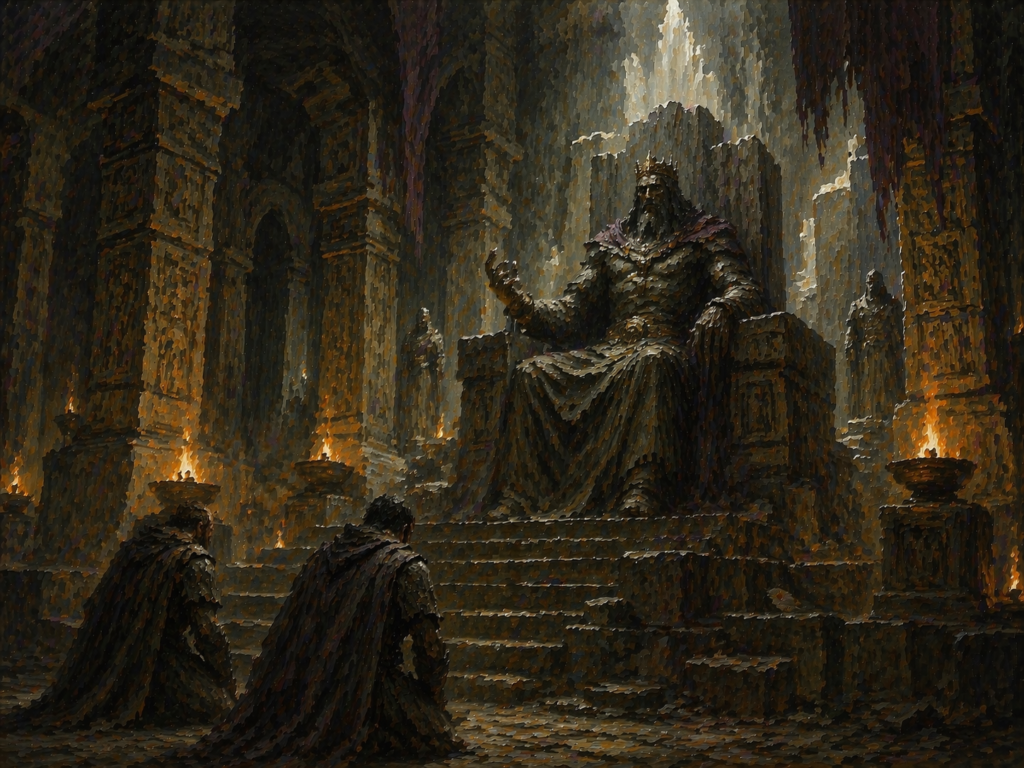
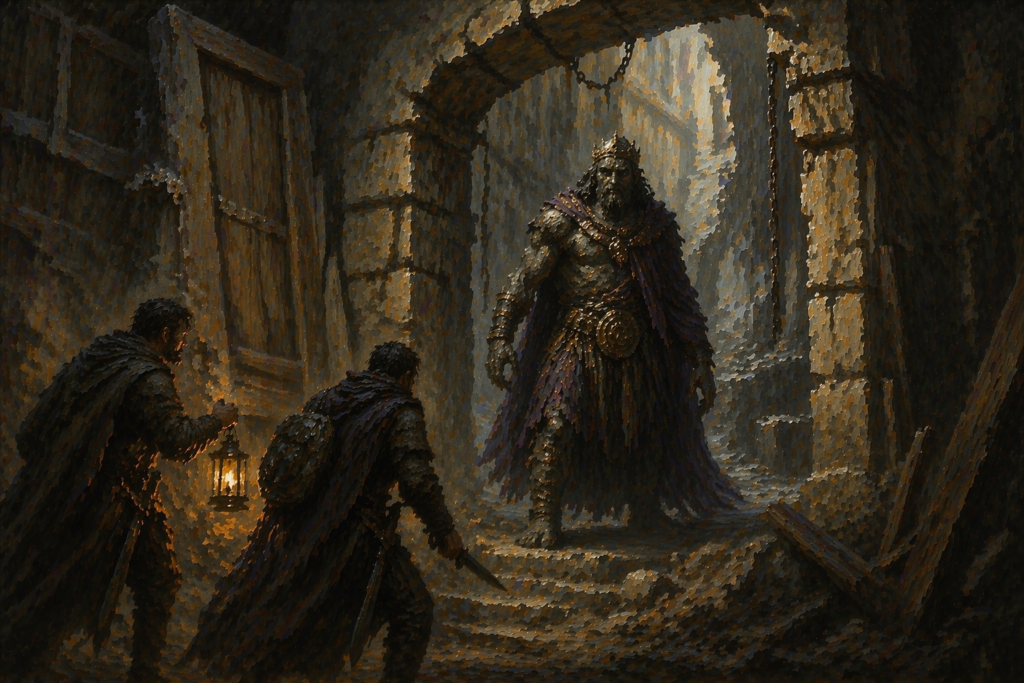
A Shaitan appears as a mighty humanoid figure of regal and terrible solidity, as though an ancient king had been carved from the richest and hardest substances of the earth and then given breath, pride, and command. Its flesh may resemble polished basalt, dark granite, veined marble, bronze-streaked porphyry, serpentine, or iron-rich stone burnished by subterranean heat. Beneath the surface, seams of metal may gleam like ore exposed in a quarry face: copper in the throat, silver in the brow, gold in the arms, black iron through the chest.
Its face is severe, monumental, and unmistakably lordly. The features often look less grown than hewn, like those of a conqueror immortalized in temple relief and then awakened from the wall. Its eyes may burn like embers behind cracked stone, molten metal glimpsed through fissures, or gems lit from deep within the mountain’s dark. Its beard, hair, or braided crown-work may seem formed of black mineral strands, chiseled obsidian, linked metal, worked beads, or heavy angular locks like broken statuary given deliberate form.
A Shaitan adorns itself as a ruler of buried wealth. It favors engraved gold, hammered bronze, iron rings, scaled lamellar, gem-set collars, heavy belts, worked stone diadems, and robes so rich they seem to have been paid for by mines rather than merchants. It should not look merely wealthy. It should look originary, as though mortal regalia were late imitations of what the deep earth first taught kings to wear.
Its presence alters a place not like weather, but like structural truth returning. Floors seem heavier beneath it. Dust trembles along the joints in the masonry. Doors feel older. Pillars loom more severely. Vaults seem deeper than they were a moment before. Even in a finished chamber, a Shaitan gives the impression that the stone is remembering its first allegiance.
Behaviour
Shaitans are proud, hierarchical, patient, and intensely possessive. They do not hurry because they do not believe they need to. A Shaitan speaks with the calm of something that expects to outlast dispute, resistance, and even memory. It notices titles, boundaries, inheritance claims, excavation rights, burial customs, trespass, and all the little human fictions by which men pretend ownership over things drawn from the earth.
It respects craftsmanship, fortification, lineage, masonry, law, metallurgy, and any labor that turns raw matter into enduring form. A Shaitan may patronize masons, armorers, architects, engineers, quarry-masters, miners, dynasts, tomb-builders, and priests who keep the rites of old stone places. It admires things built to resist time, and it can reward service with treasure, fortification, and protection that last for generations.
None of this makes it gentle. Its patience is itself a threat. A Shaitan does not rage quickly because it does not need rage to dominate. Its displeasure is expressed in seizures, closures, claims, confiscations, structural punishments, and acts of crushing inevitability. Once it decides that a road, a vault, a tomb, or a fortress belongs to it, all opposing wills become, in its eyes, mere delays in the process of acknowledgment.
Habitat
In your campaign world, Shaitans belong above all where stone, burial, treasure, and stronghold-power meet.
They are most at home in mountain citadels, mine-realms, subterranean halls, canyon fortresses, desert cliff palaces, buried temples, royal quarries, necropolises, cavern roads, old bridges cut through living rock, and the understructures of ancient cities layered over older ruins. They fit especially well beneath mountains, inside fortress-hearts, in dynastic tomb-complexes, in rich mineral regions, and in those places where kingship and stonework have long been inseparable.
Outside such environments, a Shaitan should feel less naturally rooted, but never harmless. In marsh, open sea, or broad empty grassland, it is displaced. In a great city, however, it can be disturbingly at home, especially one of walls, cisterns, vaults, gates, tunnels, and buried layers of older conquest. A Shaitan in a city may care less for the living streets than for what lies below them: first foundations, forgotten shrines, sealed crypts, treasury vaults, collapsed halls, and the stone on which later rulers have only briefly perched.
Modus Operandi
A Shaitan prefers dominion by claim, weight, and inevitability rather than sudden spectacle. It does not need to overwhelm the eye when mass itself is enough. It enters a dispute by asserting ownership, precedence, burial right, mining authority, quarry claim, toll privilege, fortification covenant, or stone-bound inheritance. It may close a mountain pass, seal a tomb-road, take a share of all ore from a region, claim a fortress as its older holding, or stand behind a mortal house whose power depends on walls, mines, and buried regalia.
Where a Hawanar halts movement, a Shaitan obstructs outcome. Gates jam. Tunnels collapse. Floors split. Pillars crack. Portcullises fall. Bridges settle. Statues seem watchful. Chambers become traps. The built environment ceases to feel neutral and becomes an accomplice. It does not need to hurl flame across a hall if it can make the hall itself reject those within it.
In conflict, a Shaitan should feel less like a berserk giant and more like a sovereign of pressure and structure. It crushes, seals, confines, buries, pins, and outlasts. It dominates chokepoints, elevation, walls, debris, and narrow passages. Even its violence should feel architectural: not mere impact, but enforced submission by stone.
Motivation
A Shaitan desires wealth, but not as a miser does. It wants possession ratified by endurance. Gold matters because it is buried power made visible. Gems matter because they are beauty produced by darkness and pressure. Fortresses matter because they are dominion given walls. Tombs matter because they bind memory to territory. Mines matter because they turn hidden earth into tribute.
More deeply, the Shaitan wants recognition that some things should not belong to the transient hands of men at all. A kingdom’s silver veins, an emperor’s buried regalia, the black stone beneath a city, a founder-king’s tomb, a mountain fortress commanding the trade road, a quarry from which dynasties built their capitals—these are exactly the sorts of things a Shaitan may claim, extort, guard, or rule through.
One Shaitan may be a mountain prince taxing all passage through a gorge. Another may be the unseen patron behind a dynasty of fortress-builders. Another may be a tomb-lord who treats a royal necropolis as his estate. Another may keep miners, masons, and quarry-slaves in a realm beneath the hills. Another may be an exiled underking building a new dominion beneath mortal lands. Another may seek a lost crown, seal, gate, or buried charter that would prove its sovereignty over an entire region of stone and treasure.
This is what makes the Shaitan dangerous. It does not merely want riches. It wants the right to decide what may be taken from the earth, who may build upon it, and who must pay for standing where they stand.
In the World
A Shaitan is best used as a regional or structural power rather than a random encounter. It works especially well as a mountain-pass sovereign, a buried treasure lord, a fortress patron behind a ruling house, a tomb-city guardian or extortioner, a quarry or mine overlord, a subterranean prince beneath an old capital, or a claimant to a crown founded on stone, conquest, and burial.
Used properly, a Shaitan does not feel like just another genie. It feels like the will of the mountain given rank, law, and ownership.
Where one dwells for long, vaults grow more secretive, walls seem older than they are, treasure sleeps badly, and men begin to speak more quietly in the presence of stone.
Shaitan 5.5
Shaitan, Pathfinder
Shaitan
Large elemental (genie), typically lawful neutral or lawful evil
Armor Class 20 (natural armor)
Hit Points 255 (22d10 + 132)
Speed 30 ft., burrow 30 ft.
| STR | DEX | CON | INT | WIS | CHA |
|---|---|---|---|---|---|
| 24 (+7) | 10 (+0) | 23 (+6) | 18 (+4) | 17 (+3) | 20 (+5) |
Saving Throws Str +12, Con +11, Wis +8, Cha +10
Skills Insight +8, Intimidation +10, Perception +8, Persuasion +10
Damage Resistances bludgeoning, piercing, and slashing from nonmagical attacks
Damage Immunities poison
Condition Immunities poisoned
Senses darkvision 120 ft., tremorsense 60 ft., passive Perception 18
Languages Terran, Common, one regional courtly language; telepathy 120 ft.
Challenge 16 (15,000 XP)
Proficiency Bonus +5
Traits
Earth Glide. The Shaitan can burrow through nonmagical, unworked earth and stone without disturbing the material it moves through.
Lord of Stone and Metal. The Shaitan ignores difficult terrain made of earth, rubble, worked stone, masonry, or metal debris. Stone and metal objects and structures have disadvantage on saving throws against the Shaitan’s effects.
Magic Resistance. The Shaitan has advantage on saving throws against spells and other magical effects.
Sovereign Weight. A creature that starts its turn within 10 feet of the Shaitan must succeed on a DC 18 Strength saving throw or have its speed reduced by 10 feet until the start of its next turn.
Innate Spellcasting
The Shaitan’s spellcasting ability is Charisma (spell save DC 18, +10 to hit with spell attacks). It can innately cast the following spells, requiring no material components:
At will: detect magic, mold earth, stone shape
3/day each: meld into stone, passwall, wall of stone
1/day each: move earth, stoneskin
Actions
Multiattack. The Shaitan makes three attacks, using any combination of Stone Fist and Vaultbreaker. It can replace one attack with Claim of the Deep.
Stone Fist. Melee Weapon Attack: +12 to hit, reach 10 ft., one target. Hit: 18 (2d10 + 7) bludgeoning damage. If the target is Large or smaller, it must succeed on a DC 20 Strength saving throw or be knocked prone.
Vaultbreaker. Ranged Weapon Attack: +12 to hit, range 60/180 ft., one target. Hit: 16 (2d8 + 7) bludgeoning damage plus 9 (2d8) force damage. If the target is standing on the ground, it must succeed on a DC 20 Strength saving throw or be pushed up to 10 feet.
Claim of the Deep. One creature the Shaitan can see within 60 feet must succeed on a DC 18 Wisdom saving throw or become claimed until the end of the Shaitan’s next turn. While claimed, the creature’s speed is 0, and the first time on each turn that it takes damage from the Shaitan, it takes an extra 9 (2d8) bludgeoning damage.
Sealing Collapse (Recharge 5–6). The Shaitan causes stone, floor, walls, or supporting ground within 60 feet to convulse and crush inward. Each creature in a 20-foot cube originating from a point the Shaitan can see must make a DC 19 Dexterity saving throw. On a failed save, a creature takes 36 (8d8) bludgeoning damage and is restrained by rubble or jutting stone. On a successful save, it takes half as much damage and isn’t restrained. A restrained creature can use an action to make a DC 20 Strength check, freeing itself on a success. If the area has no available stone surface, the Shaitan instead causes the ground to erupt in jagged rock and debris.
King’s Embargo (1/Day). The Shaitan chooses up to three creatures it can see within 90 feet and names them trespassers, thieves, or oath-breakers. Each target must make a DC 18 Charisma saving throw. On a failed save, the target takes 22 (4d10) psychic damage and 22 (4d10) bludgeoning damage, and for 1 minute it can’t willingly move through a doorway, gate, archway, tunnel mouth, or opening wider than 5 feet. A target repeats the save at the end of each of its turns, ending the effect on itself on a success. On a successful initial save, a creature takes half as much damage and suffers no other effect.
Bonus Actions
Stone Step. The Shaitan moves up to half its speed without provoking opportunity attacks, provided it begins and ends this movement on stone, earth, rubble, or worked masonry.
Raise the Barrier. The Shaitan causes a section of ground or nearby masonry to rise in an unoccupied space it can see within 30 feet, creating a barrier that is 10 feet long, 5 feet high, and 1 foot thick. The barrier provides half cover and lasts until the start of the Shaitan’s next turn.
Reactions
Punish Trespass. When a creature within 30 feet of the Shaitan moves into or through a doorway, tunnel, passage, or gap in stonework, the Shaitan forces that creature to make a DC 20 Strength saving throw. On a failed save, the creature takes 10 (3d6) bludgeoning damage and is knocked prone.
Legendary Actions
The Shaitan can take 3 legendary actions, choosing from the options below. Only one legendary action can be used at a time and only at the end of another creature’s turn. The Shaitan regains spent legendary actions at the start of its turn.
Move. The Shaitan uses Stone Step.
Stone Fist. The Shaitan makes one Stone Fist attack.
Shift the Masonry (Costs 2 Actions). The Shaitan chooses a point it can see within 60 feet. The ground in a 10-foot square centered on that point becomes difficult terrain until the start of the Shaitan’s next turn. Each creature standing there must succeed on a DC 18 Dexterity saving throw or fall prone.
Seal the Way (Costs 2 Actions). The Shaitan targets a doorway, passage, stair, or opening it can see within 60 feet. Stone or packed earth partially closes it until the start of the Shaitan’s next turn. The space is difficult terrain, and the first creature to move through it before then takes 9 (2d8) bludgeoning damage.
Burden of the Mountain (Costs 3 Actions). The Shaitan chooses one creature it can see within 60 feet. That creature must succeed on a DC 18 Strength saving throw or become restrained by supernatural weight until the end of its next turn.
Treasure
A Shaitan’s wealth is never loose loot. It is held, sealed, recorded, and claimed.
A typical Shaitan treasury includes 22,000 gp in stamped gold coin or weighed bullion, 8,000 sp in sealed chests, and 16 iron or gold ingots worth 250 gp each. Its regalia often includes 10 cut garnets worth 100 gp each, 8 sapphires worth 250 gp each, 4 emeralds worth 1,000 gp each, a gold-and-onyx collar worth 2,500 gp, and a worked stone-and-gold diadem worth 1,800 gp.
Its greater possessions usually reflect dynastic rule and buried wealth: a quarry-seal ring worth 900 gp, a pair of engraved bronze arm-rings worth 600 gp each, a ceremonial mace or axe with a gem-set haft worth 1,500 gp, three carved ritual stone tablets worth 400 gp each, a vault key assembly of bronze and iron worth 750 gp, and burial goods or crown fragments worth a total of 3,000 gp.
For magic treasure, one or two of the following suit the Shaitan especially well: Mace of Smiting, Belt of Hill Giant Strength, Ring of X-ray Vision, Stone of Good Luck, Immovable Rod, or a sealed geomantic tablet that functions as a one-use passwall or wall of stone effect.
Its most dangerous treasure is often not portable wealth at all, but control: title-deeds to quarries, keys to fortified vaults, maps to sealed tomb-chambers, mine accounts, dynastic seals, and the hidden location of treasures buried under the first stones of fallen kingdoms.
Shaitan
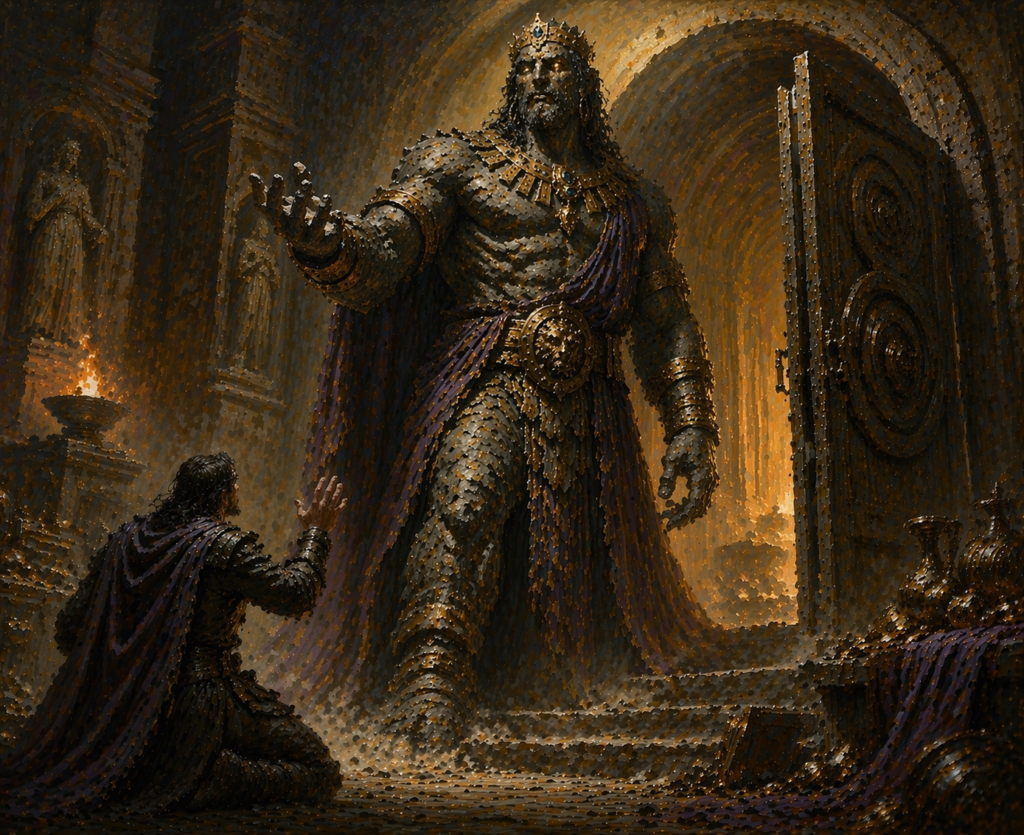
This broad-shouldered being, its muscles seemingly carved from the very living rock, has glossy skin of deep umber and eyes that glitter like agates, its bald head and neatly trimmed beard of jet-black gleaming like oiled marble. It moves with deliberate economy and smooth precision.
Shaitans are genies from the Elemental Plane of Earth. With flesh of rare metals, glittering gems, or polished stone, they are the strongest physically of the four genie races. A shaitan stands about 11 feet tall and weighs 5,000 pounds. When they move, the muted sound of stone grating on stone follows.
| Genie, Shaitan CR 7 |
| Always LN Large outsider (earth, extraplanar) Init +5; Senses Darkvision 60 ft., tremorsense 60 ft.; Listen +14, Spot +14 |
| Defense |
| AC 20, touch 10, flat-footed 19 (+1 Dexterity, +10 natural, -1 size) hp 58 (9d8+18) Fort +8, Ref +7, Will +8 Immune electricity |
| Offense |
| Speed 20 ft., burrow 60 ft., Climb 20 ft. Melee 2 slams +12 (2d6+12) Space 10 ft., Reach 10 ft. Special Attacks metalmorph, plane shift, stone curse Spell-Like Abilities (CL 12th) At will – meld into stone, soften earth and stone, stone shape, veil (self only) 3/day – quickened glitterdust (DC 14), stoneskin, wall of stone 1/day – stone tell, transmute mud to rock, transmute rock to mud |
| Statistics |
| Strength 26, Dexterity 13, Constitution 15, Intelligence 14, Wisdom 15, Charisma 15 Base Atk +9; Grapple +21 Feats Combat Casting, Improved Bull Rush, Improved InitiativeB, Power Attack, Quicken Spell-Like Ability (glitterdust) Skills Appraise +14 (+19 against gems, metal, and stone), Bluff +14, Concentration +14, Craft (gemcutting) +19, Knowledge (architecture and engineering) +19, Listen +14, Profession (miner) +19, Search +14 (+19 in stonework), Sense Motive +14, Spot +14; Racial Modifiers +5 Craft (gemcutting), +5 Knowledge (architecture and engineering), +5 Profession (miner), +5 Appraise/Search made against stone or gem subjects Languages Celestial, Common, Ignan, Terran SQ earth mastery, stone glide |
| Ecology |
| Environment Elemental Plane of Earth Organization solitary, company (2-4), or band (6-15) Treasure standard coins; double goods (gems and metals only); standard items Advancement 10-14 HD (Large), 15-27 HD (Huge) |
| Special Abilities |
| Earth Mastery (Ex) Shaitans gain a +2 bonus on attack rolls and opposed Strength-based checks (such as grapple and bull rush) when both they and their opponent are standing on any stone or earthen surface. Metalmorph (Su) As a standard action, a shaitan may touch any single metal object of no more than 10 pounds and transform it into any other metal, including adamantine, mithril, cold iron, silver, or gold. Transformed metal remains transformed as long as the shaitan remains in contact with the metal, and for 1 day after the shaitan releases the object. A shaitan may use this ability to warp and deform any one metal object within 20 feet. This functions like warp wood, but affects only metal objects that fail a DC 16 Fortitude save (attended objects use their wielder’s saves). Armor or shields lose half their bonus to AC (enhancement bonuses are unaffected), and weapons are rendered useless save as improvised clubs. The transformation lasts 1 minute, after which the affected metal reverts to its normal state. The save DC is Charisma-based. Plane Shift (Sp) Like all genies,shaitans can enter any of the elemental planes, the Astral Plane, or the Material Plane via plane shift, taking up to 8 additional creatures (caster level 13th). Stone Curse (Su) If a shaitan wins a bull rush check by 5 or more and pushes its target into a stone, metal, or crystal barrier, the target must make a DC 22 Reflex save or be forced into the barrier as if the target had cast meld into stone to merge with the object. The victim cannot exit the stone voluntarily unless he takes a full round action to make a successful DC 22 Fortitude save. Other creatures can use physical damage to the stone or magic spells to expel the trapped individual in the same way one can force someone out of meld into stone. The save DCs are Strength-based. Stone Glide (Su) Shaitans can move through stone, dirt, crystal, or metal as easily as a fish swims through water, using their burrow speed. This burrowing leaves behind no tunnel or hole or any other sign of passage. A Move earth cast on an area containing a burrowing shaitan flings it back 30 feet, stunning the creature for 1 round unless it succeeds on a DC 15 Fortitude save. This ability does not grant the Shaitan the ability to ignore damage from weapons made of stone, metal, or crystal, nor does it grant any protection against earth-based magic. |
Shaitan Pashas
A rare few (1% of the total population) shaitans are pashas. A shaitan pasha is an advanced, elite shaitan of no less than 18 Hit Dice. Their spell-like abilities function at CL 18th. Shaitan pashas can use Earthquake 1/day as a spell-like ability, and can grant up to 3 wishes per day (non-genies only) but are often loath to do so and when they do, are fond of honoring the wish strictly as worded and not as intended by the wisher. A sample Shaitan pasha statblock appears on page 15 of this volume of Pathfinder.
Keep this reference growing
If this page helped with your reading or game, you can support its upkeep or explore the curated books.
Explore the Bookshop — epics, classics and stories behind imagined worlds.