
monster, Genie, Hawanar, Princes of the Burning Wind
Genie, Hawanar, Princes of the Burning Wind
The Hawanar is a princely jinn of burning wind: a rare high-born strain of fire and air, feared across the desert-fire lands as ruler, envoy, extortioner, and living catastrophe.
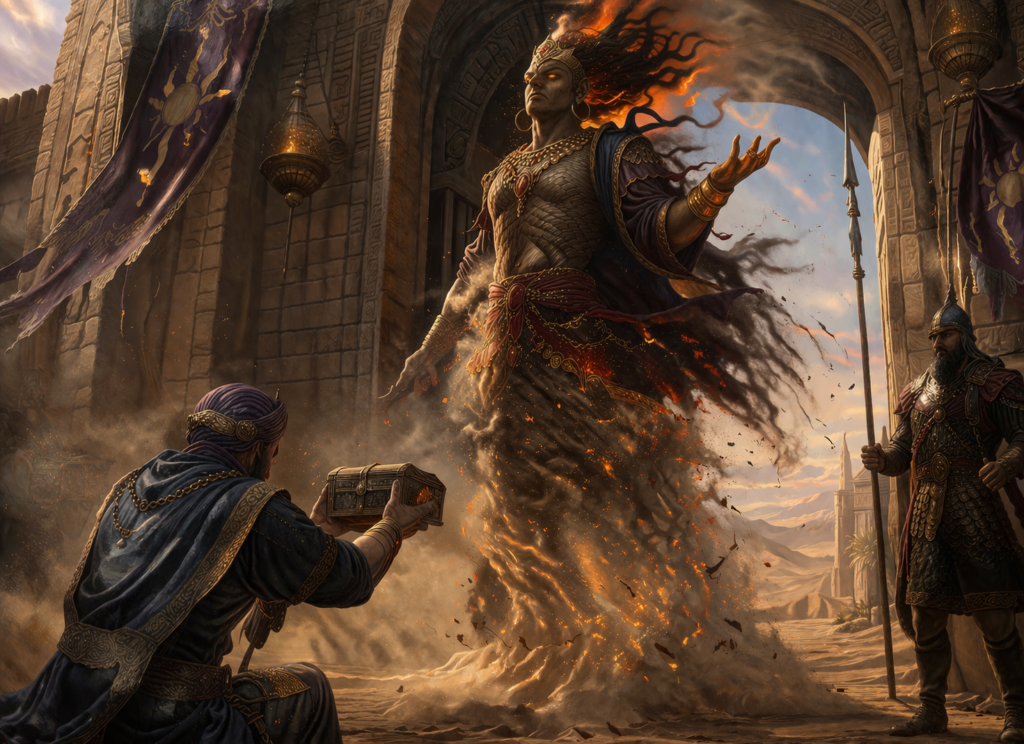
The Hawanar is no wandering elemental brute. It is a lordly power of heat, wind, splendour, and pressure, one of the dangerous aristocracies of the jinn. In the lands from Egypt through Arabia to Mesopotamia and Persia, it belongs naturally to caravan tribute, sacred fire, ruined sanctuaries, wind-scoured strongholds, and old dynasties built on forgotten bargains with the unseen. A Hawanar is the sort of being whose favour can enrich a city, whose displeasure can ruin a road, and whose arrival forces princes, merchants, priests, and oath-bound houses to remember obligations they had hoped time had buried.
It is best treated not as a common people, but as a rare and politically dangerous lineage: too few to form a nation in the mortal sense, yet numerous enough to sustain courts, feuds, embassies, exiled branches, and ancient claims of rank. Wherever one establishes itself, power becomes ceremonial, personal, and dry-throated.
Appearance
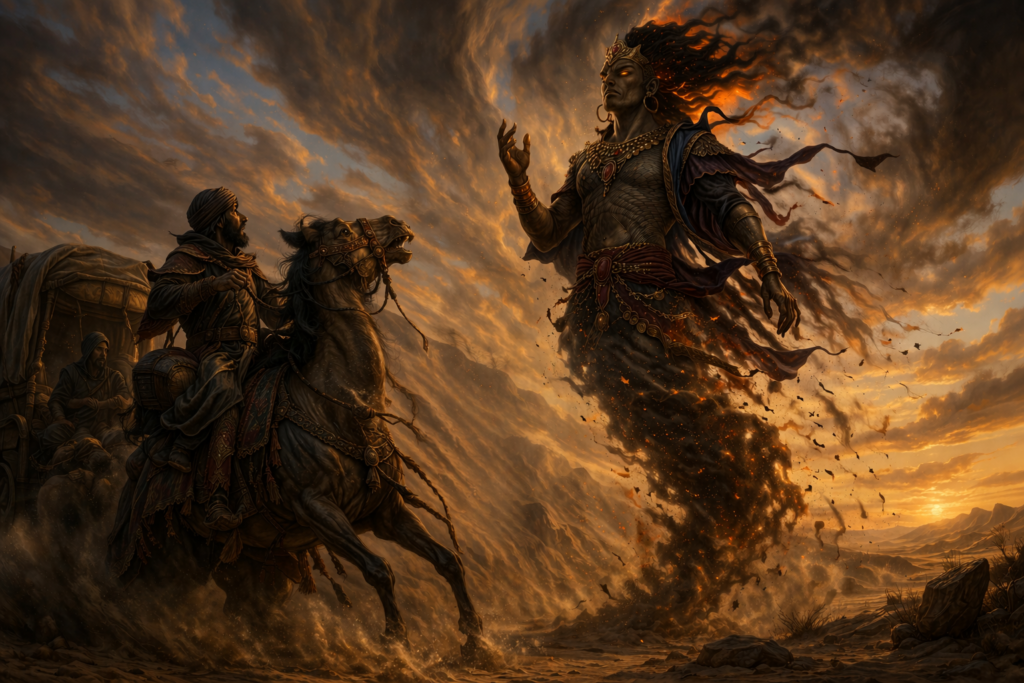
A Hawanar’s upper body is regal, beautiful, and severe. It commonly appears as a towering noble figure with ember-bright eyes, a face of hard inhuman composure, and the bearing of something long accustomed to obedience. Its skin may shine bronze, copper-red, or furnace-dark in the light, while its hair streams like smoke, heated silk, or a banner caught in a hot updraft.
It dresses in the language of rule: gold-worked belts, veils that stir without breeze, jeweled collars, lamellar or ring-mail fit for a desert court, curved blades, heavy signet rings, and silks that ripple in its own heat. Yet below the waist all mortal likeness ends. There the Hawanar becomes a revolving pillar of sparks, cinders, ash, and furnace wind, as though a firestorm had been forced into noble shape and taught heraldry.
Its presence alters the world around it before it speaks. Bronze grows warm beneath the hand. Dust stirs before it moves. Lamps gutter, then flare. Banners pull at their fastenings. The throat dries. The air itself seems to brace. A Hawanar does not merely stand in a chamber or terrace; it makes the place feel as though it has already begun to submit.
Behaviour
Hawanars are proud in the old and dangerous sense. They do not merely think well of themselves; they believe hierarchy is one of the natural laws of existence. They are acutely alert to precedence, insult, ceremony, hesitation, and public honour. A Hawanar notices who bows first, who speaks too freely, who uses the wrong title, and who understands the cost of an oath.
They are often highly cultivated. A Hawanar may patronize poets, astrologers, architects, metalworkers, falconers, temple custodians, and noble houses capable of giving visible form to power. It admires mastery, discipline, beauty, memory, and institutions that endure. It may reward service magnificently and uphold ancient bargains with terrifying exactness.
None of this refinement makes it gentle. Fire consumes and wind scatters; in the Hawanar those urges are held under rank and ceremony, never erased. It values order because order is both weapon and restraint. Without forms of deference, clear superiority, and a structure of command around it, a Hawanar tends toward obsession, theatrical vengeance, and destructive excess.
Habitat
Hawanars belong above all in lands where heat and wind already feel half-alive.
They are most at home in desert citadels above caravan roads, basalt escarpments, brass-domed palaces, ruined sanctuaries in the waste, incense-route strongholds, volcanic uplands, sulphur springs, mountain shrines open to the hot wind, and fire temples whose rites have outlived the kings who endowed them. They suit the furnace cultures of Egypt, Arabia, the Syrian marches, Mesopotamia, Persia, and neighbouring lands where sacred geography, old empire, and spirit traffic overlap.
Beyond those zones, a Hawanar should feel exceptional and wrong. In colder, wetter, greener lands it is not naturally rooted, but displaced: a summoned envoy, dynastic curse, foreign conqueror, or exile. Hearths burn too fiercely around it. The air grows dry and breathless. Summer storms arrive out of season. Even indoors, people wake with ash on the tongue and the feeling that some far desert wind has entered their house uninvited.
Modus Operandi
A Hawanar prefers dominion before slaughter. It enters magnificently, establishes superiority at once, and masters the emotional shape of an encounter before any weapon is drawn. It favours courts, terraces, treaty halls, shrine-courtyards, audience chambers, and caravan gates where fear can ripen in public. It bargains from height. It issues commands disguised as offers. It allows others to understand that defiance remains possible only in the narrowest technical sense.
Where a lesser being might simply attack, a Hawanar first imposes rank. It demands tribute, oaths, hostages, ceremonial honours, rights of passage, restoration of forgotten obligations, or public acknowledgment of ancient precedence. It may bind merchant houses to ruinous tolls, force an oasis city to maintain ancestral rites, stand behind one claimant in a succession struggle, or keep an entire route safe only so long as its name is spoken with proper reverence at every waystation.
When it chooses violence, it does not fight like a brute. It turns the environment into an accomplice. Fires leap where none should catch. Smoke is driven into lungs and eyes. Horses rear. Arrows wander in heated turbulence. Tent-cloths tear loose. Roof-canopies snap and whip. Courtyards become kilns. A hall, market, or shrine can within moments feel as though it has sided with the Hawanar against everyone trapped inside it.
Motivation
A Hawanar desires more than wealth. Treasure matters because tribute is visible obedience. Splendour matters because splendour proves rank. Oaths matter because oaths arrange the world into those who command and those who answer.
Above all, the Hawanar craves legitimacy. It is a being of mixed inheritance and uneasy standing, tied by nature to both the powers of wind and the sovereignties of flame. For that reason many are driven not merely to rule, but to justify rule. One may seek recognition in jinn courts long denied to its line. Another may build a mortal client-kingdom to prove that its authority does not depend on acceptance by djinn or efreet.
Another may act as envoy between hostile courts, using mortal rulers as leverage in greater elemental politics. Another may stand behind a dynasty for generations, ensuring prosperity so long as the family remembers who truly guards its fortune. Another may be a catastrophic exile, cast into the mortal world and determined to carve from caravan roads, shrine-cities, and fire-peaks a sovereignty no one can deny.
This hunger for recognition is what makes the Hawanar especially dangerous. It does not merely want to possess. It wants to be acknowledged, obeyed, and remembered.
In the World
A Hawanar is best used as a regional power rather than a random encounter. It should feel like a change in political climate, sacred danger, and natural order all at once. Its arrival should make rulers reconsider alliances, priests revive neglected rites, caravan masters recalculate loyalties, and old families remember which bargains founded their prosperity.
Hawanars work especially well as desert princes of the jinn courts, keepers of tribute roads, guardians or extortioners of oasis cities, bound powers behind dynasties, envoys between djinn and efreet realms, and catastrophic exiles cast into the mortal world. Used properly, a Hawanar does not feel like just another genie. It feels like the approach of a hot wind before the flames are seen.
Where one dwells for long, bronze is warm at midnight, braziers are never allowed to die, and every oath is spoken with a dry mouth.
Hawanar 5.5
Hawanar, Pathfinder
Hawanar
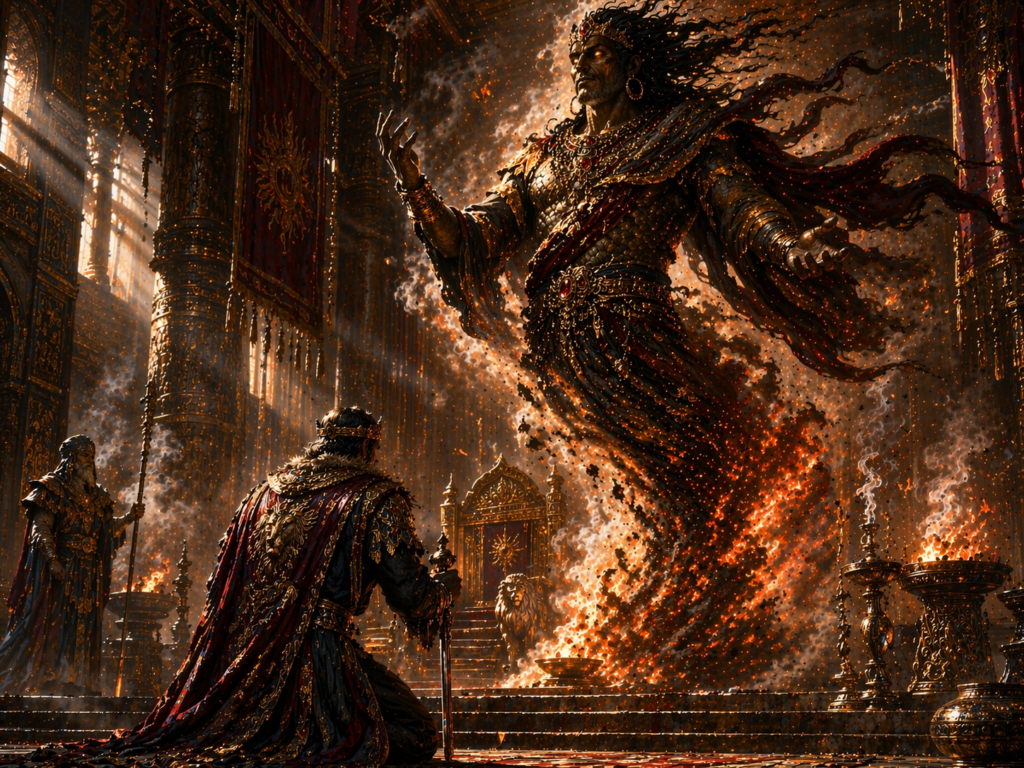
This being is twice as tall as a normal human and has reddish skin, no hair, and small fangs. Its lower torso is shrouded in a cyclone of burning embers and flame.
Hawanar are the unlikely union of an efreeti noble and a djinni noble. Neither of the parent races truly accepts the hawanar but the djinn are more tolerant while the efreet usually execute or enslave hawanar offspring on sight, viewing them as something unnatural. A typical hawanar stands 12 feet tall and weighs about 1,100 pounds.
Hawanar society is ruled by a Rajah who is served by a multitude of beys, sheiks, sahibs, and sirdars The hawanar race has no true home and can be found spread throughout the planes (most dwell on the Plane of Air or a pocket plane of air and fire). Those that dwell on the Plane of Fire generally avoid the City of Brass and efreeti patrols due to the disdain the efreet have for them.
Hawanar wade into battle in a hail of fire and wind, relying on their spell-like abilities and holocone form to dissuade and vanquish its opponents. If combat goes against it, a hawanar assumes either gaseous form or holocone form and attempts to flee.
| Hawanar Genie CR 10 |
| XP 9,600 LN Large outsider (air, extraplanar, fire) Init +8; Senses Darkvision 60 ft.; Perception +18 |
| DEFENSE |
| AC 21, touch 14, flat-footed 16 (+4 Dexterity, +1 Dodge, +7 natural, -1 size) hp 97 (13d10+26) Fort +6; Ref +12; Will +10 Defensive Abilities air mastery; Immune acid, fire Weaknesses vulnerability to cold |
| OFFENSE |
| Speed 20 ft., Fly 50 ft. (perfect) Melee 2 slams +20 (2d6+8 plus 1d8 fire) or masterwork falchion +21/+16/+11 (2d6+12/18-20 plus 1d8 fire) Space 10 ft.; Reach 10 ft. Special Attacks heat, holocone (1/10 minutes, 10-50 ft. tall, 1d8+8 plus 1d8 fire damage, DC 27) Spell-like Abilities (CL 16th): At-willinvisibility (self only), plane shift (willing targets to elemental planes, Astral Plane, or Material Plane only)1/dayburning hands (DC 13), create food and water, create wine (as create water, but wine instead), fireball (DC 15), gaseous form, invisibility, major creation (created vegetable matter is permanent), persistent image (DC 17), scorching ray (1 ray only), wall of fire (DC 16), wind walk. |
| STATISTICS |
| Strength 27, Dexterity 18, Constitution 14, Intelligence 14, Wisdom 15, Charisma 15 Base Atk +13; CMB +22; CMD 37 Feats Combat Casting, Combat Reflexes, Dodge, Improved InitiativeB, Mobility, Power Attack, Quicken Spell-Like Ability (scorching ray), Wind Stance Skills Bluff +18, Diplomacy +18, Fly +26, Intimidate +18, Knowledge (nobility) +18, Knowledge (planes) +18, Perception +18, Sense Motive +12, Spellcraft +11 Languages Auran, Celestial, Common, Ignan; telepathy 100 ft. Gear masterwork falchion |
| SPECIAL ABILITIES |
| Air Mastery (Ex) Airborne creatures take a -1 penalty on attack and damage rolls against a hawanar. Heat (Ex) A hawanar’s fists are swathed in white-hot fire that deals 1d8 points of extra fire damage whenever it hits in melee, or in each round it maintains a hold when grappling. The hawanar’s metallic weapons conduct this heat. The hawanar can suppress or resume this ability as a free action. Holocone (Su) A hawanar can transform into a vortex of embers and white-hot fire once every 10 minutes. This ability functions identically to the whirlwind ability. In this form, it can move through the air or along a surface at its fly speed. The save DC includes a +3 racial adjustment. |
| ECOLOGY |
| Environment any (Plane of Air or Plane of Fire) Organization solitary, pair, company (2-4), or band (6-15) Treasure standard |
Section 15: Copyright Notice – Tome of Horrors Complete
Hawanar Genie from the Tome of Horrors Complete, Copyright 2011, Necromancer Games, Inc., published and distributed by Frog God Games; Author Scott Greene.
Hawanar
Large elemental (genie), typically lawful neutral or lawful evil
Armor Class 19 (natural armor)
Hit Points 231 (22d10 + 110)
Speed 30 ft., fly 60 ft. (hover)
| STR | DEX | CON | INT | WIS | CHA |
|---|---|---|---|---|---|
| 22 (+6) | 18 (+4) | 20 (+5) | 18 (+4) | 17 (+3) | 22 (+6) |
Saving Throws Dex +10, Con +11, Wis +9, Cha +12
Skills Insight +9, Intimidation +12, Perception +9, Persuasion +12
Damage Resistances lightning; bludgeoning, piercing, and slashing from nonmagical attacks
Damage Immunities fire
Condition Immunities frightened
Senses darkvision 120 ft., passive Perception 19
Languages Auran, Ignan, Common, one regional courtly language; telepathy 120 ft.
Challenge 15 (13,000 XP)
Proficiency Bonus +5
Traits
Burning Wind Form. The Hawanar can move through a space as narrow as 1 inch wide without squeezing, provided air can pass through it. A creature that starts its turn within 10 feet of the Hawanar takes 7 (2d6) fire damage.
Heated Turbulence. Ranged weapon attacks made against the Hawanar from more than 20 feet away are made with disadvantage.
Magic Resistance. The Hawanar has advantage on saving throws against spells and other magical effects.
Sovereign of Flame and Air. The Hawanar ignores difficult terrain created by sand, ash, smoke, loose earth, fire, or strong wind. Nonmagical flames within 60 feet of it can’t be extinguished except by magic, and smoke in that area moves as the Hawanar wills.
Innate Spellcasting
The Hawanar’s spellcasting ability is Charisma (spell save DC 20, +12 to hit with spell attacks). It can innately cast the following spells, requiring no material components:
At will: command, detect magic, gust of wind, produce flame
3/day each: fly, suggestion, wall of fire
1/day each: control winds, dominate person, flame strike
Actions
Multiattack. The Hawanar makes three attacks, using any combination of Scimitar of the Burning Court and Ashwind Blast. It can replace one attack with Cinder Rebuke.
Scimitar of the Burning Court. Melee Weapon Attack: +11 to hit, reach 10 ft., one target. Hit: 13 (2d6 + 6) slashing damage plus 10 (3d6) fire damage. If the target is Large or smaller, it must succeed on a DC 20 Strength saving throw or be pushed up to 10 feet in a direction of the Hawanar’s choice.
Ashwind Blast. Ranged Spell Attack: +12 to hit, range 120 ft., one target. Hit: 20 (4d6 + 6) bludgeoning damage plus 10 (3d6) fire damage, and the target must succeed on a DC 20 Strength saving throw or either be pushed up to 20 feet or knocked prone (the Hawanar’s choice).
Cinder Rebuke. One creature the Hawanar can see within 60 feet that can hear it must succeed on a DC 20 Wisdom saving throw or be cowed until the end of the Hawanar’s next turn. While cowed, the creature’s speed is halved, and it has disadvantage on attack rolls against the Hawanar.
Ashen Vortex (Recharge 5–6). The Hawanar becomes a roaring pillar of sparks, cinders, and furnace wind. Each creature of the Hawanar’s choice within 20 feet of it must make a DC 20 Dexterity saving throw, taking 35 (10d6) fire damage plus 22 (4d10) bludgeoning damage on a failed save, or half as much damage on a successful one. On a failed save, the creature is also blinded until the end of its next turn. Flammable objects in the area that aren’t being worn or carried ignite.
Tribute of the Road (1/Day). The Hawanar marks up to three creatures it can see within 60 feet as debtors and oath-breakers. Each target must make a DC 20 Charisma saving throw. On a failed save, a target takes 22 (4d10) psychic damage plus 22 (4d10) fire damage and becomes bound for 1 minute. While bound, the target can’t willingly move farther away from the Hawanar than it was when the effect began. The target repeats the save at the end of each of its turns, ending the effect on itself on a success. On a successful initial save, a creature takes half as much damage and suffers no other effect.
Bonus Actions
Command the Flames. The Hawanar causes up to three nonmagical fires it can see within 60 feet to flare. Each creature of the Hawanar’s choice within 5 feet of one of those fires takes 7 (2d6) fire damage.
Wind-Step. The Hawanar moves up to half its flying speed without provoking opportunity attacks.
Reactions
Punish Defiance. When a creature within 30 feet of the Hawanar hits it with an attack or succeeds on a saving throw against one of the Hawanar’s effects, the Hawanar forces that creature to make a DC 20 Constitution saving throw. On a failed save, the creature takes 10 (3d6) fire damage and can’t speak above a rasp until the end of its next turn. While affected in this way, the creature must succeed on a DC 15 Constitution check to cast a spell with a verbal component.
Legendary Actions
The Hawanar can take 3 legendary actions, choosing from the options below. Only one legendary action option can be used at a time and only at the end of another creature’s turn. The Hawanar regains spent legendary actions at the start of its turn.
Move. The Hawanar uses Wind-Step.
Scimitar Attack. The Hawanar makes one Scimitar of the Burning Court attack.
Drive the Court (Costs 2 Actions). One creature the Hawanar can see within 60 feet must succeed on a DC 20 Strength saving throw or be pushed up to 15 feet and knocked prone.
Desert Atmosphere (Costs 2 Actions). The Hawanar creates a 20-foot-radius sphere of smoke, ash, and violent heat shimmer centered on a point it can see within 90 feet. The area is heavily obscured for the Hawanar’s enemies and lightly obscured for the Hawanar and its allies until the start of the Hawanar’s next turn.
Lord of the Furnace Road (Costs 3 Actions). The Hawanar unleashes a blast of searing wind in a 30-foot line that is 10 feet wide. Each creature in that line must make a DC 20 Dexterity saving throw, taking 18 (4d8) fire damage plus 18 (4d8) bludgeoning damage on a failed save, or half as much damage on a successful one.
Treasure
A Hawanar’s wealth is never random hoard-loot. It is tribute made visible.
A typical Hawanar treasury includes 18,000 gp in stamped gold coin, 7,000 sp in tribute jars or merchant chests, and 14 gold bars worth 250 gp each. Its court valuables often include 12 cut carnelians worth 100 gp each, 8 emeralds worth 250 gp each, 3 rubies worth 1,000 gp each, a fire-opal torque worth 2,500 gp, and a ceremonial gold-and-lapis signet ring worth 1,200 gp.
Its greater possessions usually reflect rank and sacred obligation: an incense burner of chased brass worth 750 gp, six bricks of rare temple incense worth 150 gp each, a court scimitar with a gemstone pommel worth 1,500 gp, a pair of bronze braziers worth 500 gp each, and a set of noble desert robes sewn with gold thread worth 900 gp. Many also keep an oath-tablet, sealed treaty-scroll, dynastic seal, or rights-charter whose material value is modest but whose political value may be immense.
For magic treasure, one or two of the following suit the Hawanar especially well: Scimitar of Warning, Ring of Fire Resistance, Brazier of Commanding Fire Elementals, Dust of Disappearance, Wind Fan, or a bound-oath seal that serves as a one-use plane shift focus to a court of fire and air.
Keep this reference growing
If this page helped with your reading or game, you can support its upkeep or explore the curated books.
Explore the Bookshop — epics, classics and stories behind imagined worlds.