
SpiralWorlds Bestiary · Outsiders
Qlippoth
Void-Born Enemies of Creation
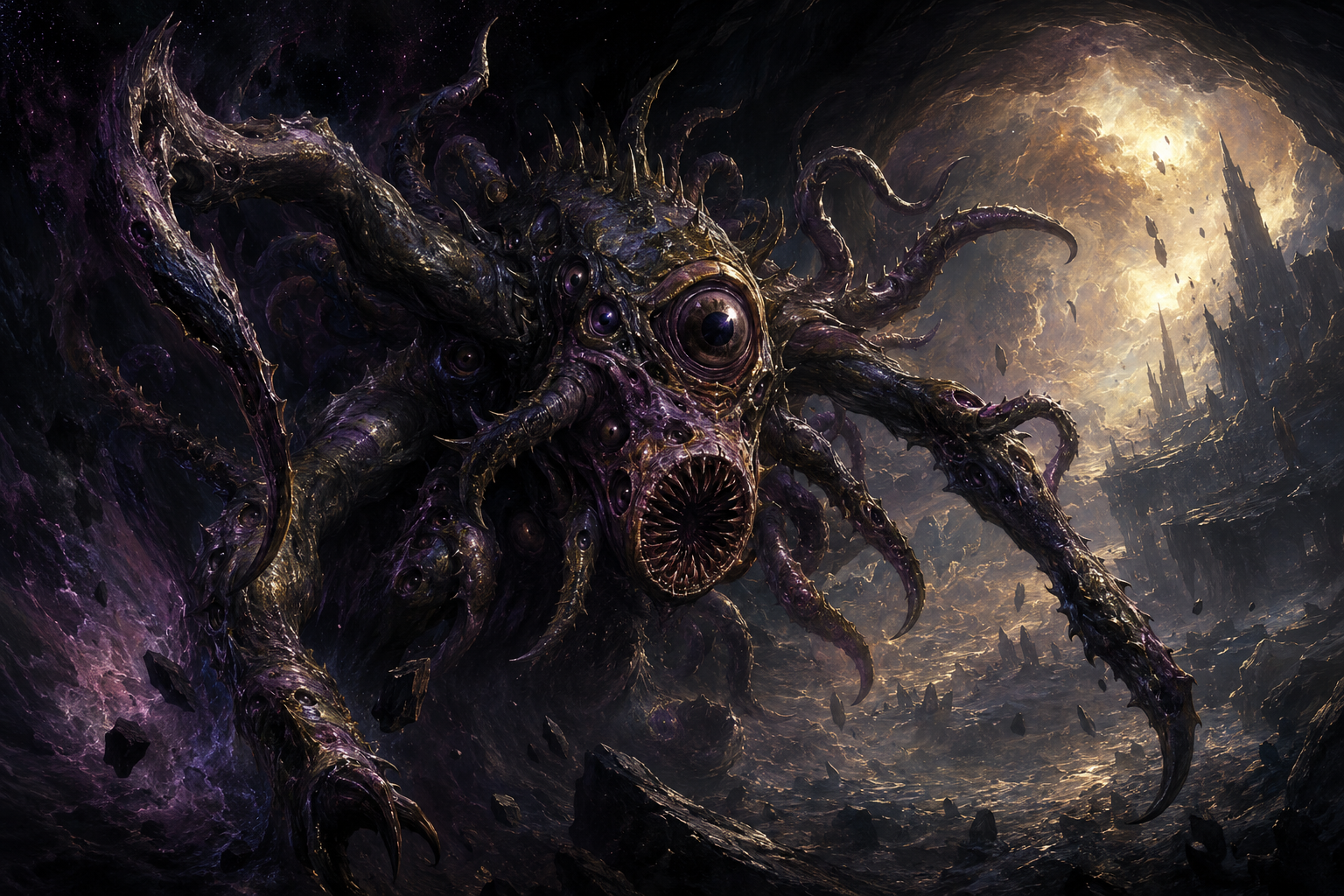
Qlippoths are primordial fiends born in the Void Between Universes. They attack ordered creation, seek the extinction of mortal life and wage an ancient war against the demons that displaced them from the deepest reaches of the Abyss.
Before stars, planes and mortal souls, the qlippoths learn to preserve themselves where identity itself should dissolve.
They arise within the Void Between Universes, enter the present creation through its unfinished boundaries and attack the earliest Codices of Existence. During Eon V, the Elder Gods raise the Astral Beacon and drive the invaders into the Abyssal wound opened by the First Cosmic Schism.
When the Outer Planes become self-sustaining during Eon VII, that wound develops into the Abyss. Qlippoths become its first great horrors. The later rise of demons breaks their supremacy and forces their surviving broods into the plane’s oldest and least accessible depths.
01 · Overview
Void-born enemies of creation
Qlippoths are not one species, kingdom or orderly civilisation. They are a family of primordial fiends united by their Void-born origin, impossible anatomy and hatred of the present cosmic order.
Running qlippoths in thirty seconds
| Question | Answer |
|---|---|
| What does the qlippoth want? | To destroy demons, kill mortals, widen a planar breach, reclaim an ancient territory or damage a surviving law of creation. |
| Why has it appeared? | A summoning, failed ward, damaged planar boundary, cult ritual or Abyssal conflict has opened a route. |
| Why does it hesitate? | It is studying an unfamiliar law, avoiding a stronger enemy, waiting for a boundary to fail or manipulating mortals into completing its work. |
| What makes it distinctive? | Its anatomy follows a clear but impossible internal logic, and witnessing its complete form produces a specific reaction. |
| Can it negotiate? | Intelligent qlippoths make temporary bargains when those agreements advance revenge, destruction or survival. |
| What ends the encounter? | Destruction, banishment, restoration of the damaged boundary, removal of its objective or intervention by a stronger power. |
Qlippoths range from predatory parasites to unique powers capable of threatening demon lords. Their forms, intelligence and methods vary enormously, but each preserves an individual identity first formed before the present universe possessed dependable law.
They recognise no universal ruler. A powerful qlippoth may dominate a brood, hunting pack or war host through terror and physical supremacy. Such associations survive only while the leader remains strong enough to destroy challengers or provide access to prey, territory and revenge.
Their hatred has three principal objects. They hate ordered creation because its laws oppose the conditions in which they arose. They hate demons because demonkind displaced them from much of the Abyss. They hate mortal life because mortal corruption and violence continue to sustain demonic growth.
02 · Before measurable time
Origin in the Void Between Universes
Qlippoths arise within the interval between creations. They are not remnants, refugees or transformed survivors of the Last Universe.
The qlippoths develop during the interval between the destruction of the Last Universe and the beginning of the present creation. The Void possesses no dependable distance, duration, matter or physical law. Memory, form and identity can separate from the beings that possess them.
Qlippoths become native horrors of this interval. Each preserves an individual will where lesser identities dissolve. Hunger, cruelty and refusal provide continuity before continuity becomes an established principle of reality.
No reliable chronology identifies the first qlippoth. Measurable time has not yet begun, and the eldest creatures remember their origins through incompatible impressions rather than ordered sequences.
One remembers itself as a mouth that refused to close. Another remembers an endless fall before direction existed. A third claims that it first became conscious when it discovered something else to hate.
03 · Eon V
The First Cosmic Schism
The unfinished Codices make the new universe coherent enough for the qlippoths to recognise it as an enemy.
The Codices Begin
The Elder Gods establish early patterns of identity, boundary, sequence and consequence during Cosmic Dawn.
The Incursion
Void-born hosts exploit unfinished cosmic boundaries and attack the developing Codices of Existence.
The Astral Beacon
The Elder Gods concentrate their separate powers into a shared stabilising defence within the Astral Plane.
The Abyssal Wound
The surviving qlippoths are driven into a wound beyond the stabilised Astral order.
During Eon V, qlippothic hosts enter the developing cosmos through boundaries that remain unfinished. Their purpose is unmaking rather than conquest. They attack relationships holding creation together: names cease to identify their owners, causes detach from consequences and sequences repeat without beginning or end.
The Elder Gods cannot preserve the Codices separately. They raise the Astral Beacon, concentrating identity, relationship and directed intention into a single defence. The Beacon preserves enough of the Codices for creation to survive and provides a stable centre from which the invaders can be driven back.
The force of the defence tears open the Abyssal wound. Predatory chaos, dissolution and the pressure of the retreating host combine within it. The principal invaders are forced into its depths, while the Astral Beacon Scar remains as a permanent wound within the Astral Plane.
04 · The oldest Abyss
From first horrors to dispossessed enemies
The Abyss develops around the confinement created during the First Cosmic Schism, and the qlippoths become its earliest dominant inhabitants.
During Eon VII, the First Thought-Realms separate from the Astral Plane and become self-sustaining Outer Planes. The Abyssal wound develops into the Abyss: a plane of predatory chaos, violent transformation and unstable geography.
These conditions suit beings born before dependable reality. Qlippoths spread through the plane’s first rifts, caverns, black waters and unfinished layers. They nest within wounds left by the Schism, prey upon new planar life and reshape territories around their individual compulsions.
Their supremacy never forms a united empire. Some regions fall beneath ancient lords whose bodies and desires alter the surrounding layer. Elsewhere, rival broods consume one another while solitary predators guard territories older than mortal worlds.
The later rise of demonkind changes the Abyss. Demons multiply rapidly, adapt to newly created worlds and establish continuing connections with mortal violence and corruption. Their numbers eventually break qlippoth supremacy.
The continuing Abyssal war
Qlippoth offensives
Qlippoths strike demonic spawning grounds, fortresses, cult routes, soul markets and newly conquered layers.
Demonic hunts
Demons pursue qlippoths for territory, experimentation, prestige and revenge for ancient defeats.
Temporary alliances
Both sides may cooperate against a greater danger, but such agreements normally end in betrayal or mutual slaughter.
05 · Impossible biology
Appearance, perception and Horrific Revelation
Qlippoth bodies preserve patterns that developed before the present universe established dependable anatomy.
Their forms combine jaws, eyes, tendrils, wings, spines, fungal growths, segmented limbs, exposed organs and unfamiliar sensory structures without following ordinary biological arrangements.
A qlippoth may resemble a spider, worm, cephalopod, fungus, reptile or mass of internal organs, but these comparisons describe only the features a mortal observer can recognise. One may possess several apparent fronts. Another may move through a mouth, perceive through wounds distributed across its body or contain internal spaces larger than its surrounding flesh.
Humanoid features sometimes occur as mimicry, bait, imposed mutation or prolonged exposure to mortal worship. Such features rarely make the creature easier to understand. A familiar face placed within an incompatible body often makes its presence more disturbing.
Horrific Appearance
A qlippoth’s Horrific Appearance expresses more than physical ugliness. The observing mind attempts to interpret a form built according to rules older than the present creation. Perception and reality briefly disagree.
Each species produces a distinct effect. A witness may become paralysed, fascinated, nauseated, confused, terrified or temporarily transformed.
| Feature witnessed | Possible reaction | Example description |
|---|---|---|
| Impossible internal space | Confusion or psychic harm | A mouth opens into a remembered room rather than a throat. |
| Contradictory identity | Fascination or paralysis | An eye reflects the observer’s body without the observer’s identity. |
| Disordered sequence | Stunning or lost actions | A limb completes its movement before it begins to move. |
| Invasive anatomy | Poisoning or mutation | Fungal organs imitate the witness’s breathing and heartbeat. |
Game Master guidance: describe one impossible feature clearly and then show its effect upon the witness. One precise violation of reality creates stronger horror than a long catalogue of unrelated deformities.
06 · Minds, broods and mortal servants
Qlippoth society and cults
Qlippoths form temporary communities around fear, breeding sites, shared enemies and the dominance of stronger individuals.
Minds and communication
Intelligence ranges from predatory instinct to minds capable of planning across cosmic ages. Telepathy carries images, sensations, compulsions and false memories.
Broods and war hosts
Broods gather around breeding grounds, dominant creatures or ancient behavioural patterns. Mixed broods combine parasites, hunters and greater qlippoths.
Qlippoth lords
Unique powers rival great Abyssal rulers. Their authority depends upon terror, physical dominance and the destruction of challengers.
Mortal cults
Cultists seek forbidden knowledge, revenge against demons, freedom from divine law or transformation capable of surviving cosmic destruction.
False bargains
A cult may believe it has summoned an ancient enemy of demons and discover that its patron regards all mortals as one infestation.
Cult signs
Missing names, impossible diagrams, repeated sensory organs, altered genealogies and dreams of falling before gravity existed.
Summoning and binding
Qlippoths are among the most dangerous fiends to call. They recognise weaknesses in imposed laws and possess experience with forms of containment older than mortal magic.
| Safeguard | Purpose |
|---|---|
| Verified name or species-name | Reduces the risk of reaching an unintended qlippoth. |
| Separate physical and magical barriers | Prevents one failure from immediately releasing the creature. |
| Law-aligned geometry | Reinforces boundary, sequence and consequence. |
| Observers outside the chamber | Preserves an external record if memory or identity is altered. |
| Prepared banishment | Provides an immediate response when control fails. |
| Narrowly written objective | Limits the interpretations the qlippoth can exploit. |
An intelligent qlippoth may accept a task against demons, rival qlippoths or a hated cosmic boundary. Such service remains tactical. The creature searches for opportunities to escape, redirect the task or make the summoner’s victory serve a greater act of destruction.
A released qlippoth often seeks concealment before open slaughter. It establishes a route, breeding site, cult or source of knowledge that allows it to remain active after the original summoning has ended.
07 · The campaign world
Qlippoths on Earth in 1454
Qlippoths possess no recognised kingdom or open population on Earth. Every known presence begins with a breach, summoning, relic or cult.
Most incursions begin at the edges of settled life: abandoned mines, plague pits, drowned ruins, forgotten tunnels, battlefields and remote strongholds whose protective rites have failed.
Intelligent qlippoths also target archives, dynastic tombs, oath halls and centres of magical learning because such places preserve continuity across generations.
A qlippoth incursion may initially resemble a demonic attack. The difference becomes clear when demons are also found destroyed, missing or fleeing the region. Conflict between the two fiendish families warns that the visible destruction marks only the outer edge of a deeper struggle.
08 · Creature directory
Known qlippoths
Linked creatures have dedicated SpiralWorlds entries. Unlinked names remain part of the wider qlippoth family catalogue.
Augnagar
An immense wall-crawling predator used as a living siege creature or guardian of deep Abyssal rifts.
Chernobue
A writhing mass of mouths and tentacles associated with paralysing revelation, misfortune and toxic secretions.
Cythnigot
A fungal parasite that inhabits dead animals, spreads spores and prepares concealed breeding grounds.
Hydraggon
An aquatic qlippoth whose divided tongues manipulate weapons and whose kind inhabit remote Abyssal waters.
Iathavos
A colossal winged horror associated with large-scale devastation and wars against powerful demon hosts.
Nyogoth
A scavenging knot of organs and toothed maws that consumes corpses and discarded Abyssal matter.
Shiggarreb
A unique qlippoth power associated with chernobues and efforts to restore qlippoth supremacy.
Shoggti
An intelligent tentacled enslaver that attacks intellect and gathers controlled servants.
Thulgant
A powerful spider-like qlippoth whose intelligence makes it a commander, hunter or solitary adversary.
Obox-Ob
An ancient qlippoth lord associated with vermin, revenge and the lost supremacy of the early Abyss.
09 · Campaign use
Making qlippoths playable
Qlippoths work best when their presence changes the meaning of an existing conflict rather than introducing another isolated monster.
A qlippoth may attack a demonic fortress, reveal knowledge capable of closing an Abyssal breach or destroy a cult the characters already consider dangerous. Its opposition to demons creates an immediate temptation to treat it as an ally.
The choice should remain difficult. Helping a qlippoth defeat demons may save a city while opening a route for mortal extinction. Destroying it may preserve the demonic power it was hunting. Bargaining may reveal an ancient truth while placing that knowledge within the mind of a creature capable of attacking memory itself.
Qlippoth encounters
| d8 | Encounter | Complication |
|---|---|---|
| 1 | Dead vermin move beneath pale fungal stalks. | The infestation follows a planar route towards a crowded town. |
| 2 | A demon begs for protection from something hunting through the walls. | It knows how to close the breach but demands safe passage. |
| 3 | A summoning chamber contains an intact circle and no creature. | The qlippoth has entered the surviving summoner’s memories. |
| 4 | An archive loses every personal name while retaining all recorded events. | Speaking a missing name allows the qlippoth to perceive the speaker. |
| 5 | An aquatic qlippoth follows an impossible current through a well. | The current carries stolen memories towards the Abyss. |
| 6 | A qlippoth reveals the location of a hidden demonic cult. | The cult protects a seal preventing a larger qlippoth incursion. |
| 7 | A battlefield repeats its final minute before sunset every night. | A qlippoth outside normal sequence is extending the repetition. |
| 8 | A demon fortress in the Abyss has fallen silent. | The victors are reshaping it into a route towards Earth. |
Adventure hooks
- The Missing Clause: a cult attempts to erase inheritance from a contested kingdom by damaging a fragment of the Codices.
- The Enemy Below: demons driven from an underground shrine warn that an older Abyssal power now occupies the tunnels.
- The Nameless Dynasty: a royal family retains rank, property and memory but loses the ability to recognise its own names.
- The Broken Familiar: a dead familiar returns carrying a cythnigot that remembers conversations held before the animal died.
- The Lord’s Bargain: Obox-Ob offers the location of a demon lord’s gate in exchange for the destruction of an ancient seal.
- The Second Schism: unrelated planar boundaries fail in the sequence used during the first assault upon the Codices.
10 · Multi-system mechanics
Qlippoth rules
These family rules provide a shared foundation. Individual creature entries determine their final defences, movement, saving throws and Horrific Appearance effects.
D&D 5E 2024-compatible framework
Creature Type. Fiend, usually with the Qlippoth tag.
Typical Alignment. Chaotic Evil.
Typical Senses. Darkvision 120 feet.
Typical Languages. Abyssal and telepathy with a range of 60 or 120 feet. Lesser parasites may communicate through touch, spores, sensations or images.
Choosing defences
Do not give every qlippoth identical immunities. Select defences appropriate to the individual species and its Challenge Rating.
- Immunity to Poison damage and the Poisoned condition is common.
- Resistance or Immunity to Cold damage is common in deep-Abyssal species.
- Acid, Fire or Lightning Resistance may suit particular environments or anatomies.
- Magic Resistance is appropriate for powerful or ancient qlippoths.
- Immunity to the Charmed or Frightened condition should remain species-specific.
Horrific Revelation
Horrific Revelation — Recharge 5–6. Each creature of the qlippoth’s choice within 30 feet that can see it must make a Wisdom saving throw. The DC equals 8 plus the qlippoth’s Proficiency Bonus plus its Charisma modifier.
Constitution may replace Charisma when the effect depends primarily upon spores, venom, stench or physical mutation.
On a failed save, the target suffers the species-specific effect given in the qlippoth’s stat block. Suitable consequences include Psychic damage, the Frightened, Poisoned, Stunned or Paralyzed condition, involuntary movement, sensory distortion or temporary transformation.
On a successful save, the target is immune to that individual qlippoth’s Horrific Revelation for 24 hours.
Averting the eyes
At the start of its turn, a creature that can see the qlippoth may avert its eyes until the start of its next turn. While doing so, it cannot see the qlippoth and is unaffected by a Horrific Revelation that requires sight.
The creature may stop averting its eyes at any time. Once it does, it can see the qlippoth again and may be affected by a later revelation.
Suggested effects
| Suggested CR | Suitable consequence |
|---|---|
| 0–4 | Frightened or Poisoned until the end of the target’s next turn. |
| 5–10 | Frightened for 1 minute, with another saving throw at the end of each turn. |
| 11–16 | Psychic damage followed by Stunned until the end of the target’s next turn. |
| 17+ | A species-specific transformation or combination of damage and incapacitation. |
Pathfinder 1E qlippoth traits
Qlippoths are Chaotic Evil outsiders. Unless an individual entry states otherwise, a qlippoth possesses the following traits:
- Immunity to Cold, mind-affecting effects and Poison.
- Resistance to Acid 10, Electricity 10 and Fire 10.
- Telepathy.
- Abyssal as a spoken language unless otherwise stated.
Horrific Appearance — Su
A qlippoth presents its full form as a standard action, assaulting all living creatures within 30 feet that can perceive it.
The exact effect varies by species. A successful Will saving throw reduces or negates the effect. The DC equals 10 + half the qlippoth’s Hit Dice + its Charisma modifier.
Horrific Appearance is a mind-affecting gaze attack unless the individual entry states otherwise.
Binding a qlippoth
Use the normal rules of the calling or binding spell, including Spell Resistance, opposed Charisma checks and restrictions imposed by the summoning diagram.
A called qlippoth interprets every command according to its own interests and seeks release whenever an order or diagram leaves sufficient room for escape.
D&D 3.5E-compatible conversion
Qlippoths use the Outsider type with the Chaotic, Evil, Extraplanar and Qlippoth subtypes.
- Immunity to Cold, mind-affecting effects and Poison.
- Resistance to Acid 10, Electricity 10 and Fire 10.
- Darkvision 60 feet.
- Telepathy at the range stated in the creature’s entry.
- Abyssal as a spoken language unless otherwise stated.
Horrific Appearance — Su
As a standard action, the qlippoth reveals its full form to living creatures within 30 feet. The save DC equals 10 + half the qlippoth’s Hit Dice + its Charisma modifier.
The individual entry determines whether a successful Will save negates or reduces the effect. This is normally a mind-affecting gaze attack.
Pathfinder conversion
- Remove CMB and CMD.
- Calculate grapple modifiers using Base Attack Bonus, Strength, size and relevant feats.
- Replace Perception with Listen and Spot.
- Replace Acrobatics with Balance, Jump or Tumble as appropriate.
- Replace Stealth with Hide and Move Silently.
- Use the individual creature’s listed Damage Reduction.
11 · History and source traditions
Historical and mythological context
The fantasy creature name derives from terminology used in Jewish mystical traditions, but the SpiralWorlds creature family belongs to a separate work of fantasy cosmology.
The name qlippoth draws upon kelipot, qlippoth or qliphoth, terms used in Jewish mystical traditions. The underlying Hebrew word is commonly translated as shells, husks or coverings.
Within Kabbalistic thought, the concept concerns spiritual concealment, impurity and the relationship between holiness and forces that obscure it. Interpretations vary across texts, periods and traditions. The theological concept is broader and substantially different from a species of fantasy monster.
The SpiralWorlds qlippoths are fantasy roleplaying creatures developed from modern gaming traditions. Their origin in the Void Between Universes, assault upon the Codices and place in the early Abyss belong to the SpiralWorlds cosmology.
Selected video guides
These external videos provide gaming and historical context. They do not determine SpiralWorlds canon.
Qlippoth — Pathfinder to Fifth Edition D&D
A gaming-focused discussion of adapting qlippoth creatures for fifth-edition play.
Watch on YouTube
The Origins of Evil and Qlippoth in Kabbalah
A historical discussion of the religious terminology from which the fantasy name developed.
Watch on YouTubeSelected references
12 · Key questions
Qlippoth lore clarified
The essential distinctions governing qlippoth history, appearance and campaign use.
Where do qlippoths originate?
Qlippoths arise within the Void Between Universes. They are native to the interval between creations rather than survivors of the Last Universe.
Are qlippoths demons?
No. Qlippoths are an older family of primordial fiends. Demons later multiply within the Abyss and displace them from much of the plane.
Did qlippoths originate in the Abyss?
No. They originate in the Void. They are forced into the Abyssal wound during Eon V, and that wound develops into the Abyss as the Outer Planes form during Eon VII.
Why do qlippoths want mortals dead?
Mortal corruption and violence can strengthen demonkind. Qlippoths seek mortal extinction both to weaken demons and to attack the ordered creation they have always hated.
Do all qlippoths look alike?
No. Their bodies vary enormously. Their shared visual identity is alien, non-humanoid anatomy arranged according to biological rules that do not belong to the present universe.
Can qlippoths become allies?
An intelligent qlippoth may make a temporary bargain against demons or another enemy. Such an agreement remains tactical and never changes its fundamental hostility towards mortal life.
13 · Continue exploring
Related SpiralWorlds entries
Licensing and copyright notices
SpiralWorlds material
The Void-born origin, First Cosmic Schism chronology, campaign setting material, encounter guidance, adventure hooks and original 5E-compatible family framework are original SpiralWorlds material.
Creative Commons attribution
This work includes material from the System Reference Document 5.2.1 by Wizards of the Coast LLC. The SRD 5.2.1 is licensed under the Creative Commons Attribution 4.0 International License.
Open Game Content
The Pathfinder 1E and D&D 3.5E-compatible rules material is presented under the Open Game License version 1.0a.
Section 15: Copyright Notice
Open Game License v 1.0a Copyright 2000, Wizards of the Coast, Inc.
System Reference Document Copyright 2000–2003, Wizards of the Coast, Inc.; Authors Jonathan Tweet, Monte Cook, Skip Williams, Rich Baker, Andy Collins, David Noonan, Rich Redman and Bruce R. Cordell, based on original material by E. Gary Gygax and Dave Arneson.
Pathfinder Roleplaying Game Bestiary 2, © 2010, Paizo Publishing, LLC; Authors Wolfgang Baur, Jason Bulmahn, Adam Daigle, Graeme Davis, Crystal Frasier, Joshua J. Frost, Tim Hitchcock, Brandon Hodge, James Jacobs, Steve Kenson, Hal MacLean, Martin Mason, Rob McCreary, Erik Mona, Jason Nelson, Patrick Renie, Sean K Reynolds, F. Wesley Schneider, Owen K.C. Stephens, James L. Sutter, Russ Taylor and Greg A. Vaughan.
Pathfinder Campaign Setting: Lords of Chaos: Book of the Damned, Vol. 2. Copyright 2010, Paizo Publishing, LLC; Author James Jacobs.