
Treant — Ancient Guardian of the Forest
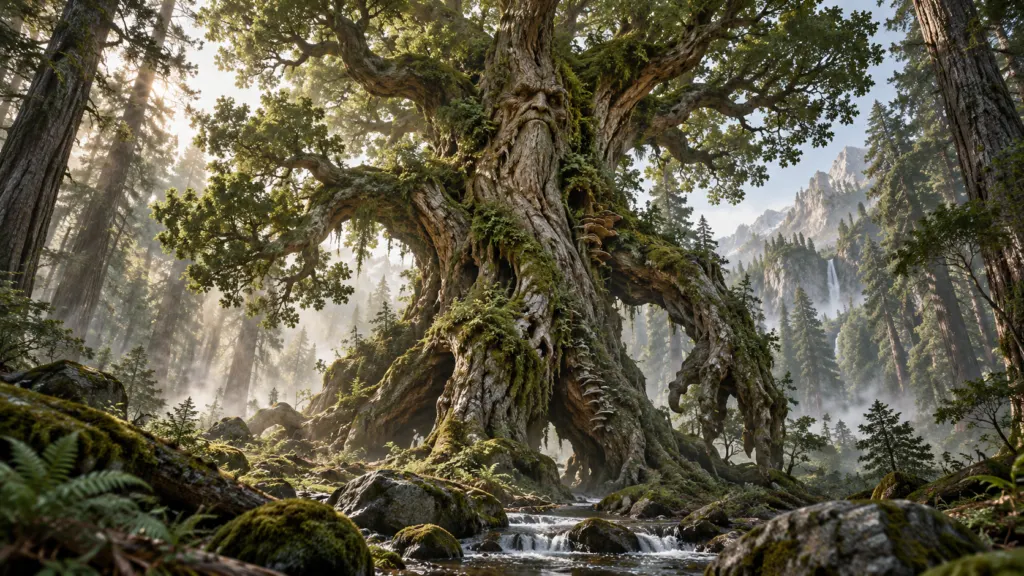
A treant is not a tree that suddenly became angry. It is an ancient intelligent woodland being that can stand unnoticed for years, listen to the life around it, remember boundaries older than kingdoms and tear down a fortification when persuasion fails. Most are patient guardians rather than indiscriminate killers. The danger begins when people assume the forest is empty simply because nobody has answered them yet.
Treants resemble enormous living trees until they move. Bark folds into a face, branches become arms and roots wrench themselves from the earth as legs. A typical adult stands about 30 feet tall and resembles the dominant trees of its home forest. Their apparent stillness is deceptive: a treant may have watched travellers, soldiers or woodcutters for hours before deciding whether they are guests, fools or enemies.
In SpiralWorlds, ordinary treants are an ancient people of the living forests, but they are not merely younger versions of Elder Treants. Elder Treants belong to a much older and more extreme form of arboreal life; ordinary treants arose later and interact with individual creatures far more readily.
At a Glance
| Creature | Treant |
|---|---|
| Type | Intelligent plant |
| Typical scale | Huge; about 30 feet tall |
| Temperament | Patient, territorial and protective; capable of negotiation, memory and long-term judgement |
| Campaign role | Forest guardian, ancient witness, negotiator, siege threat or dangerous ally |
| Habitat | Old forests, sacred groves, remote woodland valleys and surviving tracts of ancient forest |
| Deep history | Ordinary treants emerge in the Late Carboniferous–Permian, after the earliest Elder Treants |
| Primary weakness | Fire |
| Rules | CR 9 in 5.5e / 2024; CR 9 in 5e / 2014; CR 8 in Pathfinder 1e; CR 8 in D&D 3.5e |
Game Statistics
Choose the rules tab for the system being played. Each tab is standalone. The 5.5e block follows SRD 5.2.1, the 5e block preserves the 2014 presentation, and the Pathfinder 1e and D&D 3.5e versions retain their own native rules structures.
Treant
Huge Plant, Chaotic Good
AC 16
HP 138 (12d12 + 60)
Speed 30 ft.
Initiative +3 (13)
Vulnerabilities Fire
Resistances Bludgeoning, Piercing
Senses Passive Perception 13
Languages Common, Druidic, Elvish, Sylvan
CR 9 (XP 5,000; PB +4)
Traits
Siege Monster. The treant deals double damage to objects and structures.
Actions
Multiattack. The treant makes two Slam attacks.
Slam. Melee Attack Roll: +10, reach 5 ft. Hit: 16 (3d6 + 6) Bludgeoning damage.
Hail of Bark. Ranged Attack Roll: +10, range 180 ft. Hit: 28 (4d10 + 6) Piercing damage.
Animate Trees (1/Day). The treant magically animates up to two trees it can see within 60 feet. Each uses the Treant stat block except that its Intelligence and Charisma are 1, it cannot speak and it lacks Animate Trees. An animated tree acts immediately after the treant on the same Initiative count and obeys it. The animation lasts for 1 day, or until the tree dies, the treant dies or the tree moves more than 120 feet from the treant. It then takes root if possible.
Treant — D&D 5e / 2014
Huge plant, chaotic good
Armor Class 16 (natural armor)
Hit Points 138 (12d12 + 60)
Speed 30 ft.
Damage Resistances bludgeoning, piercing
Damage Vulnerabilities fire
Senses passive Perception 13
Languages Common, Druidic, Elvish, Sylvan
Challenge 9 (5,000 XP)
Traits
False Appearance. While motionless, the treant is indistinguishable from an ordinary tree.
Siege Monster. The treant deals double damage to objects and structures.
Actions
Multiattack. The treant makes two Slam attacks.
Slam. Melee Weapon Attack: +10 to hit, reach 5 ft., one target. Hit: 16 (3d6 + 6) bludgeoning damage.
Rock. Ranged Weapon Attack: +10 to hit, range 60/180 ft., one target. Hit: 28 (4d10 + 6) bludgeoning damage.
Animate Trees (1/Day). The treant animates one or two trees it can see within 60 feet. The animated trees use treant statistics except that Intelligence and Charisma are 1, they cannot speak and they can only use Slam. They remain allies for up to 1 day, ending sooner if destroyed, if the treant dies, if they move more than 120 feet away or if the treant ends the animation.
Treant
CR 8; XP 4,800
NG Huge plant
Init −1; Senses low-light vision; Perception +12
Defense
AC 21, touch 7, flat-footed 21 (−1 Dex, +14 natural, −2 size)
hp 114 (12d8+60)
Fort +13, Ref +3, Will +9
Defensive Abilities plant traits; DR 10/slashing
Weaknesses vulnerability to fire
Offense
Speed 30 ft.
Melee 2 slams +17 (2d6+9/19–20)
Ranged rock +7 (2d6+13)
Space 15 ft.; Reach 15 ft.
Special Attacks rock throwing (180 ft.), trample (2d6+13, DC 25)
Statistics
Str 29, Dex 8, Con 21, Int 12, Wis 16, Cha 13
Base Atk +9; CMB +20; CMD 29
Feats Alertness, Improved Critical (slam), Improved Sunder, Iron Will, Power Attack, Weapon Focus (slam)
Skills Diplomacy +9, Intimidate +9, Knowledge (nature) +9, Perception +12, Sense Motive +9, Stealth −9 (+7 in forests); Racial Modifiers +16 Stealth in forests
Languages Common, Sylvan, Treant
SQ animate trees, double damage against objects, treespeech
Special Abilities
Animate Trees (Sp). At will, the treant can animate trees within 180 feet and control up to two at once. A tree needs 1 full round to uproot itself. It then moves at 10 feet and fights using treant statistics, but has only one slam attack and lacks Animate Trees and rock throwing. It shares the treant’s vulnerability to fire. If the controlling treant ends the effect, becomes incapacitated or moves out of range, the tree immediately roots itself and becomes normal again.
Double Damage Against Objects (Ex). A treant or one of its animated trees deals double damage when it makes a full attack against an object or structure.
Treespeech (Ex). The treant can communicate with plants as though continuously affected by speak with plants; ordinary plants usually begin friendly or helpful toward it.
Ecology
Environment any forest
Organization solitary or grove (2–7)
Treasure standard
Treant
| Size/Type | Huge Plant |
|---|---|
| Hit Dice | 7d8+35 (66 hp) |
| Initiative | −1 |
| Speed | 30 ft. (6 squares) |
| Armor Class | 20 (−2 size, −1 Dex, +13 natural), touch 7, flat-footed 20 |
| Base Attack/Grapple | +5/+22 |
| Attack | Slam +12 melee (2d6+9) |
| Full Attack | 2 slams +12 melee (2d6+9) |
| Space/Reach | 15 ft./15 ft. |
| Special Attacks | Animate trees, double damage against objects, trample 2d6+13 |
| Special Qualities | Damage reduction 10/slashing, low-light vision, plant traits, vulnerability to fire |
| Saves | Fort +10, Ref +1, Will +7 |
| Abilities | Str 29, Dex 8, Con 21, Int 12, Wis 16, Cha 12 |
| Skills | Diplomacy +3, Hide −9*, Intimidate +6, Knowledge (nature) +6, Listen +8, Sense Motive +8, Spot +8, Survival +8 (+10 aboveground) |
| Feats | Improved Sunder, Iron Will, Power Attack |
| Environment | Temperate forests |
| Organization | Solitary or grove (4–7) |
| Challenge Rating | 8 |
| Treasure | Standard |
| Alignment | Usually neutral good |
| Advancement | 8–16 HD (Huge); 17–21 HD (Gargantuan) |
| Level Adjustment | +5 |
Combat
Treants prefer to observe intruders before committing to a fight. When they decide that a threat is deliberate, they use their reach and bulk to trample enemies, break structures and force opponents away from vulnerable trees. If pressure continues, they animate nearby trees to multiply the danger.
Animate Trees (Sp). A treant can animate trees within 180 feet at will and control up to two at a time. A normal tree takes 1 full round to uproot, then moves at speed 10 feet and fights as a treant. If the treant is incapacitated or goes out of range, the animated tree can no longer move. The effect otherwise functions similarly to Liveoak at caster level 12th. Animated trees share the treant’s vulnerability to fire.
Double Damage Against Objects (Ex). A treant or animated tree that makes a full attack against an object or structure deals double damage.
Trample (Ex). Reflex DC 22 for half damage. The save DC is Strength-based.
Skills. Treants gain a +16 racial bonus on Hide checks made in forested areas.
What Are Treants Doing Right Now?
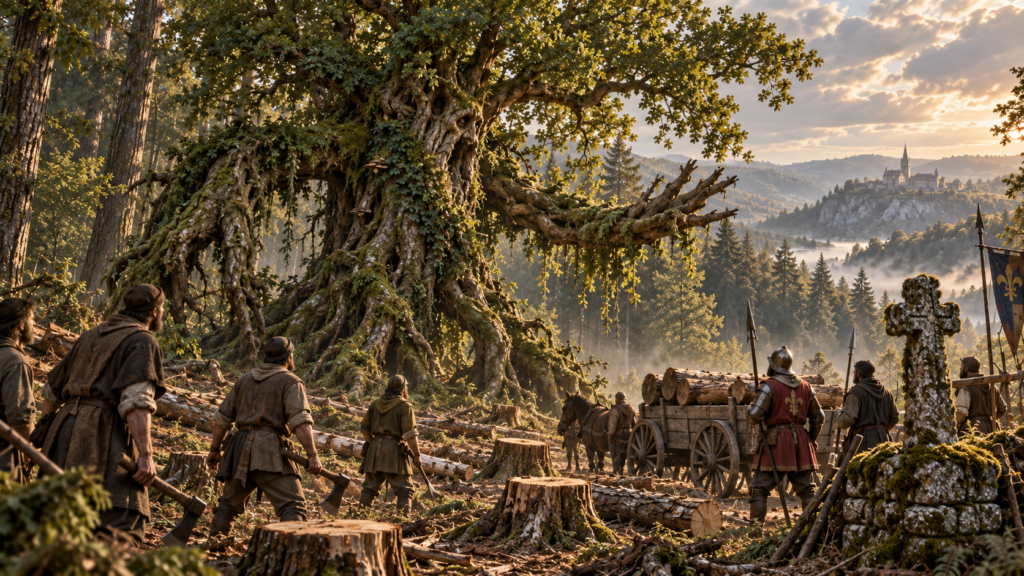
Across the surviving old forests, treants are being forced to decide how much of the human world they can tolerate. Timber is needed for houses, ships, bridges, mines, charcoal, palisades and siege works. Roads push into woods that were once difficult to reach. Lords grant cutting rights over land whose oldest inhabitants were never consulted. Villages that have taken fallen wood for generations may suddenly be ordered to fell living timber for war.
Treants do not respond to all of this in the same way. One may accept careful coppicing, deadwood gathering and narrow roads while forbidding the destruction of veteran trees. Another may tolerate a village because its people have honoured an old boundary for centuries. A third may have watched three generations break successive promises and no longer believe human agreements last long enough to matter.
This makes treants useful as more than combat encounters. They can remember a murder concealed beneath a tree two centuries ago, recognise the route of a vanished Roman road beneath the roots, know which spring changed after an earthquake, or identify the place where something unnatural first entered the forest. Their answers are rarely quick. To a treant, a question about “recent events” may include the reigns of several kings.
A campaign around Baden-Baden and the Black Forest is an immediate place to use this pressure. Timber, charcoal, roads and fortified settlements all create believable disputes at the forest edge without requiring the treant to be unreasonable or the human community to be villainous.
Signs That a Treant Is Near
Before Anyone Sees It
- A large tree stands in a place where local people insist no such tree stood last season.
- Axes and wedges are found carefully placed outside the forest rather than stolen.
- Boundary stones have been lifted intact by roots and moved back to an older line.
- Game trails avoid one apparently ordinary tree even when it offers good shelter.
- Fresh wheel ruts end where a timber cart has been overturned without its load being taken.
- Birds continue singing around a huge shape that strangers assume is part of the wood.
When the Forest Is Angry
- Recently cut stumps split or push up new shoots with unnatural speed.
- Roadside trees lean across a route without wind or landslip.
- Wooden fortifications are broken while nearby people are initially left alive.
- Felled trunks disappear at night and are found stacked across the road.
- A warning is repeated in several languages because the treant has learned exactly enough to make the meaning unmistakable.
- Ordinary trees begin moving only after the treant has decided negotiation has failed.
Behaviour
A treant does not think like a human wearing a wooden body. Its sense of time is slower, its attention is broader and many of its strongest memories are attached to places rather than dates. It can remain motionless while observing a dispute, then interrupt at the exact moment it believes a decision has become irreversible.
Treants are nevertheless individuals. Some are patient teachers. Some are stern wardens. Some are suspicious isolationists. A treant that has spent centuries near roads and villages may understand contracts, tolls, family feuds and local politics better than expected. One from an isolated forest may know almost nothing about current kingdoms and care even less.
They do not need a universal treant kingdom, monarch or priesthood. A grove is a relationship among neighbouring treants, not a state. A moot is a rare gathering called when a danger is too large or too long-lived for one grove to judge alone. Such meetings can take weeks or months because no participant feels obliged to hurry merely because humans do.
If Violence Starts
Treants are most dangerous when the battlefield contains exactly what their enemies came to exploit: trees, wooden structures, narrow roads and heavy equipment. Their first objective is usually to end the threat to the forest, not to maximise casualties.
How a Treant Escalates
- Observe. Determine who is responsible and whether the damage is deliberate.
- Warn. Block roads, return tools, destroy empty equipment or speak through someone likely to understand.
- Separate. Isolate workers, guards and leaders so the real decision-maker cannot hide behind hired labour.
- Break the work. Smash palisades, carts, scaffolds, bridges or siege engines before attacking fleeing people.
- Awaken the grove. Animate nearby trees when the threat becomes a battle rather than a dispute.
What Can End the Fight?
- Stop cutting immediately and withdraw from the disputed ground.
- Identify the person who ordered the destruction rather than blaming labourers.
- Offer a boundary the treant can recognise physically and remember.
- Restore a spring, grove, burial place or damaged stand of trees.
- Expose a third party that deliberately provoked both sides.
- Bring a trusted Druid, local fey or other witness whose promises have meaning beyond a single human lifetime.
Fire changes the encounter immediately. A torch carried for light is not the same thing as deliberate burning, but once fire is used as a weapon against the forest, negotiation becomes much harder. A treant that believes an uncontrolled blaze may spread will often ignore smaller enemies to extinguish, contain or remove the source.
Treant Groves and Moots
Most treants spend long periods alone. Solitary does not mean antisocial; it means that one intelligent guardian may be responsible for a woodland area large enough that another treant is rarely encountered. Where several territories touch, the individuals form a grove and exchange news, warnings and memories.
Groves need not agree. One treant may favour cooperation with nearby villagers while another argues that every road brings the next road. A third may care primarily about a river, a stand of ancient oaks or a supernatural boundary passing through the forest. Their disagreements can create adventures without making either side foolish.
A moot is exceptional. It is called for threats such as a spreading supernatural blight, organised forest clearance, a planar intrusion, a migrating monster population or a danger remembered from deep history. Adventurers allowed to address a moot have achieved something important; being heard does not mean the treants will agree.
Ancient History
Elder Treants belong to the earliest great arboreal intelligences of the Carboniferous. Ordinary treants appear later, during the Late Carboniferous–Permian transformation of the world’s forests. They are smaller, more numerous and far more likely to take notice of individual travellers, settlements and neighbouring peoples.
This distinction matters. Elder Treants are not kings sitting above a universal treant hierarchy. They are immense survivors whose attention rests on forests as whole living systems. An ordinary treant may respect one, avoid one, seek its memory or regard waking it as a desperate last resort. None of those relationships makes the Elder Treant a routine ruler of local groves.
During the ancient struggle against Zuggtmoy, the forest world faced something worse than ordinary predation. Zuggtmoy’s parasitic ecology sought to replace independent living systems with extensions of a single invading colony. Great woodland pillars were destroyed and surviving treant lines withdrew into protected refuges. The memory of that conflict helps explain why some treants react with extraordinary severity to supernatural infestations that erase the independence of an ecosystem.
Treants and Other Woodland Powers
Elder Treants
Elder Treants are older, vastly larger and much harder to rouse. They are not simply advanced ordinary treants and should not be presented as automatic rulers of treant society. Their concerns operate at the scale of watersheds, forests and long ecological changes. An ordinary treant is much more likely to notice a road, village or individual oath.
Druids
Druids can become valuable intermediaries because their promises may be tied to groves, circles and traditions rather than to one short-lived ruler. Treants do not automatically obey druids. A druid who excuses needless destruction because a lord ordered it may lose a treant’s respect very quickly.
Dryads and Fey
A Dryad is a distinct being with its own bond to a particular tree. Dryads and treants may become allies, neighbours, rivals or messengers for one another, but neither is a subordinate form of the other. Fey courts can also complicate a treant’s decisions when ancient woodland agreements predate present human boundaries.
Fungi and Zuggtmoy
Natural fungi are part of healthy woodland life. Treants do not wage war on decomposition, mushrooms or independent Fungoid peoples merely because they are fungal. Zuggtmoy is different: her threat is parasitic replacement, the destruction of independent organisms and ecosystems until all become parts of her colony.
Magic That Imitates Treants
The Changestaff spell can create a treant-like guardian, but that construct of magic is not a true member of the treant people and does not inherit their social authority or ancient memory. In legacy rules, Liveoak provides a related magical framework for an animated tree. Neither should be mistaken for proof that treants themselves are merely animated vegetation.
Using a Treant in an Adventure
The strongest treant adventures give the creature something more specific to defend than “the forest.” Decide what matters to this individual: a boundary, a spring, a grove of veteran trees, a buried ruin whose opening would release something dangerous, a pact with a village, a road that must never widen, or a place where the treant remembers an ancient catastrophe.
1. The Lord’s Timber
A local lord orders villagers to cut old trees for emergency fortifications. The villagers know the grove is protected but refusing the order means punishment. The treant has begun destroying empty carts and tools. Neither side has yet killed anyone. The characters have very little time before soldiers arrive to enforce the cutting.
2. The Moving Boundary
Two villages accuse each other of shifting boundary stones. In fact a treant is moving the stones back to the line agreed with their ancestors generations ago. The surviving human charter describes the boundary differently. Both documents may be genuine.
3. The Silent Witness
A murder from decades ago becomes politically important when new evidence appears. The only living witness is a tree that was present at the scene—and the treant who has spoken with it for years. The treant will answer questions only after the characters resolve a current threat to the same patch of woodland.
4. The False Treant
Travellers claim a treant is attacking people along a road. The real treant insists it has not moved for months. Someone is using magic, an animated tree or a treant-like guardian to make the forest appear responsible for attacks carried out for another purpose.
5. What the Roots Found
A treant uproots itself after centuries because its roots have encountered warm stone, metalwork and a hollow chamber below the forest. It does not know what the buried structure is, only that something inside has begun disturbing the soil.
6. The Grove Votes No
A road project would save several villages from isolation each winter. One treant accepts the proposed route, another refuses it and a third will agree only if a bridge is moved away from a sacred spring. The characters must negotiate with beings whose timescale makes a human deadline almost meaningless.
Treasure and Rewards
A treant does not need to carry coins for an encounter to have a reward. Material wealth found in its territory may consist of objects recovered from abandoned camps, old battlefields or travellers who died naturally beneath its trees. More interesting rewards are often permissions and knowledge:
- safe passage through a forest that is otherwise difficult to cross;
- the location of a forgotten road, ruin, grave or spring;
- testimony about an event no living human witnessed;
- permission to harvest a rare plant without angering the grove;
- guidance to a druid, dryad or older woodland power;
- an agreement that animated trees will defend a settlement against a specific invading threat.
A promise from a treant can outlast dynasties. So can a grievance.
Related SpiralWorlds Entries
Habitat and Ecology
Treants resemble the tree species that dominate their woodland territory. A typical adult is about 30 feet tall, with a trunk roughly 2 feet across, and may weigh around 4,500 pounds. Seasonal colour, bark texture and crown shape therefore vary with the forest rather than following one universal appearance.
An ordinary treant belongs to a living woodland system rather than standing outside it as a supernatural landlord. Birds may nest in its crown, moss and lichen may grow across its bark, and roots share the same soil and water pressures as neighbouring trees. Its intelligence lets it recognise slow changes that short-lived inhabitants easily miss: drainage altering over decades, a disease creeping through one species, over-browsing, repeated charcoal cutting or a magical influence that does not behave like natural decay.
A treant can remain motionless for so long that travellers mistake patience for dormancy. Movement is normally purposeful. Leaving a long-held rooting place means something has become important enough to outweigh the value of staying within the familiar forest.
Treant FAQ
Is a treant just an animated tree?
No. A true treant is an intelligent woodland being with memory, relationships and independent judgement. Spells such as Changestaff can create treant-like guardians, but those are not members of the treant people.
Are Elder Treants the rulers of ordinary treants?
No. Under current SpiralWorlds canon, Elder Treants are much older and more extreme arboreal beings, not monarchs at the top of a universal treant hierarchy. Ordinary treants are far more concerned with individual travellers, neighbouring communities and local woodland boundaries.
Do treants automatically attack woodcutters?
No. Context matters. Sustainable cutting, fallen timber gathering and long-standing local agreements may be tolerated. Deliberate destruction of protected woodland, broken boundaries, uncontrolled fire or repeated bad-faith agreements can turn a dispute into violence.
What language does a treant speak in SpiralWorlds?
There is no universal Common language. A treant normally knows Sylvan and whatever regional, ritual or learned languages fit its actual history. The rules tabs preserve source-language entries for edition accuracy; the campaign uses the Speak Language framework.
Treant Video
For an optional lore discussion, this video is kept low on the page so it does not interrupt the creature entry, mechanics or campaign material.
Sources and Licensing
The page deliberately separates campaign material from rules material. The 1454 integration, deep-time placement, ecology, encounter material, relationships, adventure hooks, presentation and editorial prose are SpiralWorlds setting content.
SRD 5.2.1 Attribution — 5.5e / 2024
This work includes material from the System Reference Document 5.2.1 (“SRD 5.2.1”) by Wizards of the Coast LLC, available at https://www.dndbeyond.com/srd. The SRD 5.2.1 is licensed under the Creative Commons Attribution 4.0 International License, available at https://creativecommons.org/licenses/by/4.0/legalcode.
The 5.5e Treant mechanics on this page follow SRD 5.2.1: CR 9, AC 16, 138 hit points, Siege Monster, two Slam attacks, Hail of Bark and Animate Trees (1/Day). This modern block is kept separate from the legacy OGL mechanics below.
Legacy Open Game Content
Mechanical rules material inside the Pathfinder 1e and D&D 3.5e mechanics panels is designated Open Game Content only to the extent that it derives from material already released as Open Game Content under the Open Game License version 1.0a.
No other portion of this page is designated Open Game Content. SpiralWorlds setting material, 1454 campaign material, deep-time canon, original explanatory prose, encounter guidance, adventure hooks, artwork, CSS, page design and editorial presentation are excluded from that designation.
Original SpiralWorlds content: Copyright © 2026 SpiralWorlds. All rights reserved except material separately identified as Open Game Content or licensed under Creative Commons Attribution 4.0 International.
OPEN GAME LICENSE Version 1.0a
The following text is the property of Wizards of the Coast, Inc. and is Copyright 2000 Wizards of the Coast, Inc (“Wizards”). All Rights Reserved.
1. Definitions: (a) “Contributors” means the copyright and/or trademark owners who have contributed Open Game Content; (b) “Derivative Material” means copyrighted material including derivative works and translations (including into other computer languages), potation, modification, correction, addition, extension, upgrade, improvement, compilation, abridgment or other form in which an existing work may be recast, transformed or adapted; (c) “Distribute” means to reproduce, license, rent, lease, sell, broadcast, publicly display, transmit or otherwise distribute; (d) “Open Game Content” means the game mechanic and includes the methods, procedures, processes and routines to the extent such content does not embody the Product Identity and is an enhancement over the prior art and any additional content clearly identified as Open Game Content by the Contributor, and means any work covered by this License, including translations and derivative works under copyright law, but specifically excludes Product Identity. (e) “Product Identity” means product and product line names, logos and identifying marks including trade dress; artifacts; creatures characters; stories, storylines, plots, thematic elements, dialogue, incidents, language, artwork, symbols, designs, depictions, likenesses, formats, poses, concepts, themes and graphic, photographic and other visual or audio representations; names and descriptions of characters, spells, enchantments, personalities, teams, personas, likenesses and special abilities; places, locations, environments, creatures, equipment, magical or supernatural abilities or effects, logos, symbols, or graphic designs; and any other trademark or registered trademark clearly identified as Product identity by the owner of the Product Identity, and which specifically excludes the Open Game Content; (f) “Trademark” means the logos, names, mark, sign, motto, designs that are used by a Contributor to identify itself or its products or the associated products contributed to the Open Game License by the Contributor (g) “Use”, “Used” or “Using” means to use, Distribute, copy, edit, format, modify, translate and otherwise create Derivative Material of Open Game Content. (h) “You” or “Your” means the licensee in terms of this agreement.
2. The License: This License applies to any Open Game Content that contains a notice indicating that the Open Game Content may only be Used under and in terms of this License. You must affix such a notice to any Open Game Content that you Use. No terms may be added to or subtracted from this License except as described by the License itself. No other terms or conditions may be applied to any Open Game Content distributed using this License.
3. Offer and Acceptance: By Using the Open Game Content You indicate Your acceptance of the terms of this License.
4. Grant and Consideration: In consideration for agreeing to use this License, the Contributors grant You a perpetual, worldwide, royalty-free, non-exclusive license with the exact terms of this License to Use, the Open Game Content.
5. Representation of Authority to Contribute: If You are contributing original material as Open Game Content, You represent that Your Contributions are Your original creation and/or You have sufficient rights to grant the rights conveyed by this License.
6. Notice of License Copyright: You must update the COPYRIGHT NOTICE portion of this License to include the exact text of the COPYRIGHT NOTICE of any Open Game Content You are copying, modifying or distributing, and You must add the title, the copyright date, and the copyright holder’s name to the COPYRIGHT NOTICE of any original Open Game Content you Distribute.
7. Use of Product Identity: You agree not to Use any Product Identity, including as an indication as to compatibility, except as expressly licensed in another, independent Agreement with the owner of each element of that Product Identity. You agree not to indicate compatibility or co-adaptability with any Trademark or Registered Trademark in conjunction with a work containing Open Game Content except as expressly licensed in another, independent Agreement with the owner of such Trademark or Registered Trademark. The use of any Product Identity in Open Game Content does not constitute a challenge to the ownership of that Product Identity. The owner of any Product Identity used in Open Game Content shall retain all rights, title and interest in and to that Product Identity.
8. Identification: If you distribute Open Game Content You must clearly indicate which portions of the work that you are distributing are Open Game Content.
9. Updating the License: Wizards or its designated Agents may publish updated versions of this License. You may use any authorized version of this License to copy, modify and distribute any Open Game Content originally distributed under any version of this License.
10. Copy of this License: You MUST include a copy of this License with every copy of the Open Game Content You Distribute.
11. Use of Contributor Credits: You may not market or advertise the Open Game Content using the name of any Contributor unless You have written permission from the Contributor to do so.
12. Inability to Comply: If it is impossible for You to comply with the terms of this License with respect to some or all of the Open Game Content due to statute, judicial order, or governmental regulation then You may not Use any Open Game Material so affected.
13. Termination: This License will terminate automatically if You fail to comply with all terms herein and fail to cure such breach within 30 days of becoming aware of the breach. All sublicenses shall survive the termination of this License.
14. Reformation: If any provision of this License is held to be unenforceable, such provision shall be reformed only to the extent necessary to make it enforceable.
15. COPYRIGHT NOTICE
Open Game License v 1.0a Copyright 2000, Wizards of the Coast, Inc.
System Reference Document. Copyright 2000, Wizards of the Coast, Inc.; Authors Jonathan Tweet, Monte Cook, Skip Williams, based on material by E. Gary Gygax and Dave Arneson.
Pathfinder Roleplaying Game Reference Document. © 2011, Paizo Publishing, LLC; Author: Paizo Publishing, LLC.
Pathfinder Roleplaying Game Core Rulebook. © 2009, Paizo Publishing, LLC; Author: Jason Bulmahn, based on material by Jonathan Tweet, Monte Cook, and Skip Williams.
Pathfinder Roleplaying Game Bestiary. © 2009, Paizo Publishing, LLC; Author: Jason Bulmahn, based on material by Jonathan Tweet, Monte Cook, and Skip Williams.
END OF LICENSE
Artwork
Treant ancient forest guardian hero illustration — SpiralWorlds, 2026: spiralworlds-treant-ancient-forest-guardian-hero.png.
Treant forest-boundary encounter illustration — SpiralWorlds, 2026: spiralworlds-treant-forest-boundary-encounter.png.
Rules and Page References
- Wizards of the Coast LLC — System Reference Document 5.2.1, Treant.
- Pathfinder First Edition open rules — Treant.
- Revised d20 System Reference Document — Treant.
- Open Game License v1.0a text.
- SpiralWorlds — Elder Treant, Zuggtmoy, Dryad, Druid, Changestaff, Liveoak, Speak Language, Alignment and Baden-Baden.