
Shango (Sango) — Yoruba Orisha of Thunder and Kingship
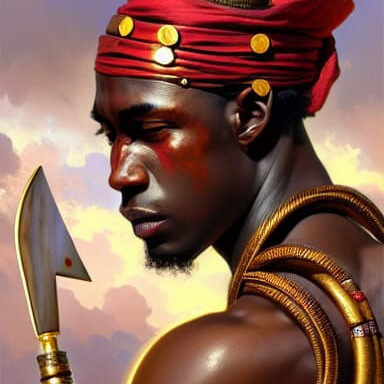
Yoruba tradition · Thunder · Lightning · Kingship · Judgement · Vitality
Shango is the Yoruba orisha of thunder and a deified legendary king of Oyo-Ile. His sacred presence combines explosive power with royal authority: the thunderbolt punishes wrongdoing, the double axe marks his cult, and his imagery can also carry ideas of fertility, children, protection and vigorous life.
Shango at a Glance
- Tradition
- Yoruba
- Names
- Shango, Sango, Ṣàngó
- Campaign alignment
- Chaotic Good; proud, forceful and intolerant of cowardly injustice
- Divine standing
- Major orisha and deified royal power
- Divine sphere
- Thunder, lightning, royal authority, judgement, vitality and protection
- Historic-mythic identity
- Remembered as a legendary king of Oyo-Ile and worshipped as an orisha
- Primary emblem
- The double-headed axe, associated with thunderstones and lightning
- Sacred setting
- Storms, royal compounds, shrines, ceremonial dance and places struck by lightning
- Favoured weapon
- Double axe or battleaxe
- Campaign present
- Active in Yoruba royal and religious life wherever thunder is read as judgement, warning or blessing
Divine Mechanics
Encounter role: Striker/controller. Balance: the printed CR assumes the deity uses its full Legendary Actions each round. Sacred Site Actions are additional encounter pressure and are not included in the base CR.
Shango is built as a mobile divine striker and battlefield judge. Thunder is not random area damage: his strongest abilities punish deliberate wrongdoing, broken oaths and attacks on those under his protection.
Shango
Medium Celestial (Deity), Chaotic Good
AC 23 · Initiative +13 (23)
HP 540 (40d8 + 360) · Speed 50 ft., fly 80 ft. (hover)
| STR | DEX | CON | INT | WIS | CHA |
|---|---|---|---|---|---|
| 30 (+10) | 24 (+7) | 28 (+9) | 22 (+6) | 26 (+8) | 30 (+10) |
Saving Throws Str +19, Con +18, Wis +17, Cha +19
Skills Athletics +19, Insight +17, Intimidation +19, Perception +17, Persuasion +19
Resistances fire, radiant, thunder; bludgeoning, piercing and slashing from nonmagical attacks
Immunities lightning, poison; Frightened, Paralyzed, Poisoned
Senses Truesight 120 ft., Passive Perception 27
Languages all; telepathy 120 ft.
CR 30 (155,000 XP; PB +9)
Traits
Legendary Resistance (4/Day). If Shango fails a saving throw, he can choose to succeed instead.
Magic Resistance. Shango has Advantage on saving throws against spells and magical effects.
Storm-Crowned. Shango is surrounded by a 20-foot aura of charged air. Enemies that start their turn in it take 10 Lightning damage. Allies of Shango’s choice in the aura have Advantage on saves against being Frightened.
Judgement Remembers. When a creature within 120 feet knowingly breaks an oath, harms a helpless creature, or attacks a creature Shango has placed under divine protection, Shango marks it until the end of his next turn. His attacks against the marked creature deal an extra 13 (3d8) Thunder damage.
Divine Spellcasting. Charisma is Shango’s spellcasting ability (save DC 27, +19 to hit). At will: Command, Thaumaturgy, Thunderwave. 3/day each: Call Lightning, Control Weather, Dispel Magic, Flame Strike. 1/day each: Fire Storm, Storm of Vengeance.
Actions
Multiattack. Shango makes three Oshe attacks.
Oshe, Double Axe of Thunder. Melee or Ranged Weapon Attack: +19 to hit, reach 10 ft. or range 120/360 ft. Hit: 28 (4d8 + 10) Slashing plus 22 (4d10) Lightning damage. The axe returns instantly after a ranged attack.
Thunderstone (Recharge 5–6). Shango hurls a stone axe of condensed storm at a point within 150 feet. Creatures in a 30-foot radius make a DC 27 Dexterity save. Failure: 45 (10d8) Lightning plus 45 (10d8) Thunder damage and Prone. Success: half damage, not Prone. A creature marked by Judgement Remembers has Disadvantage on the save.
Royal Command. Up to five creatures Shango can see within 90 feet make a DC 27 Wisdom save. On failure Shango chooses one effect for each: drop one held object, move up to its speed away from a protected creature, or kneel (Prone) until the start of its next turn.
Bonus Actions
Ride the Thunder. Shango teleports up to 60 feet to a space he can see. Creatures within 5 feet of the space he leaves or enters take 9 (2d8) Thunder damage.
Reactions
Answer the Blow. When a creature within 60 feet damages an ally or protected creature, Shango strikes it with lightning for 27 (6d8) Lightning damage, Dexterity DC 27 for half.
Legendary Actions
- Move. Shango moves up to half his speed.
- Oshe. Make one Oshe attack.
- Drum of the Storm (Costs 2). Enemies within 30 feet make a DC 27 Constitution save or take 22 (4d10) Thunder damage and lose Reactions until the start of their next turn.
- King’s Thunder (Costs 3). One marked creature within 120 feet is struck by lightning for 44 (8d10) Lightning plus 22 (4d10) Thunder damage, Dexterity DC 27 for half.
Sacred Site Actions
- Thunder Court. Enemies within 30 feet make a DC 27 Constitution save or take 27 (6d8) Thunder damage and lose Reactions until the next round.
- Royal Storm. A 20-foot-radius area within 120 feet erupts with wind and rain; enemies inside have Disadvantage on ranged attacks until the next round.
- Axe of Judgement. One creature marked by Judgement Remembers within 120 feet takes 36 (8d8) Lightning damage, Dexterity DC 27 half.
Divine Defeat
At 0 hit points Shango’s manifestation explodes into thunder and a fused stone axe remains behind. The storm withdraws, but the deity is not destroyed. If the axe is carried into a public act of courageous protection, the manifestation may return.
Shango
CR 30 · CG Medium outsider (chaotic, extraplanar, good)
Init +11; Senses true seeing; Perception +46
Aura storm-crowned (20 ft.)
AC 50, touch 30, flat-footed 41; hp 585
Fort +35, Ref +32, Will +33; DR 20/epic and evil; SR 41; immune electricity, paralysis, poison; resist fire 30, sonic 30
Speed 50 ft., fly 80 ft. (perfect)
Melee +5 holy shocking burst battleaxe +46/+41/+36/+31 (2d8+22/19–20 plus 2d6 electricity)
Ranged oshe +43 (same damage, 120 ft.; returns)
Special Abilities
Storm-Crowned (Su). Enemies starting within 20 feet take 2d6 electricity damage. Allies in the aura gain +4 morale bonus against fear.
Judgement Remembers (Su). Shango marks creatures that knowingly break sworn oaths, attack helpless targets or harm a creature under his protection. Against marked creatures his weapon gains bane and deals +4d6 sonic damage.
Thunderstone (Su) 1d4 rounds. 150-foot range, 30-foot burst, 15d8 electricity plus 15d8 sonic, Reflex DC 36 half. Failed save also knocks Prone.
Ride the Thunder (Su). As a swift action Shango teleports 60 feet. Adjacent enemies at either endpoint take 4d6 sonic damage, Fortitude DC 36 half.
Royal Command (Su) 3/day. Up to five creatures within 90 feet must make a DC 36 Will save or obey one brief command to drop an item, retreat, or kneel for 1 round.
Spell-Like Abilities
CL 30th; concentration +44. Constant—freedom of movement, true seeing. At will—command, greater dispel magic, shout. 3/day—call lightning storm, control weather, flame strike. 1/day—fire storm, storm of vengeance. Save DC 24 + spell level.
Statistics
Str 34, Dex 26, Con 30, Int 24, Wis 28, Cha 32
Base Atk +30; CMB +42; CMD 60
Feats Combat Reflexes, Critical Focus, Improved Critical (battleaxe), Improved Initiative, Iron Will, Power Attack, Quicken Spell-Like Ability, Weapon Focus (battleaxe)
Skills Acrobatics +41, Athletics-equivalent Climb +45, Diplomacy +44, Intimidate +44, Knowledge (history) +40, Knowledge (religion) +40, Perception +46, Sense Motive +42
Languages all; telepathy 1 mile
Shango
Lesser Deity · Divine Rank 10 · CG Medium Outsider (Chaotic, Extraplanar, Good)
CR 30
Hit Dice 32d8+320 (464 hp)
Initiative +12 · Speed 50 ft., fly 80 ft. (perfect)
AC 49, touch 31, flat-footed 41
Base Attack/Grapple +32/+44
Attack +5 holy shocking burst battleaxe +49 melee (2d8+23/19–20 plus 2d6 electricity)
Special Attacks alter reality, salient divine abilities, storm-crowned, thunderstone
Special Qualities DR 20/epic and evil, divine immunities, fast healing 15, immunity to electricity, SR 40, true seeing
Saves Fort +35, Ref +32, Will +33
Abilities Str 34, Dex 26, Con 30, Int 24, Wis 28, Cha 32
Skills Concentration +50, Diplomacy +49, Intimidate +49, Knowledge (history) +45, Knowledge (religion) +45, Listen +47, Sense Motive +47, Spot +47
Feats Combat Reflexes, Epic Weapon Focus (battleaxe), Improved Critical, Improved Initiative, Iron Will, Power Attack, Quicken Spell-Like Ability, Weapon Focus (battleaxe)
Languages all; telepathy 1 mile
Divine Abilities
Portfolio Sense. Shango senses major storms, royal crises, oath-breaking and violence against his worshippers up to ten weeks before or after they occur.
Storm-Crowned (Su). A 20-foot aura deals 2d6 electricity damage per round to enemies and grants allies +4 on saves against fear.
Thunderstone (Su). Every 1d4 rounds Shango throws a divine thunderstone as a 150-foot ranged touch attack. On impact it explodes in a 30-foot radius for 12d8 electricity plus 12d8 sonic damage, Reflex DC 36 half.
Salient Divine Abilities. Alter Reality, Battlesense, Divine Blast, Divine Storm, Extra Domain, Power of Truth, Supreme Initiative.
Spell-Like Abilities. At will: command, dispel magic, shout. 3/day: call lightning storm, control weather, flame strike. 1/day: fire storm, storm of vengeance. Caster level 30th.
Use Shango Tonight
Thunder in a Clear Sky
A succession council begins under perfect weather. Thunder sounds once for each candidate except one. The silent candidate insists the omen was manipulated.
The Stone from the Storm
A lightning strike uncovers an ancient stone axe beneath a palace courtyard. Three factions claim it proves Shango supports three different political causes.
The House That Lightning Avoids
A district suffers repeated storm damage, but one corrupt official’s compound is never touched. The immunity is not divine favour; someone has redirected the danger onto everyone else.
The Drums Stop
During a ceremony, every drum skin splits at the same instant. A priestess declares that somebody present has used Shango’s name to justify an act he never sanctioned.
Mythic Identity
Smithsonian National Museum of African Art objects identify Shango as the Yoruba orisha of thunder and as a deified legendary king of Oyo-Ile. Ceremonial staffs carried in his honour frequently bear the double-axe form associated with thunderbolts. The staff is not simply a fantasy weapon rendered in wood: it is a ritual emblem carried by devotees in ceremonies and dance.
Shango’s thunder is moral as well as spectacular. Smithsonian labels describe his thunderbolts as punishment directed at wrongdoers who arouse his anger. Other Shango imagery balances that destructive force with generosity, fertility, children and protection. The same deity who can shatter a roof with lightning may also be approached as a giver of children and protector of twins.
That combination is more interesting than the generic “storm god” model. Shango is hot, forceful, royal and public. His signs are difficult to ignore. Where Eshu can turn a choice through ambiguity, Shango can make a judgement arrive like thunder over a crowded court.
Shango and Kingship
The association with Oyo-Ile gives Shango a political weight that a purely elemental deity lacks. Royal authority in his shadow is never just personal strength. A ruler’s charisma, courage, generosity and capacity for decisive action can be praised in Shango-like terms; uncontrolled anger, arrogance and destructive excess can become warnings about the same power.
In the campaign present, Yoruba political life is not frozen into later imperial arrangements. Courts and lineages change, alliances shift and different Yoruba centres possess their own histories. Shango’s cult therefore connects royal memory to living politics without requiring every later institution of Oyo history to exist unchanged in 1454.
What Is Shango Doing Right Now?
Shango is attentive to rulers who confuse fear with legitimacy. A war leader who protects a town during crisis may attract his favour; the same leader can lose it by treating victory as permission for cruelty. Priests read unusual thunder, lightning strikes and recovered thunderstones as events requiring interpretation rather than as automatic instructions.
His cult also follows drums, dance and public ritual. Storm power is embodied, performed and remembered. A ceremony can become a political arena because everyone sees who carries the staff, who kneels, who speaks, and whether the weather answers.
Shango’s presence around childbirth and children should not be forgotten. Museum imagery explicitly links children with blessings returned for devotion and depicts maternal figures as appropriate bearers of Shango symbolism. That gives his cult a domestic and protective dimension beside the royal and martial one.
Signs of Favour
Thunder answers a just declaration; a lightning-struck tree survives and flowers; a lost child is found beneath an untouched roof after a storm; a ceremonial axe becomes warm in a worthy bearer’s hands.
Signs of Warning
Thunder rolls without rain; metal rings in empty rooms; every flame bends toward one person; a double-axe emblem cracks down the centre.
Direct Appearance
Shango may appear as a royal warrior surrounded by heat and thunder, as a presence inside a storm, or through a devotee whose ritual state becomes unmistakably more than performance.
Worship, Emblems and Sacred Conduct
Shango’s real ritual traditions are richer than a list of game props. The campaign therefore takes visible inspiration from documented ceremonial staffs, dance, double-axe imagery and the interpretation of thunder without claiming one universal rite for every Yoruba community.
| Practice | Meaning in Play |
|---|---|
| Carry the double-axe emblem | The emblem identifies ritual authority and recalls thunderbolts rather than functioning only as a battlefield weapon. |
| Interpret lightning strikes | A strike can become a legal, political or religious crisis whose meaning must be established by qualified specialists. |
| Public courage | Shango’s devotees value decisive action but distinguish courage from reckless harm. |
| Generosity with power | Royal or martial strength that never returns protection or prosperity to the community becomes spiritually suspect. |
| Respect children and family blessings | Fertility and protection remain part of Shango’s documented sacred imagery beside thunder and punishment. |
Regional Effects
When Shango’s divine presence dominates a region, thunder, public authority and broken obligations become difficult to separate. These are campaign effects inspired by his sacred associations, not claims about real-world Yoruba ritual practice.
- Thunder Answers Public Oaths. Within 6 miles, a solemn oath made before a gathered community may be followed by distant thunder even under clear skies; knowingly false oaths produce a harsher report.
- Lightning Reveals Rotten Authority. Structures used to conceal sustained abuse or corruption attract harmless but unmistakable static, sparks and scorch marks before major storms.
- Storm Courage. Allies defending civilians or dependants during a natural storm gain the edition-appropriate bonus against fear.
- Thunderstones Surface. After lightning strikes, unusual stone or fused-earth objects are more likely to be found and treated as omens requiring interpretation.
- Drums Carry Farther. Ceremonial drumming associated with legitimate communal rites can be heard at twice its normal distance without becoming louder at the source.
These effects fade over 1d10 days after Shango’s presence withdraws.
Domain Spells and Divine Gifts
Shango’s clerics emphasise Tempest, War, Protection, Strength and Royal Authority. Suitable spells include Thunderwave, Command, Shatter, Call Lightning, Protection from Energy, Flame Strike, Control Weather, Fire Storm and Storm of Vengeance, using edition-equivalent spells where needed.
Gift: Thunder Answers
Once per long rest after a devotee publicly protects someone weaker from deliberate harm, the devotee may add thunder damage equal to twice proficiency bonus to one successful attack or spell before the end of the next minute.
Gift: Storm Courage
The devotee has Advantage, or the edition-equivalent bonus, against fear while natural thunder can be heard.
Relics and Sacred Objects
The Oshe of the Returning Bolt
A double-headed ritual axe that can be wielded in battle only when its bearer has first made a public declaration of what they are defending. If used for private murder, its lightning turns on the wielder.
The King’s Thunderstone
A smooth stone said to have fallen where lightning struck. It becomes warm when an oath is knowingly broken nearby and can shatter magical silence with a single impact.
The Drum That Calls the Storm
A sacred drum whose rhythm can summon storm clouds, but only the community gathered around it determines whether the storm arrives as rain, warning or destruction.
Relationships
Shango belongs within the wider Yoruba orisha network. Oshun appears in important related traditions, but her page remains centred on river, fertility and living sacred landscape rather than reducing her to a relationship with Shango. Eshu governs communication and change; in stories and ritual logic, opening the road and judging what happens on it are different powers.
Historical and Cultural Sources
- Smithsonian National Museum of African Art — Shango staff: identifies Shango as thunder orisha and deified legendary king of Oyo-Ile; explains double-axe thunderbolt imagery.
- Smithsonian National Museum of African Art — Shango emblem staff: documents Shango as punisher of wrongdoers, generous giver of children and protector of twins.
Related Paths
World & Culture
African Gods & Sacred Traditions · Oyo Kingdom · West Africa · Africa · African History · African NPCs · African Bestiary
Divine Network
Oya · Oshun · Obá · Eshu · Ogun
Rules & Magic
Cleric · Call Lightning · Control Weather · Flame Strike · Fire Storm · Storm of Vengeance · Elemental Plane of Air
Rules Compatibility & Licensing
The divine statistics, regional effects, relics and combat mechanics on this page are original fantasy rules. Shango’s cultural identity, kingship traditions and ritual emblems are presented separately from those mechanics.
Rules terms and edition-specific mechanics are used for compatibility with the named game systems. Any third-party rules material remains subject to its original licence and attribution; original campaign text, encounter design and setting additions remain original material.
Keep this reference growing
If this page helped with your reading or game, you can support its upkeep or explore the curated books.
Explore the Bookshop — epics, classics and stories behind imagined worlds.