
West Africa
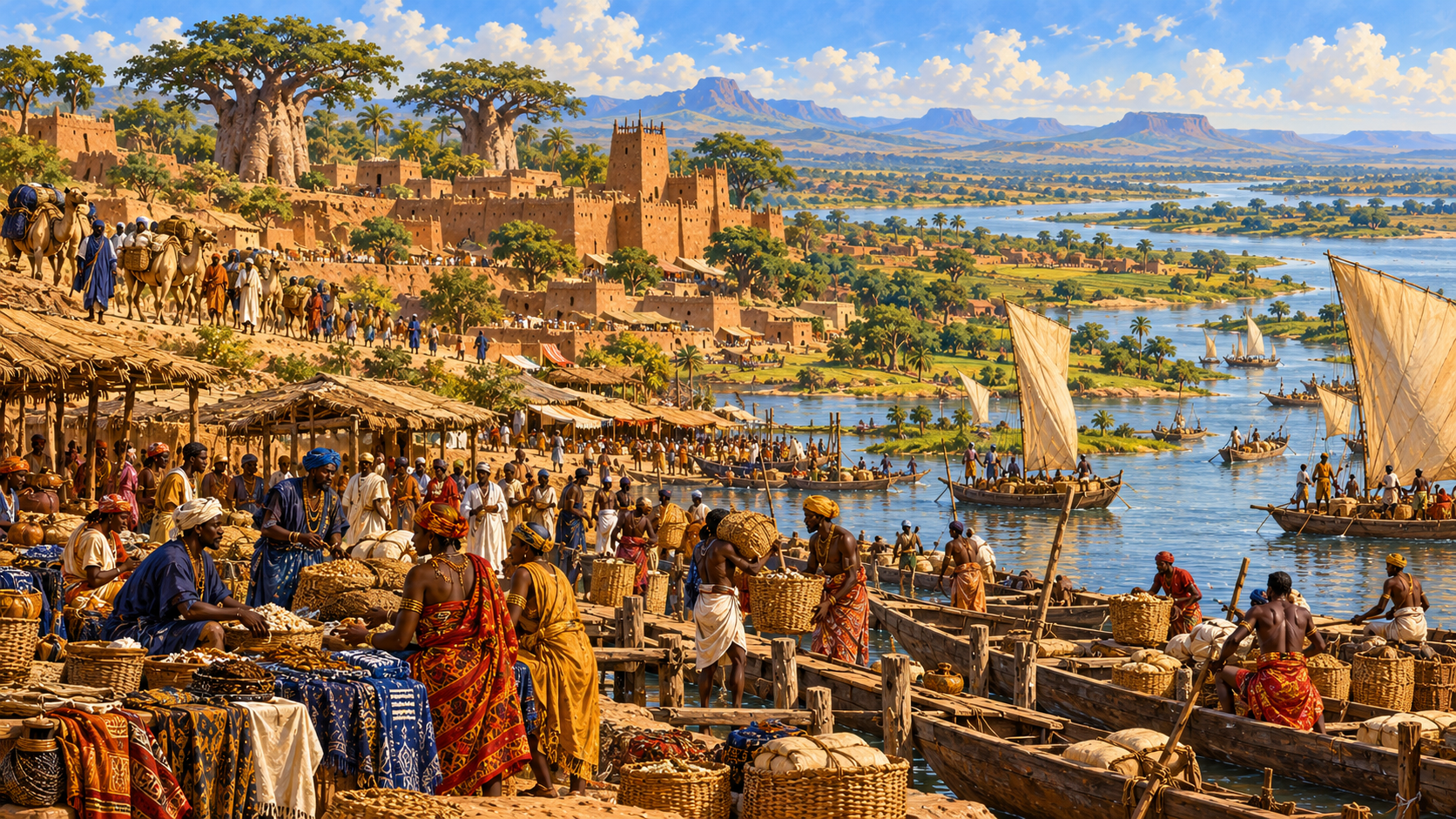
Mali · Niger roads · Tuareg trade power · rising Songhai · Hausa cities · Yoruba kingdoms · living sacred traditions
At a Glance
| Character | River kingdoms, savanna states, forest powers and markets connected by the Niger and trans-Saharan trade |
|---|---|
| Major powers | Mali, Tuareg-controlled trade centres, rising Songhai, Hausa states, Yoruba kingdoms and other forest and savanna powers |
| Key routes | Niger traffic, Saharan caravans, savanna roads, forest trade and coastward routes |
| Common expeditions | Court politics, caravan escorts, river journeys, sacred landscapes, trade disputes, monster hunts and contested markets |
| Current pressure | Mali is weakening while Tuareg and Songhai power reshape the northern Niger world and newer states profit from changing trade |
| Supernatural pressure | River powers, crossroads spirits, storm and iron cults, ancestral obligations and monsters tied to particular local traditions |
West Africa is a world of roads built by trade, rivers that serve as highways and courts whose power depends on controlling movement as much as territory. Mali remains important, but its old dominance is weakening. Tuareg power controls key northern trade centres, Songhai is rising farther east, and forest and savanna states are growing through commerce of their own.
Explore West Africa
- Hausa Kingdoms — city-states and trade networks across the central savanna.
- Houssa — a settlement on the region’s trading roads.
- Oyo Kingdom — a Yoruba political centre on the forest and savanna roads.
- Sudanian Savanna — the grassland belt carrying roads, herds and armies across the region.
- Sahara — the northern caravan world.
What Is Happening Right Now?
Mali still commands respect, wealth and old loyalties, but it no longer controls the western Sudan as securely as in the age of Mansa Musa. The problem is not a single defeat. Trade routes are changing, succession struggles have weakened authority, and rivals can now challenge places once assumed to belong within Mali’s political world.
Tuareg power dominates important northern trade centres. Timbuktu and Gao sit inside a shifting contest over caravans, river traffic and political allegiance. Songhai is growing in strength around the Niger. Its rulers and merchants seek a larger share of river tolls, market wealth and caravan trade.
Beyond the Niger centres, Hausa cities, Yoruba states, forest kingdoms and market networks are growing in their own directions. Mossi states profit as intermediaries between savanna and forest; Benin flourishes, and the trading roads reach the coast. Farther east, internal revolt and nomadic invasion have driven the ruler of Kanem and his followers into Bornu. No single court controls the whole region, and a merchant can cross several legal and sacred worlds during one long journey.
Courts, Caravans and Local Powers
- Mali Court — an established factional power defending old authority and trade.
- Tuareg Caravan Powers — route knowledge, wells, escorts and northern trade give them influence beyond formal borders.
- Hausa city authorities — urban rulers and merchants competing for trade and security.
- Yoruba courts — political and sacred authority tied to towns, roads, rivers and royal centres.
Landmarks and Places to Know
The Niger
The river is both highway and political frontier. Ports, ferries and market towns turn control of water into control of trade.
Timbuktu
The city remains a great northern trade centre even as political control changes. Whoever controls the approaches can tax, protect or threaten caravans entering the Niger world.
The Sudanian Savanna
Grasslands carry herds, armies, market traffic and seasonal fires across an enormous east-west belt.
Forest-Savanna Frontiers
Trade between woodland and open country creates wealthy intermediary states and contested routes. Goods, sacred practices and political influence all move through the same markets.
Markets, Lodging and Resupply
Travellers find rest in market compounds, caravan yards, guest houses attached to merchant households, river settlements and temporary camps. The most valuable service is often a trustworthy intermediary: someone who can arrange boats, translate agreements, hire porters, identify a safe road or explain which authority controls the next market.
Sacred Worlds and Specialist Services
West Africa’s sacred worlds are as varied as its kingdoms and peoples. The African Gods & Sacred Traditions encompass distinct rites and obligations. Anansi belongs to Akan story tradition; Yoruba sacred traditions honour Eshu, Oshun, Shango, Ogun, Orunmila, Obatala, Oya, Yemoja, Obá, Oshosi and Babalú-Ayé / Ṣọ̀pọ̀na.
Sacred expertise includes divination before a journey, ironwork bound to oath, river rites, healing, storm interpretation or negotiating with a shrine whose local authority is as real as a magistrate’s.
Dangers and Monsters
The African Bestiary includes Abiku, Adze and Shigidi. Their dangers follow particular communities, sacred obligations and local stories. A river journey, an Akan settlement and a Yoruba town each carry different supernatural threats.
- River hazards, floods and dangerous crossings.
- Caravan raids and disputes over wells or tolls.
- Grassland fires and long stretches without reliable shelter.
- Predators, shapechangers and spirits attached to forest, village or road.
- Political arrest when a party carries the wrong letter, cargo or patron’s seal.
Trouble on the Roads
The Missing Tribute
A convoy carrying gifts to a court disappears between two markets. Both authorities insist it crossed the border safely. The only surviving porter says the road itself changed direction at sunset.
The River Chooses a New Bank
A Niger channel shifts after one night of impossible rain, leaving a wealthy landing place useless and revealing stonework beneath the old waterline.
The Caravan King’s Well
Tuareg caravan leaders close a vital well after someone breaks an old agreement. Three courts send negotiators, and one sends assassins.
Thunder Over the Market
A clear sky erupts above a royal market during a succession dispute. Traders want business to continue; diviners insist the sign must be answered first.
Travel, Authority and Law
River rights, market tolls, caravan protection, grazing, road tribute and local sponsorship matter more than a single regional law. A party may be welcome in one city and suspect in the next because its patron, cargo or weapons carry political meaning. Travellers should learn who controls each ferry, road, well and market before assuming that a previous agreement still applies.
History and Older Powers
Mali inherited roads and trading relationships older than its own imperial power. The wealth and patronage of Mansa Musa remain part of its royal legacy. River towns, caravan markets and forest courts preserve their own histories through lineages, sacred places, craft traditions and old agreements. A fallen empire can leave a claim to tribute alive long after it loses the strength to enforce it.