
Quirinus at a Glance
Tradition
Roman and Italic.
Divine standing
Intermediate Deity · Campaign Divine Tier 33.
Alignment
Lawful Neutral.
Portfolio
Civic community, citizenship, collective identity, public order, lawful membership and the deified Romulus tradition.
Sacred places
The Quirinal Hill, the ancient shrine of Quirinus and the later Temple of Quirinus in Rome.
Symbols
Spear and civic wreath.
Favoured weapon
Spear.
Hellenic equivalent
None required. Quirinus is a distinctly Roman civic power.
Roman Pantheon · Civic Community · Citizenship · Quirinal · Romulus Tradition
Quirinus is not simply “Romulus as a god.” He is an older Roman power of the civic community whose identity later absorbed the deified founder. Where Jupiter embodies sovereign authority and Mars the armed strength of the people, Quirinus is the citizen body itself: the people who belong, assemble, serve, inherit and carry a city from one generation to the next.
Divine Mechanics
Campaign Divine Tier 33 expresses Quirinus’s setting-scale divine authority. The 5.5e rules-facing form is an encounterable manifestation capped at CR 29; Pathfinder 1e and D&D 3.5e use campaign epic/divine extensions rather than treating a god as an ordinary monster.
Quirinus — 5.5e Rules-Facing Form
Medium Celestial (Deity), Lawful Neutral
CR 36 (custom epic) · PB +10 · Campaign Divine Tier 33
AC 28 · HP 720 · Speed 40 ft.
| STR | DEX | CON | INT | WIS | CHA |
|---|---|---|---|---|---|
| 30 (+10) | 26 (+8) | 30 (+10) | 28 (+9) | 30 (+10) | 32 (+11) |
Saving Throws Str +20, Con +20, Wis +20, Cha +21
Skills History +17, Insight +18, Perception +18, Persuasion +19, Religion +17
Damage Resistances psychic, radiant; bludgeoning, piercing and slashing from nonmagical attacks
Condition Immunities Charmed, Frightened, Poisoned
Senses Truesight 120 ft., passive Perception 28 · Languages all; telepathy 120 ft.
Traits
Legendary Resistance (5/Day). If Quirinus fails a saving throw, he can choose to succeed instead.
Magic Resistance. Quirinus has Advantage on saving throws against spells and magical effects.
People in Assembly. Quirinus and allies of his choice within 30 feet gain a +2 bonus to saving throws while at least two conscious allies are also within the aura. A creature can benefit from only one People in Assembly aura at a time.
Civic Identity. Quirinus knows when a creature within 120 feet knowingly makes a false claim of citizenship, lawful membership or public office in a community whose customs he understands. This reveals the false civic claim, not every lie the creature tells.
Unbroken Citizen-Body. Quirinus cannot be forced to move or knocked Prone while at least three conscious allies of his choice are within 30 feet.
Divine Spellcasting
Charisma is Quirinus’s spellcasting ability (spell save DC 29, +21 to hit with spell attacks). He requires no material components.
At will: Aid, Command, Zone of Truth, Heroism
3/day each: Freedom of Movement, Greater Restoration, Hallow
1/day each: Geas, Heroes’ Feast, Mass Heal
Actions
Multiattack. Quirinus makes three Civic Spear attacks.
Civic Spear. Melee or Ranged Weapon Attack: +21 to hit, reach 15 ft. or range 120/360 ft., one target. Hit: 31 (4d10 + 9) piercing plus 18 (4d8) radiant damage.
Call the Quirites (Recharge 5–6). Allies of Quirinus’s choice within 60 feet may immediately move up to half their Speed without provoking Opportunity Attacks and gain 20 Temporary Hit Points. Each enemy in the area must succeed on a DC 29 Charisma saving throw or be unable to benefit from the Help action, allied reactions or features that require coordination with another creature until the end of that enemy’s next turn.
Judgement of the False Citizen (Recharge 6). One creature within 120 feet that has knowingly betrayed an oath of office, citizenship or lawful membership must make a DC 29 Wisdom saving throw. On a failure it takes 55 (10d10) psychic damage, is Frightened of Quirinus until the end of its next turn and cannot willingly move closer to a creature it has betrayed. On a success it takes half damage and suffers no other effect.
Bonus Action
Take Your Place. One willing ally within 60 feet moves up to 20 feet toward another ally without provoking Opportunity Attacks.
Reaction
Stand Together. When an ally within 30 feet is hit by an attack, Quirinus grants it +4 AC against that attack if another conscious ally is within 5 feet of the target.
Legendary Actions
Quirinus can take 4 Legendary Actions, one at a time at the end of another creature’s turn, regaining all spent uses at the start of his turn.
- Move. Quirinus moves up to half his Speed without provoking Opportunity Attacks.
- Civic Spear. Quirinus makes one Civic Spear attack.
- Assembly’s Voice (Costs 2). Up to three allies within 60 feet gain Advantage on their next saving throw before the end of their next turn.
- Hold the Line (Costs 2). Until the start of Quirinus’s next turn, allies of his choice within 30 feet cannot be pushed, pulled or knocked Prone.
Divine Manifestation — The City Stands
Once per encounter, when Quirinus would be reduced to 0 hit points while defending a recognised community, he instead drops to 1 hit point, ends all conditions affecting him and gains 180 Temporary Hit Points. Until those Temporary Hit Points are gone, People in Assembly extends to 60 feet.
Quirinus — Pathfinder 1e
Intermediate Deity; Lawful Neutral Medium Outsider (native, lawful); campaign divine extension
CR benchmark 29 · Divine Tier 33
AC 47, touch 29, flat-footed 39 · hp 620 · Speed 40 ft.
Fort +31 · Ref +28 · Will +33
DR 20/epic · SR 40 · Immune charm, fear, poison · Resist electricity 20, fire 20, cold 20
Perception +42 · Sense Motive +42 · Diplomacy +44 · Knowledge (history) +40 · Knowledge (religion) +40
Offense
Melee +5 civic spear +40/+35/+30/+25 (2d6+18 plus 2d6 lawful and 2d6 divine)
Ranged +5 civic spear +38 (2d6+18 plus 2d6 lawful and 2d6 divine; 120-ft. range increment; returns immediately after the attack)
Spell-Like Abilities
Constant: detect thoughts, discern lies, status
At will: aid, command, greater heroism, zone of truth
3/day: forbiddance, greater restoration, hallow, heroes’ feast
1/day: mass heal, miracle
Use caster level 29 for encounter resolution unless a higher divine effect is explicitly called for.
Special Abilities
Assembly Aura (Su). Allies within 30 feet gain a +2 morale bonus on saving throws and CMD against forced movement while at least two other conscious allies remain in the aura.
Civic Identity (Su). Quirinus automatically notices a deliberate false claim of public office, citizenship or lawful membership within 120 feet.
Call the Quirites (Su) 1d4 rounds. Allies within 60 feet may immediately take a 20-foot move as an immediate action without provoking attacks of opportunity and gain 20 temporary hit points for 1 minute. Enemies in the area must succeed at a DC 35 Will save or be unable to use aid another or teamwork feats until the end of their next turn.
Stand Together (Su). As an immediate action, Quirinus grants one ally within 30 feet a +4 sacred bonus to AC against one attack if another conscious ally is adjacent to that creature.
Divine Presence. Quirinus’s full divine authority exceeds this CR benchmark. This form is intended for an epic encounter, audience, trial or divine intervention scene rather than to reduce the god to a normal monster.
Quirinus — D&D 3.5e
Intermediate Deity; Divine Rank 12; Lawful Neutral Medium Outsider (Extraplanar, Lawful)
Divine Rank 12 · Divine Aura 1,200 ft. · DR 25/epic · SR 44
Speed 40 ft. · Favoured weapon spear
Portfolio civic community, citizenship, public order, collective identity, lawful membership and the Romulus apotheosis tradition
Divine Qualities
As an intermediate deity, Quirinus receives the standard benefits of divine rank, including rank bonuses to checks and attacks where appropriate, divine senses, remote communication with worshippers, portfolio awareness within the limits of the campaign and immunity to ordinary mortal effects that do not overcome divine protections.
Salient Divine Abilities
- Divine Protection. Quirinus can extend divine protection to a community, civic assembly or group acting under a recognised public oath.
- Divine Inspiration. He can strengthen courage, discipline and collective purpose in a gathered citizen body.
- Power of Truth. Civic oaths, citizenship claims and declarations of public office are unusually difficult to falsify in his presence.
- Alter Reality. Used principally for civic protection, restoration of lawful records, preservation of assemblies and enforcement of divinely witnessed public obligations.
Domain Spell-Like Abilities
Quirinus favours Community, Law, Protection and War. Domain spell-like abilities function at caster level 22 before other divine modifiers. Especially appropriate effects include aid, status, zone of truth, heroes’ feast, greater restoration, forbiddance, hallow and mass heal.
Special Divine Expression
The Quirites Endure. Once per round as a free action, Quirinus may allow one ally within his divine aura to reroll a failed save against fear, compulsion or forced movement. A creature can benefit only once per encounter.
Lawful Membership. Quirinus can determine whether a creature is legally recognised as a member, citizen or office-holder of a community whose law he understands. This is a divine sense, not mind reading.
Who Is Quirinus?
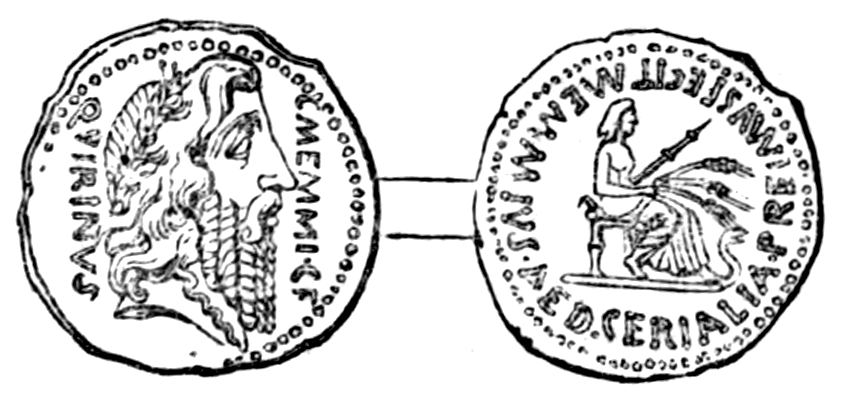
Quirinus belongs to the oldest layers of Roman religion. He was worshipped on the Quirinal, possessed one of Rome’s major priesthoods, and stood in the archaic triad with Jupiter and Mars. That older cult matters because it prevents the god from collapsing into a single later story.
Roman tradition eventually identified Quirinus with the deified Romulus. In the campaign, that identification is real without being retroactive: the ancient civic god existed first, while Romulus’s apotheosis became joined to Quirinus so completely that worshippers can address the founder and the old god as one divine identity without pretending the two traditions began at the same moment.
What Quirinus Represents
Quirinus governs the difference between a crowd and a civic body. A city is not merely walls, rulers or soldiers. It is the network of recognised people who can inherit, serve, swear public oaths, claim protection and accept obligations toward one another.
Citizenship
Who belongs, who is protected by law and who carries duties in return.
Assembly
The people gathered in a form that can speak, decide and bind itself collectively.
Public identity
The names, rolls, symbols and traditions that let a community recognise itself across generations.
Lawful admission
Adoption, naturalisation, oath-taking and the formal entry of outsiders into a community.
What Is Quirinus Doing Right Now?
Across Italy, rulers and councils continue to borrow Roman language, law and legitimacy. Quirinus pays less attention to their titles than to the people underneath them. A prince may call himself heir to Rome, but if he strips whole districts of rights while demanding their taxes and military service, Quirinus notices the contradiction.
His signs appear around disputed citizenship rolls, contested civic offices, mass expulsions, charters, guild admissions, military colonies and communities rebuilding after conquest. When a city starts deciding that some of its people count only when labour or soldiers are needed, Quirinus becomes dangerous.
Worship in the Campaign Present
Quirinus has no single universal cult hierarchy. His cult survives through civic fraternities, old Roman families, guardians of public registers, military-settler communities and towns that still treat citizenship as a sacred bond rather than a bureaucratic entry.
Some worshippers emphasise Quirinus as the ancient god of the Quirinal. Others invoke him as Romulus transformed. Most priests accept both traditions and care more about the obligations of membership than about deciding which story came first.
Priests and devotees
- Civic priests witness citizenship, adoption, office-taking and public oaths.
- Record keepers guard rolls, charters, boundary documents and hereditary civic rights.
- Veteran colonies invoke Quirinus when soldiers become settled citizens rather than merely an occupying force.
- Urban defenders call on him when the survival of the people matters more than a ruler’s prestige.
Common signs
A spear planted upright without falling, a missing citizen’s name reappearing on a damaged register, a crowd suddenly speaking one sentence together or a civic wreath remaining green through winter are all taken as signs that Quirinus is paying attention.
The Quirinal, the Archaic Triad and Romulus
The Quirinal Hill is central to Quirinus’s identity. His shrine and later temple made the hill one of the clearest physical anchors of his cult. His priest, the flamen Quirinalis, belonged to the senior Roman priesthoods, placing Quirinus among powers far older and more important than the later Romulus equation alone would suggest.
In archaic religious tradition, Jupiter, Mars and Quirinus form a triad. Their roles are not interchangeable. Jupiter stands above as sovereign and guarantor of public order; Mars represents force, protection and the military capacity of the people; Quirinus represents those people as an organised civic community.
The later Romulus tradition adds a founder-king dimension. It allows Quirinus to act as the divine memory of a people becoming a city — but the god remains larger than one heroic biography.
Domains, Spells and Divine Gifts
Quirinus has full access to the Community, War, Glory and Protection domains in the matching edition. Order remains a strong thematic expression of his civic portfolio; use the linked domains’ complete spell lists rather than limiting him to the examples below.
Order
Command, Zone of Truth and Geas express public obligation and lawful speech.
Protection
Aid, Warding Bond, Freedom of Movement and Hallow protect the people rather than merely the throne.
Community
Heroism, Beacon of Hope, Heroes’ Feast and Greater Restoration support a group that survives by acting together.
War
Quirinus grants war magic when defence of the citizen body is the purpose. Conquest for private glory belongs far more naturally to other powers.
Divine Gifts
Know the Citizen
You can recognise whether a creature has been formally admitted to a community whose laws and customs you know. This reveals legal membership, not loyalty, morality or private intention.
Stand as One
Once per long rest, you and up to three willing allies within 20 feet gain +1 AC for 1 minute while each beneficiary remains within 20 feet of at least one other beneficiary.
Witness the Oath
When you hear a willing creature make a formal public oath, you know if it deliberately states an obligation it already intends to break. You do not learn hidden details beyond that intent.
Artifacts and Relics
The Quirinal Spear
Major Divine Artifact · Weapon (spear)
Attunement: Required by a creature holding recognised civic office or formally entrusted with defending a community.
5.5e
The Spear is a +3 spear.
Civic Defence. Once per turn when you hit a creature threatening a recognised member, home, assembly or boundary of your community, the attack deals an extra 13 (3d8) Force damage.
Office Is Not Property. If you knowingly use public office solely for private enrichment or revenge, the Spear becomes impossibly heavy for you until you make restitution or relinquish that office.
Stand as Citizens (1/Day). For 1 minute, up to six allies within 30 feet gain +2 AC while within 10 feet of another affected ally.
Pathfinder 1e
Major Artifact · CL 20th. Functions as a +5 defending spear. Against creatures threatening recognised members or boundaries of the bearer’s community it deals +3d6 force damage. Abuse of public office suppresses the spear for that bearer. 1/day: six allies gain +2 sacred bonus to AC for 10 rounds while adjacent to another affected ally.
D&D 3.5e
Major Artifact · CL 20th. Functions as a +5 defending spear, deals +3d6 force damage when defending recognised citizens or civic boundaries, and 1/day grants six allies +2 sacred AC for 10 rounds while they stand together.
Destroying the Spear
The Spear can be destroyed only when a lawful community unanimously dissolves the civic office it represents, protects every person who loses status in that dissolution, and melts the spearhead into equal shares of ordinary tools.
The Tablet of the Quirites
Lesser Divine Relic · Wondrous Item (civic register)
Names lawfully entered on the Tablet cannot be erased by mundane damage, forgery or political decree while those people remain lawful members of the community. If someone is unlawfully stripped of status, the name darkens but remains legible. The Tablet records status; it does not decide who deserves citizenship.
Relationships
Jupiter
Jupiter governs sovereignty, oath and public authority. Quirinus asks whether that authority still rests on a recognisable civic people.
Mars
Mars is the disciplined force that defends the community. Quirinus is the community for whose sake that force exists.
Janus
Janus governs passage and beginnings. Quirinus governs what it means once an outsider has actually crossed the civic threshold and become one of the people.
Vesta
Vesta preserves the hearth and continuity of the state. Quirinus preserves the human body of citizens whose shared life gives that continuity meaning.
Saturn
Saturn represents an older social memory and idealised order. Quirinus is more concerned with the civic body that exists now and the obligations it recognises.
How Quirinus Appears
Quirinus rarely arrives like a conqueror. He appears as an armed citizen, a stern magistrate without insignia, a veteran carrying a spear but no trophies, or a crowned Romulus whose authority comes from the people standing behind him rather than from the crown itself.
When angered, he does not usually destroy walls. He exposes the legal and social fractures inside them: falsified citizenship rolls become readable, erased names return, stolen charters reappear and public oaths become impossible to ignore.
Use Quirinus Tonight
The City Forgets Its Citizens
Every name from one district vanishes from the civic register. The residents still remember who they are, but guards, courts and tax collectors now insist the district has never legally existed.
Two Romuluses
Two supernatural figures appear on the Quirinal, each claiming to be Quirinus speaking as Romulus. Both know true secrets of the city’s foundation, but they give opposite commands.
The Empty Assembly
A civic decision is procedurally legal, yet every statue and image of Quirinus turns its back on the result. The law may have been followed while the citizen body was deliberately excluded.
The Veteran Roll
A company promised citizenship after military service reaches the city and finds the charter quietly altered. Their patron claims the promise never existed; the Tablet of the Quirites says otherwise.
Deep Dive
Continue through the Roman Pantheon, compare Quirinus with Jupiter, Mars, Janus and Vesta, then follow the cult into Rome and wider Italy. For player-facing divine characters, see the Cleric.
Historical Sources and Rules Compatibility
Quirinus is historically difficult because the cult is extremely old and later Roman writers reinterpret it through the Romulus tradition. The page therefore keeps two facts distinct: Quirinus is an ancient independent Roman god, and later Roman religion strongly identifies him with the deified Romulus.
- Sanctuaries of Quirinus — topographical evidence for the Quirinal shrine and later temple, with discussion of the cult’s development.
The 5.5e material is an original campaign adaptation designed to interoperate with SRD 5.2.1 conventions. Pathfinder 1e and D&D 3.5e material is likewise original compatibility material rather than reproduced official deity statistics. Historical cult material is separated from campaign invention throughout.
Rules licensing. D&D 5.5e terminology derived from the System Reference Document 5.2.1 is used under CC BY 4.0 where applicable. Pathfinder 1e and D&D 3.5e deity statistics on this page are original campaign conversions rather than official published deity stat blocks.
Divine Estate and Regional Effects
Where Quirinus’s presence is strong, a major sanctuary can project the following effects across roughly six miles. A small shrine normally manifests only one effect in a smaller area. Unless another divine power contests them, the effects fade over 1d10 days after the sanctuary is abandoned or desecrated.
Citizens Muster
When a protected settlement is threatened, lawful bells, horns and messengers reach able defenders with unusual speed and clarity.
The Civic Body Remembers
Public records of citizenship, oath and lawful service resist casual alteration; forged entries develop visible inconsistencies.
Arms Return Home
Weapons carried in defence of the community are less likely to be lost after battle; abandoned arms tend to be found by allies rather than enemies.
Keep this reference growing
If this page helped with your reading or game, you can support its upkeep or explore the curated books.
Explore the Bookshop — epics, classics and stories behind imagined worlds.