
Caribbean Sea
At a Glance
| Sea | Caribbean Sea, between the Antilles and the American mainland |
|---|---|
| Main approaches | Atlantic passes through the island arcs, the Yucatán Channel and the Gulf of Mexico approaches |
| Coasts and islands | Greater and Lesser Antilles, Central American shores and northern South America |
| Frequent voyages | Island-hopping, fishing, coastal trade, armed convoys, pirate expeditions and mainland passages |
| Powers | Indigenous Island Councils, Brethren of the Coast, port councils, maroon allies and Sea-Elf Reef Kingdoms |
| Greatest hazards | Reefs, hurricane seas, violent squalls, shallow channels, unfamiliar coastal batteries and things guarding submerged passages |
At first light the outer reef lies like a thin pale scar beneath the water. A local pilot stands at the bow of a small vessel, calling turns between coral heads that the captain cannot see. Beyond the breakers are palms, a beach and smoke lifting above a settlement; to the west sits a larger ship with guns run out, waiting near the entrance. The passage is narrow enough that neither crew wants a fight before reaching safe water.
The Caribbean is a sea of inhabited islands, deep channels, sheltered bays and treacherous approaches. Its people know which reefs can be crossed, which coves hold fresh water, and whose flags or shell marks mean danger. The sea is part road, part home and part battlefield.
What Is Happening Right Now?
A passage under two banners
A convoy bound for Port Royal reaches a channel where a privateer demands payment for escort. The escort boat is not the most urgent problem: sea-elf markers have been planted along the approach and the normal channel is closed. A fishing family can lead ships through an older gap in the reef, but the passage emerges directly beneath a coastal fort’s guns. Everyone wants the convoy to move; nobody agrees on who may command the route.
The fisherman with the bronze nail
After a storm a fisherman near Tortuga finds the remains of a wreck pinned beneath a coral overhang. He brings ashore one bronze fastening from the hull, and a deep-water creature follows his boat into the harbour. He has seen many wrecks, but never one whose timber seems to have been planted deliberately among living coral. His family needs him back at sea, while rival salvage crews now offer more money than they have ever seen.
The water casks at the wrong island
A vessel carrying freed captives and refugees reaches a quiet cove but finds the only freshwater source fouled by debris brought up in the recent storm. The people of an inland community can provide water and a safer route to the next shore, but the anchored vessel is being hunted by a hostile captain. Keeping the refugees alive means finding clean water and a pilot before the pursuer reaches the cove.
Reefs, channels and island approaches
A long sandy beach may have no safe channel for a ship. A rocky harbour can be protected from one wind and deadly when the weather shifts. Shallow water is a resource and a threat: local craft cross areas where a deep-keeled vessel runs aground, while a pursuing ship risks losing its rudder if it follows too quickly.
The Greater Antilles contain wide islands and long coasts with distinct inland and maritime communities. The Lesser Antilles form chains of shorter passages, exposed headlands and volcanic islands. Water moves rapidly through some gaps, turning an easy-looking crossing into a race against the current.
The great mainland shores bring river mouths, mangroves, beaches and estuaries, each with their own hazards. A sailor who knows a Spanish harbour may still need a different pilot for a reef on the far side of an island. The safest approach is often not the shortest.
The people who keep the sea roads open
The Indigenous Island Councils maintain fishing grounds, gardens, coastal routes and knowledge that arriving fleets cannot reproduce by carrying a chart. Some negotiate with foreign harbours; others keep their own waters closed. The sea gives them both livelihoods and leverage.
The Brethren of the Coast gather armed captains around Tortuga and Port Royal without creating a single obedient navy. They rely on anchorage, food, repair work and local intelligence as much as on guns. A pirate ship without a place to refill water and replace sailcloth is soon a wreck.
Maroon communities use inland and coastal routes to shelter fugitives and move information. The people who choose to help a vessel do so for reasons of their own. A captain with a bag of gold cannot assume everyone ashore wants it more than security.
Guabancex, Atabey and the islands’ sacred waters
The Taíno islands have their own powers of sea, rain and storm. Among them is Guabancex, whose furious winds can tear houses apart and lay down forests. Guataubá announces the storm with wind and thunder; Coatrísquie sends the waters into the low valleys. On a coast where generations have endured hurricanes, these names are not an excuse for bad seamanship. They are spoken by people who know how a storm begins and what remains when it passes.
After a violent night, the people of a fishing village find their beach altered and their food gardens flooded with salt water. A sacred stone belonging to Guabancex has been carried far inland from a damaged shelter; strangers offer money for it. The village families insist it must remain among them. The next storm front appears to be forming earlier than expected, and the fishermen refuse to launch until the stone is returned.
Atabey, mother of Yúcahu, belongs to fresh water and fertility. Her waters matter wherever an island’s source is as precious as its anchorage. A spring that turns brackish after a storm can imperil every person on a small island, and its restoration is more urgent than a visiting captain’s demands. The local guardians know the old paths and understand what must be protected. A crew that helps restore the freshwater source earns a place in the island’s story; one that steals water makes enemies.
Yúcahu’s association with the sea and cassava makes another truth visible: fishing grounds and cultivated fields support one another. Food comes neither solely from the ocean nor solely from the gardens. The lives of the islands are tied together by their own sacred powers, as well as by alliances and trade.
Beneath the reef
The Sea-Elf Reef Kingdoms watch submerged routes that surface captains think of merely as shipping channels. The Brethren of the Coast, Indigenous Island Councils, Port Royal Harbour Council and Maroon Confederacies pursue their own interests around the islands. Their settlements, gardens and protected waters can lie directly beneath the tracks of armoured fleets. A treaty signed inside a harbour does not automatically bind the people below it.
Merfolk maintain their own coastal interests. A submerged ruin can attract salvagers and predatory beings for very different reasons. A claim to gold dragged from a wreck may be meaningless to one captain and a declaration of war to another species.
A reefclaw hiding beneath a fishing platform can injure a diver or destroy the day’s catch before anybody realises what is below. A sea serpent or kraken can turn even a gun-armed vessel into prey. Yet a simple storm may be more destructive to a community than any one monster: boats lost, fish traps smashed, water tainted and the narrow channels themselves rearranged.
The storm season
Storms can strike without giving a crew time to reach a harbour; seasonal hurricanes are the great terror of warm Atlantic waters. Heavy rain and surf change beaches and river mouths. Broken coral, shifted sand and wreckage leave passages different from the ones remembered by old pilots.
After a severe storm, a sheltered harbour is not necessarily a place of comfort. People have damaged homes and lost food stores. Boat owners need repairs and families search for missing crews. A visiting armed ship can make matters worse by demanding provisions that are no longer there.
Ships that do reach safety must choose carefully where to anchor, what to repair first and which local people can be trusted with the route onward. A sound pilot and an honest water seller are worth more than a chest of coins when a second gale is coming.
Ship, canoe or shallow-water pilot?
A merchant carrack brings cargo and armed passengers across the Atlantic, but it cannot follow every island fisher through coral shallows. Local canoes and rowboats cross the smaller passages; galleys and warships pursue an enemy when the channel has water enough for their hulls. The captain who hires a local pilot rather than relying on a distant chart has the advantage.
A boarding fight uses Ship Combat. Wreck salvage calls for divers, lines, and sometimes a diving bell. There is no charm that saves a ship when its drinking water is spoiled and the nearest shore refuses to trade.
Ports, food, shelter and repair
The working waterfront holds boatyards, rope makers, sail repairers, fish stalls and people ready to hire out small craft. Larger towns provide stores, healers and lodging. Remote islands may offer only a settlement willing to share food and a cove where a boat can be drawn above the ordinary tide. Every landing has inhabitants and expectations.
A crew that arrives with weapons ready may obtain compliance for a day but lose the friendship that makes return passages possible. Islanders remember who paid fairly, who helped after a storm and who stole their boat.
Routes beyond the Caribbean
The wider Caribbean page covers its named ports and regional powers; the Atlantic Ocean connects it to wider sea roads. North of the Caribbean Sea itself, the Bahamas belong to those Atlantic approaches. There, the Lusca haunts deep blue holes: a boat lowered too close to the dark opening may disappear into a submerged cavern rather than be carried off by any ordinary current. The coasts open into North America and the shores of South America. Follow Oceans for the other major waters; use Aquatic Terrain for sea hazards.
Reference illustration
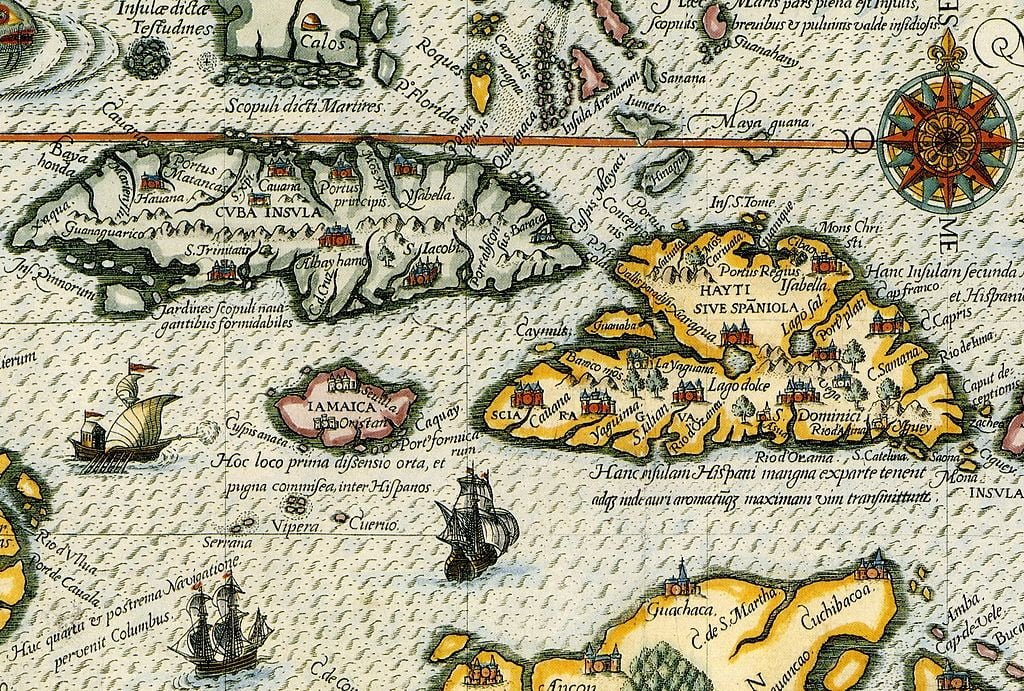
Sources
- Library of Congress, Columbus and the Taíno — Atabey, Yúcahu and the relationship between fresh water and the sea.
- Princeton University Press, Sea of Storms — Guabancex, Guataubá, Coatrísquie and Taíno knowledge of hurricane patterns.
- NOAA, Hurricanes and Sea Life — hurricanes can disrupt reefs, sands and marine life.
Keep this reference growing
If this page helped with your reading or game, you can support its upkeep or explore the curated books.
Explore the Bookshop — epics, classics and stories behind imagined worlds.