
Warship — Armed Fleets and Coastal Sieges
At a Glance
- Type
- Dedicated armed ship for patrol, battle, escort and troop landing
- Employment
- Royal and city fleets, guarded convoys, straits and fortified harbours
- Propulsion
- Sail and sometimes oars, depending on hull and tactical purpose
- Protection
- Strong timber, raised fighting positions and trained defenders
- Armament
- Archers, crossbowmen, boarding gear and fitted siege weapons
- Weaknesses
- Fire, damaged rudder, broken rigging, crew losses and hostile shoals
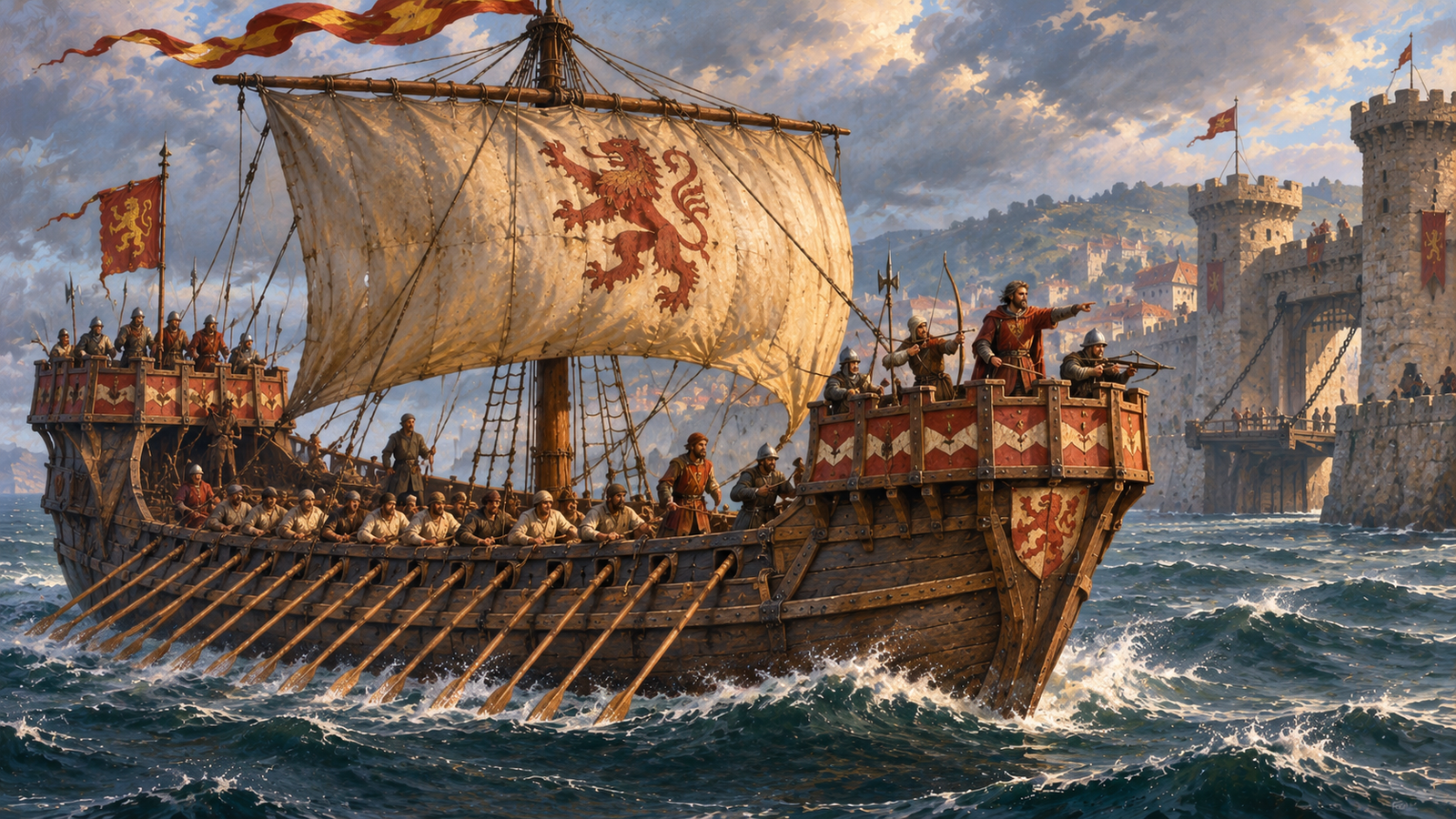
A warship comes out of the morning haze, its flags hanging damp and its fighting platforms already crowded with armed men. The harbour’s chain has not yet been raised. From the high stern a captain calls for the vessel to hold its course, but the pilot points to smoke rising from the signal tower. Someone ashore has betrayed the watch, and the first ship to enter the channel will decide the town’s fate.
Warships in 1454 differ widely in size and rig: a coastal galley is built for oars and manoeuvre, a strengthened sailing vessel for convoy and sea defence, and a ruler’s flagship may be fitted with castles, heavy artillery or reinforced sides. Such vessels are expensive assets supported by ports, shipwrights and sailors. No hull survives a campaign without food, rope, timber, reliable command and a protected place to repair.
Hull, Fighting Decks and Crew
Timbers are braced to bear the strain of weapons and the weight of men crowded along the rails. Raised fighting positions give archers a view over the deck. Heavy weapons require secure mounting, ammunition and trained crews; where they are placed determines which side of the ship can be fired upon.
Command. A captain orders the voyage and battle, a pilot guides the channel, a helmsman holds the course, and experienced sailors manage sails, lines and anchors. Soldiers may form a distinct fighting complement. Confusing sailors with armed passengers risks leaving a ship unable to move when its crew is ordered into combat.
Boarding. Grapples can bring a fleeing vessel alongside, but they also expose the attackers to missiles and blades. A ship with high fighting platforms may dominate a lower deck at close range. Boarding ladders, hooks and spare lines often matter more than ornamental armour.
Repairs and logistics. A damaged mast may leave the ship drifting; shattered steering gear can force a captain to beach or anchor before a storm. Provisions, powder or ammunition, fresh water and replacement wood are the unseen cost of naval power.
Blockade, Piracy and Maritime Law
A ruler may order a warship to intercept smugglers or protect a merchant fleet. A governor may declare a blockade, while neutral merchants argue that their cargo has no part in the war. Captured ships, prisoners and disputed cargo can turn a naval victory into a legal conflict that lasts years.
Adventure — The Chain Across the Harbour. A fortified town asks the party to escort grain through an enemy blockade. The old harbour chain has been hauled up, but its keeper claims he never received the signal. A warship waits beyond bowshot, and the captain’s messenger bears orders signed by the town’s own ruler.
Adventure — The Empty Flagship. A victorious fleet returns without its admiral. The largest ship carries no visible damage, but every officer’s name has been cut out of the logbook. A prisoner in the hold insists that the admiral is still giving orders from the captain’s cabin.
Hazards. Wind, tides and shoals shape battle as surely as arrows. A ship fighting in a narrow channel may be caught between reefs and shore batteries; a broad, deep hull cannot follow a fast raiding boat through shallow water. When fire breaks out aboard, victory may depend upon putting it out rather than pursuing the enemy.
Warship — Vehicle Rules
Warship — D&D 2024
Official vessel: Warship.
| Ship | Warship |
|---|---|
| Speed | 2½ mph |
| Crew | 60 |
| Passengers | 60 |
| Cargo (Tons) | 200 tons |
| AC | 15 |
| HP | 500 |
| Damage Threshold | 20 |
| Cost | 25,000 GP |
Crew and soldiers. The 60-person crew is the operating requirement, separate from the 60-passenger capacity of the table. Combat troops, siege engine operators and unusual weapons need their own space and equipment. The published hull values do not describe the AC or hit points of individual crew members or mounted weapons.
Movement. Use the ship’s 2½ mph travel speed subject to wind, water and crew; a vessel without any propulsion in a calm cannot move merely because its hull is seaworthy. A dangerous close approach or boarding manoeuvre may require an appropriate ability check.
Damage and repair. The hull’s threshold of 20 prevents lesser blows from reducing its hit points. Ship repair at berth costs one day and 20 GP per HP, halved in a fully equipped shipyard. Resolve rigging, steering, ammunition, fire and crew separately as needed.
Official source: D&D 2024 Basic Rules — Airborne and Waterborne Vehicles.
Warship — D&D 2014
Official vessel: Warship.
| Ship | Warship |
|---|---|
| Speed | 2½ mph |
| Crew | 60 |
| Passengers | 60 |
| Cargo (Tons) | 200 tons |
| AC | 15 |
| HP | 500 |
| Damage Threshold | 20 |
| Cost | 25,000 gp |
Engagement. Treat the ship as a vessel with its own AC, hit points and damage threshold; do not substitute the combat statistics of any other edition. Attacks on exposed crew, sails, rudder or siege weapons target those elements as circumstances allow.
Sea travel. The listed speed is for ordinary passage, not a guaranteed tactical movement each round. Weather, skill, wind and crew losses can prevent manoeuvres or force the captain to disengage. Resolve repairs under the ship and object rules after docking.
Official source: Dungeon Master’s Guide (2014), chapter 5, Airborne and Waterborne Vehicles, p.119.
Warship — Pathfinder 1e
Warship — Colossal water vehicle; Squares 80 (20 ft. by 100 ft.); Cost 25,000 gp.
Defense
AC 2; Hardness 10; hp 1200 (broken 599); Base Save +0.
Offense
Maximum Speed 150 ft. (current), 60 ft. (muscle); Acceleration 30 ft. (current), 15 ft. (muscle); CMB +8; CMD 18; Ramming Damage 8d8.
Description
Propulsion current (air and water; one mast, 160 squares of sails, 800 hp) or muscle (pushed; 80 Medium rowers); Driving Check Profession (sailor) or Knowledge (nature), +10 to the DC for air-current propulsion; Forward Facing bow; Driving Device steering wheel; Driving Space nine squares around the aft steering wheel; Crew 60; Decks 2; Capacity 50 tons of cargo or 160 soldiers; Weapons 20 Large direct-fire engines (10 per side), or six Huge (three per side); broadsides cannot fire while rowed.
The official Pathfinder warship is not the D&D 2024 warship’s 200-ton cargo vessel.
Official vehicle profile: Pathfinder Ultimate Combat — Water Vehicles. The carrack is explicitly a modified comparison, not a separate official vehicle.
Warship — D&D 3.5e
| Transport | Warship |
|---|---|
| Cost | 25,000 gp |
| Weight | — |
| Dimensions | 100 ft. long |
| Crew | 60–80 rowers |
| Capacity | 160 soldiers for a limited period |
| Travel speed | 2½ mph |
The core SRD describes a one-masted coastal vessel with oars, not the Pathfinder’s 1,200-hp stat block.
Voyages. The core SRD warship is intended for coastal forays and troop deployment, not cargo trading or long ocean passages. A force of 160 soldiers leaves little space for the stores necessary on a long voyage. The operating crew and soldiers should be accounted for separately when planning a battle.
Combat. Use the edition’s naval travel, Profession (sailor), object damage and relevant siege weapon rules. The core SRD transport listing does not assign this ship Pathfinder’s hardness 10, 1,200 hp or CMB/CMD; use only statistics actually established for this craft in the chosen encounter.
Official source: D&D 3.5e SRD — Warship.
Related Vessels and Sources
Compare the Galley, Longship, Sailing Ship and Carrack, or return to the Vehicles catalogue.
The warship depicted above combines sail and oar power with elevated fighting platforms, armed defenders and a timber hull suited to a late-medieval coastal engagement. Fleet vessels vary by region and purpose; this example is not a later frigate or galleon.
Section 15: Copyright Notice — Pathfinder Roleplaying Game Ultimate Combat © 2011, Paizo Publishing, LLC; authors Jason Bulmahn, Tim Hitchcock, Colin McComb, Rob McCreary, Jason Nelson, Stephen Radney-MacFarland, Sean K Reynolds, Owen K.C. Stephens and Russ Taylor.
Keep this reference growing
If this page helped with your reading or game, you can support its upkeep or explore the curated books.
Explore the Bookshop — epics, classics and stories behind imagined worlds.