
Reefclaw — Venomous Coastal Aberration
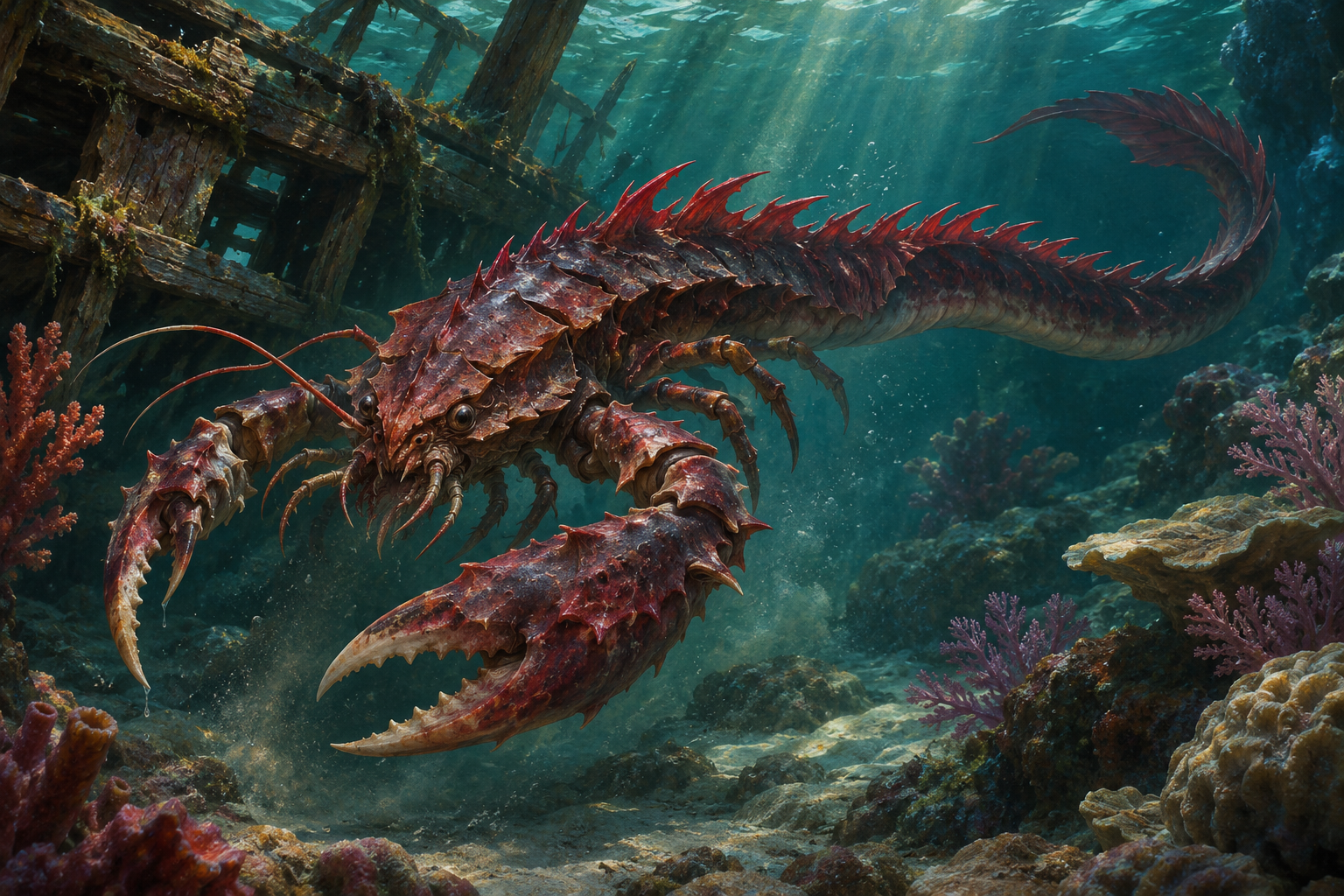
The pearl diver’s rope comes up taut, then slack. A crimson spine slices the water beside the boat. Below the keel, something with the claws of a lobster and the tail of an eel has learned to wait until its prey turns towards the surface.
At a Glance
| Creature | Reefclaw; Small aquatic aberration; usually chaotic neutral |
|---|---|
| Encounter Threat | A dangerous shoreline ambusher; even a lone reefclaw can drag an unprepared swimmer beneath the surface |
| Campaign Range | Tidal shallows, coral passages, warm estuaries and lower rivers; notably the Caribbean Sea and waters of the Great Barrier Reef |
| Appearance | Three-and-a-half-foot red-spined armoured predator with lobster-like pincers and an eel-shaped hindbody; about 70 pounds |
| Disposition | Intelligent enough to learn fishing patterns and understand speech, but unable to speak or read |
| Principal Danger | Venomous pincers, a punishing grip, dragging swimmers into deep water and a death frenzy |
| Treasure | None kept; possessions of victims may be lodged in its feeding crevice |
Game Statistics
Reefclaw
Small Aberration, Chaotic Neutral
Armor Class 14 (natural armor) · Hit Points 27 (6d6 + 6) · Speed 5 ft., Swim 40 ft. · Initiative +2 (12)
| STR | DEX | CON | INT | WIS | CHA |
|---|---|---|---|---|---|
| 12 (+1) | 14 (+2) | 13 (+1) | 5 (−3) | 12 (+1) | 6 (−2) |
Skills Perception +3, Stealth +4 · Resistance Cold · Senses Darkvision 60 ft., Passive Perception 13 · Languages understands Common or a prevalent local language but cannot speak · Challenge 1 (200 XP; PB +2)
Traits
Amphibious. The reefclaw can breathe air and water.
Tenacious Grip. It can grapple up to two Medium or smaller creatures, one with each claw. It moves at half Speed while dragging a creature its size or smaller.
Death Frenzy. When the reefclaw drops to 0 Hit Points, it makes one Claw attack against a randomly determined creature within reach before dying.
Actions
Multiattack. The reefclaw makes two Claw attacks.
Claw. Melee Attack Roll: +4, reach 5 ft. Hit: 4 (1d4 + 2) Slashing damage plus 2 (1d4) Poison damage. A Medium or smaller target also has the Grappled condition (escape DC 12).
Bonus Actions
Crush. One creature Grappled by the reefclaw takes 3 (1d6) Bludgeoning damage.
Reefclaw
Small aberration, chaotic neutral
Armor Class 14 (natural armor) · Hit Points 27 (6d6 + 6) · Speed 5 ft., swim 40 ft.
| STR | DEX | CON | INT | WIS | CHA |
|---|---|---|---|---|---|
| 12 (+1) | 14 (+2) | 13 (+1) | 5 (−3) | 12 (+1) | 6 (−2) |
Skills Perception +3, Stealth +4
Damage Resistances cold
Senses darkvision 60 ft., passive Perception 13
Languages understands Common or a prevalent local language but cannot speak
Challenge 1 (200 XP)
Traits
Amphibious. The reefclaw can breathe air and water.
Tenacious Grip. The reefclaw can grapple up to two Medium or smaller creatures, one with each claw. Its speed is halved when it moves while dragging a creature no larger than itself.
Death Frenzy. When reduced to 0 hit points, the reefclaw makes a single claw attack against a randomly determined creature within reach before it dies.
Actions
Multiattack. The reefclaw makes two claw attacks.
Claw. Melee Weapon Attack: +4 to hit, reach 5 ft., one target. Hit: 4 (1d4 + 2) slashing damage plus 2 (1d4) poison damage. If the target is Medium or smaller, it is grappled (escape DC 12).
Crushing Grip. One creature grappled by the reefclaw takes 3 (1d6) bludgeoning damage.
Reefclaw CR 1
XP 400
CN Small aberration (aquatic)
Init +5; Senses darkvision 60 ft., low-light vision; Perception +6
Defense
AC 14, touch 12, flat-footed 13 (+1 Dex, +2 natural, +1 size)
hp 13 (2d8+4)
Fort +2, Ref +1, Will +4
Defensive Abilities ferocity; Resist cold 5
Offense
Speed 5 ft., swim 40 ft.
Melee 2 claws +2 (1d4 plus grab and poison)
Special Attacks death frenzy, constrict (1d4)
Statistics
Str 10, Dex 13, Con 14, Int 5, Wis 12, Cha 13
Base Atk +1; CMB +0 (+8 grapple); CMD 11 (can’t be tripped)
Feats Improved Initiative
Skills Perception +6, Swim +8; Racial Modifiers +8 Swim
Languages Common (cannot speak)
SQ amphibious
Ecology
Environment coastal water and lower rivers
Organization solitary, school (2–5), or breeding shoal (6–11)
Treasure none
Special Abilities
Death Frenzy (Su). When it dies, the reefclaw immediately makes a full attack against a creature it threatens. If multiple creatures are within reach, determine the target of each attack at random, including other reefclaws.
Grab (Ex). The reefclaw can grab a target of any size. Its +8 racial bonus on grapple checks replaces the normal +4 bonus from grab.
Poison (Ex). Claw—injury; save Fort DC 13; frequency 1/round for 4 rounds; effect 1d2 Strength damage; cure 1 save. The save DC is Constitution-based.
Tactics
Before Combat Hides beneath broken coral, piers or flooded masonry.
During Combat Grabs a swimmer and pulls for the nearest deep fissure, using both pincers.
Morale Retreats if it cannot hold its prey, but fights viciously if cornered.
Reefclaw
Small Aberration (Aquatic); usually Chaotic Neutral
Hit Dice: 2d8+4 (13 hp)
Initiative: +5
Speed: 5 ft. (1 square), swim 40 ft. (8 squares)
Armor Class: 14 (+1 size, +1 Dex, +2 natural), touch 12, flat-footed 13
Base Attack/Grapple: +1/−3 (+5 with improved grab and racial bonus)
Attack: Claw +2 melee (1d4 plus poison)
Full Attack: 2 claws +2 melee (1d4 plus poison)
Space/Reach: 5 ft./5 ft.
Special Attacks: Constrict, death frenzy, improved grab, poison
Special Qualities: Amphibious, cold resistance 5, darkvision 60 ft., ferocity, low-light vision
Saves: Fort +2, Ref +1, Will +4
Abilities: Str 10, Dex 13, Con 14, Int 5, Wis 12, Cha 13
Skills: Spot +6, Swim +8
Feats: Improved Initiative
Environment: Warm or temperate coastal waters and estuaries
Organization: Solitary, school (2–5), breeding shoal (6–11)
Challenge Rating: 1
Treasure: None
Alignment: Usually chaotic neutral
Advancement: 3–4 HD (Small); 5–6 HD (Medium)
Level Adjustment: —
Combat
Improved Grab (Ex). After a claw hit, the reefclaw can begin a grapple without provoking an attack of opportunity, even against a larger foe. It gains a +8 racial bonus on the ensuing checks.
Constrict (Ex). A successful grapple check deals 1d4 points of bludgeoning damage.
Poison (Ex). Injury, Fortitude DC 13, initial and secondary damage 1d2 Strength; the DC is Constitution-based.
Death Frenzy (Su). When killed, the reefclaw immediately makes a full claw attack against creatures in reach, rolling randomly if more than one is threatened.
Ferocity (Ex). It continues to fight while disabled or dying, although it still takes damage and dies normally.
Amphibious (Ex). It can breathe air and water. Its +8 racial bonus on Swim checks allows it to take 10 while threatened or distracted.
Appearance
The reefclaw is built around its grip. Its head and thorax wear plates of blackened red shell; serrated claws unfold on thick joints before a body that narrows into an eel’s muscular tail. Spines stand along its back in a broken crimson ridge. Short walking legs anchor it to stone while the tail provides bursts of astonishing speed. A mature specimen measures about three and a half feet and weighs seventy pounds.
The claws carry venom along their inner edges. Folded in a coral fissure, the creature resembles storm-damaged timber or a tangle of red sea growth until its pincers snap shut.
Behaviour, Motivation and Hunting
Reefclaws take fish, crabs, dolphins and animals that approach drinking places. The cleverest individuals learn to distinguish a lone diver from an armed boat, and recognise the creak of ropes and the clang of a diving weight. They understand words commonly spoken in their feeding grounds but cannot answer, read, organise a state or negotiate a treaty.
One reefclaw normally rules a small feeding patch. Several may gather where a slaughterhouse channel or fishery supplies food. Their motive remains appetite, survival and breeding rather than malice, though a wounded animal attacks with extraordinary violence.
Signs of the Reefclaw
- Deep paired claw-grooves score mooring posts beneath the tide.
- Fish are cut open rather than bitten, with chipped pincer teeth lodged in the shell.
- Discarded red spines and dark armour flakes collect near a cave mouth.
- Swimming ropes jerk violently although no large fish is visible.
A cautious party can act on these signs. A pole tests a crevice; a weighted line draws the creature away; a rope tied to every diver prevents an easy disappearance.
If Violence Starts
Establish the waterline, drop-off and possible escape routes before the ambush. A reefclaw darts from cover, grabs a swimmer and pulls toward the nearest gap in the reef. On shore it is slow and vulnerable; in water it turns like a knife. It targets lowered hands, hooks and swimmers rather than smashing a whole ship.
The decisive choices are positional. Haul the victim into a boat, prise open a claw, obstruct the descent or abandon a trapped piece of equipment. When a reefclaw falls, its dying spasm can still injure a nearby creature. Resolve that strike immediately, without letting the corpse swim or choose a fresh position.
Habitat, Range and Ecology
Reefclaws thrive in shallow coastal waters, reef channels, tidal river mouths and submerged masonry. Their hunting grounds are usually confined to a short stretch of water where the current delivers food. Established populations occur in mangrove channels of the Caribbean and coral passages near the Great Barrier Reef. They are residents of the world’s oceans, not creatures that casually roam dry land.
The species descends from an ancient fleshcrafted guard animal. Forgotten builders bred reefclaws to defend submerged channels; the creatures escaped those enclosures and became a wild lineage long before 1454. This origin does not make them servants of modern kingdoms, aboleths or the Elemental Plane of Water. Such powers can capture and use reefclaws, but cannot claim their obedience as a birthright.
They are normally solitary. During the breeding season females converge and attack males in a brief, violent frenzy; their eggs are deposited in enormous numbers, but currents and hungry animals consume nearly all the young. That loss keeps many once-infested reefs empty for years.
Reefclaw Fishing, Treasure and Remains
In some ports reefclaw claw-meat is a delicacy. Fishermen lower meat on a chain, then haul the biting creature against the boat and cut at the joints with an axe. A severed claw can close reflexively, and the unfortunate fisherman who leans too far across the gunwale may lose a hand.
Reefclaws hoard no valuables, but tools, rings, fishing weights and blades sometimes lie beneath the remains of their prey. Intact venom sacs require careful harvesting. Eating their flesh confers no supernatural strength. Their grasp of spoken language also makes the trade in live animals a moral question in some communities, even where hunting them is lawful.
Encounters and Rumours
The Lost Diver
A pearl diver’s line is cut in two at the same depth as three earlier disappearances. The guild speaks of a sea serpent, but the carved grooves under the boat reveal a much smaller threat. One diver is still alive in a flooded fissure as the tide rises.
A Dozen Living Claws
A merchant pays handsomely for living reefclaws. The catch is stored beside a crowded harbour well, where the animals have learned the sound of the watchman’s bell and the position of the feeding gate.
The Door Below the Reef
Reefclaws gather around restraint rings fixed to a submerged archway. Past the predators lies a passage watched by locathah wardens. Killing the reefclaws makes the route safer for explorers—and also for thieves seeking the wardens’ vaults.
Near a ruined ship, a reefclaw might compete with a siyokoy for territory. Such contact does not imply friendship or command.
Sources and Licensing
The original Reefclaw’s identity and Pathfinder 1e game statistics are documented in Pathfinder Roleplaying Game Bestiary 2 (2010), with earlier source material from Pathfinder #7: Edge of Anarchy (2008). The setting history here is written for the 1454 Earth campaign; the Golarion names Alaznist and Thassilon are not part of this creature’s Earth history. The additional stat blocks and encounter material are original adaptations.
Section 15 notices: Pathfinder #7: Edge of Anarchy © 2008 Paizo Publishing, LLC; Author Nicolas Logue.
Pathfinder Roleplaying Game Bestiary 2, © 2010, Paizo Publishing, LLC; Authors Wolfgang Baur, Jason Bulmahn, Adam Daigle, Graeme Davis, Crystal Frasier, Joshua J. Frost, Tim Hitchcock, Brandon Hodge, James Jacobs, Steve Kenson, Hal MacLean, Martin Mason, Rob McCreary, Erik Mona, Jason Nelson, Patrick Renie, Sean K Reynolds, F. Wesley Schneider, Owen K.C. Stephens, James L. Sutter, Russ Taylor, and Greg A. Vaughan, based on material by Jonathan Tweet, Monte Cook, and Skip Williams.
SRD 5.2.1 and SRD 5.1 rules: Wizards of the Coast SRD resources, released under Creative Commons Attribution 4.0. Pathfinder and older open rules are credited under the Open Game License 1.0a and their original copyright notices. Original illustration created for this entry.
Keep this reference growing
If this page helped with your reading or game, you can support its upkeep or explore the curated books.
Explore the Bookshop — epics, classics and stories behind imagined worlds.