
Galley — The Oared Warship of the Coastal Seas
At a Glance
- Kind
- Large oar-driven and sail-assisted coastal vessel
- Usual Waters
- Harbours, sheltered seas, islands and coastal trade routes
- Propulsion
- Organised banks of rowers, supplemented by sail when conditions permit
- Purpose
- Troop transport, coastal patrol, naval warfare and commerce
- Principal Strength
- Can manoeuvre without a favourable wind
- Principal Weakness
- Large crews consume space and provisions; exposed oars are vulnerable
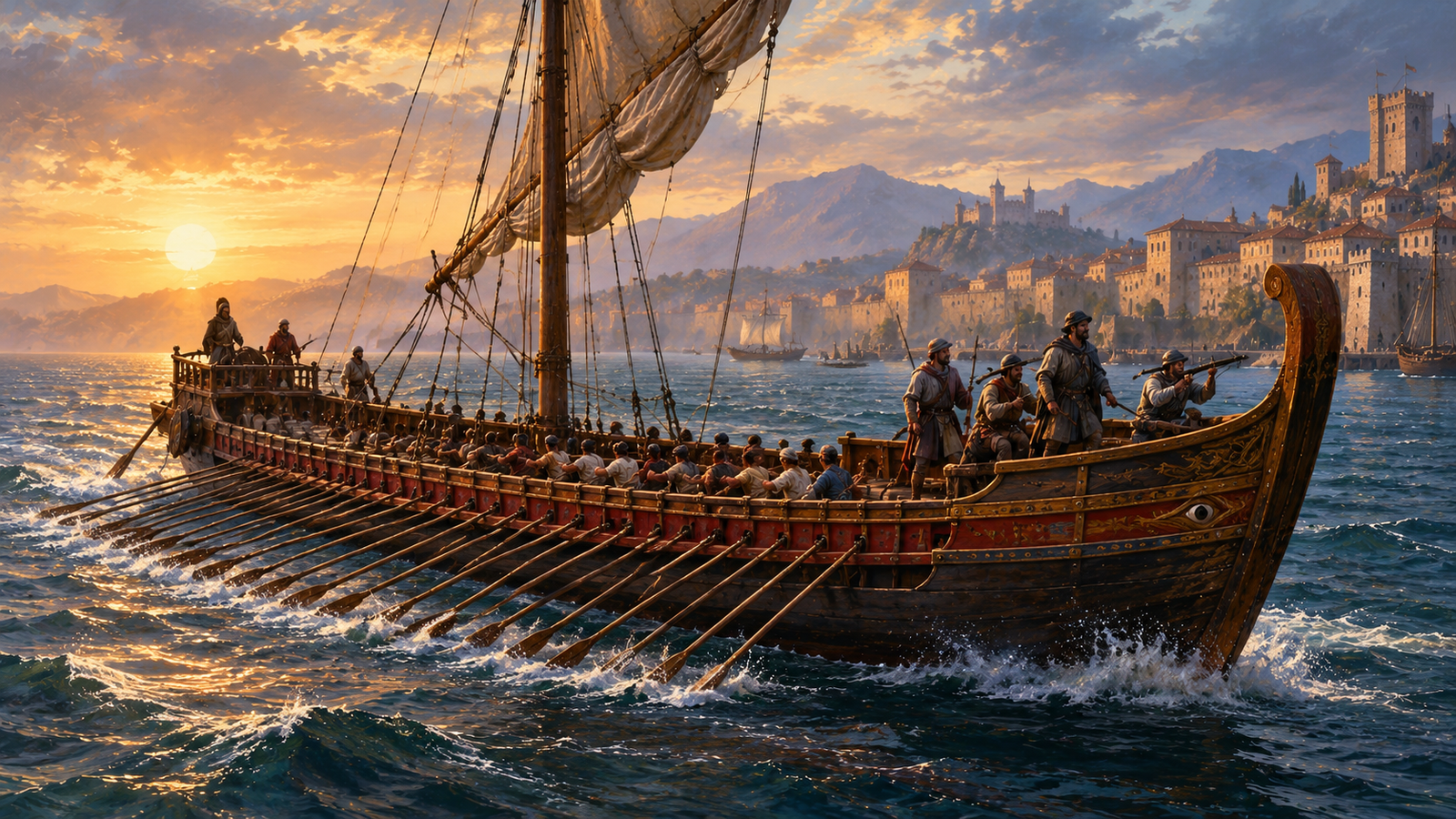
The harbour bells sound as a great galley draws away from the quay. On each side, ranks of oars strike the water in unison. Beneath the officers’ shouted commands, the rhythm of the rowers is almost like a heartbeat. Beyond the chain that guards the harbour mouth, a second vessel waits beneath a false flag, and the captain has just learned that the enemy knows his course.
In 1454 galleys remain important throughout sheltered seas and coastal waters where a ship that can move in calm conditions may determine a battle. They are long vessels whose oars give deliberate movement when the wind cannot. Their hulls demand skilled steersmen, constant repairs and a great many people to keep them moving. A galley might convoy merchants, carry troops, guard a strait or bring siege equipment against a fortified waterfront.
Along the Banks of Oars
The hull is long and relatively narrow, with banks of rowing stations and a deck where soldiers, sailors and officers work. Some vessels carry one or more masts; rigging can help on an open passage, but oars remain essential when the captain must bring the ship alongside another hull or hold position against an inconvenient wind.
Rowers and watch. A galley requires coordinated labour. The captain and helmsman give the orders, a master of oars controls the rhythm, and the crew maintains rigging, anchors, sails and stores. Some states use professional or paid oarsmen, others use prisoners or forced labour. The vessel’s laws and the treatment of its rowers shape morale and the risk of mutiny.
Stores. Water, food, spare oars, rope and sailcloth occupy precious space. During a chase the crew may row beyond normal endurance for a short period, but fatigue and thirst soon demand their price. A galley is not an ideal unattended ocean trader, especially if it cannot replenish its water.
Landing and battle. Troops may disembark from a beach or quay faster than they could from a deep-draft merchantman. Naval tactics rely on approach, missiles, grappling, boarding and, where fitted, rams or siege weapons. A smashed bank of oars can leave the vessel circling or helpless.
Law, Conflict and Campaign Use
At a guarded strait, governors levy tolls and search crews for contraband. Galleys can escort pilgrim ships and merchants or impose an embargo. Captives taken during a raid may be kept below the officers’ platform, and an ambitious captain can alter the fate of a port by refusing to follow an illegal order.
The Silent Stroke. A galley drifts into harbour with every oar extended and no sound from its decks. Its sails are furled; a sealed command scroll lies in the captain’s cabin. The ship carries enough provisions for another month, but the crew has vanished, leaving a single rower chained to his bench and insisting that they are still aboard.
The Narrow Channel. The characters must board an enemy transport before it passes the harbour towers. A gale pins the pursuing ships near shore, but a galley may still move under oars. The challenge is to reach the target without exhausting the crew, snapping the oars on submerged stakes or coming within range of the fortress guns.
Galley — Vehicle Rules
Galley — D&D 2024
Official vessel: Galley.
| Ship | Galley |
|---|---|
| Speed | 4 mph |
| Crew | 80 |
| Passengers | — |
| Cargo (Tons) | 150 tons |
| AC | 15 |
| HP | 500 |
| Damage Threshold | 20 |
| Cost | 30,000 GP |
Crew. The 80-person crew figure is the published operating complement in this ship table, not an automatic number of fighting passengers. To carry soldiers as additional occupants, determine available space and supplies for the specific galley.
Movement and weather. Oars permit movement when sail propulsion is unavailable, provided a functioning crew is aboard. A sailing vessel moves at half speed against a strong wind; in a calm it must use another means of propulsion. Use appropriate checks for close manoeuvres, collisions and storm hazards.
Damage. A single attack or effect must equal or exceed the damage threshold of 20 to damage the hull. Damage to individual oars, rigging or people is resolved separately. Ship repairs at berth cost 20 GP and one day per HP, halved in a well-supplied shipyard.
Official source: D&D 2024 Basic Rules — Airborne and Waterborne Vehicles.
Galley — D&D 2014
Official vessel: Galley.
| Ship | Galley |
|---|---|
| Speed | 4 mph |
| Crew | 80 |
| Passengers | — |
| Cargo (Tons) | 150 tons |
| AC | 15 |
| HP | 500 |
| Damage Threshold | 20 |
| Cost | 30,000 gp |
Operations. The printed crew number is the operating requirement for this game profile. Treat troops, additional rowers and armed detachments as a specific load or troop-carrying configuration rather than assuming unlimited passenger space.
Naval encounter. The galley can row when becalmed or manoeuvring near a shore. Attacks on the ship’s hull, its crew and its exposed oars are distinct targets. Use the 2014 damage threshold and ship repair procedures, and call for appropriate ability checks in exceptional manoeuvres.
Official source: Dungeon Master’s Guide (2014), chapter 5, Airborne and Waterborne Vehicles, p.119.
Galley — Pathfinder 1e
Galley — Colossal water vehicle; Squares 104 (20 ft. by 130 ft.); Cost 10,000 gp.
Defense
AC 2; Hardness 5; hp 1560 (broken 779); Base Save +0.
Offense
Maximum Speed 180 ft. (current), 60 ft. (muscle); Acceleration 30 ft. (current), 15 ft. (muscle); CMB +8; CMD 18; Ramming Damage 8d8.
Description
Propulsion current (air; three masts, 60 squares of sails, 300 hp), current (water), or muscle (pushed; 140 Medium rowers); Driving Check Profession (sailor) or Knowledge (nature), +10 to the DC when under sail; Forward Facing bow; Driving Device steering wheel; Driving Space nine squares around the aft steering wheel; Crew 20 under sail; 160 while rowed; Decks 3; Capacity 150 tons cargo or 250 soldiers; Weapons 40 Large direct-fire engines in banks of 20, or 12 Huge engines in banks of six, broadside only; cannot fire while rowing.
The published 8,000 gp ram-and-castles option adds raised fighting platforms and alternate firing arcs.
Official vehicle profile: Pathfinder Ultimate Combat — Water Vehicles. The carrack is explicitly a modified comparison, not a separate official vehicle.
Galley — D&D 3.5e
| Transport | Galley |
|---|---|
| Cost | 30,000 gp |
| Weight | — |
| Dimensions | 130 ft. long; 20 ft. beam |
| Crew | 200 |
| Capacity | 150 tons cargo or 250 soldiers |
| Travel speed | 4 mph |
The SRD describes seventy oars per side and an optional ram-and-castles fitting costing another 8,000 gp.
Voyage. This three-masted galley relies on oars or sail, is intended for coastal passages and cannot normally make an open-ocean voyage. Its great crew needs ample food and water. A ram and castles with firing platforms can be added for 8,000 gp.
Combat and handling. Use Profession (sailor), the edition’s sea travel, object and siege weapon rules. The equipment entry does not assign the Pathfinder galley’s AC 2, 1,560 hp, CMB or CMD to this vessel; those belong to a different rules profile.
Official source: D&D 3.5e SRD — Galley.
Other Vessels and Sources
Compare the Warship, Longship and Sailing Ship, or return to the Vehicles catalogue. The old illustration of ships fighting in 1602 has been withdrawn from this 1454 entry.
Section 15: Copyright Notice — Pathfinder Roleplaying Game Ultimate Combat © 2011, Paizo Publishing, LLC; authors Jason Bulmahn, Tim Hitchcock, Colin McComb, Rob McCreary, Jason Nelson, Stephen Radney-MacFarland, Sean K Reynolds, Owen K.C. Stephens and Russ Taylor.
Keep this reference growing
If this page helped with your reading or game, you can support its upkeep or explore the curated books.
Explore the Bookshop — epics, classics and stories behind imagined worlds.