
Fossegrim
The master fiddler of the falls: a capricious Norwegian water spirit whose music can enthral travellers, draw listeners toward dangerous water, and teach a worthy mortal secrets no human musician can impart.
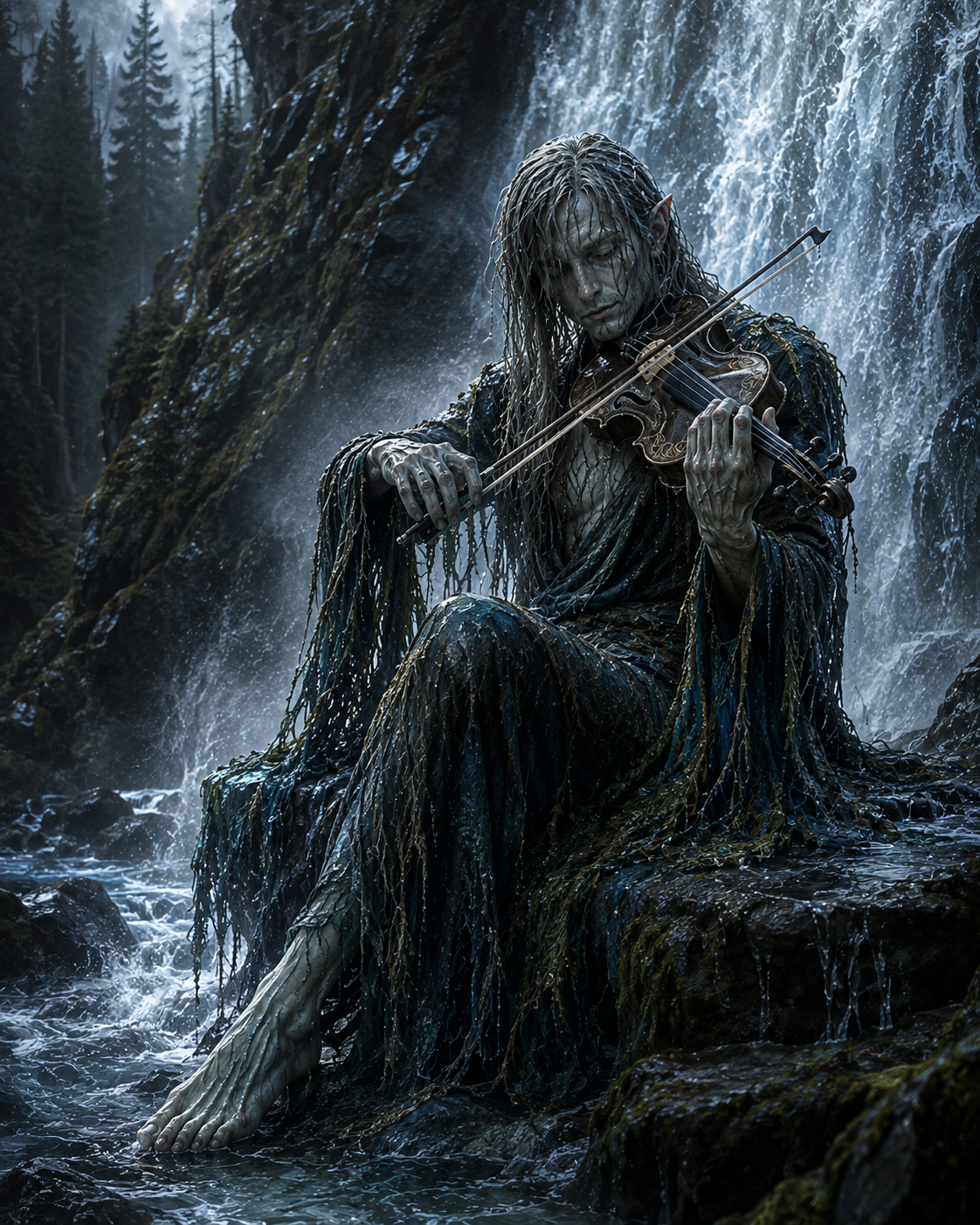
A melody threads through the roar of falling water. It is too precise to be birdsong, too mournful to be a shepherd’s tune and too clear to be an echo. Somewhere behind the white curtain of the falls sits the Fossegrim, bow moving across the strings while the river itself seems to keep time.
Fossegrims are supernatural fey musicians associated with waterfalls, fast rivers and old millwaters. They can be dangerous, but they are not merely predators waiting for an adventuring party to enter attack range.
A Fossegrim may lure a disrespectful traveller toward deep water, drive away those who damage its stream, ignore an ordinary passer-by entirely, or grant a determined musician the lesson of a lifetime.
Fossegrims are encountered most often in the isolated valleys and mountain waters of the Kingdom of Norway . Fiddlers, millers, hunters and woodcutters tell of particular falls where music can be heard after sunset and where a carefully chosen offering may receive an answer.
Game Statistics
The Fossegrim is a water-bound controller and social encounter rather than a conventional melee brute. Its strongest encounters combine supernatural music, compelled movement, broken sight-lines, rushing water and the physical danger of the waterfall itself.
Fossegrim
Medium Fey, Usually Chaotic Neutral
AC 15
Initiative +4 (14)
HP 78 (12d8 + 24)
Speed 30 ft., Swim 40 ft.
| Ability | Score | Modifier | Save |
|---|---|---|---|
| STR | 10 | +0 | +0 |
| DEX | 18 | +4 | +6 |
| CON | 14 | +2 | +2 |
| INT | 13 | +1 | +1 |
| WIS | 14 | +2 | +4 |
| CHA | 18 | +4 | +6 |
Skills Perception +4, Performance +8, Stealth +6
Senses Darkvision 60 ft.; Passive Perception 14
Languages Norwegian, Sylvan
CR 4 (XP 1,100; PB +2)
Amphibious. The Fossegrim can breathe air and water.
Master Fiddler. The Fossegrim’s supernatural music remains clearly audible through ordinary wind, rushing water and the roar of its waterfall. Magical silence prevents it from using abilities that require its music to be heard.
Water Veil. While in natural flowing water or waterfall spray, the Fossegrim has Advantage on Dexterity (Stealth) checks and can take the Hide action while only Lightly Obscured by mist, spray or turbulent water.
Waterfall Bond. At the start of each of its turns while in natural flowing water within 300 feet of its home waterfall, the Fossegrim regains 5 Hit Points if it has at least 1 Hit Point.
Cold Iron Aversion. When the Fossegrim takes damage from a cold iron weapon, its Water Veil and Waterfall Bond cease to function until the end of its next turn.
Multiattack. The Fossegrim makes two Water Chord attacks.
Water Chord. Ranged Spell Attack: +6 to hit, range 60 ft., one target. Hit: 10 (1d12 + 4) Thunder damage. If the target is within 10 feet of a natural body of water, the Fossegrim can pull it up to 5 feet toward that water.
Drowning Touch. Melee Spell Attack: +6 to hit, reach 5 ft., one creature. Hit: 13 (2d8 + 4) Cold damage.
If the target is Charmed by the Fossegrim, it must also succeed on a DC 14 Constitution saving throw or supernatural water fills its mouth and lungs until the end of its next turn.
While affected, its Speed is halved, it cannot speak or provide Verbal components, and it takes 7 (2d6) Cold damage at the start of its next turn.
Enchanting Melody (Recharge 5–6). The Fossegrim begins an irresistible fiddle tune. Each creature of its choice in a 30-foot Emanation that can hear it must make a DC 14 Wisdom saving throw.
On a failed save, the creature has the Charmed condition for 1 minute. While Charmed in this way, the creature cannot take Reactions and, on each of its turns, must spend at least half its available movement moving toward the Fossegrim by a route it can traverse.
The creature repeats the saving throw at the end of each of its turns and whenever it takes damage, ending the effect on itself on a success.
The melody ends for all affected creatures if the Fossegrim has the Incapacitated condition, becomes unable to play, or begins another Enchanting Melody.
A creature that succeeds on the initial saving throw is immune to that Fossegrim’s Enchanting Melody for 24 hours.
Call of the Falls (Recharge 6). The Fossegrim drives a violent surge of water through a 15-foot Cone.
Each creature in the area must make a DC 14 Strength saving throw, taking 14 (4d6) Bludgeoning damage and being pushed 10 feet away on a failed save. On a successful save, the creature takes half as much damage and isn’t pushed.
Slip Through the Spray. While touching natural water, the Fossegrim takes the Disengage action and moves up to 20 feet. This movement can include swimming.
A Fossegrim begins a serious confrontation with Enchanting Melody, then uses the waterfall and surrounding pools as part of the encounter.
It separates opponents with Water Chord, uses Call of the Falls against clustered enemies and slips back into the spray when threatened.
It reserves Drowning Touch for a creature already under its influence. Unless its waterfall has been desecrated or deliberately endangered, a Fossegrim usually allows enemies who withdraw from its territory to escape.
Fossegrim
CR 4 • XP 1,200 • CN Medium fey (aquatic)
Init +7; Senses low-light vision; Perception +15
AC 18, touch 14, flat-footed 14 (+3 Dex, +1 dodge, +4 natural)
hp 41 (9d6 + 9)
Fort +4, Ref +9, Will +8
DR 5/cold iron
Speed 30 ft., swim 40 ft.
Melee 2 slams +7 (1d6)
Special Attacks drowning touch, enchanting reel
Spell-Like Abilities (CL 9th; concentration +14)
- Constant — water walk
- 3/day — hydraulic torrent
Str 10, Dex 17, Con 13, Int 12, Wis 14, Cha 21
Base Atk +4; CMB +4; CMD 18
Feats Alertness, Dodge, Improved Initiative, Iron Will, Weapon Finesse
Skills Bluff +17, Diplomacy +13, Knowledge (nature) +10, Perception +15, Perform (string) +21, Sense Motive +15, Stealth +15, Swim +16
Languages Norwegian, Sylvan
SQ amphibious, waterfall veil
Environment cold or temperate waterfalls and fast-flowing rivers
Organization solitary
Treasure standard, plus masterwork fiddle or other stringed instrument
Amphibious (Ex). A Fossegrim breathes air and water.
Enchanting Reel (Su). As a full-round action, the Fossegrim plays a supernatural melody and chooses one creature within 60 feet that can hear the performance.
The target must succeed on a DC 19 Will save or become fascinated and compelled to approach the Fossegrim by the safest available route.
The effect lasts while the Fossegrim continues playing, to a maximum of 9 rounds.
A threatened or injured creature immediately receives a new saving throw. This is a sonic, mind-affecting compulsion effect. The save DC is Charisma-based.
Drowning Touch (Su). The Fossegrim can use this ability against a willing or helpless creature, or against a creature currently affected by its Enchanting Reel.
The Fossegrim makes a melee touch attack. On a hit, the target must succeed on a DC 15 Fortitude save or supernatural water fills its lungs.
A creature that fails the save is treated as though it has exhausted its available breath for the purpose of the drowning rules.
At the start of each of its turns it can attempt another DC 15 Fortitude save. A successful save expels the water and ends the effect.
Waterfall Veil (Su). While completely underwater or immediately behind natural falling water, the Fossegrim gains concealment.
If it remains still, this improves to total concealment until it attacks, begins playing or leaves the water.
A Fossegrim prefers to fight from its own water. It opens with Enchanting Reel, breaks enemy formations with moving water and avoids prolonged exchanges with heavily armed opponents on dry ground.
Fossegrim
Medium Fey (Aquatic)
Hit Dice: 7d6+14 (38 hp)
Initiative: +7
Speed: 30 ft. (6 squares), swim 60 ft.
Armor Class: 18 (+3 Dex, +5 natural), touch 13, flat-footed 15
Base Attack/Grapple: +3/+4
Attack: Slam +6 melee (1d6+1)
Full Attack: 2 slams +6 melee (1d6+1)
Space/Reach: 5 ft./5 ft.
Special Attacks: drowning touch, enchanting reel
Special Qualities: amphibious, damage reduction 5/cold iron while in natural water, fast healing 5 in splashing water, low-light vision, spell resistance 15 in splashing water, waterfall dependency
Saves: Fort +4, Ref +8, Will +7
Abilities: Str 12, Dex 17, Con 14, Int 12, Wis 14, Cha 19
Skills: Diplomacy +14, Hide +13, Knowledge (nature) +11, Listen +12, Perform (string) +18, Sense Motive +12, Spot +12, Survival +12, Swim +17
Feats: Alertness, Improved Initiative, Weapon Finesse
Environment: Cold or temperate waterfalls
Organization: Solitary
Challenge Rating: 5
Treasure: Standard, plus masterwork fiddle
Alignment: Usually chaotic neutral
Advancement: 8–12 HD (Medium)
Languages: Norwegian, Sylvan
Amphibious (Ex). A Fossegrim can breathe air and water.
Enchanting Reel (Su). As a standard action, a Fossegrim can begin playing a supernatural melody.
A living creature within 60 feet that can hear the music must succeed on a DC 17 Will save or become fascinated.
An affected creature uses its movement each round to approach the Fossegrim by the safest available route.
The effect continues for as long as the Fossegrim plays, up to 7 rounds. A creature receives a new save whenever it is attacked or takes damage.
This is a sonic, mind-affecting compulsion effect. The save DC is Charisma-based.
Drowning Touch (Su). A Fossegrim can deliver supernatural water through a melee touch attack against a willing, helpless or fascinated creature.
The target must succeed on a DC 15 Fortitude save or immediately be treated as having exhausted its breath under the drowning rules.
At the beginning of each subsequent turn, the victim can repeat the save. A successful save expels the water and ends the effect.
Power of the Cascade (Su). While immersed in its river or standing within heavy natural waterfall spray, a Fossegrim gains fast healing 5 and spell resistance 15.
Its damage reduction against weapons not made from cold iron also functions only while it remains in natural water.
Waterfall Dependency (Su). Each Fossegrim is mystically joined to a particular waterfall or cataract.
It can travel freely within 1 mile of that place. Beyond that boundary it loses Power of the Cascade and cannot recover hit points naturally.
After 24 consecutive hours beyond the boundary, it takes 1 point of Constitution damage every 6 hours. This damage cannot be restored until the Fossegrim returns to its bound waters.
Waterfall Camouflage (Ex). A Fossegrim gains a +8 racial bonus on Hide checks made in falling water, heavy spray or turbulent river water.
Fossegrims avoid conventional weapon battles. They remain in the cascade whenever possible, using terrain and supernatural music to separate intruders.
A Fossegrim fights persistently when its waterfall is threatened but usually permits opponents who abandon the site to escape.
The Fossegrim’s Lesson
The most important Fossegrim encounter need not involve combat. Musicians seek these spirits because a Fossegrim can teach a mortal to hear structure, rhythm and harmony within the voice of running water.
The student does not merely copy a tune. The lesson changes how the musician listens.
A Bargain at the Falls
A musician seeking instruction must approach the waterfall without threatening its master, make an offering and remain after ordinary travellers would have turned back.
Traditional tales associate Fossegrim instruction with gifts of good meat and secret visits to the waterfall.
In play, the meaning of the gift matters as much as its monetary value. A sacrifice that costs the petitioner nothing is unlikely to impress a supernatural master of his art.
| Offering | Response | Result |
|---|---|---|
| Careless, insulting or obviously worthless | The music stops and the spirit does not appear. | No lesson. |
| Modest but sincerely given | The Fossegrim appears and corrects the student’s most obvious faults. | The student learns exceptional tuning, maintenance and musical judgement. |
| Costly and appropriate | The Fossegrim gives a full night’s instruction. | The student gains the Fossegrim’s minor musical blessing. |
| Exceptional sacrifice from an accomplished musician | The waterfall itself seems to join the lesson. | The Fossegrim may teach a unique melody, supernatural technique or closely guarded secret. |
Minor Musical Blessing
D&D 5.5e
The character gains proficiency with one stringed musical instrument.
If already proficient, once per Long Rest the character can give themselves Advantage on one Charisma (Performance) check made with that instrument.
Pathfinder 1e / D&D 3.5e
The character gains a +2 competence bonus on Perform checks made with one chosen type of stringed instrument.
Once per day, the character can reroll one such Perform check and use the better result.
A Fossegrim can withdraw a supernatural blessing from somebody who deliberately violates a bargain made as part of the lesson. Ordinary knowledge already learned remains; only the supernatural gift disappears.
Appearance
No single appearance defines every Fossegrim. A traveller may see a pale man seated barefoot on a water-darkened stone, an unnaturally beautiful musician glimpsed through the spray, a weathered stranger carrying a fiddle, or nothing at all except movement behind the waterfall.
The signs surrounding him are often more reliable than his face. Water seems to fall in rhythm. A note continues after the bow should have stopped.
Birds fall silent immediately before a phrase begins. The creak of a nearby mill wheel becomes part of a melody no mortal player appears to be performing.
The principal illustration shows a period-appropriate bowed fiddle rather than a later Hardanger fiddle. The supernatural music may anticipate sounds heard in later Norwegian traditions, but the physical instrument belongs to the campaign’s fifteenth-century setting.
Behaviour
Fossegrims are proud of their music and fiercely protective of the waters to which they are attached.
They do not divide mortals neatly into friends and enemies. The behaviour of the visitor determines much of the encounter.
- Respectful travellers can usually drink, cross or rest near the water without trouble.
- Musicians receive particular scrutiny, especially those willing to listen before demonstrating their own skill.
- Careless intruders may be frightened, misdirected or driven from the pool without being seriously harmed.
- Polluters and vandals are treated as enemies once the Fossegrim understands that the damage is deliberate.
- Those who dam or silence the falls can earn an enemy that knows every pool, ford and tributary in the valley.
- Those who attempt to steal the Fossegrim’s instrument rarely receive a second warning.
The Fiddle
The fiddle is not a crude melee weapon. It is the focus of the Fossegrim’s art, supernatural identity and authority over its waters.
Some instruments appear ancient and stained by centuries of spray; others remain impossibly perfect despite constant exposure to the waterfall.
A Fossegrim’s fiddle usually loses most of its supernatural power if permanently separated from its owner.
A stolen instrument may retain a single impossible note, echo whenever running water is nearby, refuse to remain in tune, or begin playing by itself until it is returned.
Waterfalls, Mills and Hidden Waters
Fossegrims favour places where moving water possesses a strong natural voice: mountain waterfalls, steep forest streams, narrow gorges, millraces, plunge pools and rivers whose sound carries far through otherwise quiet valleys.
They are not wandering sea spirits. A Fossegrim’s connection is intimate and local.
It knows the stones beneath its waterfall, the winter shape of the ice, the pools where fish shelter, the roots holding the bank together and every path by which a mortal can approach.
The waterfall is simultaneously its home, refuge, stage and instrument.
Territory
Most Fossegrims claim a small watershed rather than an entire river system.
Two can live surprisingly close together when separate cascades form distinct territories, although diverted streams and competing millraces can provoke long disputes.
The spirit cares particularly about changes that alter the voice or health of the water.
A new bridge may mean very little. A mill can be tolerated and may even interest it. A dam that silences the waterfall is an entirely different matter.
Historical and Mythological Context
In Norwegian folk tradition, Fossegrimen is a supernatural being associated particularly with waterfalls and mills.
Accounts do not require him to possess one fixed physical appearance. His defining characteristic is extraordinary music, especially music emerging from places dominated by the sound of running water.
Stories make the Fossegrim more than an enchanter. He is also a supernatural teacher.
A determined musician can seek him at the waterfall and offer suitable payment in exchange for instruction. Poor offerings bring poor lessons; generous offerings can produce extraordinary results.
The Offering Tradition
Different versions of the tradition vary in their precise ritual. Thursday evenings, repeated visits to the falls, meat offerings and secrecy all occur in surviving accounts.
Particularly famous variants describe a rich piece of meat or livestock given to the spirit in return for mastery of the fiddle.
For SpiralWorlds this tradition is treated as a family of local customs rather than one universal rule.
One Norwegian valley may insist upon three Thursday visits; another may preserve a story about a particular stone, season or offering known only to local musicians.
Fossegrim and the Nøkk
Fossegrim traditions overlap with wider Scandinavian traditions of supernatural water beings, including the nøkk.
SpiralWorlds keeps these traditions related without automatically making every name a synonym for the same Bestiary creature.
The Fossegrim is defined here principally as the waterfall musician and supernatural teacher. Other water spirits can retain their own appearances, behaviours and legends.
Characters within the setting may confuse the names; the Bestiary does not require the beings themselves to be identical.
Fossegrimen in Norwegian Art
Theodor Kittelsen’s nineteenth-century depiction Fossegrimen became one of the best-known visual interpretations of the legend.
Later Norwegian art, theatre and music repeatedly returned to the image of the supernatural musician emerging from or performing beside wild water.
1454 Instrument Note
The distinctive Hardanger fiddle belongs to a later historical tradition.
A Fossegrim encountered on Earth in 1454 therefore plays a medieval bowed fiddle or another period-appropriate stringed instrument.
Its supernatural music may contain sounds that later musicians would recognise, but the physical instrument remains part of the fifteenth-century world.
The Fossegrim in 1454 Norway
In 1454, most people know Fossegrims through local stories rather than through any universal scholarly classification.
One valley may know precisely which waterfall has a resident spirit while people two days’ travel away regard the story as little more than a fiddler’s tale.
Millers are often excellent sources of information. They spend long hours beside running water, know every ordinary sound their machinery produces and therefore notice quickly when another musician has joined the river.
A professional musician might travel a considerable distance after hearing that a particular Fossegrim still teaches.
The journey itself creates an adventure: the waterfall may stand inside disputed territory, beyond a winter pass, beneath another creature’s hunting ground or beside a settlement whose inhabitants desperately want the spirit driven away.
What Locals Know
| Degree of Success | Information |
|---|---|
| Easy | The waterfall has a reputation for strange fiddle music after dark. |
| Moderate | The spirit dislikes damage to the stream and is said to take an interest in mortal musicians. |
| Hard | A particular household remembers the offering custom and the last musician believed to have received a lesson. |
| Exceptional | The characters learn the correct route to the falls, a favoured offering place or the terms of an old bargain made with the Fossegrim. |
Fossegrim Adventures
The Silent Mill
A mill wheel has stopped although the river still runs strongly. The miller diverted part of an old waterfall, and its resident Fossegrim has answered by silencing every mechanism fed by the stream.
The Impossible Fiddler
A young village musician returns from the mountains playing with impossible skill. He refuses to explain where he learned and becomes terrified whenever anyone proposes altering the nearby river.
The Broken Bargain
A celebrated musician once promised something in exchange for the Fossegrim’s teaching. Decades later, his descendants inherit the unpaid obligation.
The Drowned Road
Travellers leave the safe path whenever music rises from a gorge. The Fossegrim insists that something else has begun hunting the listeners drawn toward its falls.
The Stolen Fiddle
A wealthy collector displays a fiddle allegedly stolen from a water spirit. Streams across his lands begin overflowing and every instrument in the house plays the same unfinished melody after midnight.
The Last Lesson
An ageing musician asks the characters to escort her into the mountains. She wants one final lesson from the being she met beside the waterfall as a child.
Running the Encounter
Do not begin every Fossegrim scene with initiative.
Let the characters hear the music, inspect the water, question local people and decide whether they intend to enter another being’s territory respectfully.
If violence begins, make the waterfall matter.
Use slick ledges, deep pools, spray, current, narrow approaches and broken sight-lines. On featureless dry ground the Fossegrim loses much of what makes the encounter distinctive.
Music of Fossegrimen
The Fossegrim remained a powerful figure in later Norwegian music and theatre.
Johan Halvorsen’s Fossegrimen brings the legendary supernatural fiddler into the orchestral tradition while retaining the figure’s associations with wild water, Norwegian music and extraordinary virtuosity.
Johan Halvorsen — Fossegrimen
This later Norwegian musical treatment provides an atmospheric counterpart to the older Fossegrim folklore described above.
If embedded playback is unavailable, watch Fossegrimen directly on YouTube .
Sources and Further Reading
- Store norske leksikon — Fossegrimen. Norwegian reference material on the supernatural being, waterfalls, mills and musical tradition. Read the reference .
- Theodor Kittelsen — Fossegrimen. Historical Norwegian visual interpretation. View the historical artwork .
- Ringve Music Museum — Hardanger Fiddle. Background on the later development of the Hardanger fiddle tradition. Read the museum reference .
Explore SpiralWorlds
Keep this reference growing
If this page helped with your reading or game, you can support its upkeep or explore the curated books.
Explore the Bookshop — epics, classics and stories behind imagined worlds.