
Great Ming — Living Cities, Sacred Rivers and the Orc Frontier
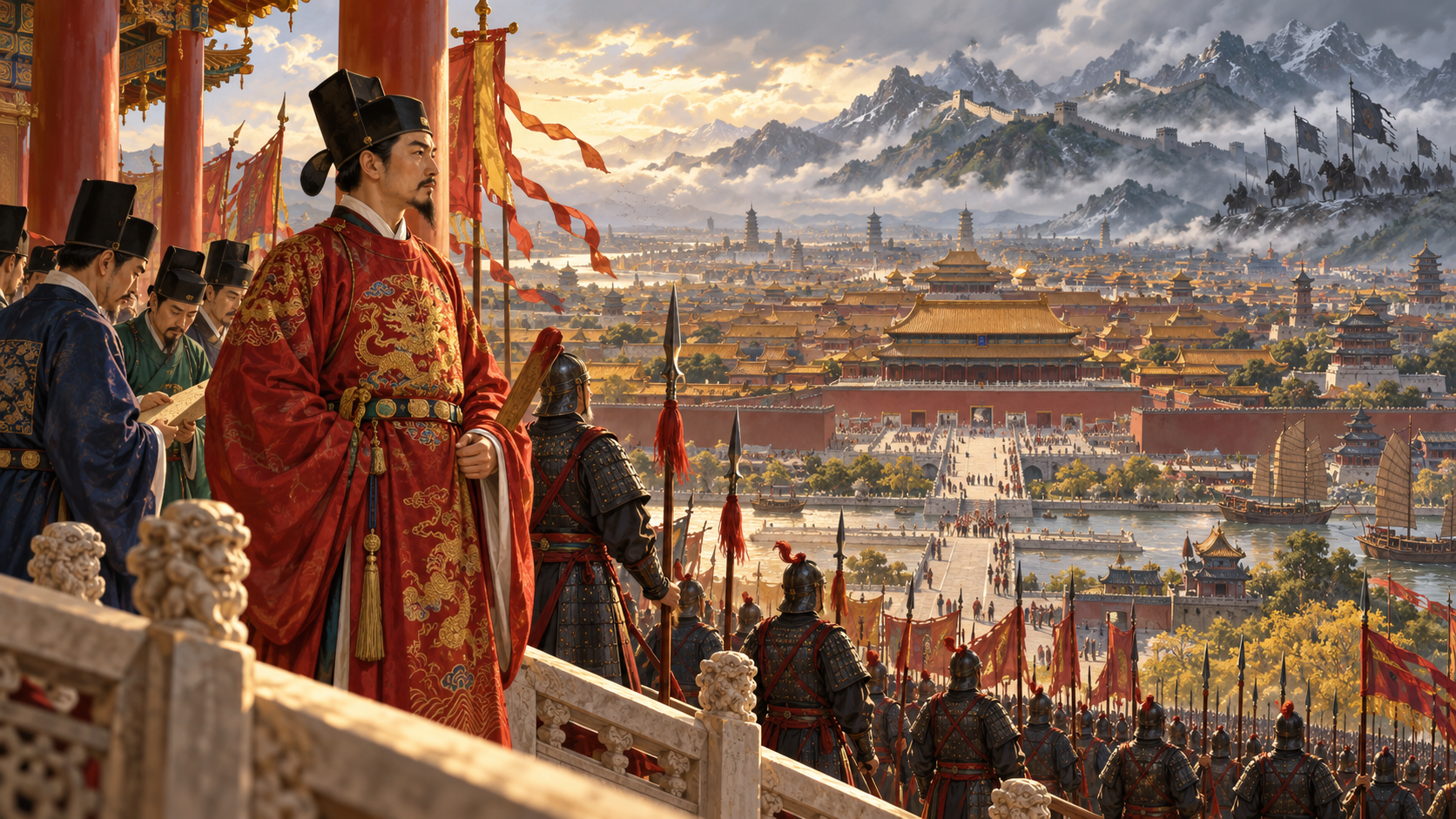
At a Glance
| Capital | Beijing, with the Forbidden City at the heart of the court |
|---|---|
| Current rule | Emperor Jingtai (Zhu Qiyu); his elder brother Yingzong remains a prisoner of the northern orc war hosts |
| People | Many Chinese-speaking communities alongside diverse frontier and trading populations, languages and local traditions |
| Ways through | Grand Canal barges, rivers, ferries, city roads, coastal shipping, mountain tracks and guarded northern approaches |
| Money and trade | Copper cash, silver weighed by tael and older paper-money practices; grain, cloth, ceramics, salt, timber and other goods |
| Sacred world | Ancestors, Daoist and Buddhist communities, Confucian rites, the celestial court and specific river, mountain, city and maritime powers |
| Best for | River voyages, market adventures, sacred mountains, coastal mysteries, frontier danger and a court where the imperial succession remains fiercely contested |

The Ming Lands — Historical Map

At sunrise a grain barge enters the Grand Canal beneath a bridge crowded with porters. Far away, a bell sounds in a Fujian harbour as sailors prepare to leave. In Beijing, the gates of the Forbidden City open to an imperial court in crisis. These journeys belong to the same empire, yet the lives, sacred places and dangers along them could hardly be more different.
The Great Ming is the largest settled power of eastern China, a realm of walled cities, long rivers, mountain roads, markets, workshops and cultivated land. The dynasty threw off the Eastern Fang inheritance of the orc Great Muster, and its restoration remains unfinished: enemy forces hold Emperor Yingzong, while his younger brother reigns as the Jingtai Emperor. The old war is visible at the northern frontier, but most travellers meet the empire through its people: a ferryman who knows the winter current, a dyer who must deliver cloth, a mountain host, a harbour pilot or a keeper of a local shrine.
What Is Happening Right Now?
The captive emperor. Forces of the Alliance of the Four Orcats defeated the Ming army and captured Emperor Yingzong. Minister Yu Qian held the realm together through the emergency and backed the enthronement of Zhu Qiyu, the Jingtai Emperor. Yingzong’s son Zhu Jianshen now lives under the shadow of his uncle’s court. The emperor in Beijing cannot easily welcome his brother’s return without inviting a new struggle for the throne. This continuing captivity is the campaign’s alternate history, not the historical chronology of the real Ming court.
The frontier after the Great Muster. The Ming restoration expelled the Eastern Fang court from the imperial heartland in 1368, but orc successor powers, including the Broken Dragon Standards and the wider steppe hosts, still shape the northern frontier. Watchtowers and garrisons matter, yet farmers, herders, merchants and entire towns also live beside that border. Not every traveller arriving from the steppe is an enemy.
Trade continues while the court worries. Barges still carry grain north. Market towns depend on ferries, weavers, potters, boatbuilders and carriers. A loss of a canal boat or the closing of a mountain pass is immediately felt by working households who have little influence over the Forbidden City.
The trapped grain boats — Jiangnan
At a canal lock, a damaged gate has left two laden grain barges jammed against the bank. The families aboard cannot unload everything before the water rises again. A canal engineer knows the problem, but a powerful water dragon has begun taking fish from the neighbouring river, and the villagers think the disturbance is no accident. Characters can help free the vessels, inspect the gate, speak to the river’s guardians or discover an entirely ordinary structural failure. A careless fight could break the embankment and flood the downstream fields.
The missing harbour lantern — Fujian
At a coastal fishing harbour, the light used to guide boats past a reef has vanished just before a storm. People ask for help at a shrine of Mazu, the sea goddess associated especially with coastal Fujian. Her protection is real, but it does not remove the need for experienced pilots, careful repairs and sound seamanship. The party must locate the lantern and decide whether to guide the returning boats through the weather, shelter those ashore or seek help from a local divine presence. The missing lantern has left a wet iron clasp on the tide steps, the only sign of how it vanished.
The watchtower without a fire — northern frontier
A hilltop signal station has fallen silent after a night of snow. Refugees from a nearby hamlet say that orc riders were seen beyond the pass, but the watchmen’s families believe the garrison has been cut off by fallen stone and bitter weather. A party can bring food and tools, scout the heights and determine whether the threat is human, orc, beast or merely the mountain. A mistaken warning could send the defending army away from the people who need it.
Imperial Celestial Fleet
Explore Imperial Celestial Fleet in the Space Atlas.
In an imperial observatory, a sealed chart returns from a voyage whose captain never crossed the sea. The scholar entrusted with it has sent three copies to Beijing. Only two have arrived. The third contains a route to an inhabited world, and the courier is missing.
The court’s celestial fleet is small, expensive and carefully guarded. Aethership captains borrow the discipline of the great maritime expeditions: measured supplies, reliable records, pilots who know how to come home and orders carried under imperial seal. Shipwrights and astronomers work alongside warding specialists who know that ordinary protection against storms does nothing against the void. Some officers seek trade and knowledge; others want the fleet kept beyond the reach of rival palace factions.
With Emperor Yingzong still held by orc enemies and the Jingtai Emperor ruling in Beijing, no expedition escapes the politics of succession. A returned pilot can be questioned as a loyal servant or accused of concealing a message for the captive sovereign. Admiral Zheng He advises the officers responsible for provisions, navigators and the route home. Whoever recovers the missing chart must decide which court officer can be trusted with it. The Space Atlas records the other earthly powers contesting the same routes.
Six Places to Explore
Beijing and the Forbidden City
Beijing is a city of workshops, markets, houses, temple precincts and officials, not just the emperor’s walls. The Forbidden City, completed in the early fifteenth century, is at once a residence, ritual centre and place where the succession crisis is lived out. Outside its gates, a courier needs fresh horses, a physician attends a frightened servant and artisans wait for payment for work commissioned before the court changed hands. Visitors seeking an audience must pass the palace guards; the surrounding city provides its own lodgings, markets and craftsmen.
The northern passes and the Great Wall
At the Great Wall and the approaches beyond, travel follows valleys, steep paths, beacon lines and defended settlements. Ming garrisons face the orc successor powers, but their daily work also includes maintaining roads, tending animals and protecting the communities that keep the posts supplied. The wall is not a single uninterrupted stone rampart identical along its entire length.
The Grand Canal and the northern grain route
The Grand Canal links Beijing with the river basins of eastern China and the productive regions of the south. Barges carry grain and other necessities past locks, banks, bridges and crowded waterside markets. Boat crews, porters and water engineers know which stretches run low and which locks are failing. The empire can feed a distant capital because thousands of people keep these waterways working; an expedition that travels by water will meet many of them.
Jiangnan and the lower Yangtze
South of the great river lies a dense world of towns, gardens, paddy fields, workshops, canals and silk-weaving communities. A traveller moves between ferry landings, street markets, craft quarters and shrines rather than crossing an unbroken countryside of empty rice paddies. Flooding can spoil crops and roads, while people with the right boats and knowledge of small channels may still travel when the highway is unusable.
Fujian and the southern sea
Rocky coastal inlets, mountain paths, fishing villages and trading ports make Fujian very different from the northern plain. Around Meizhou Island, Mazu’s maritime sacred tradition is especially significant. Her remembered protection of people in danger at sea binds worship to practical coastal life: return voyages, missing boats, tides, families and the work of getting fishermen home. Mariners and shrine keepers may ask different questions of the same storm.
Mount Tai and the sacred eastern mountains
In Shandong, Mount Tai has been venerated for many centuries, its ascent marked by temples, stone inscriptions, ancient trees and mountain paths. It is a place of imperial rites and ordinary pilgrimage. In this fantasy world, an enduring mountain power may recognise offerings and protect particular paths, but it need not turn each shrine into an identical celestial office. The mountain is difficult to climb even without an enemy: rain, fog, broken steps and the needs of fellow travellers can shape an encounter.
Where Travellers Sleep, Trade and Find Help
In a large town, travellers can seek a guesthouse, food seller, boatyard, herbalist, cloth merchant or messenger, depending on the quarter and local custom. Canal settlements are good places to find bargemen, porters and craftspeople who can repair a leaking hull or replace a snapped rope. A coastal harbour has ship carpenters, sailmakers and pilots, while a mountain host may offer shelter and warning of the next difficult ascent but very little spare equipment.
Food and payment vary by region. Rice is important in the south; northern agriculture has different staples. Copper cash and measured silver are useful for trade, but carrying enough money does not guarantee safe passage through a winter pass or a dangerous stretch of river. People with specialist knowledge can save a party far more than another sword or spell.
For a clearly fictional campaign staging point, Reed Lantern Landing stands beside a side canal used by smaller craft. Its boatbuilder, Madam Wu, will mend a damaged rudder if the characters help free her apprentice’s barge before evening. She knows the local river shrine and the approach to the next market, but she does not sell imperial passes, supernatural favours or an impossible stock of magical goods. The landing and characters are invented for the campaign.
Living Gods, Local Spirits and the Rivers
The Ming sacred world is no more uniform than its landscapes. People honour ancestors in household and lineage settings, visit Buddhist and Daoist temples, and turn to local deities associated with cities, mountains, rivers or the sea. Court-sponsored ceremony and the prayers of a fishing family can coexist without being the same rite or answering to the same authority.
In Fujian the sea goddess Mazu belongs to a specific coastal tradition that grew from Meizhou and spread with ships and communities; she is not a generic replacement for every Chinese water deity. Inland, Dragon Kings and other local water powers can be concerned with rain, rivers and particular pools. On Mount Tai, older mountain veneration exists beside temples and imperial rites. These powers are active in SpiralWorlds, with their own places and interests, not merely decorative stories.
The existing Chinese Pantheon supplies deeper links for the Jade Emperor, the examination patron Kui Xing and the older powers Nüwa and Xiwangmu. An examination hall, court shrine, mountain path and fishing harbour should not all lead to the same supernatural encounter. Each has living neighbours who can tell travellers what actually matters there.
The Orc Conquest and the Ming Restoration
Generations ago, the Great Muster of Mhurak Stone-Blood brought northern China under orc imperial power. The Eastern Fang court governed through Chinese institutions while military commanders and trusted households held positions of influence. Its later chroniclers remember both the military households that rose in its service and the unrest that followed the empire’s fracture.
After Mhurak’s realm fragmented, Eastern Fang authority weakened. Ming armies drove its court from the imperial heartland in 1368, while rival orc houses withdrew beyond the frontier to form the Broken Dragon Standards and other successor powers. The restored state revived examination learning, court ceremonies and the routines of government. The old struggle continues, however: the Alliance of the Four Orcats has captured Yingzong, Jingtai occupies the throne and minister Yu Qian works to keep the realm from falling apart.
Ming captains have sailed the seas of Southeast Asia and the Indian Ocean, exchanging embassies, knowledge and goods. Some royal records also describe extraordinary voyages farther from home, though the court protects the most unusual charts and asks hard questions of any commander unable to explain a safe route back.
Travelling Onward
Follow the Asia atlas for the neighbouring realms. Northward routes lead to defended frontier country and steppe trade; coastal shipping connects to Southeast Asia; roads and seas also link to Joseon and Japan. Distance between regions is substantial, and the best route depends on season, cargo, language and the party’s purpose.
History and Sources
- UNESCO: Imperial Palaces of the Ming and Qing Dynasties — construction of Beijing’s Forbidden City, 1406–1420, and palace life.
- UNESCO: The Grand Canal — historic inland trade, grain transport and the river-basin system.
- UNESCO: Mazu Belief and Customs — coastal Fujian and Meizhou sea-goddess traditions, distinguished from wider Chinese myth.
- UNESCO: Mount Taishan — long-lived mountain cults, temples and sacred ascent.
- The Age of Severed Crowns — the struggles that shaped the northern frontier and the present Ming succession.
Keep this reference growing
If this page helped with your reading or game, you can support its upkeep or explore the curated books.
Explore the Bookshop — epics, classics and stories behind imagined worlds.