
The Forbidden City — Palace of the Great Ming
At a Glance
| Location | Beijing, capital of the Great Ming |
|---|---|
| Year | 1454 CE |
| Ruler | Emperor Jingtai (Zhu Qiyu) |
| The captive emperor | Yingzong, Jingtai’s elder brother, held by orc steppe powers |
| Principal entrance | Wumen, the Meridian Gate, to the south |
| Other gates | Donghua (east), Xihua (west) and Xuanwu (north) |
| Great halls | Fengtian, Huagai and Jinshen, beside the inner imperial residences |
| Residents | The imperial family, palace women, eunuchs, guards, clerks, physicians and craftspeople |
| Admission | On imperial business, authorised service or with a recognised escort |
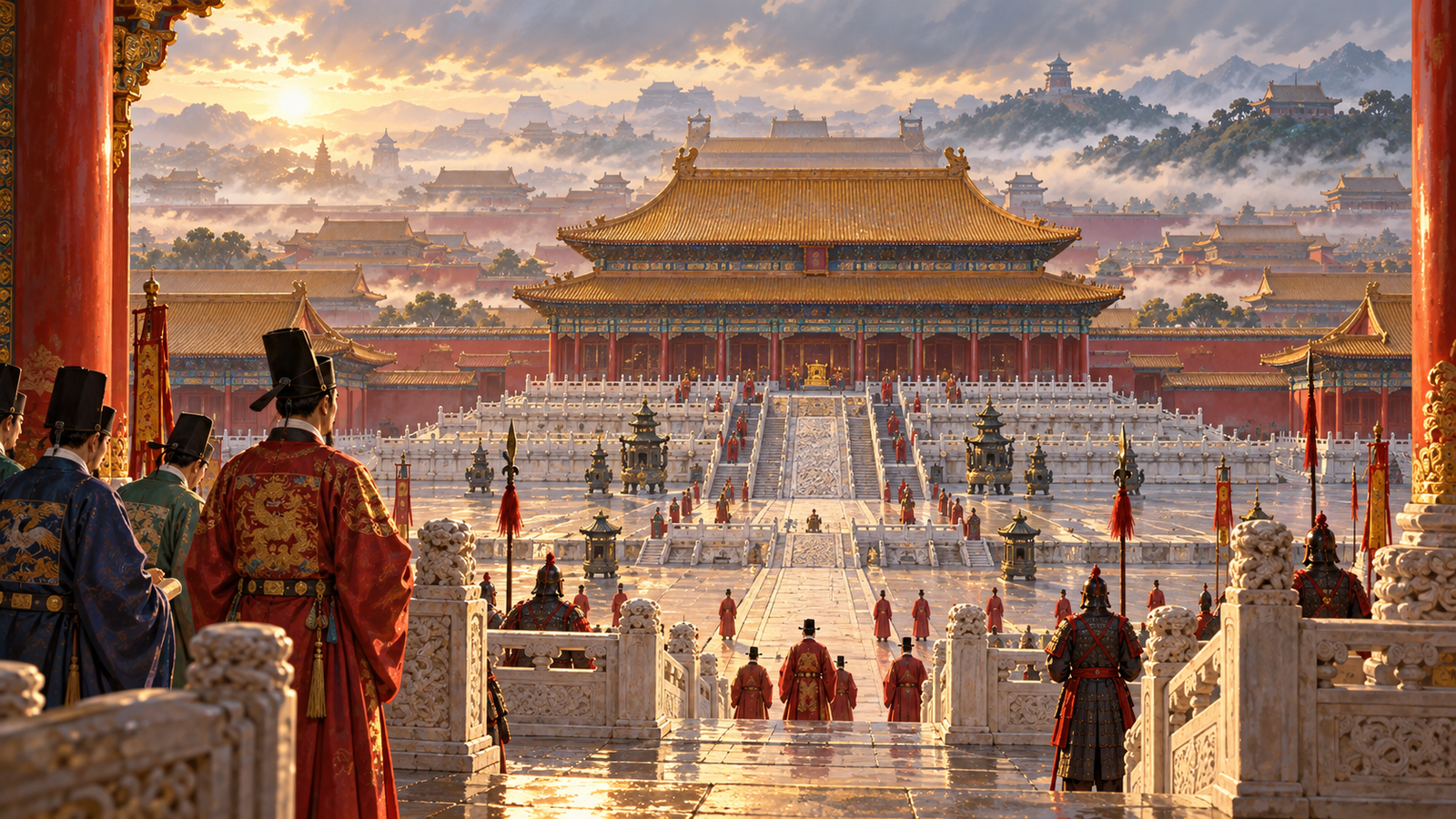
The court officials assemble before sunrise, breath pale against the red palace walls. Beyond the Meridian Gate, the Inner Golden Watercourse winds beneath five stone bridges. A palace carpenter crosses the forecourt carrying a bundle of roof tiles; he has seen one of the glazed guardian beasts turn its head in the night. An imperial messenger reaches the gate with a letter from the north. Two different officers are waiting to take it.
The Forbidden City is more than the great audience halls. It is a walled household, workshop and ceremonial city within Beijing, where cooks, doctors, gardeners, grooms, artisans, guards, palace women and learned clerks keep the imperial world moving. A provincial governor may wait in the outer court for hours, while a servant carrying fresh linen enters the inner apartments through a side passage. The most important news in the empire often passes through those quieter doors.
What Is Happening Right Now?
The letter from the captive emperor
Emperor Yingzong remains in the hands of the orc armies beyond the northern frontier. His younger brother Jingtai sits on the throne in Beijing, with minister Yu Qian working to protect the capital from panic and factional revenge. Now a courier has brought a letter bearing Yingzong’s personal mark. A palace clerk who examined the seal has vanished. Yingzong’s son Zhu Jianshen lives under his uncle’s watchful court, and any rumour of a rescue could endanger him. The letter may be an appeal, a trick of the steppe or a forgery by someone closer to the throne. Those sent to find the clerk must decide who should read the message first.
The Golden Water rises
For three mornings the water within the palace has climbed the steps below its white-stone bridges without rain. Servants carrying water are being accused of blocking the channels, but an old gardener has seen a long bronze-scaled dragon pass beneath the central arch. Its secret chamber was disturbed during a repair, and someone has removed a tablet from its bed. The dragon will not let the water settle until the tablet returns. It can speak to those willing to listen, but it cannot leave the channel unguarded to pursue the thief. Without help the next flood will strike kitchens and workshops before it reaches the ceremonial courts.
The shipyard’s third chart
A brass navigation instrument has arrived from the Imperial Celestial Fleet for examination by court scholars. Two sets of calculations agree, except for the date of arrival. Beneath its rim is a third record, scratched in a script the astronomers cannot read. The officer responsible for the instrument wants it returned before word reaches the rival palace factions. A young scholar fears that the next aethership will depart on a false course. She seeks witnesses she can trust with both a celestial secret and a court secret.
Through the Great Courts
Wumen — the Meridian Gate
The principal southern gate rises above a forecourt of waiting officials, envoys and armed escorts. Clerks check summons; guards distinguish recognised service from a stranger hoping to bargain for entry. The central way is reserved for the emperor. Messengers can be turned away here even when their news is urgent, and anyone forced to wait hears the grievances of officials who dare not speak so freely inside.
The five bridges and Fengtian Gate
The Inner Golden Watercourse passes beneath five white-stone bridges before Fengtian Gate. Carved balustrades mark the paths reserved for the emperor and for different ranks of court attendants. A pair of bronze lions watches the great entrance. Water carriers know where the current is deepest, while the court’s cleaners are the first to notice when a pale stain appears on the lions’ feet.
Fengtian Hall
The great audience hall stands on a broad marble terrace under a golden roof. Its predecessor burned shortly after the palace was completed, and the hall was rebuilt before the present crisis. It is both a source of imperial grandeur and a place whose carpenters remember the fear of fire. The court receives grave matters here, surrounded by painted brackets, dragon decoration and carefully ordered rows of officials. Above the entrance a glazed roof-beast has begun watching a concealed heat beneath the timbers.
Huagai and Jinshen Halls
The smaller halls behind Fengtian carry processions and preparations deeper into the palace. In Huagai Hall, attendants assemble objects for imperial ceremonies; in Jinshen Hall, documents, seals and ceremonial equipment pass through smaller gatherings. These passages are less crowded than the main court but not unobserved. A servant who knows which doors lead to the storerooms may travel farther than an armed noble.
Qianqing Palace and the northern residences
Beyond the Gate of Heavenly Purity lie the residences and daily working rooms of the imperial family. Qianqing Palace houses the emperor’s more private life; the Hall of Union, Kunning Palace and the households to either side form a maze of walled courtyards, gardens, kitchens and small service rooms. Palace women, nurses, eunuchs, doctors and trusted attendants know one another’s duties and obligations. An outsider hoping to find Zhu Jianshen must win an introduction from someone who guards the family rather than the throne.
Donghua, Xihua and Xuanwu Gates
The east and west gates connect guarded service approaches to Beijing’s imperial city. Here provisions arrive, workers receive supplies and escorts are changed. The northern Xuanwu Gate looks toward Wansui Hill. Its name honours the Black Tortoise of the north, whose signs appear in its shadows and water channels when the palace faces danger.
People of the Palace
Jingtai Emperor. He has kept the throne while his brother remains captive, but every news-bearing horse from the frontier may change the loyalties of his court. He dislikes public uncertainty and rewards those who solve dangerous problems quietly.
Yu Qian. Minister and defender of Beijing. His concern is a stable capital, a supplied palace and a message examined without handing the court to rival conspirators. He can secure a proper escort, but not guarantee the safety of a witness who trusts the wrong official.
Lan, reader of the morning seals. A careful junior clerk at the eastern approach. She has found two different orders bearing the same impression. Her elderly mother lives outside the imperial city; Lan will not endanger her merely to satisfy a suspicious captain.
Wei Ren, carpenter of the yellow roofs. His family works on the great halls. He knows that a ridge-beast was moved after the latest repairs, and that the man who ordered it turned never entered his name in the workshop register.
Lady Shen of the northern apartments. Responsible for medicine, bedding and several trusted servants. She can grant access to a patient or a frightened maid, but will not sacrifice her household to the ambitions of strangers.
Food, Shelter and Services
No public guesthouse stands inside the Forbidden City. A formally received visitor may be lodged under palace authority; other travellers must find beds, food, a washroom, stabling and ordinary repairs in Beijing. Horses and carts cannot pass freely into the inner courts. Medicines, court instruments and specialist repairs require introductions rather than a handful of coins at the gate.
The Resting Crane — eastern lanes
Mistress Luo runs a modest, tidy guesthouse east of the imperial city’s approaches. Its regulars include letter carriers, merchants, visiting scribes and relatives awaiting court appointments. Hot millet porridge, tea, a clean sleeping mat and a little private space are available for a fair price; a neighbouring stable takes animals separately. Luo quietly remembers who last carried a sealed document through her courtyard. She will share information with a guest she trusts, but refuses to risk her servants for anyone’s court intrigues.
The Three Lamps — the southern road
Han the Broad-Shouldered serves hearty bowls of noodles and offers crowded, inexpensive lodging to wagon drivers, porters and travelling craftspeople. He knows muleteers, cartwrights and which craftsmen have been summoned to palace works. A missing palace mechanic once left a small brass parcel behind his counter. Han wants it returned to the proper hands before an armed officer demands it.
Workshops, physicians and sacred help
Neighbourhood carpenters and smiths repair ordinary gear, while herbal physicians treat travellers who cannot summon a court doctor. Within the walls, specialists tend the imperial household and maintain ceremonial fittings, roof tiles and astronomical instruments. The palace’s household observances honour ancestors, protective powers and the guardians of water and roof. An offering can win goodwill from a spirit; it will not open a gate held by an imperial guard.
The Palace’s Living Guardians
The bronze dragon of Golden Water
The water dragon below the bridges keeps its stream clear and cool. It dislikes bloodshed in the channel and will speak to unarmed visitors who return its stolen tablet. Its anger raises the water and puts servants, not ministers, in the greatest danger. It will not follow anyone outside the palace: the channel and the lives depending on it are its charge.
The chiwen of Fengtian Hall
Among the glazed creatures along the roof ridge is a chiwen that awakens when fire gathers beneath its tiles. It turns its head toward the danger, then watches until someone acts. It cannot abandon the hall. The carpenter who knows its signs may stop another conflagration, though the officer concealing the hidden flame has ordered him silent.
The Black Tortoise’s northern sign
The guardian of the north sometimes appears as a tortoise and snake together in the water shadow of Xuanwu Gate. A watchman has noticed them beside a blocked culvert, near marks left by a sealed box being dragged toward the northern service exit. The sign is a warning, not a promise that any stranger can pass the gate.
Arriving and Travelling Onward
From the roads of Great Ming, travellers enter Beijing by its guarded city approaches. River cargo comes by boat to the eastern port of Tongzhou and continues toward the capital by established routes. Those approaching the palace from the south pass along the ceremonial road by Chengtian Gate and Duan Gate before reaching Wumen. A summons or escort is required to proceed through the palace; even a noble guest cannot simply walk from the southern gate to the private halls.
After an audience, visitors usually return to the surrounding streets for lodging, carts, fresh mounts and passage onward. The eastern and western exits are useful to authorised court workers and couriers; the northern exit is closely watched. The Great Wall lies far beyond the capital, on the frontier roads, not in the palace precinct. The celestial fleet uses separate shipyards and protected facilities: no aethership launches from an open palace courtyard.
History of the Palace
The Yongle emperor ordered the construction of Beijing’s great palace in 1406. The complex was completed in 1420, and the imperial court moved its principal seat to Beijing in the years that followed. Early fires destroyed the central audience halls; Fengtian Hall was rebuilt by the time the present century’s succession crisis arose. The original Ming hall and gate names remain in use in 1454: Fengtian Gate and Fengtian Hall are not yet called by their later Qing titles.
The wider Ming dynasty rose after the fall of the orc-dominated Yuan realm, and the northern steppe remains dangerous. The capture of Yingzong now throws the questions of succession, loyalty and survival across the very courtyards where imperial order is meant to be most visible.
Finding Your Way
South to north the main axis runs through Wumen, the Golden Water bridges, Fengtian Gate, Fengtian Hall, Huagai Hall, Jinshen Hall, and the inner residences, ending near the gardens and Xuanwu Gate. Donghua and Xihua Gates serve the eastern and western approaches.
Palace plan · Great Ming geography. The reference plan uses some later palace names; the court here uses its mid-fifteenth-century names.
Historical Sources
Palace Museum: original plan · Fengtian Gate · Fengtian Hall · UNESCO: Ming imperial palaces.
Keep this reference growing
If this page helped with your reading or game, you can support its upkeep or explore the curated books.
Explore the Bookshop — epics, classics and stories behind imagined worlds.