
Emperor Jingtai — Defender of the Great Ming Throne
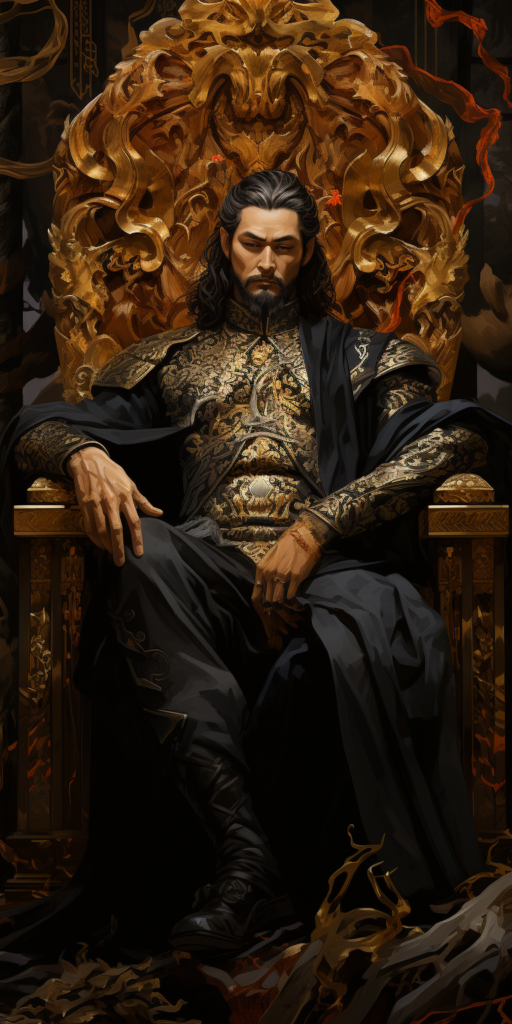
At a Glance
| Name | Zhu Qiyu, the Jingtai Emperor |
|---|---|
| Role | Reigning emperor of the Great Ming |
| Present | 1454 CE |
| Seat | Forbidden City, Beijing |
| Elder brother | Emperor Yingzong, captive of the steppe orc powers |
| Heir contested | Yingzong’s son Zhu Jianshen and the court factions contesting succession |
| Counsellor | Minister Yu Qian, defender of the capital |
| Consort | Empress Hang; his son Zhu Jianji is mourned within the household |
| Temperament | Disciplined, careful, proud and anxious to secure the throne |
| Alignment | Lawful Neutral; his choices depend on the people and the survival of the realm |

At the morning audience Jingtai hears three reports: a grain convoy delayed on the Grand Canal, a northern horseman carrying news of his captive brother, and a court astronomer who refuses to sign a ship’s celestial chart. He dismisses the public audience before giving any answer. The people beyond the palace walls need food and protection; his own court needs certainty that the man on the throne will still be there tomorrow.
What Is Happening Right Now?
In 1449, the Ming army suffered catastrophe on the northern frontier. Emperor Yingzong was captured by an orc coalition, and officials in Beijing faced the prospect of a helpless capital. Zhu Qiyu, Yingzong’s younger brother, was raised to the throne, with Yu Qian leading the defence and the recovery of the realm. Jingtai continues to rule in 1454. His brother remains in enemy hands, and competing courtiers view any rumour of his release as a possible change of dynasty within the family.
Yingzong’s son Zhu Jianshen remains a figure of great consequence in the succession. Jingtai has lost his own son, Zhu Jianji, and the absence of a secure, universally accepted heir makes every appointment and household allegiance matter. An honest messenger from the north might preserve the family—or be blamed for a crisis he did not cause.
The Emperor in His Court
Jingtai is a working ruler rather than a figure of distant ceremony. He hears petitions, weighs military expenditure and must keep the Grand Canal and northern roads open to supplies. His greatest political asset is a capital that endured its trial; his greatest weakness is the knowledge that the captive emperor has loyal supporters in the same halls. He pays close attention to maps, granaries, provincial governors and letters that bear an imperial seal.
In private Jingtai speaks carefully and expects facts before promises. He can be cold when he believes an official has concealed an important loss, yet he listens to an unwelcome report delivered with evidence. He is proud of what Beijing survived and wary of the courtiers who call his position temporary. He does not practise sorcery to control his officials: his authority lies in appointments, guards, the imperial seal and the responsibilities of government.
The Family and the Question of Succession
The prisoner Yingzong is both a brother and a danger. Jingtai must decide whether negotiating his release safeguards the imperial family or puts his own government at risk. Zhu Jianshen, Yingzong’s son, has supporters who expect him to stand near the throne. Within the inner palace, Empress Hang and the household attendants guard a family’s grief and confidential disputes from outside factions. Neither chamber servants nor soldiers can predict how a newly arrived letter will change the balance.
Allies, Rivals and People to Approach
Yu Qian. The minister who held Beijing through the emergency. He argues for a strong defence, accurate reports, sufficient grain and restraint against rumours. Those who bring proof of danger to the frontier find him easier to approach than they expect.
The imperial household. Empress Hang, court attendants, physicians and eunuch administrators keep the inner palace functioning. A servant may know where a crucial letter went, but not what it contained. Compelling a witness by violence threatens the very lives an adventurer might hope to protect.
Officials loyal to Yingzong. They want the captive emperor safe and argue that Zhu Jianshen’s claim deserves respect. Some work openly within the system; others search for messages from the orc frontier. Their existence alone does not make them rebels.
The northern orc powers. The war hosts holding Yingzong can demand payments, concessions or prisoners, but they cannot be treated as allies of the hobgoblin Ninefold Dominion. Their divisions give the Ming court opportunities and dangers of its own.
The Celestial Fleet and a Disputed Chart
An imperial aethership has returned with a copied route whose departure and arrival dates do not agree. Zheng He insists the navigators repeat their observations and protect their crew. A palace faction wants the chart seized and the next expedition launched before its rivals learn the destination. Jingtai needs the knowledge that the Imperial Celestial Fleet might bring, but understands that no celestial voyage can feed the northern army until its vessel returns.
Rules by Edition
Emperor Jingtai
Medium Humanoid (Human), Lawful Neutral
AC 16 (ceremonial breastplate); Initiative +2 (12)
HP 91 (14d8 + 28)
Speed 30 ft.
14 (+2)
14 (+2)
14 (+2)
17 (+3)
16 (+3)
20 (+5)
Saving Throws Wis +5, Cha +7
Skills History +5, Insight +5, Investigation +5, Persuasion +9
Senses Passive Perception 13
Languages Court Chinese, regional languages of Great Ming
CR 4 (1,100 XP); PB +2
Traits
Disciplined Court. Jingtai has Advantage on saving throws against being Frightened while a friendly guard or court officer he can see is within 30 feet.
Measured Authority. Jingtai has Advantage on Charisma (Persuasion) checks made to issue lawful orders to sworn servants of his court. His authority has no effect upon people who do not recognise it.
Actions
Multiattack. Jingtai makes two Imperial Dao attacks.
Imperial Dao. Melee Attack Roll: +5, reach 5 ft. Hit: 8 (1d8 + 4) Slashing damage.
Command the Guard (Recharge 5–6). Up to two allied creatures Jingtai can see within 60 feet can each use their Reaction to move up to half their Speed and make one weapon attack. Jingtai cannot use this action while Incapacitated.
Demand an Explanation. Wisdom Saving Throw: DC 15, one creature within 30 feet that can hear and understand him. Failure: The target has Disadvantage on its next attack roll against Jingtai before the end of its next turn. Success: No effect. This is not magical compulsion; a creature immune to the Frightened condition succeeds automatically.
Reaction
Royal Escort. When Jingtai is hit by an attack and a willing allied guard is within 5 feet, that guard can use its Reaction to become the attack’s target instead, taking the attack’s effects.
Emperor Jingtai
Medium humanoid (human), lawful neutral
Armor Class 16 (breastplate)
Hit Points 91 (14d8 + 28)
Speed 30 ft.
14 (+2)
14 (+2)
14 (+2)
17 (+3)
16 (+3)
20 (+5)
Saving Throws Wis +5, Cha +7
Skills History +5, Insight +5, Investigation +5, Persuasion +9
Senses passive Perception 13
Languages Court Chinese and regional Ming languages
Challenge 4 (1,100 XP)
Traits
Disciplined Court. Jingtai has advantage on saving throws against being frightened while he can see a friendly guard or court officer within 30 feet.
Measured Authority. Jingtai has advantage on Charisma (Persuasion) checks made to issue lawful orders to sworn servants who recognise him as emperor.
Actions
Multiattack. Jingtai makes two imperial dao attacks.
Imperial Dao. Melee Weapon Attack: +5 to hit, reach 5 ft., one target. Hit: 8 (1d8 + 4) slashing damage.
Command the Guard (Recharge 5–6). Up to two friendly creatures he can see within 60 feet can each use their reaction to move up to half their speed and make one weapon attack.
Demand an Explanation. One creature within 30 feet that can hear and understand Jingtai must succeed on a DC 15 Wisdom saving throw or have disadvantage on its next attack roll against Jingtai before the end of its next turn. A creature immune to being frightened succeeds automatically. This ability is not magic.
Reactions
Royal Escort. When Jingtai is hit by an attack, one willing allied guard within 5 feet can use its reaction to become the attack’s target instead.
Emperor Jingtai — CR 4
XP 1,200
LN Medium humanoid (human aristocrat 7)
Init +2; Senses Perception +10
Defense
AC 18, touch 12, flat-footed 16 (+6 armour, +2 Dex)
hp 45 (7d8+14)
Fort +4, Ref +4, Will +8
Offense
Speed 30 ft.
Melee masterwork dao +8 (1d8+2/19–20)
Ranged light crossbow +7 (1d8/19–20)
Special Attacks court command
Statistics
Str 14, Dex 14, Con 14, Int 17, Wis 16, Cha 20
Base Atk +5; CMB +7; CMD 19
Feats Alertness, Combat Expertise, Iron Will, Skill Focus (Diplomacy)
Skills Diplomacy +21, Knowledge (history) +13, Knowledge (nobility) +13, Linguistics +10, Perception +10, Sense Motive +13
Languages Court Chinese, several regional languages
Gear ceremonial breastplate, masterwork dao, imperial seal, court correspondence.
Special Abilities
Court Command (Ex). Once per round as a standard action, Jingtai may allow one allied creature within 60 feet that can see and hear him to move up to half its speed and make one attack as an immediate action. He cannot use this ability while helpless or stunned.
Royal Escort (Ex). Once per encounter, a willing allied guard adjacent to Jingtai may, as an immediate action, interpose and become the target of one attack that would otherwise hit the emperor.
Ecology
Environment Great Ming imperial court
Organization solitary with attendants, escorted (4–12 guards), or imperial audience
Treasure NPC gear
Emperor Jingtai
Medium Humanoid (Human), Lawful Neutral
Hit Dice: 7d8+14 (45 hp)
Initiative: +2
Speed: 30 ft. (6 squares)
Armor Class: 18 (+6 breastplate, +2 Dex), touch 12, flat-footed 16
Base Attack/Grapple: +5/+7
Attack: Masterwork dao +8 melee (1d8+2/19–20)
Full Attack: Masterwork dao +8 melee (1d8+2/19–20)
Space/Reach: 5 ft./5 ft.
Special Attacks: Court command
Special Qualities: Royal escort, courtly authority
Saves: Fort +4, Ref +4, Will +8
Abilities: Str 14, Dex 14, Con 14, Int 17, Wis 16, Cha 20
Skills: Diplomacy +21, Knowledge (history) +13, Knowledge (nobility and royalty) +13, Listen +10, Sense Motive +13, Spot +10
Feats: Alertness, Combat Expertise, Iron Will, Skill Focus (Diplomacy)
Environment: Great Ming imperial court
Organization: Court with retinue
Challenge Rating: 4
Treasure: NPC gear
Alignment: Lawful neutral
Advancement: By character class
Level Adjustment: —
Special Abilities
Court Command (Ex): As a standard action, Jingtai allows one ally within 60 ft. who can see and hear him to move up to half its speed and make one attack as an immediate action, once per round.
Royal Escort (Ex): Once per encounter, an adjacent willing guard can interpose as an immediate action to receive an attack otherwise striking Jingtai.
Courtly Authority (Ex): Jingtai receives a +4 circumstance bonus on Diplomacy checks addressed to sworn officials who accept his lawful authority.
Adventure Hooks
The Seal with Two Owners
Two imperial instructions arrive bearing an identical private mark. The clerks swear each is genuine, but the orders cannot both be carried out. A messenger has vanished between Fengtian Gate and the northern household.
The Envoy from the Frontier
An orc captain offers to release a witness who saw Yingzong alive. Yu Qian asks the adventurers to confirm the report without promising ransom on behalf of the crown. A second envoy claims the first has no authority.
The Empty Seat at the Astronomers’ Table
A scholar refuses to launch a ship with falsified figures and disappears. Jingtai quietly orders the scholar found alive before anyone notices the palace has concealed an error.
Travel and Court Access
Jingtai resides within the Forbidden City. The palace is a guarded household, not a public inn or a place where strangers demand audiences. Petitioners generally arrange introductions through recognised clerks, provincial officials or the emperor’s appointed advisers. Those seeking an audience need an identifiable reason, reliable witnesses and a willingness to wait. The Great Ming gazetteer follows the roads, markets and frontier towns beyond the palace.
History and Sources
The Ming succession after the 1449 frontier disaster and the role of Yu Qian follow the documented history of the Jingtai reign. The prisoner remaining in orc hands in 1454 is part of the present world. Palace Museum: Jingtai Emperor · Research on the change of heir apparent · Timeline.
Keep this reference growing
If this page helped with your reading or game, you can support its upkeep or explore the curated books.
Explore the Bookshop — epics, classics and stories behind imagined worlds.