
Aboleth — Ancient Psychic Tyrant of the Deep
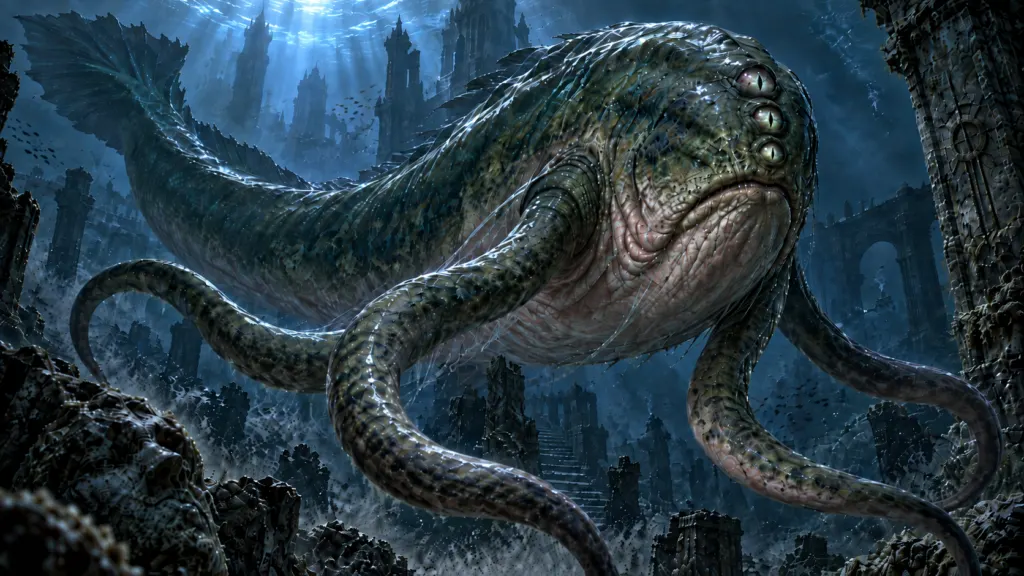
An Aboleth is an ancient Lawful Evil aquatic aberration that turns memory, desire and physical dependence into systems of control. It does not need to conquer a kingdom openly. It builds hidden networks of dominated servants, water-bound captives and carefully managed intermediaries while remaining below the surface.
At a Glance
What Is an Aboleth?
An aboleth is a huge, primeval-looking aquatic aberration with a heavy fishlike body, a powerful tail, three alien eyes and four long tentacles. Clear mucus constantly slicks its skin. The mucus is not cosmetic: aboleth biology and magic can alter other creatures so that water becomes necessary to their survival.
Most aboleths prefer deep water and darkness. On land they are slow and awkward. In water they are at home, and a prepared submerged environment lets them control distance, visibility, breathing and escape routes at the same time.
They are intelligent enough to make brute force optional. An aboleth would rather possess a harbourmaster, confessor, mine overseer, ship captain or trusted servant than fight ten armed people at once. Violence is used when domination, dependency and deception have already prepared the field.
Behaviour
An aboleth begins by studying a community through water, servants and stolen information. It identifies people whose positions provide access to others—harbour officials, navigators, mine overseers, household servants, guards, clergy, merchants and anyone who controls records or routes—and compromises one before moving to the next.
Once a servant is secure, the aboleth isolates that person from competing loyalties. Telepathy, illusion, domination and physical dependence on water can make escape increasingly difficult. The servant is usually expected to continue an ordinary life. A useful thrall who still appears to be a respected captain, steward or official is worth more than an obvious cultist.
The network then expands. Records disappear. Ships alter course. Excavations continue despite danger. Captives are moved toward flooded chambers. Wells, cisterns, sea caves and underground waterways become meeting points. The aboleth remains physically hidden while its servants make the surface world behave differently on its behalf.
It does not keep every compromised servant once exposure begins. It protects the slaves, memories, routes and positions that still matter, abandons liabilities and withdraws through water when direct confrontation no longer serves the plan.
In battle, the same method becomes immediate. The aboleth tries to control one dangerous opponent, pull another into water and force the remaining characters to choose between pursuit, rescue and protecting compromised allies. Its Lawful Evil alignment describes the result: domination is organised into a durable system rather than expressed as random cruelty.
Aboleths in Deep Time
Aboleths are ancient by any mortal standard, but they are not older than the cosmic gods and did not once rule the whole Earth. Their own arrogance encourages claims of primordial sovereignty; the SpiralWorlds chronology places them as one of several very old aberrant powers inhabiting Earth’s early waters, never as the planet’s universal masters.
By the long Precambrian eras described in The Dawn of Earth, aboleth enclaves already exploit deep and twilight waters. They coexist with native slime lineages, invasive aberrations and other forms of supernatural predation. Their strength lies in concealed communities and controlled populations rather than continent-spanning empires.
During the late Precambrian Age of Love and Pulsing Light, the vast psychic radiance of the Flumph choirs makes many upper-water regions increasingly hostile to aboleth manipulation. Aboleth colonies withdraw into deeper water, submarine caverns and isolated basins. Later freezing episodes, ancient ooze-haunted refuges and repeated ecological upheavals reinforce that deep-water pattern.
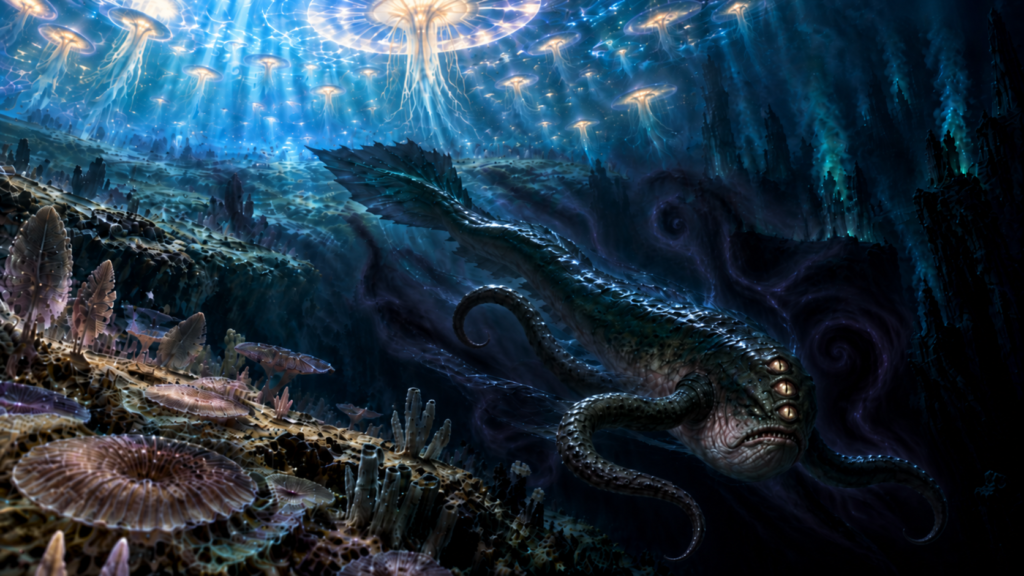
The result is continuity rather than lost global empire. Aboleths survive because they retreat, seal, enslave and wait. A drowned city discovered in 1454 may be unimaginably old without ever having ruled more than one basin, trench, cave-sea or regional slave network.
Memory and Long Plans
The modern 5.5e aboleth can literally consume memories. Older rules emphasise illusion, domination and supernatural knowledge. Together they create the same campaign truth: aboleths accumulate information across generations and treat memory as property.
A captured navigator can teach an aboleth coastlines. A magistrate can expose local law. A priest can reveal sacred routines. A merchant can provide names, debts and supply routes. The aboleth does not need to understand human society from first principles if it can take the memories of people who already do.
This makes an aboleth conspiracy unusually difficult to uproot. Killing a visible servant does not erase what has already been learned, and in 5.5e even destroying the aboleth’s body may not end the creature permanently.
Society, Broods and Drowned Cities
Aboleths can be solitary, but solitude does not imply social simplicity. Broods cooperate when control of a water system, slave population or submerged complex benefits them. Larger concentrations establish drowned cities and underground lake-enclaves supported by Skum, transformed captives and dominated specialists.
These settlements are not remnants of a single vanished world empire. They are separate ancient powers with their own histories, rivalries, memories and territories. Some have survived continuously. Others occupy ruins built by previous peoples. Still others are comparatively recent colonies founded around a newly opened cavern sea, flooded mine or drowned coast.
The Aboleth Drowned Cities therefore function as a network of hidden aquatic slave-cities rather than one unified state. Cooperation is possible, but so are old grudges, incompatible schemes and competition over servants.
Aboleths and the Gods
Aboleths do not need to predate the gods to despise them. Gods receive worship, loyalty and obedience that an aboleth believes should belong to the aboleth itself. Divine allegiance also gives captives a source of identity and authority outside the master’s hierarchy.
An aboleth therefore attacks religion as a rival system of loyalty. It corrupts clergy, controls access to sacred sites, manufactures false revelations through illusion and isolates servants from communities capable of helping them resist.
Aboleths in 1454
In 1454, most surface people regard aboleths as sailors’ nightmares, occult speculation or monsters from flooded caverns. That ignorance is useful. The strongest surviving enclaves lie in deep seas, underground waters and drowned ruins where ordinary armies cannot reach them.
Surface operations are conducted through layers of intermediaries. A controlled ship captain alters routes. A harbour official suppresses reports of missing sailors. A mine owner keeps workers excavating toward a flooded chamber. A monastery’s cellar well becomes a communication point. A coastal noble funds a breakwater whose foundations conceal a submerged entrance.
An aboleth plot should therefore become visible through patterns of obedience and water before the monster itself appears.
Signs of Aboleth Influence
People protect water they cannot explain. A well, flooded cellar, quarry pool or sea cave becomes more important than property, family or safety.
Servants avoid dry journeys. Someone who once travelled freely now arranges their entire life around baths, wet cloth, river routes or access to a harbour.
Different witnesses repeat identical reasoning. Controlled agents may have separate personalities but converge unnaturally on the same priorities.
Architecture descends. New stairs, shafts, tunnels and drains lead toward water rather than away from it.
Records disappear selectively. Harbour logs, mine surveys and old maps vanish while apparently more valuable documents remain untouched.
Someone knows what only the dead knew. Stolen memory can expose secrets whose original keeper never shared them.
Game Statistics
Aboleth — D&D 5.5e / 2024
Large Aberration, Lawful Evil
AC 17 Initiative +7 (17) HP 150 (20d10 + 40) Speed 10 ft., Swim 40 ft.
| STR | DEX | CON | INT | WIS | CHA |
|---|---|---|---|---|---|
| 21 (+5) | 9 (−1) | 15 (+2) | 18 (+4) | 15 (+2) | 18 (+4) |
Saving Throws Dex +3, Con +6, Int +8, Wis +6
Skills History +12, Perception +10
Senses Darkvision 120 ft.; Passive Perception 20
Languages Deep Speech; telepathy 120 ft.
CR 10 (5,900 XP, or 7,200 XP in lair; PB +4)
Traits
Amphibious. The aboleth can breathe air and water.
Eldritch Restoration. If destroyed, the aboleth gains a new body in 5d10 days, reviving with all its Hit Points in the Far Realm or another location chosen by the GM.
Legendary Resistance (3/Day, or 4/Day in Lair). If the aboleth fails a saving throw, it can choose to succeed instead.
Mucus Cloud. While underwater, the aboleth is surrounded by mucus. DC 14 Constitution save, each creature in a 5-foot Emanation originating from the aboleth at the end of the aboleth’s turn. On a failure, the target is cursed. Until the curse ends, the target’s skin becomes slimy, it can breathe air and water, and it can’t regain Hit Points unless underwater. Outside water, the target takes 6 (1d12) Acid damage at the end of every 10 minutes unless its skin is moistened.
Probing Telepathy. If a creature the aboleth can see communicates telepathically with it, the aboleth learns that creature’s greatest desires.
Actions
Multiattack. The aboleth makes two Tentacle attacks and uses either Consume Memories or Dominate Mind if available.
Tentacle. Melee Attack Roll: +9, reach 15 ft. Hit: 12 (2d6 + 5) Bludgeoning damage. If the target is Large or smaller, it has the Grappled condition (escape DC 14) from one of four tentacles.
Consume Memories. DC 16 Intelligence save, one creature within 30 feet that is Charmed or Grappled by the aboleth. Failure: 10 (3d6) Psychic damage. Success: half damage. Failure or success: if a Humanoid is reduced to 0 Hit Points by this action, the aboleth gains the target’s memories.
Dominate Mind (2/Day). DC 16 Wisdom save, one creature the aboleth can see within 30 feet. On a failure, the target has the Charmed condition until the aboleth dies or moves to another plane. While within 60 feet, the target acts as the aboleth’s ally and is under its control. Aboleth and target can communicate telepathically over any distance. The target repeats the save whenever it takes damage and after each 24 hours spent at least 1 mile from the aboleth.
Legendary Actions
Legendary Action Uses: 3, or 4 in its lair. Immediately after another creature’s turn, the aboleth can expend one use to take one of the following actions, regaining all uses at the start of its turn.
Lash. The aboleth makes one Tentacle attack.
Psychic Drain. If at least one creature is Charmed or Grappled by the aboleth, it uses Consume Memories and regains 5 (1d10) Hit Points.
Aboleth — D&D 5e / 2014
Large aberration, lawful evil
Armor Class 17 (natural armor)
Hit Points 135 (18d10 + 36)
Speed 10 ft., swim 40 ft.
| STR | DEX | CON | INT | WIS | CHA |
|---|---|---|---|---|---|
| 21 (+5) | 9 (−1) | 15 (+2) | 18 (+4) | 15 (+2) | 18 (+4) |
Saving Throws Con +6, Int +8, Wis +6
Skills History +12, Perception +10
Senses darkvision 120 ft., passive Perception 20
Languages Deep Speech, telepathy 120 ft.
Challenge 10 (5,900 XP)
Traits
Amphibious. The aboleth can breathe both air and water.
Mucous Cloud. While underwater, contact with the aboleth’s mucus can force a creature to rely on water for breathing for 1d4 hours; the effect uses a DC 14 Constitution saving throw.
Probing Telepathy. When a creature communicates telepathically with an aboleth that can see it, the aboleth can discern that creature’s strongest desires.
Actions
Multiattack. The aboleth makes three Tentacle attacks.
Tentacle. Melee Weapon Attack: +9 to hit, reach 10 ft., one target. Hit: 12 (2d6 + 5) bludgeoning damage. A creature hit must succeed on a DC 14 Constitution saving throw or contract the aboleth’s transformative disease. After 1 minute, the victim becomes slimy, cannot regain hit points unless underwater and takes 6 (1d12) acid damage every 10 minutes spent out of water unless its skin is kept moist. Powerful disease-curing magic can end the effect.
Tail. Melee Weapon Attack: +9 to hit, reach 10 ft., one target. Hit: 15 (3d6 + 5) bludgeoning damage.
Enslave (3/Day). One creature the aboleth can see within 30 feet must make a DC 14 Wisdom saving throw. On a failure it is charmed and controlled by the aboleth until the effect ends. Damage allows another save, and a distant victim can attempt another save once per 24 hours.
Legendary Actions
The aboleth has 3 legendary actions, taking one option at the end of another creature’s turn and regaining all spent actions at the start of its turn.
Detect. The aboleth makes a Wisdom (Perception) check.
Tail Swipe. The aboleth makes one Tail attack.
Psychic Drain (Costs 2 Actions). One creature charmed by the aboleth takes 10 (3d6) psychic damage, and the aboleth regains hit points equal to the damage dealt.
Aboleth — Pathfinder 1e
CR 7 XP 3,200
LE Huge aberration (aquatic)
Init +5; Senses darkvision 60 ft.; Perception +14; Aura mucus cloud (5 ft.)
Defense
AC 20, touch 9, flat-footed 19 (+1 Dex, +11 natural, −2 size)
hp 84 (8d8+48)
Fort +8, Ref +5, Will +11
Offense
Speed 10 ft., swim 60 ft.
Melee 4 tentacles +10 (1d6+5 plus slime)
Space 15 ft.; Reach 15 ft.
Spell-Like Abilities (CL 16th)
At will—hypnotic pattern (DC 15),
illusory wall (DC 17),
mirage arcana (DC 18),
persistent image (DC 18),
programmed image (DC 19),
project image (DC 20),
veil (DC 19)
3/day—dominate monster (DC 22)
Statistics
Str 20, Dex 12, Con 22, Int 15, Wis 17, Cha 17
Base Atk +6; CMB +13; CMD 24 (can’t be tripped)
Feats
Improved Initiative,
Iron Will,
Lightning Reflexes,
Weapon Focus (tentacle)
Skills
Bluff +11,
Intimidate +14,
Knowledge (any one) +13,
Perception +14,
Spellcraft +13,
Swim +24
Languages Aboleth, Aquan; individuals may know additional languages learned from captives
Ecology
Environment any aquatic
Organization solitary, pair, brood (3–6), or shoal (7–19)
Treasure double
Special Abilities
Mucus Cloud (Ex). While underwater, the aboleth exudes a cloud of transparent slime. Every adjacent creature must succeed on a DC 20 Fortitude save each round or lose the ability to breathe air and gain the ability to breathe water for 3 hours. Renewed failed exposure extends the duration another 3 hours. Constitution-based DC.
Slime (Ex). A creature hit by a tentacle must succeed on a DC 20 Fortitude save or its skin and flesh transform into a clear, slimy membrane over 1d4 rounds. The transformation reduces Constitution by 4 while it persists. If the membrane is not kept moist, the creature takes 1d12 damage every 10 minutes. Remove Disease and similar effects can restore the victim, but immunity to disease gives no protection. Constitution-based DC.
Aboleth — D&D 3.5e
CR 7
Usually LE Huge aberration (aquatic)
| Hit Dice | 8d8+40 (76 hp) |
|---|---|
| Initiative | +1 |
| Speed | 10 ft.; swim 60 ft. |
| Armor Class | 16 (−2 size, +1 Dex, +7 natural), touch 9, flat-footed 15 |
| Base Attack/Grapple | +6/+22 |
| Attack | Tentacle +12 melee (1d6+8 plus slime) |
| Full Attack | 4 tentacles +12 melee (1d6+8 plus slime) |
| Space/Reach | 15 ft./10 ft. |
| Special Attacks | Enslave, psionics, slime |
| Special Qualities | Aquatic subtype, darkvision 60 ft., mucus cloud |
| Saves | Fort +7, Ref +3, Will +11 |
| Abilities | Str 26, Dex 12, Con 20, Int 15, Wis 17, Cha 17 |
| Skills | Concentration +16, Knowledge (any one) +13, Listen +16, Spot +16, Swim +8 |
| Feats | Alertness, Combat Casting, Iron Will |
| Environment | Underground waters and deep aquatic refuges |
| Organization | Solitary, brood (2–4), or slaver brood (1d3+1 plus 7–12 skum) |
| Treasure | Double standard |
| Alignment | Usually Lawful Evil |
| Languages | Aboleth, Aquan; additional learned languages vary by individual |
| Advancement | 9–16 HD (Huge); 17–24 HD (Gargantuan) |
Combat
Enslave (Su). Three times per day, the aboleth can attempt to enslave one living creature within 30 feet. A DC 17 Will save negates. On a failure, the creature is affected as though by Dominate Person (caster level 16th). The target retries once every 24 hours. Control ends if the aboleth dies or moves more than 1 mile from the slave. Charisma-based DC.
Psionics (Sp). At will—hypnotic pattern (DC 15), illusory wall (DC 17), mirage arcana (DC 18), persistent image (DC 18), programmed image (DC 19), project image (DC 20), veil (DC 19). Effective caster level 16th.
Slime (Ex). A creature struck by a tentacle must make a DC 19 Fortitude save or begin transforming over 1d4+1 minutes. Its skin becomes a clear, slimy membrane that must remain moist or the creature takes 1d12 damage every 10 minutes. Natural armor is reduced by 1, minimum 0. Remove Disease reverses the change before completion; afterward only heal or mass heal reverses it.
Mucus Cloud (Ex). Underwater, the aboleth surrounds itself with a roughly 1-foot-thick mucus cloud. A creature that contacts and inhales the mucus must make a DC 19 Fortitude save or lose the ability to breathe air for 3 hours. Renewed failed exposure extends the duration.
Skills. The aboleth has a +8 racial bonus on Swim checks to perform special actions or avoid hazards. It can take 10 even when distracted or endangered and can run while swimming in a straight line.
Prepared Aboleth Lairs
An ordinary aboleth does not gain a custom set of SpiralWorlds lair actions or mile-wide regional effects merely because it is powerful. What makes its home dangerous is preparation: submerged escape routes, dominated servants, controlled access to water, concealed chambers, false approaches and years of accumulated knowledge about the site.
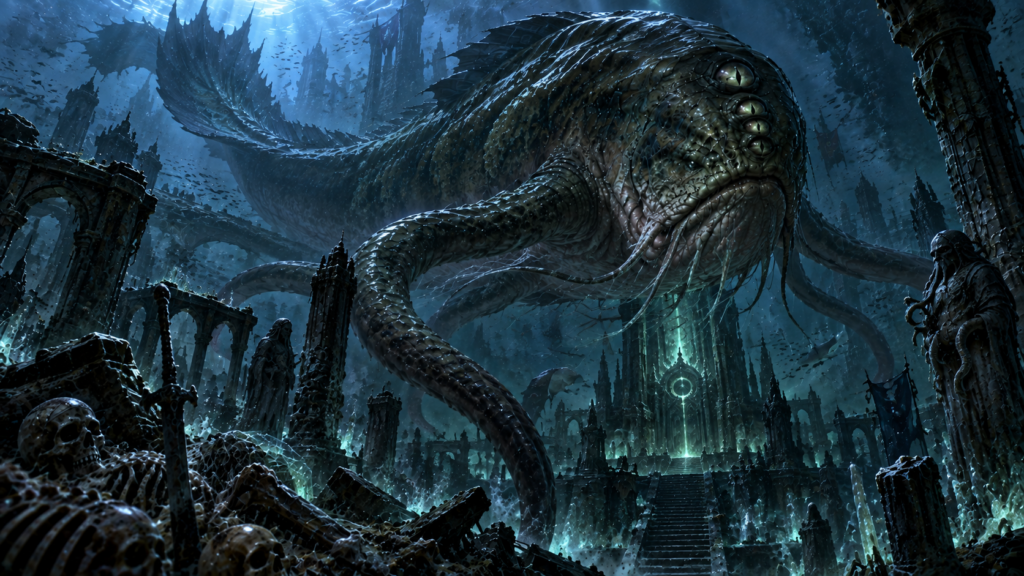
A long-established lair may include flooded galleries connected by passages too small or deep for surface pursuers, sluices that can raise or lower water levels, submerged doors, observation chambers, slave quarters kept permanently wet and dry rooms maintained for useful air-breathing servants.
Entrances are rarely obvious. A harbour cistern, monastery well, flooded mine shaft, sea cave or drainage tunnel may be only the surface end of a much larger route. The aboleth arranges these approaches so that servants can move information and captives without revealing where the creature itself rests.
Illusions and controlled witnesses provide another defensive layer. A chamber may appear collapsed when it is merely concealed. A surviving prisoner may sincerely direct rescuers toward the wrong tunnel. Guards may believe they are protecting a reservoir, crypt or treasury rather than an aboleth.
The Drowned Nexus is therefore a prepared stronghold, not a supernatural aura. Its danger comes from architecture, water, slaves, secrecy and the aboleth’s ability to make other creatures defend its interests.
Running an Aboleth
Do not reveal the aboleth first. Reveal its system.
The party should meet people who are behaving rationally according to priorities that make no sense from the outside. A harbour watch refuses to search a specific cistern. A missing person returns but will not sleep away from the river. A mine keeps pumping water into a chamber everyone claims is empty. Only after the characters discover the dependency, domination or memory theft should the creature itself become visible.
If Violence Starts
In combat, the aboleth uses water as security. It dominates or grapples targets, consumes memories where the rules allow it, and forces enemies to choose between entering its preferred environment or abandoning captives. It retreats through routes land-bound creatures cannot easily follow.
Aboleth Knowledge
Characters who investigate aboleths through Knowledge, occult study, surviving thralls or recovered records can uncover increasingly dangerous truths.
| Discovery | What it reveals |
|---|---|
| Basic recognition | The creature is an intelligent aquatic aberration. Its mucus and tentacles can alter other creatures, and it is far more dangerous in water than on land. |
| Experienced hunter | Aboleths use domination, illusion and transformed servants. Destroying visible thralls does not necessarily break the underlying network. |
| Deep lore | Aboleth enclaves are genuinely ancient but never ruled Earth globally. Some lineages preserve memories reaching into Precambrian oceans and recognise events no mortal archive records. |
| Forbidden lore | In 5.5e, destruction of the body may be temporary. A hunter who believes one corpse ends the threat can become part of the next plan. |
Legacy Variant: Aboleth Mage — D&D 3.5e
Some aboleths formalise their study of mortal arcane magic. The 3.5e SRD presents the Aboleth Mage as an aboleth with ten wizard levels. It is not a separate species and does not replace the ordinary aboleth.
CR 17; HP 177; AC 18; Initiative +7; Base Attack/Grapple +11/+28
Abilities Str 28, Dex 16, Con 24, Int 20, Wis 16, Cha 14
Typical Wizard Spells Prepared (4/6/5/4/4/3; save DC 15 + spell level)
0: daze, detect magic (2), resistance.
1st: alarm, charm person, color spray, mage armor, magic missile (2).
2nd: blur, bull’s strength, darkness, fox’s cunning, see invisibility.
3rd: dispel magic, displacement, fly, lightning bolt.
4th: greater invisibility, phantasmal killer, scrying, stoneskin.
5th: hold monster, empowered lightning bolt, wall of force.
The mage retains the ordinary aboleth’s enslave, psionics, slime and mucus cloud, with save DCs adjusted for its altered ability scores.
Adventure Hooks
| The Flooded Mine | Workers have broken into an underground lake. The mine owner forbids evacuation and insists the new water is harmless, even as labourers begin sleeping in flooded galleries. |
|---|---|
| The Returning Captain | A ship captain missing for months returns with flawless memories, a new route and an absolute refusal to sail anywhere except one remote harbour. |
| The Drowned Archive | A submerged ruin contains records from a civilisation unknown to historians. An aboleth wants the explorers alive long enough to learn what they know about the surface world. |
| The Slave Who Escaped | A former thrall reaches dry land but is physically unable to remain away from water. Keeping the witness alive means solving the transformation before the aboleth’s agents recover them. |
| Two Masters Below | Two drowned cities are quietly competing for the same coastal network. The characters initially mistake the contradictory orders among compromised officials for political infighting. |
Treasure and Remains
Aboleths value information, tools and controlled access more than coins for their own sake. A lair may contain relics taken from drowned ships, magic useful for communication or concealment, records produced by slaves, maps of underwater routes and objects whose owners were consumed for their memories.
Aboleth mucus is valuable and dangerous. In older rules it can be used in magic associated with water breathing and transformation, but harvesting it safely should require containment and knowledge rather than treating the body as a routine component pouch.
Further Viewing
These three videos are the strongest surviving legacy selections from the earlier SpiralWorlds Aboleth page. They remain useful as supplementary viewing for anatomy, tabletop use and quick orientation.
Canon note: These videos discuss published D&D Aboleth lore. Where their cosmology or history differs from this campaign, the canon on this page takes precedence.
Related Entries
- Greater Aboleth — a much larger and more powerful aboleth variant.
- Aboleth Noble — one of the site’s established advanced aboleth forms.
- Aboleth Ruler — a higher-ranking legacy aboleth variant.
- Skum — classic aboleth servitors and slave-bred enforcers.
- Aberrations — creature-type rules and related monsters.
- The Dawn of Earth — the Precambrian chronology relevant to aboleth deep-time survival.
- Aboleth Drowned Cities — the hidden aquatic slave-city network in the faction ledger.
- Conditions — Charmed, Grappled, Poisoned and other conditions used by the 5.5e rules.
- Skills and Feats — reference indexes for the legacy-system statistics.
Sources and Licensing
D&D 5.5e / 2024: The core modern statistics are taken from System Reference Document 5.2.1, released by Wizards of the Coast LLC under the Creative Commons Attribution 4.0 International Licence. The SRD establishes the current 150 hp stat block, memory consumption, revised domination, Eldritch Restoration, and the increased lair XP/Legendary Action profile.
Pathfinder 1e: The Pathfinder statistics follow Pathfinder Roleplaying Game Bestiary (2009), including CR 7, four tentacle attacks, mucus cloud, slime and illusion-heavy spell-like abilities. The SpiralWorlds language line follows the setting’s established language rules rather than importing generic subterranean lingua-franca assumptions.
D&D 3.5e: The 3.5e statistics and Aboleth Mage variant derive from the Revised System Reference Document. The core creature remains CR 7 with enslave, psionics, slime and mucus cloud.
SpiralWorlds campaign: The deep-time correction, non-global history, Flumph-era retreat, drowned-city network, 1454 operations, Lawful Evil behavioural treatment and Drowned Nexus campaign integration are SpiralWorlds setting material.
Open Game License v1.0a and Section 15
OPEN GAME LICENSE Version 1.0a
The following text is the property of Wizards of the Coast, Inc. and is Copyright 2000 Wizards of the Coast, Inc (“Wizards”). All Rights Reserved.
1. Definitions: (a) “Contributors” means the copyright and/or trademark owners who have contributed Open Game Content; (b) “Derivative Material” means copyrighted material including derivative works and translations (including into other computer languages), potation, modification, correction, addition, extension, upgrade, improvement, compilation, abridgment or other form in which an existing work may be recast, transformed or adapted; (c) “Distribute” means to reproduce, license, rent, lease, sell, broadcast, publicly display, transmit or otherwise distribute; (d) “Open Game Content” means the game mechanic and includes the methods, procedures, processes and routines to the extent such content does not embody the Product Identity and is an enhancement over the prior art and any additional content clearly identified as Open Game Content by the Contributor, and means any work covered by this License, including translations and derivative works under copyright law, but specifically excludes Product Identity; (e) “Product Identity” means product and product line names, logos and identifying marks including trade dress; artifacts; creatures; characters; stories, storylines, plots, thematic elements, dialogue, incidents, language, artwork, symbols, designs, depictions, likenesses, formats, poses, concepts, themes and graphic, photographic and other visual or audio representations; names and descriptions of characters, spells, enchantments, personalities, teams, personas, likenesses and special abilities; places, locations, environments, creatures, equipment, magical or supernatural abilities or effects, logos, symbols, or graphic designs; and any other trademark or registered trademark clearly identified as Product Identity by the owner of the Product Identity, and which specifically excludes the Open Game Content; (f) “Trademark” means the logos, names, mark, sign, motto, designs that are used by a Contributor to identify itself or its products or the associated products contributed to the Open Game License; (g) “Use”, “Used” or “Using” means to use, Distribute, copy, edit, format, modify, translate and otherwise create Derivative Material of Open Game Content; (h) “You” or “Your” means the licensee in terms of this agreement.
2. The License: This License applies to any Open Game Content that contains a notice indicating that the Open Game Content may only be Used under and in terms of this License. You must affix such a notice to any Open Game Content that You Use. No terms may be added to or subtracted from this License except as described by the License itself. No other terms or conditions may be applied to any Open Game Content distributed using this License.
3. Offer and Acceptance: By Using the Open Game Content You indicate Your acceptance of the terms of this License.
4. Grant and Consideration: In consideration for agreeing to use this License, the Contributors grant You a perpetual, worldwide, royalty-free, non-exclusive license with the exact terms of this License to Use, the Open Game Content.
5. Representation of Authority to Contribute: If You are contributing original material as Open Game Content, You represent that Your Contributions are Your original creation and/or You have sufficient rights to grant the rights conveyed by this License.
6. Notice of License Copyright: You must update the COPYRIGHT NOTICE portion of this License to include the exact text of the COPYRIGHT NOTICE of any Open Game Content You are copying, modifying or distributing, and You must add the title, the copyright date, and the copyright holder’s name to the COPYRIGHT NOTICE of any original Open Game Content you Distribute.
7. Use of Product Identity: You agree not to Use any Product Identity, including as an indication as to compatibility, except as expressly licensed in another, independent Agreement with the owner of each element of that Product Identity. You agree not to indicate compatibility or co-adaptability with any Trademark or Registered Trademark in conjunction with a work containing Open Game Content except as expressly licensed in another, independent Agreement with the owner of such Trademark or Registered Trademark. The use of any Product Identity in Open Game Content does not constitute a challenge to the ownership of that Product Identity. The owner of any Product Identity used in Open Game Content shall retain all rights, title and interest in and to that Product Identity.
8. Identification: If you distribute Open Game Content You must clearly indicate which portions of the work that you are distributing are Open Game Content.
9. Updating the License: Wizards or its designated Agents may publish updated versions of this License. You may use any authorized version of this License to copy, modify and distribute any Open Game Content originally distributed under any version of this License.
10. Copy of this License: You MUST include a copy of this License with every copy of the Open Game Content You Distribute.
11. Use of Contributor Credits: You may not market or advertise the Open Game Content using the name of any Contributor unless You have written permission from the Contributor to do so.
12. Inability to Comply: If it is impossible for You to comply with any of the terms herein with respect to some or all of the Open Game Content due to statute, judicial order, or governmental regulation then You may not Use any Open Game Material so affected.
13. Termination: This License will terminate automatically if You fail to comply with all terms herein and fail to cure such breach within 30 days of becoming aware of the breach. All sublicenses shall survive the termination of this License.
14. Reformation: If any provision of this License is held to be unenforceable, such provision shall be reformed only to the extent necessary to make it enforceable.
15. COPYRIGHT NOTICE
Open Game License v 1.0a Copyright 2000, Wizards of the Coast, Inc.
System Reference Document Copyright 2000–2003, Wizards of the Coast, Inc.; Authors Jonathan Tweet, Monte Cook, Skip Williams, Rich Baker, Andy Collins, David Noonan, Rich Redman, Bruce R. Cordell, John D. Rateliff, Thomas Reid, James Wyatt, based on original material by E. Gary Gygax and Dave Arneson.
Pathfinder Roleplaying Game Core Rulebook © 2009, Paizo Publishing, LLC; Author Jason Bulmahn, based on material by Jonathan Tweet, Monte Cook and Skip Williams.
Pathfinder Roleplaying Game Bestiary © 2009, Paizo Publishing, LLC; Author Jason Bulmahn, based on material by Jonathan Tweet, Monte Cook and Skip Williams.
Original setting material, campaign material, Pathfinder conversion material, page structure and editorial content Copyright © 2026. All rights reserved except material separately identified as Open Game Content or licensed under Creative Commons Attribution 4.0 International.