
Races and Peoples · Playable People
Dragonborn — Heirs of Dragonkind
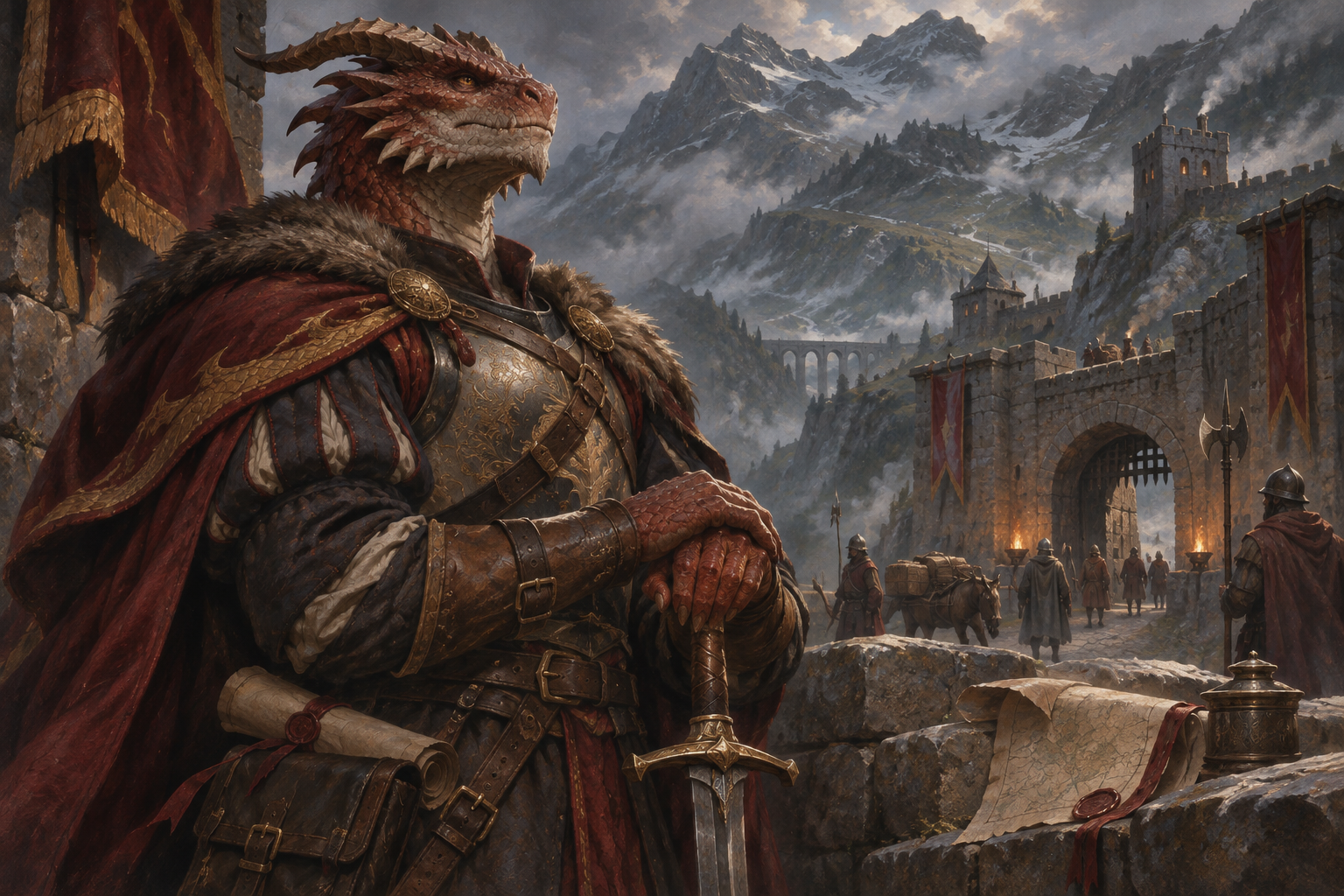
Dragonborn carry draconic power without belonging to the dragons. Their scaled bodies and elemental breath are a visible inheritance, but they live as merchants, parents, soldiers, artisans, scholars, travellers, criminals and rulers. In 1454, a dragonborn character begins with a homeland and an obligation, not automatic loyalty to any dragon.
Dragonborn at a Glance
| People | Dragonborn — a mortal people with inherited draconic characteristics |
|---|---|
| Appearance | Scaled, generally broad-built humanoids with horns, crests or ridges; colour and features differ among families |
| Homes | Mixed towns, mountain passes, fortified valleys, trade ports, caravan routes and surviving former dragon-held territories |
| Communities | Households, oath-bound families, guilds, independent settlements, garrisons and itinerant companies |
| Draconic ancestry | An inheritance of elemental power; it does not predetermine character, politics, patron deity or allegiance |
| Languages | Languages actually learned from household, homeland, education and travel; Draconic only where taught |
| Relationship with dragons | Ranges from kinship and worship to negotiations, independence, rebellion and open warfare |
| In play | Choose homeland, upbringing, ancestor, vocation and a living obligation |
A People Between Dragons and Kingdoms
A dragonborn watch captain refuses entry to a dragon’s herald until a treaty is shown. Across the sea, her cousin works as a shipwright, carving his family mark into the keel of a vessel owned by a human merchant. Far inland a village keeper recites the names of ancestors who fled a wyrm’s tyranny. All three know of dragons, yet none serves the same master.
Dragonborn families live where other peoples live. Some keep their own fortifications and marriage networks; others have been part of a larger town for generations. Old dragon courts left languages, monuments, grudges and taxes. They did not create a single dragonborn kingdom extending across the world. A dragonborn met at a city gate may be a local resident, a pilgrim or a foreign prisoner, not an emissary of an ancestral empire.
Origins and the claims of dragons
Old accounts disagree about the first dragonborn. One account tells of dragon eggs blessed by Bahamut and Tiamat; another credits dragons working without divine approval. Households may preserve several irreconcilable stories. Draconic powers are real, but a ruler’s preferred genealogy is not automatically historical fact. Some dragonborn families also tell of exceptional initiates who take on draconic traits through sacred rites. Such initiates are not proof of any single origin for the people as a whole.
Bahamut is a protector and judge in the dragon traditions; his shrines can shelter dragonborn caravans and captives. Tiamat, the Five-Headed Dragon Queen, seeks tribute and submission, and her heralds contest draconic loyalties. Her ancient salt-sea history also involves Marduk, who is a separate deity from Bahamut. A family may accept a dragon patron, resist a dragon’s demand or remain uninvolved. Neither metallic nor chromatic descent grants moral authority, requires worship or makes a dragonborn responsible for a dragon’s actions. Some family chronicles remember a gold dragon as a patron or a red dragon as an enemy; those are particular histories, not universal destinies.
Relations with other peoples
- Humans: mixed households and trading settlements provide jobs, friendships and rivalries. The reception a dragonborn receives depends greatly on the ruler and locality.
- Dwarves: craftspeople and caravaneers exchange metalwork and contracts; disagreements about old hoards or tunnel access can turn into feuds.
- Elves: long-lived witnesses preserve earlier accounts of dragon wars, though neither side can agree whose chronicles are trustworthy.
- Giants: conflicts between some dragon and giant houses have affected dragonborn settlements for generations; other houses trade or negotiate.
- Orcs and other travelling peoples: treatment is governed by actual borders, campaigns and friendships, not fixed racial alliances or hatred.
- Tieflings: families of both peoples may face expectations based on powerful ancestors, but neither ancestry creates an automatic obligation to serve them.
Settlements and Older Ruins
Mountain watch-holds protect narrow approaches and pastures. River gate-towns grow around toll bridges, markets and ferry crossings. Harbour households sell their skills as mariners, soldiers, merchants and translators. Dragon-court ruins survive as basalt audience chambers, walled terraces, collapsed galleries or abandoned egg vaults. A ruined building may be a former palace, a refuge or a prison; its true history is discovered through play.
Dragonborn do not have one universal capital. A character’s homeland should name a particular river, valley, town or jurisdiction and the people who actually hold power there. Their local naming customs, laws, dialects and trades can differ as much as those of any other dispersed people. The settlement forms above are examples for play, not evidence of a single verified dragonborn empire or a fixed inventory of named dragonborn cities.
In Castile and León, dragonborn envoys are uncommon enough that Torquemada has no uniform kingdom-wide policy for them. His inquisitors examine foreign heraldry, unfamiliar sacred claims and a visitor’s allies; some officials negotiate, while others use suspicion to detain or extort. This is a local political danger, not a trait of dragonborn ancestry.
Daily Life, Faith and Names
Children learn the work their families know: ledgers, masonry, animal care, watch duty, sail repair or the custody of archives. Some households carve scales or claw marks into memorial stones; others preserve histories through songs and family letters. Draconic can be a learned language of scholarship or ritual, not a biological instinct. In 1454 a dragonborn raised in a Welsh-speaking village ordinarily speaks the village’s language; one raised in a port may have learned several languages through trade.
Names follow actual upbringing. A clan may transmit a draconic honorific, a human city may give a dragonborn a local surname, and a soldier may adopt a campaign nickname. Neither ancestry nor scale colour dictates a common naming system worldwide.
Playing a Dragonborn
Choose one relationship that matters now: a parent who still sends tribute to a wyrm, a military commander who trusts you, a friend exiled after a clan dispute, or an older rival who disputes your family’s claim to a ruined hall. Choose a private ambition as well. Discipline, cruelty, wit, piety, compassion and ambition are individual qualities, not consequences of an ancestral energy type. A character’s alignment follows their decisions, loyalties and conduct.
Character questions
- Who first taught you what dragons were?
- Which promise to your household do you regret making?
- Who knows the truth behind your family’s oldest story?
Reasons to adventure
- Protect a Bahamut-bound caravan whose former dragon patron demands its people and cargo as tribute.
- Escort a caravan through land contested by a giant house.
- Discover why a sealed egg vault has become warm again.
Character Rules by Edition
Select the edition you are playing. Each panel is a complete, separate rules reference. Cultural descriptions elsewhere on this page do not grant additional abilities.
Dragonborn — D&D 2024
| Creature Type | Humanoid |
|---|---|
| Size and Speed | Medium, generally 5–7 feet tall; 30-foot Speed |
| Draconic Ancestry | Choose black, blue, brass, bronze, copper, gold, green, red, silver or white. The selection determines the damage type of Breath Weapon and Damage Resistance. |
| Darkvision | 60 feet |
| Damage Resistance | Resistance to the ancestral damage type |
| Breath Weapon | When taking the Attack action, replace one attack with a 15-foot cone or 30-foot line (5 feet wide); choose the shape each use. Creatures make a Dexterity saving throw, DC 8 + Constitution modifier + Proficiency Bonus, taking half damage on success. The damage is 1d10 at level 1, 2d10 at level 5, 3d10 at level 11 and 4d10 at level 17. Uses equal your Proficiency Bonus; regain all on a Long Rest. |
| Draconic Flight | From level 5, a Bonus Action produces spectral wings and a Fly Speed equal to your Speed for up to 10 minutes, once per Long Rest. |
| Ability Scores and Languages | Ability-score increases come from background, not species. Choose languages at character creation; the campaign replaces universal Common with a genuine homeland language. |
Ancestral energies: black/copper: acid; blue/bronze: lightning; brass/gold/red: fire; green: poison; silver/white: cold. Ancestry does not determine alignment or culture.
Dragonborn — D&D 2014
| Ability Score Increase | Strength +2, Charisma +1 |
|---|---|
| Size and Speed | Medium; 30 feet |
| Draconic Ancestry | Select one of the ten listed dragons; this sets Breath Weapon energy and shape and your damage resistance |
| Breath Weapon | Spend your action to exhale the ancestral energy. Damage 2d6 at level 1, 3d6 at level 6, 4d6 at level 11 and 5d6 at level 16. Save DC 8 + Constitution modifier + Proficiency Bonus; a successful save halves damage. Regain one use after a Short or Long Rest. |
| Damage Resistance | Resistance to the ancestral damage type |
| Languages | The printed race lists Common and Draconic. Replace Common with a learned local language; retain the same language-slot count and use Draconic if actually taught. |
| Dragon ancestry | Damage | Breath area | Saving throw |
|---|---|---|---|
| Black, Copper | Acid | 5-by-30-foot line | Dexterity |
| Blue, Bronze | Lightning | 5-by-30-foot line | Dexterity |
| Brass | Fire | 5-by-30-foot line | Dexterity |
| Gold, Red | Fire | 15-foot cone | Dexterity |
| Green | Poison | 15-foot cone | Constitution |
| Silver, White | Cold | 15-foot cone | Constitution |
2014 Dragonborn do not automatically receive the 2024 Darkvision, attack-replacing breath or spectral wings.
Dragonborn — Pathfinder 1e
SpiralWorlds conversion, subject to Games Master approval. This is an original Pathfinder 1e adaptation, not a Paizo-published core dragonborn race. Its features do not stack with the D&D packages.
| Ability Score Modifiers | +2 Strength, +2 Charisma, –2 Dexterity |
|---|---|
| Type, Size and Speed | Humanoid (dragonborn), Medium; 30 feet |
| Senses | Darkvision 60 feet |
| Lineage | Select an ancestral dragon. Use acid for black, copper or green; electricity for blue or bronze; fire for brass, gold or red; cold for silver or white, following Pathfinder 1e dragon energies. |
| Energy Resistance | Resistance 5 against the chosen ancestral energy |
| Breath Weapon (Su) | Once daily, exhale a 15-foot cone or 30-foot line of ancestral energy dealing 2d6 damage, with a Reflex save for half. Save DC is 10 + half the character’s Hit Dice + Constitution modifier. Increase damage by 1d6 at 6, 11 and 16 Hit Dice. |
| Languages | One language actually learned from the character’s homeland plus one other learned language, often Draconic; bonus-language choices by GM permission. No universal Common. |
| Limits | No automatic wings, natural armour, natural attacks or spellcasting. Other rules follow the selected Pathfinder 1e class. |
Green-dragon conversion: unlike 2024 poison damage, the Pathfinder 1e green-dragon lineage uses acid damage and acid resistance. The GM should review the package against the campaign’s race-power budget.
Dragonborn — D&D 3.5e
SpiralWorlds native-born dragonborn: This complete playable race is a campaign implementation for characters born into dragonborn families. It may be chosen at 1st level without a transformation rite. The alternative printed Dragonborn of Bahamut is a different character option and is not combined with these traits.
| Race and Type | Humanoid (dragonborn). This is a mortal, native-born people, not a dragon or an outsider. |
|---|---|
| Size and Base Speed | Medium; base land speed 30 feet. |
| Ability Score Adjustments | +2 Constitution, –2 Dexterity. |
| Racial Hit Dice and Level Adjustment | No racial Hit Dice; take class levels normally. Level Adjustment +0; effective character level equals class levels. |
| Vision | Darkvision 60 feet. |
| Draconic Ancestry | At character creation choose one lineage: black or copper (acid); blue or bronze (electricity); brass, gold or red (fire); green (acid); silver or white (cold). This selection cannot ordinarily be changed. |
| Energy Resistance (Ex) | Energy resistance 5 against the chosen ancestral energy type. |
| Breath Weapon (Su) | Once per day, as a standard action, release ancestral energy in a 15-foot cone or a 30-foot line 5 feet wide; choose one shape when creating the character. All creatures in the area take 1d6 damage at character levels 1–5, 2d6 at levels 6–10, 3d6 at levels 11–15, or 4d6 at level 16 or higher. A Reflex save halves the damage. Save DC = 10 + half the dragonborn’s total Hit Dice + Constitution modifier. This is a supernatural ability and does not provoke attacks of opportunity. |
| Languages | Begin with one language of the household or homeland and one additional language learned through upbringing (Draconic is an option). For a positive Intelligence modifier, choose that many bonus languages from languages the character could realistically have learned, approved by the Games Master. |
| Favored Class | Any. Ignore the highest-level class when checking for multiclass experience penalties. |
| Alignment and Equipment | Any alignment. Use the normal equipment and class rules; there is no inherent armor, claw attack, flight or spellcasting. |
Choose the ancestry and its energy type when you create your character. Racial abilities above are complete; no unlisted transformation features, draconic aspect, wing progression or racial bonuses apply.
Dangers and Adventure Hooks
- The sealed stair: a dwarven envoy arrives with a key to a dragonborn hall blocked from within for generations.
- The giant’s envoy: a giant house offers peace in exchange for the surrender of a dragonborn family archive.
- The contested heir: rival dragons each summon the same dragonborn magistrate to judge a vanished clutch.
- The oath company: a human lord offers a mercenary band land if it abandons a promise no living patron remembers.
Continue Your Character
Player Resources · Choose Your People · Character Classes · Dragons
Rules Sources and Licensing
Setting and native-born D&D 3.5e dragonborn mechanics are original SpiralWorlds material. D&D 2024 species rules: Dragonborn and SRD 5.2.1, made available under CC BY 4.0. D&D 2014: Basic Rules, Races. The Pathfinder 1e dragonborn package is an original adaptation informed by the Pathfinder 1e Race Builder and is not a Paizo-published race. The separately published Dragonborn of Bahamut transformation in Races of the Dragon is a different D&D 3.5e option, not a prerequisite for using the original native-born race on this page.
Keep this reference growing
If this page helped with your reading or game, you can support its upkeep or explore the curated books.
Explore the Bookshop — epics, classics and stories behind imagined worlds.