
SpiralWorlds Player’s Manual · Character Creation
Choose Your People
5.5e species · Pathfinder 1e races · D&D 3.5e races
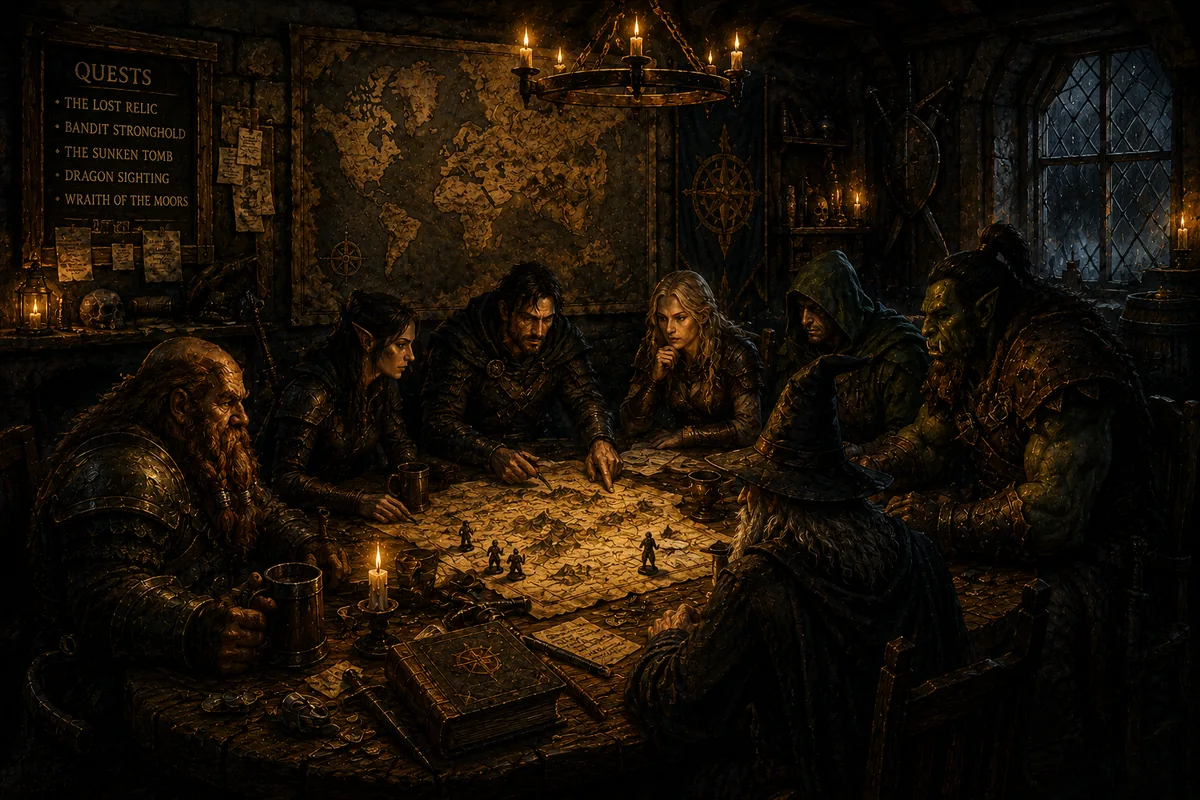
Your people describes inherited physical or supernatural traits and the histories of the communities from which your character comes. It does not decide personality, alignment, profession, loyalty, homeland or language. Choose the person first, then apply only the mechanics for your campaign edition.
Setting identity
Separate inheritance from upbringing
Do not derive personality from ancestry. Being a dwarf, elf, gnome, halfling, catfolk, half-elf, half-orc or human does not dictate courage, morality, intelligence, profession, faith, politics or loyalty.
Playable people gateway
Choose a published SpiralWorlds people page
The status label tells you whether that destination is already safe as a multi-edition rules page. Where a page is marked legacy, use it for setting identity only and use the edition procedure below for mechanics.
Dwarves
Dispersed through holds, mines, guilds, warden networks, enclaves and itinerant families. The current page includes separate 5.5e, PF1e and 3.5e mechanics.
Catfolk
Feline peoples with their own communities and histories, including the Catfolk realm of Kemet. The current page contains separate supported-edition material.
Elves
Use the page for SpiralWorlds elven identity and history. Until its Player’s Manual pass, use current 5.5e Elf mechanics or the correct PF1e/3.5e rules source rather than assuming the page is edition-safe.
Gnomes
Use the page for SpiralWorlds gnome identity and history. Apply mechanics from the selected edition until this people page is rebuilt.
Halflings
Settled and itinerant halfling communities exist across the setting. Use the legacy page for identity; use the selected edition’s mechanics.
Half-Elves
Half-elves remain a valid SpiralWorlds identity. They are not a core 2024 species entry, so a 5.5e character uses a Games Master-approved older/custom species implementation with 2024 conversion rules.
Half-Orcs
Half-orcs remain a valid SpiralWorlds identity. In 5.5e, use a Games Master-approved older/custom species implementation and ignore legacy ability-score increases.
Humans
Humans are defined mechanically by the chosen edition and culturally by homeland, family and community. There is no separate SpiralWorlds Human people page yet.
Rules procedure
Apply only your edition’s mechanics
D&D 5.5e / 2024
1. Choose a species implementation. For a current 2024 species, record Creature Type, Size, Speed and all special traits. Species does not provide the standard 2024 ability-score increases, languages or alignment. If the SpiralWorlds people page is still marked legacy, use the current 2024 Character Origins species rules for its mechanics where that species is available.
2. Keep ability increases with the background. Apply the +2/+1 or +1/+1/+1 increases from the character’s 2024 background when you complete Ability Scores.
3. Choose languages separately. The 2024 rules normally give Common plus two chosen languages. SpiralWorlds has no universal Common. Replace Common with one real home/local language appropriate to the character’s upbringing, then choose the two additional languages allowed by the rules unless another feature changes the number.
4. Using an older species: if the Games Master approves a species from an older book, ignore that older species’ Ability Score Increase and use the 2024 background increases instead. Keep only the older species traits the Games Master has approved for the 2024 build.
Pathfinder 1e
Pathfinder 1e race mechanics include racial ability adjustments, size, speed, senses, racial traits and legacy language rules. Use the complete PF1e race entry for the chosen race. The familiar core ability adjustments are:
| People / race | PF1e ability adjustment |
|---|---|
| Dwarf | +2 Constitution, +2 Wisdom, –2 Charisma |
| Elf | +2 Dexterity, +2 Intelligence, –2 Constitution |
| Gnome | +2 Constitution, +2 Charisma, –2 Strength |
| Half-Elf | +2 to one ability score of your choice |
| Halfling | +2 Dexterity, +2 Charisma, –2 Strength |
| Half-Orc | +2 to one ability score of your choice |
| Human | +2 to one ability score of your choice |
Apply those adjustments after generating the base ability scores. For Catfolk, use the PF1e tab on the Catfolk page.
D&D 3.5e
D&D 3.5e uses its own race traits and adjustments. Do not substitute Pathfinder’s later revisions. The core adjustments are:
| People / race | 3.5e ability adjustment |
|---|---|
| Dwarf | +2 Constitution, –2 Charisma |
| Elf | +2 Dexterity, –2 Constitution |
| Gnome | +2 Constitution, –2 Strength |
| Half-Elf | None |
| Halfling | +2 Dexterity, –2 Strength |
| Half-Orc | +2 Strength, –2 Intelligence, –2 Charisma |
| Human | None |
Then record size, speed, senses, racial traits, favored class and any other rules elements in the chosen 3.5e entry. For Catfolk, use the 3.5e tab on the Catfolk page.
Character record
Write down the person, not just the rules package
Before moving on
People checklist
- The campaign edition is fixed.
- A SpiralWorlds people has been chosen.
- Only the selected edition’s species/race mechanics have been applied.
- 5.5e species ability-score increases have not been added.
- PF1e and 3.5e racial adjustments have not been mixed together.
- Languages come from actual upbringing and the edition’s allowed number, not a universal Common language.
- Homeland and people are recorded separately.
- Culture and personality have not been treated as biological traits.
- Size, Speed and relevant inherited traits are recorded.
- The next character-creation step is clear for the selected edition.
Legacy note
What this rebuild replaces
Open legacy explanation
The old page presented one Pathfinder-style ability-bonus table as though it applied to all characters, said race automatically granted languages, and used Intelligence-based bonus languages as a universal rule. Those assumptions are now confined to the editions that actually use them and converted to SpiralWorlds’ language rules.
The original URL remains unchanged so existing inbound links continue to work.
Sources and licensing
Rules sources
- D&D 2024 Basic Rules — Creating a Character
- D&D 2024 Basic Rules — Character Origins
- System Reference Document 5.2.1
- Pathfinder 1e — Races
- d20 SRD — D&D 3.5e Races
SRD 5.2.1 attribution: This work includes material from the System Reference Document 5.2.1 by Wizards of the Coast LLC, licensed under Creative Commons Attribution 4.0 International.
Open Game License v1.0a + Section 15
Open Game Content designation: Pathfinder 1e and D&D 3.5e mechanical material on this page is Open Game Content only to the extent that it derives from material previously released as Open Game Content. SpiralWorlds setting material, examples, artwork, CSS, page design and editorial presentation are excluded.
OPEN GAME LICENSE Version 1.0a
The following text is the property of Wizards of the Coast, Inc. and is Copyright 2000 Wizards of the Coast, Inc (“Wizards”). All Rights Reserved.
1. Definitions: (a) “Contributors” means the copyright and/or trademark owners who have contributed Open Game Content; (b) “Derivative Material” means copyrighted material including derivative works and translations (including into other computer languages), potation, modification, correction, addition, extension, upgrade, improvement, compilation, abridgment or other form in which an existing work may be recast, transformed or adapted; (c) “Distribute” means to reproduce, license, rent, lease, sell, broadcast, publicly display, transmit or otherwise distribute; (d) “Open Game Content” means the game mechanic and includes the methods, procedures, processes and routines to the extent such content does not embody the Product Identity and is an enhancement over the prior art and any additional content clearly identified as Open Game Content by the Contributor, and means any work covered by this License, including translations and derivative works under copyright law, but specifically excludes Product Identity; (e) “Product Identity” means product and product line names, logos and identifying marks including trade dress; artifacts; creatures characters; stories, storylines, plots, thematic elements, dialogue, incidents, language, artwork, symbols, designs, depictions, likenesses, formats, poses, concepts, themes and graphic, photographic and other visual or audio representations; names and descriptions of characters, spells, enchantments, personalities, teams, personas, likenesses and special abilities; places, locations, environments, creatures, equipment, magical or supernatural abilities or effects, logos, symbols, or graphic designs; and any other trademark or registered trademark clearly identified as Product identity by the owner of the Product Identity, and which specifically excludes Product Identity; (f) “Trademark” means the logos, names, mark, sign, motto, designs that are used by a Contributor to identify itself or its products or the associated products contributed to the Open Game License; (g) “Use”, “Used” or “Using” means to use, Distribute, copy, edit, format, modify, translate and otherwise create Derivative Material of Open Game Content; (h) “You” or “Your” means the licensee in terms of this agreement.
2. The License: This License applies to any Open Game Content that contains a notice indicating that the Open Game Content may only be Used under and in terms of this License. You must affix such a notice to any Open Game Content that you Use. No terms may be added to or subtracted from this License except as described by the License itself. No other terms or conditions may be applied to any Open Game Content distributed using this License.
3. Offer and Acceptance: By Using the Open Game Content You indicate Your acceptance of the terms of this License.
4. Grant and Consideration: In consideration for agreeing to use this License, the Contributors grant You a perpetual, worldwide, royalty-free, non-exclusive license with the exact terms of this License to Use, the Open Game Content.
5. Representation of Authority to Contribute: If You are contributing original material as Open Game Content, You represent that Your Contributions are Your original creation and/or You have sufficient rights to grant the rights conveyed by this License.
6. Notice of License Copyright: You must update the COPYRIGHT NOTICE portion of this License to include the exact text of the COPYRIGHT NOTICE of any Open Game Content You are copying, modifying or distributing, and You must add the title, the copyright date, and the copyright holder’s name to the COPYRIGHT NOTICE of any original Open Game Content you Distribute.
7. Use of Product Identity: You agree not to Use any Product Identity, including as an indication as to compatibility, except as expressly licensed in another, independent Agreement with the owner of each element of that Product Identity. You agree not to indicate compatibility or co-adaptability with any Trademark or Registered Trademark in conjunction with a work containing Open Game Content except as expressly licensed in another, independent Agreement with the owner of such Trademark or Registered Trademark. The use of any Product Identity in Open Game Content does not constitute a challenge to the ownership of that Product Identity. The owner of any Product Identity used in Open Game Content shall retain all rights, title and interest in and to that Product Identity.
8. Identification: If you distribute Open Game Content You must clearly indicate which portions of the work that you are distributing are Open Game Content.
9. Updating the License: Wizards or its designated Agents may publish updated versions of this License. You may use any authorized version of this License to copy, modify and distribute any Open Game Content originally distributed under any version of this License.
10. Copy of this License: You MUST include a copy of this License with every copy of the Open Game Content You Distribute.
11. Use of Contributor Credits: You may not market or advertise the Open Game Content using the name of any Contributor unless You have written permission from the Contributor to do so.
12. Inability to Comply: If it is impossible for You to comply with any of the terms of this License with respect to some or all of the Open Game Content due to statute, judicial order, or governmental regulation then You may not Use any Open Game Material so affected.
13. Termination: This License will terminate automatically if You fail to comply with all terms herein and fail to cure such breach within 30 days of becoming aware of the breach. All sublicenses shall survive the termination of this License.
14. Reformation: If any provision of this License is held to be unenforceable, such provision shall be reformed only to the extent necessary to make it enforceable.
15. COPYRIGHT NOTICE
Open Game License v 1.0a Copyright 2000, Wizards of the Coast, Inc.
System Reference Document. Copyright 2000, Wizards of the Coast, Inc.; Authors Jonathan Tweet, Monte Cook, Skip Williams, based on material by E. Gary Gygax and Dave Arneson.
Pathfinder Roleplaying Game Core Rulebook. © 2009, Paizo Publishing, LLC; Author: Jason Bulmahn, based on material by Jonathan Tweet, Monte Cook, and Skip Williams.
END OF LICENSE
Keep this reference growing
If this page helped with your reading or game, you can support its upkeep or explore the curated books.
Explore the Bookshop — epics, classics and stories behind imagined worlds.