
Tomás de Torquemada — Grand Inquisitor of Flame and Iron
At a Glance
- Alias: The Hammer of Heretics, The Light of Castile, The Grand Inquisitor
- Gender: Male
- Race: Human
- Age: 64 in 1454 (born c. 1390)
- Occupation: Grand Inquisitor, supreme head of the Inquisition of Flame and Iron throughout Castile and León; Prior of Santa Cruz; royal councillor
- Religion: Public champion of court-sanctioned Iberian and Celtiberian worship; secretly bound to Belial
- Allies: Hard-line Castilian court factions, the Inquisition of Flame and Iron, loyal inquisitors and tribunal judges
- Targets and opponents: Independent dwarf guilds, elven embassies, travellers and minorities his officials choose to scapegoat; rival cults, hostile nobles and human opponents of inquisitorial domination. His specific racial prejudices and their consequences are detailed below.
- Abode/Base of operations: Santa Cruz, Segovia; recognised tribunal courts in parts of Castile, with agents in Seville, Jaén, Córdoba and Ciudad Real
- Nationality: Castilian
- Languages: Castilian, Latin for ritual and legal matters, and enough regional speech for interrogation and field work
- Alignment: Lawful Evil — rigid rank, selective rewards, coercive courts and calculated punishments
- Affiliation(s): Supreme commander of the Inquisition of Flame and Iron; hard-line factions within the Castilian court; secretly bound to Belial
- Significant others: Princess Isabella of Castile, an adult claimant with her own allies; King Henry IV; the queen dowager; senior inquisitors and royal councillors
At sixty-four, Tomás de Torquemada is the undisputed Grand Inquisitor and head of the Inquisition of Flame and Iron, the realm-wide religious tribunal of the Crown of Castile and León. Born around 1390, he spent decades turning a stern sacred order into an institution with its own judges, prisons, informers and armed officers. He remains Prior of Santa Cruz in Segovia, but his true seat of power is the Inquisition itself. Every tribunal answers ultimately to him, and his appointed inquisitors carry his seal into the cities, towns and borderlands of the crown.
Torquemada has ruled the Inquisition for more than a decade. Its jurisdiction is recognised across Castile and León, and its senior officers owe their positions to him rather than to individual bishops, magistrates or noble houses. When John II died and Henry IV succeeded in 1454, the Grand Inquisitor retained his office and demanded that the new king reaffirm its privileges. Local lords can obstruct an investigation, bribe an officer or shelter a fugitive, but they are defying an established royal institution rather than rejecting a wandering preacher’s claims. Torquemada answers opposition with denunciations, confiscations and proceedings that turn resistance to his authority into an accusation of heresy.
Princess Isabella of Castile is twenty-four, an educated adult who maintains a household, receives envoys and has begun to assemble a political following. Torquemada treats her as a serious dynastic power, not a ward to be raised. He offers her the discipline and intelligence network of the Inquisition in exchange for public support of its authority. Isabella understands what such an alliance could accomplish, but she also knows the Grand Inquisitor seeks to bind the crown to his tribunal. Her elder half-brother Henry IV is king, while Prince Alfonso and the queen dowager remain important figures in the contest for influence.
He presents his tribunals as guardians of the court-sanctioned sacred order. They have already imprisoned, dispossessed and executed opponents, including members of dwarven communities whose ancestral worship and commercial independence frustrate his supporters. Yet the Inquisition does not control all Castile. Merchants conceal fugitives in their caravans, rival temples dispute his theology, and lords who value dwarven smiths quietly obstruct his agents. His persecution is systematic rather than mindless: he targets households whose wealth, knowledge or loyalties he believes he can break and absorb.
The Grand Inquisitor’s deepest secret is the difference between the sacred law he preaches and the power he actually wields. His mastery of pain, fire and domination bears the marks of a pact with Belial’s dominators. Some tribunal adepts believe the flames around him are divine approval. Others know that obedience is being purchased at a terrible price. Torquemada never confirms the infernal bargain before witnesses he cannot control.
Stories claim that his ashes can be gathered and restored beneath a tribunal, or that a successor can assume his mask and name. No witness has established whether either is true. Torquemada encourages the uncertainty: a judge thought impossible to kill can command more obedience than one merely protected by guards. His enemies need not prove him immortal to defeat him; they need to sever the patrons, records and bargains that keep his courts alive.
What Is Happening Right Now?
The new king tests an old power. Henry IV has inherited a kingdom in which Torquemada already commands the Inquisition. The king’s councillors dispute whether the Grand Inquisitor may arrest a royal officer without first informing the crown. When the Inquisition takes a provincial treasurer, the king’s household demands custody; Torquemada refuses, insisting that no one stands above sacred judgment. Both sides seek agents who can recover the treasurer’s seized ledgers.
Hammerdeep’s survivors have names. A dwarven caravan brings a ledger identifying the nobles who financed the assault on the freehold. Torquemada offers a pardon to anyone who hands it over. The smiths seek a sanctuary where a human judge cannot simply claim their evidence as confiscated property.
The black writ is being copied. A travelling examiner carries orders that are accurate in every detail except the seal. One judge considers the forged summons an unforgivable threat to sacred law; another has quietly been using it to eliminate rivals. Proving which official issued it could destroy a tribunal from within.
Belial’s price is due. An emissary from the dominators of Belial demands a living prisoner whom Torquemada has publicly declared innocent. The Grand Inquisitor cannot fulfil the bargain without exposing the hypocrisy at the heart of his office. He is preparing to make a witness disappear.
Legends and Role in History
- The Ashborn Prophecy: Tribunal preachers proclaim that no blade can end Torquemada while his sacred fire burns. His enemies suspect a deliberate fiction, a concealed infernal rite, or men trained to wear the same iron mask.
- The Black-Writ Trials: Condemned prisoners wear dark penitential cloaks marked with serpents and fire. The marks identify confiscated households as much as accused individuals; families spend fortunes trying to remove them from tribunal registers.
- The Fall of Hammerdeep: Torquemada’s troops broke the defences of the dwarven freehold and burned captives before its captured forge altar. Surviving smiths fled with account books, family relics and the names of human collaborators. His patrons gained ore and workshops; the neighbouring lords gained refugees and a lasting grievance.
Personality and Motivation
Torquemada is utterly devoted to order, obedience, and purity as dictated by the state religion. He sees himself not as a villain, but as a necessary flame—burning the unworthy so that the righteous may thrive.
He feels neither hatred nor joy in cruelty; he considers it sacred labor. He is calm, terrifyingly polite, and treats every conversation as a sermon. But beneath his composure lies a volcanic certainty: anyone may be a heretic—and all heresy must burn.
He does not merely punish sin—he erases doubt.
Appearance
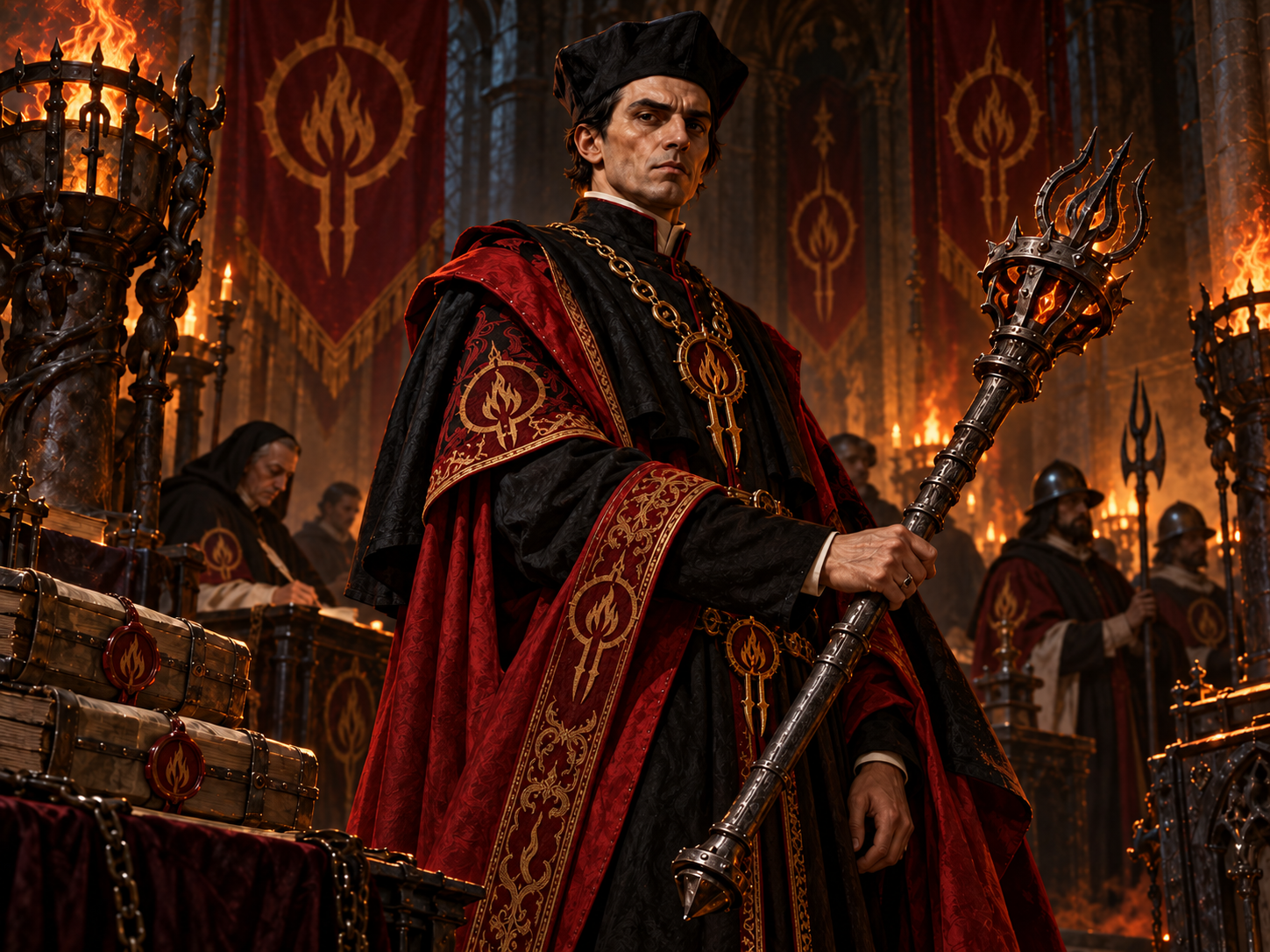
Torquemada wears a black scholar’s cap, high-collared black robes and a richly embroidered crimson mantle. His public chain of office bears a crimson flame enclosed by an iron ring, the seal of the Inquisition. The two-pronged fork belongs to the secret insignia of his infernal circle and is never displayed at an open tribunal. His face is unmasked at court: narrow, composed and unsettlingly youthful for a man of sixty-four. Those who have known him for decades whisper that the infernal fire has preserved him.
He stands with the same formal stillness before a frightened prisoner and a visiting prince. He rarely raises his voice; scribes bend over the evidence while armoured officers wait behind him. His ceremonial iron faceplate is worn for great public sentences, not to conceal his identity during every audience.
The Rod of Contrition is an iron sceptre crowned with a cage of burning metal, a weapon of office as well as a mace. Its flames answer to the infernal pact, though Torquemada claims they are the judgment of the approved gods. The rod can break a shield and ignite a condemned writ in the same motion.
Torquemada’s Judgements of the Peoples
Torquemada’s prejudices are policy, not impartial knowledge. He assigns reputations to entire peoples, then creates courts, inspections and punishments around those assumptions. He makes calculated exceptions for useful servants, wealthy patrons and informers. The victims’ ancestry proves nothing about their conduct; the danger lies in the Inquisition’s power to make an accusation stick.
Elves
Belief: Long-lived elven courts preserve loyalties to ancient powers beyond Castilian reach. Orders: Watch embassies, seize suspicious correspondence and question travelling lorekeepers. He may permit an accredited envoy to pass rather than provoke a foreign ruler, while imprisoning a less protected elven messenger on the same evidence.
High Elves
Belief: Their scholars can outmanoeuvre mortal judges through magic and old alliances. Orders: Demand inventories of arcane books, restrict private spellcasting near royal households and recruit cooperative scholars as closely watched experts. Torquemada fears what they know more than what they are.
Wood Elves
Belief: Forest peoples place oaths to groves and fey powers above the tribunal’s writ. Orders: Interrogate guides, outlaw unsanctioned shrines where his soldiers have reach, and force passage rights through occupied forests. Remote communities can resist him in ways urban minorities cannot.
Dwarves
Belief: Independent holds and forge cults threaten his ideal of one sacred hierarchy; their guild wealth makes them convenient political targets. Orders: Register workshops, denounce ancestral rites, seize forges and compel guildmasters to fund tribunals. The destruction of Hammerdeep shows his methods. A dwarven armourer serving his own guard may receive protection while the armourer’s family faces prosecution.
Hobgoblins of the Ninefold Dominion
Belief: The Dominion’s ordered armies and rival sacred traditions represent an organised imperial threat, not merely an outlaw population. Orders: Treat Dominion agents as possible spies, interrogate prisoners and exploit border rumours to secure crown funding. He does not mistake the Dominion for the orc hordes, although his public speeches sometimes blur the distinction.
Orcs of the One-Eyed Horde
Belief: Steppe raiders demonstrate what becomes of lands without a single governing sacred authority. Orders: Support frontier intelligence and harsh treatment of captured raiders. An orc merchant or mercenary under Castilian protection can still be made a scapegoat when a raid causes panic; Torquemada understands the difference but finds the confusion useful.
Tieflings
Belief: Infernal ancestry is public evidence of corruption—even though his own power comes from Belial. Orders: Question bloodlines, search homes after unexplained fires and demand denunciations of forbidden pacts. He protects tiefling agents who serve him, then keeps the protection secret to preserve his public image.
Gnomes
Belief: Mechanical invention, independent guilds and undisclosed experiments undermine the tribunal’s control of skilled labour. Orders: Inspect workshops, confiscate unusual devices and require favoured patrons for dangerous experiments. He commissions useful engines while prosecuting their makers for keeping private plans.
Dragonborn
Belief: A dragonborn envoy may claim a sacred ancestry competing with the royal cults. Orders: Examine unfamiliar heraldry and ritual objects, and test loyalties through interpreters. Dragonborn are too uncommon in Castile for a settled kingdom-wide policy; inquisitors improvise, sometimes disastrously.
Drow and Other Deep Elves
Belief: Underground networks conceal cults and powerful magic beyond ordinary scrutiny. Orders: Restrict underground trading posts and offer rewards for information about routes beneath forts. He will bargain with a deep-elf intermediary who delivers a rival’s secret.
Half-Orcs and Other People of Mixed Ancestry
Belief: Families crossing cultural boundaries weaken the neat categories on which he relies. Orders: Scrutinise household loyalties and inheritance claims, pressure families into sponsored guilds and offer conditional acceptance to soldiers who serve his command. Such discrimination reflects the inquisitor’s prejudices, not the character of those families.
Halflings, Catfolk and Other Travellers
Belief: Traders without a fixed patron carry information, wealth and sacred customs outside his reach. Orders: Examine caravans, interrogate merchants and recruit couriers. A caravan with powerful sponsors may be waved through while an unprotected family loses its goods.
Humans Who Oppose Him
Belief: A Castilian noble, magistrate or priest who resists his tribunal is more dangerous than a stranger, because their refusal offers others a model. Orders: Discredit rivals, seize records, cultivate informers and force open confrontations with the crown. Shared humanity and approved worship offer no protection when he decides a person threatens his office.
These judgements become consequences at the table: travel inspections, sealed workshops, disputed property, vanished witnesses and offers of immunity in exchange for betrayal. His officials are not one mind. Some embrace the cruelty; others enforce the writ reluctantly; a few protect the accused at considerable personal risk.
Inquisitorial Doctrine
“One realm. One law. One tribunal. One truth.” — the doctrine Torquemada demands from the Inquisition of Flame and Iron.
Castilian courts favour approved Iberian and Celtiberian rites, but no single temple governs every household or shrine. Torquemada declares rival observances—from elven moon rites and dwarven forge cults to the sacred traditions of the Ninefold Dominion—heretical wherever his judges can enforce that claim. He seeks dominion over difference, not merely the punishment of forbidden magic.
The Inquisition of Flame and Iron
Torquemada is the supreme commander of the Inquisition of Flame and Iron, one of the most powerful institutions in the Spanish lands. Its central chancery in Segovia directs six principal Castilian circuits, supported by examiners, clerks, informers, confiscation offices, guards and regional allies. Its reach extends through the courts and ports of Aragon, Navarre, Granada, the Mediterranean islands and Spanish-linked Atlantic settlements, although it has no automatic right to govern independent peoples or foreign kingdoms.
The institution gives Torquemada something more dangerous than personal magic: the ability to mobilise magistrates, damage a family’s livelihood, pursue a witness across borders and turn a ruler’s own courtiers against them. Its public devotion to the sanctioned gods disguises a secret inner circle indebted to Belial. Many lower officers are unaware of the infernal conspiracy, and some oppose the corruption they discover.
Faction page: The Inquisition of Flame and Iron — membership, ranks, resources, regional reach, enemies and adventures.
Game Statistics
Torquemada, Grand Inquisitor — D&D 2024
Medium Humanoid (Human), Lawful Evil
AC 21 (infernal iron and protection)
HP 420 (40d8 + 240)
Speed 30 ft.
Initiative +2 (12)
Saving Throws Con +13, Wis +13, Cha +14
Skills Deception +14, Insight +13, Intimidation +21, Investigation +11, Perception +13, Religion +11
Damage Resistances necrotic, psychic
Damage Immunities fire
Condition Immunities frightened
Senses truesight 30 ft., passive Perception 23
Languages Castilian, Latin, Infernal
CR 22 (41,000 XP; PB +7)
Traits
Infernal Compact. Torquemada has advantage on saving throws against spells and magical effects. Three times per day, after failing a saving throw, he can choose to succeed instead.
Presence of Pain. An enemy starting its turn within 10 feet of Torquemada must succeed on a DC 22 Wisdom saving throw or be frightened of him until the beginning of its next turn. On a success it is immune to his aura for 24 hours.
Punishment (1/Turn). A melee attack that hits a creature Torquemada has already damaged since the end of his previous turn, or that is frightened or charmed by him, deals an extra 14 (4d6) psychic damage.
Spellcasting. Torquemada casts the following spells without material components (spell save DC 22, Charisma): At will—command, detect magic, thaumaturgy; 3/day each—hold person, zone of truth, dispel magic; 1/day each—hold monster, wall of fire.
Actions
Multiattack. Torquemada makes two Rod of Contrition attacks.
Rod of Contrition. Melee Attack Roll: +14 to hit, reach 5 ft., one target. Hit: 16 (2d8 + 7) bludgeoning damage plus 18 (4d8) fire damage and 9 (2d8) psychic damage.
Condemn (Recharge 5–6). Each enemy of his choice in a 30-foot cone makes a DC 22 Wisdom saving throw. On a failure the creature takes 45 (10d8) psychic damage and is frightened until the end of its next turn; on a success, it takes half damage without the condition.
Presence of Passion (2/Day). As a Magic action, Torquemada targets a humanoid he can see within 30 feet that he damaged in melee since the end of his previous turn. The target must succeed on a DC 22 Wisdom saving throw or be charmed for 1 minute, regarding him as a feared superior. It repeats the save at the end of its turns and whenever it takes damage. He can charm only one creature this way at once.
Bonus Actions
Order the Arrest. One ally within 60 feet who hears Torquemada can use its reaction to move up to half its speed without provoking opportunity attacks and make one weapon attack.
Reactions
Suffer. When a creature within 5 feet deals melee damage to Torquemada, he can make that creature suffer psychic damage equal to half the hit points he actually lost to the attack, rounded down. Reflected damage cannot create a reflection loop.
Legendary Actions
Torquemada can take 3 Legendary Actions, one at a time after another creature’s turn, and regains them at the start of his turn.
- Advance (1 action). Move up to half his speed.
- Edict (1 action). A creature within 60 feet must succeed on a DC 22 Wisdom saving throw or have disadvantage on its next attack roll before the end of its next turn.
- Rod Strike (2 actions). Make one Rod of Contrition attack.
Lair Actions — Tribunal of Flame and Iron
On initiative count 20 (losing ties), inside his tribunal Torquemada can close one heavy iron doorway until the next count 20, or set alight a visible 15-foot square (DC 22 Dexterity save or 14 (4d6) fire damage). He cannot use the same option in consecutive rounds.
Torquemada, Grand Inquisitor — D&D 2014
Medium humanoid (human), Lawful Evil
Armor Class 21 (infernal iron and protection)
Hit Points 420 (40d8 + 240)
Speed 30 ft.
Saving Throws Con +13, Wis +13, Cha +14
Skills Deception +14, Insight +13, Intimidation +21, Investigation +11, Perception +13, Religion +11
Damage Resistances necrotic, psychic
Damage Immunities fire
Condition Immunities frightened
Senses truesight 30 ft., passive Perception 23
Languages Castilian, Latin, Infernal
CR 22 (41,000 XP; PB +7)
Traits
Infernal Compact. Torquemada has advantage on saving throws against spells and magical effects. Three times per day, after failing a saving throw, he can choose to succeed instead.
Presence of Pain. An enemy starting its turn within 10 feet of Torquemada must succeed on a DC 22 Wisdom saving throw or be frightened of him until the beginning of its next turn. On a success it is immune to his aura for 24 hours.
Punishment (1/Turn). A melee attack that hits a creature Torquemada has already damaged since the end of his previous turn, or that is frightened or charmed by him, deals an extra 14 (4d6) psychic damage.
Spellcasting. Torquemada casts the following spells without material components (spell save DC 22, Charisma): At will—command, detect magic, thaumaturgy; 3/day each—hold person, zone of truth, dispel magic; 1/day each—hold monster, wall of fire.
Actions
Multiattack. Torquemada makes two Rod of Contrition attacks.
Rod of Contrition. Melee Weapon Attack: +14 to hit, reach 5 ft., one target. Hit: 16 (2d8 + 7) bludgeoning damage plus 18 (4d8) fire damage and 9 (2d8) psychic damage.
Condemn (Recharge 5–6). Each enemy of his choice in a 30-foot cone makes a DC 22 Wisdom saving throw. On a failure the creature takes 45 (10d8) psychic damage and is frightened until the end of its next turn; on a success, it takes half damage without the condition.
Presence of Passion (2/Day). As an action, Torquemada targets a humanoid he can see within 30 feet that he damaged in melee since the end of his previous turn. The target must succeed on a DC 22 Wisdom saving throw or be charmed for 1 minute, regarding him as a feared superior. It repeats the save at the end of its turns and whenever it takes damage. He can charm only one creature this way at once.
Bonus Actions
Order the Arrest. One ally within 60 feet who hears Torquemada can use its reaction to move up to half its speed without provoking opportunity attacks and make one weapon attack.
Reactions
Suffer. When a creature within 5 feet deals melee damage to Torquemada, he can make that creature suffer psychic damage equal to half the hit points he actually lost to the attack, rounded down. Reflected damage cannot create a reflection loop.
Legendary Actions
Torquemada can take 3 Legendary Actions, one at a time after another creature’s turn, and regains them at the start of his turn.
- Advance (1 action). Move up to half his speed.
- Edict (1 action). A creature within 60 feet must succeed on a DC 22 Wisdom saving throw or have disadvantage on its next attack roll before the end of its next turn.
- Rod Strike (2 actions). Make one Rod of Contrition attack.
Lair Actions — Tribunal of Flame and Iron
On initiative count 20 (losing ties), inside his tribunal Torquemada can close one heavy iron doorway until the next count 20, or set alight a visible 15-foot square (DC 22 Dexterity save or 14 (4d6) fire damage). He cannot use the same option in consecutive rounds.
Torquemada — Pathfinder 1e
CR 24 (XP 1,228,800)
Male human fighter 2/cleric 12/dominator of Belial 10
LE Medium humanoid (human)
DEFENSE
Init +2; Senses darkvision 60 ft. (infernal gift), Perception +28
AC 39, touch 17, flat-footed 37 (+11 armor, +2 Dex, +5 deflection, +5 shield, +6 natural)
hp 326 (2d10+22d8+216)
Fort +32, Ref +14, Will +27
Immune fire and fear; SR 29 against good or chaotic spells
OFFENSE
Speed 30 ft.
Melee Rod of Contrition (+3 unholy heavy mace) +27/+22/+17/+12 (1d8+9 plus 2d6 unholy), or +3 flaming whip +27/+22/+17/+12 (1d3+9 nonlethal plus 1d6 fire)
Special Attacks channel negative energy 6d6 (DC 23, 10/day), punishment +3d6, presence of pain 3/day, presence of passion 3/day, revelation of pain 1/day, suffer 1/day, touch of fire 7/day
Notable Cleric Spells Prepared (CL 12th, concentration +19, save DC 17 + spell level; spell slots per day 4/7+1/7+1/7+1/5+1/4+1/3+1, including domain slots): 6th—blade barrier, greater dispel magic; 5th—flame strike, slay living, true seeing; 4th—divine power, freedom of movement; 3rd—bestow curse, dispel magic, prayer; 2nd—hold person, silence, zone of truth; 1st—command, divine favor, shield of faith; 0—detect magic, guidance, light. Domains Domination and Pain.
STATISTICS
Str 22, Dex 14, Con 28, Int 16, Wis 24, Cha 24
Base Atk +18; CMB +24; CMD 41
Feats Combat Casting, Devotee of Darkness (Belial), Great Fortitude, Improved Initiative, Iron Will, Persuasive, Power Attack, Toughness, Weapon Focus (whip), Weapon Focus (heavy mace)
Skills Bluff +24, Diplomacy +21, Intimidate +35, Knowledge (nobility) +22, Knowledge (planes) +25, Knowledge (religion) +28, Perception +28, Sense Motive +30, Spellcraft +24, Use Magic Device +21
Languages Castilian, Latin, Infernal; Gear Rod of Contrition, +3 flaming whip, enchanted iron armour, tribunal seal and confiscation ledger.
SPECIAL ABILITIES
Presence of Pain (Su). Three times per day as a standard action, creatures within 5 ft. must make a Will save DC 29 or be shaken for 1d4 rounds (fear, mind-affecting).
Punishment (Ex). Subsequent melee hits deal +3d6 precision damage against a creature struck by Torquemada in the past four rounds or under his Presence or Revelation of Pain; immunity to precision damage applies.
Presence of Passion (Su). Three times per day as a standard action, a visible humanoid within 30 ft. who suffered 11 or more damage from a single melee hit by him in the last four rounds must save Will DC 29 or become charmed for 10 minutes; one target at a time.
Revelation of Pain (Su). Once per day as a standard action, Torquemada produces a sigil within 30 ft. Creatures within 10 ft. must make a Will save DC 29 or become sickened for 10 minutes. The sigil vanishes when triggered.
Touch of Fire / Soul of Fire (Su/Ex). Seven times per day, a confirmed melee hit can deal +1d10 fire damage. Torquemada has fire immunity.
Suffer (Su). Once per round as an immediate action, an attacker who deals melee hit-point damage takes supernatural damage equal to half the hit-point damage Torquemada actually suffered, rounded down; no reflection loops. Once per day he may cast dominate person on a visible humanoid he damaged in melee within the previous four rounds (Will DC 29, duration 10 rounds, another save when harmed).
Torquemada — D&D 3.5e
CR 24
Male human fighter 2/cleric 8/epic dominator of Belial 14
LE Medium humanoid (human)
DEFENSE
Init +1; Speed 30 ft.; Senses Listen +4, Spot +3
AC 28, touch 20, flat-footed 27 (+1 Dex, +3 Wis, +8 bracers, +5 deflection, +1 monk’s belt)
hp 250 (2d10+8d8+14d6+150; includes +96 Constitution, +24 Improved Toughness and +30 Epic Toughness; rolled Hit Dice total 100)
Fort +28, Ref +13, Will +23
Immune fire, fear, supernatural pain; SR 24 against good or chaotic spells
OFFENSE
Base Atk +17; Grapple +21
Melee +2 vicious wounding whip +23/+18/+13 (1d3+6 plus 2d6 vicious and 1 Con damage from wounding; Torquemada suffers 1d6 vicious damage), or Rod of Contrition (+2 heavy mace) +23/+18/+13 (1d8+6 bludgeoning), or unarmed strike +26/+21/+16 (1d8+9). The whip follows its usual limitations against armoured or naturally armoured opponents; the mace or unarmed strike is his alternative.
Special Attacks punishment +4d6, presence of pain (DC 26), presence of passion (DC 26 plus damage adjustment) 4/day, revelation of pain 2/day, suffer (DC 26 plus damage adjustment), rebuke undead 7/day, touch of fire 4/day (2d10 fire)
Notable Cleric Spells Prepared (CL 8th; DC 13 + spell level; spells per day 6/5+1/4+1/4+1/2+1, including domain slots): 4th—divine power, lesser planar ally; 3rd—bestow curse, deeper darkness, dispel magic; 2nd—hold person, silence, zone of truth; 1st—bane, command, cause fear; 0—detect magic, guidance, mending. Domains Domination and Pain; domain slots are separate.
STATISTICS
Str 19, Dex 13, Con 19, Int 11, Wis 16, Cha 18
Skills Bluff +11, Gather Information +21, Intimidate +38, Knowledge (religion) +10, Knowledge (the planes) +9, Sense Motive +10, Use Rope +12
Feats Devotee of Darkness (Belial), Endurance, Great Fortitude, Improved Grapple, Improved Unarmed Strike, Improved Toughness, Persuasive, Power Attack, Skill Focus (Intimidate), Spell Focus (Enchantment), Vile Martial Strike (whip). Epic feats Epic Endurance, Epic Toughness, Improved Touch of Fire.
Possessions +2 vicious wounding whip, Rod of Contrition (+2 heavy mace), amulet of mighty fists +5, bracers of armor +8, ring of protection +5, monk’s belt, tribunal seal.
CLASS FEATURES
Touch of Fire and Soul of Fire (Su/Ex). Four times a day Torquemada adds 2d10 fire damage to a confirmed melee hit; he is immune to fire.
Presence of Pain (Su). As a standard action, creatures within 5 ft. must save Will DC 26 or suffer fear as a caster of character level 24.
Punishment (Ex). Later melee hits against creatures struck in the preceding four rounds or affected by his Presence or Revelation of Pain deal +4d6 additional damage; creatures immune to critical hits are immune.
Presence of Passion (Su). Four times per day, as a standard action, Torquemada can attempt charm person on a humanoid dealt more than 10 damage by one of his melee hits in the last four rounds, Will DC 26 +1 per complete 5 damage beyond 10; caster level 24. Up to fourteen targets at once.
Revelation of Pain (Su). Twice per day, as a standard action, he produces symbol of pain at caster level 24, Will DC 19 (15 + Cha modifier 4). The symbol is active 70 minutes, with its ordinary lingering effects.
Suffer (Su). He has immunity to fear and pain and reflects half the actual damage from a melee hit, rounded down, to the attacker (no reflection chain). Four times per day as a standard action he uses dominate person on a humanoid struck in the past four rounds, Will DC 26 +1 per 10 damage inflicted in a qualifying single hit. Up to ten dominated targets.
True Torturer / Masochist. He gains +4 on relevant coercive interrogation checks. On taking 5 or more hit points from one hit, he gains +1 on attacks, saves, skills and class DCs for one round. Repeated triggers refresh, not stack.
Epic progression: Prestige-class level 14 includes Punishment +4d6 and Revelation of Pain 2/day. Cleric caster level remains 8; the epic class-based save DC formula counts half of the four class levels beyond ten.
Allies, Rivals and Infernal Masters
King Henry IV: Torquemada needs royal support but refuses to allow royal magistrates to examine every inquisitorial sentence. The king’s councillors can exploit that refusal when the Inquisition seizes property or detains a member of the royal household.
Princess Isabella: At twenty-four she commands her own political following. Torquemada offers her the tribunal’s informers and armed protection, but the price is recognition of his authority over nobles who might otherwise support her. She can accept an advantage without ever trusting its giver.
Belial: The true master behind Torquemada’s powers. Belial’s demands take priority over the tribunal’s proclamations, and the inquisitor devotes considerable effort to preventing his senior officers from discovering that contradiction. Fierna pursues compromise and seduction where he favours public coercion; Gazra measures the practical results of his infernal obligations.
The inquisitors and their victims: Ordinary clerks, judges and soldiers are not interchangeable. A meticulous examiner may insist on a truthful record, a captain may release prisoners for payment, and a confiscations clerk may secretly preserve evidence Torquemada has ordered burned. These people create allies and vulnerabilities without requiring the entire tribunal to collapse at once.
Running Torquemada
At an audience: He asks a specific question and has the scribe record the exact reply. He offers safety or a limited pardon in return for testimony, then tests the terms of the promise. He knows that zone of truth does not force a witness to speak, and uses the threat of confiscation to fill the silence. A precise answer or authenticated document can interrupt his plan; appeals to pity cannot.
In battle: His escorts occupy doorways and seize witnesses. In D&D 2024 or 2014, he opens with hold monster or Condemn, uses Order the Arrest to focus his guards and keeps the Rod of Contrition for enemies who press past them. In Pathfinder 1e or D&D 3.5e, he prepares cleric protections before an anticipated arrest, then uses Presence of Pain and controlled targets to turn the attackers against one another. He does not expose himself to an unnecessary duel while officers remain.
Defeat and aftermath: He bargains for time when defeat is likely, promises a named captive’s release and orders a trusted clerk to secure the infernal ledger. The party can end an execution by winning a fight, but ending the persecution requires witnesses, evidence and a new authority willing to protect them. Seized records must be preserved: destroying them may erase the victims’ claims to property as effectively as Torquemada intended.
Encounter difficulty: The listed CR covers Torquemada alone. Armoured escorts, inquisitorial spellcasters, warded chambers and summoned devils add their own difficulty; the tribunal’s officers need not fight to the death once the Grand Inquisitor falls.
Sources and Artwork
Historical reference: Spanish State Archives, Torquemada; Castilian royal succession timeline. Historical records preserve a later lifetime and appointment for Torquemada; the present account follows the earlier birth and longer-established Inquisition of the 1454 setting.
Class reference: Dominator of Belial, with the Dicefreaks source credited on that class page. The four game-statistics panels are distinct campaign adaptations, not official published NPC stat blocks.
Artwork: The painted hero shows Torquemada with the Rod of Contrition and the flame-and-fork insignia of the Inquisition of Flame and Iron. Original artwork created for this NPC.
Keep this reference growing
If this page helped with your reading or game, you can support its upkeep or explore the curated books.
Explore the Bookshop — epics, classics and stories behind imagined worlds.