
Ludwig IX the Rich — Duke of Bavaria-Landshut
At a Glance
| Identity | Ludwig IX (Louis IX), called the Rich; House of Wittelsbach |
|---|---|
| Ancestry and Alignment | Human; Lawful Neutral |
| Age | 37 in the campaign present; born in 1417 |
| Title | Reigning Duke of Bavaria-Landshut since 1450, not Duke of Bavaria-Munich |
| Seat | Trausnitz Castle above Landshut; also Burghausen |
| Family | Son of Henry XVI the Rich and Margaret of Austria; married to Amalia of Saxony since 1452 |
| Court Languages | Bavarian German, Latin; interpreters for visiting courts |
| Strengths | Command, legal authority, wealth, strategic patience and courtly leverage |
| Present Concern | Secure the Ingolstadt inheritance, expose corrupt toll officers and maintain his dynasty’s standing |
| Game Role | Noble commander; CR 5–6 |
The Rich Duke · Master of the Landshut treasury · Wittelsbach ruler of the Isar court
Above Landshut, in the guarded chambers of his castle, Ludwig IX studies two sealed petitions. One seeks permission to collect an inherited toll; the other proves that the same toll has already been collected three times. A clerk waits for a verdict, a captain waits for an arrest order, and a dwarven craftsman waits outside the gate with a claim no one at court wishes to read. The duke does not raise his voice. He asks whose seal authorised the third collection.
What Is Ludwig IX Doing Right Now?
A New Duke with Old Debts
Ludwig succeeded his father Henry XVI in 1450. The Treaty of Erding secured most of the former Bavaria-Ingolstadt inheritance for his duchy, but not a clean account book. He is demanding reports from bailiffs, inspecting security along the Isar and Danube roads, and quietly negotiating with families whose charters were issued under another branch of the Wittelsbachs. A court that looks prosperous can still be alarmed by a missing inventory.
The Dwarven Petition
Guild disputes and special levies have pushed some dwarven smithing households from the duchy. Ludwig maintains that ducal taxes apply to all craft privileges; the displaced families argue that their agreements were altered after the inheritance. Neither account need be wholly true. He wants proof of forgery more than a public confrontation, provided the inquiry does not discredit his office.
A Marriage Alliance, Not a Future Wedding
Ludwig married Amalia of Saxony in 1452, binding his court more closely to the Saxon electoral family. In this campaign present he is concerned with preserving that alliance and securing his own succession. His son George is not yet born and the great Landshut Wedding is not an event being arranged now.
A Watchful Imperial Relationship
He watches the privileges claimed by Free Imperial Cities and the court of Emperor Frederick III. Their future disputes are not predetermined; in 1454 Ludwig is navigating claims, tolls and local influence, not celebrating later victories.
How Adventurers Meet the Duke
Most visitors encounter his chamberlain, a treasury clerk, a senior household knight or a council secretary first. The duke grants an audience for a matter affecting his revenues, honour or legal authority, especially where the petitioners bring an authentic seal, corroborating witnesses and a clear remedy. He is more likely to hire capable outsiders to retrieve an old Ingolstadt charter than to personally ride into a ruined mine.
Three Ways to Earn His Attention
- The Toll Chest. A caravan master hands the party a set of mutually contradictory toll receipts; the Duke wants the honest clerk found before a captain raids the merchants’ camp.
- The Dwarven Witness. A smith has proof that a ducal charter was amended, but will speak only under a guarantee of safe-conduct. Ludwig sends outsiders because his own officers are suspected.
- The Broken Courtesy. An emissary from Munich is detained in a disputed district. Releasing him preserves peace; discovering who forged his invitation may prevent a wider dynastic quarrel.
Personality, Relationships and Secrets
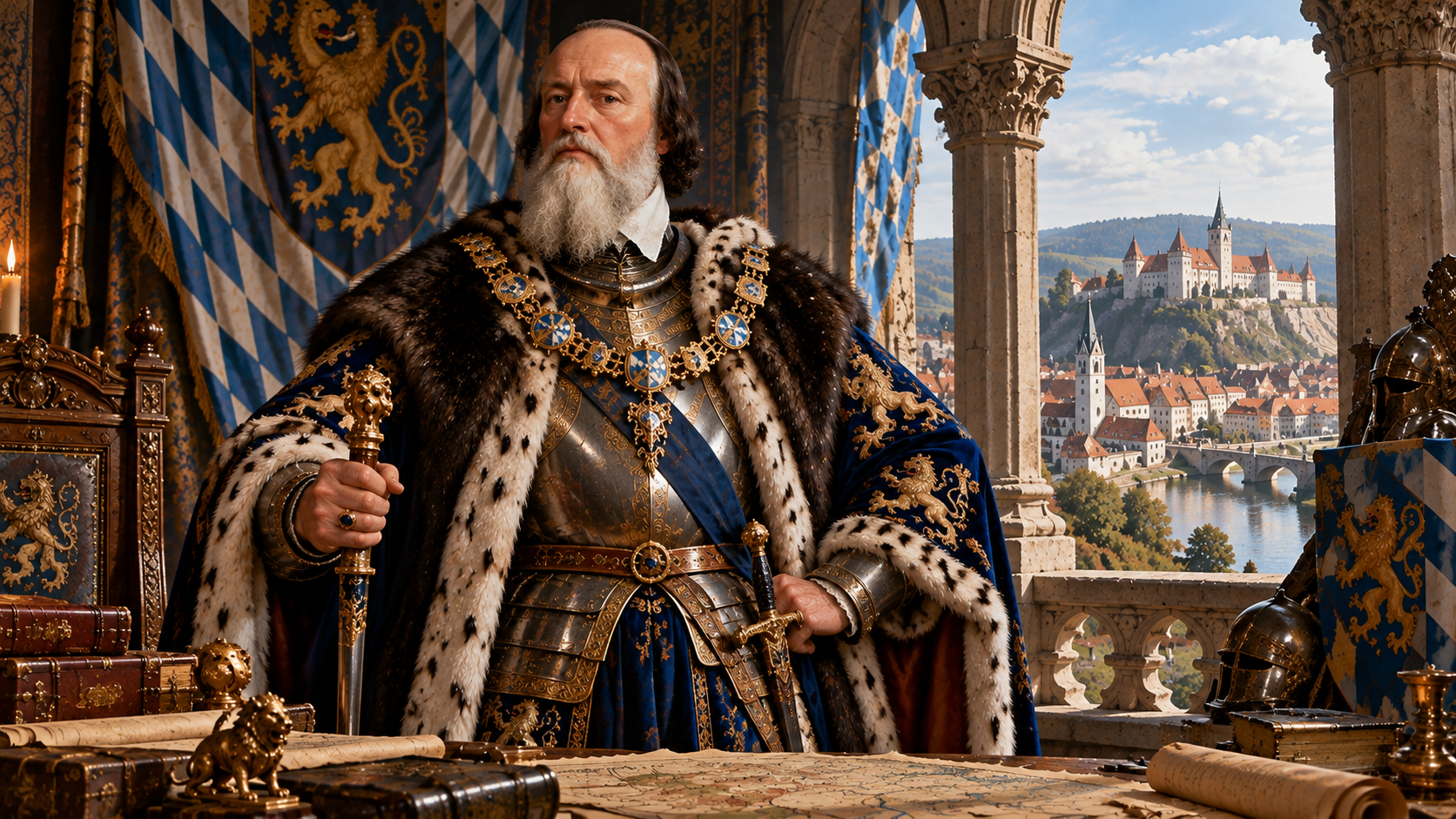
Appearance. At thirty-seven, Ludwig is a capable horseman whose expensive coats, fur and enamelled fittings advertise his treasury rather than unusual supernatural power. During formal hearings he dresses as a ruling prince, with household guards close enough to hear an order.
Voice. He uses short questions and expects precise answers. He seldom repeats a demand. He will hear a plain-spoken clerk who brings a sound document before a flattering lord who brings only complaints.
Virtue and fault. He can be fiercely protective of legitimate merchants and travellers under his peace, but he may mistake resistance to an unjust levy for defiance of government itself. Public humiliation makes compromise difficult.
Amalia of Saxony. His wife operates through household patronage and dynastic ties. Her attendants can provide a quieter route to a hearing than the ducal chancery.
Albrecht III and Albert IV. Munich remains a separate Wittelsbach court. Albert IV is already an adult prince in the campaign’s deliberately altered chronology; Ludwig regards him as a skilled, ambitious envoy, not his direct subordinate.
The Emperor. Frederick III’s distant authority matters when city privileges and ducal rights collide. Ludwig would rather win a written settlement than provoke a military confrontation over a petty official’s error.
Hidden weakness. A duplicate treasury book names beneficiaries of levies imposed on displaced dwarven families. If the original emerges, Ludwig must decide whether protecting a corrupt officer is worth making his own ducal seal seem dishonourable.
Encounters and Adventure Hooks
| d6 | The Rich Duke’s Commission |
|---|---|
| 1 | The Forged Ingolstadt Deed. Two charters award the same mine to different families. A lost notary can reveal which record predates the 1450 treaty. |
| 2 | The Missing Treasurer. A clerk flees Trausnitz with a ledger revealing double levies. Agents of both the guilty bailiff and an innocent claimant pursue him. |
| 3 | The Smiths’ Oath. Displaced dwarves will return to negotiate only if their escort first retrieves confiscated tools from a river customs house. |
| 4 | A Prince’s Letter. A messenger associated with Albert IV seeks shelter carrying a document that could reopen a sensitive Wittelsbach inheritance dispute. |
| 5 | The Toll under the Water. A nixie has claimed a bridge’s coins after a river pact was broken. Ludwig’s officers call it smuggling; the ferrymen insist payment has already been made. |
| 6 | The Candle Cipher. A document thief sells ducal archive copies to a covert cell of the Bavarian Illuminati. Ludwig needs the copies recovered without exposing a related family’s embarrassment. |
Possessions, Patronage and Rewards
Equipment. A ceremonial chain, personal signet, ducal writs, guarded travel chests, armour, sword and crossbow. His court wealth belongs to the duchy’s treasury and households; it is not a personal hoard automatically available to a character who defeats him.
Rewards. Depending on the scale of service, Ludwig can order a fair fee, restore a wrongly seized charter, issue a narrowly worded letter of passage, arrange a household audience, commission an escort or provide temporary hospitality. He cannot legally overrule Regensburg’s independent government merely by handing a party his seal.
If made an enemy. He may summon witnesses, suspend a commission, freeze a disputed claim or authorise a lawful arrest. Sending soldiers across a frontier risks an imperial complaint. For the strongest campaign, give the characters a chance to challenge him with evidence before drawing weapons.
NPC Statistics
Ludwig IX — D&D 2024
Medium Humanoid (Human), Lawful Neutral
AC 18 (breastplate, shield)
Initiative +2 (12)
HP 104 (16d8 + 32)
Speed 30 ft.
| Ability | Score | Mod | Save |
|---|---|---|---|
| STR | 18 | +4 | +7 |
| DEX | 14 | +2 | +2 |
| CON | 14 | +2 | +2 |
| INT | 16 | +3 | +3 |
| WIS | 14 | +2 | +5 |
| CHA | 18 | +4 | +7 |
Skills History +6, Insight +5, Intimidation +7, Persuasion +7
Senses Passive Perception 12
Languages Bavarian German, Latin
CR 5 (1,800 XP; PB +3)
Traits
Trained Commander. Ludwig has Advantage on saving throws against being Frightened while he can see or hear a conscious allied guard within 30 ft. This provides no benefit to guards.
Ducal Authority. When an official lawfully recognises Ludwig’s rank, he has Advantage on Charisma (Persuasion) checks to request records or an audience. This does not compel hostile, independent or magically influenced creatures .
Actions
Multiattack. Ludwig makes three Longsword attacks.
Longsword. Melee Attack Roll: +7, reach 5 ft. Hit: 8 (1d8 + 4) Slashing damage.
Heavy Crossbow. Ranged Attack Roll: +5, range 100/400 ft. Hit: 7 (1d10 + 2) Piercing damage. Ludwig must doff his shield before firing this two-handed weapon (AC 16 without shield).
Bonus Actions
Command the Line. One ally Ludwig can see within 30 ft. that can hear him can immediately use its Reaction either to move up to half its Speed without provoking Opportunity Attacks or to make one weapon attack against a creature in range. Ludwig cannot choose an unwilling ally.
Reactions
Parry. Ludwig adds 3 to his AC against one melee attack that would hit him, provided he sees the attacker and holds his longsword.
Ludwig IX — D&D 2014
Medium humanoid (human), lawful neutral
Armor Class 18 (breastplate, shield)
Hit Points 104 (16d8 + 32)
Speed 30 ft.
| STR | DEX | CON | INT | WIS | CHA |
|---|---|---|---|---|---|
| 18 (+4) | 14 (+2) | 14 (+2) | 16 (+3) | 14 (+2) | 18 (+4) |
Saving Throws Str +7, Wis +5, Cha +7
Skills History +6, Insight +5, Intimidation +7, Persuasion +7
Senses passive Perception 12
Languages Bavarian German, Latin
Challenge 5 (1,800 XP)
Traits
Trained Commander. Ludwig has advantage on saving throws against being frightened while a conscious allied guard he can see or hear is within 30 feet.
Ducal Authority. Ludwig has advantage on Charisma (Persuasion) checks to request an audience or records when his ducal authority is lawfully recognised; a hostile or autonomous official is not obliged to comply.
Actions
Multiattack. Ludwig makes three longsword attacks.
Longsword. Melee Weapon Attack: +7 to hit, reach 5 ft., one target. Hit: 8 (1d8 + 4) slashing damage.
Heavy Crossbow. Ranged Weapon Attack: +5 to hit, range 100/400 ft., one target. Hit: 7 (1d10 + 2) piercing damage. Ludwig must doff his shield before firing this two-handed weapon (AC 16 without shield).
Bonus Actions
Command the Line. One willing ally within 30 ft. that can hear Ludwig may use its reaction immediately to move up to half its speed without provoking opportunity attacks or to make a single weapon attack against a target in range.
Reactions
Parry. Ludwig adds 3 to his AC against one melee attack that would hit him, provided he can see the attacker and is holding his longsword.
Ludwig IX — Pathfinder 1e
LN Medium humanoid (human), fighter 6
CR 5; XP 1,600; Init +6; Senses Perception +8
Defense
AC 20, touch 12, flat-footed 18 (+6 breastplate, +2 heavy steel shield, +2 Dex)
hp 51 (6d10 + 18; includes Toughness)
Fort +7, Ref +4, Will +6
Offense
Speed 30 ft. (armor training permits normal speed in medium armour)
Melee +1 longsword +13/+8 (1d8+6/19–20; includes weapon training +1)
Ranged heavy crossbow +8 (1d10/19–20; reload as full-round action; shield removed)
Special Abilities armor training 1, weapon training (heavy blades +1), bravery +2
Statistics
Str 18, Dex 14, Con 14, Int 16, Wis 14, Cha 18
Base Atk +6; CMB +10; CMD 22
Feats Weapon Focus (longsword), Power Attack, Improved Initiative, Combat Expertise, Toughness, Skill Focus (Diplomacy), Iron Will, Improved Shield Bash
Skills Diplomacy +13, Intimidate +13, Knowledge (nobility) +9, Perception +8, Sense Motive +8, Ride +11 (before armor check penalty); Languages Bavarian German, Latin; Gear breastplate, heavy steel shield, +1 longsword, heavy crossbow, bolts and ducal signet
Special Abilities
Power Attack. He may take a –2 penalty on melee attack rolls for a +4 bonus on one-handed weapon damage rolls. With Power Attack, his longsword attack is +11/+6 (1d8+10/19–20); the principal attack line excludes this adjustment.
Order the Guards (Ex, 1/round). As a standard action, Ludwig can allow one willing allied guard within 30 ft. who can hear him to immediately move up to its speed, using its next turn’s move action in advance. This does not grant an additional move action and remains an original encounter option, not a standard fighter class feature. This is an original encounter option, not a standard fighter class feature.
Ludwig IX — D&D 3.5e
Human fighter 6, lawful neutral
| Size/Type | Medium Humanoid (Human) |
|---|---|
| Hit Dice | 6d10+12 (45 hp) |
| Initiative | +6 |
| Speed | 20 ft. (4 squares) in breastplate; 30 ft. base |
| Armor Class | 20 (+6 armor, +2 shield, +2 Dex), touch 12, flat-footed 18 |
| Base Attack/Grapple | +6/+10 |
| Attack | +1 longsword +12 melee (1d8+7/19–20) |
| Full Attack | +1 longsword +12/+7 melee (1d8+7/19–20), or heavy crossbow +8 ranged (1d10/19–20; loaded, shield removed) |
| Space/Reach | 5 ft./5 ft. |
| Special Attacks | — |
| Special Qualities | Rallying Order |
| Saves | Fort +7, Ref +4, Will +6 |
| Abilities | Str 18, Dex 14, Con 14, Int 16, Wis 14, Cha 18 |
| Skills | Diplomacy +10, Intimidate +13, Knowledge (nobility and royalty) +7, Sense Motive +8, Listen +3, Spot +3, Ride +11 |
| Feats | Weapon Focus (longsword), Weapon Specialization (longsword), Power Attack, Improved Initiative, Combat Expertise, Improved Disarm, Iron Will, Negotiator |
| Environment | Bavaria-Landshut |
| Organization | Solitary or ducal household |
| Challenge Rating | 6 |
| Treasure | +1 breastplate, heavy steel shield, +1 longsword, heavy crossbow, bolts, ducal signet |
| Alignment | Lawful neutral |
| Advancement | By character class |
| Level Adjustment | +0 |
| Languages | Bavarian German, Latin |
Special Qualities
Rallying Order (Ex, 1/day). As a standard action, Ludwig grants willing allied guards within 30 feet who can hear him a +1 morale bonus on attacks and saves against fear for 3 rounds.
Historical Portrait and Context
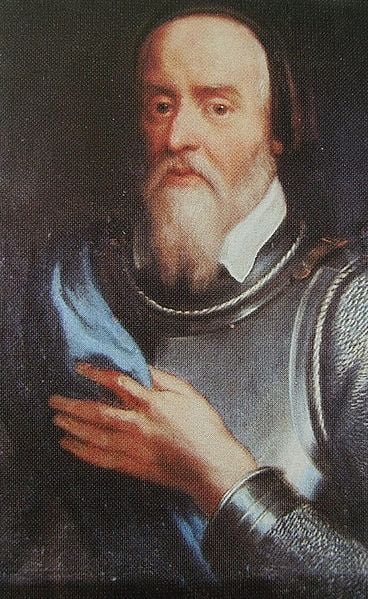
The historical Ludwig IX the Rich was born at Burghausen in 1417 and ruled Bavaria-Landshut from 1450 until his death in 1479. His father was Henry XVI; his mother was Margaret of Austria. He married Amalia of Saxony in 1452. The historical invasion of Dinkelsbühl and Donauwörth occurred in 1458; the establishment of the university at Ingolstadt followed in 1472, and George’s famous wedding in Landshut followed in 1475. These later events have not happened in the campaign present.
Connections and Further Reading
Enter the court through Bavaria-Landshut and its Trausnitz stronghold; examine the neighbouring divided Bavarian duchies, Munich, Albert IV, the Empire NPC archive and the Bavarian Illuminati. More conflicts arise along the Alpine wilderness and river trade routes; for the legal background consult the Treaty of Erding.
Historical sources. Deutsche Biographie: Ludwig IX documents his genealogy, rule and death. Ludwig-Maximilians-Universität: Foundation of the Ingolstadt university confirms the later foundation in 1472. The Bavarian Palace Administration’s Trausnitz Castle history supplies the ducal seat’s history. Political intrigue, non-human communities and all game mechanics in this entry belong to the fantasy campaign rather than the historical record.
Rules Licensing
Original unofficial NPC profiles. Pathfinder and D&D 3.5e rules derived from Open Game Content are designated Open Game Content; setting prose and artwork are excluded.
This work includes material from the System Reference Document 5.2.1 (“SRD 5.2.1”) by Wizards of the Coast LLC, available at https://www.dndbeyond.com/srd. The SRD 5.2.1 is licensed under the Creative Commons Attribution 4.0 International License.
This work includes material from the System Reference Document 5.1 (“SRD 5.1”) by Wizards of the Coast LLC, available at https://www.dndbeyond.com/srd. The SRD 5.1 is licensed under the Creative Commons Attribution 4.0 International License.
Open Game License v1.0a & applicable Section 15 notices
OPEN GAME LICENSE Version 1.0a
The following text is the property of Wizards of the Coast, Inc. and is
Copyright 2000 Wizards of the Coast, Inc (“Wizards”). All Rights Reserved.
1. Definitions:
(a) “Contributors” means the copyright and/or trademark owners who have
contributed Open Game Content; (b) “Derivative Material” means copyrighted
material including derivative works and translations (including into other
computer languages), potation, modification, correction, addition,
extension, upgrade, improvement, compilation, abridgment or other form in
which an existing work may be recast, transformed or adapted; (c)
“Distribute” means to reproduce, license, rent, lease, sell, broadcast,
publicly display, transmit or otherwise distribute; (d) “Open Game
Content” means the game mechanic and includes the methods, procedures,
processes and routines to the extent such content does not embody the
Product Identity and is an enhancement over the prior art and any
additional content clearly identified as Open Game Content by the
Contributor, and means any work covered by this License, including
translations and derivative works under copyright law, but specifically
excludes Product Identity; (e) “Product Identity” means product and product
line names, logos and identifying marks including trade dress; artifacts;
creatures characters; stories, storylines, plots, thematic elements,
dialogue, incidents, language, artwork, symbols, designs, depictions,
likenesses, formats, poses, concepts, themes and graphic, photographic and
other visual or audio representations; names and descriptions of
characters, spells, enchantments, personalities, teams, personas,
likenesses and special abilities; places, locations, environments,
creatures, equipment, magical or supernatural abilities or effects, logos,
symbols, or graphic designs; and any other trademark or registered
trademark clearly identified as Product identity by the owner of the
Product Identity, and which specifically excludes the Open Game Content;
(f) “Trademark” means the logos, names, mark, sign, motto, designs that are
used by a Contributor to identify itself or its products or the associated
products contributed to the Open Game License by the Contributor; (g)
“Use”, “Used” or “Using” means to use, Distribute, copy, edit, format,
modify, translate and otherwise create Derivative Material of Open Game
Content; (h) “You” or “Your” means the licensee in terms of this agreement.
2. The License:
This License applies to any Open Game Content that contains a notice
indicating that the Open Game Content may only be Used under and in terms
of this License. You must affix such a notice to any Open Game Content that
you Use. No terms may be added to or subtracted from this License except as
described by the License itself. No other terms or conditions may be
applied to any Open Game Content distributed using this License.
3. Offer and Acceptance:
By Using the Open Game Content You indicate Your acceptance of the terms
of this License.
4. Grant and Consideration:
In consideration for agreeing to use this License, the Contributors grant
You a perpetual, worldwide, royalty-free, non-exclusive license with the
exact terms of this License to Use, the Open Game Content.
5. Representation of Authority to Contribute:
If You are contributing original material as Open Game Content, You
represent that Your Contributions are Your original creation and/or You
have sufficient rights to grant the rights conveyed by this License.
6. Notice of License Copyright:
You must update the COPYRIGHT NOTICE portion of this License to include the
exact text of the COPYRIGHT NOTICE of any Open Game Content You are
copying, modifying or distributing, and You must add the title, the
copyright date, and the copyright holder’s name to the COPYRIGHT NOTICE of
any original Open Game Content you Distribute.
7. Use of Product Identity:
You agree not to Use any Product Identity, including as an indication as
to compatibility, except as expressly licensed in another, independent
Agreement with the owner of each element of that Product Identity. You
agree not to indicate compatibility or co-adaptability with any Trademark
or Registered Trademark in conjunction with a work containing Open Game
Content except as expressly licensed in another, independent Agreement
with the owner of such Trademark or Registered Trademark. The use of any
Product Identity in Open Game Content does not constitute a challenge to
the ownership of that Product Identity. The owner of any Product Identity
used in Open Game Content shall retain all rights, title and interest in
and to that Product Identity.
8. Identification:
If you distribute Open Game Content You must clearly indicate which
portions of the work that you are distributing are Open Game Content.
9. Updating the License:
Wizards or its designated Agents may publish updated versions of this
License. You may use any authorized version of this License to copy,
modify and distribute any Open Game Content originally distributed under
any version of this License.
10. Copy of this License:
You MUST include a copy of this License with every copy of the Open Game
Content You Distribute.
11. Use of Contributor Credits:
You may not market or advertise the Open Game Content using the name of
any Contributor unless You have written permission from the Contributor
to do so.
12. Inability to Comply:
If it is impossible for You to comply with any of the terms of this
License with respect to some or all of the Open Game Content due to
statute, judicial order, or governmental regulation then You may not Use
any Open Game Material so affected.
13. Termination:
This License will terminate automatically if You fail to comply with all
terms herein and fail to cure such breach within 30 days of becoming aware
of the breach. All sublicenses shall survive the termination of this
License.
14. Reformation:
If any provision of this License is held to be unenforceable, such
provision shall be reformed only to the extent necessary to make it
enforceable.
15. COPYRIGHT NOTICE
Open Game License v 1.0a Copyright 2000, Wizards of the Coast, Inc.
System Reference Document. Copyright 2000, Wizards of the Coast, Inc.;
Authors Jonathan Tweet, Monte Cook, Skip Williams, based on material by
E. Gary Gygax and Dave Arneson.
Pathfinder Roleplaying Game Reference Document. © 2011, Paizo Publishing,
LLC; Author: Paizo Publishing, LLC.
Pathfinder Roleplaying Game Core Rulebook. © 2009, Paizo Publishing, LLC;
Author: Jason Bulmahn, based on material by Jonathan Tweet, Monte Cook,
and Skip Williams.
Pathfinder Roleplaying Game Bestiary. © 2009, Paizo Publishing, LLC;
Author: Jason Bulmahn, based on material by Jonathan Tweet, Monte Cook,
and Skip Williams.
Ludwig IX — original NPC adaptation, copyright © 2026 SpiralWorlds.
Keep this reference growing
If this page helped with your reading or game, you can support its upkeep or explore the curated books.
Explore the Bookshop — epics, classics and stories behind imagined worlds.