
The Alps — Mountains of the Hidden Passes
The Alps at a Glance
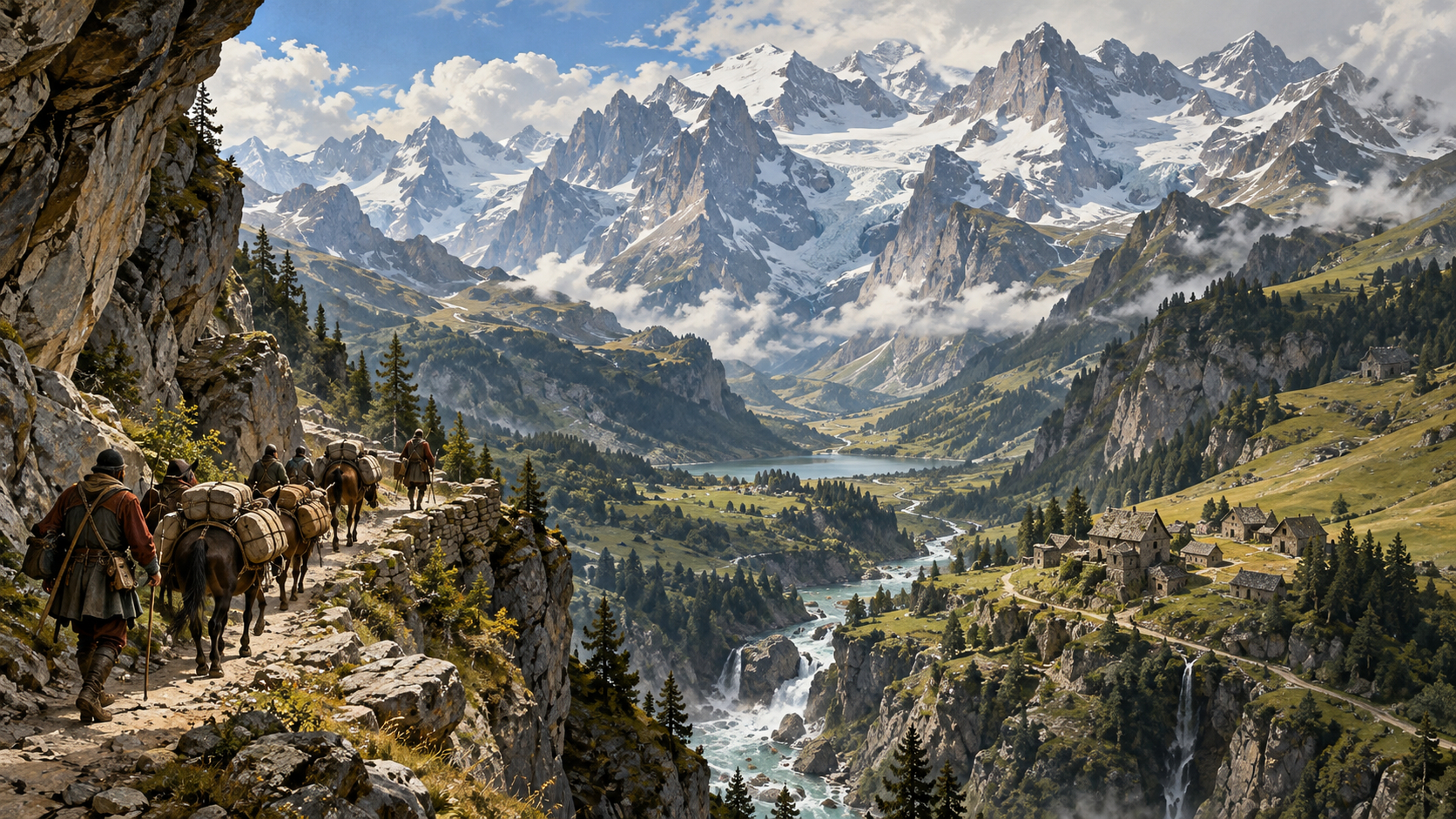
Beyond the last pasture huts, the mountains rise like a broken wall of stone. Forest yields to grass, grass to scree, and scree to snow that may endure even in summer. A caravan road is no guarantee of safety: one storm can bury the track, and an hour after sunset every torch on a mountain path may be hidden by cloud.
Yet the Alps are no empty waste. Families keep flocks in high meadows, miners work hidden seams, guides lead laden beasts through the cols, and guardsmen watch the bridges. The right crossing joins the markets of the north to the wealthy cities of Italy. Whoever holds that road can tax it, defend it, or close it.
What Is Happening Right Now?
Swiss lands are only a few years beyond the peace that ended the Old Zürich War in 1450. Rival interests have not vanished with the armies. Tyrol’s Habsburg ruler, Sigismund, commands passes and mining revenues, while Savoy and the Italian powers watch the western and southern approaches. In every valley, a bridge or caravan station may matter more than a distant court.
- The trade must pass. Cloth, salt, wine, metal, grain and correspondence move through the valleys in guarded pack trains.
- Tolls are contested. A merchant can encounter several jurisdictions in a single journey. Documents respected at one gate may be questioned at the next.
- The winter roads are closing. Even when lowland farms are green, high snow and breaking cornices can trap travellers far from shelter.
- Hunters are turning back. Signs of a tatzlwyrm have been found above a summer pasture; whether they mark a lair or an attempt to drive shepherds away is uncertain.
Regions and the Great Mountain Valleys
Western Alps — Savoy, Aosta and the High Routes
To the west, the Mont Cenis and Great St Bernard crossings serve travellers bound toward Piedmont and the Aosta valley. Savoy guards important approaches, but safe passage still depends on local shepherds, muleteers and those who maintain the tracks. The slopes hold fortified road stations, dark forests, stone villages and scattered shelters where a storm may force strangers to share a roof.
Central Alps — The Swiss Passes
The Gotthard carries travellers from the north through the lands of Uri, across high ground and toward the Leventina valley and Milan. The narrow Schöllenen gorge is a reminder that a bridge can decide the fate of an entire road. The Simplon, Septimer and Splügen offer other routes through the central mountains, each with its own risks, tolls and seasonal constraints. The Swiss Confederacy is a union of places, not an Alpine monarchy.
Eastern Alps — Tyrol and the Imperial Passes
In the east, the Brenner links Innsbruck and the County of Tyrol with the valleys leading south. Caravans carry goods past toll stations, mines and walled settlements while servants of rival lords dispute rights over their movement. Routes farther east approach Carinthia and the wider imperial marches.
Beyond the Named Roads
Hidden hanging valleys shelter summer flocks, abandoned workings, glacial caves and ruins older than the present boundaries. A reliable guide may know a route unknown to any official map; a secret valley may prove unreachable when the thaw comes. Not every path is fit for a horse, let alone a loaded wagon.
Important Alpine Passes
| Crossing | Main connection | Chief concern |
|---|---|---|
| Mont Cenis | Savoy to Piedmont | Exposed heights and Savoyard toll rights |
| Great St Bernard | Upper Rhône to Aosta | Snowfields, mist and lack of shelter |
| Simplon | Valais toward Domodossola | Steep pack paths and rapid changes of weather |
| St Gotthard | Uri to the Leventina and Milan routes | The gorge, bridges and control of the southern approaches |
| Septimer and Splügen | Grisons to routes south of the divide | High exposed ground and seasonal passage |
| Brenner | Innsbruck and Tyrol toward Bozen | Customs, escorts and difficult side valleys |
Travel note: A marked route is not a broad carriageway. Traders often shift loads from carts to pack animals, hire local men to lead them and wait days for storms to clear. Weather and the condition of bridges are better guides to travel time than a fixed distance alone.
People, Powers and Life in the Valleys
Shepherds, miners, charcoal burners, drovers, hunters, muleteers and traders are the most common people encountered. Village elders and experienced guides hold practical knowledge no visiting noble possesses. Some settlements barter fairly with strangers; others defend grazing rights, stores and customary tolls with fierce suspicion.
- Swiss mountain communities guard roads and local privileges, while neighbouring cantons negotiate wider obligations.
- Tyrolean authorities maintain important crossings and demand revenue from traffic through their lands.
- Savoyard wardens watch the western gates where an army or caravan might enter from another jurisdiction.
- Smugglers and free companies use side paths when law, taxes or vengeance block the regular highway.
Law, Trade and Services
Expect charges for beasts, freight and passage at guarded bridges. Possession of an order from a distant ruler does not automatically settle a valley dispute. Theft of winter provisions, damage to a bridge and violence against a guide may be punished sharply. In a larger settlement, travellers can buy rope, wool, iron fittings, pack saddles, dried food, lanterns, beasts and escort services. Above the tree line, supplies become scarce and expensive.
Hidden Powers and Mountain Lore
Old weather stones, narrow caves, lonely springs and places where the snow never settles are named in local tales. Herbalists search for rare plants near the upper meadows. Some travellers employ magic to read a trail or shield a company against the cold, though no charm should be mistaken for knowledge of the mountain.
Peoples of the Alps
The mountains are inhabited, not merely haunted. Many non-human families share markets, roads and valleys with human neighbours; others defend older rights beneath the stone, in deep woodland or above the snow line.
Below the Stone — Dwarves, Gnomes and Kobolds
Dwarves work mines, maintain bridges and mountain roads, and hold fortified settlements and guild workshops. Their clans and road-wardens have obligations that cross human borders. Gnomes are numerous throughout the Alpine and Upper Rhine lands: some live openly as locksmiths, surveyors and apothecaries; others keep woodland villages and concealed workshops. Kobolds may inhabit disused galleries and deeper caverns, guarding tunnels that outsiders incorrectly believe abandoned. Not every mine belongs to them.
On the Roads — Halflings
Halfling families keep inns, work valley farms, guide animals and carry goods between markets. Some are settled householders; others belong to travelling networks with relatives and trusted lodgings on both sides of the mountains.
In the Forest — Elves
Elves, especially wood elves, keep quiet homes in older forests and secluded valleys. Their claims to hunting grounds, springs and timber may be upheld by agreements that are older than neighbouring lordships.
Above the Snow — Barbegazi
Barbegazi live in independent families among glaciers and high snowfields, building with ice and stone. Outsiders sometimes call them “ice gnomes”, a name they dislike. They favour caution and misdirection over open fighting, but defend their clans and know routes invisible to lowland travellers.
Rights, Trust and Neighbours
A noble toll grant does not erase a dwarf charter, a gnome guild privilege, an elven boundary pact or a valley’s customary rights. A missing caravan may need rescue by a halfling guide or a barbegazi family, not an armed hunt. Meet these people as neighbours, patrons, rivals and hosts—not automatic combat encounters.
Creatures of the Alps
Most mountain journeys bring storms, ordinary wildlife and difficult people—not constant battles with monsters. The creatures below are drawn from the World Bestiary; their habitats and rarity help give each valley a distinct character.
Valley Woods and Pastures — Familiar Wildlife
Brown bears, wolves, lynx and eagles belong in the ordinary Alpine landscape alongside flocks and wild mountain goats. Their tracks, calls and movements make useful encounters without requiring combat.
Old Alpine Legends — Signature Beings
The tatzlwyrm is the region’s signature hidden predator, haunting caves and high pasture. A Bergeist may watch over lonely ridges and sacred places, testing or advising visitors. In eastern valleys, Perchten, Frau Perchta and Krampus belong to old winter observances; these are seasonal or consequential meetings, not everyday wandering encounters. At lakes and treacherous crossings, the Wassernixe lures the unwary toward dangerous water.
Ancient Forests, Caves and Ruins
A woodwose may defend a secluded woodland and respond to an intruder’s conduct. Cave fishers ambush prey in dark rock fissures and abandoned workings. A winter hag may command unnatural frost around a lost settlement. Use these for specific sites rather than scattering them uniformly across the range.
Remote Peaks — Rare Great Threats
Griffons nest on inaccessible ledges; frost drakes claim icy hunting grounds. Snow trolls may stalk exceptional high passes, while a mountain giant is a devastating, stealthy predator capable of emptying an entire district. The Wild Hunt is a rare supernatural event, not a random fight on a road.
For the Games Master: Choose one or two supernatural presences for a particular valley. Let rumours, missing livestock, damaged bridges and witnesses establish their influence before the party encounters them. The dwarf, gnome, elf, halfling, barbegazi and kobold communities described above are neighbours with their own interests, not entries on a hostile encounter table. The basilisk has a stronger setting connection to Basel than to the entire mountain chain.
Adventure Hooks
- The Broken Pack Train. A salt caravan has disappeared between shelters. Its goods lie beneath a fresh snow slide, but the muleteers’ tracks lead elsewhere.
- The Toll Twice Paid. Two officers present competing claims to the same bridge. Neither will release the party’s pack animals without payment.
- The Last Summer Pasture. Goats have vanished from an upper meadow and the shepherds blame a tatzlwyrm. Miners have recently disturbed a nearby cave.
- The Missing Guide. The only person who knows a safe traverse vanishes on the night before the ascent.
- The Letter Beneath the Ice. A thaw reveals the body of a messenger and a sealed letter naming an ally in a long-ago betrayal.
- The Winter Procession. Bells sound beyond a blocked ridge, and fresh tracks lead into the snow without returning.
Mountain Travel — Rules for Each Edition
Apply the chosen game’s wilderness procedures. A storm, a steep slope, an avalanche and high altitude are separate hazards, but a single expedition may suffer from several. Do not add mechanics from different editions together.
| Edition | Use at the Table | Related Rules |
|---|---|---|
| D&D 5.5e / 2024 | Travel pace, navigation, difficult terrain, weather, exhaustion and checks appropriate to an actual obstacle. | Mountain terrain; avalanche |
| D&D 5e / 2014 | The 2014 rules for travel, altitude, extreme cold and exhaustion. | Altitude; mountains |
| Pathfinder 1e | Its own Survival, Climb, mountain terrain, cold, altitude and avalanche rules. | Mountains; avalanches |
| D&D 3.5e | The 3.5e movement, high-altitude, cold, falling and avalanche procedures. | Altitude; avalanches |
Seasons on the Trail
| Season | Typical Conditions | What Travellers Should Do |
|---|---|---|
| Spring | Snowmelt, swollen streams, unstable slopes | Check bridges and avalanche gullies. |
| Summer | Most dependable travel, sudden storms | Keep guides and emergency shelter close. |
| Autumn | Short days, sleet, early snow | Leave exposed passes before closure. |
| Winter | Ice, blocked tracks, intense cold | Use lower routes or wait in safety. |
Mountain Encounter Die — d6
| Roll | Encounter or Complication |
|---|---|
| 1 | A caravan bearing a disputed toll warrant. |
| 2 | A collapsed bridge and an uncertain detour. |
| 3 | A griffon’s shadow moving above a herd. |
| 4 | Cracking snow, a fresh slide or a blocked gully. |
| 5 | A wounded guide pleading for help with stranded travellers. |
| 6 | Unnatural tracks leading to a tatzlwyrm’s rocky haunt. |
For the Games Master: An encounter might be a sighting, trail, warning or difficult choice rather than an automatic battle. Use the creature’s own bestiary statistics and the selected edition’s danger rules.
The Roads of Old
These mountains have never been an absolute wall. Passes used for generations carry soldiers, messengers and merchants between northern Europe and Italy. Older crossings became more valuable as markets flourished and communities learned to defend their narrow approaches. The great roads remain, but control of them changes.
The recent struggle among the Swiss places, the ambitions of Habsburg Tyrol and the interests of Savoy and Milan give every crossing a political price as well as a physical one.

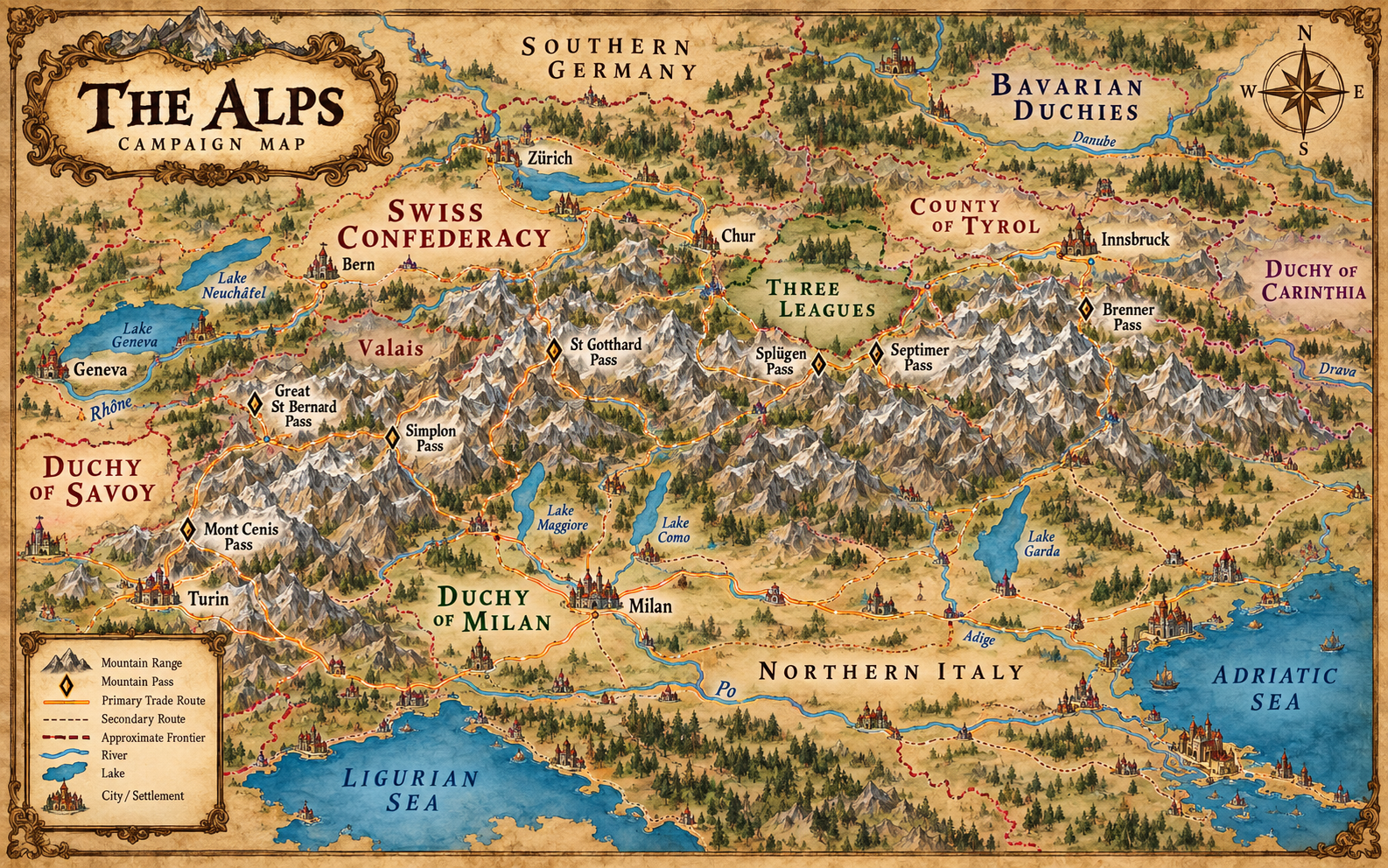
Map of the Alpine Passes
The main routes cross the mountains between Savoy, Valais, the Swiss lands, the Three Leagues and Tyrol. Follow the marked passes towards northern Italy, but reckon with tolls, local authority and the weather before choosing a road.
Further Journeys and Related Entries
- Swiss Confederacy and Uri — the central mountain approaches.
- Duchy of Savoy — western crossings and Alpine politics.
- County of Tyrol and Duchy of Carinthia — the eastern mountains.
- Bavarian duchies and Milan — the lands on opposite sides of the mountains.
- Mountain Terrain, Altitude and Avalanches — travel and survival rules.
Keep this reference growing
If this page helped with your reading or game, you can support its upkeep or explore the curated books.
Explore the Bookshop — epics, classics and stories behind imagined worlds.