
Imperial City of Regensburg
At a Glance
| Status | Free Imperial City in the Holy Roman Empire |
|---|---|
| Government | Magistrates and civic council, influenced by powerful merchant and patrician households; independent of direct ducal rule |
| Year | 1454 |
| Population | About 20,000 inhabitants (local estimate) |
| Settlement | Large city; generally lawful neutral in civic outlook |
| Languages | German, Latin in learned affairs and legal records, and foreign tongues among merchants |
| Wealth | River tolls, long-distance trade, warehouses, metalwork, craft guilds and shipping |
| Chief landmark | The great Stone Bridge across the Danube |
| Dangers | Factional feuds, contraband, forged papers, floods and contested jurisdictions |
The City’s Arms

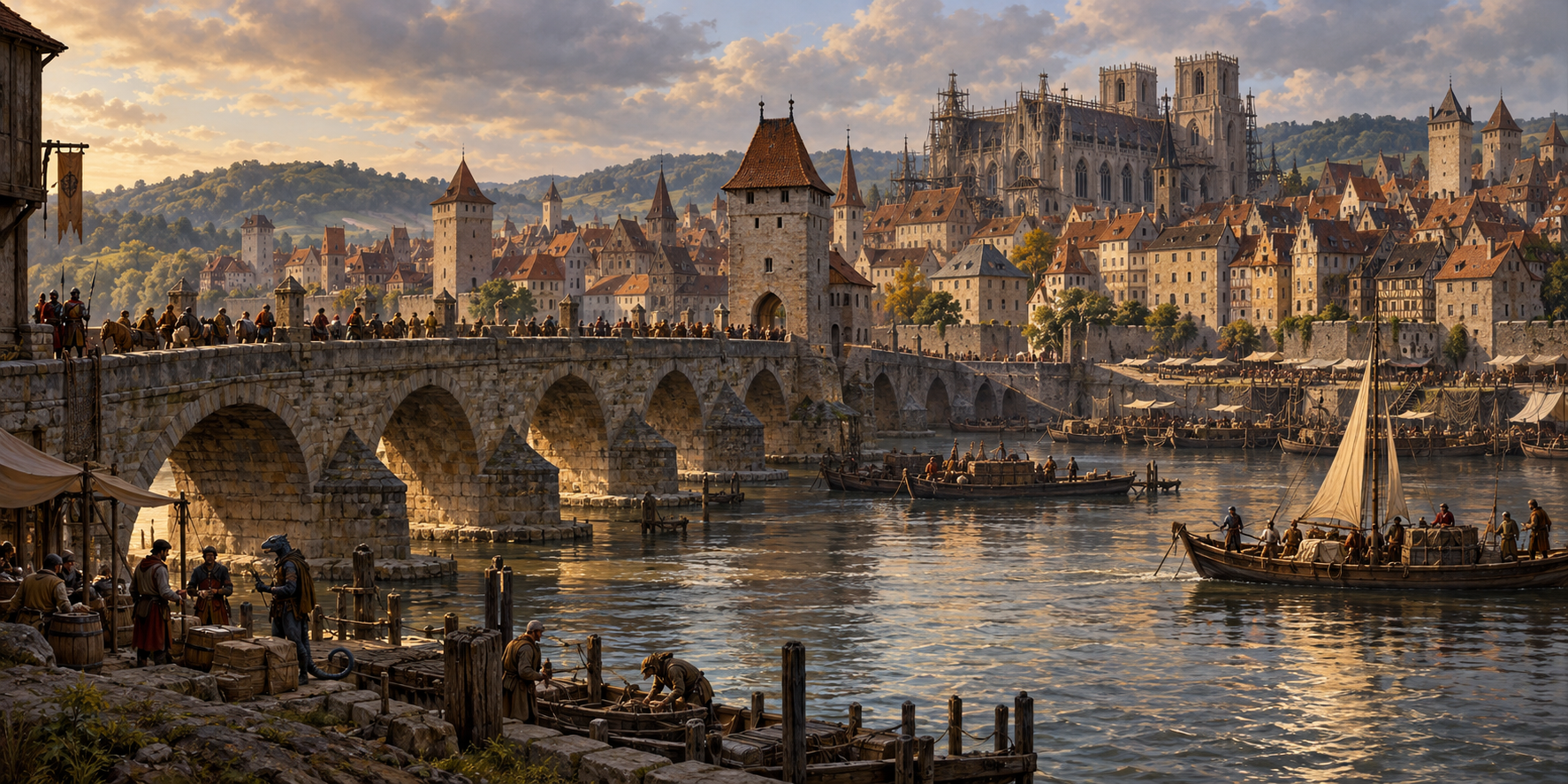
The Imperial City of Regensburg commands the Danube where merchants, envoys, river pilots and armed retainers meet beneath the towers of a free city. Its Stone Bridge carries traders between the Empire’s northern roads and southern markets; its patrician houses rise above old Roman walls, narrow lanes, warehouses and craftsmen’s yards. The city council guards its liberties, but every toll, judgement and charter may draw the attention of a bishop, an abbot, an imperial envoy or a neighbouring duke.
What Is Happening Right Now?
The city keeps its own council and protects its charters with scrupulous care. The leading merchant households argue over levies, bridge maintenance, guild privileges and who may bring armed men through the gates. A seal properly entered in the town registers can be more useful than a regiment.
From the northern bank, agents of the Bavarian duchies watch the city’s wealth and independence. Across the bridge, Stadtamhof belongs to a Bavarian lordship but stands pledged to Regensburg. A traveller’s papers may be accepted at one gate and challenged at the next. The bishopric and privileged abbeys exercise claims of their own, so disputes often turn upon exactly whose law applies on which side of a threshold.
Traders whisper that routes are shifting and old family fortunes are less secure than their towers suggest. At the riverfront, guards inspect manifests while boatmen dispute passage through the arches. The council cannot afford to close the bridge, but no one can afford to lose it.
Entering the City
From the north, the Stone Bridge rises above swift channels of the Danube and leads toward guarded city streets. Boats nose into landing places near stacked cargo and busy wharves. Within the walls stand tall merchant residences, close-set roofs, courts, markets and fragments of Roman stonework. The great Gothic cathedral rises above its builders’ yards, its western towers still unfinished and its walls alive with the work of stonemasons.
Porters move cloth, salt, timber, metal goods and barrels. Scribes verify letters of passage, apprentices carry guild tokens, and citizens recognise strangers long before strangers learn the city. Gate guards inspect unfamiliar weapons and doubtful cargo; those carrying conspicuous magic may be questioned, while merchants with recognised guild seals usually pass more easily.
Districts and Important Places
The Stone Bridge and River Gates
The twelfth-century Stone Bridge carries carts, pilgrims and guarded freight across the Danube. The bridge watch checks loads and collects tolls, while river pilots can be hired to steer beneath the arches. Smugglers know the dangerous currents; a vessel lost after dusk may leave only broken timbers caught among the piers.
The Old Town Hall
At the Altes Rathaus, petitioners queue to have disputes heard and documents authenticated. A clerk can search the civic registers for a fee or a favour, though access to sealed charters requires a magistrate’s permission. One missing deed could decide who owns a warehouse, an island or the right to collect a toll.
The Great Cathedral Precinct
Stonecutters labour beside the unfinished cathedral while petitioners, scholars and healers pass through its precinct. The great sanctuary serves the city’s divine traditions: healing, ritual counsel and access to its learned custodians can be sought here, though favours may carry obligations. Officers of the neighbouring prince-bishopric assert their own authority, distinct from the city council.
Emmeram Abbey
The Imperial Abbey of Emmeram holds archives, estates and ancient privileges. Visitors seeking a charter, an old account or instruction from its scholars must first gain the trust of a custodian. A letter of introduction opens more doors than a purse of coins; removing a document without leave may provoke a dispute with the abbot himself.
Obermünster and Niedermünster
At Obermünster and Niedermünster, noble households preserve family letters, valuable records and rights over land. An audience with their leaders may secure a patron, a tutor or sanctuary, but any favour binds the petitioner to powerful families whose rivalries reach beyond the city walls.
The Merchant Towers and Quays
High merchant towers hide counting rooms, guarded strongboxes and guests whose identities are carefully concealed. At the quays, brokers arrange passage and warehouse space, while moneychangers inspect coin and credit notes. A copied seal or stolen bill of exchange may buy more than a crate of silver, provided no one checks the ledger too closely.
People and Factions
- The magistrates and patrician council: guard Regensburg’s independence while bargaining for office, authority and public revenue.
- Guilds, merchants and river pilots: want secure deliveries, predictable tolls and honest inspection of cargo.
- Friedrich III von Plankenfels: the bishop of Regensburg; his officers defend the bishopric’s lands, privileges and independent jurisdiction.
- Abbot Hartung Pfersfelder: ruler of Emmeram Abbey, whose custodians guard valuable charters and whose favour can secure an audience, healing or access to learned counsel.
- The privileged abbey households: maintain influence through kinship, property, archives and letters of recommendation.
- Bavarian emissaries: seek leverage over debts, trade routes, bridge access and the surrounding countryside without formally governing the city.
Magic, Markets and Services
Blacksmiths and armourers work near the busy market streets; river pilots, interpreters, moneychangers, scribes and respectable lodgings can be found by asking at the quays or through a guild contact. Healing is available through established sacred houses, though their custodians may require a petition or service in return. Rare enchanted goods pass between trusted patrons, guild contacts and ritual foundations rather than being offered freely at market stalls.
Openly dangerous magic near crowded streets, wharves or bridge piers draws the attention of the city watch. Those seeking a ritual, a sealed manuscript or an unusual reagent must usually persuade an abbey custodian or wealthy patron to grant access; a letter of introduction may prove more valuable than coin.
Dangers and Adventure Hooks
- The Sealed Barge: a newly arrived riverboat carries two conflicting cargo lists, both bearing the council’s seal. The toll clerk asks for a discreet inspection before the cargo is unloaded. Breaking the wrong seal could implicate an innocent merchant—or conceal a shipment dangerous enough to close the docks.
- The Missing Charter: a deed disappears from Emmeram’s archive just before a disputed property hearing. The abbot demands its return, a merchant offers to purchase it, and a magistrate insists it be brought to the council. Whichever claimant receives it gains the stronger legal position.
- Flood Beneath the Bridge: a falling stone exposes a narrow chamber below the bridge as the Danube begins to rise. A trapped boatman claims to have seen a locked chest inside. Reaching him may mean abandoning the chest; chasing the treasure risks a collapsing passage.
- Sanctuary Disputed: a wanted prisoner seeks refuge within a privileged sacred house. The city watch demands surrender, while its custodians insist on sanctuary. Witnesses must decide which account is true before armed men force their way across the threshold.
- The False Toll Collector: merchants report being charged twice on the northern approach. The forged stamp looks genuine, and the council threatens to suspend crossings until the culprits are found. Following the false toll receipts may expose a smuggling ring—or a clerk working inside the watch.
- The Duke’s Courier: a Bavarian messenger vanishes after visiting a powerful merchant household. The council orders a quiet search, but the missing letter may reveal an offer that would place the city’s liberties at risk. Returning it unopened protects one secret; reading it may expose another.
Travel, Law and Civic Custom
Roads run towards the Bavarian territories and northward into the Empire, while barges follow the Danube to other great markets. Merchants declare cargo and pay tolls; gates may close after dark. Proof of citizenship, guild membership or safe-conduct is valuable, but a permit granted by the council may not hold on a bishop’s land or within a privileged abbey estate.
Violent disputes draw guards, magistrates and witnesses. Status matters: a noble retainer, a guild-affiliated merchant and an unknown wanderer may all receive different treatment. A named sponsor with a recognised seal is often the best defence against detention.
Older Stones and Deeper History
The Roman fortress Castra Regina left walls and foundations beneath later streets. Regensburg became an important Bavarian centre before prospering through long-distance trade. Construction of the Stone Bridge in the twelfth century made the city an exceptional Danube crossing. Imperial recognition of civic self-government in 1245 helped secure liberties the council still defends.
Many of the old privileges endure, but routes and fortunes change. In Regensburg an ancient obligation, lost Roman chamber or medieval title deed may prove more dangerous than a band of raiders.
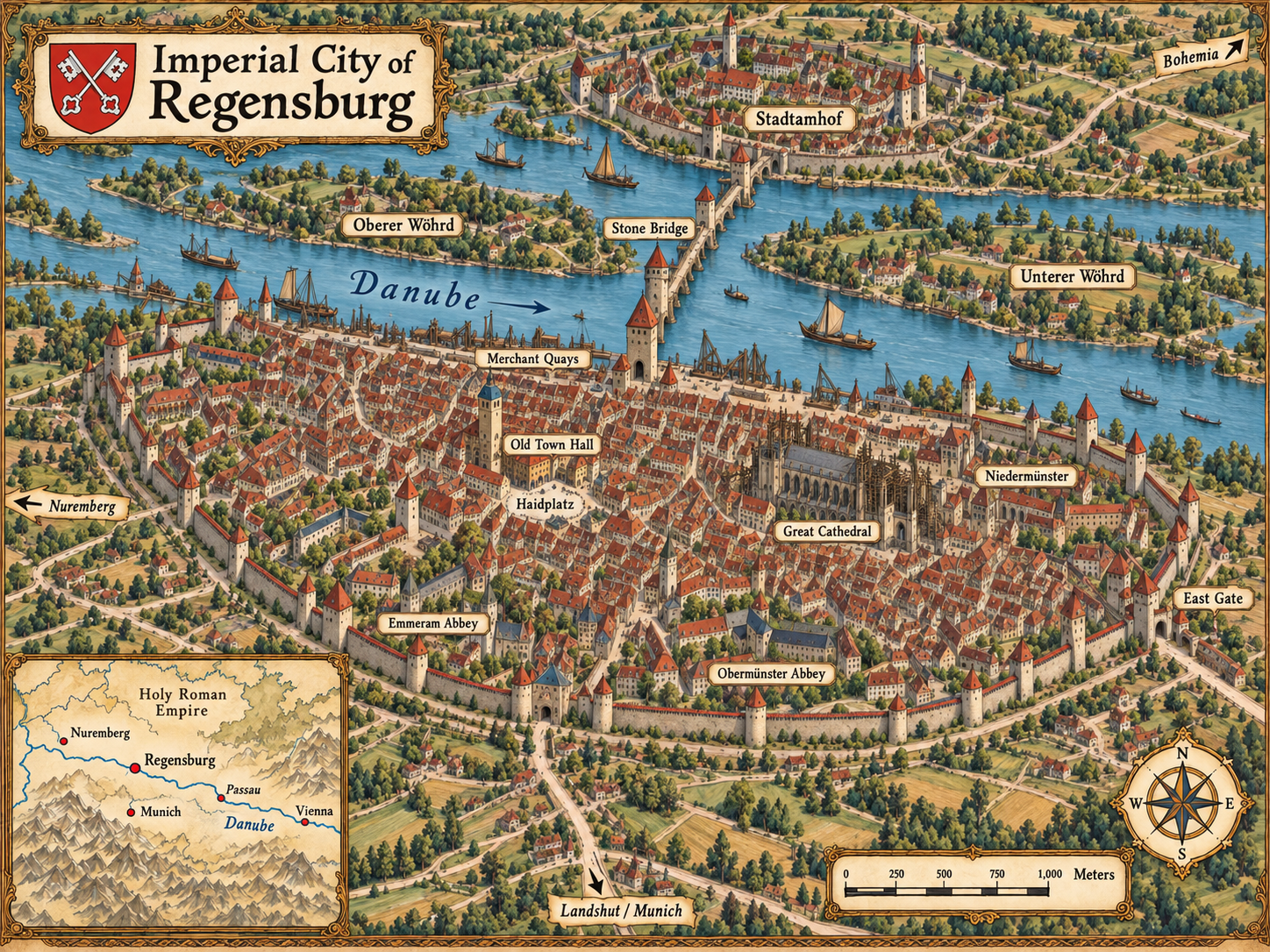
Campaign Map of Regensburg
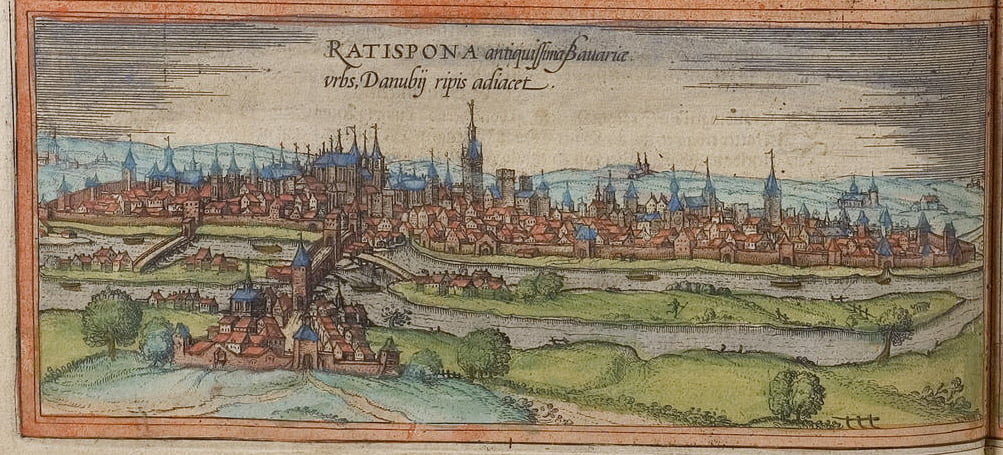
Historical View
Explore the Region
Visit the Empire, Bavaria, Bishopric of Regensburg, Emmeram, Obermünster and Niedermünster.
Historical sources: UNESCO: Old Town of Regensburg with Stadtamhof; Regensburg Tourism: Stone Bridge; Regensburg Tourism: Old Town Hall; Historisches Lexikon Bayerns: Regensburg Cathedral.
Keep this reference growing
If this page helped with your reading or game, you can support its upkeep or explore the curated books.
Explore the Bookshop — epics, classics and stories behind imagined worlds.