
Munich — The Wittelsbach Court on the Isar
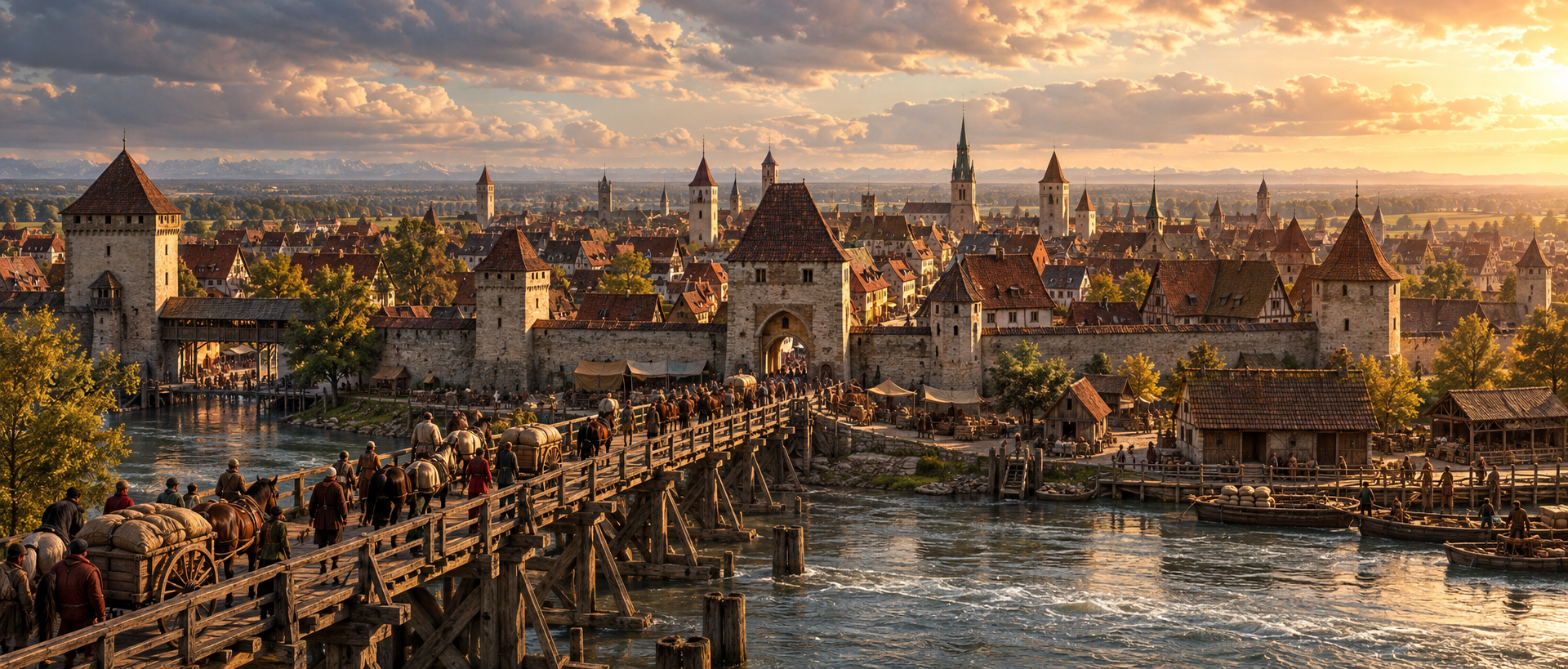
Salt wagons rattle through the Isar Gate, ducal riders guard the courts, and every merchant knows the price of a pass through Munich’s walls.
Munich at a Glance
| Campaign Present | 1454 CE |
|---|---|
| Region | Bavaria-Munich, in the Holy Roman Empire |
| Status | Fortified small city and ducal residence of Bavaria-Munich; not the capital of a unified Bavaria |
| Ruler | Duke Albrecht III of the House of Wittelsbach (reigned 1438–1460) |
| Civic Authority | The municipal council and magistrates, answerable within their privileges to the duke and his officers |
| Population | 13,447 in the existing campaign register; a game-setting figure, not a verified 1454 census |
| Languages | Bavarian German in streets and markets; Latin in learned records; traders and visitors bring other regional tongues |
| Trade | Salt, grain, cattle, leather, cloth, beer, metalwork, transport and credit |
| Major Sites | Alter Hof, Neuveste, Isartor, Sendlinger Tor, the market square, old Frauenkirche parish site, Isar river crossings |
| Local Dangers | Dynastic agents, forged privileges, toll fraud, contested arrests and river spirits |
| Adventures | Court intrigue, missing persons, guild disputes, river mysteries, escorts and nocturnal investigations |
Behind the Isar Gate
Munich looks prosperous from the road: tiled roofs clustered behind double defences, workshops humming near the markets, and guarded courtyards where the duke’s household receives envoys. Salt traffic enriches the city, but its wealth is never simply its own. Duke Albrecht III holds court here while the divided branches of the Wittelsbach family watch one another from neighbouring lands. A merchant with the right seal can cross the gates before dusk; a stranger carrying an unlicensed enchanted relic may find an audience with an officer before finding a room at an inn.
The ducal officers and the city council work together when it suits them. Merchants demand predictable tolls, guilds defend their rights, and nobles expect favours without explanation. Beneath this political contest are older bargains: river people leave offerings to currents that have names, craftsmen whisper of impossible materials, and an abandoned cellar may have more owners than any register admits.
What Is Happening Right Now?
The Duke Guards His Inheritance
Albrecht III rules Bavaria-Munich, but Bavaria is not united. The wealthy Bavaria-Landshut court of Duke Ludwig IX governs another branch of the Wittelsbach lands. After the 1447 extinction of the Bavaria-Ingolstadt line, its inheritance has increased the influence of Landshut. A disputed toll, marriage agreement or castle command can therefore become an affair of several ducal households.
New Stone Defences, Old Suspicions
The expanded medieval enceinte and its fortified outer barrier continue to demand guards, carts, masons and money. Watch captains argue over access to towers; stewards count timber and stone; guilds protest work demanded without prompt payment. Scaffolds and construction yards make useful hiding places for someone who knows the walls from the inside.
The Market Measures Every Claim
Salt, grain and barrels pass through the gates with letters of origin and recorded dues. Officials compare marks on casks and caravan tallies, while honest dealers lose patience with favourites who receive exemptions. A counterfeit ducal order can redirect a shipment; a genuine order may be just as troublesome if issued by the wrong branch of the family.
The Shadow of Agnes Bernauer
The death of Agnes Bernauer in 1435 remains a bitter memory associated with the Wittelsbach court. The historical affair involved Albrecht III’s earlier relationship and his father’s opposition; in tavern versions, each teller knows a different culprit. Some say a woman in wet garments has been glimpsed near the river. That haunting is a campaign rumour, not an established historical event, and any apparition should be connected to evidence the characters can investigate rather than offered as a certain fact.
Places Adventurers Can Enter
Alter Hof — The Old Ducal Court
The Wittelsbachs’ long-established town residence encloses guarded passages, service yards, chambers and administrative offices. Couriers wait beneath the gate tower while stewards decide who may enter the inner rooms. A petition can be heard here, but a request to search ducal property requires authority far beyond a city watchman’s writ.
The Neuveste — The Newer Stronghold
The fortified ducal complex begun in the late fourteenth century offers more private security than the crowded older court. It is a place for sensitive visitors, valuables and household guards. It must not be imagined as the later grand Munich Residenz palace with its Renaissance and Baroque wings.
Isartor — The Eastern Gate
The Isar Gate stands on the route from the river into the market quarter. Its tower, passages and flanking defences make it a natural place for inspections, arrests and hurried departures. Sentries know the smell of unmarked barrels and the faces of the city’s regular carters. A party entering openly can ask questions here, provided it can withstand questions in return.
The Old Market and Council Precinct
The central market is busy with grain, cloth, meat, tools and news. The civic tower and council buildings near the old gate mark the magistrates’ presence. Call it the market: the square’s later formal shape and some familiar modern features belong to the decades after the campaign present. Here guild elders settle weights and measures, brokers vouch for strangers and town officers record complaints.
The Old Frauenkirche Parish Site
An earlier parish building occupies the place where Munich’s famous large brick Frauenkirche will be constructed beginning in 1468. Do not place the completed cathedral and its towers in an encounter set in 1454. For the campaign, the nearby lanes attract copyists, builders, charities and petitioners; any exceptional spiritual power arises from the fantasy setting, not from assumed real-world theology.
Sendlinger Tor and the Southern Roads
Travellers bound for villages and the Alpine approaches head through the southern gate. Hostlers, guides and traders from the hills bring hides, timber, livestock and stories of treacherous mountain paths. The guards pay particular attention to traffic that attempts to avoid the official toll routes.
The Isar Crossings and River Yards
Carriers unload timber and imported goods by the river approaches; mills, yards and waterfront paths are noisier and less controlled than the formal market. At high water the Isar turns a routine crossing into a dangerous passage. At night a drowned messenger, cut mooring rope or strange singing from beneath a bridge can demand more than a search by torchlight.
People Adventurers May Actually Meet
Albrecht III, Duke of Bavaria-Munich
The duke is an experienced ruler in his early fifties, protective of Wittelsbach interests and mindful of the court’s reputation. Adventurers rarely reach him by simply asking at a gate. His chamberlains, marshals and legal officers control access; an accusation involving a noble household will have to survive their scrutiny before it is heard.
Anna of Brunswick-Grubenhagen
The duchess has household retainers and family connections of her own. Her attendants and stewards can provide legitimate access to court where an armed demand would fail. They also keep careful account of presents, promises and people who presume too much upon an introduction.
The Princes of the Munich Court
The duke’s sons Johann and Sigismund belong to a household where rank, patronage and succession matter at every audience. Albert IV is also an adult prince in this campaign, already active as an envoy, investigator and patron of capable adventurers. He commands his own retainers but does not yet rule: Duke Albrecht III holds the ducal seal. A missing set of chancery papers or a forged order in Albert’s name could embroil the entire court.
The City Councillors, Toll Clerks and Guild Elders
These are the people strangers are most likely to deal with. A gate clerk wants documents; a merchant elder wants contracts honoured; a watch captain wants disturbances ended quickly. They may disagree without being corrupt. For a recurring campaign, give each official a business interest, family obligation and person to whom they must answer.
Factions, Households and Rivals
- The ducal household: controls access to Albrecht III, military instructions, private messengers and major appointments.
- The civic council: protects chartered rights, market order, toll income, courts and public security.
- The craft guilds: supervise training, workshops, fees, standards and access to trades; their rivalries can frustrate even a ducal officer.
- Bavaria-Landshut agents: merchants and noble envoys with real business here, not automatic enemies. Their patron’s growing strength makes every negotiation politically sensitive.
- River guilds and old-current keepers: bargemen, millers and others who understand both water conditions and the city’s older, less visible bargains.
- Freising’s neighbouring interests: the nearby Prince-Bishopric of Freising has separate rights and officers, making border dues and legal refuge recurrent disputes.
Magic, Services and the Market
Everyday trade. Inns, stables, wagon repairers, coopers, brewers, leatherworkers, smiths and scribes serve travellers. Salt caravans can hire armed escorts and guides, but reliable passage requires toll money, references and sensible weather.
Rare arts. Apprentices, healers, alchemists and discreet practitioners may identify uncommon substances or study a suspected enchantment. A powerful spell should require time, introductions, obligation or a dangerous price; it is not an item automatically stocked on a shelf.
Dwarven and other unusual craftsmen. In the fantasy setting, specialist makers can be found through established trading households and guild patrons. Their rare techniques do not erase the historical character of the town’s ordinary trades.
Regional creatures. Hunting stories describe the Wolpertinger in wooded country beyond the walls. A nixie might occupy a dangerous Isar pool. Alpine winter tales speak of Krampus and related dark processions. These are creatures and customs of the fantasy campaign, not claims that such beings were observed in Munich in historical records.
Dangers and Adventure Hooks
| d6 | Trouble at the Bavarian Court |
|---|---|
| 1 | The Duplicate Seal. Two couriers carry apparently identical ducal orders through Isartor. One commands that a salt caravan be seized, the other that it receive an escort. Find who forged which seal before the convoy vanishes. |
| 2 | The Widow’s Witness. A dying court servant claims to know what really happened to Agnes Bernauer. A rival offers money to destroy his statement; the river has begun returning the personal effects of people connected with the old affair. |
| 3 | The Forty-Fourth Tower. A mason working on the outer defences disappears. Beneath his unfinished tower is a sealed passage apparently older than the wall, and someone inside has been paying the guard for food. |
| 4 | Salt Without Weight. Barrels declared at full weight reach the market mysteriously light. The smugglers insist nothing was removed, and a water-spirit’s mark appears on the planks of each affected wagon. |
| 5 | Two Dukes’ Men. A Landshut messenger is arrested by the city watch on another noble’s complaint. The court demands release; the council claims jurisdiction. The messenger’s letters concern the loyalty of a border castle. |
| 6 | The Singing Ford. A bargeman disappears at the Isar crossing. Those who hear a woman’s voice from the dark water dream of an iron-bound chest lodged beneath the bridge. |
Any of these troubles can end in negotiation rather than combat. Clearing an innocent guard may win a patron; exposing a forged document may close one door at the duke’s court while opening another at the council.
Travel, Law and Living in Munich
Gates and Curfews
At the gates, guards can inspect carts, levy dues and question armed strangers. Night entry is harder without a household token or trusted sponsor. A failed bribe attracts notice; a convincing explanation supported by a real contact is more useful.
Whose Law Applies?
A merchant quarrel may belong before town officers; an offence inside a ducal residence may be handled by household authorities. Guild sanctions, fines, confinement and confiscation are more common beginnings to a dispute than open warfare. Adventurers should learn which official issued an order before treating every document as absolute authority.
Roads Beyond the Walls
Roads and river routes connect Munich to Augsburg, Landshut, Freising and the Alpine approaches. Weather, changing water levels, toll stations and ducal jurisdictions matter more than a fixed travel-time promise. A royal escort may help at one barrier and create fresh suspicion at the next.
Money and Markets
Different coins must be weighed, compared and accepted by local merchants. Significant purchases pass through brokers or written agreements. Claiming a caravan’s goods without proper authority can invite a charge of theft, even when a visiting noble says the property is owed to him.
Settlement Mechanics — Pathfinder 1e (Optional)
Use Munich’s existing Pathfinder 1e settlement figures for games in that edition. These are game statistics, not historical census or economic records; other editions can use the city description without them.
- Settlement: Small city; generally Neutral.
- Modifiers: Corruption +0; Crime +0; Economy +4; Law +4; Lore +4; Society +4.
- Settlement qualities: Academic; Holy Site. The latter is a rules label for a significant sacred or magical site in the campaign.
- Market: Base Value 1,600 gp; Purchase Limit 10,000 gp. Spellcasting up to 4th level may be available through suitable contacts.
- Original magic-item budget figures: Minor 4,000 gp; medium 10,000 gp; major 16,000 gp. These figures are preserved from the original entry as optional budgets, not the normal Pathfinder 1e number of available magic items.
- Danger: Determine from the situation, district, hour and current intrigue. The older entry’s unfinished “Danger +” has no defined numerical value.
For the Game Master: Uncommon spells and magic items are not guaranteed purchases. For strict Pathfinder 1e settlement generation, use the edition’s standard availability rules rather than treating the legacy budget figures as item counts.
History Beneath the Paving Stones
- 1158: Munich appears in surviving documentary records during a dispute over a market and crossing.
- 1255: Bavaria’s partition makes Munich an important ducal residence of Upper Bavaria.
- 1337: The Isartor is completed as part of the extended city fortifications.
- Late fourteenth century: the Neuveste takes shape as a more secure ducal stronghold.
- 1435: Agnes Bernauer is killed; her story continues to echo through Wittelsbach memory.
- 1438–1460: Albrecht III rules Bavaria-Munich; this is the campaign’s present reign.
- 1468, later: construction starts on the great Gothic Frauenkirche now associated with the city’s skyline.
- 1506, later: Munich becomes the capital of the reunited Duchy of Bavaria.
City Orientation and Historical View
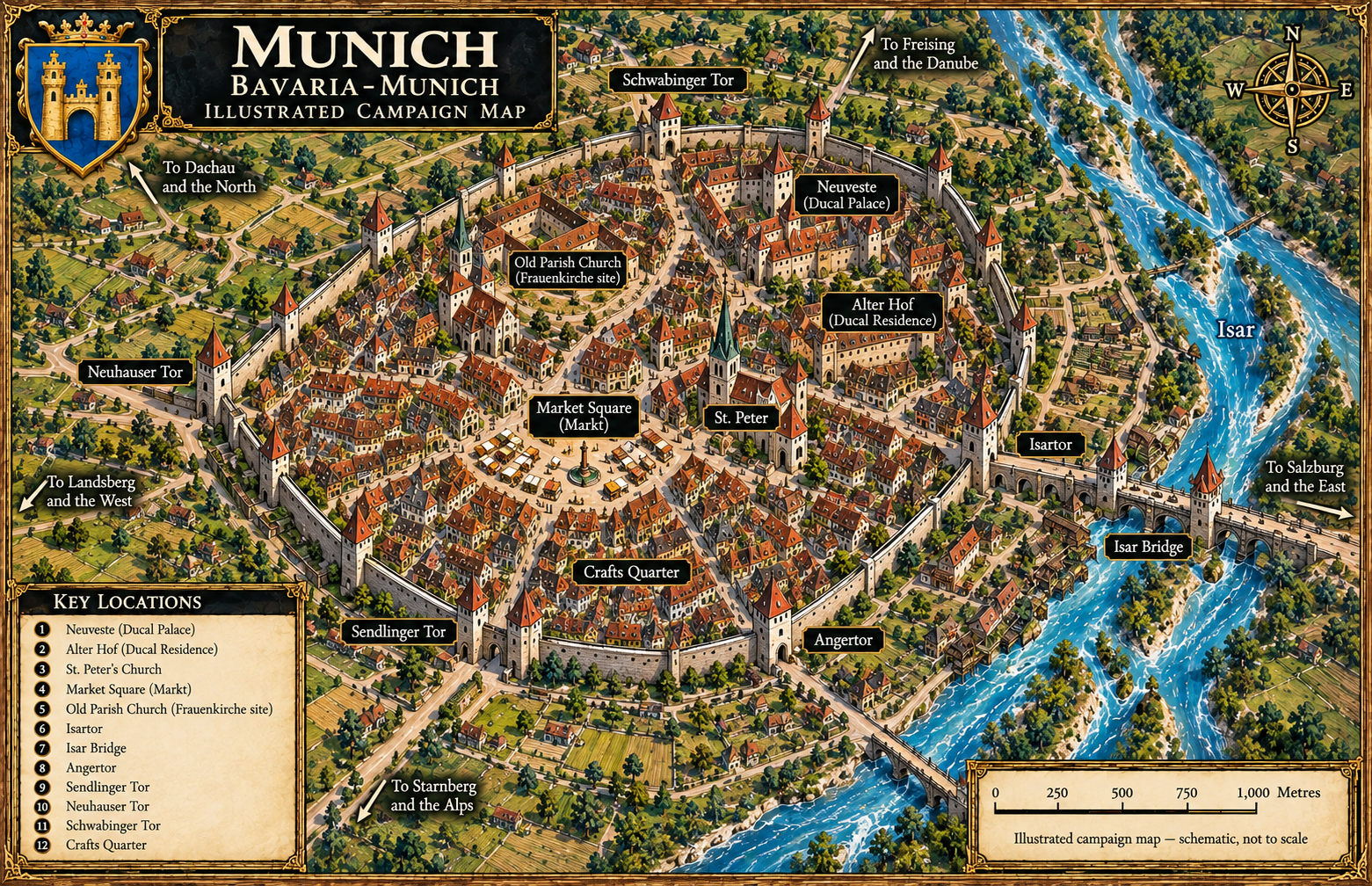
From the east: cross the Isar and enter by Isartor toward the market and council precinct. From the market: the older court lies a short way into the central streets; more private ducal grounds lie beyond. To the south: Sendlinger Tor opens the route toward the Alpine country. Along the river: mills, crossings and merchants’ yards offer less formal paths around the supervised trading streets.
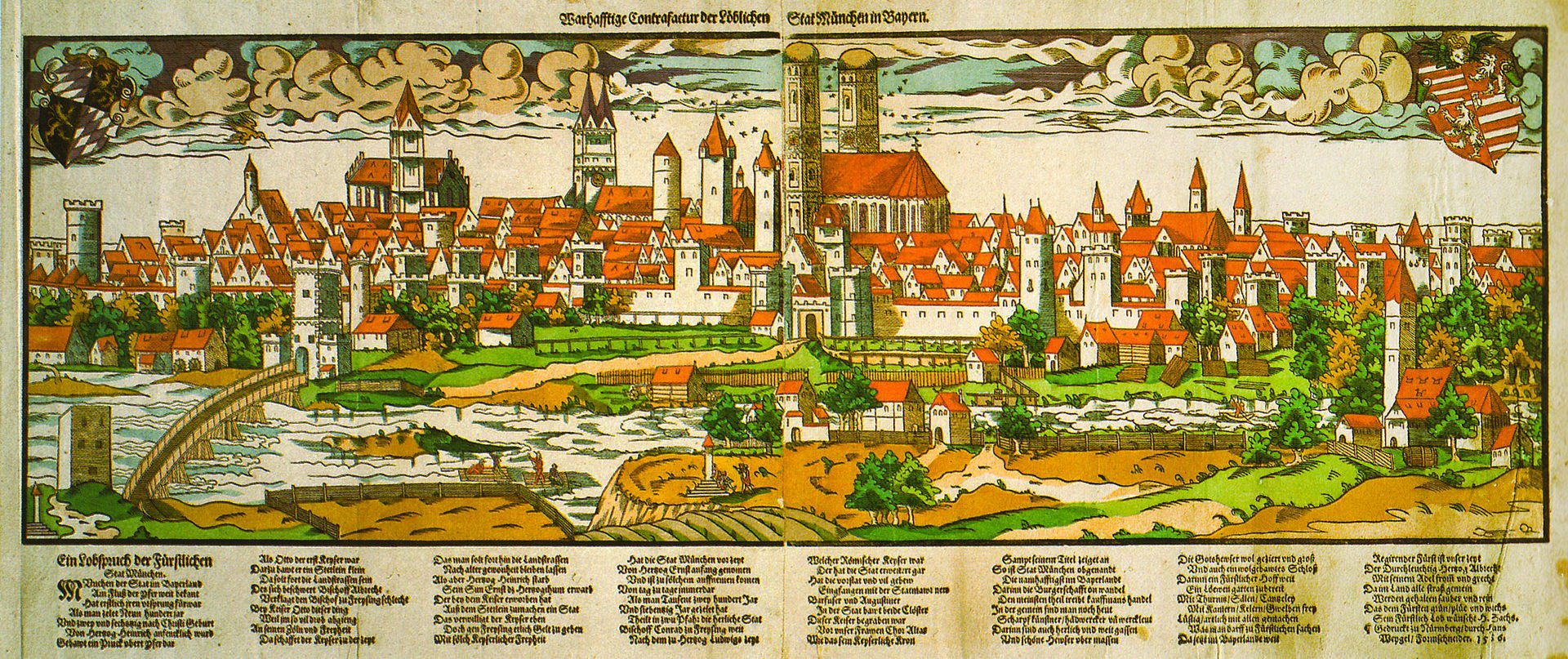
Reading the illustrations. The campaign map is a schematic guide to the relationships between gates, courts, markets and river crossings: individual street alignments, buildings and apparent distances are illustrative rather than exact. The 1572 panorama below it is an authentic later historical illustration and shows changes made after the campaign present; it is not a map of the city in its earlier form.
Historical Sources and Image Credits
- City of Munich — historical chronology, for the medieval ducal residence, civic arms and later capital status.
- Munich Tourism — Alter Hof, for the medieval court.
- Munich Tourism — medieval fortifications, for the gate and wall chronology.
- City of Munich — München: die befestigte Stadt (historical fortification study, PDF), for the medieval city wall, original inner wall, watercourses and the 1424–1472 period of additional defensive works.
- Munich Frauenkirche — building history, for the 1468 commencement of the replacement building.
- Illustrated campaign map: original fantasy cartography of medieval Munich, showing approximate landmark relationships. Not a measured historical reconstruction; it intentionally carries no campaign year on the artwork.
- Historical city view: original image retained from this page, dated 1572; a later illustration rather than a reconstruction of the campaign-present city.
- Munich campaign shield: original painted fantasy artwork depicting a gilded castle gate above Isar waves and a blue-and-white Bavarian border. This is an invented campaign emblem, not historical Munich civic arms; the earlier traditional city-symbol image has been replaced in the identity block.
Keep this reference growing
If this page helped with your reading or game, you can support its upkeep or explore the curated books.
Explore the Bookshop — epics, classics and stories behind imagined worlds.