
Duchy of Bavaria — The Divided Wittelsbach Lands
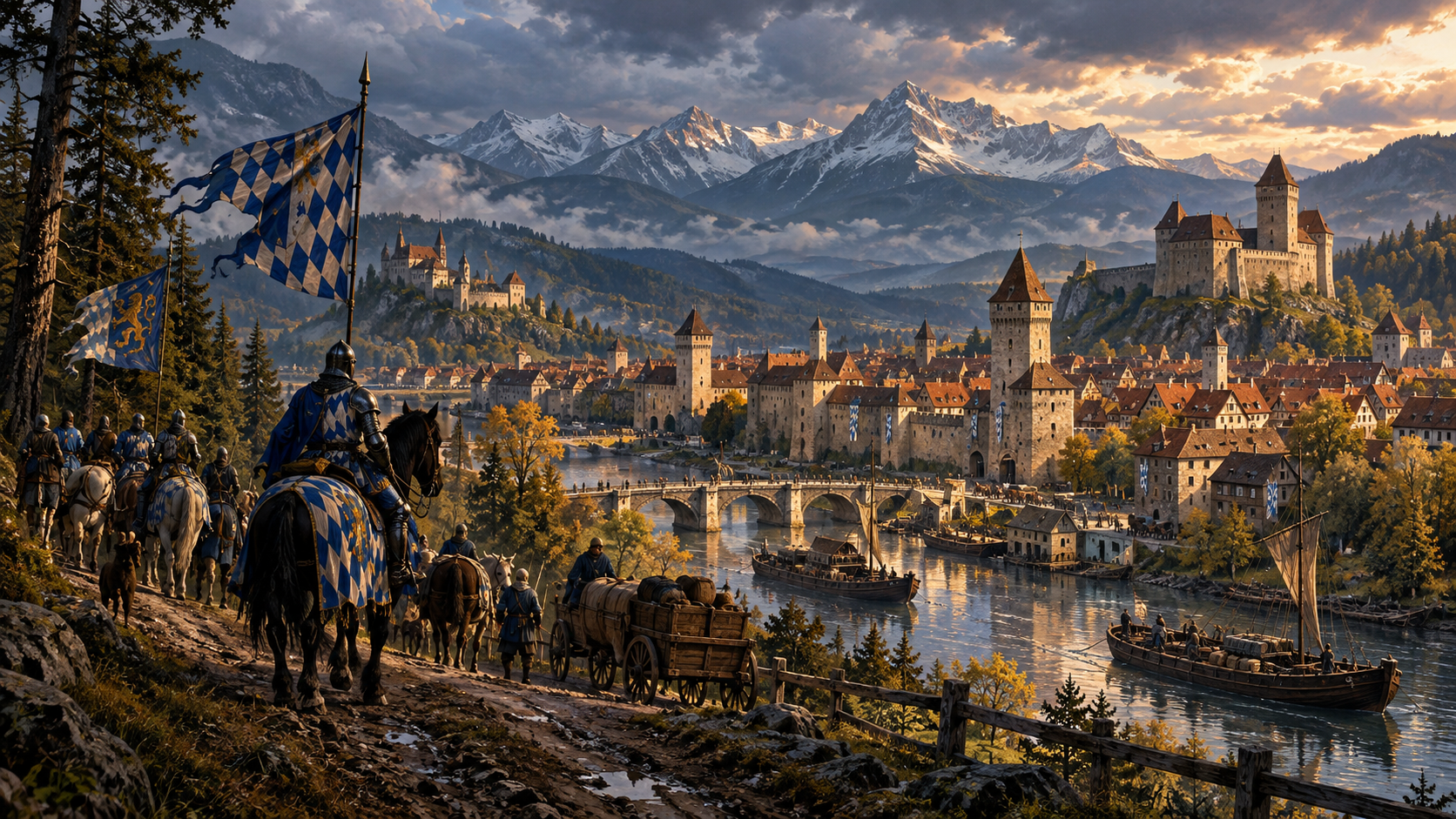
Two courts, one divided dynasty. On the roads between Munich and Landshut, a sealed letter may carry more danger than a drawn sword.
Bavaria at a Glance
| Political Lands | Bavaria-Munich and Bavaria-Landshut — two rival duchies |
|---|---|
| Munich | Albrecht III, reigning duke |
| Landshut | Ludwig IX, the Rich |
| Albert IV | Prince of Bavaria-Munich, envoy, commander and rising voice in the ducal council |
| Principal Courts | Munich and Landshut |
| Trade | Salt, grain, iron, brewing and river tolls |
| Languages | Bavarian German, court Latin and merchant tongues |
| At Stake | Succession, old charters, forest pacts and hidden orders |
A Land Divided by Inheritance
The river roads cross rich grain fields, pine woods and walled market towns. The Isar links Munich and Landshut, the Danube carries northern trade, and the alpine approaches lead south to difficult winter passes. Every bridge has a toll, every castle claims a district and every dispute can expose an older family grievance.
Bavaria is not a unified state in 1454. Albrecht III rules Bavaria-Munich, while Ludwig IX rules the wealthier Bavaria-Landshut. Landshut gained most of the former Bavaria-Ingolstadt inheritance. The dukes are related, but they do not share a single government, treasury or military command. A merchant holding an authentic Munich charter can still be challenged in Landshut.
Beneath the legal boundaries lie the deeper territories of forest spirits, river beings, solitary clans and ancient dwarven works. In the lowlands a written warrant opens doors; in the high forests safe passage must sometimes be bargained for.
What Is Happening Right Now?
An Uneasy Settlement
The Treaty of Erding (1450) settled the division of much of the extinct Bavaria-Ingolstadt inheritance. Landshut retained almost all its gains; Munich secured selected territories and a financial settlement. Four years later, tenants, creditors and captains still quarrel about debts and disputed estates. The treaty settled the dukes’ immediate contest, not every grievance.
Two Competing Courts
At Munich, Albrecht III weighs the claims of nobles and the privileges of towns. At Landshut, Ludwig IX marshals the wealth and influence of a powerful duchy. A messenger welcomed at one court may be stopped at the next frontier, where the same sealed warrant carries no authority.
Albert IV — The Prince Who Will Not Wait
Albert IV has become a powerful voice at the Munich court. He negotiates with rival houses, commands trusted retainers and maintains correspondents from the market towns to the imperial court. His ambition is plain: a stronger Bavaria whose divided branches cannot be played against one another. Yet Albrecht III remains the ruling Duke of Bavaria-Munich. Albert’s authority depends on his father’s commissions and on the captains, councillors and nobles willing to stand with him. He searches for lost charters, concealed debts and broken oaths that might reshape the balance between the two courts. Travellers who bring him reliable evidence may gain an influential patron; those who conceal a document he needs may discover how far his reach extends.
The Secret War of Knowledge
Behind the chancery desks and merchant offices, the Bavarian Illuminati maintain hidden cells in Munich and Ingolstadt. One of their couriers has disappeared with records of the Black Sun trials. The sealed account is now sought by rival agents, each fearing what the others might learn. Under Johann Adam Weishaupt, the order gathers influence through scholars, clerks and courtiers while concealing its activities from the ducal authorities.
Places Adventurers Can Reach
Munich — The Isar Court
Albrecht III’s fortified residence is a city of guild charters, salt traders, gate towers, councils and private ducal audiences. The Old Court and Neuveste protect the household, while disputes at gates and markets offer more accessible work.
Bavaria-Landshut — The Richer Duchy
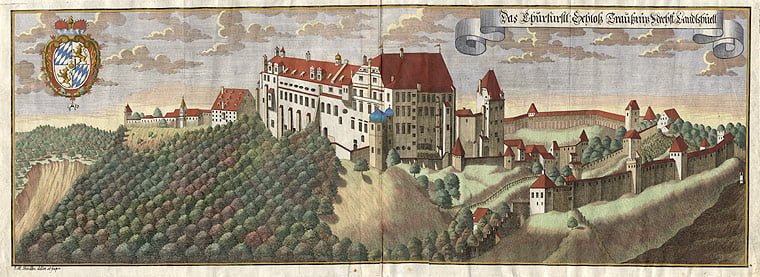
The Landshut court manages fertile estates and major trade revenues. Trausnitz Castle dominates the town. Its stewards, captains and treasurers often matter more to travellers than the duke himself.
Ingolstadt — An Inherited Stronghold
A fortified Danube town once linked to the extinct Ingolstadt ducal branch, now largely under Landshut’s authority. Old charters and municipal privileges complicate new commands. Its bookkeepers and clerks attract the attention of secret scholars.
Prince-Bishopric of Freising
Freising is a neighbouring territory with its own courts, lands and privileges, not simply a suburb or subject estate of the Munich duke. Petitioners exploit these borders and officials jealously protect them.
Regensburg — The Imperial City
Regensburg’s independent civic status and river trade mean that Bavarian ducal power cannot be treated as universal. The nearby Bishopric of Regensburg and Imperial Abbey of Emmeram hold further distinct rights.
Woods, Rivers and High Passes
The deep forest, dangerous pools and Alpine wilderness hide isolated settlements and difficult routes. To the west and south, the County of Tyrol and Archduchy of Austria are neighbouring powers, not ordinary estates of either Bavarian duchy.
People Adventurers May Actually Meet
Albrecht III, Duke of Bavaria-Munich
The experienced reigning duke governs through councillors, judges, household officers and mounted retainers. Petitioners need recognised introductions, witnesses and credible evidence before a matter reaches him.
Albert IV — The Ambitious Wittelsbach Prince
Albert surrounds himself with capable clerks, envoys and mounted retainers, although their commissions still depend upon his father’s favour. He appears at noble hunts, toll hearings and private meetings over disputed estates, where a well-placed document may achieve more than a cavalry charge. He asks precise questions, demands discretion and remembers those who honour their agreements. A sealed message bearing his mark can open the doors of Munich—or draw attention from enemies at Landshut.
Ludwig IX — Duke of Bavaria-Landshut
The Rich Duke is a formidable patron and negotiator with a treasury and broad estates behind him. Travellers might seek payment for escorting a convoy or delivering proof of fraud among his bailiffs.
Anna of Brunswick-Grubenhagen
The Duchess of Bavaria-Munich and Albert IV’s mother controls important household introductions and maintains the kinship ties that hold the ducal court together. Her attendants know which petitions will reach the duke, which visitors have offended the household and which alliances are in need of repair.
Stewards, Bailiffs and Guild Elders
Castle stewards issue orders, clerks protect toll books, guild elders regulate crafts and magistrates defend town privileges. A well-paid toll clerk can delay a caravan for days, while a friendly guild master may arrange a trusted guide or discreetly introduce a visitor to a member of the ducal household.
Factions, Courts and Rival Authorities
- The Munich Wittelsbach household: the duke’s retainers, legal officers, councillors and family protect his existing rights and the succession.
- The Landshut Wittelsbach household: Ludwig IX’s court, officials and garrisons guard the greater inheritance and its revenues.
- Merchant houses and craft guilds: secure markets, river carriage, weights, contracts and privileges, sometimes against ducal officials.
- Independent territorial powers: Freising, Regensburg, the Imperial County of Ortenburg and other neighbouring states keep their own legal standing.
- The Bavarian Illuminati: a secretive order established around 1410, with agents in Munich and Ingolstadt and influence reaching beyond Bavaria. Its members conceal their loyalties from the ducal courts.
- Forest guardians and old-water keepers: local people who tend sacred groves and river pacts without answering to noble courts.
Magic, Markets and Services
Everyday purchases. Inns, wagon repairs, scribes, smiths, brewers, hunters and river pilots serve ordinary travellers. Armoured escorts, unusual medicines and private investigations require negotiation, money and trustworthy introductions.
Unusual craft. Dwarven metalworkers, discreet alchemists and local wise folk may identify strange substances or enchantments. Rare magic is held by individuals and small traditions rather than stocked universally at a market stall.
Living dangers. Hunters whisper of the Wolpertinger in the uplands; ferrymen leave offerings where nixies haunt deep water; and guides avoid scree slopes claimed by Tatzlwyrms. Winter nights bring darker warnings of Perchten and Krampus. Most roads remain busy with ordinary commerce, but lonely crossings deserve care.
Dangers and Adventure Hooks
| d6 | Trouble in the Duchies |
|---|---|
| 1 | The Double Seal. Two apparently genuine warrants claim the same salt caravan for Munich and Landshut. A vanished clerk can establish which one is valid before the convoy is seized. |
| 2 | The Prince’s Cipher. A trusted courier of Albert IV disappears on the road to Ingolstadt. His ledger holds a cipher naming nobles prepared to betray their present patron. The prince needs the truth before either court can turn it into an accusation. |
| 3 | The Ingolstadt Deed. An inherited estate record contradicts the 1450 settlement. An honest claimant, a corrupt bailiff and a foreign agent all seek the original. |
| 4 | The Toll beneath the Isar. Boatmen vanish at a flooded crossing. Their guild blames smugglers, but a nixie guards the water and demands restitution. |
| 5 | Black Sun Courier. The Bavarian Illuminati seek a missing courier. Protecting the witness reveals an illicit network of agents in both duchies. |
| 6 | The Mountain Gallery. A dwarven smith disappears while escorting metal down from the foothills. A Tatzlwyrm has been seen near a collapsed shaft. |
Travel, Law and the Roads Between Courts
The Isar links the two principal ducal capitals, while the Danube carries merchants and messengers through Ingolstadt and Regensburg. Floods close ferries, forest roads turn to mud and snow blocks the higher approaches. The journeys below assume ordinary wagons or well-provisioned travellers in fair weather; mounted couriers may travel faster.
| Road | Journey Guide | Likely Difficulty |
|---|---|---|
| Munich to Landshut | Two to four days for a laden wagon; mounted couriers may be faster | Ducal tolls, bridges, river conditions |
| Munich to Ingolstadt | Several days overland | Former Ingolstadt lands and competing writs |
| Landshut toward Regensburg | Several days across rural estates and river approaches | Imperial and separate territorial law |
| Munich to Alpine foothills | One or more days before the higher passes | Weather, guides, narrow routes |
Whose Writ Is Valid?
Ducal officers enforce local law, while imperial cities, autonomous estates and other lords preserve separate jurisdictions. Keep seals, toll receipts and letters of safe-conduct. A warrant from Munich may be lawful in Munich and useless beyond its duke’s lands. Serious fraud, violence and unauthorised dangerous magic attract local courts.
People of the Roads
Human merchants and farmers share the routes with dwarven craftsmen bound for metal markets, halfling merchant households, gnomish wanderers and occasional elves from the older forests. Their legal standing depends on local custom, charters and noble protection. No ducal register accounts for every woodland settlement or travelling family.
The Division of the Wittelsbach Lands
1392 — The Partition
The Wittelsbach inheritance was divided among Bavaria-Munich, Bavaria-Landshut and Bavaria-Ingolstadt. Estates lay across distant valleys and rivers, leaving the rival courts to contest tolls, road rights and the allegiance of nobles whose lands touched more than one duchy.
1447 — The Ingolstadt Inheritance
The Ingolstadt line ended with the death of Ludwig VII. Henry XVI of Landshut seized the larger portion of its possessions; Albrecht III maintained some claims of his own.
1450 — The Erding Treaty
After Henry XVI’s death, Ludwig IX and Albrecht III accepted a settlement. Landshut retained most of Ingolstadt’s possessions; Munich obtained certain lands and financial concessions. This settlement did not unify Bavaria.
A Separate Electoral Right
The Palatine Wittelsbach branch possesses electoral status, but the Munich and Landshut dukes do not automatically possess the Palatine electoral vote. Family kinship is not the same as identical constitutional rights.
Map and Regional Road Guide
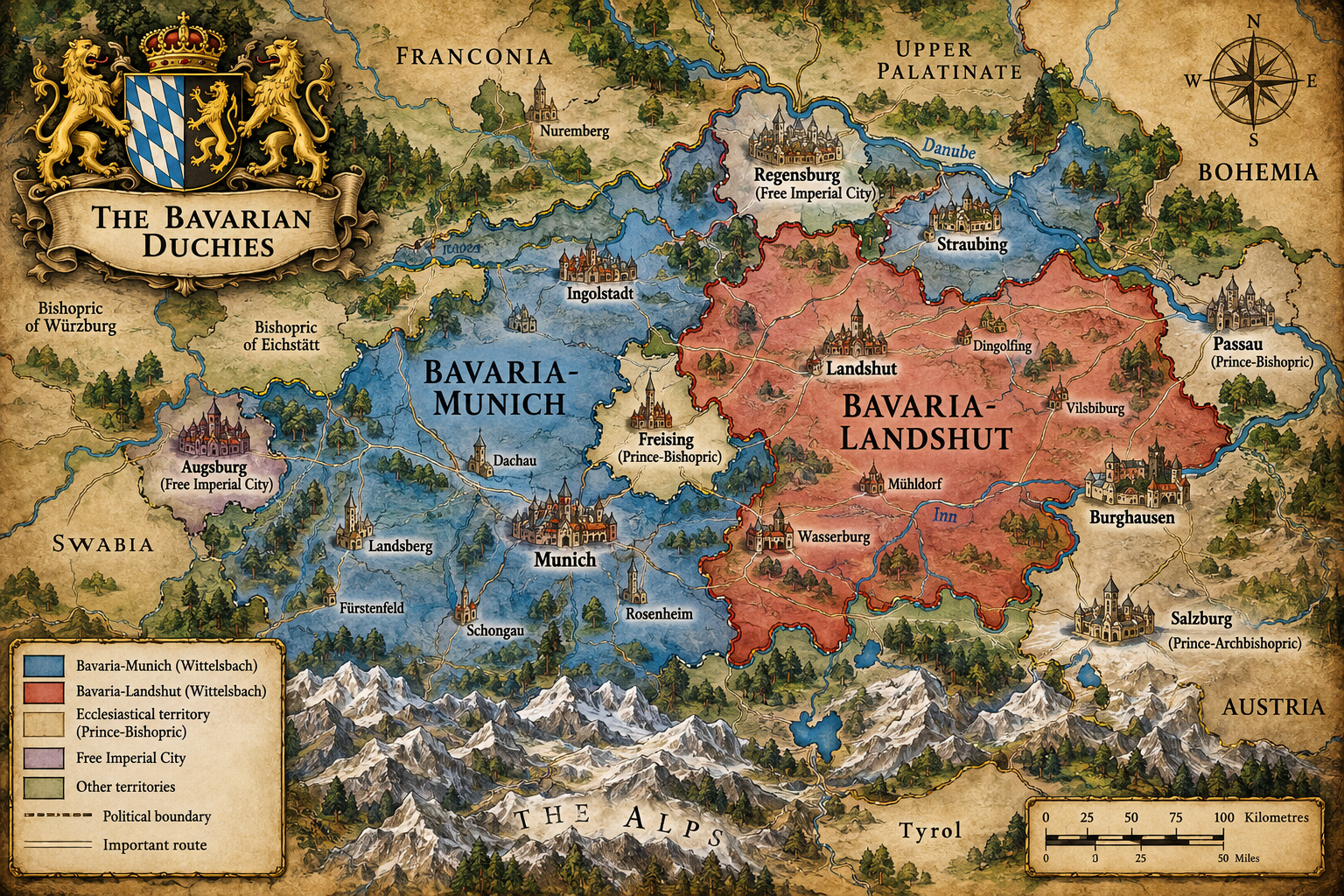
The Isar runs through Munich and Landshut; Ingolstadt and Regensburg stand beside the Danube. Freising maintains its own lands and courts north of Munich, and the Free Imperial City of Regensburg answers to neither Bavarian duke. Beyond these major roads, small lordships and privileged estates make the borders more intricate than the map’s colours suggest.
The Treaty of Erding records the settlement of the disputed inheritance. For local streets, courts and dangers, see Munich, Bavaria-Landshut and Regensburg.
Sources, Images and Historical Background
Bernhard Glasauer, Erdinger Vertrag, 16. Dezember 1450, Historisches Lexikon Bayerns, documents the inheritance division. The Bavarian Palace Administration’s Trausnitz chronology supplies castle context. The hero is an original fantasy painting of Wittelsbach river country; the historical section retains a later Michael Wening engraving of Trausnitz Castle. The shield joins Wittelsbach lozenges and the Palatine lion in a composite design; it is not an official coat of arms of a unified Bavarian duchy in 1454. Supernatural beings, secret orders and adventure incidents belong to the fantasy setting rather than historical documentation.
Keep this reference growing
If this page helped with your reading or game, you can support its upkeep or explore the curated books.
Explore the Bookshop — epics, classics and stories behind imagined worlds.