
George Jeffreys — The Hanging Judge
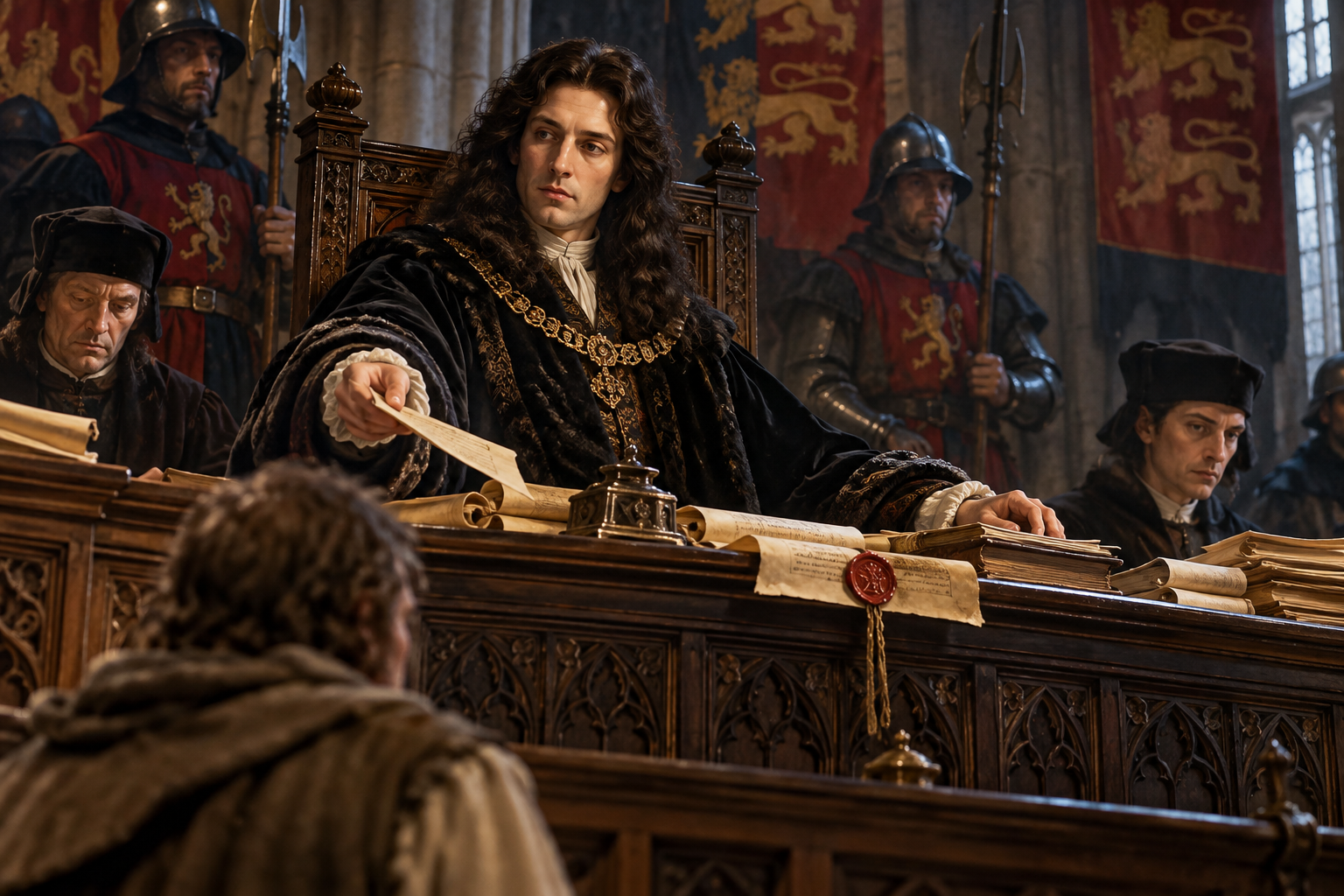
Jeffreys shows how violence can arrive wearing procedure: an official hearing, a lawful seal and a sentence desired before the evidence is heard.
George Jeffreys is translated into the campaign as a royal justice used for politically sensitive trials. He is not secretly possessed by a monster; he is dangerous because institutions can be weaponised by an entirely human official. His hearings are fast, intimidating and shaped by patrons who prefer conviction to uncertainty.
At a Glance
- Species: Human
- Role: Royal justice, interrogator and political legal enforcer
- Primary region: England, especially London and travelling royal courts
- Status: Alive, active and protected by powerful patrons
- Campaign use: Judicial antagonist, dangerous patron, investigator, witness-pressure threat or obstacle to an appeal
- Reputation: Efficient to those who want convictions; terrifying to defendants who expect procedure to protect them
- Immediate pressure: A politically important prosecution is beginning to unravel because one arrest warrant may be forged
- Power: CR 6 in 5.5e; CR 7 in Pathfinder 1e and D&D 3.5e
Game Statistics
George Jeffreys
Medium Humanoid (Human)
AC 15; Initiative +2 (12)
HP 71 (11d8 + 22)
Speed 30 ft.
Skills Deception +7, History +6, Insight +8, Intimidation +10, Investigation +6, Persuasion +7
Senses Passive Perception 12
Languages English, French, court Latin
CR 6 (XP 2,300; PB +3)
Gear court seal, warrant case, concealed dagger, case rolls and armed attendants
Traits
Judicial Authority. During a formal hearing, interrogation or examination conducted under recognised authority, Jeffreys has Advantage on Charisma (Intimidation) checks. A creature that knowingly lies to him during such a proceeding has Disadvantage on its first Charisma (Deception) check unless protected by counsel, patronage or equivalent status.
Control the Record. Once per hearing, when a creature within 30 feet makes an Intelligence (Investigation), Wisdom (Insight) or Charisma (Persuasion) check concerning evidence or testimony, Jeffreys can force that creature to reroll the check and use the new result. A creature presenting authenticated documentary proof is immune to this trait for that check.
Unflinching Office. Jeffreys has Advantage on saving throws against being Frightened while at least one recognised court officer or armed retainer can see him.
Actions
Dagger. Melee or Ranged Attack Roll: +5, reach 5 ft. or range 20/60 ft. Hit: 4 (1d4 + 2) Piercing damage.
Sentence of Fear. One creature Jeffreys can see within 30 feet must succeed on a DC 15 Wisdom saving throw or have the Frightened condition until the end of its next turn. A creature that succeeds is immune to this action for 24 hours.
Call the Officers. One allied guard, bailiff or officer within 30 feet who can hear Jeffreys may use its Reaction to move up to its Speed and make one weapon attack or attempt to Grapple a creature.
Reactions
Objection Sustained. When a creature Jeffreys can hear within 30 feet makes a Deception, Intimidation or Persuasion check during a formal hearing, Jeffreys imposes Disadvantage on the roll. He must do so before the result is known.
George Jeffreys — 5e / 2014
Medium humanoid (human), lawful evil
Armor Class 15; Hit Points 71 (11d8 + 22); Speed 30 ft.; Challenge 1 (200 XP; proficiency bonus +2, personal combat only).
STR 10 (+0), DEX 14 (+2), CON 14 (+2), INT 17 (+3), WIS 15 (+2), CHA 19 (+4).
Saving Throws Con +4, Int +5, Wis +4, Cha +6; Skills Deception +6, History +5, Insight +6 (expertise), Intimidation +8 (expertise), Investigation +5, Persuasion +6; Senses passive Perception 12; Languages English, French, court Latin.
Traits
Judicial Authority. During recognised formal hearings, Jeffreys has advantage on Charisma (Intimidation) checks; witnesses retain ordinary rights to resist, challenge evidence and demand allies or counsel.
Control the Record (1/Hearing). When a creature Jeffreys can hear within 30 feet makes an Intelligence (Investigation), Wisdom (Insight) or Charisma (Persuasion) check concerning evidence or testimony, he may force it to reroll the check and use the new result. Authenticated proof defeats this trait.
Unflinching Office. Jeffreys has advantage on saving throws against being frightened while a court officer or loyal retainer can see him.
Actions
Dagger. Melee or Ranged Weapon Attack: +4 to hit, reach 5 ft. or range 20/60 ft., one target. Hit: 4 (1d4 + 2) piercing damage.
Sentence of Fear. A creature within 30 feet that can see and hear Jeffreys makes a DC 14 Wisdom saving throw; on a failure it is frightened of him until the end of its next turn. A creature that succeeds cannot be affected by this feature for 24 hours.
Original 5e/2014 adaptation; his cruelty and court power cannot be measured by personal combat CR. The existing editions and the fictional 1454 transfer are preserved.
George Jeffreys CR 7
XP 3,200
Male human aristocrat 5/expert 4
Init +2; Senses Perception +12
Defense
AC 17, touch 12, flat-footed 15
hp 58
Fort +5, Ref +5, Will +11
Offense
Speed 30 ft.
Melee dagger +8/+3 (1d4+1/19–20)
Statistics
Str 10, Dex 14, Con 13, Int 17, Wis 15, Cha 19
Base Atk +6; CMB +6; CMD 18
Feats Alertness, Iron Will, Persuasive, Skill Focus (Intimidate), Skill Focus (Sense Motive)
Skills Diplomacy +16, Intimidate +20, Knowledge (local) +15, Knowledge (nobility) +15, Perception +12, Sense Motive +17
Special Abilities
Judicial Pressure (Ex). In a recognised court or formal interrogation, Jeffreys gains a +4 circumstance bonus on Intimidate checks against a creature subject to that court’s authority.
Control the Record (Ex). Once per proceeding, Jeffreys may make an opposed Sense Motive check against a creature attempting to introduce disputed testimony or documentary evidence. Success delays its acceptance until another authority reviews the ruling.
George Jeffreys
Medium Humanoid (Human)
| Hit Dice | 9 class levels (49 hp) |
|---|---|
| Initiative | +2 |
| Speed | 30 ft. |
| Armor Class | 16, touch 12, flat-footed 14 |
| Base Attack/Grapple | +6/+6 |
| Attack | Dagger +8 melee (1d4/19–20) |
| Full Attack | Dagger +8/+3 melee (1d4/19–20) |
| Saves | Fort +4, Ref +5, Will +10 |
| Abilities | Str 10, Dex 14, Con 12, Int 17, Wis 15, Cha 19 |
| Skills | Diplomacy +16, Intimidate +19, Knowledge (local) +14, Sense Motive +16, Gather Information +14 |
| Feats | Iron Will, Persuasive, Skill Focus (Intimidate), Skill Focus (Sense Motive) |
| Challenge Rating | 7 |
Special Qualities
Judicial Pressure (Ex). In a formal court where Jeffreys holds recognised authority, he gains a +4 circumstance bonus on Intimidate checks made against defendants or witnesses subject to that court.
Control the Record (Ex). Once per proceeding, Jeffreys can make an opposed Sense Motive check against a speaker attempting to introduce disputed evidence. Success forces the matter into procedural review rather than immediately accepting the evidence.
What Is George Jeffreys Doing Right Now?
Jeffreys has been sent to hear a group of cases arising from a failed local rising. His instructions are formally neutral, but everybody at court knows that powerful men expect convictions. He has already ordered several witnesses held overnight so they cannot disappear, and he has warned local officers that contradictory depositions will be treated as evidence of conspiracy rather than confusion.
The case is beginning to fracture. One prisoner has produced evidence that the original arrest warrant was forged. If genuine, it does more than free one accused rebel: it points toward a network of officials manufacturing royal authority for private ends. Jeffreys must decide whether exposing the forgery protects the Crown or humiliates the court that relied upon it.
Encounters
- The Witness Before Dawn: A frightened witness asks the party to keep them alive until the hearing. Someone has already tried to move them to another gaol.
- The Excluded Letter: Jeffreys refuses a document because its seal cannot be authenticated. The party has hours to find the clerk who saw it issued.
- The Patron’s Instruction: A senior official privately orders the party to secure a conviction rather than the truth.
- The Old Procedure: The accused invokes an obscure rule that could delay proceedings long enough for new evidence to arrive.
- The Empty Bench: A second judge who was expected to sit beside Jeffreys vanishes on the morning of the hearing.
Using George Jeffreys at the Table
Jeffreys works best when violence is possible but not yet the obvious solution. Put the players in situations where they can win through evidence, witness protection, patronage, legal procedure, exposing forged authority or forcing another official to take responsibility.
- Private audience: Jeffreys is controlled and direct. He wants names, dates, seals and witnesses, not moral speeches.
- In court: He dominates the pace. He interrupts weak answers, isolates contradictions and uses procedure to keep opponents reacting.
- When threatened: Jeffreys calls guards, secures the record and tries to turn an attack on himself into proof that his enemies fear lawful judgement.
- When shown decisive proof: He may reverse course abruptly if doing so preserves the authority of the court and damages the official who misled him.
Personality
Jeffreys is forceful, impatient and acutely sensitive to challenges to authority. He enjoys intellectual control more than theatrical cruelty. His harshest moments come when he believes a witness is wasting the court’s time, concealing a patron or trying to embarrass him publicly.
He is not fearless. He simply understands that visible hesitation weakens a judge faster than almost any legal error. When uncertain, he often becomes more formal, not less.
Appearance and Manner
Jeffreys dresses as a wealthy royal justice in dark, expensive clothing suited to a travelling court, with a court seal, document case and attendants close at hand. His appearance is deliberately official rather than flamboyant. He wants the room to notice the office before the man.
At the bench he leans forward when questioning witnesses and rarely wastes words. He reads documents closely, remembers inconsistencies and uses silence as pressure. Outside court he can be unexpectedly conversational, particularly with people who bring useful information without demanding public credit.
Ambition, Pressure and Private Truth
Jeffreys wants to become indispensable to the Crown: the judge sent where ordinary courts are too frightened, compromised or politically entangled to act. That ambition makes him vulnerable to patrons who can provide difficult cases and then demand convenient results.
His private problem is legitimacy. He knows that if royal justice becomes visibly fraudulent, every future warrant becomes harder to enforce. That creates a useful fault line for players: Jeffreys may protect a brutal verdict, but he may also turn savagely on the official who forged the document that made the prosecution possible.
Relationships and Influence
- Henry VI: The king’s name gives royal courts their highest authority, even when access to the king himself is uncertain.
- Richard, Duke of York: A lawful Protector whose warrants, appointments and political enemies can pull Jeffreys into the central struggle for government.
- Adam Orleton: A formidable legal and diplomatic mind capable of challenging Jeffreys on interpretation, precedent and procedure.
- Royal clerks and sheriffs: Essential to turning judgements into arrests, confiscations and transport orders.
- Witnesses and petitioners: The people most able to change a case and therefore the people most likely to be pressured before it begins.
Equipment and Resources
- Court seal and warrant case
- Case rolls, witness lists and copied depositions
- Fine dark robes and travelling clothes of office
- Concealed dagger
- Armed bailiffs and messengers
- Letters of introduction to sheriffs, gaolers and local officers
- A private notebook recording contradictions that do not appear in the official court roll
Adventure Hooks
- The Predetermined Sentence: Everyone knows the expected verdict except the evidence.
- The Missing Witness: One testimony can collapse the prosecution, provided the witness reaches court alive.
- The Forged Warrant: An arrest was made under a seal that should not exist.
- The Sealed Order: Jeffreys receives two contradictory commands, each apparently genuine.
- The Appeal: Winning the case is impossible; surviving long enough to reach another authority may not be.
- The Judge’s Notebook: Someone steals Jeffreys’s private record of inconsistencies and begins blackmailing both defendants and royal officers.
Connected Places and People
Mythical and Historical Context
Campaign chronology: The actual George Jeffreys lived from 1645 to 1689. The royal judge encountered here is an invented fifteenth-century counterpart given the same name and intimidating manner, not the seventeenth-century official transported unchanged. The Dictionary of Welsh Biography documents the real jurist; the forged warrant and 1454 court intrigue are campaign fiction.
The historical George Jeffreys belonged to a later century and became notorious for his role in politically charged trials and the Bloody Assizes. This campaign version deliberately translates that reputation into an earlier royal court rather than importing later clothing, institutions or chronology unchanged.
The important element retained is not caricature but function: a highly capable judge closely associated with central authority, remembered for intimidation, severity and proceedings in which law and political power became difficult to separate.
Sources and Adaptation
George Jeffreys is adapted from the historical George Jeffreys, 1st Baron Jeffreys (1645–1689). His placement in the current campaign period, his relationships with contemporary campaign figures, the forged-warrant investigation and all encounter material are alternate-history adaptations created for play. Later powdered-wig imagery and later institutional details are not used as campaign-present assumptions.
Rules and Image Licensing
The 5.5e / 2024, Pathfinder 1e and D&D 3.5e statistics are original game adaptations using the open rules conventions of their respective systems. The painted royal-court hero is original site artwork created for this campaign adaptation. Earlier George Jeffreys artwork remains in the media library as reference material.
Keep this reference growing
If this page helped with your reading or game, you can support its upkeep or explore the curated books.
Explore the Bookshop — epics, classics and stories behind imagined worlds.