
Adam Orleton — Royal Diplomat of Hereford
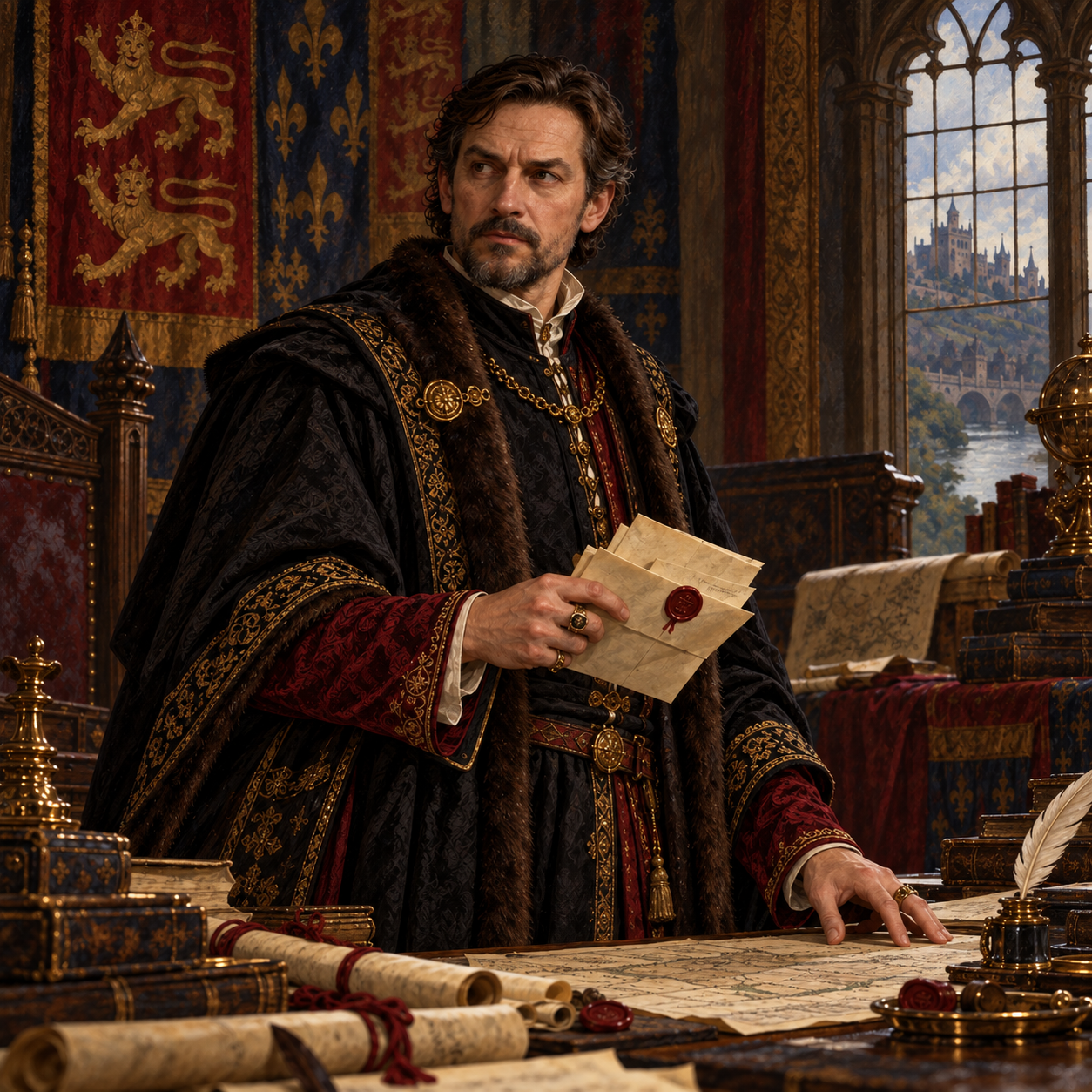
Orleton makes dangerous political arguments sound like ordinary administration, which is why rival factions keep finding uses for him.
Adam Orleton is recast as a living royal diplomat, legal negotiator and senior civic ritual administrator attached to Hereford. His strength is not battlefield command but the ability to build a lawful-looking route toward the result his patron wants. He drafts interpretations, negotiates abroad, rearranges appointments and knows exactly how much ambiguity a document can carry before it becomes useless.
At a Glance
- Species: Human
- Role: Diplomat, legal negotiator, royal administrator and political fixer
- Primary region: Hereford, London, the Welsh frontier and continental courts
- Status: Alive, active and regularly entrusted with difficult commissions
- Campaign use: Political patron, envoy, legal adversary, document expert or intermediary between rival factions
- Reputation: Brilliant with wording, dangerous with precedent and rarely careless enough to make only one plan
- Immediate pressure: Conflicting orders over Marcher levies appear to have been altered so that either side can later deny responsibility
- Power: CR 7 in 5.5e; CR 8 in Pathfinder 1e and D&D 3.5e
Game Statistics
Adam Orleton
Medium Humanoid (Human)
AC 15; Initiative +2 (12)
HP 82 (11d8 + 33)
Speed 30 ft.
Skills Deception +7, History +10, Insight +9, Investigation +10, Persuasion +10
Senses Passive Perception 13
Languages English, French, court Latin, two additional diplomatic languages
CR 7 (XP 2,900; PB +3)
Gear seal, document case, cipher notes, letters of safe conduct, fine travelling cloak and dagger
Traits
Legal Framing. Once per scene, after Orleton or an ally within 30 feet fails an Intelligence (Investigation), Wisdom (Insight) or Charisma (Persuasion) check involving law, warrants, treaties or official procedure, Orleton may allow that creature to reroll the check.
Diplomatic Immunity. Orleton has Advantage on Charisma checks made against officials who recognise his current commission, unless he has openly broken the terms of that commission.
Dangerous Ambiguity. Orleton can draft a written instruction that supports two plausible interpretations. A creature studying the document must succeed on a DC 17 Intelligence (Investigation) check to identify both readings before one of them is contradicted by direct evidence.
Actions
Dagger. Melee or Ranged Attack Roll: +5, reach 5 ft. or range 20/60 ft. Hit: 4 (1d4 + 2) Piercing damage.
Expose the Contradiction. Orleton identifies a flaw in a creature’s account. One creature he can hear within 30 feet must succeed on a DC 15 Wisdom saving throw or have Disadvantage on the next Deception or Persuasion check it makes before the end of its next turn.
Order the Messenger. One allied creature within 30 feet that can hear Orleton may use its Reaction to move up to its Speed without provoking Opportunity Attacks.
Reactions
That Is Not What the Order Says. When a creature Orleton can hear within 30 feet makes a Deception, Investigation or Persuasion check concerning a written order, treaty or warrant, Orleton imposes Disadvantage on the roll. He must do so before the result is known.
Adam Orleton — 5e / 2014
Medium humanoid (human), lawful neutral
Armor Class 15; Hit Points 82 (11d8 + 33); Speed 30 ft.; Challenge 1 (200 XP; proficiency bonus +2, personal combat only).
STR 10 (+0), DEX 14 (+2), CON 16 (+3), INT 19 (+4), WIS 16 (+3), CHA 18 (+4).
Saving Throws Int +6, Wis +5, Cha +6; Skills Deception +6, History +8 (expertise), Insight +7 (expertise), Investigation +8 (expertise), Persuasion +8 (expertise); Senses passive Perception 13; Languages English, French, court Latin, two additional languages.
Traits
Legal Framing (1/Scene). After Orleton or an ally he can see within 30 feet fails an Intelligence (Investigation), Wisdom (Insight) or Charisma (Persuasion) check about warrants, treaties or official procedure, that creature can reroll the check, using the second roll.
Diplomatic Immunity. Orleton has advantage on Charisma checks against officials recognising his genuine commission, unless he openly violates it.
Dangerous Ambiguity. Orleton can draft an instruction with two plausible readings; a DC 16 Intelligence (Investigation) check identifies both interpretations.
Actions
Dagger. Melee or Ranged Weapon Attack: +4 to hit, reach 5 ft. or range 20/60 ft., one target. Hit: 4 (1d4 + 2) piercing damage.
Expose the Contradiction. One creature within 30 feet that can hear Orleton must succeed on a DC 14 Wisdom saving throw or have disadvantage on its next Deception or Persuasion check before the end of its next turn.
Original 2014 conversion. This challenge rating describes Orleton alone in a fight; his far greater campaign threat is control of documents, officers and patrons. Existing 2024/PF1e/3.5e statistics remain unchanged.
Adam Orleton CR 8
XP 4,800
Male human expert 6/aristocrat 3
Init +2; Senses Perception +13
Defense
AC 18, touch 12, flat-footed 16
hp 64
Fort +5, Ref +6, Will +11
Offense
Speed 30 ft.
Melee dagger +8/+3 (1d4+1/19–20)
Statistics
Str 10, Dex 14, Con 14, Int 19, Wis 16, Cha 18
Base Atk +6; CMB +6; CMD 18
Feats Alertness, Iron Will, Negotiator, Persuasive, Skill Focus (Diplomacy)
Skills Diplomacy +21, Intimidate +15, Knowledge (history) +18, Knowledge (local) +17, Linguistics +19, Perception +13, Sense Motive +18
Special Abilities
Legal Framing (Ex). Once per scene, Orleton can grant an ally within 30 feet a +4 circumstance bonus on a Diplomacy, Knowledge or Linguistics check involving official procedure, treaties or warrants.
Dangerous Ambiguity (Ex). A document drafted by Orleton may support two plausible readings. Identifying both requires a successful opposed Linguistics check against Orleton’s Linguistics.
Adam Orleton
Medium Humanoid (Human)
| Hit Dice | 9 class levels (55 hp) |
|---|---|
| Class Levels | Expert 6/Aristocrat 3 |
| Initiative | +2 |
| Speed | 30 ft. |
| Armor Class | 17, touch 12, flat-footed 15 |
| Base Attack/Grapple | +6/+6 |
| Attack | Dagger +8 melee (1d4/19–20) |
| Full Attack | Dagger +8/+3 melee (1d4/19–20) |
| Saves | Fort +5, Ref +5, Will +10 |
| Abilities | Str 10, Dex 14, Con 14, Int 19, Wis 16, Cha 18 |
| Skills | Diplomacy +20, Decipher Script +18, Knowledge (history) +17, Knowledge (local) +16, Sense Motive +17, Speak Language 4 |
| Feats | Iron Will, Negotiator, Persuasive, Skill Focus (Diplomacy) |
| Challenge Rating | 8 |
Special Qualities
Legal Framing (Ex). Once per scene, Orleton can grant an ally a +4 circumstance bonus on a Diplomacy, Knowledge or Decipher Script check involving a formal order, treaty or legal interpretation.
Dangerous Ambiguity (Ex). A document drafted by Orleton can sustain two plausible interpretations until contradicted by external evidence; recognising both readings requires an opposed Decipher Script check.
What Is Adam Orleton Doing Right Now?
Orleton is comparing three versions of the same order concerning Marcher levies. The wording differs by only a few lines, but each version places responsibility on a different authority if the troops cross the frontier without permission. One copy bears a household seal associated with Henry VI; another carries an endorsement from officials aligned with Richard, Duke of York.
Orleton believes the disagreement is deliberate. Someone wants the levy to move while preserving enough ambiguity for every powerful patron to deny ordering it. He wants neutral adventurers to trace the messengers, recover the missing draft and establish which wording existed first before he commits himself to an interpretation.
Encounters
- The Hypothetical Question: Orleton asks the party what appears to be a theoretical question about obedience to a warrant. Their answer determines which commission he offers them.
- Two Readings, One Letter: Rival factions quote the same sentence to prove opposite claims. Orleton wants the party to find the clerk who copied the original.
- The Silent Envoy: A foreign representative refuses to speak except through Orleton, turning every translation choice into a political act.
- The Stolen Draft: A preliminary version of an order disappears because its discarded wording proves intent more clearly than the sealed final document.
- The Border Muster: Armed retainers have already begun assembling. The party must reach them before a disputed interpretation becomes an irreversible military fact.
Using Adam Orleton at the Table
Orleton works best when the adventure turns on what an order means, who had authority to issue it and who benefits from a particular interpretation. He should give players choices rather than merely explaining politics to them.
- Private audience: He asks precise questions and rarely reveals which answer he hopes to hear.
- Negotiation: Orleton offers language both sides can accept, then quietly points out what each side has actually conceded.
- Document scene: He compares seals, handwriting, corrections and messenger routes before making a judgement.
- Under threat: He avoids heroics, secures the documents first and uses safe-conducts, witnesses and rival jurisdictions as protection.
Personality
Orleton is patient, ambitious and almost never surprised by hypocrisy. He treats law as a structure that can protect people or conceal power depending on who writes first. He is rarely shocked by a lie; what interests him is why that particular lie was chosen and who needed it written down.
He prefers leverage to confrontation and is at his most dangerous when apparently conceding a point. Orleton can be genuinely useful to people in danger, but he seldom acts without considering what obligation the rescue creates.
Appearance and Manner
Orleton dresses as a wealthy learned official and senior royal envoy: dark layered robes, a fine travelling cloak, seal cases, writing materials and a document satchel carried close at hand. A clerk or messenger is usually nearby. Nothing about his appearance is accidental; even the order in which documents are presented is part of the argument.
He speaks calmly, rarely interrupts and has the unnerving habit of repeating a person’s exact words back to them several minutes later. When he is angry, he becomes more precise rather than louder.
Ambition, Pressure and Private Truth
Orleton wants to be the man rival powers still need when they can no longer speak directly to one another. That requires a reputation for usefulness without becoming so obviously partisan that half the realm refuses to deal with him.
His immediate pressure is the Marcher levy dispute. If he chooses the wrong interpretation, one faction will accuse him of manipulating the order and the other will abandon him as unreliable. Privately, he suspects the ambiguity was designed by someone who understands his methods well enough to make him carry the blame.
Relationships and Influence
- Hereford civic institutions: His administrative base and the network through which he finds clerks, messengers, witnesses and local information.
- Henry VI: The king’s household remains a source of commissions, seals and dangerous uncertainty when instructions arrive through competing officers.
- Richard, Duke of York: A lawful Protector whose officials need interpreters capable of turning emergency authority into workable orders.
- George Jeffreys: A formidable legal operator whose preference for decisive rulings often clashes with Orleton’s preference for language that preserves room to manoeuvre.
- Marcher lords: Clients, opponents and bargaining partners who value Orleton’s wording precisely because frontier authority is rarely simple.
Equipment and Resources
- Personal seal and document case
- Legal rolls, copied warrants and cipher notes
- Fine travelling cloak and practical court dress
- Dagger
- Letters of safe conduct and introductions
- A network of clerks, messengers and interpreters
- A private bundle of discarded drafts whose corrections reveal what powerful people originally intended to say
Adventure Hooks
- The Ambiguous Levy: One sentence can start a border war if the wrong lord reads it first.
- The Missing Draft: A preliminary text proves intent more clearly than the sealed final version.
- The False Envoy: Diplomatic credentials are almost perfect, but one formula belongs to the wrong chancery.
- The Marcher Appeal: Two lords demand contradictory rulings and both can produce apparently valid warrants.
- The Sealed Interpretation: Orleton will commit himself only after the party finds the messenger who carried the first copy.
- The Dead Clerk’s Hand: A murdered copyist left marginal notes showing that an important order was altered after sealing.
Connected Places and People
Mythical and Historical Context
Campaign chronology: The historical Adam of Orleton died in 1345. His appearance as a living royal diplomat in 1454 is a conscious fictional survival, not a claim about the documented career. The negotiation, record-keeping and political crisis elements are grounded in the Dictionary of National Biography’s Adam of Orleton entry; supernatural longevity and any modern campaign relationships belong only to the setting.
The historical Adam Orleton was an English administrator and diplomat associated with Herefordshire who became deeply involved in the political crisis surrounding Edward II. He served on diplomatic missions, supported the coalition that removed Edward from power, later held treasury office and continued to act for the Crown under Edward III.
Those traits make him useful as a campaign political operator: highly educated, experienced in negotiation, comfortable with disputed authority and capable of surviving changes of regime by remaining useful to whoever controls government.
Sources and Adaptation
This version draws on the historical Adam Orleton’s documented work as a royal administrator, diplomat and political intermediary. His survival into the campaign present, his connections to Henry VI, Richard of York and George Jeffreys, the Marcher levy dispute and the encounter material are campaign adaptations. See the Encyclopedia.com biography of Adam of Orleton for the historical career behind the adaptation.
Rules and Image Licensing
The 5.5e / 2024, Pathfinder 1e and D&D 3.5e statistics are original game adaptations using the open rules conventions of their respective systems. The painted campaign hero is original site artwork created for this adaptation. Earlier Adam Orleton artwork remains in the media library as reference material.
Keep this reference growing
If this page helped with your reading or game, you can support its upkeep or explore the curated books.
Explore the Bookshop — epics, classics and stories behind imagined worlds.