
Guelders — The Independent Duchy of Arnold of Egmont
Four quarters · Duke Arnold · Cities, noble houses and a Burgundian frontier
At a Glance
| Realm | Independent Duchy of Guelders, an imperial principality in the Low Countries |
|---|---|
| Ruler | Arnold of Egmont, Duke of Guelders since 1423 |
| Family | Duchess Catherine of Cleves and their teenage son Adolf |
| Territory | The quarters of Nijmegen, Zutphen, Arnhem/Veluwe and the Upper Quarter around Geldern and Roermond |
| Government | Duke, regional estates, noble households and cities with influential privileges and courts |
| Neighbours | Philip the Good’s Burgundian holdings, Cleves, Utrecht and other imperial principalities |
| Rivers and trade | The Waal at Nijmegen, the IJssel at Zutphen, Rhine routes near Arnhem and the Maas through the Upper Quarter; grain, pottery, cloth and livestock |
| Folklore and sacred life | White women of the Lochem hills, the haunted Solse Gat, local river shrines and the gods honoured in the towns |
Arriving in Guelders
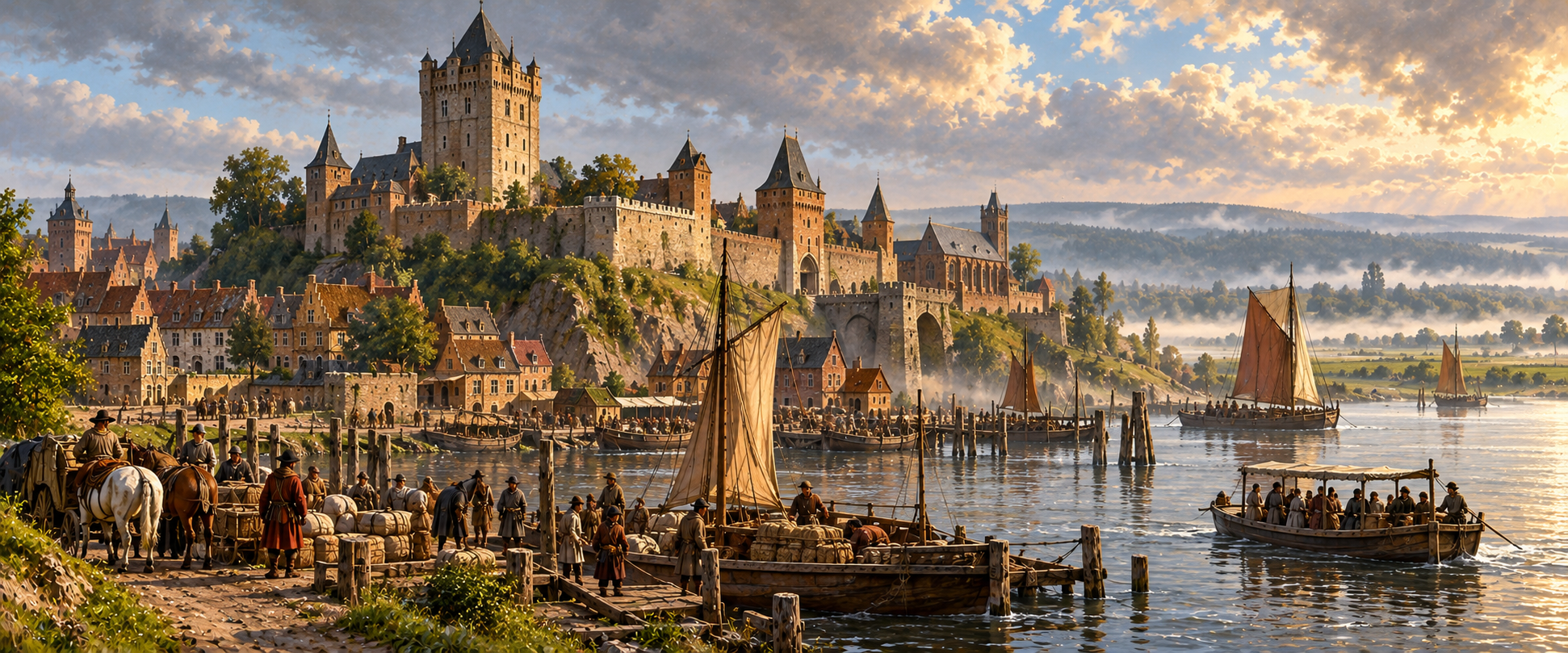
Look down from Nijmegen’s stone walls and the Waal is busy with ferries, grain boats and long, low cargo barges. Above the landing stands the great Valkhof castle. Eastwards the river roads pass market towns, grazing fields and wooded heights. In the Veluwe, even a well-used cart track can disappear between the trees. Guelders is a duchy of four quarters, but the river town where you arrive matters more than a noble title on a map.
Duke Arnold of Egmont holds Guelders and the county of Zutphen. His wife Catherine of Cleves and their son Adolf live within a court whose neighbours are keen to influence it. Burgundy has not conquered the duchy. The local councils guard their freedoms, though travellers are more likely to meet a bargeman seeking a crew or a farmer whose stock has strayed than the duke himself.
Bring dry provisions for the road and ask a ferryman about the current before agreeing to a crossing. From Nijmegen the Waal opens the western waterways; farther north the IJssel links Zutphen with the Hanseatic towns. The wooded Veluwe is better crossed with someone who knows the sandy tracks and marshy hollows.
What Is Happening Right Now?
The Ferry Below the Valkhof
A ferry on the Waal reached Nijmegen with its cargo of clay jars intact but without its pilot. The stern rope was tied from inside the boat and the ferryman’s dog refuses to go near it. Maarten, a potter waiting for his wares, will pay anyone who traces the boat’s last crossing. A boy on the bank saw a lantern moving against the current just before dawn.
White Figures on the Lochem Road
A cart carrying flour and iron tools has not returned from the road near Lochem. Villagers saw white figures moving on the wooded slopes after dark. The driver is alive, but his apprentice has been missing since he climbed towards a hollow among the hills. Geertruid, the apprentice’s aunt, wants the boy found before a party of armed neighbours goes searching with torches.
The Duke’s Unwanted Visitors
A small company of strangers arrives at Arnhem asking for a safe passage to the river. Among them is a sailor who says he fought under Grutte Pier’s Black Hope of Arum. Two armed escorts wearing Burgundian colours follow him. A ducal captain needs witnesses to learn whether they came to arrest a fugitive or steal a packet of letters. Prince Adolf watches how his father’s officers handle the affair, measuring their loyalties.
Places Worth Exploring
Nijmegen and the Valkhof
The city stands high over the Waal. The Valkhof, a great stone castle rebuilt by Emperor Frederick Barbarossa, overlooks the quay and ferries. Porters haul grain, iron and pottery through the streets below. The old sacred precinct and markets provide supplies and news from river travellers. A party seeking the missing pilot can begin with the boys who watch the ferry landings.
Arnhem and the Veluwe
Arnhem is a market town near the Rhine, where wagons arrive from the wooded Veluwe. Merchants stock rope, harness, lamp oil and spare wheels before crossing towards the duchy’s other quarters. Beyond the town, heath and forest open onto isolated farms and ancient paths. A rider who loses the sandy road can wander for hours among the pines.
Zutphen, Lochem and the Achterhoek
Zutphen has its own counts’ history and busy IJssel quays. Its guilds and merchants are proud of their links with inland trade, yet the countryside beyond is a different world of wooded rises, farm tracks and old burial places. Near Lochem and Zwiep, travellers speak of white women among the hills. The road can be walked in daylight; at dusk villagers ask who else is watching the path.
Geldern, Roermond and the Upper Quarter
The Upper Quarter reaches from Geldern towards Roermond on the Maas. Market boats, mills and small fortresses connect farms with inland towns and neighbouring territories. Teamsters need safe river landings and repairs more often than a court audience. A small shrine or a ferryman’s cabin may be the only shelter between villages after rain.
The Veluwe and the Solse Gat
In a deep hollow of the Veluwe, travellers tell stories of buildings lost beneath the earth and strange sounds heard after sunset. This is the Solse Gat, known in later local legend as the site of a sunken religious house. Here its old sacred precinct is buried under sand and leaf mould. The hollows are worth exploring, but a lost woodsman is a better reason to enter them than a promise of easy treasure.
People, Folklore and Everyday Life
Duke Arnold struggles to hold his court together while stronger neighbours seek influence. Duchess Catherine of Cleves and young Adolf have their own allies and interests. In the towns, guild families, ferry owners, millers and craftsmen carry on regardless. A messenger’s seal may open a gate; a hungry mule needs hay, and a stranded boat needs someone who can handle a rope.
The Witte Wieven Near Lochem
People in the Achterhoek speak of witte wieven, pale women seen around wooded hills, hollows and ancient mounds. No two hollows promise the same welcome. One woman guides a traveller away from a dangerous drop; another drives intruders from the resting place she guards. People who know the Lochem road approach them respectfully, and never mistake every wisp of mist for an enemy.
The Hollow in the Veluwe
Old tales say a sacred house sank at the Solse Gat. Woodcutters now report bells sounding from under the forest floor on windless evenings. One may be a trick of the trees, another the warning of something still keeping watch beneath the ground. A search should start by asking the foresters what has changed rather than digging up the entire hollow.
Divine rites differ among households, town sanctuaries and forest shrines. Healers, shrine attendants and guides can offer practical help; rare spellwork cannot be assumed to be waiting at every market stall.
Where to Stay and Find Help
The following inns, named hosts and their services are campaign establishments rather than documented historical businesses.
- The River Bell, Nijmegen: Martha serves thick soup and bread near the Waal landing. There are straw beds upstairs and a guarded storeroom, but horses are stabled in a separate yard. Martha knows the ferry crews and the potter Maarten.
- The Green Stag, Arnhem: a quieter inn kept by Dirk, with a small stable, dry rooms and a blacksmith who repairs wagon fittings. Woodland guides eat here when they return from the Veluwe; do not expect them to take strangers into the forest after dark without good reason.
- The Three Reeds, Zutphen: Elske rents a few rooms above a busy riverside common room. A barge can unload nearby, and visiting cloth merchants share news of the road to Lochem. She can put travellers in touch with a miller or boatwright.
Town markets sell rope, grain, lamps and basic ironwork. For specialist healing ask at a reputable civic shrine; for ferry repairs seek the boatwrights who work on the quay. Keep animals outside overcrowded lodging houses and find dry storage for provisions before a long crossing.
Travel and Onward Routes
- West by the Waal: boatmen carry cargo and travellers from Nijmegen towards Holland. Hire someone who knows the shallows, especially after a flood.
- North by the IJssel: follow the markets of Zutphen towards Overijssel and its trading cities.
- East through the Achterhoek: the smaller roads lead towards Lochem, wooded heights and neighbouring imperial territories. Ask where the next reliable well and inn can be found.
- South to the Upper Quarter: roads and rivers link Geldern, Roermond and the Maas country. A fast rider and a laden barge take very different amounts of time.
Weather closes tracks without warning. A cart that passes safely through a village in summer may sink at the same crossing after autumn rain. Before leaving town, speak to someone who has travelled the route this week.
History and Sources
Guelders was raised to a duchy in 1339 and organised around four important quarters: Nijmegen, Arnhem, Zutphen and the Upper Quarter centred on Roermond and Geldern. Duke Arnold of Egmont came to power in 1423. His teenage son Adolf is already drawing the attention of rival noble households. For the four-quarter political geography and Arnold’s contested position, see Ghent University research on late-medieval Guelders and the Canon of Nijmegen.
Nijmegen’s Valkhof was rebuilt in stone by Barbarossa in 1155 and served later lords of Guelders. The Gelderland heritage account of the Valkhof describes its medieval use. Mijn Gelderland’s Lochem folklore record and the broader Gelderland folklore collection document the white-women traditions while noting how the particular Zwiep tale was reshaped much later. They are inspiration for the present supernatural encounters, not proof that a modern story was told in this exact form in the Middle Ages.
The living spirits, the names and services of the inns, and the immediate missing-person incidents are inventions for this campaign. The existing overview of the duchy and ducal succession list remain useful supplementary references.
Related Lands
The Low Countries · Burgundian Netherlands · Utrecht · Zutphen
Keep this reference growing
If this page helped with your reading or game, you can support its upkeep or explore the curated books.
Explore the Bookshop — epics, classics and stories behind imagined worlds.