
Kingdom of Naples — Alfonso’s Southern Court
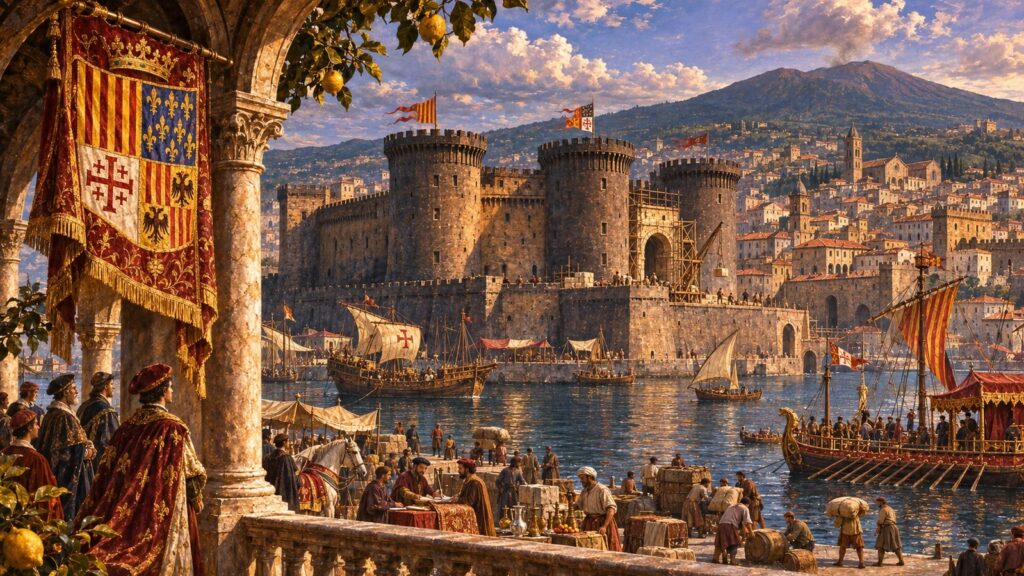

At a Glance
| Region | Southern mainland Italy, from Abruzzo and Campania to Apulia and Calabria |
|---|---|
| Capital | Naples |
| Ruler | Alfonso V of Aragon, ruling Naples as Alfonso I |
| Heir | Ferrante, Duke of Calabria |
| Government | Royal court and territorial lords under strong Aragonese administration |
| Pressure | Succession, baronial power, Aragonese ties and the Sacred College’s claims |
| Campaign tone | Court terror, harbour trade, captivity and restless dead |

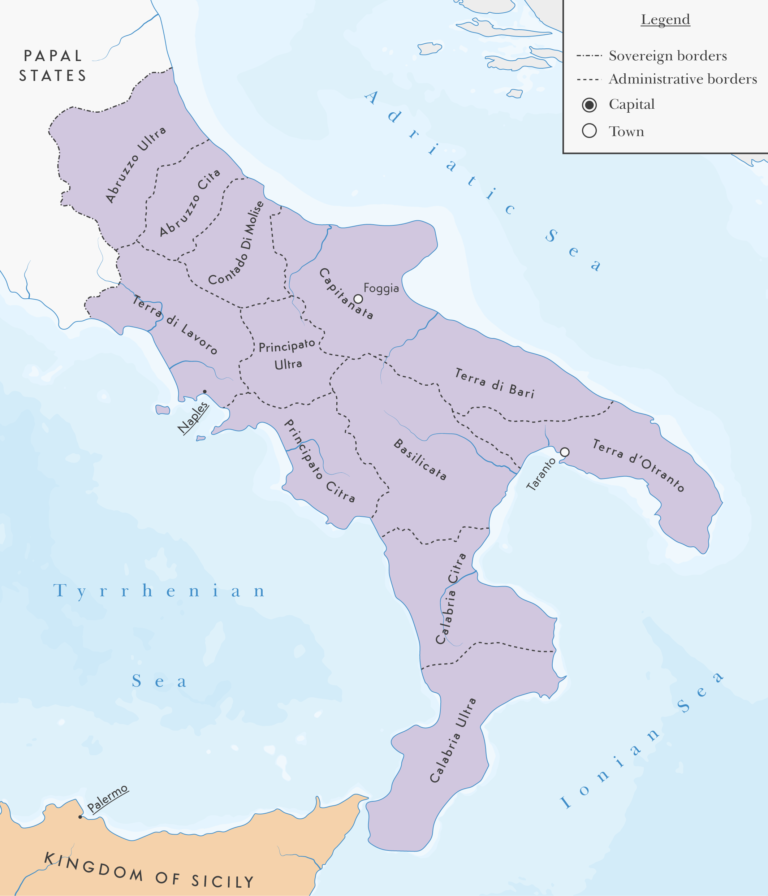
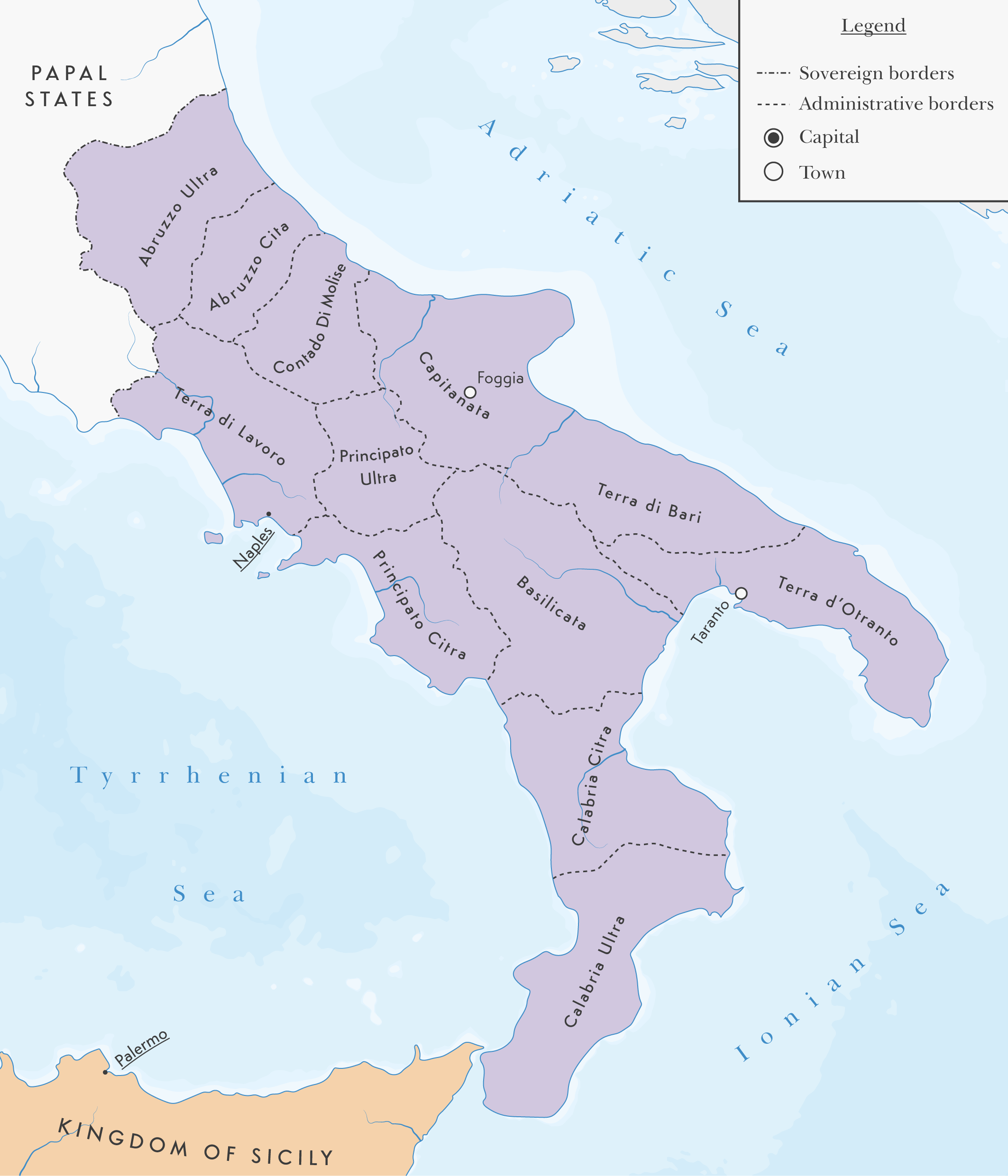
Campaign Map — The Kingdom and Its Provinces
Naples rules the southern mainland, from the Abruzzi to the Straits of Messina. This historical map locates its twelve provinces and principal towns in 1454. Sicily is a separate kingdom under Alfonso V; Benevento is a papal enclave within the surrounding mainland.
Naples is a magnificent place to arrive by sea and a dangerous place to enter royal service. Alfonso V has made the city the centre of his southern kingdom and a court of soldiers, diplomats, scholars and ambitious nobles. His heir Ferdinand “Ferrante”, Duke of Calabria, already has his own clients, enemies and ruthless reputation. Behind the splendour lie barons with private soldiers, merchants who need the port open and courtiers calculating what happens when the old king dies.
A messenger from Taranto waits outside the royal hall while masons carve Alfonso’s unfinished arch. His letter concerns a dead nobleman’s inheritance. In Ferrante’s chambers, another dead nobleman is about to speak. The king can refuse the first audience, but someone has already promised the second.
What Is Happening Right Now?
The Prince of Taranto is furious. Giovanni Antonio Orsini del Balzo, the most formidable lord in the southeast, has seen Alfonso favour Maria Donata in the dispute over the lands of Gabriele Orsini, who died in 1453. The prince remains an immensely valuable royal ally, yet his household is building a case against the decision. Messengers are already carrying different versions of the inheritance to Bari, Taranto and Naples. A forged testimony could turn a grievance into open conflict.
A peace abroad is changing bargains at home. The agreement made at Lodi in 1454 between Milan and Venice gives Italian rulers new reasons to seek allies, restrain their soldiers and exchange envoys. Alfonso cannot afford to ignore Milan, Genoa or the Roman States while the fate of his Neapolitan succession remains unsettled. A diplomatic courier arriving by sea may be more dangerous than a mercenary captain.
A mason is missing from Castel Nuovo. Alfonso’s rebuilt towers dominate the harbour, but the great marble entrance is not yet finished. A sculptor’s assistant has vanished after seeing a sealed coffin carried through a working passage after dark. The king’s officers believe the man stole quarry accounts; Ferrante’s keeper fears he saw a way into the Still Court.
The Kingdom Beyond Naples
The crown rules much of the southern Italian mainland, from the Abruzzi south to Calabria and east across Apulia. Mountains interrupt the roads, fertile plains support cities and flocks, and every major harbour has patrons whose loyalty cannot be taken for granted. This is not Sicily: Alfonso wears both crowns, but the island kingdom and mainland kingdom have distinct histories, administrations and local interests.
Campania and Terra di Lavoro — The Crown’s Heart
Naples contains the royal court, the wealthiest gathering of patrons, the busy western harbour and the fortress that makes royal ambition visible. Capua guards inland approaches, Aversa lies amid the northern court lands, and Gaeta is a fortified seaport on the road toward Rome. Here the king can more readily assemble guards and officials, but a traveller can still be followed by agents of rival households. The coastal villages supply fish, olive oil, sailors and news from the north.
Salerno, Amalfi and the Southern Coast
Salerno serves the gulf, its surrounding farmland and the routes entering the southern hills. Amalfi and neighbouring ports know the demands of trade and difficult coasting waters; they have old maritime traditions without possessing the power of the royal capital. The narrow roads and cliffside paths make a discreet landing or interception possible, though hauling heavy supplies inland is another matter. Ships that cannot safely enter Naples sometimes seek shelter farther down the coast.
Apulia — The Two Seas and the Great Lord
The Adriatic ports of Bari, Trani, Brindisi and Otranto face merchants and dangers from across the water. Taranto, looking into its sheltered inner waters and out toward the Ionian Sea, is the seat of Giovanni Antonio Orsini del Balzo’s formidable principality. Lecce and the estates of Terra d’Otranto connect his family to the southern countryside. Royal influence here must reckon with the prince’s retainers, officers and extensive kinship network. A proclamation from Naples is not enough to make Taranto obey.
Foggia and the Tavoliere — Wool and Grain
The broad plains near Foggia sustain grain cultivation and winter pasture. Flocks descend along long-established drove roads from the Abruzzi mountains, bringing shepherds, merchants and disputes over access to grazing land. Wool, food and pack animals are practical foundations of royal power. Adventurers protecting a vulnerable caravan of herders may discover that powerful men are using shepherds to carry messages between distant estates.
Basilicata, Calabria and the Southern Straits
Wooded inland valleys, mountain roads and fortified hill settlements divide Basilicata from the more accessible coast. Cosenza anchors the northern Calabrian interior; Reggio watches the narrow waters toward Sicily. Storms and piracy can endanger a passage, but even safe weather cannot overcome a hostile port commander. The mainland’s southern tip provides a route to the king’s island realm and an escape from the reach of some northern enemies.
Abruzzo and the Northern Marches
L’Aquila, Chieti and the mountain towns look toward rugged passes and the northern Italian states. Their soldiers and livestock matter greatly to the crown. Benevento, however, is a separate sacred enclave within the southern political landscape, not simply another royal Neapolitan city. Travellers crossing its territory must account for a different set of loyalties and authorities.
People Who Can Change Your Fortunes
Alfonso V, the Magnanimous: king of Aragon and Naples, patron of learning and determined master of the royal household. A petition may impress him if it solves a problem that his councillors cannot settle. His generosity does not mean that he willingly surrenders command of the kingdom he conquered.
Ferrante, Duke of Calabria: Alfonso’s acknowledged heir and ruler of a private court. His favour can obtain soldiers or sanctuary; his enmity may place someone among the undead witnesses of the Still Court. He intends to inherit Naples, not his father’s entire Aragonese dominion.
Isabella of Chiaromonte: Ferrante’s wife since 1445. She is a niece of Giovanni Antonio Orsini del Balzo, Prince of Taranto; her household therefore links Ferrante directly to the great lord whose support the crown needs. She is a vital route to negotiations the prince cannot conduct with threats alone. A request addressed respectfully to her may find a hearing after Ferrante has refused one.
Giovanni Antonio Orsini del Balzo: Prince of Taranto, Duke of Bari and a major pillar of royal military power. He supported Alfonso, but the succession to his brother Gabriele’s estates has become an immediate source of grievance. He does not yet lead the later open rebellion, yet he has the men and influence to make the king take his objections seriously.
Antonio Beccadelli, called Panormita: humanist and court author who gives Alfonso’s achievements a lasting public voice. A story pleasing to the king may be rewarded; a document that changes the official account of the conquest could be invaluable. Giovanni Pontano: a younger scholar in Alfonso’s orbit, still building his influence rather than exercising the power he will hold in later decades.
Rodrigo Borgia, the Golden Pontiff: a powerful external figure in the kingdom’s sacred politics. His supporters seek leverage over titles and royal oaths, but the monarchy and great lords contest any claim that his judgement settles every Neapolitan dispute.
Torquemada’s Agents at Alfonso’s Court
In Naples, the Inquisition of Flame and Iron has access to Alfonso V’s royal court through Aragonese nobles, courtiers and officials who value its spies and financial intelligence. A tribunal envoy may seek the return of a suspected fugitive or evidence concerning an Iberian faction. Torquemada’s organisation cannot replace the Neapolitan judiciary: the king, local barons and the Roman States’ Sacred College all resist attempts to turn a foreign seal into an unquestioned order.
An examiner demands access to a noble family’s private archive after letters are intercepted at the port. The family insists the documents concern the succession, not forbidden worship. Ferdinand’s men see an opportunity to learn which barons are preparing to betray him. If the examiner’s case proves genuine, the court risks exposure to a dangerous infernal compact; if it was manufactured, Torquemada’s influence may provoke a diplomatic scandal.
Gods of Naples and the Southern Kingdom
At court, Jupiter sanctions oaths, Juno receives devotion from noble households and Minerva is honoured by craftsmen, scholars and patrons of learning. Along the shore, Poseidon and Neptune guard ships and fishermen; older inland sanctuaries preserve the rites of Demeter and Persephone. Such worship remains entangled with competing Neapolitan institutions, including the Sacred College’s claims.
The Inquisition of Flame and Iron has foreign patrons at Alfonso’s court, but its examiners cannot simply condemn a priest who serves an established Neapolitan god. A baron who offers the inquisitor shelter may lose the loyalty of sailors who depend on their shrine at the harbour mouth.
Current Pressures
The succession after Alfonso
Alfonso has ruled Naples since his conquest of the kingdom, but the future already matters. Ferdinand is his designated heir in Naples, while the king’s wider Aragonese inheritance will not pass to him in the same way. Barons, foreign courts and sacred lawyers are positioning themselves before the succession becomes a crisis.
Rodrigo’s judgement
Rodrigo Borgia, the Golden Pontiff, can question a marriage, title or oath that supports the succession. Alfonso needs the Sacred College kept inside the settlement; Ferdinand needs it prevented from deciding his future for him.
Sea and southern roads
Genoese vessels, Aragonese interests and island trade meet in the harbour. Inland lords can hinder grain, tax a bridge or shelter a claimant.
Places Worth Visiting
Castel Nuovo — The King’s House
Alfonso’s five mighty towers face the port and protect the heart of his court. Its rebuilding has brought masons, sculptors and costly stone to the city. The great triumphal arch is still being carved, and the galleries are full of people who know which doorway admits a royal visitor and which only leads to a guardroom. Courtiers come seeking a commission; prisoners might enter without ever being named publicly. The work passages also hide the approaches to Ferrante’s forbidden Still Court.
Castel Capuano — Ferrante’s Household
Ferrante and Isabella receive servants, petitioners and select guests away from the king’s principal fortress. The Duke of Calabria’s household contains capable guards, ambitious attendants and people with divided family loyalties. A discreet conversation with Isabella may prevent violence that an official audience with Ferrante would make unavoidable. Someone who is welcomed here may never learn what lies beneath Castel Nuovo.
The Harbour and Waterside Markets
Catalan and other Aragonese vessels share the waterfront with Genoese merchants, coastal craft and sailors seeking work. Grain, oil, wool, timber, cloth and letters pass between ships and the crowded market streets. Crews exchange news more quickly than ministers do; a shipmaster may know which noble house has bought passage for armed men. The danger is not merely theft, but a cargo that becomes evidence in a struggle between rival patrons.
The City of Scholars and Petitioners
Copyists, interpreters, physicians, artists and masters of rhetoric are drawn to Alfonso’s royal patronage. A scholar may win a meal for translating a rare text or lose a patron for repeating an unguarded remark. Antonio Beccadelli’s associates hear the king’s version of his victories; a rival chronicler may preserve accounts the court wishes forgotten.
Old Powers Beneath the Gulf
Castel dell’Ovo — The Egg That Holds Naples
The oldest sea fortress of Naples rises from the islet of Megaride. Sailors say that the poet Virgil, master of secret arts, placed a charmed egg in a vessel deep beneath its stones. If the egg breaks, the castle and the city lose the protection he laid upon them. A royal officer dismisses the story as superstition; the castle’s oldest keeper guards the lower doors with great care. When water begins seeping through a wall that has stood dry for generations, two rival patrons offer to pay adventurers to find the vessel. One wants the egg protected, the other wants to learn what happens if it cracks.
Lake Avernus and the Cumaean Sibyl
West of Naples, beyond Pozzuoli and the steaming ground of the Phlegraean Fields, the dark waters of Avernus lie in an ancient volcanic hollow. The Greeks and Romans knew the lake as a way towards the Underworld. Its fumes can harm an unprepared traveller even when no spirit walks its banks. Above it, the ruins and sacred passages of Cumae preserve memories of Apollo’s Sibyl, whose oracles once guided heroes to the dead. Those who ask for a name or a prophecy may receive an answer on a fallen leaf, but the dead do not surrender their secrets without a cost. An escaped witness from Ferrante’s Still Court could make for this ancient passage, seeking the freedom denied by the prince’s necromancers.
Who Controls the Dead?
Ferrante can bind individual corpses through his keepers and seals; he cannot command the Underworld itself. Priests of Persephone may recognise a rightful passage for the dead that the prince’s household has defied. The loss of a captive’s binding does not make the creature harmless. A bargain struck by the shore of Avernus may save a witness while placing an older and less forgiving power against the court.
Services, Magic and Royal Access
What Visitors Can Obtain
Passage by sea can be arranged through brokers, shipmasters and merchants who know the coast to Sicily, the Adriatic or northern Italian ports. A captain may accept a reliable armed escort more readily than a stranger’s promise of later payment. On land, guides familiar with an Apulian estate or a mountain crossing are often more useful than a grand letter from the capital. Physicians, horse dealers, copyists, translators, shipwrights and armourers are available in the larger towns, though local reputation matters.
Temples and Ritual Specialists
Within Naples, the established priesthoods of Jupiter, Juno and Minerva attend oaths, households, scholars and craftsmen. At the harbour, worshippers of Poseidon and Neptune seek blessings before hazardous voyages; inland, the harvest cults of Demeter remain important. Clerics may provide healing, divination and blessings appropriate to their patron and training, but these services depend on a real priest, a willing temple and the terms of the request. The dead who serve Ferrante have not been raised by these ordinary household rites.
Access to Power
A merchant reaches court through a patron; a stranger may first need an introduction from an officer, scholar or trusted shipmaster. The quickest path to Ferrante is not necessarily the safest. Characters who carry evidence of a threat to his inheritance may win a private hearing, but the prince has more than one way to question a witness. The Inquisition of Flame and Iron has contacts among Alfonso’s Aragonese visitors; it cannot simply overrule the king, his great lords and the kingdom’s established priesthoods.
Dangers, Rumours and Adventure Hooks
The Prince’s Missing Witness
A messenger carries sworn testimony about Gabriele Orsini’s disputed estates, but the witness dies before arriving in Naples. A noble intermediary asks the adventurers to recover his documents from a guarded lodging. Ferrante already possesses the dead man’s voice in his Still Court and offers to reveal it only if the party undertakes a second, darker service. The characters can seek the written evidence, win the confidence of Taranto’s agents, bargain with the undead witness or expose the prince’s private gallery.
A Door Beneath the Unfinished Arch
A stoneworker disappears after taking a wrong turn through the rebuilding works at Castel Nuovo. His sister believes he was seized over a debt; his master insists he stole a valuable sketch of the new gate. In truth, he has found a route to Ferrante’s bound dead. One inhabitant of the Still Court has offered to keep him alive in exchange for a message sent to an estranged daughter. The rescue becomes difficult when the keeper discovers that the prisoner knows the route and orders the doors sealed.
The Sheep Road Letters
A caravan bringing sheep from the Abruzzi to the plains near Foggia is attacked on a narrow road. Its shepherds carry no treasure, but one has hidden correspondence between a northern financier and a magnate of Apulia. The bandits are paid to destroy the letters, not steal the flock. The adventurers can safeguard the animals, follow the attackers to their employer, or discover that the letters could split the king’s alliance with Taranto.
The Galley with Two Masters
A vessel arrives off Naples flying one flag but carrying sealed papers from another court. Its captain refuses to enter the harbour until a named envoy meets him at sea. The ship also holds a survivor who can identify an attack on an allied convoy. Genoese interests, Aragonese officers and a representative of the Sacred College all want the passenger. The characters may decide which patron receives the witness, but saving a man’s life could upset the delicate new balance between Italian states.
Travel, Borders and Authority
North by land: travel through Capua and Gaeta leads toward the territories and cities of the Roman States. A separate road network passes toward the inland Apennine settlements. East: crossing the mountains reaches the grain lands and Adriatic ports of Apulia, including Bari and Brindisi. South: coastal passages and hill roads reach Salerno, Calabria and the waters opposite Sicily. West and north by sea: merchant routes connect Naples with Genoa and other Mediterranean harbours.
The time required depends on wind, season, mountain weather, the condition of a vessel and the willingness of local authorities to let travellers pass. In towns directly held by Alfonso, royal officers answer for the king’s peace. Beyond them, a powerful baron’s household, a municipal council or the authorities of a separate enclave may matter more than a distant royal command. Benevento is not a straightforward royal possession. Adventurers should identify who actually controls the gate, bridge or harbour before assuming that a Neapolitan commission protects them.
History and Sources
The mainland kingdom grew from the long contest over southern Italy after the separation of the island of Sicily from the old kingdom. Angevin rulers made Naples their capital, but disputes over dynastic succession left rival households and foreign claimants with deep roots in the country. Queen Giovanna II’s contested arrangements and the later struggle with René of Anjou brought Alfonso V of Aragon into a costly war for the throne.
Alfonso took Naples in 1442 and made his ceremonial entry in February 1443. His dynasty governs a land that still contains former Angevin supporters and magnates powerful enough to challenge a royal officer. His acknowledged son Ferrante, Duke of Calabria, is heir to Naples and married Isabella of Chiaromonte in 1445; the wider Aragonese inheritance follows a different line. Ferrante will not succeed Alfonso as king until 1458. In 1454 the duke’s claim is recognised at court, but the great lords are still deciding whether they will uphold it when the throne becomes vacant.
The year 1454 has its own immediate flashpoints. Gabriele Orsini del Balzo died in 1453; the king’s decision concerning his estates has angered his brother Giovanni Antonio, Prince of Taranto. Farther north, the Peace of Lodi has opened new diplomatic negotiations after years of fighting between Milan and Venice; Alfonso’s formal participation in the later Italian League belongs to 1455. Castel Nuovo’s rebuilt stone towers already dominate the waterfront, but its triumphal entrance remains under construction.
Alfonso’s humanist court draws writers including Antonio Beccadelli and Giovanni Pontano, while the kingdom’s wealth still depends on practical sources of power: the grain and wool of Apulia, seasonal flocks from the Abruzzi, harbour trade, rural estates and the loyalty of armed households. Beneath Castel Nuovo, Ferrante’s bound undead turn the private memory of betrayal into a weapon that may outlast the men who commit it.
Historical sources: Treccani: Alfonso V; Treccani: Ferrante; Treccani: Giovanni Antonio Orsini del Balzo; Columbia: Castel Nuovo’s Aragonese reconstruction; Guenzi and Rossi: wool and grain in southern Italy; Lazzarini: the Peace of Lodi and its alliances; Naples tourism: Castel dell’Ovo and Virgil’s egg; City of Naples: Lake Avernus and the Sibyl.
Historical map: Cattette, Kingdom of Naples administrative divisions (1454) (CC BY-SA 4.0). Heraldry: FDRMRZUSA, royal arms of Naples under Aragonese monarchs (CC BY-SA 4.0; image displayed without changes to the design).
Keep this reference growing
If this page helped with your reading or game, you can support its upkeep or explore the curated books.
Explore the Bookshop — epics, classics and stories behind imagined worlds.