
Rodrigo Borgia — The Golden Pontiff and Borgia Sovereign
Rome · Sacred College · House Borgia · Sovereign-Pontiff
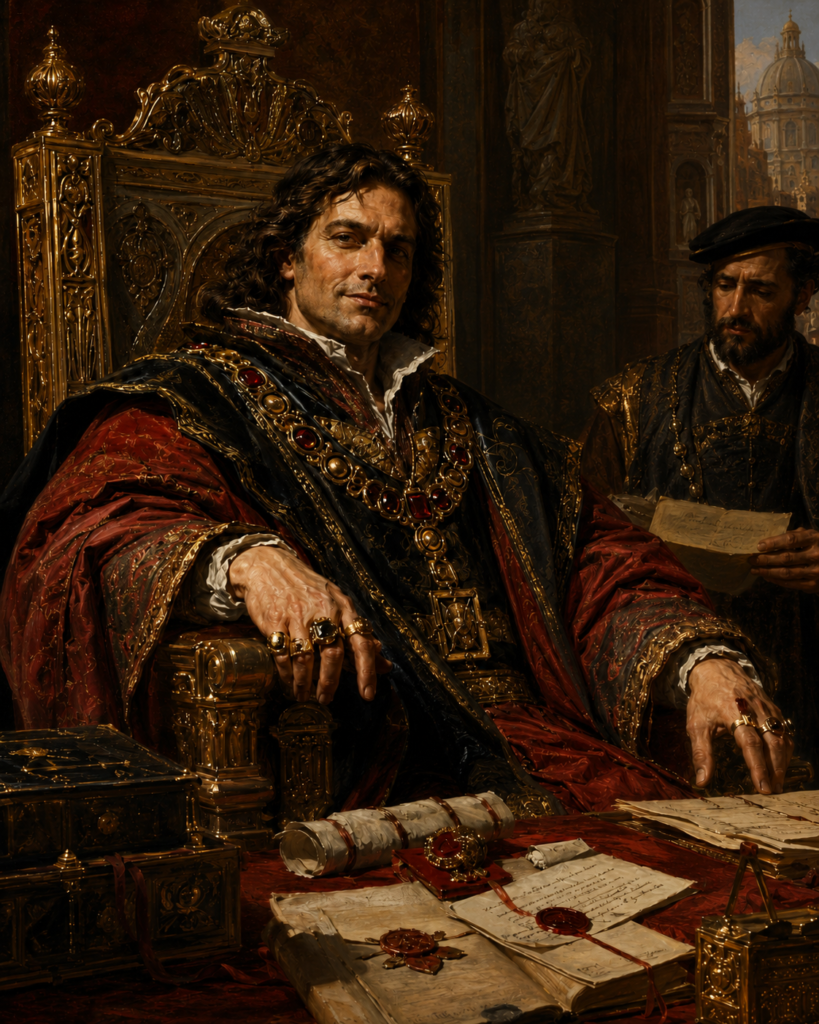
Rodrigo Borgia is the sovereign-pontiff of the Sacred College and one of the most dangerous political powers in Italy. He does not need to conquer every enemy. He can legitimise an heir, invalidate a marriage, recognise a claimant, open an archive, condemn an oath or make an entire court wonder whether opposing him is lawful.
Explore: Italian NPCs · Rome · Roman States · Cesare Borgia · Lucrezia Borgia
Sovereign-Pontiff of the Sacred College, Father of the Borgia Ascendancy, the Valencian Fox
- Aliases: Rodrigo de Borja, Rodrigo Borgia, the Golden Pontiff, the Valencian Fox, the Father of Dispensations, Sovereign-Pontiff of the Sacred College
- Gender: Male
- Ancestry: Human
- Occupation: Sovereign-pontiff, sacred monarch, dynastic kingmaker, legal autocrat, patron of artists, scholars, spies, and assassins
- Origin: Xàtiva, Kingdom of Valencia, Crown of Aragon
- Nationality / Political Identity: Valencian; Aragonese by political root; ruler within the Mediterranean sacred-legal order
- Languages: Valencian/Catalan, Castilian, Latin, Italian, court French, Greek for ceremony and learned intimidation
- Religion / Sacred Office: Supreme head of a Mediterranean sacred-legal hierarchy concerned with kingship, inheritance, oaths, relics, marriage, legitimacy, divine sanction, and interdiction
- Abode / Base of Operations: The palace-temple of the Sacred College in Rome; villas, courts, archives, fortified treasuries, and Borgia-controlled residences across the Italian states
- Affiliations: House of Borgia, Sacred College, temple courts, Aragonese interests, Italian noble factions, banking houses, legal universities, mercenary captains
- Allies: Borgia relatives, loyal temple-princes, bankers, clerks, assassins, court physicians, spies, artists, diplomats, ambitious nobles
- Enemies: Roman old houses, rival sacred families, reformers, dispossessed claimants, foreign kings, betrayed lovers, exposed witnesses, incorruptible judges
- Significant Others: Lovers, children, favourites, and dynastic dependants should be treated as political vulnerabilities and instruments of policy
- Alignment: Lawful Evil
- Role: Sovereign patron, sacred tyrant, dynastic kingmaker and courtly endgame power
- Challenge: CR 15 in D&D 5.5e / 2024-style play; CR 15 in Pathfinder 1e
- Current Reach: Full sovereign-pontiff authority across the Sacred College, its courts, archives, dispensations, relic law and dynastic judgements
Overview
Rodrigo Borgia is not merely a corrupt holy man. He is a sovereign who understands that the most durable throne is not made of iron, but of permission.
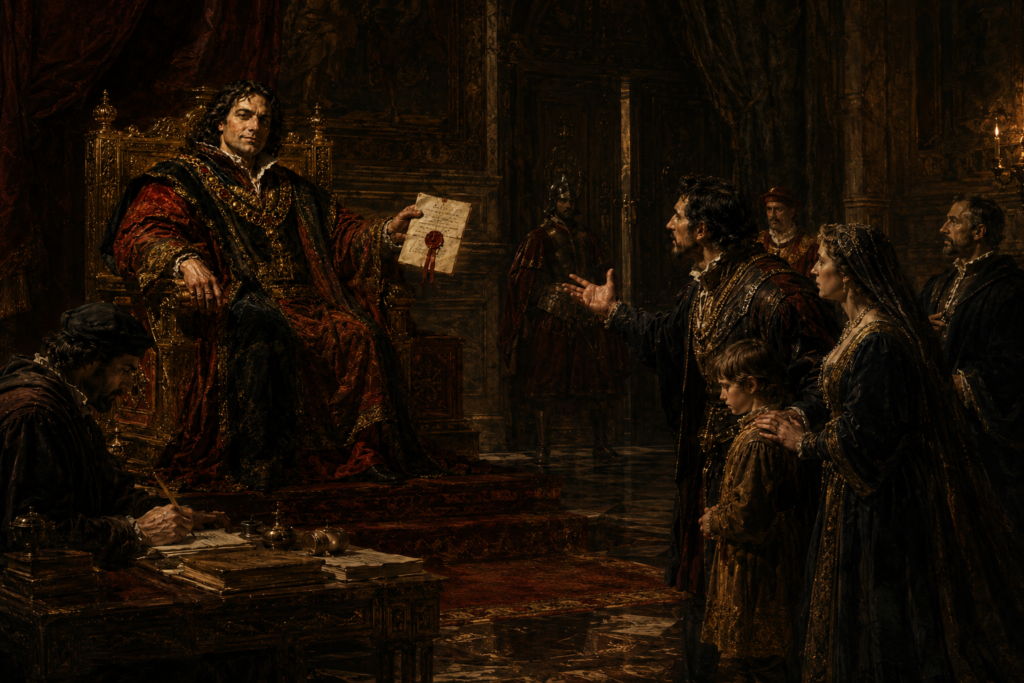
He decides which marriages bind. He decides which bastards become heirs. He decides which ruler is lawful, which oath is sacred, which relic is genuine, which crime is forgiven, which scandal is proclaimed, and which dynasty is placed under divine suspicion. Armies can take cities. Rodrigo can make cities believe their conqueror has no right to rule them.
In public, he is magnificent. He gives feasts, funds artists, grants pardons, blesses marriages, receives ambassadors, honours widows, and speaks of peace with a warmth that can move a hostile room. In private, he is precise, hungry, and almost impossible to shame. He does not see contradiction between sacred office and dynastic appetite. He believes power is safest when held by the man most capable of using it.
Rodrigo Borgia’s evil is not chaos. It is order bent around himself.
He does not need to kill every enemy. He can delegitimise them, bankrupt them, bind their heirs in marriage, expose their bastards, deny their oaths, freeze their inheritance, or make their allies doubt whether opposing him is lawful. When violence is necessary, it arrives through a servant, a cup, a sealed warrant, a hired captain, a private knife, or a public trial.
He is a patron as much as a villain. Player characters may need him. He can open borders, restore titles, pardon crimes, confirm inheritances, sanctify dangerous alliances, release prisoners, silence accusations, or place them under his protection. Every gift is real. Every gift is expensive.
Sacred Office
Rodrigo rules the Sacred College as sovereign-pontiff. Its palace-temple court controls divine sanction, inheritance law, relic authority, noble dispensations, oath courts, marriage legitimacy, interdiction and the spiritual legality of rule across much of the Mediterranean world.
That authority makes him dangerous far beyond Rome. A sealed judgement can legitimise a claimant, destroy a marriage alliance, release an oath, place a city under interdiction or turn a private scandal into a question of lawful rule.
Appearance
Rodrigo Borgia is handsome, heavy with authority, and lavish without seeming foolish. He dresses like a man who understands that splendour is a form of government: deep velvet, cloth-of-gold, fur-lined robes, jewelled rings, soft gloves, and sacred insignia that make his body appear almost secondary to his office.
His face is warm, full, and expressive. He smiles easily. He listens beautifully. He can make a petitioner feel chosen, a young noble feel destined, an old enemy feel briefly safe, and a murderer feel understood.
His eyes are the danger. They do not glare. They receive.
Rodrigo’s body is not that of a battlefield champion, but he has the presence of a man who expects armed men to move when he raises one finger. In his own halls, drawing steel against him feels less like attacking a man and more like striking the law itself.
Character
Rodrigo is a dynastic sacred monarch. He believes family, law, office, appetite, and divine authority can be fused into a single instrument of rule.
He is not a hypocrite in the simple sense. He does not believe sacred law is meaningless. He believes it is extremely meaningful, and therefore too important to be left in the hands of weak men, sentimental fools, or rival families.
He is capable of real generosity. He is capable of loyalty. He can reward service magnificently. He can admire courage, beauty, wit, scholarship, and political nerve. He may protect artists, scholars, widows, bastard children, disgraced nobles, and ruined petitioners with sincere warmth.
But Rodrigo’s mercy always creates a relationship of ownership.
He does not ask, “Is this good?”
He asks, “Can this be made lawful?”
Then he asks, “Who benefits?”
Then he makes sure the answer is Borgia.
What Rodrigo Wants
Rodrigo wants the Borgia name to become part of the machinery of the world.
Not merely wealthy.
Not merely noble.
Not merely feared.
Permanent.
He wants Borgia blood in ruling houses, Borgia clients in temple courts, Borgia captains in fortress commands, Borgia clerks in archives, Borgia debt in noble treasuries, Borgia lovers in private chambers, and Borgia law in the mouths of judges.
His goals in play should involve:
- legitimising a bastard who changes succession;
- invalidating a marriage to collapse a rival alliance;
- sanctifying a marriage that creates a Borgia client-state;
- claiming or authenticating a relic that grants political authority;
- issuing an interdiction against a city, noble house, army, or court;
- placing a relative in command of land, temple, treasury, or army;
- protecting a scandal long enough for it to become irreversible;
- buying, frightening, seducing, or spiritually trapping a dangerous witness;
- turning the player characters into public agents of his will.
What Rodrigo Fears
Rodrigo Borgia does not fear accusation. Accusation is weather. It can be endured, redirected, mocked, buried, or answered with a greater accusation.
He fears proof in the hands of someone he cannot move.
The nightmare is a witness who cannot be bought, a document he cannot suppress, a relic he cannot discredit, a public moment he cannot control, and an enemy protected by enough force that Rodrigo cannot simply issue a warrant and call it justice.
He also fears family weakness. Not because he lacks affection, but because family is the centre of his political theology. A foolish son, reckless lover, disloyal daughter, ambitious nephew, or compromised favourite can endanger the entire Borgia project.
Most of all, Rodrigo fears becoming ordinary: another dead ruler whose decrees are scraped from the wall by the next regime.
Public Manner
Rodrigo Borgia’s public manner is dazzling. He is gracious, theatrical, intimate, and kingly. He remembers names. He praises lineage. He speaks to frightened petitioners as if they are not beneath him. He lets ambitious men feel seen.
He does not threaten early. Threats are crude. Instead, he offers restoration, advancement, pardon, recognition, marriage, access, money, office, sanctuary, or revenge.
His favourite trap is gratitude.
Private Truth
Rodrigo believes that morality without power is decorative.
He does not think this makes him wicked. He thinks it makes him honest. A good law unenforced is a song. A sacred oath without punishment is theatre. A rightful heir without soldiers is a corpse waiting for weather. Rodrigo believes the world belongs to those who can bind desire, law, fear, and ceremony into action.
He knows he sins. He simply believes lesser men sin for smaller reasons.
Rodrigo in the Campaign
Rodrigo belongs at the centre of campaigns about power.
Use him when the story involves disputed inheritance, noble marriage, sacred law, temple courts, dynastic scandal, relic legitimacy, assassinations disguised as policy, public trials, illegitimate children, city-state diplomacy, mercenary contracts, forbidden lovers, forged genealogies, or rulers who need divine recognition to hold the throne.
He works best when the player characters cannot simply fight him.
Not because he is unreachable, but because reaching him means crossing law, guards, witnesses, public opinion, foreign ambassadors, debt, sacred taboo, and the interests of people who hate Rodrigo but still need the system he controls.
Rodrigo’s first appearance should usually be helpful. He solves a problem. He grants access. He rescues an ally. He recognises the party’s importance before their enemies do. Then, later, the cost appears.
How Rodrigo Enters the Story
Rodrigo should enter through usefulness, not menace. His first scene should make the party understand why powerful people tolerate him.
Choose one opening:
- He signs a pardon no one else can obtain.
- He recognises a disputed title the party needs.
- He protects the characters from a charge they cannot easily disprove.
- He grants access to an archive, court, prison, relic chamber, or royal audience.
- He offers sanctuary to someone the party cares about.
- He arranges a marriage, truce, or treaty that prevents immediate war.
- He exposes a worse villain, then quietly claims the spoils.
- He offers the party exactly what they need before they ask for it.
The first favour should be valuable. Rodrigo does not trap people with worthless gifts.
Allies and Enemies
Rodrigo’s web is not static. He constantly buys, promotes, ruins, forgives, marries, and compromises people.
Likely Allies
- House Borgia: His family is not merely private kin. It is his project. Rodrigo advances relatives into office, marriage, command, and legitimacy because blood is the one institution he trusts more than law.
- Temple-Princes of the Sacred College: Some serve him loyally. Some fear him. Some hate him but profit from him. Rodrigo survives because even his enemies inside the sacred hierarchy are implicated in the system he controls.
- Bankers and Money-Changers: Rodrigo requires credit, liquidity, emergency funds, bribes, dowries, mercenary pay, art patronage, and discreet transfer of wealth.
- Legal Scholars and Archivists: These are among his sharpest weapons. A soldier kills one man. A clerk can unmake a lineage.
- Court Physicians, Cooks, and Servants: Rodrigo understands that the most secure palace is vulnerable through its kitchens, beds, laundry, medicines, letters, and lovers.
- Artists and Poets: He uses splendour as policy. Art makes rule feel inevitable. A fresco can sanctify a lie more durably than a proclamation.
- Mercenary Captains: Rodrigo prefers legal victory, but law needs soldiers. He keeps captains near enough to hire and divided enough to control.
Likely Enemies
Roman Old Houses: They resent his Valencian blood, his appetite, and his success. They call him foreign when they cannot call him weak.
Reformers of Sacred Law: Anyone who wants sacred office stripped of luxury, nepotism, sensuality, dynastic politics, or saleable privilege is a direct threat.
Dispossessed Claimants: Rodrigo has made enemies of men and women whose inheritances, marriages, titles, children, or offices he has invalidated.
Foreign Kings: They need his sanction but hate needing it. They court him, bribe him, threaten him, and plot around him.
Principled Player Characters: Characters who cannot be bought, seduced, shamed, frightened, pardoned, promoted, or legally trapped are Rodrigo’s worst kind of problem.
Edition Tabs
Rodrigo Borgia, the Golden Pontiff 5.5e / 2024
Rodrigo Borgia, the Golden Pontiff Pathfinder 1e
Rodrigo Borgia, the Golden Pontiff 5.5e / 2024

Medium Humanoid, Lawful Evil
Armour Class 18, hidden mail, sacred vestments, and protective rings
Hit Points 187 (25d8 + 75)
Speed 30 ft.
Proficiency Bonus +5
| STR | DEX | CON | INT | WIS | CHA |
|---|---|---|---|---|---|
| 10 (+0) | 14 (+2) | 16 (+3) | 20 (+5) | 18 (+4) | 22 (+6) |
Saving Throws Int +10, Wis +9, Cha +11
Skills Deception +16, History +10, Insight +14, Intimidation +11, Investigation +10, Persuasion +16, Religion +15, Sleight of Hand +7
Damage Resistances poison; psychic while in a formal court, temple, or council chamber
Condition Resistances advantage on saving throws against being charmed or frightened
Senses passive Perception 14
Languages Valencian/Catalan, Castilian, Latin, Italian, French, Greek
Challenge CR 15
Traits
Sovereign-Pontiff. Rodrigo has advantage on Charisma checks made against nobles, priests, judges, envoys, soldiers, courtiers, petitioners, and officials who recognise the authority of the Sacred College. He also has advantage on Intelligence and Wisdom checks involving inheritance, oath-law, dynastic marriage, noble legitimacy, sacred office, relic authentication, sanctuary, and interdiction.
Golden Tongue. If Rodrigo speaks with a creature for at least 1 minute, he may force it to make a DC 19 Wisdom saving throw. On a failed save, the creature is charmed by Rodrigo for 1 hour or until Rodrigo or his allies harm it. While charmed in this way, the creature regards Rodrigo as reasonable, impressive, and politically necessary. A creature that succeeds is immune to this trait for 24 hours.
Prepared Leverage. At the start of an encounter in a court, palace, temple, noble house, archive, council chamber, or diplomatic setting, Rodrigo may declare that he has prepared one plausible piece of leverage against up to three creatures present. This leverage may be debt, scandal, family connection, legal vulnerability, secret correspondence, forged testimony, threatened reputation, hostage pressure, inheritance claim, or sacred censure. Rodrigo gains advantage on one Deception, Intimidation, or Persuasion check against each affected creature during the scene.
Law Is a Cage. Creatures that can hear and understand Rodrigo have disadvantage on saving throws against his social, fear, charm, and psychic effects if they are currently in a formal public setting where attacking him would create legal, political, or sacred consequences.
Courtly Protection. Rodrigo is never casually alone. In any planned encounter, he is accompanied by 4d6 guards, clerks, witnesses, advocates, servants, envoys, spies, or noble clients unless the story has specifically isolated him. At least two of these attendants are willing to die for him.
Too Sacred to Strike. The first time Rodrigo would be reduced to 0 hit points while in a public, formal, or sacred setting, he instead drops to 1 hit point. One nearby ally immediately moves up to its speed and interposes itself, becoming the target of the triggering damage if possible. This trait does not function if Rodrigo is alone, secretly ambushed, or already publicly stripped of authority.
Master of Delayed Consequences. If Rodrigo is defeated, exposed, or forced to retreat, one prepared consequence still occurs within 24 hours unless the characters specifically prevent it. Examples include a sealed warrant being delivered, a witness being murdered, a marriage being declared invalid, an ally being arrested, a bank account being frozen, or a public accusation being read aloud.
Actions
Multiattack. Rodrigo makes two attacks, choosing from Dagger, Commanding Word, or Offer of Favour.
Dagger. Melee or Ranged Weapon Attack: +7 to hit, reach 5 ft. or range 20/60 ft., one target. Hit: 5 (1d4 + 2) piercing damage plus 21 (6d6) poison damage if Rodrigo prepared the blade before the scene.
Commanding Word. Rodrigo targets one creature within 60 feet that can hear and understand him. The target must make a DC 19 Wisdom saving throw. On a failed save, it takes 31 (7d8) psychic damage and has disadvantage on the next attack roll, saving throw, or ability check it makes before the end of its next turn. On a success, it takes half damage and suffers no disadvantage. Rodrigo inflicts this damage through accusation, revelation, command, judgement, or public humiliation.
Offer of Favour. Rodrigo targets one creature within 60 feet that can hear and understand him. The target must make a DC 19 Charisma saving throw. On a failed save, it cannot willingly attack Rodrigo until the end of its next turn, provided Rodrigo has not damaged it during this encounter. If the target has accepted a gift, pardon, payment, introduction, office, legal protection, or favour from Rodrigo within the last month, it makes this save with disadvantage.
Seal of Interdiction, 3/Day. Rodrigo produces a signet, sealed decree, relic-token, writ, or sacred judgement. Up to three creatures of his choice within 60 feet must make a DC 19 Wisdom saving throw. On a failed save, a creature is restrained by legal terror, sacred hesitation, or social paralysis until the end of Rodrigo’s next turn. This restraint is psychological and ceremonial, not physical. A restrained creature may repeat the saving throw at the end of its turn if one of its allies openly denounces Rodrigo or physically attacks one of his attendants.
Dispensation of Sin, 1/Day. Rodrigo chooses one ally within 60 feet that can hear him. Until the end of Rodrigo’s next turn, that ally has advantage on attack rolls and saving throws, and its weapon attacks deal an extra 10 (3d6) psychic damage. The ally also becomes immune to being frightened for the duration. Rodrigo frames the ally’s violence as necessary, lawful, and sanctified.
Public Ruin, 1/Day. Rodrigo names a creature within 60 feet and reveals a scandal, accusation, legal flaw, secret debt, false genealogy, forbidden lover, broken oath, or forged document. The target must make a DC 19 Charisma saving throw. On a failed save, it takes 45 (10d8) psychic damage, is frightened of Rodrigo for 1 minute, and has disadvantage on Charisma checks made in that scene. On a success, it takes half damage and is not frightened. The target may repeat the saving throw at the end of each of its turns, ending the frightened condition on a success.
Bonus Actions
Whispered Instruction. Rodrigo chooses one ally within 30 feet that can hear him. That ally may immediately move up to half its speed without provoking opportunity attacks, make one weapon attack, or take the Help action.
Read the Room. Rodrigo makes a Wisdom (Insight) check against one creature he can see. On a success against DC 15, he learns whether the creature is currently most driven by fear, greed, honour, loyalty, ambition, love, shame, faith, or revenge.
Call the Witness. Rodrigo chooses one attendant, servant, clerk, guard, or noble client within 60 feet. That creature immediately speaks, produces a document, blocks a path, opens a door, closes a door, or creates a distraction. Rodrigo gains advantage on his next Charisma check before the end of his turn.
Reactions
Not in This Hall. When a creature Rodrigo can see targets him with an attack in a public, formal, or sacred setting, Rodrigo forces that creature to make a DC 19 Wisdom saving throw. On a failed save, the attack is made with disadvantage. If the attack misses, the attacker has disadvantage on Charisma checks in that scene until the end of its next turn.
Counter-Accusation. When Rodrigo fails a Charisma check or saving throw, he may reroll it if he can plausibly accuse another creature in the scene of hypocrisy, treachery, unlawful conduct, impurity, debt, broken oath, secret motive, or disloyalty. He must use the new roll.
A Servant Takes the Cup. When Rodrigo would take poison damage or suffer a poison-related condition, he may halve the damage and transfer the remaining damage or condition to one willing or deceived adjacent ally, servant, or food-taster.
Legendary Actions
Rodrigo can take 3 legendary actions, choosing from the options below. Only one legendary action may be used at a time and only at the end of another creature’s turn.
Smile and Listen. Rodrigo makes a Wisdom (Insight) check.
Move the Witness. One allied creature within 30 feet may move up to half its speed without provoking opportunity attacks.
Shift Blame. One creature Rodrigo can see within 60 feet must succeed on a DC 19 Charisma saving throw or have disadvantage on the next Charisma check or Wisdom saving throw it makes before the end of its next turn.
Issue a Quiet Order. One ally Rodrigo can see within 60 feet makes one weapon attack or takes the Help action.
The Room Turns. Costs 2 Actions. Rodrigo chooses one creature within 60 feet. Until the end of Rodrigo’s next turn, that creature has disadvantage on Charisma checks made in the same social scene unless it openly accuses Rodrigo and accepts immediate political consequences.
Sanctioned Violence. Costs 3 Actions. Rodrigo chooses one ally within 60 feet. That ally immediately moves up to its speed and makes one weapon attack with advantage. On a hit, the attack deals an extra 10 (3d6) psychic damage.
Court Actions
When Rodrigo is encountered in his palace-temple, council chamber, tribunal, archive, ceremonial hall, noble feast, or diplomatic court, he may take one court action on initiative count 20, losing initiative ties.
The Doors Close. Guards, servants, or ceremonial officers close and bar one exit Rodrigo can see. Opening it requires an action and a successful DC 18 Strength check, Dexterity check with thieves’ tools, or Charisma check to command the attendants aside.
A Document Is Produced. A clerk produces a sealed letter, judgement, genealogy, confession, debt record, or witness statement. One creature of Rodrigo’s choice has disadvantage on the next Charisma check it makes before initiative count 20 on the next round.
The Crowd Gasps. Rodrigo turns public feeling against one creature he can see. Until initiative count 20 on the next round, that creature has disadvantage on attack rolls against Rodrigo unless it first succeeds on a DC 19 Wisdom saving throw.
A Guard Interposes. One guard or loyal attendant moves up to its speed and places itself between Rodrigo and a threat. Until the start of the next round, the first attack that would hit Rodrigo hits the interposing creature instead, if that creature is still in position.
The Bell of Office Rings. Rodrigo calls the authority of the Sacred College into the room. Each hostile creature that can hear the bell must succeed on a DC 19 Wisdom saving throw or be unable to take reactions until initiative count 20 on the next round.
A Secret Passage Opens. A concealed door, curtain passage, servant stair, or archive screen opens within 60 feet of Rodrigo. Rodrigo or one chosen ally may immediately move up to half speed without provoking opportunity attacks.
Regional Political Effects
When Rodrigo is secure in power, his authority changes the region around him. These effects are political, sacred, and social rather than natural.
Within His Seat of Power
- No noble marriage of consequence is considered fully safe unless Rodrigo’s court recognises it.
- Bastards, heirs, widows, and claimants travel with guards because a single sealed judgement can alter their future.
- Bankers prosper, but every major loan has political strings.
- Artists, scholars, and architects gather under his patronage, making the city beautiful and morally diseased.
- Assassinations are often followed by legal explanations prepared in advance.
- Public trials become theatre. The verdict may matter less than who is seen accepting it.
- Relics, genealogies, temple seals, and old charters become more valuable than jewels.
- Foreign ambassadors treat feast invitations like battlefields.
If Rodrigo Marks a House
A noble house marked by Rodrigo may suffer one or more of the following:
- marriage negotiations collapse;
- creditors demand sudden repayment;
- witnesses appear with old accusations;
- temple courts question inheritance;
- soldiers hesitate to serve;
- rivals receive dispensations;
- allies become silent;
- servants vanish;
- a scandal becomes public at the worst possible hour.
If Rodrigo Favours a House
A house favoured by Rodrigo may gain one or more of the following:
- legitimised heirs;
- forgiven debts;
- sanctified marriages;
- access to military contracts;
- temple protection;
- archive privileges;
- restored titles;
- political marriages;
- public ceremonies that make their rise appear divinely ordered.
Rodrigo Borgia, the Golden Pontiff Pathfinder 1e
CR 15
XP 51,200
Male human aristocrat 5 / expert 5 / bard 7 / mastermind 3
Alignment LE
Size and Type Medium humanoid
Init +6
Senses Perception +22
Defence
AC 27, touch 17, flat-footed 25; +2 Dex, +7 armour, +3 deflection, +3 natural or protective charm, +2 sacred/courtly authority
hp 189
Fort +13, Ref +15, Will +22
Defensive Abilities courtly protection, legal immunity, sovereign presence
Resist poison 10
Offence
Speed 30 ft.
Melee poisoned masterwork dagger +17/+12/+7 (1d4+2 plus poison)
Ranged poisoned masterwork dagger +19 (1d4+2 plus poison)
Special Attacks bardic performance 27 rounds/day, fascinate, suggestion, cutting accusation, public ruin, prepared scandal
Bard Spells Known CL 7th; concentration +13
3rd: glibness, scrying
2nd: detect thoughts, enthrall, hold person, suggestion
1st: charm person, comprehend languages, disguise self, silent image, undetectable alignment
0: detect magic, ghost sound, message, read magic, prestidigitation, spark
These spells represent Rodrigo’s supernatural court authority in the campaign version. For a lower-magic interpretation, each spell can be replaced by spies, bribed witnesses, poisons, forged documents, staged omens, legal pressure, and prepared servants.
Statistics
Str 10, Dex 14, Con 16, Int 20, Wis 18, Cha 22
Base Atk +14; CMB +14; CMD 29
Feats Deceitful, Persuasive, Skill Focus (Diplomacy), Skill Focus (Sense Motive), Iron Will, Leadership, Improved Initiative, Noble Scion, Greater Leadership, Skill Focus (Bluff), Skill Focus (Knowledge nobility)
Skills Bluff +35, Diplomacy +39, Disguise +24, Intimidate +30, Knowledge (history) +28, Knowledge (local) +26, Knowledge (nobility) +35, Knowledge (religion) +32, Linguistics +28, Perform (oratory) +30, Profession (sacred jurist) +32, Sense Motive +35, Sleight of Hand +20, Use Magic Device +24
Languages Valencian/Catalan, Castilian, Latin, Italian, French, Greek, plus several court and trade dialects as needed
Special Abilities
Courtly Protection. In a formal social setting, Rodrigo gains a +4 circumstance bonus to AC and saving throws against attacks, spells, or hostile actions made by anyone who would suffer legal, sacred, or political consequences for attacking him.
Sovereign Presence. Creatures of lower social, legal, or sacred rank take a –4 penalty on Bluff, Diplomacy, Intimidate, and Sense Motive checks opposed by Rodrigo while in his court or before recognised witnesses.
Cutting Accusation. Five times per day, Rodrigo may make a Bluff, Diplomacy, or Intimidate check opposed by a target’s Sense Motive. If Rodrigo succeeds, the target takes a –4 penalty on attack rolls, Will saves, and Charisma-based checks for 1 minute. This is a language-dependent mind-affecting effect.
Prepared Scandal. Three times per session, Rodrigo may reveal that he has prepared a damaging secret, forged document, bribed witness, legal claim, debt record, or succession challenge relevant to the current scene. This grants him a +10 circumstance bonus on one Bluff, Diplomacy, Intimidate, Knowledge (nobility), or Profession (sacred jurist) check.
Legal Immunity. While acting under recognised authority of the Sacred College, Rodrigo cannot be lawfully arrested, detained, searched, or tried without a public legal challenge by someone of sufficient rank. Player characters may still act against him, but doing so creates immediate political consequences.
Public Ruin. Once per day, Rodrigo may publicly accuse a target within 60 feet, revealing scandal, legal flaw, forbidden oath, false marriage, illegitimate birth, debt, treachery, or forged descent. The target must succeed at a DC 24 Will save or be shaken for 10 minutes and take a –6 penalty on Charisma-based checks in that scene. If the accusation is substantially true, the target instead becomes frightened for 1d4 rounds, then shaken.
Gear
Rodrigo carries a poisoned masterwork dagger, hidden mithral shirt beneath court vestments, ring of protection +3, amulet of natural armour +3, cloak of resistance +4, jewelled signet ring worth 2,500 gp, sovereign chain of office worth 8,000 gp, ceremonial vestments worth 5,000 gp, purse of emergency bribe coin worth 2,000 gp, coded correspondence, sacred writs, relic certificates, sealed pardons, poison vial, and a locked dispatch case containing blackmail material.
Running Rodrigo at the Table
Scene Use
Rodrigo should enter most scenes with four things already prepared:
- A gift the characters want.
- A secret someone else wants hidden.
- A public consequence that makes violence costly.
- A delayed trap that still matters if he loses the scene.
He should not simply hire the characters. He should arrange matters so that helping him appears to solve another urgent problem.
Example: the party needs a condemned ally released. Rodrigo can sign the pardon. In exchange, he asks them to escort a noble child to a “safe” household. The child is the key to a disputed succession. By delivering the child, the party has not performed a small favour. They have altered the balance of a kingdom.
His Best Opening Move
Rodrigo’s best opening move is generosity.
He grants what others withhold: access, pardon, sanctuary, money, healing, marriage recognition, restored rank, legal protection, safe conduct, or revenge. Then he lets gratitude become obligation.
He should seem useful before he seems monstrous.
His Best Defensive Move
Rodrigo’s best defence is the room.
He moves danger into public view: court, tribunal, feast, marriage ceremony, oath-taking, relic authentication, funeral, or diplomatic reception. He wants witnesses, scribes, guards, envoys, servants, and rivals present.
If the characters attack him there, even successfully, they create a crisis larger than the combat.
His Best Offensive Move
Rodrigo attacks the thing a character cannot easily heal.
Not hit points.
Reputation.
Inheritance.
Trust.
Marriage.
Office.
Debt.
Family.
Sanctuary.
Lawful standing.
A fighter can survive a dagger. A noble may not survive a public claim that his mother’s marriage was invalid.
How Rodrigo Rewards the Party
Rodrigo’s rewards should be powerful, real, and dangerous.
He does not cheat them with worthless gifts. He gives them things that work, because functional gifts create dependency.
He might offer:
- a pardon for a crime;
- recognition of noble status;
- restoration of confiscated property;
- safe conduct through hostile lands;
- access to a forbidden archive;
- the release of a prisoner;
- annulment or confirmation of a marriage;
- legal protection against a rival;
- a relic certificate;
- mercenary support;
- proof of inheritance.
The cost should not always be immediate. The cost should mature.
How Rodrigo Punishes the Party
Rodrigo rarely begins with murder. Murder is final and sometimes wasteful.
He may instead:
- freeze their credit;
- invalidate their charter;
- accuse their patron;
- protect their enemy;
- release an edited confession;
- deny them lawful burial;
- issue a travel ban;
- declare their marriage, title, oath, or inheritance suspect;
- place a bounty through a secular ruler while keeping his own hands clean;
- make their allies wonder whether helping them is spiritually or legally dangerous.
Secrets Rodrigo May Hold
- Rodrigo possesses proof that a royal heir is illegitimate.
- He forged a relic certificate now used to justify a ruler’s authority.
- He arranged a murder, then issued a legal judgement that made the result useful.
- He has secretly legitimised one of his own children into a major succession line.
- He protects a poisoner because the poisoner knows which noble houses buy deaths.
- He has purchased the debts of several families that publicly oppose him.
- He has hidden correspondence with a fey, infernal, or ancient power.
- He knows that a celebrated holy relic is not false, but dangerously alive.
- He keeps a private archive of confessions copied without permission.
- He once spared an enemy for love, and that mercy may yet destroy him.
Evidence Rodrigo Leaves Behind
Rodrigo is careful, but he is not clean. His power depends on documents, witnesses, payments, servants, and intermediaries. That gives the party ways to fight him without simply stabbing through his guards.
Use one or more of the following as practical evidence:
- a duplicate dispensation bearing an impossible date;
- a servant’s payment record hidden in a household account book;
- two relic certificates using the same seal matrix;
- a witness who was declared dead but is alive under another name;
- a marriage register altered in a different ink;
- a courier route that proves Rodrigo knew of a murder before it was public;
- a food-taster’s death recorded as fever;
- a forged genealogy copied from an older, genuine one with one line changed;
- a banker’s ledger showing payments to both sides of a conflict;
- a private letter in which Rodrigo does not confess guilt, but reveals motive.
This section gives players a way to act. Rodrigo should be hard to kill, but not impossible to expose.
Adventure Hooks
The Legitimised Bastard
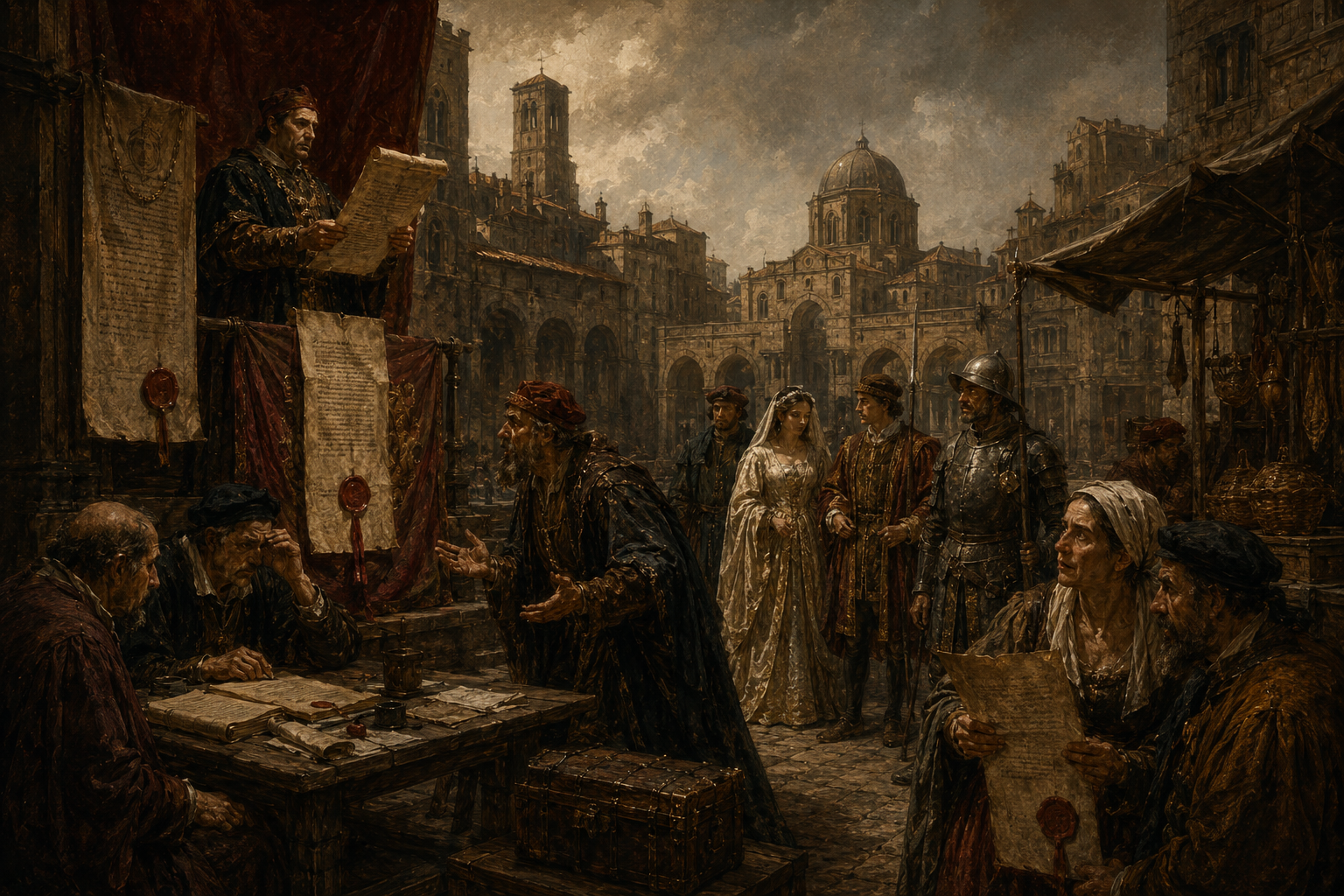
Rodrigo declares a bastard child lawful heir to a contested lordship. Civil war may follow. The party is hired to protect the child, expose the fraud, or discover whether Rodrigo’s judgement is false, politically useful, or horribly true.
The Marriage That Should Not Stand
Two great houses are united by a marriage Rodrigo has personally sanctified. A rival produces evidence that one party was already bound by oath. Rodrigo asks the party to recover the evidence before it becomes public. The rival claims the marriage will enslave an entire province to Borgia influence.
The Relic Certificate
A king’s right to rule rests on a relic authenticated by Rodrigo’s court. The relic is real, but not what the certificate says it is. The party must decide whether exposing the truth prevents tyranny or causes a worse war.
The Witness Beneath the Orange Trees
A former Borgia servant has fled with letters proving Rodrigo ordered a political murder. Rodrigo wants the witness returned alive. His enemies want the witness displayed publicly. The witness has altered some letters to increase their value.
The Feast of Forgiveness
Rodrigo hosts a public reconciliation between enemy houses. Everyone expects poison. The real danger is the seating plan, the public oaths, and the sealed announcement Rodrigo intends to read once all rivals are in the same room.
The City Under Interdiction
A city refuses Rodrigo’s judgement. He places it under sacred interdiction: marriages are disputed, contracts become suspect, soldiers desert, creditors panic, and neighbouring rulers prepare to intervene. The party must negotiate, break the decree, or prove Rodrigo issued it for private gain.
The Beautiful Prisoner
Rodrigo’s favourite, child, lover, or political dependent has been taken by enemies. He offers the party anything within reason for a rescue. The captive may be innocent, complicit, or more dangerous than the captors.
Treasure, Documents, and Rewards
Rodrigo’s treasure is not only gold. His true wealth is the power to make other people’s lives lawful or impossible.
Tangible Treasure
- Jewelled sovereign signet: 2,500 gp
- Chain of sacred office: 8,000 gp
- Ceremonial vestments: 5,000 gp
- Hidden mithral shirt: 1,100 gp plus enchantment if used
- Emergency bribe purse: 2,000 gp
- Locked dispatch case: 500 gp
- Rare legal manuscript: 3,000 gp
- Relic certificate with political value: 1,000–10,000 gp, depending on buyer
- Poison vial: 1 weapon application or 1 cup dose
- Private archive key: Priceless to the right faction
Political Treasure
- Pardon: Removes or suppresses a legal charge.
- Dispensation: Allows a disputed marriage, oath, succession, or appointment.
- Safe Conduct: Protects travel through hostile territory.
- Recognition of Rank: Makes a title or inheritance harder to challenge.
- Archive Access: Opens sealed histories, genealogies, confessions, or relic records.
- Public Denial of Scandal: Protects reputation, temporarily or permanently.
- Letter of Introduction: Grants access to rulers, bankers, generals, or temple-princes.
- Interdiction Relief: Saves a city, house, temple, or army from legal-sacred isolation.
Dangerous Reward
Every reward from Rodrigo should carry a hook.
A pardon may be valid only while Rodrigo remains sovereign-pontiff.
A title may be lawful but contested.
A marriage dispensation may save one alliance and destroy another.
A sealed letter may open a gate but implicate the bearer.
A relic certificate may be genuine but politically explosive.
A debt forgiven by Rodrigo may make the recipient look like his creature.
Source and Historical Context
Rodrigo Borgia, later Alexander VI, was born in Xàtiva near Valencia in 1431 and became one of the most controversial figures of the Italian Renaissance. His historical career is associated with the rise of the Borgia family, political patronage, dynastic ambition, scandal, corruption accusations, and the advancement of his children and relatives. For general historical background, see Encyclopaedia Britannica’s article on Alexander VI.
In the living setting, Rodrigo rules the Sacred College as the supreme authority of a Mediterranean sacred-legal hierarchy concerned with kingship, inheritance, oaths, legitimacy, temple privilege, dynastic marriage, relic authority, interdiction and divine sanction.
Keep this reference growing
If this page helped with your reading or game, you can support its upkeep or explore the curated books.
Explore the Bookshop — epics, classics and stories behind imagined worlds.