
Houska Castle
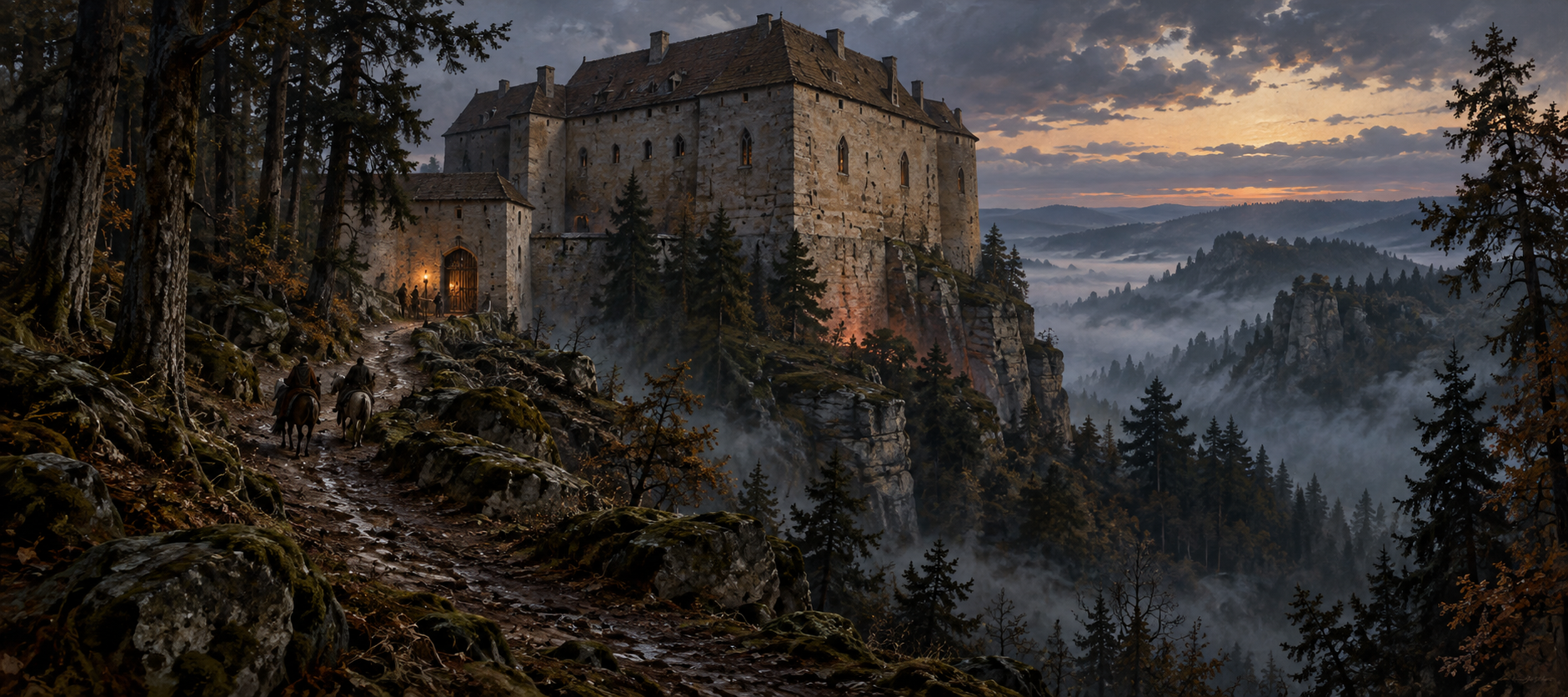
Houska is a remote Gothic castle in northern Bohemia within the world atlas, built in the thirteenth century and standing in 1454 at the edge of a dangerous political inheritance. Its former lord, Jan Smiřický of Smiřice, was executed for treason in Prague in 1453. His widow and underage heirs remain bound to the estate while guardians administer their lands. Beneath the chapel, older stone seals a place no one is meant to open.
At a Glance
- Region: Northern Bohemia
- Type: Gothic castle and noble estate
- Campaign status: Inherited estate under guardianship after the execution of Jan Smiřický
- Current authority: The Smiřický heirs and their guardians, with Markéta of Michalovice retaining a direct connection to the estate
- Political pressure: Post-Hussite factional tension, crown scrutiny, disputed loyalty and noble inheritance
- Supernatural danger: A sealed chasm beneath the castle chapel
- Best use in play: Isolated stronghold, inheritance mystery, religious horror, secret prison or gateway site
What Is Happening Right Now?
Houska has entered an uneasy year. Jan Smiřický, who purchased the castle in 1432, was executed in Prague in September 1453 after his political enemies exposed a secret letter attacking the position of George of Poděbrady. His death leaves Houska caught between family survival and royal suspicion.
Zdeněk of Šternberk acts as guardian for the underage Smiřický heirs. Jan’s widow, Markéta of Michalovice, still has interests in the estate, and servants who once answered to Jan must now decide whether their loyalty lies with the family, the guardians or whichever power dominates Bohemia next.
No army currently besieges Houska, but every visitor is judged politically. A priest may be an informer. A merchant may be carrying messages. A knight seeking shelter may actually be testing whether the household remains loyal to Jan’s old allies.
The Castle
Houska was founded in the thirteenth century as a royal administrative stronghold and later passed to the lords of Dubá before entering Smiřický hands. It is a compact Gothic castle rather than a sprawling royal fortress. Thick masonry, an enclosed courtyard, storerooms, chambers and the castle chapel create a place that feels self-contained and inward-looking.
The chapel is the most important room in the castle. Its painted walls and older fabric connect the current household to generations of worship and fear. The floor and foundations conceal masonry that does not align neatly with the visible structure above.
Servants avoid certain lower passages after dark. Horses refuse to stand near one section of the inner wall. Water drawn from a particular cistern sometimes carries the smell of wet stone and iron even after weeks without rain.
The Sealed Chasm
Beneath the chapel lies a vertical break in the rock, older than the castle and deeper than any ordinary cellar. The first builders did not create it. They enclosed it.
The shaft does not simply descend into earth. At certain hours, sound travels through it incorrectly. A dropped stone may strike once, then again much later from a direction that should be impossible. Cold air rises when the surface world is warm. Scratched marks appear on stones that were smooth the night before.
The chapel exists partly to contain this breach. Consecration, bells, painted saints, repeated prayer and physical masonry reinforce the seal. The castle’s political owners may change, but the household priest is expected to maintain rites whose purpose is never fully explained to outsiders.
Anything that weakens the chapel also weakens the seal: desecration, prolonged abandonment, bloodshed in the sanctuary or the theft of certain stones from the foundation.
The Household
The people of Houska live with two forms of fear. The first is political. Jan Smiřický’s execution proved that a nobleman’s correspondence can be as deadly as a battlefield. The second is older and harder to discuss.
- The steward keeps account books, food stores and family correspondence while quietly destroying letters that could endanger the heirs.
- The chaplain knows the daily rites maintaining the chapel seal but has never been told the full history of the chasm.
- The garrison is small and suspicious. Some men served Jan directly; others were appointed after his death.
- The servants know which doors close by themselves and which stair should never be used after midnight.
- The heirs’ retainers fear that confiscation, forced marriage or political guardianship may strip the family of the estate.
Bohemia Around Houska
The Hussite Wars ended two decades ago, but their divisions have not disappeared. Catholic, Utraquist and former radical networks still shape noble alliances, towns and local memory. George of Poděbrady dominates Bohemian politics, while the young king Ladislaus Posthumous remains the formal monarch.
Houska stands away from the great cities, yet it cannot escape this struggle. Its isolation makes it useful precisely because few travellers come here by accident. Secret meetings, guarded prisoners and dangerous objects can be hidden more easily in a remote estate than in Prague.
Travel and Access
Approach roads run through wooded and broken country rather than a busy commercial corridor. Travellers should expect mud, steep tracks and settlements whose inhabitants know one another well enough to recognise outsiders immediately.
Entry to the castle depends on status and purpose. A noble messenger with a seal is treated differently from wandering armed strangers. Priests, craftsmen and merchants may be admitted if their business is credible. Anyone asking directly about the chapel foundations will immediately attract attention.
Dangers and Adventure Hooks
- A document survives proving that Jan Smiřický expected his execution and hid evidence at Houska.
- Someone is removing small stones from beneath the chapel and selling them as charms.
- A young Smiřický heir dreams repeatedly of a voice beneath the castle calling him by name.
- A royal officer arrives to inventory the estate but disappears before completing his work.
- A priest from Prague insists that the chapel must be reconsecrated, unaware that the old rite cannot safely be interrupted.
- A prisoner held in a lower chamber claims he can hear people speaking from inside the rock.
- Fresh claw marks appear on the inside of a sealed masonry wall.
- A rival noble offers the party money to find letters that would justify confiscating Houska from the Smiřický family.
Using Houska in Play
Houska works best when the political and supernatural plots reinforce one another. The household cannot simply abandon the castle because the estate is their inheritance and defence. They cannot openly ask for help because admitting that the chapel conceals a breach would invite church, crown and rival nobles to take control.
The most effective adventures begin with ordinary noble business—inheritance, missing letters, a prisoner, a disputed steward—and only gradually reveal why generations of owners kept the chapel maintained so carefully.
Historical Foundations
The documented castle history, Smiřický ownership and 1453 execution are historical. The sealed chasm and supernatural manifestations are presented as campaign truth from the later Houska legends.
Keep this reference growing
If this page helped with your reading or game, you can support its upkeep or explore the curated books.
Explore the Bookshop — epics, classics and stories behind imagined worlds.