
Freising — Sacred Principality of the Isar
At a Glance
| Realm | Freising, a distinct sacred principality within the Empire, not a subdivision of the Munich duchy |
|---|---|
| Ruler | Johann Tulbeck, prince-bishop elected in 1453 |
| Seat | Freising on the Isar, north of Munich |
| Government | Prince-bishop, temple chapter, household officers and stewards administering fragmented estates |
| Lands | Freising, Ismaning, Burgrain, Werdenfels, and distant property or income rights; not one continuous territory |
| Worship | Several established gods, shrine traditions, ancestral oaths and local Isar river rites |
| Languages | Bavarian German, written Latin and visitors’ regional tongues |
| Resources | Archive, healers, temple households, estates, Isar tolls and Alpine passage rights |
| Dangers | Rival warrants, forged grants, contested sanctuary and winter travel over Werdenfels roads |

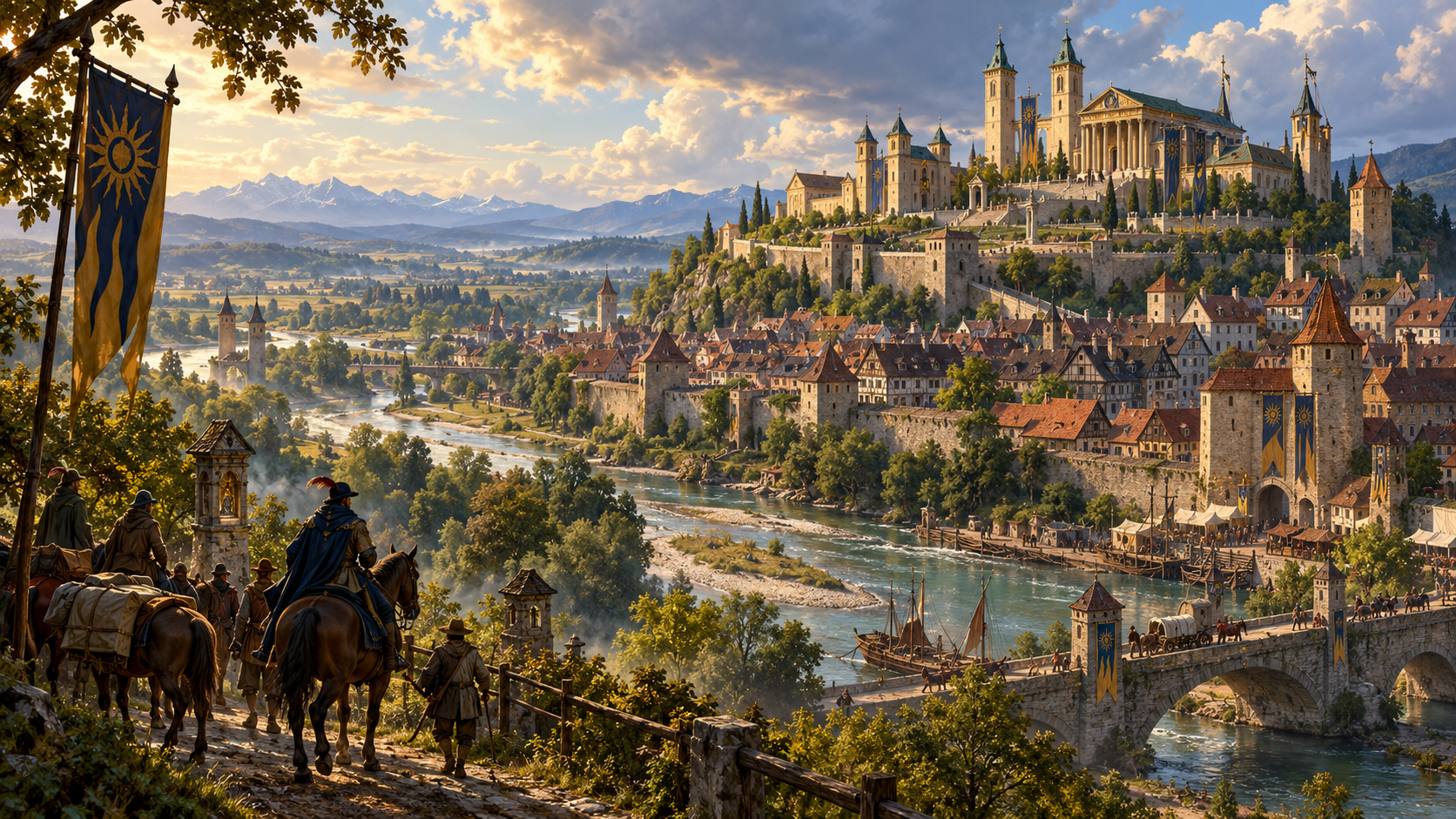
Two sealed instructions arrive at the Isar gate, and each names a different lord. Freising’s sacred principality has scattered estates, rights and revenues rather than a single defensible border. A messenger carrying a charter may pass from Freising into Wittelsbach land, then return to a sacred estate after only an hour on the road. The principality has its own ruler and officers, but rights associated with Tyrol, Austria, Styria, Carniola and the Alps do not turn those regions into provinces ruled directly from Freising.
Territories, Roads and Rights
Older accounts give roughly 15,000 subjects across Freising’s many holdings. Treat this as an approximate historical description rather than an exact campaign census; distant estates may represent rents and charters more readily than freely deployable military forces. The following inherited territorial list is retained for reference.
- Immediate lordships:
- the City of Freising on the Isar river, located north of Munich, with a population of approximately 4,000
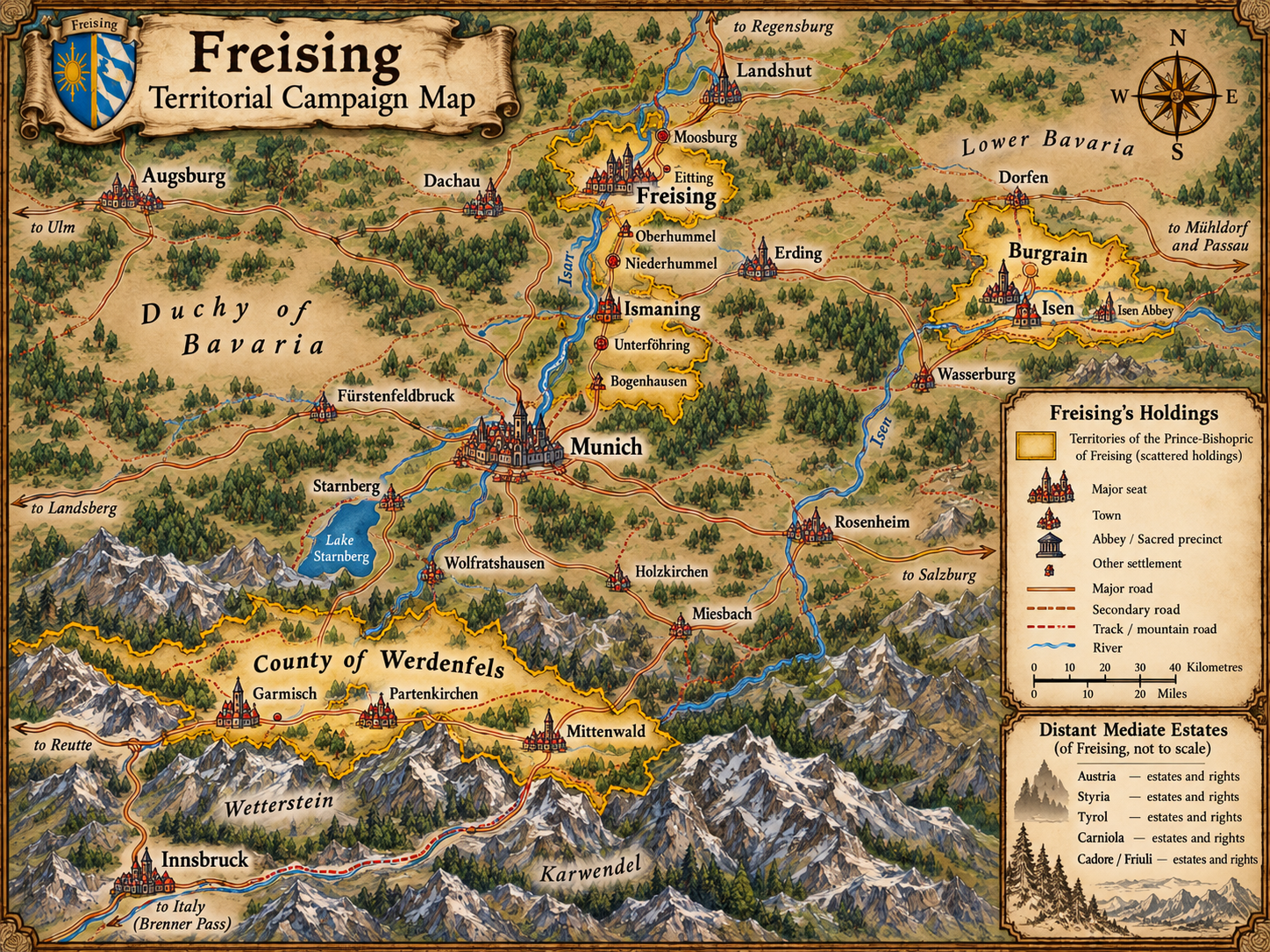
- the adjacent County of Ismaning a narrow band of territory stretching along the east bank of the Isar river, from Freising in the north to the outskirts of Munich in the south
- the exclave of Burgrain centred around Isen Abbey, east of Yserrain
- the County of Werdenfels, located between Munich and Innsbruck, with the towns of Garmisch, Partenkirchen and Mittenwald.
- Mediate estates:
- several small territories in Old Bavaria
- Entersdorf, Hollenburg, Ulmerfeld, and Waidhofen in Austria
- Wölz in Styria
- Innichen in Tyrol
- Bischoflack and Klingenfels in Carniola
- County of Cadore in the Patria del Friuli.
What Is Happening Right Now?
The Seal from Ismaning
A ducal tax officer has claimed the right to inspect a shipment moving through Ismaning. Freising’s steward holds an older charter of immunity, but the copy delivered to Munich lacks a witness’s mark. Johann Tulbeck needs independent investigators before either side arrests the river merchants. The charter may be genuine while the cargo is not.
Burgrain’s Missing Rent Rolls
The road to the eastern enclave of Burgrain has gone quiet. A household steward alleges that a wagon of rent grain has been taken by outlaws; nearby families say the wagon never left the estate. A false report could provoke armed intervention in a lordship whose legal protection is already disputed.
A Winter Summons from Werdenfels
Mountain watchmen have requested reinforcements after travellers disappeared on the approach to Mittenwald. The duke’s officers offer soldiers at a price: recognition of their authority at the next toll station. The prince-bishop’s council would rather send a neutral company to discover what happened before making that concession.
Places Adventurers Can Actually Reach
Freising — The Isar Court and Temple Hill
Stone buildings and storehouses rise above the Isar valley. The sacred hill holds the prince-bishop’s meeting rooms, an archive and halls serving several traditional gods; riverside yards provide boats, rope, ironwork and provisions. Entry to the guarded inner court requires a sealed petition or a patron. Temple custodians can give testimony on land rights, but they cannot command Munich’s civic watch.
Ismaning — The Disputed River Estate
This long, narrow holding follows the eastern Isar approaches toward Munich. Farmers and ferrymen know exactly which fields owe dues to whom. Rival patrols occasionally demand the same road toll; travellers with a credible guarantee may need to show it twice on a single day.
Burgrain and Isen — The Eastern Enclave
The estate around Burgrain is separate from Freising’s main territory. Its household relies on distant instructions, hired guards and local cooperation. A forged summons can isolate it from the prince-bishop before he knows a dispute has begun.
Werdenfels — The Alpine Road
Garmisch, Partenkirchen and Mittenwald lie among the principality’s mountain rights. Inns, mountain guides, smiths and pack-horse handlers serve those crossing toward Tyrol. The weather, the condition of a mountain bridge and the loyalties of its toll collector matter more than a noble map. Rumours of a Tatzlwyrm near a livestock path may conceal a genuine predator or a smuggler’s clever warning.
The Distant Estate Network
Named properties in Austria, Styria, Carniola, Tyrol and the southern approaches preserve links of tribute, grant or patronage. Some are mediate interests rather than garrisoned possessions. Characters sent to enforce a payment must distinguish a defensible ancient claim from the ability to exercise it without an ally.
People and Factions
Johann Tulbeck, prince-bishop: an elected ruler concerned with income, appointments and the cost of keeping distant estates loyal. He may offer an audience, a writ of passage or access to the temple archive, but will demand a report that can survive scrutiny by his chapter.
The temple chapter: senior custodians whose votes and records constrain the prince-bishop. One keeper of grants favours negotiations with Munich, while a second believes yielding any claim invites future seizures.
Albrecht III’s officers: neighbouring Munich officials who enforce ducal tolls and security beyond Freising’s immunities. They are rivals in some disputes and necessary partners against banditry.
Werdenfels guides and river pilots: practical people who know which passes remain open and which isolated villages can provision travellers. Their evidence may matter more than a costly advocate’s seal.
Magic, Markets and Services
In Freising and its better-connected market estates, adventurers may arrange horses, lodging, boat passage, scribal research, translators, armour repair and modest healing through recognised patrons. Sacred custodians honour several gods, ancestral compacts and river rites. Divination or powerful magic requires an introduction, a clear purpose and obligations to the institution providing it. The market does not guarantee enchanted equipment.
Brewers of the two hills. The ancient Weihenstephan brewhouse, whose brewing privilege dates to 1040, supplies ale to visitors, wagon crews and travelling scholars. The Freising court brewers, recorded as a separate establishment by 1160, fill the ceremonial cellars of the sacred hill. Their patrons disagree over grain deliveries and the price of safe passage; a brewer’s ledger may identify a suspect whom the temple archive cannot. Travellers seeking a meal, company or a discreet messenger can start with the brewers’ serving yards before asking permission to enter the guarded court.
Dangers and Adventure Hooks
- The Two Toll Books: two local officers both hold valid authorisations to collect revenue at a crossing. Find who issued the second order before the next grain convoy is seized.
- The Burdened Bear: the old local legend tells of a bear that killed a travelling sacred messenger’s packhorse and was compelled to carry the lost animal’s burden to its destination. The bear bearing a bundle became a civic sign long ago. Now a living bear drags a deserted saddlebag through the woods; its load contains a missing steward’s papers. Is the beast following a sworn road, guarding its dead handler or simply carrying what smugglers left behind?
- Three Villages, One Grant: an ancient deed appears to transfer a remote village to Freising, but the villagers have sworn to a different lord for generations. Should the characters enforce the grant, broker a bargain or expose it as a forgery?
- The Pass under Snow: rescue travellers before the weather closes Werdenfels, while deciding whether to accept help from a ducal captain whose soldiers will demand the next toll station.
Travel, Law and Deeper History
Freising’s holdings are not a contiguous country. Each road crosses the authority of villages, Bavarian dukes, imperial officers and sacred estates. City gates may close after dark; mountain roads close in snow; formal safe-conduct from one court is not permission to ignore another. Travellers should secure horses, letters and guides before leaving the valley.
Freising’s historical line of rulers places Johann IV Tulbeck’s election in 1453. He was noted for carefully managing the principality’s debts and restoring pledged estates; a ruler who needs reliable records and negotiators is therefore rooted in his documented priorities. For the historical basis, see the Bavarian Historical Lexicon. Freising’s civic history records the burdened-bear emblem in its surviving seal of 1362; its tale is adapted here as a polytheistic local legend (see the city’s heraldic account). The city’s brewing history records Weihenstephan’s 1040 privilege and the court brewhouse by 1160. All current disputes, fantasy worship and adventure characters above are campaign developments. For the surrounding region, see the Bavarian duchies and their existing regional guide.
Freising Territorial Campaign Map
Freising’s scattered territories and rights connect the Isar valley to Burgrain and the Werdenfels Alpine road. The highlighted borders and scale are interpretive for tabletop play, not surveyed historical boundaries or reliable journey measurements.
Keep this reference growing
If this page helped with your reading or game, you can support its upkeep or explore the curated books.
Explore the Bookshop — epics, classics and stories behind imagined worlds.