
Bishopric of Regensburg

At a Glance
| Status | Small sacred principality within the Holy Roman Empire |
|---|---|
| Seat | The Great Temple precinct, Regensburg |
| Ruler | Prince-Bishop Friedrich III von Plankenfels |
| Government | Elective temple-principality; prince-bishop advised and constrained by the temple chapter |
| Sacred tradition | Worship of several established gods; oaths, judgement, healing and protection |
| Languages | German and formal Latin; interpreters for distant petitioners |
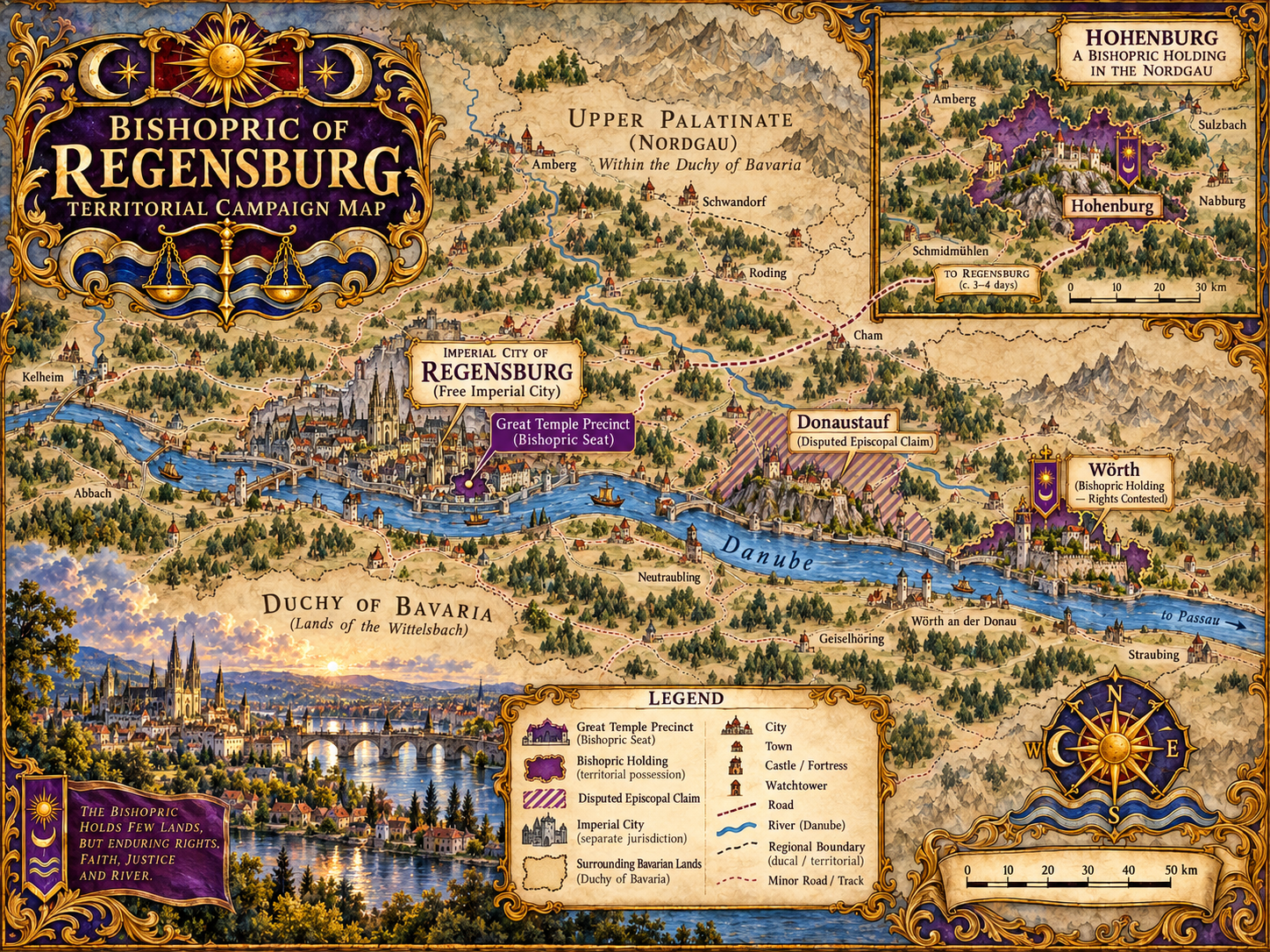
| Lands | Scattered lordships and estates around the Danube and Upper Palatinate, including rights associated with Donaustauf, Wörth and Hohenburg |
| Immediate concerns | Lost revenues, disputed estates, temple chapter demands and competing charters |
The Bishopric’s Sacred Emblem

Bells of bronze and the smoke of offering-fires rise above the Great Temple, but Regensburg’s prince-bishop holds less land than many neighbouring lords. His power rests upon ancient charters, sacred estates and the loyalty of his chapter. Every road to his court passes through territory where someone else may claim the toll, the gate or the final word.
The Prince-Bishop’s Authority
Friedrich rules by sacred office, imperial recognition and carefully worded agreements with the temple chapter. A written judgement sealed by his household can settle a quarrel across miles of countryside—or begin one inside the city walls.
The Bishopric’s authority extends over its own holdings and privileged precincts. It does not make Friedrich ruler of the Free Imperial City, whose council guards its independence.
What Is Happening Right Now?
Prince-Bishop Friedrich III von Plankenfels has held office since 1450. His election bound him to promises made to the temple chapter: major decisions require consultation, disputed privileges invite arbitration, and revenues lost under earlier administrations must be recovered where possible. The chapter’s senior custodians do not question his rank, but they examine his accounts.
Beyond Regensburg the Bishopric’s holdings lie in scattered pockets rather than one compact realm. Donaustauf and Wörth are particularly tangled in old pledges and competing claims; Hohenburg has its own obligations and vulnerabilities. A debt recorded generations ago can determine who collects a harvest, staffs a watchtower or commands a gate today.
The nearby Imperial City of Regensburg controls its own council, trade and civic law. Its magistrates bargain with Friedrich’s officers but accept no general rule from his temple. Meanwhile, noble families, neighbouring Bavarian dukes and the great sacred houses seek influence over any judgement that touches their lands.
Approaching the Sacred Precinct
The temple precinct stands amid the crowded streets of Regensburg, close enough to hear the market and the river traffic. Within its guarded entrance, petitioners wait beside stone basins and bronze lamps. Scribes carry sealed rolls through colonnades while ritual attendants arrange grain, incense, fresh water and offerings for the gods.
Travellers seeking shelter may be admitted to public courts, but archives, treasuries and private chambers open only with a writ or a trusted introduction. Armed retainers gather at the outer gates; no one wishes a dispute with the city watch to become a battle upon sacred ground.
Temples, Estates and Places of Power
The Great Temple and Its Courts
The Great Temple houses public rites and the prince-bishop’s sacred court. Petitioners bring accusations, inheritance claims, contested oaths and requests for healing. A visitor who comes in peace may find a mediator here, though formal hearings require sworn witnesses and often a written petition.
The Temple Chapter and Archive
Senior ritual custodians keep the election charters, estate accounts and records of privileges. The chapter can advise the prince-bishop and resist decisions that violate his sworn obligations. Its archive is a prize for scholars, debt collectors and anyone tracing a family’s ancient rights. Access is granted by office or sponsorship, not by wandering in with coin.
The Prince-Bishop’s Household
Friedrich’s hall is part court and part counting house. Envoys arrive with sealed orders, captains seek wages, and stewards argue over rents that have not been paid. A request for military protection may be weighed against a dispute over land income; the richest offer is not always the safest.
Donaustauf and the River Approaches
Donaustauf guards an important stretch of the Danube corridor. Its lordship is bound up in older pledges, and control of income is more complicated than the Bishopric’s charters suggest. Boatmen, toll officers and hired guards can give very different accounts of whose authority holds at the landing.
Wörth and Hohenburg
Wörth’s rights and revenues remain subjects of negotiation, while Hohenburg’s scattered possessions and guarded roads are vulnerable to local quarrels. A sealed order from Regensburg may carry weight in a lord’s hall, yet still require horses, silver and allies to be enforced.
The Independent Sacred Houses
Emmeram, Obermünster and Niedermünster guard substantial property and privileges of their own. Their custodians may support the prince-bishop in a dispute—or remind him that spiritual influence is not the same as ownership.
Faith and the Living Gods
No single divine throne commands every altar. The precinct’s sacred duties embrace several established powers, and their followers need not agree about the best judgement. Forseti is invoked in mediation and the settlement of feuds, while Tyr hears oaths sworn under threat or before battle. Frigg is honoured in household protection, kinship and solemn promises. Healers and petitioners also turn to the powers of restoration named among the Asgardian gods.
Bronze lamps, carved runic staves, scales, woven ribbons and painted divine emblems distinguish the shrines. Ceremonies centre upon offerings, spoken vows, processions and divination. A blessing is not a guarantee of favour: the gods may demand justice, sacrifice or the repair of a broken promise.
People and Powers
- Prince-Bishop Friedrich III von Plankenfels: learned ruler of the Bishopric, answerable for debts, appointments and the defence of its privileges. He prizes sound evidence and knows that an imprudent judgement can alienate the chapter or a neighbouring lord.
- The temple chapter: a council of senior custodians who elected Friedrich and retain rights under his sworn agreements. They are essential allies for anyone pursuing an ancient record.
- The bishop’s stewards and marshals: collect revenue, maintain estates and command such guards as the treasury can support.
- The city council: guards Regensburg’s independent laws and demands proper recognition whenever the prince-bishop’s men act within civic territory.
- The great sacred houses: custodians of Emmeram, Obermünster and Niedermünster defend their separate privileges and serve as influential patrons.
- Bavarian envoys and estate-holders: exploit unpaid debts, old pledges and disputed roads to extend their influence over the Bishopric’s scattered lands.
What Visitors Can Seek
Judgement and arbitration: the temple court hears disputes involving estates, sworn vows and sacred privileges. A written petition and witnesses will be expected. Healing and ritual: recognised attendants may offer care or petition the gods for stronger intervention, usually in return for a donation, obligation or evidence of genuine need.
Archives and introductions: the chapter preserves deeds, contracts, genealogies and decisions reaching back generations. A well-connected sponsor may obtain access; attempting to steal a sealed record risks a conflict with several jurisdictions at once. Travel protection: the prince-bishop’s officers can provide letters or an escort for his estates, though their authority ends where another lord’s rights begin.
Dangers and Adventure Hooks
- The Missing Revenue: three villages report paying their rents to a Bavarian officer, yet the bishop’s ledger says payment is overdue. A steward asks for proof before sending armed collectors. The villagers will lose their stores if the wrong claimant prevails.
- A Broken Oath: witnesses at a rite of Tyr remember two different promises. The accused claims the temple archive has been altered. Uncovering the truth may disgrace an honoured knight—or an influential custodian.
- Silence at Donaustauf: a river watchpost has stopped sending messages. Merchants blame smugglers, while the chapter fears an old pledge has been enforced by force. The landing must be reached before the next cargo boat arrives.
- The Chapter’s Seal: an ancient decree is discovered with a seal belonging to a custodian not yet elected when the document was supposedly written. Exposing forgery would overturn a powerful family’s inheritance.
- The Forseti Hearing: two rival households agree to sacred arbitration. On the hearing day, the principal witness disappears into the Free Imperial City, where the bishop’s guards cannot lawfully seize him.
- The Unquiet Offering: bronze lamps in a side shrine burn cold, and a healing rite fails without explanation. The attendants suspect theft from the treasury, but the disturbance began after a recent judgement deprived a family of its home.
Law, Travel and Rival Jurisdictions
The Bishopric is small and fragmented. Regensburg’s bridge and city gates remain under civic control; temple officers need permission or a recognised legal claim to exercise authority there. Beyond the walls, a day’s journey may cross several rulers’ lands. Travellers should seek a written safe-conduct that names the road and the lordship through which they intend to pass.
Sanctuary and judgement are also disputed. A fugitive admitted into the temple precinct may be defended by its custodians, yet the city watch or a duke’s marshal may challenge the claim. The strongest solution is often not a drawn sword but a witness, a surviving charter or an oath both parties are willing to keep.
Older Rights and Deeper History
The Bishopric rose around an old religious seat in Regensburg, but the city later secured its own imperial liberties. As those civic rights strengthened, the prince-bishop’s direct rule remained attached to a much smaller collection of estates and jurisdictions. The title of bishop describes a wider sacred office; the lands he governs as an imperial prince are a more limited and contested possession.
Friedrich’s predecessors entered agreements with their chapter, and properties were pledged or sold to sustain their households. By the present day, the recovery of revenue is as urgent as the defence of doctrine. Donaustauf, Wörth and Hohenburg appear repeatedly in arguments over rights that neither a single signature nor a single sword can settle.
Map and Surrounding Realms
The prince-bishop’s sacred seat lies within the independent Imperial City of Regensburg. His scattered lands and disputed rights stretch along the Danube and into the Nordgau. Wörth and Hohenburg are shown as separate holdings; Donaustauf is marked as a claim contested by the Bavarian dukes. The city remains outside the Bishopric’s territorial jurisdiction.
For the city gates, streets and bridge, see Regensburg’s illustrated city map.
Explore the Region
Continue to the Empire, the Imperial City of Regensburg, Bavaria, Emmeram, Obermünster and Niedermünster. Divine rites and patrons are found among the gods and pantheons.
Historical references: Historisches Lexikon Bayerns: Regensburg, Hochstift; Regensburg succession of bishops.
Keep this reference growing
If this page helped with your reading or game, you can support its upkeep or explore the curated books.
Explore the Bookshop — epics, classics and stories behind imagined worlds.