
Guide NPC — Wilderness Scout and Hireling (Human Expert 2)
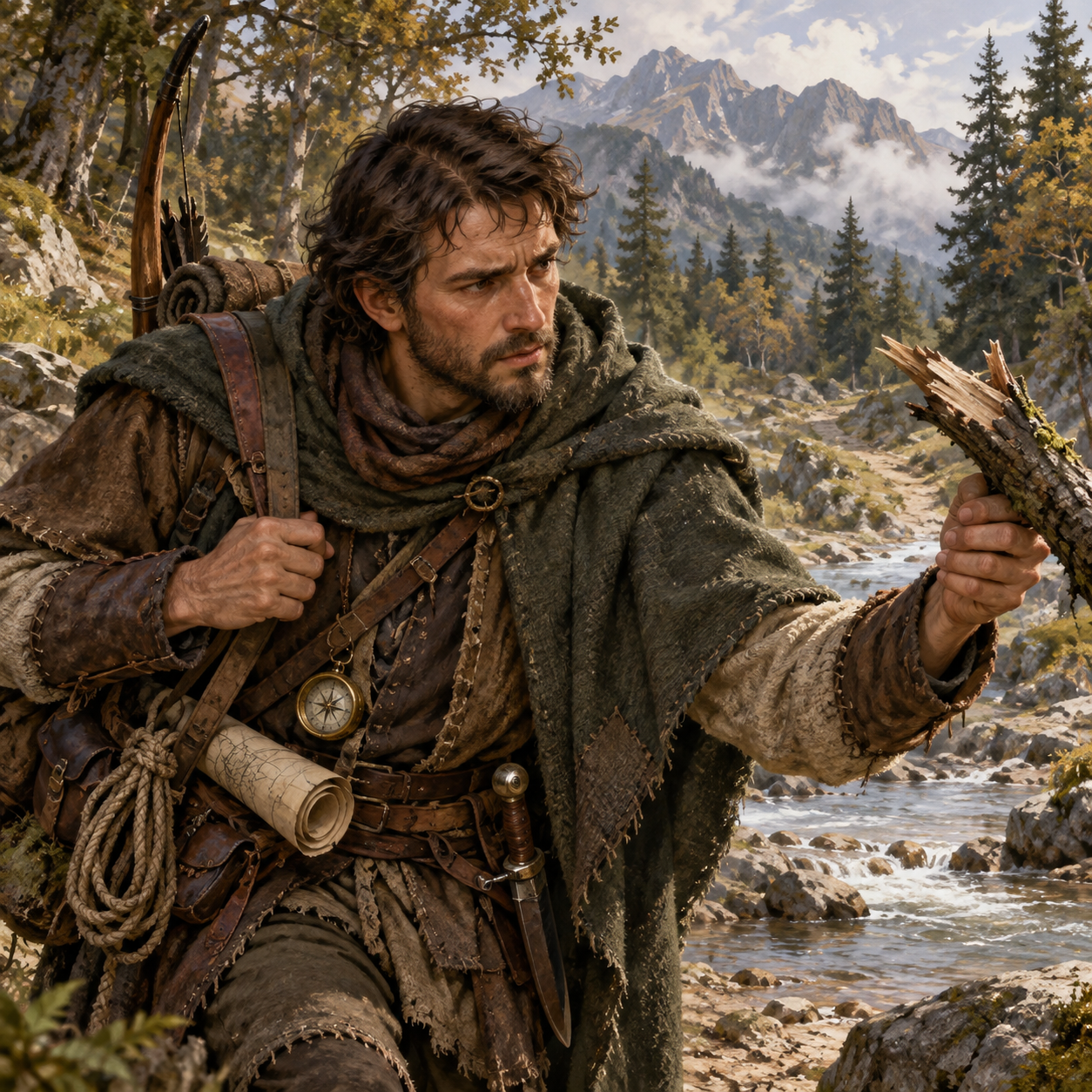
Before the party leaves the last settled road, the guide checks the wind, the river level and the state of the pack straps. They name two routes: one quicker but exposed, the other slower with reliable water. Their job is to get travellers through unfamiliar country, warn them before danger becomes a crisis and say plainly when the fee is no longer worth the risk.
At a Glance
| Role | Local pathfinder, scout, tracker and noncombatant hireling |
|---|---|
| Typical allegiance | Village, caravan company, family or roadwardens; generally loyal to the land before distant rulers |
| Price | 2 sp/day (original Pathfinder hire rate); agree on hazard pay and provisions before departure |
| Best use | Wilderness travel, missed roads, weather warnings, secret routes and human-scale mysteries |
| Danger | A false trail, an ambush at a ford or the guide’s own undisclosed obligation |
| Disposition | Practical, observant and reluctant to risk lives for somebody else’s deadline |
Rules: Select the edition below. The Pathfinder tab retains the credited original statistics; the two 5e tabs and D&D 3.5e tab are site adaptations.
Game Statistics
Hired to find safe approaches, whether mountain pass or dangerous reef. Select the edition for its rules and combat numbers; the original Pathfinder source is retained in full.
D&D 5.5e / 2024
Original 2024-format NPC conversion; Challenge Ratings use D&D balancing rather than the Pathfinder CR.
Guide
Medium Humanoid (Human), any alignment
Armor Class 13 (studded leather); Hit Points 16 (3d8 + 3); Speed 30 ft.; Initiative +1.
Skills Nature +2, Perception +4, Stealth +3, Survival +6 (expertise); Navigator’s Tools +4; Senses passive Perception 14; Languages one local language and one additional language learned through travel.
Challenge 1/4 (50 XP); Proficiency Bonus +2.
Equipment dagger, shortbow, compass, net, waterskin, map case.
Traits
Trailwise. The guide has Advantage on Survival checks to detect natural hazards and find food in familiar terrain. Overland Guide. A party following the guide ignores the first hour of difficult terrain’s effect on overland travel each day; this does not change battle Speed.
Actions
Dagger. Melee Attack Roll: +3, reach 5 ft. Hit: 3 (1d4 + 1) Piercing damage.
Shortbow. Ranged Attack Roll: +3, range 80/320 ft. Hit: 4 (1d6 + 1) Piercing damage.
Bonus Actions
Point Out the Route (Bonus Action, 1/Day). One ally within 30 ft. gains a 1d4 bonus to its next Survival check made within 1 hour.
Reactions
Spot the Danger (Reaction, 1/Day). When an ally within 30 ft. makes a Dexterity saving throw against a visible terrain hazard, the ally can add 1d4.
D&D 5e / 2014
2014 creature-stat terminology and action conventions; no 2024-only Weapon Mastery is assumed.
Guide
Medium Humanoid (Human), any alignment
Armor Class 13 (studded leather); Hit Points 16 (3d8 + 3); Speed 30 ft.; Initiative +1.
Skills Nature +2, Perception +4, Stealth +3, Survival +6 (expertise); Navigator’s Tools +4; Senses passive Perception 14; Languages one local language and one additional language learned through travel.
Challenge 1/4 (50 XP); Proficiency Bonus +2.
Equipment dagger, shortbow, compass, net, waterskin, map case.
Traits
Trailwise. The guide has Advantage on Survival checks to detect natural hazards and find food in familiar terrain. Overland Guide. A party following the guide ignores the first hour of difficult terrain’s effect on overland travel each day; this does not change battle Speed.
Actions
Dagger. Melee Weapon Attack: +3 to hit, reach 5 ft., one target. Hit: 3 (1d4 + 1) piercing damage.
Shortbow. Ranged Weapon Attack: +3 to hit, range 80/320 ft., one target. Hit: 4 (1d6 + 1) piercing damage.
Bonus Actions
Point Out the Route (Bonus Action, 1/Day). One ally within 30 ft. gains a 1d4 bonus to its next Survival check made within 1 hour.
Reactions
Spot the Danger (Reaction, 1/Day). When an ally within 30 ft. makes a Dexterity saving throw against a visible terrain hazard, the ally can add 1d4.
Pathfinder First Edition
Guide — original Pathfinder statistics
| Guide CR 1/3 |
| XP 135 human expert 2 CN Medium humanoid (human) Init +0; Senses Perception +7 |
| DEFENSE |
| AC 13, touch 10, flat-footed 13 (+3 armor) hp 12 (2d8+3) Fort +1, Ref +0, Will +5 |
| OFFENSE |
| Speed 30 ft. Melee dagger +0 (1d4-1/19-20) Ranged shortbow +1 (1d6/×3) |
| STATISTICS |
| Strength 9, Dexterity 10, Constitution 12, Intelligence 10, Wisdom 15, Charisma 9 Base Atk +1; CMB +0; CMD 10 Feats Skill Focus (Survival), Stealthy Skills Handle Animal +3, Heal +6, Intimidate +4, Knowledge (Geography) +5, Knowledge (nature) +5, Linguistics +1, Perception +7, Profession (guide) +6, Stealth +5, Survival +10 Languages Common, Hallit Gear studded leather, bottle of fine wine, compass, foothold trap, hunting knife, net, shortbow, 48 gp |
Pathfinder Guide Special Abilities
Special Abilities
Country Food
A competent wilderness guide can help stretch supplies by gathering ‘country food’ from the wild. Assume an NPC guide takes 10 each day to collect food as the party travels, feeding themselves first and supplying additional food for the party with the excess. The one described here can provide food for four additional people each day spent in the wild.
Foothold Trap 25 gp
Type mechanical; Perception DC 20; Disable Device 15 Trigger location; Reset manual Effect Atk +10 melee (1d6+1/x3); target cannot move from trapped square; DC 20 Strength check to release.
Guide
So long as an expedition employs a guide, everyone involved gains a +2 bonus to all Survival checks to avoid natural hazards and a +2 bonus to all Craft: Cartography skill checks.
Trailblazer
One familiar with the terrain can exploit game trails and sidestep hazards that even keen-eyed city dwellers miss. Their lives revolve around efficient overland travel. With a successful DC 15 Profession (guide) check, the guide increases a small group’s effective speed by five feet for the purposes of determining overland travel speed. This check can be attempted once each day, and its effects last for 24 hours. This ability has no effect on individual party members’ movement or combat speeds. Large or heavily-equipped groups increase the DC as follows:
| Condition | DC Increase |
| More than ten creatures | +1 per additional creature |
| Large-sized creatures | +2 per Large creature (including mounts) |
| Huge-sized or larger | Impossible |
| Wagons or wheeled vehicles | +5 per vehicle |
D&D 3.5e
Guide
Medium Humanoid (Human), alignment varies · CR 1
| Size / Type | Medium Humanoid (Human) |
|---|---|
| Hit Dice / HP | 2d6+2 (9 hp) |
| Initiative | +1 |
| Speed | 30 ft. |
| Armour Class | 14, touch 11, flat-footed 13 (studded leather, Dex +1) |
| Base Atk / Grapple | +1/+0 |
| Attack | dagger +0 melee (1d4−1/19–20) or shortbow −2 ranged (1d6/×3) |
| Full Attack | dagger +0 melee or shortbow −2 ranged |
| Space / Reach | 5 ft. / 5 ft. |
| Fort / Ref / Will | +1, +1, +5 |
| Ability Scores | Str 9; Dex 12; Con 12; Int 10; Wis 15; Cha 9 |
| Skills | Survival +10, Spot +6, Listen +6, Hide +5, Move Silently +5, Profession (guide) +6, Knowledge (geography) +5, Heal +6 |
| Feats | Skill Focus (Survival), Stealthy |
| Special Attacks / Qualities | Trailblazer (Ex): after DC 15 Profession (guide) check, increase overland travel speed for a small group by 5 ft. for 24 hours; never changes combat movement. |
| Challenge Rating | 1 |
| Equipment | dagger, shortbow, compass and travel supplies. |
Weapon proficiency: The 3.5e Expert is proficient with simple weapons, but a shortbow is a martial weapon. Its −2 ranged attack already includes the −4 nonproficiency penalty. If the guide instead carries a simple light crossbow, its ranged attack is +2 (1d8/19–20). This is a D&D 3.5e adaptation; the original Pathfinder statistics remain in their own tab.
What Is the Guide Doing Right Now?
Before dawn, the guide is replacing a smashed trail marker while keeping watch on the ridge. A provision caravan should have come through yesterday. Its two outriders arrived without the wagons and disagree about where they last saw them. The guide has discovered one deliberately reversed waymark, a snapped harness strap and a bootprint belonging to somebody they know. If the party sets out today, they can follow the fresh evidence; if they delay, rain will erase it.
Immediate choice: take the quick, exposed crossing while the light holds; follow the missing caravan’s tracks into rough country; or visit the nearby tollhouse to question the people who maintain the road. Each route reveals a different piece of the mystery. The guide recommends the last option only if the party treats a frightened local witness gently.
What really happened (for the GM): the roadwarden owes money to toll-smugglers and shifted the waymark to send the caravan past their empty tollhouse. One outrider was paid to look away; the other genuinely believes the drivers fled into the hills. The drivers escaped with the horses and are hiding near an old mill, while the smugglers hold the wagon and its cargo. The familiar bootprint belongs to the roadwarden, a person the guide once saved from a winter flood.
Resolve it through player choice: the exposed ford offers the fastest way to intercept the wagon but risks swept-away supplies; following the tracks finds the drivers and gives the party witnesses; investigating the tollhouse exposes the fraud but may put the guide’s old ally in danger. A peaceful settlement could free the drivers and force restitution. Violence scatters the smugglers, leaving the roadwardenship disputed. No path requires a predetermined battle or a single mandatory skill check.
Personality and Relationships
- Voice: short answers, precise distances, pauses to read wind, soil and animal calls. Refers to landmarks instead of miles.
- Principle: no traveller is left behind without a search; the guide will abandon a fee before abandoning a person.
- Flaw: conceals an old debt to the roadwarden or smuggler who controls a minor crossing.
- Trust: grows when the party pays fairly, shares watch, protects pack animals and listens to warnings. Fades when they take risks for spectacle.
- Connections: a caravan guard who lost a companion; a ferry keeper who records flood levels; and a way-house owner who knows which travellers arrived by night.
Negotiating the hire: the guide describes the likely risks up front and does not guarantee a safe journey. Ask the characters what they are transporting, whether anyone follows them and what they will do if the route closes. Do not make a single failed roll turn a skilled guide into a fool: let failure cost time, provisions or information while preserving informed player choices.
Running the Guide in an Encounter
The guide is useful because they can read the country, not because they can fight. Establish a visible clue before a hazard: a leaning milestone, silence among birds, water stains high on a bridge pier or smoke where no farm should stand. Tell the party what the guide notices and let the players decide how to respond. If hired to scout ahead, they report danger and return; they do not secretly resolve an adventure offstage.
Three Ready-to-Play Scenes
- The ford at dusk (exploration). The normal crossing is flooded. The guide knows an upstream ford, but its far bank bears fresh horse tracks. Clue: reeds flattened by an unusually heavy wagon. Choice: wait for daylight, risk the crossing, or follow the riders. Consequence: losing daylight exposes the party to the cold; rushing can cost equipment or alert unseen watchers.
- The wrong cairn (mystery). Somebody has moved three route stones overnight, directing newcomers towards a deserted way-house. Clue: clean undersides on stones that should be weathered. Choice: repair the route, set an observation post, or confront the suspected roadwarden. Consequence: open accusations may turn an entire settlement against the party.
- The silent pass (negotiation). An armed patrol claims the road is closed. The guide knows a narrow pack trail, but using it would violate an agreement with the valley folk. Clue: the guards bear mismatched badges and have no written order. Choice: negotiate a passage, seek another route, or expose the false authority. Consequence: the party’s conduct determines whether locals assist them later.
Checks, Clues and Consequences
Give an observable warning before calling for a check. For 5e or 5.5e, illustrative Wisdom (Survival) DCs are 10 for a clear trail, 15 for a washed-out track and 20 for evidence deliberately concealed in severe weather. These are encounter suggestions, not fixed official DCs. For Pathfinder or D&D 3.5e, use terrain, weather and tracking modifiers from the relevant rules, with Profession (guide) or Survival as appropriate. A successful check grants useful information or a safer route; failure might cost a watch, damage provisions or attract unwanted attention, but it should not erase every lead. Let the guide assist rather than replace player decisions.
Combat Behaviour
The guide begins behind cover, points out unstable terrain and protects pack animals and noncombatants. In a fight they use a bow at distance, take cover and retreat when pressed. They do not charge a monster for the sake of a damage roll. A captured guide can become the point of the encounter: rescuing them preserves a route and a valuable local relationship.
Adventure Hooks
- Missing at the marker: another guide is overdue. The last marker was moved by human hands, yet the locals insist a monster is responsible.
- Two maps, one road: a merchant’s map shows a bridge that has been gone for decades. The guide recognises the seal of the surveyor who drew it—someone believed dead.
- Payment in silence: the guide will work for half price if the party promises not to ask why they avoid a particular valley. Their fear has a living cause, not necessarily a supernatural one.
- Return of the pack train: a caravan returns without its cargo or drivers. The guide recognises its wheel marks from a forbidden side trail.
Travel, Hire and Equipment
Confirm the destination, expected duration, transport, food, camping arrangements and whether the guide can refuse an obviously suicidal order. The 2 sp/day figure belongs to the original Pathfinder NPC and should not be assumed to set universal wages across editions or regions. For a dangerous expedition, agree separately on compensation, resupply and a share of salvage, if any.
| What the party asks | What the guide can do |
|---|---|
| Reach a place quickly | Explain the fastest route and the risk it trades against safety; use Trailblazer where applicable |
| Avoid getting lost | Follow landmarks, check weather and warn of altered trail markers |
| Find food | Gather supplies on viable terrain; use Country Food in Pathfinder, appropriate checks elsewhere |
| Cross dangerous ground | Identify unstable slopes, flood levels and visible signs of concealed traps; the guide cannot guarantee success |
| Travel with a large caravan | Allow extra time for wagons, mounts and chokepoints; use the Pathfinder Trailblazer modifiers when relevant |
Typical kit: a compass, waxed map, rope, flint, water skin, knife, weatherproof cloak, shortbow, snares or a simple foothold trap. A trap is never an excuse to harm unsuspecting companions: describe its trigger and give the party meaningful opportunities to spot and avoid it. The Pathfinder foothold trap appears in full in the rules tab above.
Where to Use This NPC
Guides belong on trade routes, forest borders, marsh roads, coastal paths and high passes. In the Alps, a guide may know the difference between a safe pack trail and a slope ready to avalanche. Near an abandoned battlefield or bridge, rumours of haunts may complicate otherwise ordinary routefinding. Their neighbours can include drovers, ferrymen, shepherds, smugglers and a caravan guard. Use the Bestiary sparingly: a single creature tied to its surroundings is more memorable than a procession of unrelated attacks.
GM quick use: introduce the warning, show the evidence, offer two meaningful routes and attach a cost to each. The guide provides informed advice; the characters make the decision.
Source and Licensing
This material was created for the Pathfinder rules by a publisher other than Paizo. The original Pathfinder material is reproduced with its existing source attribution; the other edition conversions and encounter ideas are editorial adaptations.
Section 15: Copyright Notice – Hirelings Into the Wild
Hirelings: Into the Wild. Copyright 2010 Crystal Frasier
Keep this reference growing
If this page helped with your reading or game, you can support its upkeep or explore the curated books.
Explore the Bookshop — epics, classics and stories behind imagined worlds.