
Medium Wagon — Caravan Freight Vehicle
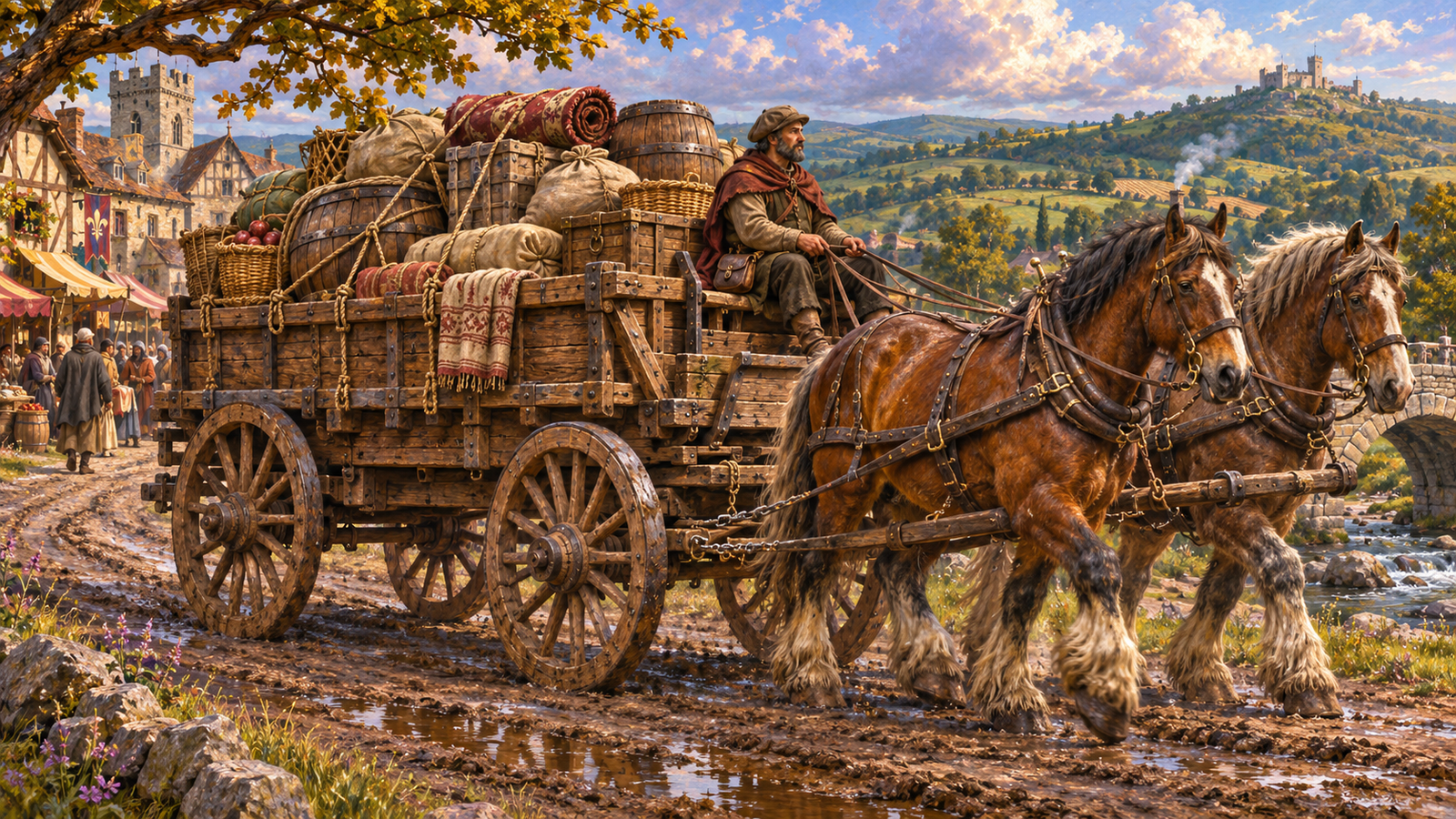
At a Glance
- Kind
- Four-wheeled merchant freight waggon
- Propulsion
- Draft horse or team, according to road and load
- Usual Cargo
- Grain, cloth, tools, casks, salt and caravan supplies
- Route
- Established roads and bridges between market towns
- Advantages
- Large load bed and stable freight carriage
- Risks
- Tolls, bandits, broken axles, flooded fords and exhausted teams
A caravan is heard before it is seen: a line of wooden wheels grinding through ruts, the low voices of drovers and the creak of ropes under a cargo of salt and iron. A medium waggon can make a trader wealthy, provided the road remains open and the load survives the journey.
In 1454, merchant waggons bind farm and town to distant market. Each carries goods that a rider cannot conveniently bear, but its value depends on firm ground and dependable draft animals. Where the road narrows between stone walls or climbs into the mountains, smaller carts and pack animals may reach places the larger waggon cannot.
Frame, Load and Crew
A heavy timber chassis rests on two axles and four iron-banded wheels. The load bed may be open or covered by canvas against rain. Chests, barrels and sacks must be placed low and secured; a shifted load can overturn the vehicle on a turn, break a wheel or unbalance the draft team.
The driver. An experienced driver chooses the safe bank of a ford, watches the horses for fatigue and knows when to unload before a steep climb. Guards may ride alongside the freight, but a waggon is no fortress. Its slow turns make it vulnerable to attacks at bridges and narrow gates.
Maintenance. Extra spokes, pegs, ropes, wedges and grease save time on the road. A serious axle break requires a wheelwright or a replacement beam. Caravans commonly plan stops around food, water, stable yards and protected overnight camps.
Trade Roads and Law
The route passes through lands where tolls, customs dues and local privileges change at each border. Freight papers may be inspected; goods may be seized or delayed by a ruler’s officers. Pirates threaten coastal cargo, but road bandits, corrupt watchmen and false guides are the usual enemies of a waggon convoy.
A party travelling with a waggon trades speed for carrying capacity. A chest of coins can buy guards but also draw thieves; carrying contraband through a guarded gate may be more dangerous than a monster-haunted road through the hills.
The Waggon Without a Driver
A covered waggon arrives at the town gate before dawn, pulled by an exhausted horse. The reins are tied neatly to the seat, but its driver and two guards have vanished. The customs officer finds the expected merchant seals on its barrels, and beneath the canvas someone has scratched a warning: Do not open the last one. The merchant’s family demands that the cargo be delivered without inspection.
Medium Wagon — Vehicle Rules
Wagon — D&D 2024
Official drawn-vehicle equipment. The published wagon costs 35 GP, weighs 400 lb., and is propelled by a suitable draft team. These are equipment values, not a Pathfinder combat vehicle.
| Item | Wagon |
|---|---|
| Official price | 35 GP |
| Official weight | 400 lb. |
| Propulsion | Draft animal team |
Pulling capacity. Each animal can pull up to five times its carrying capacity, including the 400 lb. wagon and all cargo. Combine the pulling capacities of the team. Determine movement using its speed, applicable travel pace and route conditions.
Driving and obstacles. A normal road journey requires no check. The DM can require an ability check for hazardous fords, sudden turns or broken bridges, allowing a relevant proficiency. A failed check may stop the team, damage equipment or overturn the load, depending on the encounter.
Object damage. The standard wagon entry lists price and weight, not AC, HP or ramming damage. Use the edition’s rules for objects and environmental hazards rather than treating the Pathfinder vehicle profile as a universal statistic.
Rules: D&D 2024 Basic Rules — Equipment.
Wagon — D&D 2014
Official drawn-vehicle equipment. The published wagon costs 35 gp, weighs 400 lb., and is propelled by a suitable draft team. These are equipment values, not a Pathfinder combat vehicle.
| Item | Wagon |
|---|---|
| Official price | 35 gp |
| Official weight | 400 lb. |
| Propulsion | Draft animal team |
Hauling. An animal pulling a wheeled vehicle can draw weight up to five times its normal carrying capacity, with the vehicle itself counted. Multiple animals add their capacities together. Road conditions, terrain and travel pace affect daily movement.
Manoeuvres. A trained team can follow an ordinary road without a check. When a wheel catches on a rock or a sudden threat forces a hard turn, the DM uses an appropriate ability check and describes the risk, cost and recovery. Heavy cargo makes narrow bridges dangerous.
Damage. Apply the applicable object and equipment rules to the chassis, wheels, harness and freight. The base equipment listing supplies no fixed AC, hit points or ramming value.
Rules: D&D 2014 Basic Rules — Equipment.
Wagon, Medium — Pathfinder 1e
Wagon, Medium — Large land vehicle; Squares 6 (10 by 15 ft.; 5 ft. high); Cost 75 gp. These are the published Pathfinder Ultimate Combat vehicle statistics.
Defense
AC 9; Hardness 5; hp 90 (broken 44); Base Save +1.
Offense
Maximum Speed twice the pullers’ speed; Acceleration half the pullers’ speed; CMB +1; CMD 11; Ramming Damage 1d8.
Description
Propulsion muscle (pulled; four Medium or one Large creature); Driving Check Handle Animal or Profession (driver) with animal-intelligence creatures, Diplomacy or Intimidate with intelligent pullers; Forward Facing toward pullers; Driving Device reins; Driving Space most forward square; Deck 1; Capacity 2,000 lb. cargo; Weapons none listed.
Official source: Pathfinder Ultimate Combat — Land Vehicles.
Wagon — D&D 3.5e
Official standard Wagon equipment. The core SRD does not divide its wagon into distinct light and medium combat profiles.
| Cost | 35 gp |
|---|---|
| Weight | 400 lb. |
| Propulsion | Suitable draft team |
| Travel | Normally 2 miles per hour or 16 miles per day on usable routes |
| Cargo | Limited by the load the team can haul |
Overland movement. The cart-or-wagon category normally covers 2 miles per hour or 16 miles per day before terrain and route adjustments. The animals must be able to pull the load and may need to rest when travelling heavily laden.
Handling and damage. Handle Animal and other appropriate checks can apply to difficult conditions at the DM’s discretion. Use the edition’s object rules to damage wheels or break the axle; the equipment entry does not assign Pathfinder’s CMB or CMD.
Rules: D&D 3.5e SRD — Transport and 3.5e SRD — Wilderness.
Other Vehicles and Routes
Compare the light waggon and heavy waggon, or return to the Vehicles catalogue. Trade routes and destinations belong in the Geography atlas.
Sources and Licensing
Pathfinder’s medium-wagon profile is from Ultimate Combat. The other panels cite their edition’s own equipment and travel rules, without transferring Pathfinder combat statistics.
Section 15: Copyright Notice — Pathfinder Roleplaying Game Ultimate Combat. Pathfinder Roleplaying Game Ultimate Combat © 2011, Paizo Publishing, LLC; authors Jason Bulmahn, Tim Hitchcock, Colin McComb, Rob McCreary, Jason Nelson, Stephen Radney-MacFarland, Sean K Reynolds, Owen K.C. Stephens, and Russ Taylor.
Keep this reference growing
If this page helped with your reading or game, you can support its upkeep or explore the curated books.
Explore the Bookshop — epics, classics and stories behind imagined worlds.