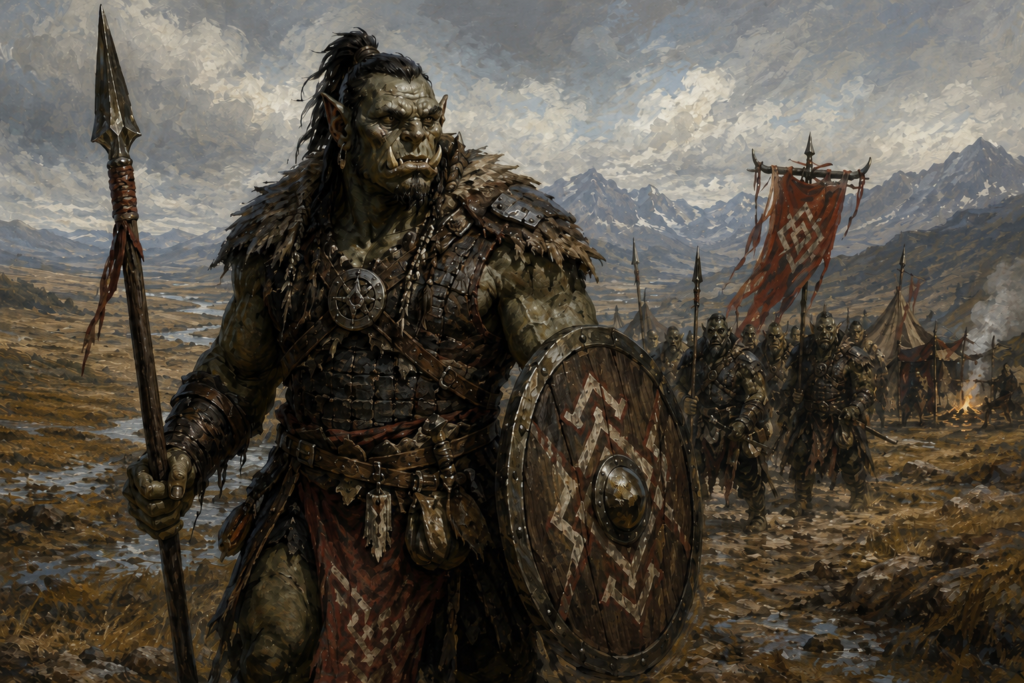
A broad, tusked warrior advances behind a hide-covered shield, its heavy spear held low and ready. Iron rings bind its dark hair, old scars cross its grey-brown skin, and a blackened fragment of dwarven metal hangs from its neck as an ancestral trophy.
Orcs are a distinct people born during the Age of Giants. They are not corrupted humans, altered elves, giant-bred soldiers or descendants of half-orcs. Their oldest traditions hold that the wounded earth shaped the first clans beneath the mountains of northern Asia after giant mining tore open the roots of the world.
The First Scar begins the orcs’ conflict with dwarves, but no single event explains the hatred that survives into 1454. Thousands of years of warfare, massacres, lost strongholds, stolen relics and inherited teaching transform the original struggle into an ancestral enmity. Most orcs need no personal grievance against a dwarf; they are raised to regard dwarves as the first and oldest enemy of their people.
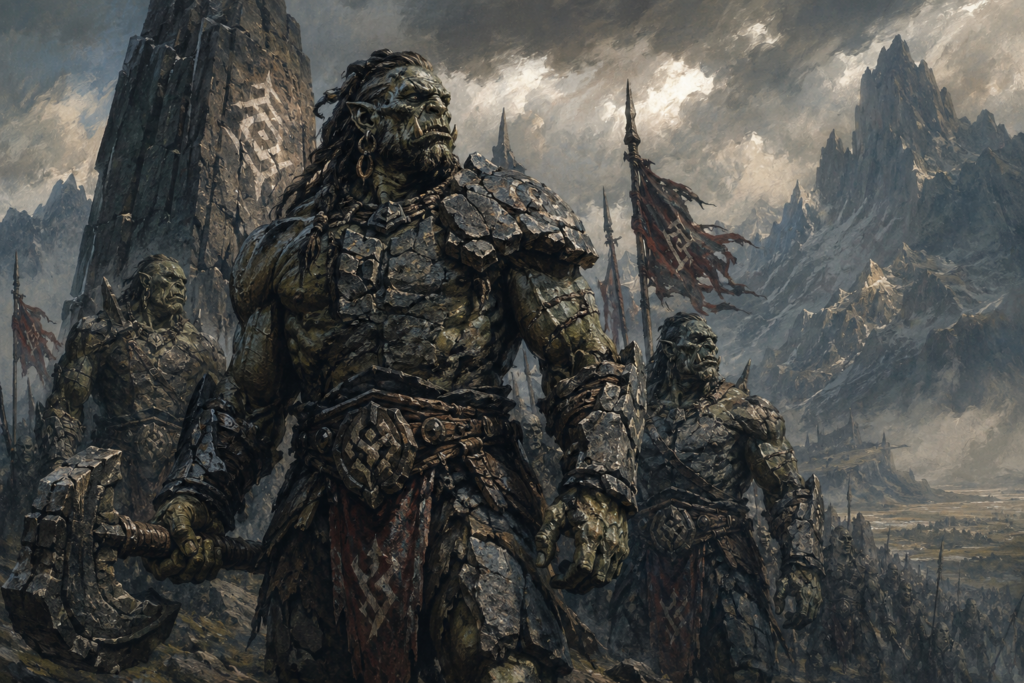
The five orc types presented here cover their essential encounter roles: the Common Orc, the Orc Worg Rider, the Orc Standard-Bearer, the Orc First-Scar Seer and the Orc Fanglord.
These are cultural, military, religious and political roles rather than biological subspecies. Orc women and men may hold any of them according to ability, clan custom and political position.
Core Types: Common Orc, Orc Worg Rider, Orc Standard-Bearer, Orc First-Scar Seer and Orc Fanglord
Running Orcs in Thirty Seconds
Question
Answer
What do they want?
Pasture, food, tribute, weapons, captives, recognised passage, revenge or recovery of a clan relic.
Why have they not attacked?
They are assessing authority, retaliation, surrender value and whether the strangers possess useful information.
What makes them fight?
Resistance to a declared claim, injury to the clan, insult before witnesses, broken surrender terms or the appearance of an ancestral enemy.
What ends the fight?
Visible surrender, payment, achievement of the raid’s objective, loss of the standard, death of the leader or danger to the clan’s dependants.
What makes them distinctive?
Scar-Law, politically important standards, intelligent worg alliances, inherited racial enmities and a culture shaped by the First Scar.
Appearance
Orcs are powerfully built humanoids with dense bones, broad shoulders, deep chests and heavy jaws. Most stand between 6 and 7 feet tall, although mountain clans and some imperial lineages regularly produce larger individuals.
Their skin ranges through iron grey, brown, olive, ochre, dark green-grey and near-black. Bright grass-green skin is rare. Skin tone varies by ancestry and region rather than indicating rank, morality or intelligence.
Orcs possess prominent lower canines commonly called tusks. These range from short, blunt protrusions to long, curved teeth extending beyond the upper lip. Broken tusks may be repaired with iron caps, carved bone or bands of precious metal.
A deliberately removed tusk may mark mourning, punishment, oath-taking, defeat or renunciation of a former clan.
Orc faces are recognisably humanoid but not human. They have broad noses, pronounced brows, powerful jaw muscles and slightly tapered ears. Their eyes are commonly amber, brown, black, yellow-grey or red-brown.
Hair is usually black, dark brown, iron grey or reddish brown. Warriors often wear it braided, bound with metal rings or cut short around the helmet line. Beards occur but are generally less dense than dwarven facial hair.
Clothing and Equipment
Orc equipment reflects region, wealth, occupation and access to trade. Orcs do not universally dress in spikes, skulls and random scraps.
Steppe and imperial orcs favour quilted coats, layered hide, scale, mail and lamellar armour. Forest clans use fur-lined leather, bark reinforcement and dark wool. Mountain clans employ heavier iron plates, reinforced helmets and equipment adapted from captured mines and giant forges.
Spears, composite bows, axes, sabres, falchions, maces and heavy knives are more common than oversized ceremonial weapons. Shields are built from hide-covered wood, layered cane, iron-rimmed timber or captured foreign designs.
Orc weapons must survive hard travel, dust, cold and poor weather. Their smiths favour thick blades, replaceable handles and fittings that can be repaired beside a campfire or mobile forge.
Trophies record specific events rather than serving as arbitrary decoration. A strip of a defeated standard, a broken dwarven tool, a giant chain link or an inherited tusk cap may represent a victory, obligation, oath or family grievance.
Orc Variations and Mechanics
Each orc type is presented with its D&D 5E 2024-compatible rules followed immediately by its Pathfinder 1e statistics and D&D 3.5e conversion notes.
Orc Type
Primary Role
5E CR
PF1e CR
Orc Warrior
Hunter, herder, guard, raider or ordinary clan warrior
1/2
1/2
Orc Worg Rider
Mounted scout, messenger, flanker and pursuer
2, excluding worg
2, excluding worg
Orc Standard-Bearer
Morale officer and guardian of clan identity
2
2
Orc First-Scar Seer
Ancestor priest and wielder of earth and curse magic
5
5
Orc Fanglord
Clan chief, negotiator and battlefield commander
6
6
Orc Warrior
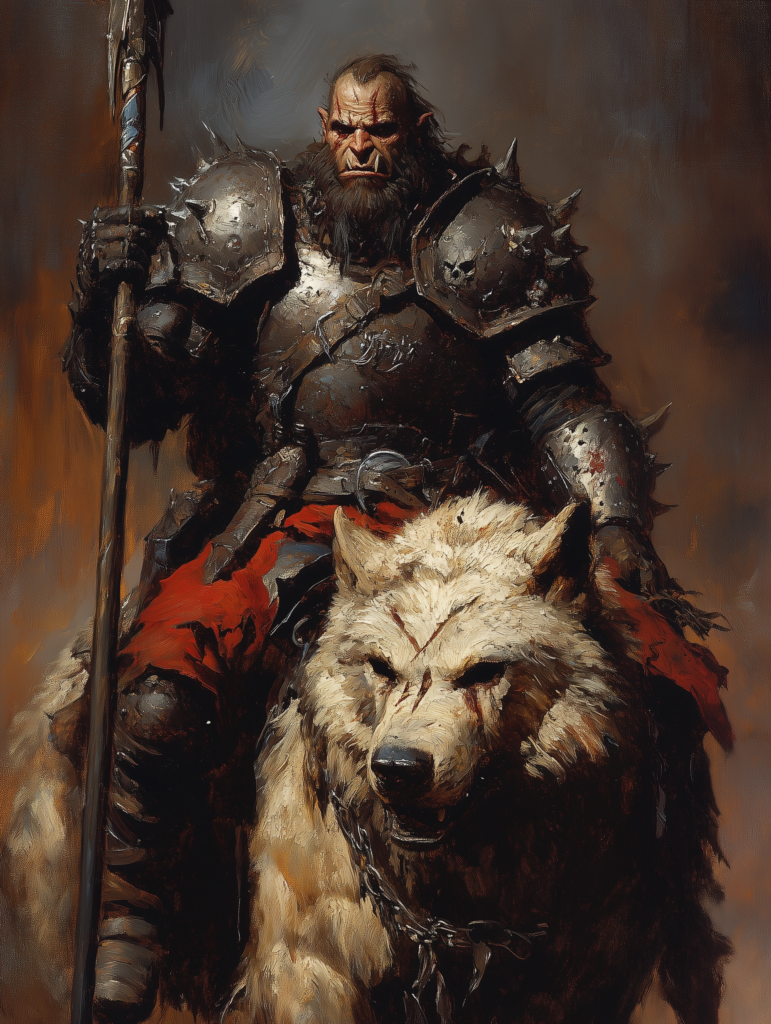
Orc Worg Rider
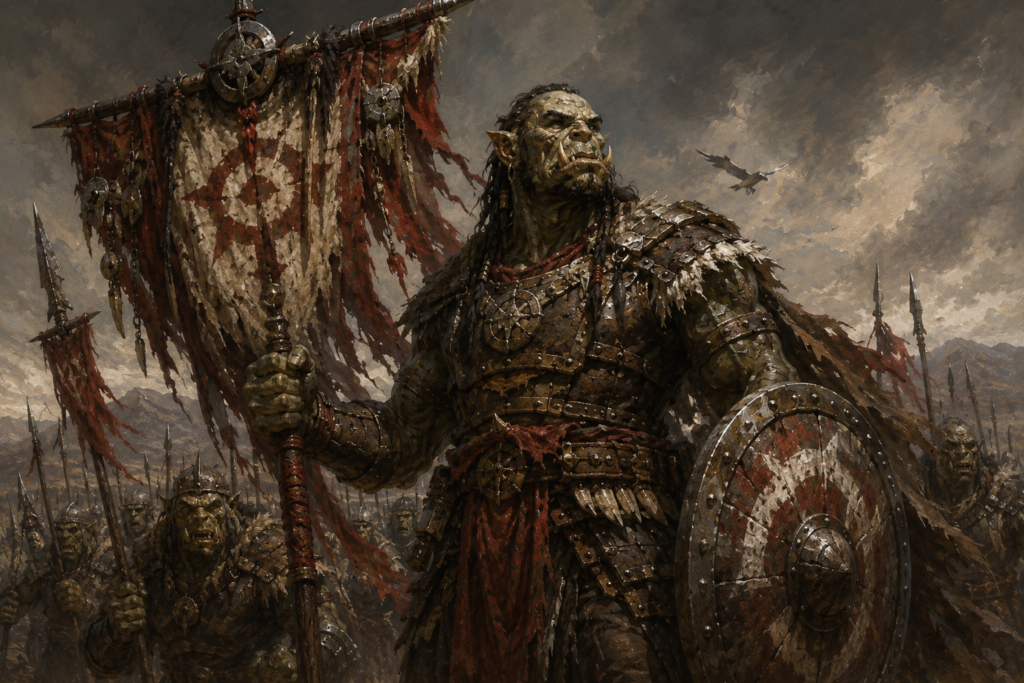
Orc Standard-Bearer
Orc First-Scar Seer
Orc Fanglord
Orc Warrior
The Common Orc is an armed adult with enough experience to patrol clan territory, defend a camp, raid a settlement or serve in an imperial company.
D&D 5E 2024-Compatible Rules
Medium Humanoid (Orc), Chaotic Evil
Armor Class 15 (hide armour, shield)
Initiative +1 (11)
Hit Points 22 (4d8 + 4)
Speed 30 ft.
Proficiency Bonus +2
STR
DEX
CON
INT
WIS
CHA
16 (+3)
12 (+1)
13 (+1)
10 (+0)
12 (+1)
10 (+0)
Saving Throws Str +5, Con +3
Skills Athletics +5, Perception +3, Survival +3
Gear hide armour, shield, broad spear, war bow, 20 arrows, heavy knife
Senses darkvision 60 ft., passive Perception 13
Languages Orc and one regional language when appropriate
Challenge 1/2 (100 XP)
Traits
Hard-March Endurance. The orc has Advantage on Constitution saving throws made to avoid or end Exhaustion caused by forced marching, extreme cold, starvation or dehydration.
Clan Courage. The orc has Advantage on saving throws against the Frightened condition while it can see or hear a conscious allied orc within 30 feet.
Inherited Hatred. The orc has Advantage on Wisdom (Survival) checks made to track dwarves or elves. Unless ordered otherwise by a recognised leader, the orc prioritises a visible dwarf over other equally dangerous enemies.
Scar-Born Endurance — 1/Day. When the orc is reduced to 0 Hit Points but not killed outright, it drops to 1 Hit Point instead.
War Bow.Ranged Attack Roll: +3, range 80/320 ft. Hit: 5 (1d8 + 1) Piercing damage.
Heavy Knife.Melee or Ranged Attack Roll: +5, reach 5 ft. or range 20/60 ft. Hit: 5 (1d4 + 3) Piercing or Slashing damage.
Bonus Actions
Driving Rush. The orc moves up to half its Speed towards an enemy it can see. It must end this movement closer to that enemy than it began.
Equipment Variations
Hunter: Remove the shield. Armor Class becomes 13. Increase War Bow range to 150/600 feet and add Stealth +3.
Shield-Bearer: Replace hide armour with scale armour. Armor Class becomes 17 and Speed becomes 25 feet.
Raider: Replace the Broad Spear and shield with a falchion. Armor Class becomes 13. Falchion: Melee Attack Roll: +5, reach 5 ft. Hit: 8 (1d10 + 3) Slashing damage.
Mountain Guard: Replace the Broad Spear with a battleaxe. Battleaxe: Melee Attack Roll: +5, reach 5 ft. Hit: 7 (1d8 + 3) Slashing damage.
These equipment changes do not normally alter the Common Orc’s Challenge Rating. Prepared positions, concealed archers or a defended choke point may make an encounter much harder without changing the printed CR.
Tactics and Morale
Common Orcs use missile fire and terrain before closing. They withdraw if their objective is achieved, their leader orders retreat, the clan standard is lost or continued fighting threatens dependants.
Against dwarves, individual warriors may abandon sound tactics to pursue inherited hatred. Experienced Fanglords and Standard-Bearers work to keep such warriors within the battle plan.
Skills Intimidate +4, Perception +5, Survival +5; Racial Modifiers +3 Perception, +4 Survival, +2 Survival when tracking dwarves or elves
Languages Orc and one regional language when appropriate
Special Qualities hard-march endurance, inherited hatred, orc weapon familiarity
Ecology
Environment cold or temperate forests, hills, mountains, plains, deserts or settlements
Organization solitary, pair, patrol (3–8), warband (9–30 plus a leader), company (30–100 plus commanders and noncombatants), or clan settlement
Treasure NPC gear
Special Abilities
Ferocity — Ex. The orc remains conscious and can continue fighting when its Hit Point total falls below 0. It is still staggered and loses 1 Hit Point each round. It dies when its negative Hit Points equal or exceed its Constitution score.
Hard-March Endurance — Ex. The orc gains a +2 racial bonus on saving throws against fatigue or exhaustion caused by forced marching, starvation, thirst or natural cold.
Inherited Hatred — Ex. The orc gains a +1 racial bonus on attack rolls against creatures with the dwarf or elf subtype and a +2 racial bonus on Survival checks made to track them.
Orc Weapon Familiarity — Ex. Orcs are proficient with battleaxes, falchions, spears and composite bows.
No Light Sensitivity. SpiralWorlds orcs retain darkvision from their subterranean origin but have lived upon the surface for thousands of years. They suffer no general penalty in bright light.
D&D 3.5e Conversion Notes
Ignore CMB and CMD. The Common Orc’s grapple modifier is +4.
Replace Perception +5 with Listen +5 and Spot +5.
Use the Pathfinder attack, damage, armour and saving throw values.
Ferocity functions as written rather than granting the Diehard feat.
Inherited Hatred applies against creatures of the dwarf or elf subtype.
Orc Worg Rider
An Orc Worg Rider is a mounted scout trained to fight beside an intelligent worg. Rider and mount are allied members of a pact between an orc clan and a worg pack.
The worg is not a domesticated animal. It retains its own judgement, motives, Hit Points, Initiative and actions.
Languages Orc, Worg and one regional language when appropriate
Challenge 2 (450 XP), excluding the allied worg
Traits
Pack-Bond. While the rider is within 5 feet of an allied worg, both creatures have Advantage on saving throws against the Frightened condition.
Mounted Discipline. The rider has Advantage on saving throws made to avoid falling from a mount. Mounting or dismounting costs the rider only 5 feet of movement.
Inherited Hatred. The rider has Advantage on Wisdom (Survival) checks made to track dwarves or elves.
Scar-Born Endurance — 1/Day. When the rider is reduced to 0 Hit Points but not killed outright, it drops to 1 Hit Point instead.
Actions
Multiattack. The rider makes two attacks using Riding Spear, Sabre or War Bow.
War Bow.Ranged Attack Roll: +5, range 150/600 ft. Hit: 7 (1d8 + 3) Piercing damage.
Bonus Actions
Ride-By Manoeuvre. While mounted on an allied worg, the rider commands the worg to use its Reaction to move up to half its Speed. This movement does not provoke Opportunity Attacks from one creature the rider attacked during the current turn.
Reactions
Coordinated Strike — Recharge 5–6. When the rider hits a creature, one allied worg within 30 feet can use its Reaction to move up to half its Speed and make one Bite attack against the same target.
Rider and Worg
The rider and worg roll separate Initiative and take separate turns. The rider’s CR and XP do not include the worg.
A rider and an ordinary CR 2 worg constitute two CR 2 creatures worth 900 XP before encounter adjustments. Do not give an ordinary worg legendary actions. If the linked worg entry uses an enhanced legendary version, treat that creature as a separate higher-CR monster.
Tactics and Morale
The pair avoids static combat. The worg circles behind enemies while the rider uses the bow, cuts off escape and attacks isolated targets.
If one partner falls, the survivor may attempt rescue, revenge or withdrawal according to the terms of their pact.
Languages Orc, Worg and one regional language when appropriate
Special Qualities armour training 1, inherited hatred, mounted discipline, pack-bond, weapon familiarity
Ecology
Environment cold or temperate forests, hills, plains or mountains
Organization pair, patrol (2–5 riders with allied worgs), messenger escort, hunting pack or warband
Treasure NPC gear
Special Abilities
Inherited Hatred — Ex. The rider gains a +1 racial bonus on attack rolls against creatures with the dwarf or elf subtype and a +2 racial bonus on Survival checks made to track them.
Pack-Bond — Ex. While adjacent to an allied worg, the rider and worg gain a +2 morale bonus on saving throws against fear.
Mounted Discipline — Ex. The rider gains a +4 bonus on Ride checks made to remain mounted and takes no penalty on ranged attacks while its worg moves at normal speed.
Coordinated Strike — Ex. Once per round, when the rider hits a creature in melee, an adjacent allied worg gains a +2 bonus on its next attack roll against that creature before the end of its next turn.
Rider and Mount. Add the worg separately when determining encounter level. A rider and CR 2 worg together normally form an EL 4 encounter.
D&D 3.5e Conversion Notes
Ignore CMB and CMD. The rider’s grapple modifier is +6.
Replace Perception +6 with Listen +6 and Spot +6.
Mounted Combat, Mounted Archery and Ride-By Attack function normally.
Remove armour training; it does not materially change the listed statistics.
Orc Standard-Bearer
A Standard-Bearer carries the visible identity, authority and battle honours of a clan. The standard may incorporate hide, iron, hair, tusks, captured banners and tokens representing old oaths.
The standard is not decorative. It identifies the authority under which the warband travels, fights, negotiates and accepts surrender.
Gear chain mail, clan standard, standard spear, heavy knife
Senses darkvision 60 ft., passive Perception 11
Languages Orc and one regional language when appropriate
Challenge 2 (450 XP)
Traits
Clan Standard. Allied orcs within 30 feet of the Standard-Bearer have Advantage on saving throws against the Frightened condition. A creature can benefit from only one Clan Standard at a time. The effect ends while the Standard-Bearer is Incapacitated or no longer carries the standard.
Standard Cannot Fall. When the Standard-Bearer is reduced to 0 Hit Points, one allied orc within 5 feet can use its Reaction to take the standard. That creature gains Clan Standard until it releases the standard or becomes Incapacitated.
The Standard. The standard is a Medium object with Armor Class 12, 10 Hit Points, Immunity to Poison and Psychic damage, and Vulnerability to Fire damage.
A creature within 5 feet of an unattended standard can take it as an action. A creature attempting to wrench the carried standard away must succeed on a DC 15 Strength (Athletics) check contested by the Standard-Bearer’s Strength (Athletics) check.
Actions
Multiattack. The Standard-Bearer makes two Standard Spear attacks.
Standard Spear.Melee Attack Roll: +5, reach 10 ft. Hit: 8 (1d10 + 3) Piercing damage.
Bonus Actions
Rally the Line — Recharge 5–6. Up to three allied orcs within 30 feet that can see or hear the Standard-Bearer gain 5 Temporary Hit Points and can immediately stand from Prone.
Tactics and Morale
The Standard-Bearer remains near the centre of the formation and avoids becoming isolated. Orcs prioritise recovering a fallen standard over pursuing fleeing enemies.
The destruction or capture of a standard may cause Common Orcs to retreat, surrender or abandon their current objective. It may also begin a lasting blood feud.
Languages Orc and one regional language when appropriate
Special Qualities armour training 1, clan standard, inherited hatred, rally the line, standard cannot fall, weapon familiarity
Ecology
Environment any orc-held territory, settlement or military camp
Organization warband, company, clan host or military procession
Treasure NPC gear plus clan standard
Special Abilities
Clan Standard — Ex. Allied orcs within 30 feet gain a +2 morale bonus on saving throws against fear and a +1 morale bonus on attack rolls. A creature can benefit from only one Clan Standard.
Inherited Hatred — Ex. The Standard-Bearer gains a +1 racial bonus on attack rolls against creatures with the dwarf or elf subtype.
Standard Cannot Fall — Ex. When the Standard-Bearer falls unconscious or dies, an adjacent allied orc can take the standard as an immediate action and maintain the Clan Standard effect.
Rally the Line — Ex. Once every 1d4 rounds as a swift action, the Standard-Bearer grants up to three allied orcs within 30 feet 5 temporary Hit Points.
The Standard — Ex. The standard has hardness 5 and 10 Hit Points. It may be attacked with a sunder combat manoeuvre. Clan Standard ends if the standard is destroyed or carried by an enemy.
D&D 3.5e Conversion Notes
Ignore CMB and CMD. The Standard-Bearer’s grapple modifier is +7.
Replace Perception +4 with Listen +4 and Spot +4.
Use opposed attack rolls when attempting to disarm the Standard-Bearer of the standard.
Remove armour training; it does not materially change the listed statistics.
Orc First-Scar Seer
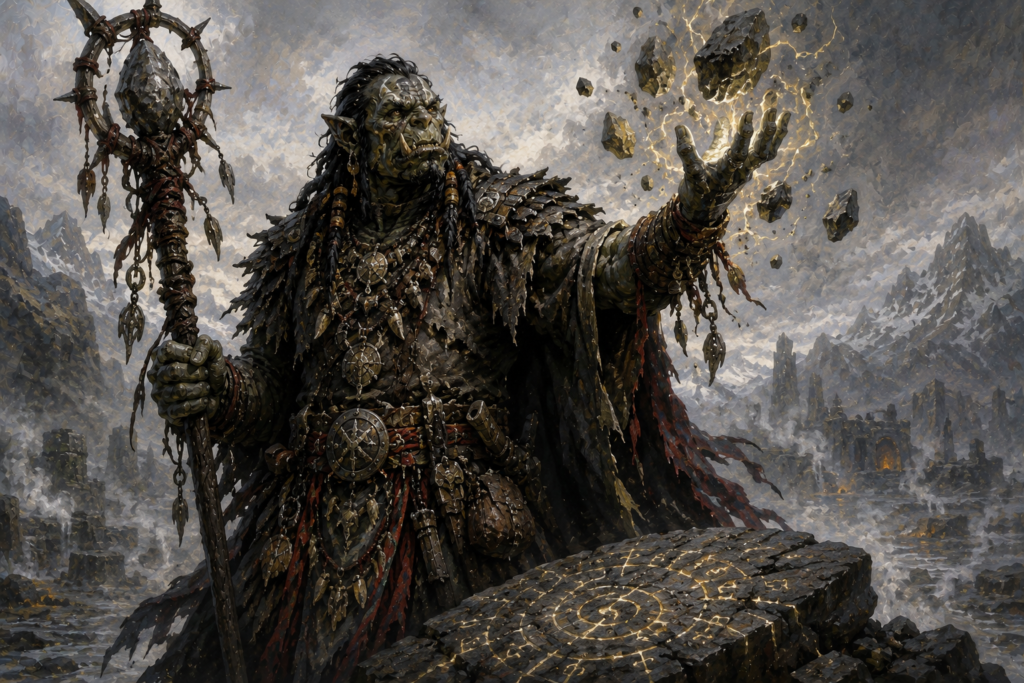
First-Scar Seers preserve the oldest accounts of orc creation. They interpret fractures in stone, movements beneath the earth, ancestral dreams and disturbances surrounding giant ruins and dwarven mines.
They are not generic tribal shamans. Their authority comes from knowledge of the First Scar, remembered precedent, dangerous earth magic and the ability to identify wounds in the land before those wounds open again.
D&D 5E 2024-Compatible Rules
Medium Humanoid (Orc), Chaotic Evil
Armor Class 15 (hide armour, ancestral ward)
Initiative +2 (12)
Hit Points 84 (13d8 + 26)
Speed 30 ft.
Proficiency Bonus +3
STR
DEX
CON
INT
WIS
CHA
13 (+1)
14 (+2)
15 (+2)
14 (+2)
18 (+4)
15 (+2)
Saving Throws Int +5, Wis +7, Cha +5
Skills History +5, Insight +7, Medicine +7, Religion +5
Gear hide armour, scar staff, stone divination pieces, ancestral tokens
Ancestral Ward. While the Seer is conscious and not wearing heavy armour, it gains a +1 bonus to Armor Class. This bonus is included above.
Ancestral Wards. The Seer has Advantage on saving throws against spells and magical effects produced directly by a Giant or by a Humanoid with the Dwarf tag. The trait does not apply merely because a magic item was originally forged by a dwarf or giant.
Earth Reader. While touching natural earth or stone, the Seer knows the direction and approximate distance of tunnels, hollow spaces and creatures moving in contact with the same continuous surface within 60 feet. Worked metal and an intervening gap of more than 5 feet block this sense.
Innate Spellcasting. Wisdom is the Seer’s spellcasting ability. Its spell save DC is 15, and it has +7 to hit with spell attacks. It requires no material components.
At will: guidance, resistance, thaumaturgy
3/day each: augury, cure wounds, hold person, shatter
1/day each: bestow curse, dispel magic, stoneskin
Actions
Scar Staff.Melee Spell Attack: +7, reach 5 ft. Hit: 11 (2d6 + 4) Bludgeoning damage plus 7 (2d6) Force damage.
Wound of the Earth — Recharge 5–6. The Seer opens a jagged fracture at a point it can see on the ground within 60 feet. Each creature in a 20-foot-radius area centred on that point must make a DC 15 Dexterity saving throw.
On a failed save, a creature takes 22 (4d10) Bludgeoning damage and falls Prone. On a successful save, it takes half as much damage and does not fall Prone. The affected area becomes Difficult Terrain until cleared.
Reactions
The Stone Remembers — 3/Day. When a creature the Seer can see within 30 feet makes an attack roll, ability check or saving throw while touching earth or stone, the Seer rolls 1d6 and subtracts the number rolled from the creature’s result.
The Seer must use this Reaction after seeing the roll but before knowing whether it succeeds or fails.
Tactics and Morale
The Seer opens with Wound of the Earth when it can strike several enemies. It then uses hold person, shatter and The Stone Remembers to disrupt dangerous opponents.
A Seer withdraws rather than allowing irreplaceable ancestral records or divination stones to be captured.
Environment mountains, caves, ancient mines, giant ruins or orc settlements
Organization solitary, accompanied by 2–6 Common Orcs, attached to a warband, or serving a Fanglord
Treasure NPC gear
Special Abilities
Ancestral Wards — Su. The Seer gains a +4 resistance bonus on saving throws against spells and spell-like abilities used directly by creatures with the dwarf or giant subtype. This bonus does not apply solely because a magic item was crafted by a dwarf or giant.
Earth Reader — Su. While touching natural earth or stone, the Seer detects tunnels, hollow spaces and moving creatures in contact with the same continuous surface within 60 feet. Worked metal and an intervening gap of more than 5 feet block this ability.
Inherited Hatred — Ex. The Seer gains a +1 racial bonus on attack rolls against creatures with the dwarf or elf subtype.
The Stone Remembers — Su. Three times per day as an immediate action, the Seer subtracts 1d6 from an attack roll, saving throw or skill check made by a creature within 30 feet that is touching earth or stone. The ability must be used after the roll but before the result is declared.
Wound of the Earth — Su. Once per day, the Seer creates a 20-foot-radius fracture centred on a point of ground within 60 feet. Creatures in the area take 4d10 points of bludgeoning damage and fall prone.
A successful DC 18 Reflex save halves the damage and prevents the fall. The affected area becomes difficult terrain. The save DC is Wisdom-based.
D&D 3.5e Conversion Notes
Ignore CMB and CMD. The Seer’s grapple modifier is +7.
Replace Perception +13 with Listen +13 and Spot +13.
Use the listed spell-like abilities at caster level 9th.
If immediate actions are not in use, The Stone Remembers is a free action usable once per round.
Orc Fanglord
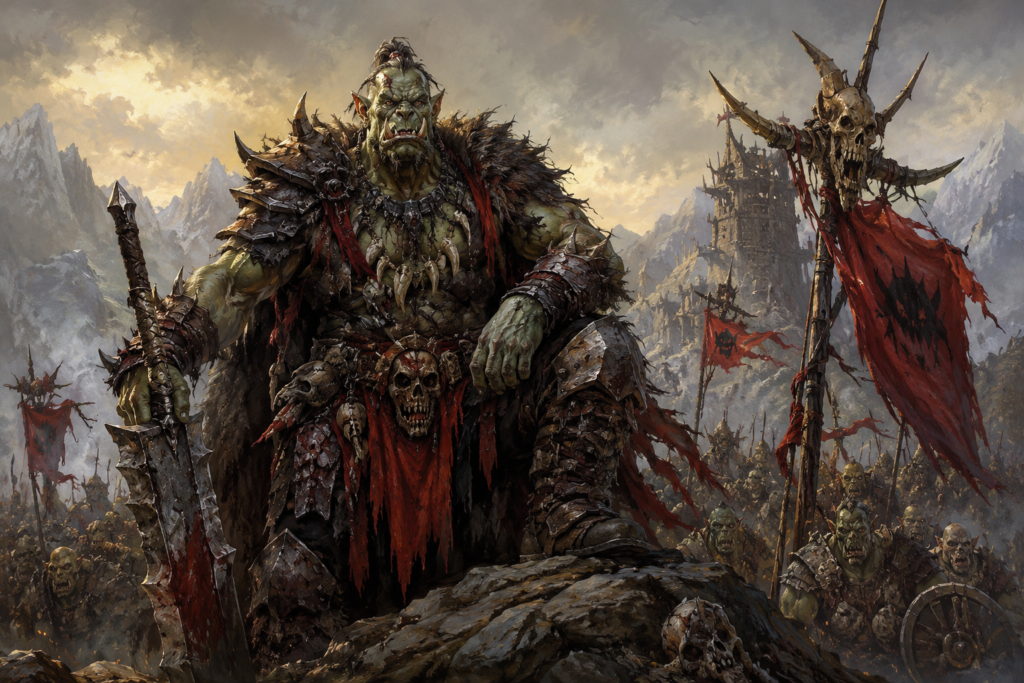
A Fanglord commands one or more clans. The title requires more than physical strength. A successful Fanglord must feed followers, distribute plunder, judge disputes, negotiate territory and prevent private feuds from destroying the warband.
Some Fanglords inherit a strong claim, but none retains authority without visible success.
Gear reinforced lamellar, shield, clan cleaver, four heavy javelins, tusk-seal
Senses darkvision 60 ft., passive Perception 12
Languages Orc and two regional languages
Challenge 6 (2,300 XP)
Traits
Authority of the Fang. Allied orcs within 30 feet of the Fanglord add 2 to damage rolls made with weapon attacks. A creature can benefit from only one Authority of the Fang.
Indomitable — 1/Day. The Fanglord rerolls a failed saving throw.
Scar-Born Endurance — 2/Day. When the Fanglord is reduced to 0 Hit Points but not killed outright, it drops to 1 Hit Point instead.
Actions
Multiattack. The Fanglord makes three attacks using Clan Cleaver or Heavy Javelin.
Heavy Javelin.Melee or Ranged Attack Roll: +8, reach 5 ft. or range 30/120 ft. Hit: 10 (1d10 + 5) Piercing damage.
Bonus Actions
Command the Clan. One allied orc within 60 feet that can hear the Fanglord can use its Reaction to move up to half its Speed and make one weapon attack.
Rallying Roar — Recharge 5–6. Up to four allied orcs within 30 feet that can hear the Fanglord each gain 10 Temporary Hit Points.
Reactions
Answer for My Clan. When an allied orc within 10 feet is hit by an attack, the Fanglord moves into an unoccupied space adjacent to that ally and becomes the target instead. The Fanglord must be within the attack’s range and cannot use this Reaction if it is already a target of the attack.
Master of Hatred. When an allied orc within 30 feet damages a dwarf or elf with a weapon attack, the Fanglord can use its Reaction to allow that orc to reroll one damage die. The new roll must be used.
Tactics and Morale
The Fanglord uses Command the Clan every round in which an ally can make a useful attack. It fights near the standard and places Common Orcs between enemies and the First-Scar Seer.
The Fanglord must choose between using Answer for My Clan to protect an ally and using Master of Hatred to intensify an attack against a dwarf or elf.
A Fanglord may accept surrender when the captives, tribute or political recognition are more valuable than continued fighting.
A Fanglord rarely fights to the death merely to prove courage. It may do so if retreat would destroy its claim to leadership or expose the clan’s dependants.
Special Qualities armour training 2, authority of the fang, command the clan, inherited hatred, rallying roar, weapon familiarity, weapon training (axes +1)
Ecology
Environment any orc-held territory, military camp or conquered settlement
Organization entourage (Fanglord plus 4–12 orcs), warband, clan host or settlement
Treasure NPC gear
Special Abilities
Authority of the Fang — Ex. Allied orcs within 30 feet gain a +2 morale bonus on weapon damage rolls. A creature can benefit from only one Authority of the Fang.
Command the Clan — Ex. As a swift action, the Fanglord allows one allied orc within 60 feet to move up to half its Speed and make one weapon attack as an immediate action.
Inherited Hatred — Ex. The Fanglord gains a +1 racial bonus on attack rolls against creatures with the dwarf or elf subtype.
Master of Hatred — Ex. Once per round, when an allied orc within 30 feet damages a creature with the dwarf or elf subtype using a weapon attack, the Fanglord allows that ally to reroll one weapon damage die. The new result must be used.
Rallying Roar — Ex. Once every 1d4 rounds as a swift action, the Fanglord grants up to four allied orcs within 30 feet 10 temporary Hit Points.
Scar-Born Endurance — Ex. Twice per day, when the Fanglord would be reduced below 0 Hit Points, it remains at 1 Hit Point instead.
D&D 3.5e Conversion Notes
Ignore CMB and CMD. The Fanglord’s grapple modifier is +12.
Replace Perception +9 with Listen +9 and Spot +9.
Remove armour training and weapon training.
Add Improved Bull Rush and Weapon Specialization (battleaxe) as bonus feats.
If immediate actions are not in use, Command the Clan is a free action usable once per round.
Encounter Groups
The following groups assume four player characters. Terrain, surprise, mounted mobility, available retreat routes and depleted party resources may alter the actual difficulty substantially.
D&D 5E 2024 Encounter Groups
Level Band
Encounter
Base XP
Complication
1
Two Common Orcs
200 XP
They demand food or passage rights before attacking.
1–2
Three Common Orcs
300 XP
One carries surrender terms from a nearby Fanglord.
2–3
Three Common Orcs and one Standard-Bearer
750 XP
The standard is an ancestral relic whose capture begins a feud.
3–4
Two Common Orcs, one Worg Rider and one ordinary worg
1,100 XP
The rider circles the party while the infantry blocks the road.
4–5
Three Common Orcs and one First-Scar Seer
2,100 XP
The group is investigating a ruined Fire Giant mine rather than seeking battle.
5–6
One Fanglord and four Common Orcs
2,700 XP
The Fanglord offers harsh surrender terms before committing to battle.
7–8
One Fanglord, one First-Scar Seer, one Standard-Bearer and four Common Orcs
4,950 XP
The warband is transporting a captured dwarven relic.
Pathfinder 1e Encounter Groups
Suggested APL
Encounter
Approximate EL
Complication
1
Two Common Orcs
EL 1
The orcs guard a disputed well rather than hunting travellers.
2
Four Common Orcs
EL 2
The patrol withdraws if its messenger escapes.
3
One Standard-Bearer and two Common Orcs
EL 3
The standard grants the patrol unusual morale.
3–4
One Worg Rider and one worg
EL 4
The pair repeatedly disengages rather than accepting a static fight.
5
One First-Scar Seer and two Common Orcs
EL 5
The Seer reshapes the battlefield while the warriors protect it.
6
One Fanglord and four Common Orcs
EL 6
The Fanglord’s aura increases the entire group’s damage.
7
One Fanglord, one Standard-Bearer, one Worg Rider and one worg
EL 7
The mounted pair attacks the rear while the infantry holds the centre.
Do not construct every encounter from identical Common Orcs. Choose one specialist whose abilities express the group’s purpose: pursuit, morale, magic or command.
The First Scar — Origin of the Orcs
Orc history begins during the Age of Giants, when northern Asia lies beneath the rule of the Crown of the Nine Mountains.
Frost Giant khans control the surface dominion. Their halls overlook glacial valleys, high passes, Siberian forests and northern grasslands. They command mammoth herds, ogre soldiers, troll hunters, ettin wardens and enslaved lesser peoples.
Fire Giant forge lords control the mines, furnaces and underground strongholds. They produce weapons and armour for the Frost Giant rulers and compete to discover deeper deposits of iron, copper and supernatural metal.
The giants enslave dwarven clans to excavate their mines, construct underground roads, maintain furnaces and forge weapons. Some dwarves become guards, foremen or favoured slaves because cooperation protects their families or improves their position. They remain subject to giant rule.
Ettins guard passes, drive work gangs, collect tribute and protect approaches to the Fire Giant mines. Their two heads make them difficult to surprise and allow one head to watch while the other sleeps.
The catastrophe begins when a Frost Giant ruler demands a weapon greater than any possessed by his rivals.
Fire Giant miners discover star-iron buried beneath the roots of the Altai. Dwarven seers warn that the metal lies inside a living foundation of the world. Removing it will not merely collapse a mine; it will wound the earth itself.
The giant lords ignore them.
Dwarven work gangs are driven deeper. Underground rivers are diverted, sealed caverns opened and enormous wedges hammered into the roots of the mountain.
The final excavation pierces the living power beneath the earth.
The mountains split.
Black smoke pours from the peaks. Rivers run red with iron. Furnaces burst, tunnels fold and giant fortresses disappear into the depths.
Orcs remember this catastrophe as the First Scar.
Within the broken caverns, the wounded earth shapes a new people from stone, blood, marrow, iron and subterranean fire. These are the first orcs: broad-boned, tusked, night-sighted and able to endure darkness, cold, hunger and injury.
Some clans describe the living power beneath the mountain as the Deep Mother. Others call it the Wounded Earth, the First Forge or the Stone beneath All Blood. These are regional interpretations rather than the worship of one universal creator god.
The first orcs awaken among collapsed tunnels, broken chains and the bodies of giants and dwarves.
The First War with the Dwarves
The first living people encountered by the orcs are dwarves.
Some are terrified slaves attempting to escape the ruined mines. Others are armed foremen, forge guards or work gangs trying to prevent further collapse. Many believe that the newly emerged orcs are dangerous creatures released by the catastrophe and attempt to bar them from the remaining passages.
The first orcs do not understand the divisions among the dwarves. They see dwarven tools beside the wound, dwarven hands upon the gates and dwarven weapons blocking the road to the surface.
The first war between orcs and dwarves begins in the collapsing tunnels.
Orcs tear down the gates, capture forge halls and kill those who stand against them. Dwarves remember the attacks as slaughter committed against an enslaved people already suffering beneath giant rule. Orcs remember dwarven blades waiting at the moment of their birth.
The giants cause the First Scar. The dwarves are their captives. Yet dwarves become the first people to oppose the orcs and the first enemy the orcs know.
When giant rule weakens, both peoples claim the abandoned mines, roads, forge halls and mountain strongholds.
Freed dwarven clans argue that their ancestors constructed the halls through generations of slavery and death. Orcs answer that the mines are instruments of the crime that wounded the earth and that the caverns belong to the people born within them.
This conflict begins the enmity. It does not, by itself, explain the hatred that exists in 1454.
Inherited Hatred
The First Scar begins the orc–dwarf conflict. Generations of war transform it into racial hatred.
For thousands of years, orc clans and dwarven holds fight over mountain roads, mines, forge halls, river valleys, sacred caverns and giant ruins. Each war creates new massacres, stolen relics, broken treaties and unburied dead.
Orc Seers and elders teach a simplified ancestral account:
dwarven hands opened the First Scar;
dwarves barred the first road to the surface;
dwarves claimed the caverns where orcs were born;
dwarves continue to cut into the wounded earth;
dwarven kingdoms have opposed orc expansion ever since.
This account is incomplete and unfair, but it gives every later conflict a sacred meaning. A border raid becomes another battle in the First War. A disputed mine becomes part of the birthplace of the orcs. A dead warrior becomes another victim of the enemy that greeted the first clans with weapons.
Dwarven histories preserve their own inherited hatred. They describe orcs as scar-spawn that slaughtered enslaved survivors, seized halls built by dwarven captives and continued attacking newly liberated holds.
Neither people needs to remember the original events accurately. Each generation inherits graves, ruined settlements and family losses that appear to prove the stories taught by the previous generation.
By 1454, most orcs require no personal injury before hating dwarves. Dwarves are the ancestral enemy because they have always been the ancestral enemy.
Orc leaders and Seers preserve the hatred because it strengthens unity, directs violence outward and gives rival clans a common foe. A Fanglord may restrain warriors for military or political reasons, but openly defending dwarves risks appearing weak, corrupted or disloyal to the First Scar.
Hatred of Elves
Elves are the orcs’ other great inherited enemy.
The hatred begins after the first orc expansion into forest-steppe, river valleys and lands protected by elven successor realms. Elves resist orc settlement, shelter escaped captives, defend woodland routes and repeatedly support dwarven holds.
Orcs remember elven armies as the force that closes fertile lands to their clans and denies them access to forests, rivers and Fey crossings. Elves remember orcs as raiders, slavers and destroyers who repeatedly burn protected settlements.
Generations of warfare make the hatred self-sustaining. Orcs may kill elves or dwarves on sight unless restrained by a Fanglord, hostage agreement, recognised truce or immediate military necessity.
Dwarves remain the primary ancestral enemy because their conflict begins at the First Scar. Elves are the ancient enemy encountered during the orcs’ expansion into the open world.
Expansion into the Open Lands
As giant rule weakens and the great ice retreats, orc clans spread from the northern mountains into forests, grasslands, river basins and desert margins.
They occupy abandoned giant forts, defend wells, claim seasonal hunting grounds and control passes leading from the Altai and Sayan Mountains. Some follow migrating herds. Others remain near the First Scar and fight for the old giant forges.
By the Rooting Age, orcs possess established territories, permanent winter camps, burial grounds, shrines, mining settlements and inherited migration routes.
Orcs are not wandering intruders in an otherwise human world. Many of their claims to roads, mountains and sacred places are older than the neighbouring kingdoms.
Temüjin and the Great Steppe Empire
Temüjin arises thousands of years after the First Scar. He does not create the orcs or begin their wars with dwarves and elves.
His achievement is political.
In 1206 CE, assembled orc chiefs proclaim Temüjin Chinggis Khan, a title commonly translated within the campaign as the Universal Ruler.
Temüjin suppresses clan feuds, reorganises military households, establishes protected imperial roads and founds the Great Steppe Empire.
The Yuan dynasty, Golden Horde, Chagatai Khanate and Ilkhanate are orc-led successor states descended from this imperial tradition. Their subject populations vary by region, but their ruling dynasties and imperial identity are orcish.
Hobgoblins are a separate people. They do not form part of Temüjin’s ruling clans, the Great Steppe imperial people or its successor khanates.
Major Orc Lands in 1454
The Great Steppe Empire no longer exists as one united realm. Its successor states, dynastic claimants and surviving military households stretch across Eurasia.
The Lands of the First Clans
The Lands of the First Clans, called Orcia by many foreigners, form the principal Northern Yuan heartland. They include the Mongolian Plateau, northern Gobi, Orkhon Valley and approaches to the Altai and Sayan Mountains.
The region is politically unstable in 1454. Chinggisid claimants, Oirat warlords and rival clan coalitions dispute who may speak for the Northern Yuan inheritance.
Karakorum remains a place of immense historical and ritual importance even though the active royal court frequently travels between seasonal camps.
The First-Scar Mountains
The First-Scar Mountains contain the oldest orc shrines, giant ruins, contested dwarf holds and cavern systems associated with the creation of the orcs.
First-Scar Seers, forge clans and dwarf-hunting warbands are particularly common here. Ettins still occupy abandoned giant forts and mountain roads.
The Eastern Fang Khanate
The Eastern Fang Khanate, called Orcistan by foreigners, descends from the eastern Chagatai territories.
Its rulers contest the Ili Valley, Tian Shan roads, Kashgar, Aksu, Turfan and neighbouring caravan routes. Open-steppe clans, fortified mountain communities and wealthy oasis settlements all lie beneath its uneven authority.
The Great Horde and Western Successors
The western orc world includes the Great Horde, Crimean Khanate, Kazan Khanate, Nogai domains and lesser claimants descended from the Golden Horde.
These powers control or contest portions of the lower Volga, middle Volga, Caspian steppe, Crimea, Don country and tribute roads leading towards the Rus principalities.
Astrakhan has not yet emerged as a fully independent khanate in 1454, although the lower Volga already contains the rival households from which it will arise.
The Former Ilkhanate
The Ilkhanate no longer exists as a united state, but its former territories contain orc military households, displaced nobles, frontier clans and rulers claiming the right to restore the khanate.
Many now live beneath, beside or in resistance to the Timurid order in Persia, Transoxiana and Afghanistan. These communities are substantial, but they do not form one secure orc kingdom.
The Ming Frontier
Orc clans, Northern Yuan forces and restoration movements remain active north of the Great Wall.
The frontier contains fortified markets, abandoned Yuan stations, burned grazing grounds, defended river crossings and seasonal war-camps. Trade and raiding often occur within days of one another.
The Ming holds China. Orc power survives north of the frontier, in old garrison families and among hidden Yuan loyalists, but orcs do not rule Beijing or the Chinese interior in 1454.
The Moving Throne
The Moving Throne is not one fixed city. It is the travelling court, treasury, hostage camp and war council of an imperial claimant.
Its position changes with pasture, season, tribute and military need. At its greatest it contains thousands of warriors, craftspeople, slaves, merchants, animals, allied worg packs and the standards of subordinate clans.
Orc Names and Place-Names
Orcs possess their own personal, clan and territorial names. English names used on this page are usually translations, foreign exonyms or established historical names.
An orc’s full identity may contain three elements:
Personal name: an untranslated birth or childhood name;
Clan identity: the household, lineage or standard to which the orc belongs;
Earned title: a name gained through conquest, injury, office, disgrace or witnessed achievement.
Temüjin remains Temüjin because that is his personal name. Chinggis Khan is his imperial title.
Later rulers may carry translated titles such as One-Tusk, Iron-Hand, Gate-Breaker, Red Standard, Broken-Chain or Keeper of the Western Road.
Historical and cosmopolitan cities such as Karakorum, Sarai, Almaliq, Kashgar, Tabriz and Herat retain their recognised names. Orc rulers may possess ceremonial titles for these places, but the cities are not automatically renamed when an orc dynasty occupies them.
Common Translated Naming Elements
Element
Usual Meaning
Scar
Origin, sacred wound, inherited grievance or dangerous knowledge.
Fang or Tusk
Authority, lineage, aggression, legal claim or leadership.
Chain
Giant oppression, captivity, liberation or an oath that cannot be escaped.
Road
Protected passage, tribute route, imperial authority or office.
Rein
Mounted household, cavalry tradition or control of migration.
Salt
Desert territory, wells, trade, exile or endurance.
Stone
Ancestry, death, permanence or connection to the First Scar.
Wolf or Worg
Pack alliance, northern territory, pursuit or inherited pact.
Translated compound names create a coherent naming tradition without reducing every orc name to an unrelated collection of harsh-sounding syllables.
Language and Speech
Orc is a complete language with extensive vocabularies for kinship, rank, routes, pasture, tribute, surrender, witness, retaliation and obligation.
Orcs who speak another language should not automatically use broken grammar. Imperial officers, caravan guards, merchants, hostages and urban orcs may speak Chinese, Persian, Turkic languages, Russian, German or other regional languages fluently.
Orc speech is often direct because speakers are expected to identify:
who possesses authority;
who witnessed the statement;
what is being offered;
what obligation is created;
what consequence follows refusal or betrayal.
An orc insult commonly attacks courage, ancestry, oath-keeping or the ability to protect dependants. Calling an orc earthless implies that the individual has abandoned clan, ancestry and every obligation that gives their word value.
Alignment
The overwhelming alignment of orcs is Chaotic Evil.
Orc societies value personal strength, clan loyalty, vengeance, conquest and freedom from outside restraint. They accept raiding, slavery, collective punishment and the violent seizure of territory as legitimate means of advancing the clan.
Scar-Law and obedience to a khan do not make them lawful. Orc authority is personal, competitive and conditional. A ruler is obeyed while strong enough to reward loyalty, enforce judgements and punish defiance. A weak ruler is challenged, deserted or killed.
Orc evil is deliberate rather than mindless. Orcs are fully intelligent people capable of planning, negotiation, affection, courage and restraint, but their societies commonly direct those qualities towards conquest and the interests of recognised insiders at the expense of outsiders.
Inherited hatred of dwarves and elves is part of the ordinary orc worldview. It does not need to arise from a personal wrong or a carefully reasoned historical judgement.
Exceptional individuals may possess another alignment, but such cases are rare departures from the normal character of the people.
Physiology
Orcs possess dense musculature and heavy bones. Even an untrained orc is normally stronger than an average human of comparable age.
Their broad ribcages and efficient lungs support sustained exertion in thin mountain air, cold weather and long marches. Orcs can still become exhausted, dehydrated, frostbitten or starved.
Orc blood is dark red. Their body temperature is slightly higher than that of humans, and they tolerate cold better than prolonged extreme heat.
Their darkvision is inherited from the first underground clans. Complete darkness appears in shades and contrast; colour and fine surface detail still require light.
Orcs recover from minor injuries well when adequately fed, but they do not possess supernatural regeneration. Infection, internal wounds and broken bones kill them when untreated.
Life Cycle and Family
Orcs reach physical maturity between fourteen and sixteen years of age.
An orc protected from warfare, famine and disease may live for approximately seventy years. Elders beyond eighty are uncommon but possible.
Age is respected when it preserves useful memory, political judgement, ritual authority or knowledge of boundaries, debts and surrender terms.
Orcs reproduce among themselves and maintain families, households and extended clans. Half-orcs are not required for orc reproduction and are not a founding branch of the orc people.
Children belong first to a household and clan rather than solely to their biological parents. Fosterage, adoption, hostage upbringing and the incorporation of surviving dependants are all recognised practices.
Orc children learn the names of ancestral enemies alongside the names of their clan, its standards and its dead. Dwarves and elves appear in stories as enemies long before most young orcs encounter either people.
Orc women and men may serve as warriors, hunters, smiths, riders, Standard-Bearers, Seers and Fanglords. Local clan custom affects opportunity, but no role requires a separate gender-based monster type.
Clan and Household
The clan is the most enduring orc institution. It connects ancestry, territory, mutual defence, marriage, blood debt, burial and responsibility for dependants.
A clan includes children, elders, hunters, craftspeople, animal keepers, healers, priests, slaves, adopted outsiders and those unable to fight.
Several households form a travelling camp or permanent settlement. Several camps may recognise one Fanglord, sacred standard or ancestral gathering place.
A successful leader must:
feed followers through winter;
distribute captured wealth without causing rebellion;
avenge recognised injuries;
judge disputes between households;
negotiate pasture, passage and tribute;
select battles the clan can survive;
maintain support among warriors, elders and Seers.
A physically powerful bully may dominate a small band for a time. Sustained authority requires alliances, judgement, memory and visible results.
Settlements
Orcs are not exclusively nomadic. Their settlements reflect terrain, season, military pressure and access to subject labour.
Settlement
Description
Adventure Use
Moving Camp
Wagons, tents, herds, temporary corrals, portable forges and a central standard ground.
The camp can relocate within hours, taking prisoners or evidence with it.
Winter Hold
A permanent stone, timber or earthwork settlement containing stores, workshops and protected animal enclosures.
Food reserves and dependants make the orcs more willing to negotiate—and more dangerous when threatened.
Road Station
A fortified toll, messenger and remount post controlling an imperial or caravan route.
Travel tokens, hostages and tribute records reveal wider political networks.
First-Scar Fortress
A captured mine, giant ruin or mountain redoubt guarding sacred caverns and old machinery.
Dwarven claims, giant relics and unstable earth magic collide in one location.
Urban Orc Quarter
A garrison, military household or ruling district inside a conquered or successor-state city.
Orcs interact with merchants, subject officials, rival ethnic communities and imperial courts.
Food, Herds and Economy
Orcs are omnivorous. Regional diets include meat, fermented milk, hard cheese, roots, grain, marrow, blood dishes, onions, preserved vegetables and dried fruit obtained through trade or tribute.
They do not require human flesh and are not natural cannibals.
Open-steppe clans depend on horses, cattle, sheep and goats. Forest-steppe clans add hunting, trapping, timber and river travel. Desert clans control wells, salt and caravan routes. Mountain clans mine, smelt metal and occupy old giant workshops.
Major sources of wealth include:
livestock and remounts;
salt, hides, felt and preserved food;
iron, captured weapons and mobile forge-work;
tribute paid by subject settlements;
tolls collected from roads and river crossings;
ransoms, hostages and enslaved labour;
military service and caravan protection;
plunder taken in raids and conquest.
Large orc armies depend upon grain, fodder and replacement animals obtained from subject communities. Destroying those supplies can stop an army that cannot be defeated in open battle.
Scar-Law
Orc law is preserved through witnessed speech, physical tokens, scars, standards and remembered precedent.
A scar does not automatically prove honour. Its location, witnesses and story determine its meaning. False scars and invented victories are serious offences because they falsify political memory.
Scar-Law recognises chiefs, envoys, oath-bound warriors, hostages, surrendered rulers, protected traders and clan dependants as distinct legal statuses.
Recognition as a person does not guarantee freedom or humane treatment. Orc law permits slavery, hostage-taking and severe collective punishment.
Envoys
A recognised envoy carries a marked token, weapon, cord or piece of a ruler’s standard. Harming the envoy is treated as an attack upon the authority that issued the protection.
Orcs may threaten, detain or reject an envoy without killing them. Murdering a recognised messenger can justify feud or war.
Surrender
Surrender must be visible, witnessed and offered by someone capable of binding the group concerned.
A settlement may lower its standard, open its gates, extinguish its war fire or deliver recognised hostages.
Terms may demand livestock, weapons, labour, captives, tribute or military service. These terms may be extremely harsh.
A Fanglord who repeatedly massacres enemies after accepting surrender weakens their own authority. Future opponents will fight to the death rather than trust the Fanglord’s word.
Feud
A recognised injury creates a debt of blood, compensation or service. Feuds may survive for generations.
Imperial rulers suspend private feuds during major campaigns. Resuming a forbidden feud while the army is at war may be treated as rebellion.
Truces with Ancestral Enemies
A truce with dwarves or elves must be explicit, witnessed and limited by purpose, place or time.
An orc may obey such a truce without abandoning inherited hatred. Once the stated terms expire, ordinary hostility resumes unless a new agreement is made.
Killing a protected dwarf or elf during a recognised truce is an offence against the authority that guaranteed the agreement, not necessarily an offence against the victim.
Ettin Oaths
Orc law treats an ettin as one creature possessing two independently responsible voices.
Both heads must hear, understand and accept an oath before it becomes binding. An agreement accepted by only one head is incomplete.
If both heads accept and either later breaks the agreement, the entire ettin is considered an oath-breaker.
Religion and Magic
Orcs do not possess one universal creator god.
Older traditions venerate the Wounded Earth, ancestors of the First Scar, mountain powers, storm beings, herd guardians, forge spirits and the dead of particular clans.
Some clans call the power that shaped the first orcs the Deep Mother. Others understand the First Scar as the earth defending itself without conscious divine intention.
Temüjin later becomes the centre of an imperial ancestor cult. As Chinggis Khan—the Universal Ruler—he represents sovereignty, conquest, protected roads, envoys, witnessed oaths and unity among rival clans.
Temüjin is not the creator of the orcs. He is the mortal conqueror who unites their greatest historical empire.
Magic is uncommon enough to command respect but not so rare that orcs mistake every spellcaster for a god. First-Scar Seers dominate the oldest religious tradition, while regional clans may also produce storm-callers, bone-diviners, forge-workers and war-singers.
First-Scar Seers preserve and intensify hatred of dwarves by interpreting every renewed conflict as a continuation of the first battle beneath the mountains.
Magic that alters memory, identity or oath testimony is particularly feared because it attacks the foundations of Scar-Law.
Death, Burial and Memory
Orcs believe that the dead must be returned to earth without allowing the earth to swallow their identity.
The dead warrior’s primary weapon is commonly broken before burial. One part enters the grave; another remains with the household or standard as proof that the dead belonged to the clan.
Burial customs vary:
steppe clans raise low stone-and-earth mounds;
mountain clans seal the dead in natural chambers rather than active mines;
urban orcs maintain walled burial grounds or family crypts;
warbands far from home carry a stone from the death site back to the clan.
A Seer or elder recites the dead orc’s witnessed scars, debts and surviving obligations. The purpose is not praise. It is to prevent false claims after death.
When dwarves or elves kill an orc, the identity of the ancestral enemy becomes part of the burial account. Such deaths reinforce hatred long after the immediate battle is forgotten.
Worg allies receive their own pack rites. They are not buried as mounts or possessions of their riders.
Relations with Other Peoples and Creatures
Other Orcs
Other orcs are a clan’s closest potential allies and its most frequent political rivals.
A witnessed oath, marriage agreement, shared standard or recognised khan can unite clans into armies capable of sustained conquest. Without such authority, disputes over pasture, wells, captives, tribute and inherited insults can rapidly lead to violence.
Most orcs are taught that dwarven hands opened the First Scar and dwarven weapons barred the first road to the surface. Later wars over mountain halls, mines and forge roads repeatedly confirm this inherited account.
Orcs may trade with dwarves through intermediaries, exchange prisoners or fight beside them against a greater enemy. Such cooperation requires strict terms and rarely survives once the immediate need ends.
Many orcs attack dwarves on sight when no recognised authority restrains them.
Elves
Elves are an ancient racial enemy encountered during the orcs’ expansion into forests, river valleys and western mountain approaches.
Elven support for dwarven holds strengthens the orc belief that the two peoples are natural allies against them.
Regional treaties and temporary alliances occur, but most orc clans expect eventual conflict with nearby elven settlements.
Orc Fanglords negotiate with pack leaders for military service, hunting rights, denning territory, meat and a share of livestock or plunder.
A recognised worg pack may fight beside the same clan for generations. A leader who starves the pack, mistreats its cubs or treats its members as ordinary animals may be abandoned or killed.
Wolves
Ordinary wolves serve as hunting animals, trackers and camp guardians. They are animals rather than political allies and are not normally large enough to carry orc riders.
Ogres
Ogres sometimes serve Fanglords as gate-breakers, wagon haulers and heavy assault troops.
The relationship is transactional. Ogres follow rulers who provide food, weapons and opportunities for violence but may desert or change sides when defeat appears likely.
Centaurs
Some centaur clans form temporary alliances with orc khans. Both peoples value mobility, knowledge of open country and the division of captured wealth.
The same clans may fight over pasture, river crossings and stolen livestock. Centaurs remain independent allies or enemies rather than automatic members of an orc army.
Ettins
Ettins are two-headed giant-kin whose ancestors serve the Crown of the Nine Mountains as fortress guards, slave-drivers, tribute collectors and wardens of mountain passes.
Orcs remember ettins as servants of the giant oppressors who guarded mines, hunted escaped captives and attempted to block the first clans from reaching the surface.
After the giant empire falls, many ettins become petty rulers of ruined forts, bridges, caves and mountain roads. Some still demand tribute in the names of giant masters dead for thousands of years.
Orcs generally hate and distrust ettins, but the hostility is less absolute than their hatred of dwarves. A Fanglord may bribe an ettin, hire it as a siege warrior or force a defeated ettin into temporary service.
Ettins make unstable auxiliaries. Their two heads may disagree about payment, allegiance, retreat or whether an oath remains advantageous.
Hobgoblins
Orcs and hobgoblins are separate peoples with different histories, gods, laws and military traditions.
Hobgoblin states do not form part of the Great Steppe Empire or its successor khanates. They compete with orc rulers for frontier cities, caravan roads, tribute and former imperial territory.
Hobgoblin armies favour permanent military institutions, codified rank and written chains of command. Orc armies remain more dependent upon clan obligations, dynastic households, personal followings and witnessed oaths.
Humans
Human contact with orcs includes trade, frontier coexistence, tribute, warfare, enslavement and imperial conquest.
Human settlements may remain within orc-ruled territories as conquered or tributary communities. Their treatment depends upon local law, status and the power capable of defending that status.
Half-Orcs
Content note: This section refers non-graphically to sexual violence.
Most half-orcs known along the SpiralWorlds frontiers arise through sexual violence committed against human captives during raids, slavery and conquest.
They are not a comfortable symbol of harmonious orc–human relations or a recognised partner people within the Great Steppe imperial order.
Some half-orcs are raised within orc clans as dependants, slaves or soldiers. Others escape, remain with human relatives or grow up among communities that distrust them because of their appearance.
Individual half-orcs may serve orc rulers, resist them, collaborate to survive, seek revenge or reject both sides of their ancestry. The crime of a parent does not determine the moral character of the child.
Regional Orc Cultures
First-Scar Clans
First-Scar clans remain near the Altai, Sayan Mountains and ancient giant mining territories. They preserve the strongest dwarf hatred and the greatest number of origin traditions.
Their settlements occupy cave mouths, abandoned giant roads, defensible valleys and captured forge complexes.
Forest-Steppe Clans
Forest-steppe orcs are hunters, trappers, timber workers and worg-pact keepers. They travel in smaller groups than open-steppe armies and use rivers or frozen waterways as seasonal routes.
These clans fight frequent wars with elves over woodland boundaries, river crossings and hidden settlements.
Open-Steppe Clans
Open-steppe orcs raise horses, cattle, sheep and goats. Their political power depends upon pasture, wells, mobile households and the ability to gather warriors quickly.
These clans form the historical core of Temüjin’s Great Steppe Empire, but they do not represent every orc culture.
Desert-Margin Clans
Orcs of the Gobi and Central Asian drylands control wells, salt routes and sheltered valleys. They maintain hidden stores against drought, siege and death-worm attacks.
Western Horde Clans
Western orcs live among the Volga, Don, Crimean and Caspian successor states. Their armies incorporate river crossings, fortified towns, tribute networks and extensive contact with Rus, Turkic, Caucasian and Black Sea communities.
Imperial and Urban Orcs
The Great Steppe conquests establish orc garrisons, military households and ruling families within cities from China to Persia and the western steppe.
Urban orcs serve as guards, armourers, tribute enforcers, caravan officers, nobles and professional soldiers. They remain orcs without reproducing every custom of a mobile clan camp.
Warfare
An orc army is not simply a mass of screaming infantry.
Depending upon region and wealth, it may include:
mounted archers and horse scouts;
Common Orc infantry with shields and spears;
Worg Riders used for pursuit and night reconnaissance;
Standard-Bearers maintaining clan cohesion;
First-Scar Seers disrupting fortifications and enemy formations;
subject archers, labourers and siege crews;
ogre or ettin auxiliaries used against gates and narrow passes;
engineers trained in captured Chinese, Persian, dwarven or giant techniques.
Orcs prefer campaigns that secure pasture, roads, tribute and political submission. They do not need to occupy every field or destroy every settlement.
Successful commanders use scouts, feigned withdrawals, night marches, dust, bad weather and attacks against supply lines.
Inherited hatred can strengthen an army facing dwarves or elves, but it can also destroy discipline. Enemies may display ancestral relics, release false reports or expose dwarven troops to draw orc warriors away from their assigned position.
The word horde should describe a recognised political or military host, not every group of orcs encountered together.
Negotiating with Orcs
Successful negotiation begins by establishing identity and authority.
An orc wants to know who speaks for the group, whose protection they carry and what consequences follow if an agreement is broken.
Useful offerings include:
food and livestock;
iron and practical tools;
information about enemies or roads;
the return of recognised captives;
weapons taken from dwarves or giants;
access to a protected market;
a witnessed promise backed by a known ruler.
Empty flattery is less valuable than a precise offer. Open fear invites pressure, while careless insults may transform bargaining into feud.
An orc negotiator does not need to like the party. The agreement works when both sides understand the price of breaking it.
Dwarven or elven negotiators require stronger protection than other envoys. A recognised Fanglord, Seer or Standard-Bearer must make it clear that the ancestral enemy is temporarily protected by Scar-Law.
Weaknesses and Fractures
Weakness
How It Affects the Orcs
How Characters Can Use It
Clan Rivalry
Competing standards, claims and blood debts divide larger armies.
Expose unequal plunder, support a rival claimant or force leaders to choose between campaign and feud.
Inherited Hatred
Warriors may abandon discipline when dwarves, elves or First-Scar relics appear.
Use genuine or forged evidence to redirect a patrol—at the risk of beginning a larger war.
Pasture and Water
Large mobile forces require grazing, wells and replacement animals.
Deny routes, evacuate herds or defend the few reliable water sources.
Standards
A standard carries authority, morale and clan identity.
Capture, hide or bargain over it rather than fighting every warrior.
Worg Pacts
Mounted forces depend upon negotiated pack alliances.
Reveal mistreatment, protect cubs or negotiate separately with the pack leader.
Subject Resentment
Tributary settlements may conceal supplies, intelligence and rebels.
Build a resistance network or offer protection against retaliation.
Succession
A ruler’s death can divide an empire into rival households.
Determine who inherits the standard, hostages, treasury and loyalty of the worg packs.
Signs of Orc Presence
tusk-shaped marks cut into boundary stones or trees;
old giant chain links displayed beside a camp entrance;
deep wagon ruts leading towards seasonal pasture;
hide-wrapped poles carrying strips of clan colours;
carefully guarded wells marked with a Fanglord’s token;
scouts observing travellers without immediately attacking;
messengers demanding the name of the traveller’s protector or ruler.
These signs do not automatically indicate an imminent attack. They may mark recognised territory, a migration route, an active military camp or a permanent settlement.
What Characters Know
Check
Information
DC 10 History or Knowledge (local)
Orcs are intelligent, speak their own language and understand surrender, tribute and negotiation.
DC 12 Nature or Knowledge (nature)
Worgs are intelligent allies rather than ordinary mounts. A rider and worg may have separate motives.
DC 12 History or Knowledge (local)
Most orcs inherit intense hatred of dwarves and elves, even without a personal grievance.
DC 15 History or Knowledge (history)
The Great Steppe Empire has fractured into several successor states. No single khan commands every orc.
DC 15 Religion or Knowledge (religion)
First-Scar Seers revere ancestors and the wounded earth rather than one universal orc creator god.
DC 18 History or Knowledge (history)
The dwarves were enslaved by giants when the First Scar opened. The original conflict alone does not explain the current hatred; thousands of years of later warfare do.
DC 20 Investigation or Knowledge (local)
The markings on a standard identify the clan, current Fanglord, inherited feuds and authorities empowered to accept surrender.
Common Falsehoods
Claim
Truth
All orcs obey one Great Khan.
The empire has fractured. Orc clans and successor states frequently fight one another.
All orcs are nomads.
Many live in winter holds, mines, road stations, fortified towns and imperial cities.
Orcs never honour surrender.
They recognise surrender, but the terms may involve tribute, hostages, labour or enslavement.
Worgs are trained war animals.
Worgs are intelligent allies whose cooperation depends upon a continuing pact.
Orcs are corrupted elves.
SpiralWorlds orcs are a separate people born from the First Scar.
Dwarves freely created the First Scar.
Frost and Fire Giants ordered the excavation; enslaved dwarves performed much of the work.
The First Scar alone explains orc hatred of dwarves.
The First Scar begins the conflict. Thousands of years of repeated war create the inherited hatred.
Orcs are too stupid for strategy.
Their empires, protected roads, siege warfare and coordinated mounted armies prove otherwise.
Treasure
Common orcs carry practical wealth:
weapons and repair tools;
food, salt and preserved meat;
hide armour and spare leather;
horse tack or worg-pact tokens;
tusk-seals and recognised travel tokens;
strips of captured standards;
iron rings recording clan membership;
dwarven or elven relics with political significance;
giant artefacts and chain links;
letters or tribute records in regional languages.
Much of an orc’s property belongs partly to a household or clan. Looting a fallen warrior may create accusations of theft, demands for restitution or a blood debt centred on one apparently worthless object.
Adventure Hooks
The Gate of the First War
An earthquake exposes an ancient mine gate beneath the Altai. Orc and dwarf expeditions arrive simultaneously, each claiming the structure as proof of its people’s account of the First Scar.
An ettin occupies the outer gate and insists that both peoples still owe tribute to its long-dead Frost Giant master.
The Captured Standard
A frontier ruler displays an orc clan standard as a trophy. The clan offers compensation for its return before declaring a blood feud.
The standard was not captured in battle. It was sold by an orc rival who wants the feud to destroy both sides.
The Broken Worg Pact
An orc clan accuses a settlement of killing three members of an allied worg pack. The settlement insists that the worgs attacked first.
The surviving pack leader demands blood payment while the clan’s Worg Riders prepare to enforce the pact. Tracks at the scene suggest that a winter wolf or shapechanger provoked the attack.
Common Questions
Are SpiralWorlds orcs corrupted humans or elves?
No. They are a distinct nonhuman people born from the wounded earth during the First Scar.
Why do orcs hate dwarves?
The first conflict begins when dwarven survivors block the newly born orcs inside the collapsing giant mines. Thousands of years of later wars over mines, roads, forge halls and mountain territory turn that first battle into inherited racial hatred.
Did dwarves cause the First Scar?
Frost Giant rulers demand the star-iron and Fire Giant forge lords direct the excavation. Enslaved dwarves perform much of the mining. Orc tradition reduces this complicated history to the claim that dwarven hands opened the wound.
Why do orcs hate elves?
Elves repeatedly resist orc expansion, protect forests and river valleys, shelter escaped captives and support dwarven holds. Generations of warfare transform these conflicts into another inherited racial enmity.
Are worgs orc mounts?
Some worgs carry trained orc riders, but they are intelligent allies rather than domesticated animals. The pack may abandon or kill a Fanglord who breaks the pact.
Where are the major orc lands in 1454?
The principal concentrations are the Northern Yuan heartland, First-Scar Mountains, Eastern Fang Khanate, Great Horde, Crimea, Kazan, Nogai territories, former Ilkhanate lands and the Ming frontier.
Are all orcs Chaotic Evil?
Chaotic Evil is the overwhelming cultural and mechanical default. Exceptional individuals may differ, but they are rare.
Historical and Mythic Context
The English word orc has a history older than modern fantasy. Related forms appear in Old English material, including the difficult term orcneas in Beowulf. The Bosworth–Toller Anglo-Saxon Dictionary provides a major reference for surviving Old English vocabulary.
Modern fantasy orcs owe much of their familiar form to J. R. R. Tolkien, although Tolkien considered several incompatible explanations for their origin. The Tolkien Gateway summary of the Orc origin texts provides an overview of those changing theories.
Earlier tabletop roleplaying descriptions commonly present orc hatred of elves and dwarves as an established ancestral enmity rather than a grievance requiring complete moral justification. SpiralWorlds follows that model while embedding the hatred within its own history.
The First Scar supplies the oldest remembered conflict. Later generations of warfare, political teaching, revenge and reciprocal killing make the hatred self-sustaining. Orcs do not need an objectively sufficient reason to preserve it.
SpiralWorlds joins five elements into one orc history:
giant imperial exploitation;
enslaved dwarven miners;
the physical wounding of the earth;
the birth of the first orcs inside the collapse;
ancestral enmities strengthened by thousands of years of later warfare.
The 1454 political geography draws upon the historical fragmentation of the Mongol successor states while changing their ruling people and supernatural history. The UNESCO Orkhon Valley Cultural Landscape provides historical context for Karakorum and the Orkhon Valley’s role in Central Asian imperial and pastoral history.
The word ettin derives from old Germanic terms for a giant or monstrous being. SpiralWorlds treats the familiar two-headed ettin as a lesser giant-kin people that served the Frost and Fire Giant rulers of northern Asia.
This entry does not rely upon Gruumsh or other proprietary Dungeons & Dragons orc deities. Temüjin is the historical mortal founder of the Great Steppe Empire. Chinggis Khan is his title, commonly translated within the campaign as the Universal Ruler.
Rules and Licensing Note
The D&D 5E 2024-compatible monster rules in this entry are original adaptations designed using the terminology and structure of the current System Reference Document.
D&D 3.5e conversion notes are supplied as concise adjustments to the Pathfinder 1e blocks rather than being presented as mechanically identical systems.