
At Lapaha, the canoe men pull a royal vessel alongside the landing while a delegation waits beneath the shade. Their gifts are correct, their speakers properly chosen, and yet no one will say who changed the order of precedence at the evening feast. Takalaua, the Tuʻi Tonga, listens without moving. The visitors have sailed for six days to settle a dispute over tribute; someone at court would rather send them home as enemies.
At a Glance
- Name: Takalaua, Tuʻi Tonga
- Present: 1454 CE; holding court as Tuʻi Tonga at Lapaha
- Home: Lapaha, Muʻa, Tongatapu
- People: Human; Tongan royal lineage
- Office: Sacredly ranked ruler whose court commands tribute, diplomacy and allegiance
- Family: Father of Kauʻulufonua and Moʻungamotuʻa, both watched closely by rival households
- Disposition: Lawful Neutral; exacting toward rivals, protective of those who honour their obligations
- Languages: Tongan; Samoan and Fijian through sustained political and maritime contact
- Role: Ruler, negotiator, organiser of alliances and potential target of a court conspiracy
- Equipment: Shortspear, chiefly ornaments and mats, protective hide vest and wooden shield for travel or battle
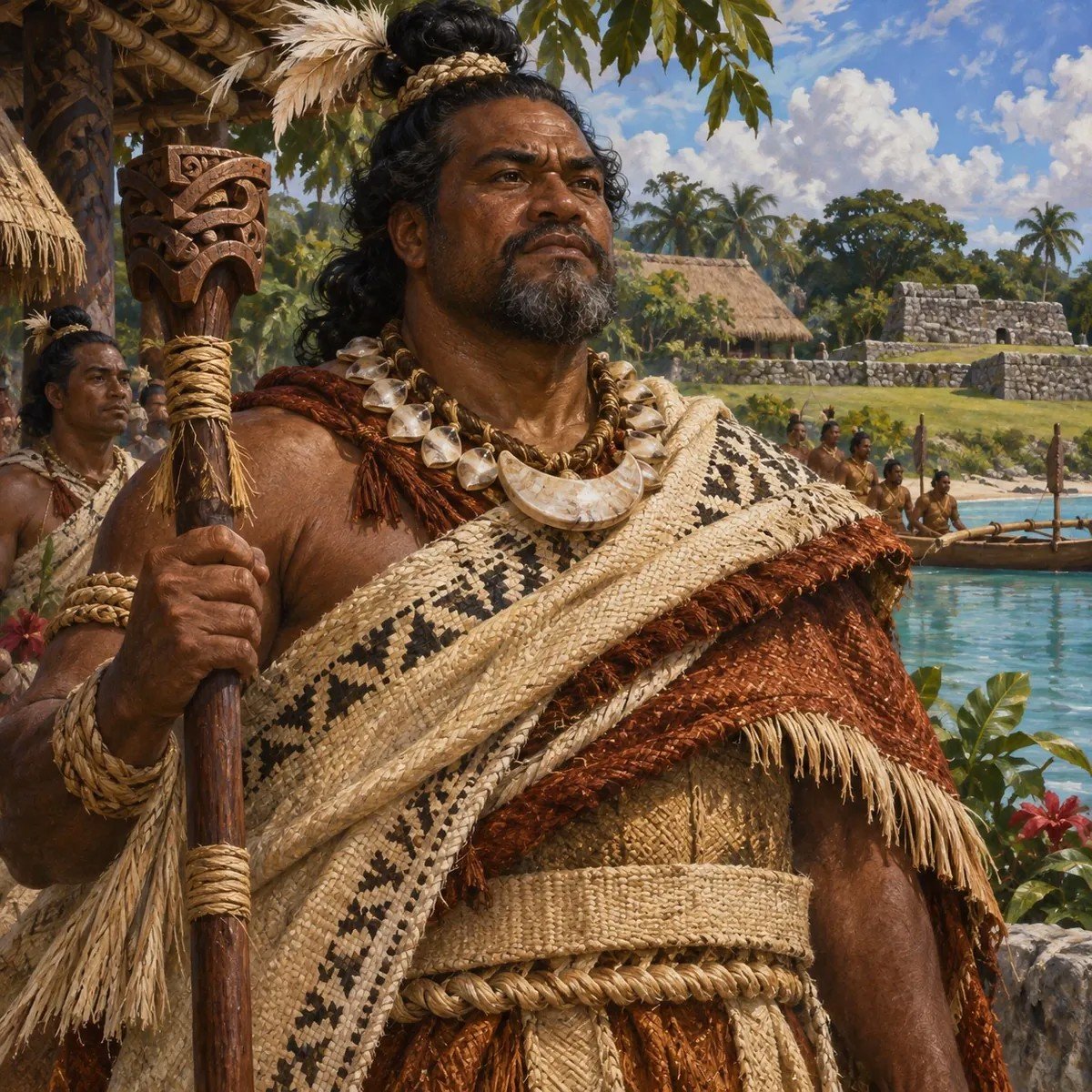
The great royal tombs stand close to the lagoon, built by generations who spent extraordinary labour to honour the rulers of this maritime world. Beyond them lie canoe landings, settlements and networks of kinship that reach to Samoa, Fiji and other island groups. No visiting captain may treat the Tuʻi Tonga as the ruler of every reef or every distant community, but his rank and his alliances command attention far beyond Tongatapu.
Takalaua receives tribute as a public sign of relationship. His attendants know which guests must be greeted first, which disputes may be discussed before witnesses, and which concessions would make a chief appear weak. He remembers favours accurately. A household that has fulfilled its obligations can obtain his protection; a chief who publicly breaks faith may face confiscation, humiliation or force. He does not excuse cruelty by a favourite merely because the favourite is loyal.
The paramount is formidable chiefly because he never enters a dispute alone. At court he speaks through attendants, messengers, legal custom and the allegiance of powerful households. In battle he fights competently with a shortspear but prefers his sworn guards to close on an enemy while he directs a withdrawal or counterattack.
Game Statistics
Takalaua — Paramount of the Lagoon
Medium Humanoid (Human), Lawful Neutral; Challenge 2 (450 XP); Proficiency Bonus +2
Armour Class 16 (hide armour, shield); Initiative +2 (12); Hit Points 84 (13d8 + 26); Speed 30 ft.
| STR | DEX | CON | INT | WIS | CHA |
|---|---|---|---|---|---|
| 16 (+3) | 14 (+2) | 14 (+2) | 14 (+2) | 16 (+3) | 18 (+4) |
Saving Throws Wisdom +5, Charisma +6; Skills History +4, Insight +5, Intimidation +6, Perception +5, Persuasion +6; Senses Passive Perception 15; Languages Tongan, Samoan, Fijian.
Traits
Steady Retinue. Friendly creatures within 10 feet of Takalaua that can see or hear him have Advantage on saving throws to end the Frightened condition.
Watch the Speaker. Takalaua has Advantage on Wisdom (Insight) checks to recognise a deliberate falsehood during a formal audience. This does not reveal information a speaker withholds or compel a truthful answer.
Actions
Multiattack. Takalaua makes two Shortspear attacks.
Shortspear. Melee or Ranged Attack Roll: +5, reach 5 ft. or range 20/60 ft. Hit: 6 (1d6 + 3) Piercing damage.
Bonus Actions
Order the Guard (2/Day). Takalaua chooses one ally within 30 feet that can hear him. That ally may immediately use its Reaction to make one weapon attack against a creature in range.
Reactions
Countermand (1/Day). When an ally Takalaua can see within 30 feet fails a saving throw against being Frightened, he may allow that ally to reroll the saving throw, using the new result.
Tactics. Two to four sworn warriors protect the royal household. Takalaua withdraws when a prolonged fight threatens his dependants, ordering trusted retainers to carry away the wounded.
Takalaua — Paramount of the Lagoon
Medium humanoid (human), lawful neutral
Armor Class 16 (hide armor, shield); Hit Points 84 (13d8 + 26); Speed 30 ft.
| STR | DEX | CON | INT | WIS | CHA |
|---|---|---|---|---|---|
| 16 (+3) | 14 (+2) | 14 (+2) | 14 (+2) | 16 (+3) | 18 (+4) |
Saving Throws Wis +5, Cha +6; Skills History +4, Insight +5, Intimidation +6, Perception +5, Persuasion +6; Senses passive Perception 15; Languages Tongan, Samoan, Fijian; Challenge 2 (450 XP).
Traits
Steady Retinue. Friendly creatures within 10 feet of Takalaua that can see or hear him have advantage on saving throws to end being frightened.
Watch the Speaker. Takalaua has advantage on Wisdom (Insight) checks to recognise deliberate falsehoods during an audience.
Actions
Multiattack. Takalaua makes two shortspear attacks.
Shortspear. Melee or Ranged Weapon Attack: +5 to hit, reach 5 ft. or range 20/60 ft., one target. Hit: 6 (1d6 + 3) piercing damage.
Bonus Actions
Order the Guard (2/Day). One allied creature Takalaua can see within 30 feet and that can hear him can use its reaction to make one weapon attack.
Reactions
Countermand (1/Day). When an ally within 30 feet fails a saving throw against being frightened, Takalaua allows that ally to reroll the saving throw and use the new result.
Tactics. He holds a guarded exit while his sworn warriors bring wounded retainers out of danger.
Takalaua — Tuʻi Tonga CR 7
XP 3,200; Human aristocrat 9; LN Medium humanoid (human); Init +6; Senses Perception +15.
DEFENSE AC 18, touch 12, flat-footed 16 (+4 hide armour, +2 Dex, +2 heavy wooden shield); hp 67 (9d8 + 27); Fort +5, Ref +5, Will +11.
OFFENSE Speed 20 ft. in hide armour; Melee shortspear +10/+5 (1d6 + 3); Ranged thrown shortspear +9 (1d6 + 3); Space 5 ft.; Reach 5 ft.
STATISTICS Str 16, Dex 14, Con 14, Int 14, Wis 16, Cha 18; Base Atk +6; CMB +9; CMD 21.
Feats Improved Initiative, Iron Will, Leadership, Skill Focus (Diplomacy), Toughness, Weapon Focus (shortspear).
Skills Diplomacy +19, Intimidate +16, Knowledge (nobility) +14, Perception +15, Profession (sailor) +15, Sense Motive +15, Survival +15. Languages Tongan, Samoan, Fijian.
Gear hide armour, heavy wooden shield, shortspear, woven chiefly mats, ceremonial ornaments, gifts and agreements held by his attendants.
Tactics
Before Combat Takalaua stations loyal guards near the landing and has visitors received by named attendants. During Combat His sworn guards secure his retreat and throw spears when enemies press the landing. Morale He retreats once his presence endangers the succession or the people entrusted to his protection.
Class Summary Aristocrat 9; six feats including the human bonus feat. His 63 skill ranks represent service at court, navigation and chiefly obligations.
Takalaua — Tuʻi Tonga CR 8
Human aristocrat 9; LN Medium humanoid (human); Init +6; Senses Listen +15, Spot +15.
DEFENSE AC 17, touch 12, flat-footed 15 (+3 hide armour, +2 Dex, +2 heavy wooden shield); hp 61 (9d8 + 21); Fort +5, Ref +5, Will +11.
OFFENSE Speed 20 ft.; Melee shortspear +10/+5 (1d6 + 3); Ranged shortspear +9 (1d6 + 3); Base Atk +6/+1; Grapple +9.
Abilities Str 16, Dex 14, Con 14, Int 14, Wis 16, Cha 18.
Feats Improved Initiative, Iron Will, Skill Focus (Diplomacy), Toughness, Weapon Focus (shortspear).
Skills Diplomacy +23, Intimidate +16, Knowledge (nobility and royalty) +14, Listen +15, Sense Motive +15, Spot +15, Survival +15. Languages Tongan, Samoan, Fijian.
Possessions hide armour, heavy wooden shield, shortspear, woven gifts, messenger tokens and attendants with the court accounts.
Tactics
Before Combat He sends heralds and positions sworn spearmen. During Combat His guards protect his retreat while he attacks enemies who breach their line. Morale He will surrender a narrow tactical advantage rather than risk his family or court.
Class Summary Aristocrat 9; five feats including the human bonus feat. His seven trained skills each have 12 ranks.
The Court at Lapaha
A visit to Takalaua is a political act. The royal precinct includes landing places on the lagoon, gardens and houses attended by families whose rank matters to the order of every audience. The stone-faced royal tombs are the most visible evidence of the labour and tribute that sustain the Tuʻi Tonga. Their builders, porters and families matter as much to the court as the chiefs who commission them. A canoe captain carrying a request for protection must also navigate a web of kinship and past promises.
The ruler cannot personally collect tribute from every island. Senior chiefs, sea captains, households and diplomatic marriages maintain the realm’s reach. A disagreement about which canoe brings tribute first can be the visible sign of a much older succession dispute. Some visitors owe allegiance; some have accepted only an alliance; others trade without submitting to Tonga. Takalaua has enough experience to tell the difference, though not always enough patience to respect it.
Sons, Allies and Rival Chiefs
Kauʻulufonua has the instincts of an avenger and a commander, alert to insults that could become rebellions. Moʻungamotuʻa sees how difficult it is to govern distant obligations from a single chiefly household. Both are recognised members of Takalaua’s family, but the later division of the sacred Tuʻi Tonga authority from the executive Tuʻi Haʻatakalaua office has not yet taken place. The brothers disagree over whether sacred rank alone can govern distant chiefs. The shape of a new executive office is not yet settled, but their dispute already points toward a division of authority.
Among the hostile chiefs, not every opponent wants to murder a ruler. Some want tribute assessed differently; others resent the growing influence of courtiers or the demands placed on their canoes. The most dangerous conspirator may combine a genuine grievance with a willingness to kill. Takalaua’s methods can win obedience and make enemies at the same time.
Gods, Sea Courts and Foreign Visitors
At Lapaha the Tuʻi Tonga traces his sacred descent to ʻAhoʻeitu, son of the divine Tangaloa ʻEitumatupuʻa and a mortal mother. His lineage commands reverence but does not give him mastery of the gods. Hikuleʻo, ruler of Pulotu, receives the ʻinasi first-fruits offerings associated with the sacred kingship; a chief who cheats the households providing those gifts can still be called to account. The sea and sky also hold local ancestral powers whose interests do not always agree. A navigator who thanks Tangaloa for his voyage may still face judgment for cargo he concealed. The traditions of distant islands have their own divine names and obligations, as the Polynesian divine histories make plain.
The coastal courts of the Pacific have their own agreements and quarrels. Ponaturi, merfolk and sea elves cannot be summoned into Tongan obedience by a royal proclamation. In Fiji, Dakuwaqa’s interests belong to the passages and people tied to that reef power. Takalaua treats a strange envoy as an agent with specific obligations, not as proof that the entire ocean has sworn fealty.
What Is Happening Right Now?
- The missing canoe. A tribute vessel arrives without its appointed navigator, and two chiefs claim the crew. Takalaua orders the cargo sealed until the disappearance is explained. The cargo belongs to a third household with a stronger claim than either accuser.
- Two messages, one seal. Kauʻulufonua receives an urgent warning apparently carried in his father’s name. Moʻungamotuʻa insists the handwriting and herald are wrong. The adventurers can follow the messenger’s route, question the canoe crew or compare testimony before a meeting turns violent.
- The price of peace. Visiting sailors request a safe harbour after a storm, but one rival household offers the port in return for carrying armed men against another chief. Takalaua will hear petitions openly, but he demands that the visitors choose whom their ship serves.
Routes and Relationships
The main court lies on the ocean world’s connected sea roads. Voyages depend on seasonal winds, local pilots and negotiated landfalls; no Tongan writ makes foreign harbours automatically safe. Connections with Fiji and Samoa are powerful but politically varied. The household that sends a boat into danger will remember who paid the cost. Envoys, navigators and rival chiefs from these passages also appear among the people of Oceania.
Sources and Licensing
Takalaua is remembered through Tongan chiefly traditions as a ruler whose assassination was followed by the campaigns of Kauʻulufonua and the division of duties between the Tuʻi Tonga and the later Tuʻi Haʻatakalaua. The dates vary in scholarly reconstructions. The division is placed after Takalaua’s death, leaving his court to contend with the rivalries that precede it.
Historical foundations: UNESCO, Ancient Capitals of the Kingdom of Tonga; Stone tools and the ancient Tongan state; Henri J. M. Claessen, Sacred Kingship: Cases from Polynesia (2018).
Rules references: Pathfinder 1e Aristocrat, Creating Pathfinder NPCs, and D&D 3.5e Aristocrat.
Rules and artwork. The encounter statistics and special abilities are original designs. Rules foundations are Wizards of the Coast’s D&D Basic Rules (2024) and D&D Basic Rules (2014); Paizo Publishing’s Pathfinder Roleplaying Game Core Rulebook (2009); and the D&D v.3.5 System Reference Document (2003). Linked rules retain their own licensing and copyright notices. The portrait is an original digital fantasy illustration.
Keep this reference growing
If this page helped with your reading or game, you can support its upkeep or explore the curated books.
Explore the Bookshop — epics, classics and stories behind imagined worlds.