
Richard, Duke of York — Protector of England
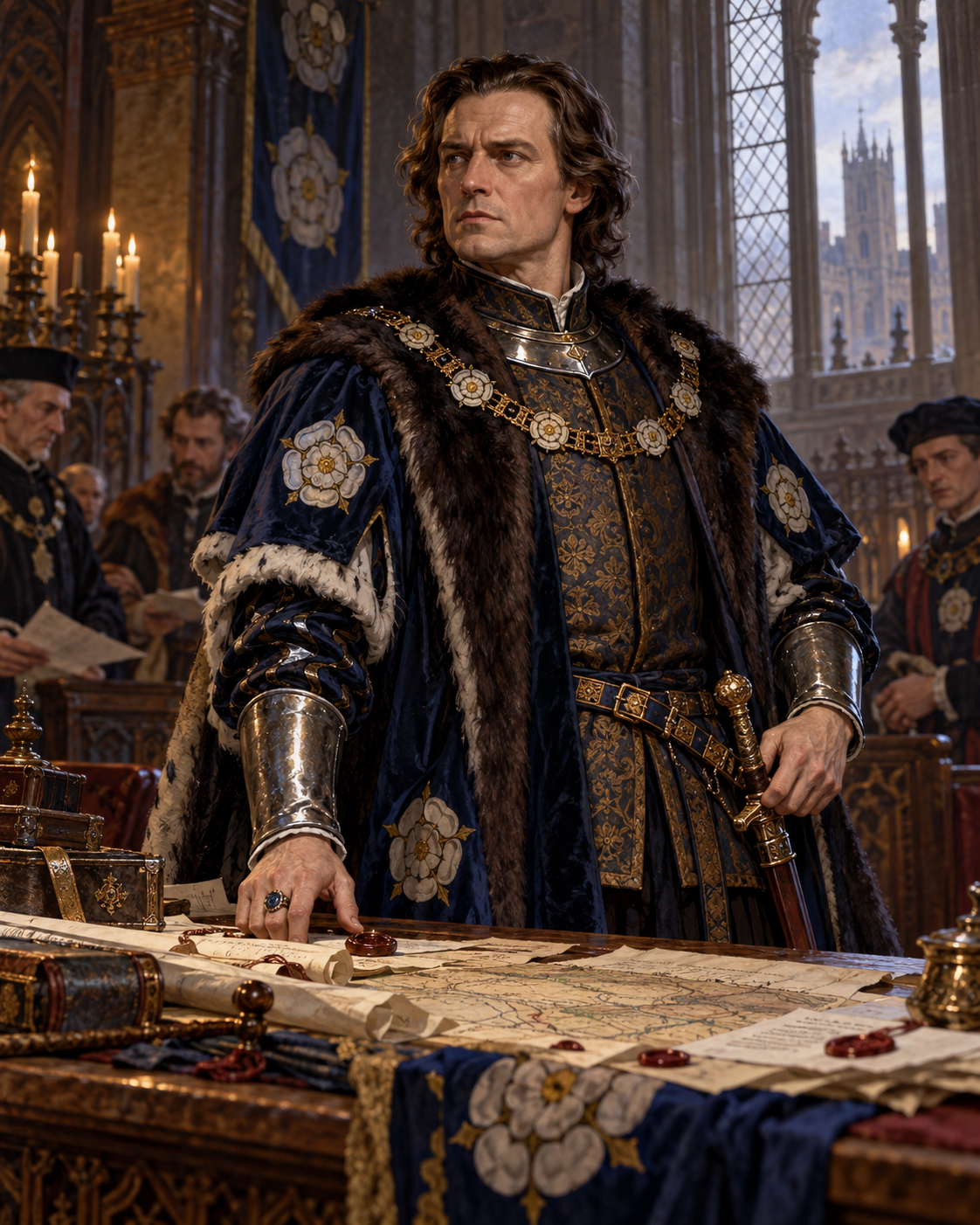
Protector of England while Henry VI cannot rule, Richard of York sits at the junction between lawful emergency government and a rivalry that may yet tear the realm apart.
Richard is not hiding in rebellion. He currently holds recognised authority as Protector while the king is incapacitated. That makes him more useful at the table than a simple claimant: the party can receive a completely lawful commission from York and still discover that the same mission terrifies men who believe he is building the machinery of a future seizure of power.
At a Glance
- Name: Richard Plantagenet
- Title: Duke of York; Protector of England
- Species: Human
- Age: 42–43
- Household: Husband of Cecily Neville; head of one of the greatest magnate affinities in England
- Role: Magnate, military commander, head of the protectorate government
- Base: London, Westminster and the royal council, backed by extensive estates and affinities
- Campaign use: Patron, commander, political employer, suspected usurper or lawful Protector depending upon who is speaking
- Reputation: To supporters, the capable noble keeping government functioning; to enemies, an over-mighty subject turning emergency office into a private power base
- Immediate pressure: Henry VI may recover at any time, while Somerset’s allies wait for the protectorate to weaken
- Key connections: British Isles NPCs, England, York, London
Game Statistics
5.5e / 2024
Richard, Duke of York
Medium Humanoid (Human)
| Armour Class | 18 (plate) | Initiative | +2 (12) |
|---|---|---|---|
| Hit Points | 110 (fixed; 13d8 + 52) | Speed | 30 ft. |
| STR | DEX | CON | INT | WIS | CHA |
|---|---|---|---|---|---|
| 18 (+4) | 14 (+2) | 18 (+4) | 15 (+2) | 16 (+3) | 16 (+3) |
Saving Throws Str +7, Con +7, Wis +6, Cha +6
Skills History +5, Insight +6, Persuasion +6, Intimidation +6
Senses passive Perception 13
Languages English, French, court Latin
Challenge 6 (2,300 XP; PB +3)
Gear plate armour, longsword, shield, ducal signet and sealed commissions
Traits
Protector’s Authority. Allied soldiers and retainers within 30 feet of Richard have advantage on saving throws against being frightened while he is conscious.
Battlefield Appraisal. At the start of combat, Richard chooses one creature he can see. Until the end of his first turn, attacks against that creature by Richard and one ally gain a +2 bonus to hit.
Actions
Multiattack. Richard makes two Longsword attacks.
Weapon Use. Richard’s AC is 20 while he carries his shield. He cannot use it while wielding the longsword with both hands.
Longsword. Melee Attack Roll: +7, reach 5 ft. Hit: 8 (1d8 + 4) Slashing damage, or 9 (1d10 + 4) Slashing damage when wielded with both hands.
Command the Line. Up to two willing allies within 30 feet who can hear Richard may each use their reaction to move up to half their Speed without provoking opportunity attacks.
Reaction
Not Yet. When an ally within 30 feet fails a saving throw, Richard grants that ally a +3 bonus to the roll, potentially turning the failure into a success.
Richard, Duke of York — 5e / 2014
Medium humanoid (human), lawful neutral
Armor Class 18 (plate); Hit Points 110 (fixed; 13d8 + 52); Speed 30 ft.; Challenge 6 (2,300 XP; proficiency bonus +3)
STR 18 (+4), DEX 14 (+2), CON 18 (+4), INT 15 (+2), WIS 16 (+3), CHA 16 (+3)
Saving Throws Str +7, Con +7, Wis +6, Cha +6; Skills History +5, Insight +6, Persuasion +6, Intimidation +6; Senses passive Perception 13; Languages English, French, court Latin
Traits
Protector’s Authority. Allied soldiers and retainers within 30 feet of Richard have advantage on saving throws against being frightened while he is conscious.
Battlefield Appraisal. When initiative is rolled, Richard names one creature he can see. Until the end of Richard’s first turn, attacks against that creature made by Richard and one of his allies have a +2 bonus to hit.
Actions
Multiattack. Richard makes two longsword attacks.
Weapon Use. Richard’s AC is 20 while he carries his shield. He cannot use it while wielding the longsword with both hands.
Longsword. Melee Weapon Attack: +7 to hit, reach 5 ft., one target. Hit: 8 (1d8 + 4) slashing damage, or 9 (1d10 + 4) slashing damage when wielded with both hands.
Command the Line. Up to two willing allies within 30 feet who can hear Richard may use their reactions to move up to half their speeds without provoking opportunity attacks.
Reaction
Not Yet. When an ally within 30 feet of Richard fails a saving throw, Richard adds +3 to the ally’s roll, potentially turning failure into success.
Richard, Duke of York — Pathfinder 1e
Richard, Duke of York CR 7; XP 3,200
Male human aristocrat 2/fighter 6
LN Medium humanoid (human)
Init +2; Senses Perception +12
Defense
AC 23, touch 12, flat-footed 21 (+9 masterwork full plate, +2 heavy shield, +2 Dex with armour training)
hp 88 (fixed; 2d8+6d10+32)
Saves Fort +8, Ref +4, Will +10; +2 on saves against fear (bravery)
Offense
Speed 20 ft. in full plate; 30 ft. base
Melee masterwork longsword +14/+9 (1d8+7/19–20)
Space/Reach 5 ft./5 ft.
Statistics
Abilities Str 18, Dex 14, Con 16, Int 15, Wis 16, Cha 16
Feats Cleave, Combat Expertise, Combat Reflexes, Iron Will, Leadership, Power Attack, Weapon Focus (longsword), Weapon Specialization (longsword), Toughness
Skills Diplomacy +14, Intimidate +14, Knowledge (history) +10, Knowledge (nobility) +13, Perception +12, Ride +6 (+12 without armour and shield), Sense Motive +12
Languages English, French, court Latin
SQ Armour training 1, bravery +2, weapon training (heavy blades +1)
Gear Masterwork full plate, heavy shield, masterwork longsword, ducal signet and sealed commissions
Richard, Duke of York — D&D 3.5e
Size/Type Medium Humanoid (Human)
Classes Aristocrat 2/fighter 6
Hit Dice 2d8+6d10+27 (72 hp, fixed)
Initiative +2
Speed 20 ft. in full plate; 30 ft. base
Armour Class 21 (+8 masterwork full plate, +2 heavy shield, +1 Dex), touch 11, flat-footed 20
Base Attack/Grapple +7/+11
Attack Masterwork longsword +13 melee (1d8+6/19–20)
Full Attack Masterwork longsword +13/+8 melee (1d8+6/19–20)
Space/Reach 5 ft./5 ft.
Special Attacks None
Special Qualities Human traits
Saves Fort +8, Ref +4, Will +10
Abilities Str 18, Dex 14, Con 16, Int 15, Wis 16, Cha 16
Skills Bluff +7, Diplomacy +14, Intimidate +14, Knowledge (history) +9, Knowledge (nobility and royalty) +13, Ride +5 (+12 without armour and shield), Sense Motive +11
Feats Cleave, Combat Expertise, Iron Will, Leadership, Power Attack, Weapon Focus (longsword), Weapon Specialization (longsword), Toughness
Environment English courts and battlefields
Organisation With household soldiers and retainers
Challenge Rating 7
Treasure Masterwork full plate, heavy shield, masterwork longsword, ducal signet and sealed commissions
Alignment Lawful neutral
Advancement By character class
Level Adjustment +0
Languages English, French, court Latin
What Is Richard, Duke of York Doing Now?
Richard is governing through the protectorate rather than merely plotting around it. Appointments, council access, military readiness and the handling of powerful rivals now pass through a system in which his influence is far greater than before Henry’s collapse. He needs the government to work well enough that his authority appears necessary rather than opportunistic.
Encounters
- A Protector’s Commission: Richard hires the party to carry sealed instructions to a northern lord whose loyalty cannot be trusted to ordinary messengers.
- The Appointment: Two candidates for the same office each claim York has promised it to them.
- Watch the Door: Richard needs neutral adventurers guarding a meeting because every household knight present belongs to one faction or another.
- The Council Chamber: Richard asks the party for a factual account in front of men who will treat every word as evidence of factional loyalty.
- The Muster: A local captain obeys York’s warrant but refuses to place his men under a rival magnate’s command, forcing the party to prevent a lawful dispute becoming armed confrontation.
Using Richard at the Table
Richard works best when the party cannot reduce him to either “future rebel” or “loyal servant.” In the campaign present he possesses lawful authority, real grievances and a growing faction. Let his scenes turn on evidence, offices, precedence and loyalty rather than speeches about destiny.
- Private audience: Richard is controlled and practical; he asks what happened, who can prove it and what can be done before his rivals hear.
- Council scene: he lets other people expose their loyalties, then uses procedure and appointments to move the decision.
- Field command: he fights as a disciplined commander, using Command the Line to reposition allies and withdrawing rather than wasting himself in a pointless melee.
Personality
Richard is disciplined, status-conscious and acutely aware of insult. He thinks in chains of obligation: who owes service, who broke faith, who holds which office and what precedent permits. He prefers a decision that can be defended as lawful, but once he concludes that an opponent has abused office or broken faith he is slow to forgive.
Appearance and Manner
Richard presents himself as one of the greatest magnates in the realm rather than as a theatrical warlord. At council he favours costly but controlled dress, household officers, seals and documents that make rank visible without shouting it. On campaign he appears in excellent plate with his household colours and standards around him. He listens closely, asks precise questions and expects people to understand the difference between a request from a duke and an order from the Protector.
Ambition, Pressure and Private Truth
Richard wants the government to function, his enemies removed from offices he believes they have misused, and his own standing treated as commensurate with his blood and service. His immediate fear is not battlefield defeat but a sudden royal recovery that restores his rivals before he has secured the protectorate’s work. The private truth for an adventuring party is that Richard does not currently need to seize the crown to be dangerous: lawful emergency authority already gives him warrants, appointments, soldiers and access to the machinery of government.
Relationships
Henry VI: The king whose incapacity gives Richard lawful authority and whose recovery can end it.
Margaret of Anjou: A determined defender of her husband’s kingship and her son’s future, and therefore deeply suspicious of any settlement that leaves York dominant.
Edmund Beaufort, Duke of Somerset: Richard’s principal political rival, blamed by York for failed policy and the loss of English power in France.
Cecily Neville: Richard’s wife, household partner and connection to the wider Neville affinity.
Richard Neville, Earl of Salisbury: York’s brother-in-law and most important great-lord ally in the developing political struggle.
Equipment and Resources
Excellent plate, a war sword, shield, riding horses, household retainers, heraldic standards, sealed commissions, account books and messengers. His most important equipment is administrative: letters, warrants, appointments, safe-conducts and promises of service. A private packet of copied correspondence records which councillors supported particular appointments; in the wrong hands it could expose alliances that are still publicly denied.
Adventure Hooks
- The Northern Letters: A courier carrying York’s instructions vanishes between inns. The letters are valuable even if nobody opens them.
- The Protector’s Enemy: A captured knight insists he serves the king, not York. Executing him may be lawful; releasing him may be wiser.
- The King Recovers: News reaches the party before it reaches Richard. For several hours they possess the most important secret in England.
- The Somerset Ledger: An account book appears to prove that one of Somerset’s officers diverted royal funds, but the handwriting may be forged.
- The Broken Safe-Conduct: A lord travelling under York’s protection is seized by local rivals, and Richard needs the party to free him without turning a legal breach into private war.
- The False Warrant: Armed men are using a convincing copy of the Protector’s seal to requisition horses and grain in York’s name.
Connected Places and People
Historical Context
Richard Plantagenet was born in 1411 and became one of the senior magnates of Henry VI’s reign. After the king’s prolonged incapacity, Richard was appointed Protector in March 1454. The protectorate therefore gives this campaign version a strong historical foundation: at this point he is not an outlaw claimant but the recognised head of emergency government. The UK National Archives transcript on the Wars of the Roses and its Wars of the Roses collection guide provide the historical frame.
Sources and Adaptation
The historical offices, family relationships and political rivalry are drawn from the public historical record. Richard’s exact conversations, private packet of correspondence, encounter situations and adventure hooks are campaign adaptations created for play. The page keeps his current lawful protectorship distinct from the later open struggle for the crown.
Rules and Image Licensing
The 5.5e / 2024, Pathfinder 1e and D&D 3.5e game statistics are original NPC builds using the open rules conventions of their respective systems; no proprietary setting text is reproduced. The hero uses a public-domain historical portrait. The separate arms image in the media library is retained as supporting heraldic artwork.
Keep this reference growing
If this page helped with your reading or game, you can support its upkeep or explore the curated books.
Explore the Bookshop — epics, classics and stories behind imagined worlds.