
Beastlands
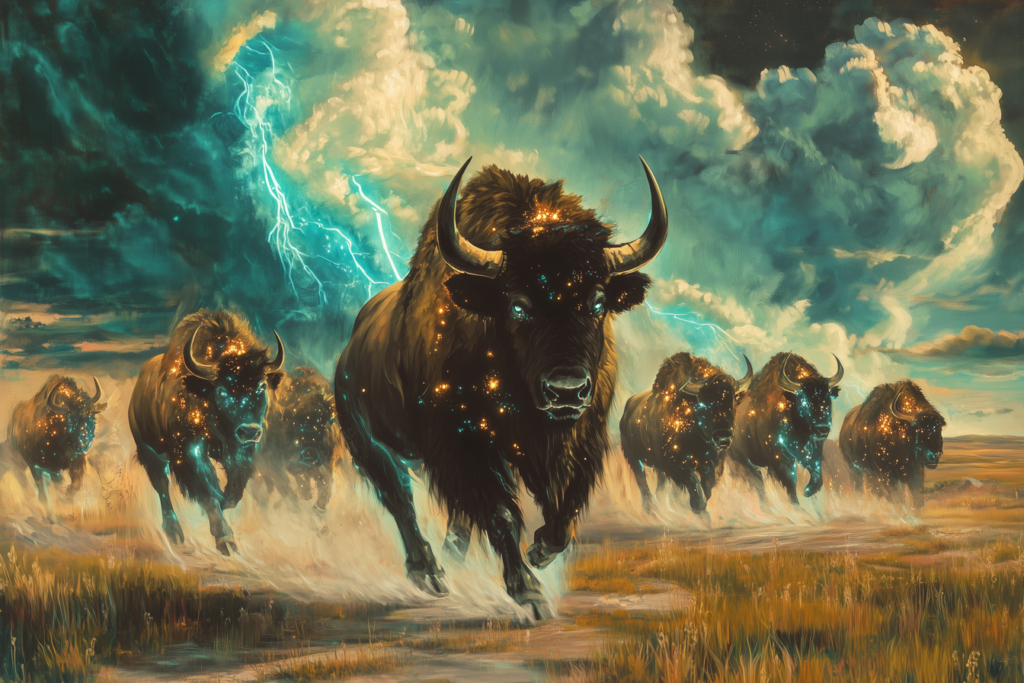
The Beastlands are the Upper Plane of living instinct: an immeasurable wilderness of migration, predation, birth, death, territory, freedom and return. The plane is good without being tame. Predators still hunt, prey still flee, storms still kill and winter still bites. What the Beastlands reject is cruelty made deliberate — cages, enslavement, waste, torment and killing performed merely to prove mastery over another living thing.
Planar Profile
- Plane: Wilderness of the Beastlands
- Three Wilds: Sunwild · Duskwild · Nightwild
- Older Outsider Name: Happy Hunting Grounds
- Gravity: Normal
- Extent: Immeasurable
- Native Animals: Usually Unaligned
- Major Waters: Threefold Ocean · River of Life · River of Souls
- Moral Nature: Neutral Good, leaning Chaotic Good
- Scholar Names: Krigala · Brux · Karasuthra
- Neighbours: Elysium · Arborea
- Time: Normal
- Morphic Nature: Self-renewing wilderness; divinely morphic within divine realms
- Native Sovereigns: Animal Lords
- Core Law: Nothing living is property here
Overview
The Beastlands are wilderness without ownership. Forests have no timber rights, rivers no masters and migration routes no borders. Dens, nests, burrows, watering places and animal trails matter more than roads. A path may remain for centuries because generations of elk continue to use it, then disappear beneath grass within weeks when the herd changes course.
Predator and prey remain what they are. A lion may kill a deer, wolves may run an injured elk to exhaustion and an orca may take another animal from the sea. Such acts belong to life. The moral boundary appears when intelligent creatures introduce slaughter without need, deliberate torment, extermination, enslavement, waste or the conviction that another living thing exists merely to be possessed.
Ordinary animals live here in immense populations alongside awakened beasts, animal petitioners, celestial creatures, dryads, hamadryads, treants and sovereign animal powers. Some mortal souls also come here after death, particularly those whose lives were deeply bound to animals, wilderness, migration or the hunt.
Cosmological Role
The Beastlands lie between Elysium and Arborea.
From Elysium they echo compassion, healing and peace. From Arborea they take appetite, storm, beauty, freedom, movement and the sacred intensity of the chase.
Their paradise is not a celestial city. It is movement: migration, river path, first flight, last run, den, watering place, nesting ground, hunting trail and moonlit return.
Planar Laws
Nothing Living Is Property
A traveller may ride with a willing mount, care for a wounded animal or form a genuine bond with a companion. Enslavement is another matter. Cages weaken, chains fail and intelligent creatures treated as possessions find the plane itself favouring their escape.
The Hunt Must Be True
Hunting for food, survival, defence, mercy or sacred duty belongs to the plane. Killing helpless creatures for amusement, slaughtering far more than can be used or pursuing quarry merely to display dominance does not.
Fear Is Not Evil
Prey flee because fear keeps them alive. Predators stalk because stealth feeds them. Teeth, venom, darkness, pursuit and terror possess no moral alignment of their own.
Cities Do Not Take Root
Camps, lodges, grown shelters and divine halls can endure. Fortified urban expansion does not. Roots break walls, migration trails cross roads and abandoned structures disappear rapidly into vegetation.
Speech Is Wider Than Language
Scent, posture, warning calls, tracks and migration can communicate as much here as words. Travellers who learn to watch before speaking understand far more of the plane.
Game Statistics
Living Instinct
After finishing a Long Rest in the Beastlands, choose Animal Handling, Perception, Stealth or Survival. Until the next Long Rest, you have Advantage on ability checks using that skill while on the plane.
Speech of the Wild
After spending 24 continuous hours in the Beastlands, a visitor understands the broad emotional meaning conveyed by ordinary animal calls and body language. This does not reproduce the full effect of Speak with Animals.
The True Hunt
A creature hunting for food, defence, sacred duty, mercy or restoration of balance suffers no planar penalty. A creature hunting for trophies, cruelty, domination or waste may find its quarry warned, its tracks confused or other predators following it.
Beast-Mark
After seven continuous days on the plane, the DM may give a visitor a cosmetic animal sign such as reflective pupils, altered scent, thicker hair, clawlike nails or sharpened teeth. Once per day while in the Beastlands, a visitor who accepts the mark may gain Advantage on one Survival check.
Cages Fail
A creature restrained primarily in order to enslave or possess it has Advantage on checks made to escape mundane restraints. Magical restraints used for enslavement may grant additional saving throws or checks to escape at the DM’s discretion.
- Alignment: Mildly neutral good and mildly chaotic good.
- Gravity: Normal.
- Time: Normal.
- Size: Immeasurable.
- Morphic: Divinely morphic within divine realms; naturally self-renewing elsewhere.
Living Instinct
After a full rest on the plane, choose Handle Animal, Perception, Stealth or Survival. The visitor gains a +2 circumstance bonus on checks with that skill until the next full rest.
True Hunt Judgment
A creature committing deliberate wasteful slaughter may become marked by scent and instinct. Creatures tracking the offender gain a +4 circumstance bonus on Survival checks until restitution is made.
Cages Fail
Mundane restraints used for enslavement take a –4 penalty where they oppose checks made to break or escape them. Magical restraints used chiefly as instruments of ownership may require a caster-level check when strongly resisted.
- Alignment: Mildly neutral good and mildly chaotic good.
- Gravity: Normal.
- Time: Normal.
- Size: Immeasurable.
- Morphic: Divinely morphic within divine realms; naturally self-renewing elsewhere.
Living Instinct
After a full rest on the plane, choose Hide, Listen, Spot or Survival. The visitor gains a +2 circumstance bonus on checks with the chosen skill until the next full rest.
True Hunt Judgment
Survival checks made to track a creature marked by the plane for needless slaughter gain a +4 circumstance bonus until the offence is answered.
Cages Fail
Mundane restraints used to enslave living creatures take a –4 penalty where they oppose checks to escape or break free. Magical restraints used primarily for enslavement may require a caster-level check to remain effective.
Sunwild — The Wild of Eternal Day
Scholar name: Krigala
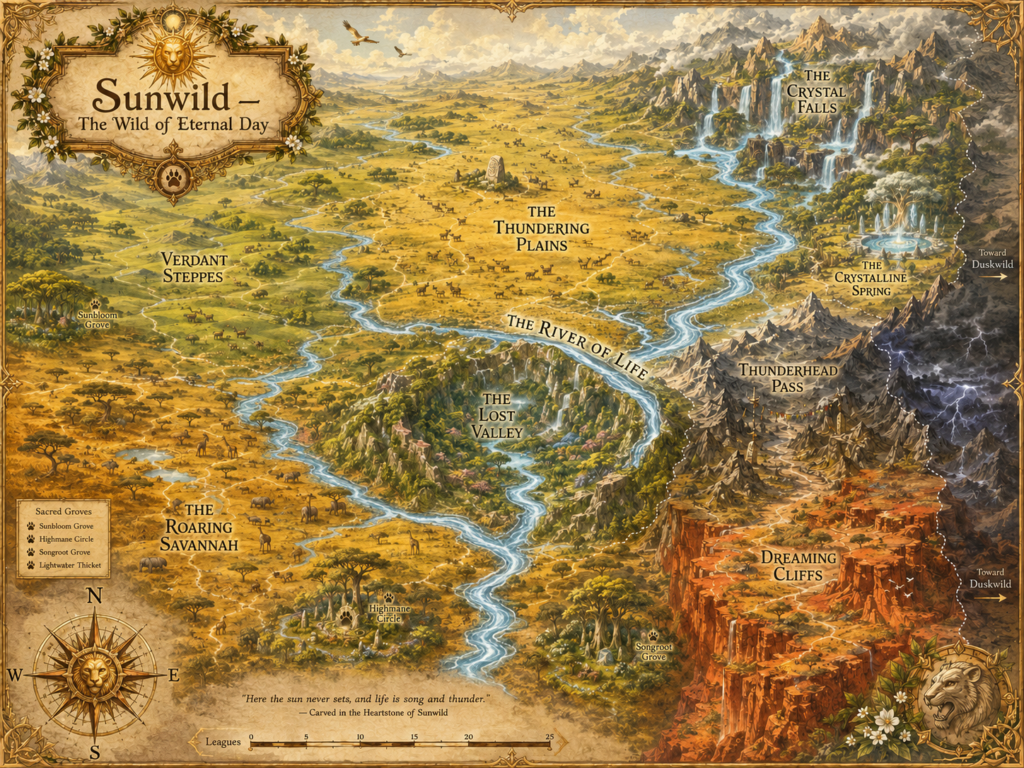
Sunwild is the Beastlands beneath enduring daylight: grassland, warm forest, river meadow, mountain pasture, savannah, storm and visible migration. Herds can be watched from miles away, birds circle on broad thermals and weather builds openly across immense horizons.
It is the easiest Wild for a newcomer to understand, but not necessarily the safest. Open country gives little protection from storms, stampedes or pursuit, and distances that appear modest beneath the clear sky may take days to cross.
The Thundering Plains
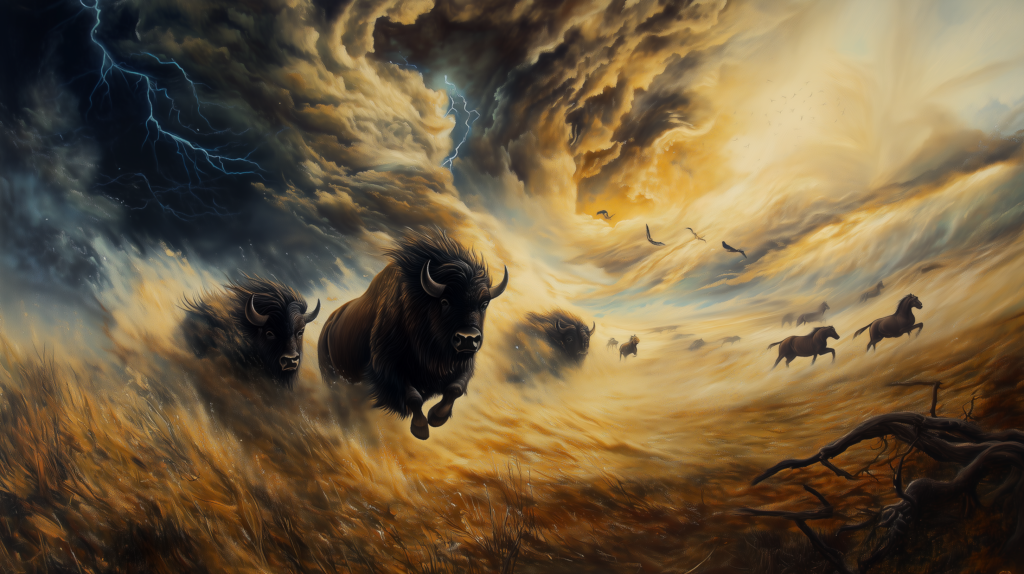
The Thundering Plains stretch beneath an immense open sky, their rolling grasslands broken by occasional ridges, watering places and shallow river valleys. Great herds of bison, elk and wild horses cross the region in numbers large enough to make the earth tremble. Lions and dire wolves shadow the migrations while eagles circle above.
Weather moves across the plains almost as dramatically as the animals. Thunderstorms build rapidly, lightning ignites seasonal grass fires and heavy rain turns dry channels into temporary rivers. The country recovers quickly: burned grass greens again, old watering places refill and migration routes shift with changing conditions.
Notable Features
- Thundercliff Ridge: a storm-struck escarpment overlooking the eastern grasslands.
- Stampede Paths: broad migration trails worn into the country by countless generations of herd animals.
- Singing Stones: wind-shaped pillars whose changing tones warn experienced travellers of approaching weather.
- The Everlasting Storm: an unusually persistent storm front frequently visible moving across the distant horizon.
Thunderhead Pass
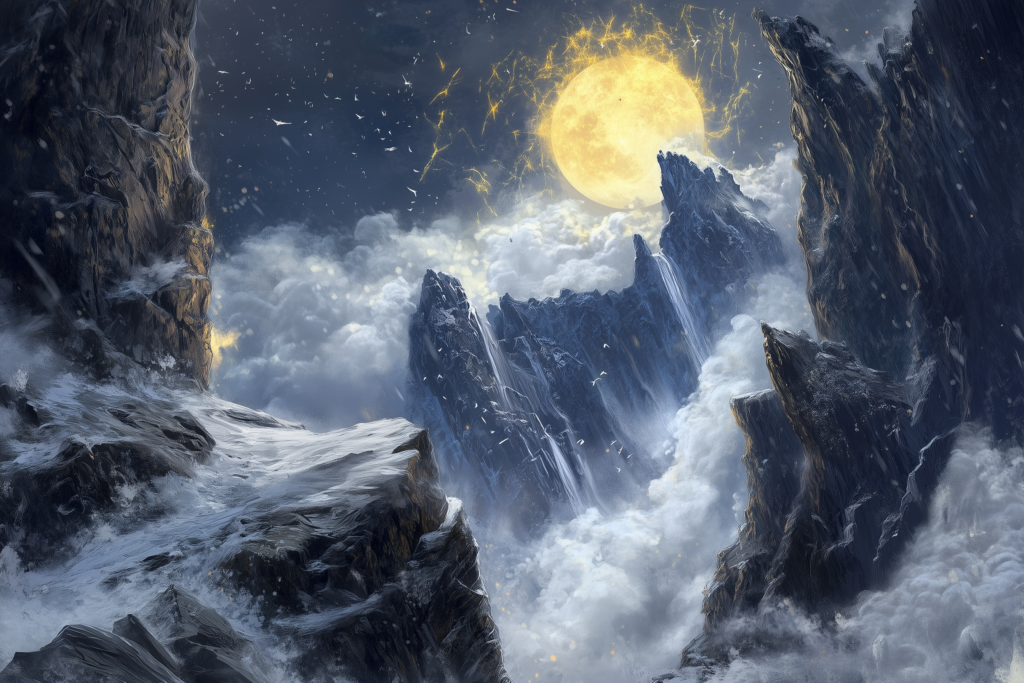
Thunderhead Pass cuts through a high mountain chain between the open country of Sunwild and the darker mountains beyond. Narrow paths cling to cliffs above mist-filled drops, while exposed saddles offer immense views of the plains. Mountain animals have used parts of the route for so long that several of its safest paths are simply widened game trails.
Weather is the chief danger. Storms strike quickly, wind funnels through the rock and snow survives in shaded gullies even when neighbouring slopes remain warm. Wolves, bears and other predators use caves along the route, but most deaths come from travellers misjudging the mountains rather than from deliberate attack.
Notable Features
- Guardian Arch: a natural stone arch marking the eastern approach to the pass.
- Screaming Caves: wind-cut caverns whose openings produce powerful tones during storms.
- Thunder Cliff: a lightning-scarred escarpment overlooking the lower trail.
Real-World Inspiration: Alpine, Rocky Mountain and Himalayan high passes.
Bestiary Inhabitants: Wolf · Brown Bear · Cougar · Eagle · Giant Eagle
Connections: Thundering Plains · Shadow Mountains · Silent Glades
The Lost Valley
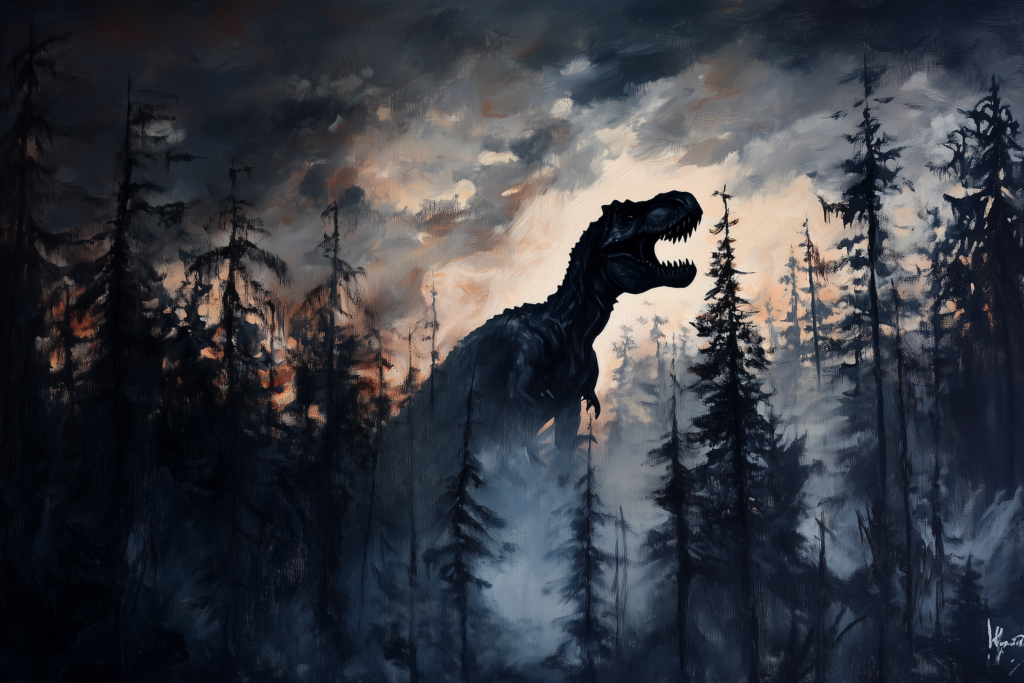
The Lost Valley lies behind a ring of broken mountains where reliable entrances are rare. Beyond the cliffs is a hot, fertile wilderness of fern forest, cycads, towering conifers, broad floodplains and steaming volcanic uplands. Rivers wander beneath heavy vegetation while dinosaur calls carry across the valley.
Dinosaurs form an ordinary functioning ecology here. Huge herbivores open clearings by feeding, herd animals follow the rivers and swift predators patrol forest margins and watering places. The valley is extraordinary because its prehistoric life survives as part of the Beastlands, not because it has been trapped outside time.
Notable Features
- Ancient Volcanoes: smoking volcanic uplands dominating the western skyline.
- Great River: the principal migration route through the valley floor.
- Hollow Forest: immense old trees whose exposed roots and cavities shelter smaller animals.
- Fern Basin: a broad humid floodplain supporting enormous herbivore herds.
Real-World Inspiration: Tepui country, volcanic rift valleys and reconstructions of Mesozoic floodplains.
Bestiary Inhabitants: Argentinosaurus · Edmontosaurus · Utahraptor · Carnotaurus · Pisanosaurus
Connections: Heartwood Forest · Crystal Falls
The Roaring Savannah
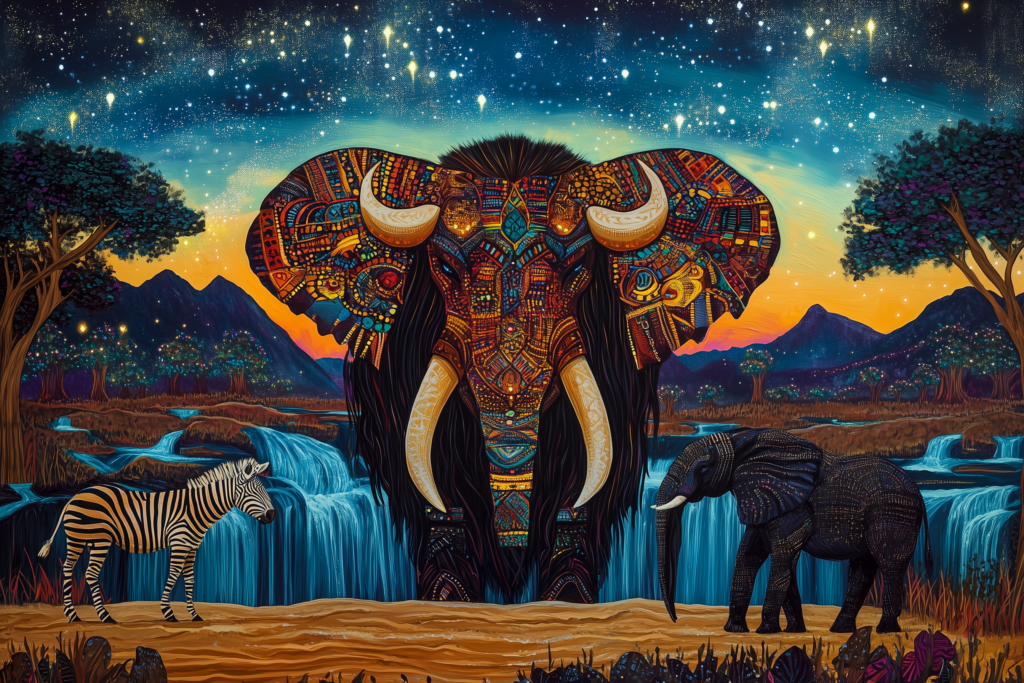
The Roaring Savannah is a broad country of golden grass, scattered woodland, baobabs and seasonal watering places. Elephants move between rivers and pools while lions watch the herds from tall grass and fast predators use open ground to run down prey. Dust, birdsong and distant animal calls travel for miles.
Rain transforms the region. Dry channels fill, grasses green quickly and migration routes swing toward new grazing. During the driest periods hundreds of animals may converge on a single watering place, creating tense but natural encounters between predators, prey and territorial herds.
Notable Features
- Great Watering Holes: seasonal pools where several migration routes converge.
- Baobab Groves: old stands of immense trees providing shade and nesting places.
- Migration Roads: broad corridors worn through grass and scrub.
- Storm Country: the open southern reaches, known for dramatic seasonal thunderstorms.
The Crystal Falls
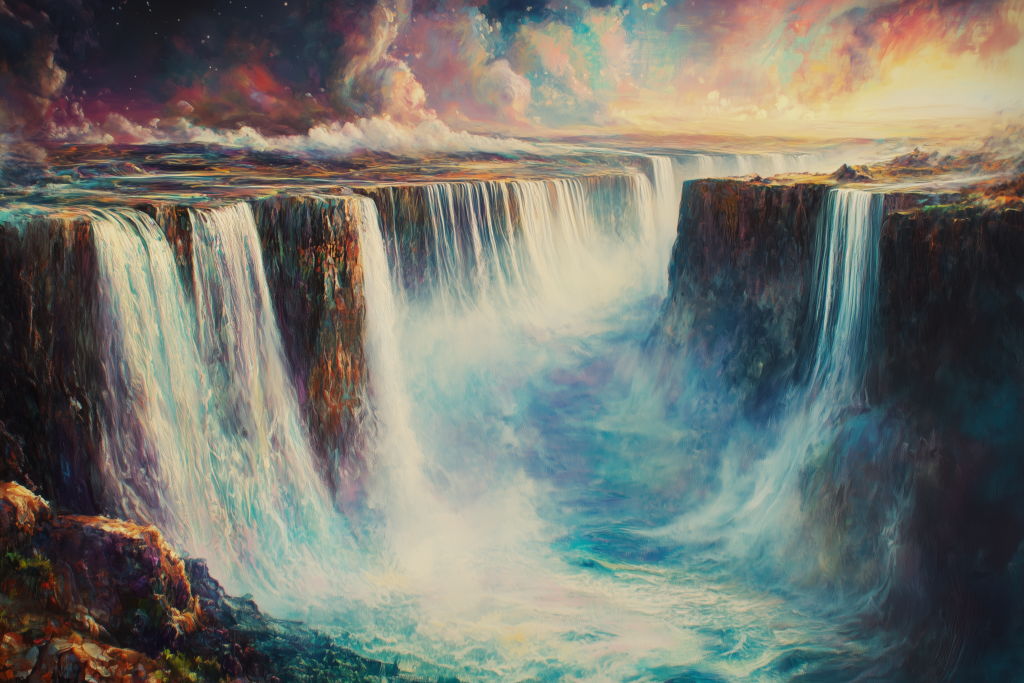
The Crystal Falls descend from a high escarpment in a series of enormous cascades before plunging into a clear lake surrounded by dense vegetation. Spray hangs permanently above the gorge, feeding moss, vines and flowering plants along the cliffs. In full Sunwild daylight the mist produces great rainbows visible from miles away.
The falls attract animals because they provide water, shade and rich vegetation. Upper channels can appear deceptively calm before breaking into rapids, while the lake below becomes dangerously turbulent close to the main cascade.
Notable Features
- Shimmering Lake: the vast plunge lake beneath the principal falls.
- Verdant Gorge: densely vegetated cliffs kept permanently wet by spray.
- Upper Pools: quieter basins above the main drop where animals gather to drink.
- Cliffside Path: a difficult trail climbing beside the falls toward the upper plateau.
Real-World Inspiration: Iguazú Falls, Victoria Falls and great tropical waterfall gorges.
Bestiary Inhabitants: Otter · Giant Toad · Deer · Eagle · Water Elemental
Connections: Lost Valley · River of Life
Verdant Steppes
The Verdant Steppes are cooler and higher than the Thundering Plains, a wide country of rolling grass, low hills and long horizons. Wind rarely stops moving across them. Wild horses, elk and bison travel in loose herds while wolves and birds follow at a distance.
The steppes are quieter than their neighbouring plains. Storms are usually less violent, trees are scarce and approaching animals can often be seen hours before they arrive. Their real challenge is scale: water is seasonal, landmarks are widely separated and a destination that seems close across open ground may remain a day’s travel away.
Notable Features
- Open Steppe: immense uninterrupted grassland with exceptionally long sightlines.
- Seasonal Streams: shallow waterways that swell after rain and shrink during dry periods.
- Long Migration Trails: old routes linking grazing country with the River of Life.
Duskwild — The Wild of Sacred Twilight
Scholar name: Brux
Duskwild rests beneath perpetual twilight. Ancient woodland, reed beds, sheltered water, misted cliffs and hidden paths dominate its landscapes. Tracks are harder to read by sight alone and animal calls carry farther through the half-light.
This is the Wild of things encountered at the edge of perception: deer at the treeline, frogs in dark water, an owl opening its eyes above the trail or a predator testing the edge of a herd without yet committing to the chase.
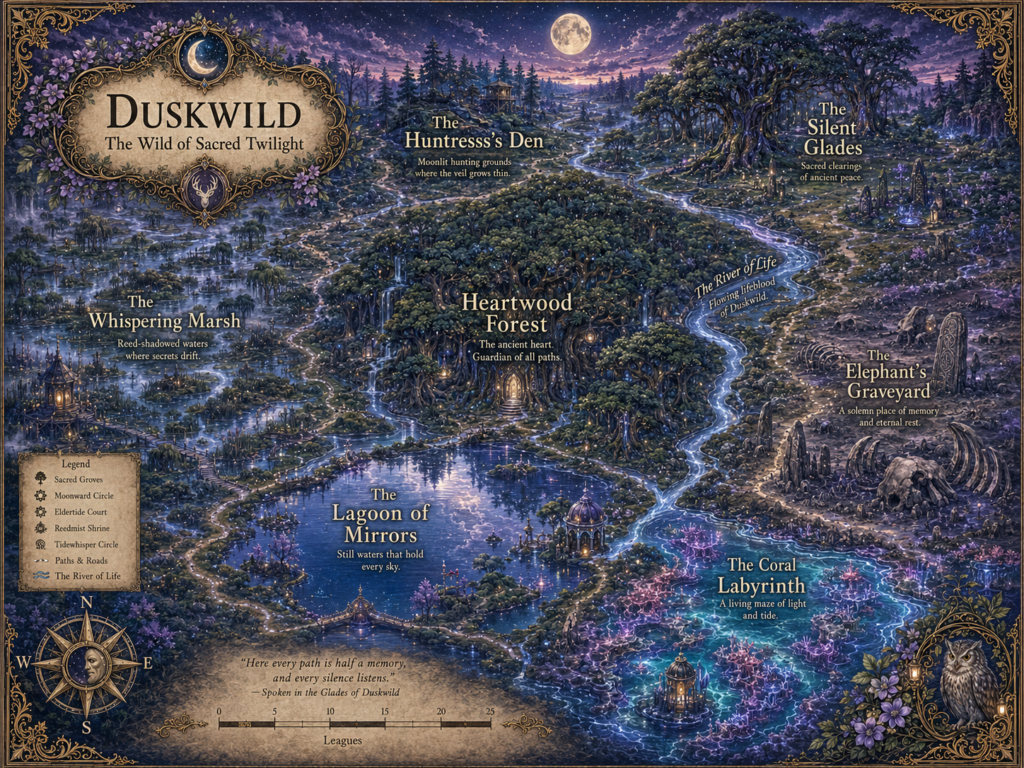
The Huntress’s Den
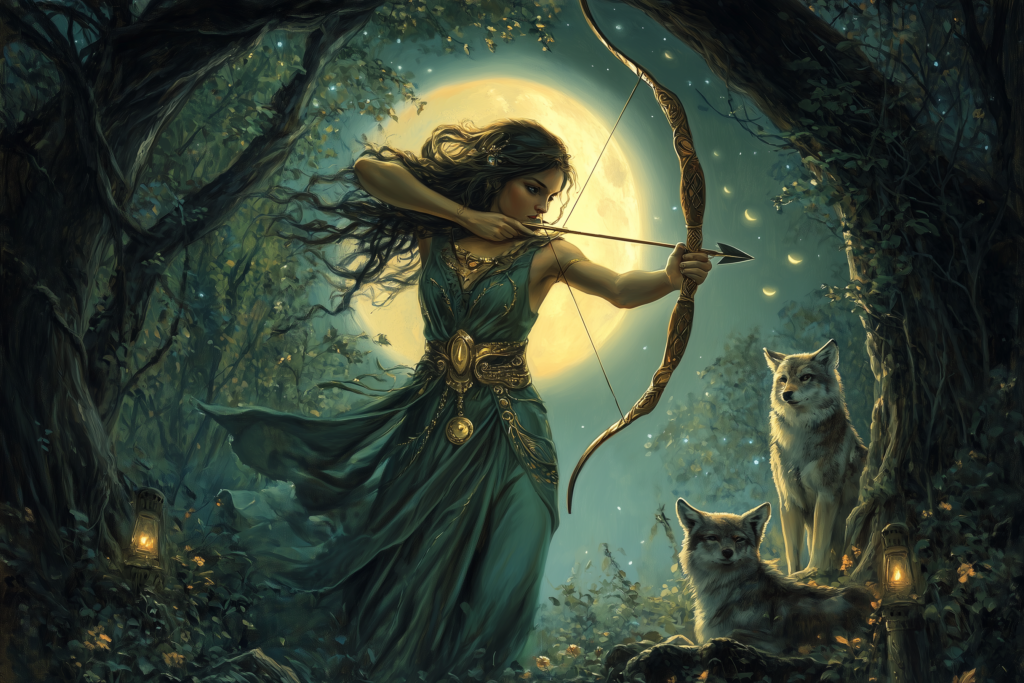
The Huntress’s Den is a great twilight woodland of oak, evergreen and pale birch, crossed by clear streams and narrow game trails. It is the Beastlands realm of Artemis, and the presence of the Huntress is felt less through monuments than through the discipline of the country itself.
The forest is both refuge and hunting ground. Deer move through its glades, boars root beneath the trees and predators follow old tracks through the undergrowth. Hunters who respect their quarry may travel freely. Poachers, defilers and those who torment animals find the same woodland considerably less welcoming.
Notable Features
- Silver Grove: a moonlit clearing used for gatherings within Artemis’s realm.
- Stag’s Crossing: a broad woodland ford heavily used by deer and boar.
- Howling Heights: broken cliffs overlooking the deeper forest.
- Hollowheart Oak: an immense hollow tree long used as shelter and meeting place.
Real-World Inspiration: Greek mountain woodland, Mediterranean oak forest and old temperate forests of southeastern Europe.
Bestiary Inhabitants: Ceryneian Hind · Erymanthian Boar · Dryad · Hamadryad · Giant Owl
Connections: Heartwood Forest · Silent Glades
The Silent Glades
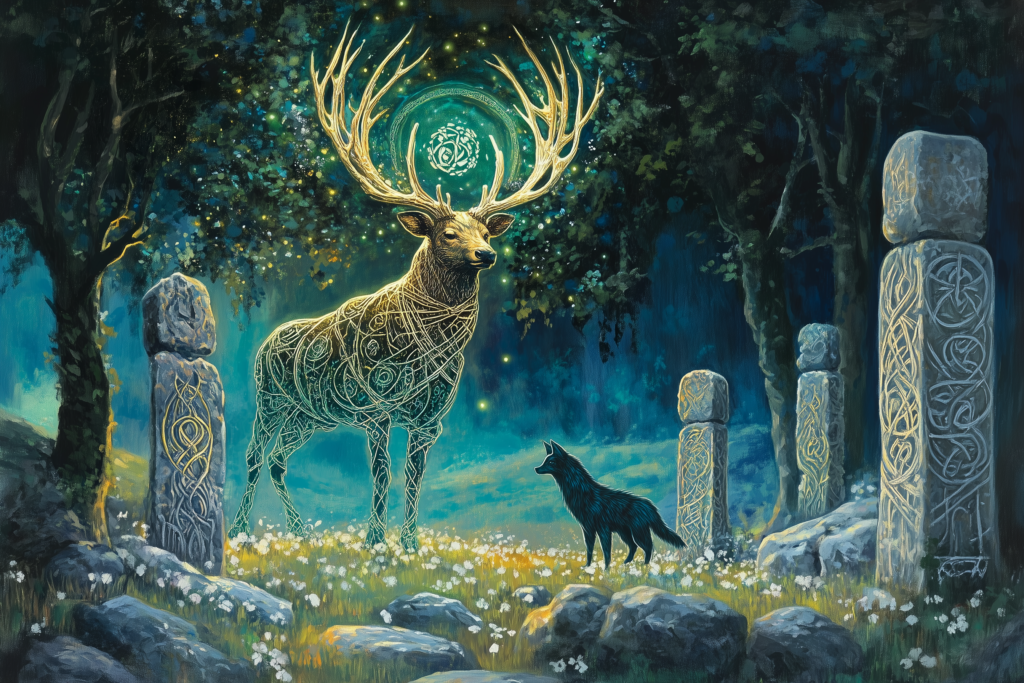
The Silent Glades occupy a sheltered basin of old woodland where streams move slowly beneath moss-covered trees. Sound is softened by foliage and damp ground, giving the region its name. Many animals use the glades as resting country between longer migrations through Duskwild.
The region is peaceful because it is undisturbed, not because predation has ceased. Deer feed beneath the canopy, bears work along the streams and dryads tend some of the oldest trees. Travellers who remain still can spend hours watching the woodland behave as though they were not there.
Notable Features
- Tranquil Pond: a sheltered watering place fed by several woodland streams.
- The Old Grove: an exceptionally ancient stand of trees occupied by dryads and hamadryads.
- Stone Circle: weathered standing stones used as neutral meeting ground by travellers and awakened animals.
Real-World Inspiration: European old-growth forest, ancient beech woodland and quiet temperate forest basins.
Bestiary Inhabitants: Deer · Brown Bear · Dryad · Hamadryad · Unicorn
Connections: Huntress’s Den · Heartwood Forest · Thunderhead Pass
Heartwood Forest
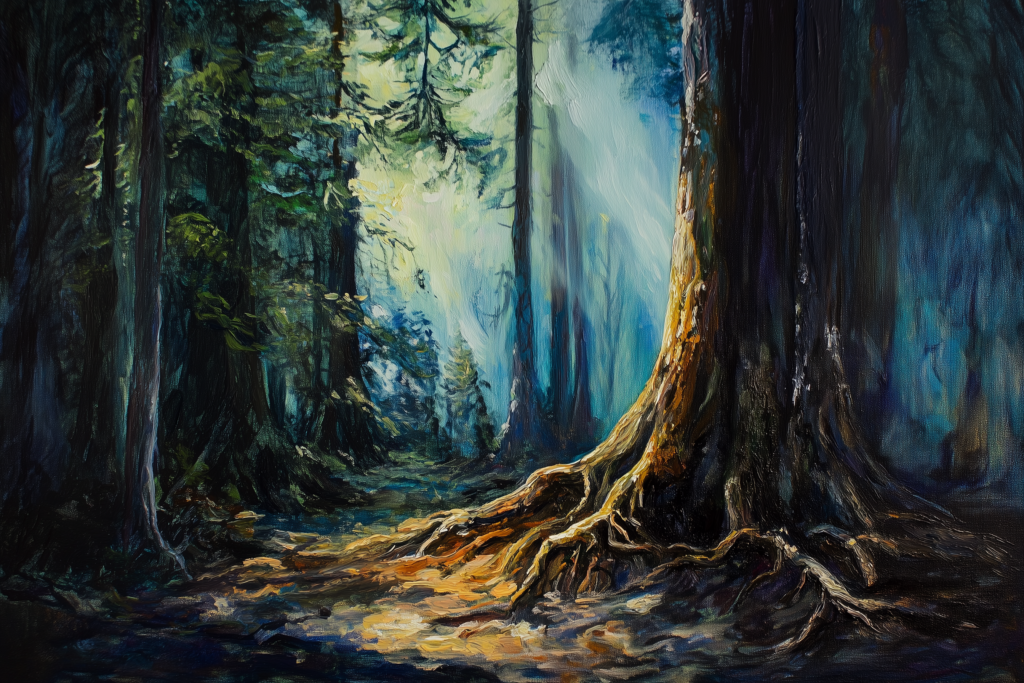
Heartwood Forest is one of the great old-growth woods of the Beastlands. Some trunks are broad enough to contain chambers beneath their bark, and fallen trees form bridges, shelters and entire strips of new habitat as they decay. The canopy is so layered that much of the forest floor remains in permanent green twilight.
Few paths run straight. Roots turn trails aside, streams divide repeatedly and animals often know routes invisible to travellers. Treants, dryads and hamadryads are common in the oldest stands, while elk, bears and great owls move between the clearings.
Notable Features
- The Heartwood Tree: an exceptionally ancient tree whose immense trunk can be used as a landmark for miles around.
- Twilight Glade: a broad opening in the canopy where several major animal trails meet.
- Grove of Echoes: hollow old trees whose trunks carry calls and knocks through the forest.
Dreaming Cliffs
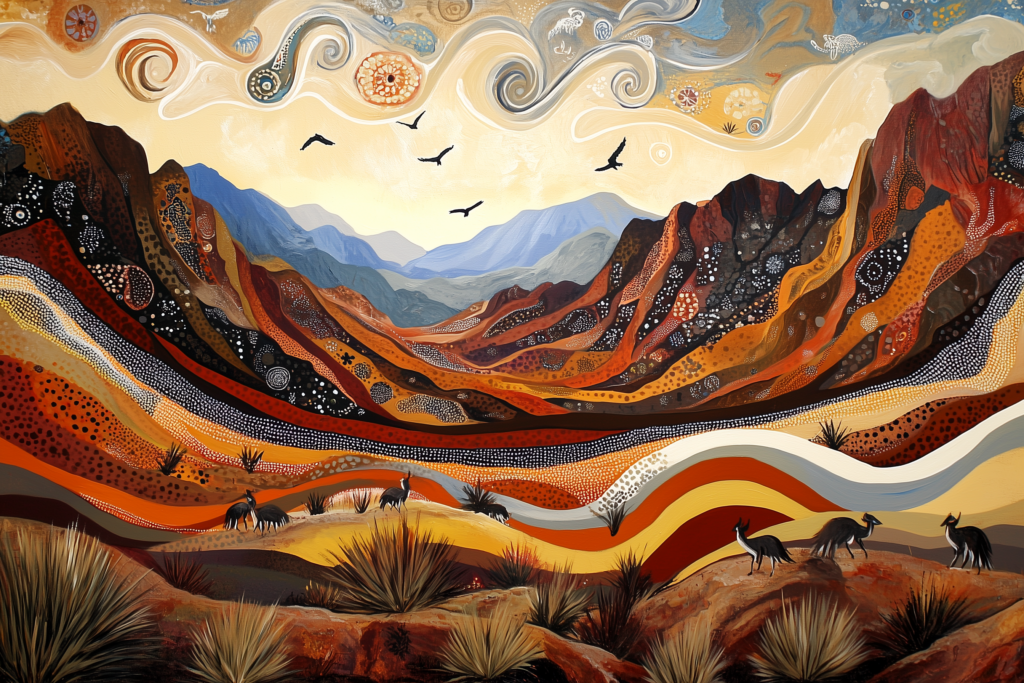
The Dreaming Cliffs are immense red, gold and ochre sandstone escarpments rising above dry country on the edge of Duskwild. Their name comes from the unusually vivid dreams experienced by travellers who sleep beneath the cliffs, especially when wind moves through their caves and narrow clefts.
The surrounding country is harsh but not barren. Tough grasses grow in sheltered hollows, rock pools fill after heavy rain and animals use shaded gullies to cross the escarpment. Caves open throughout the cliffs, some shallow and others extending deep beneath the plateau.
Notable Features
- Red Escarpment: the great wall of layered sandstone dominating the region.
- Wind Caves: natural chambers where moving air creates low resonant tones.
- Rainwater Pools: rock basins supporting concentrated wildlife after storms.
- Hidden Grottos: shaded recesses reached through narrow openings in the cliffs.
Real-World Inspiration: The sandstone escarpments, ranges and water-carved gorges of central and northwestern Australia.
Bestiary Inhabitants: Eagle · Giant Eagle · Giant Owl
Connections: Silent Glades · Lost Valley
The Elephant’s Graveyard
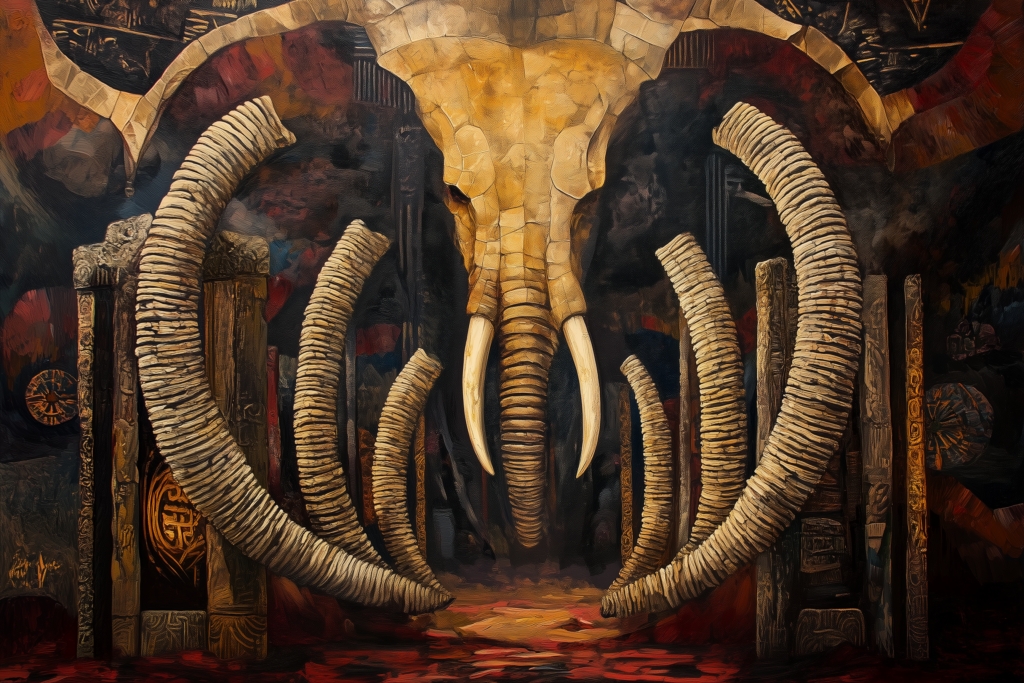
Beyond the busiest migration country lies a quiet basin where the bones of generations of elephants have accumulated beside old watercourses and sheltered hollows. Living elephants still pass through, particularly older animals and herds following routes learned across generations.
The bones weather naturally into the soil and support scavengers, insects and new growth. Animal petitioners sometimes move among the living herds, giving the region a strong association with memory without making it an undead realm. Removing ivory from the dead is treated as desecration by the elephants who continue to visit.
Notable Features
- Bone Fields: broad areas where weathered elephant remains lie among grass and scrub.
- Old Migration Track: a deeply worn route linking the graveyard with the savannah.
- Quiet Pools: seasonal mud and water hollows used by ageing elephants and migrating herds.
The Whispering Marsh
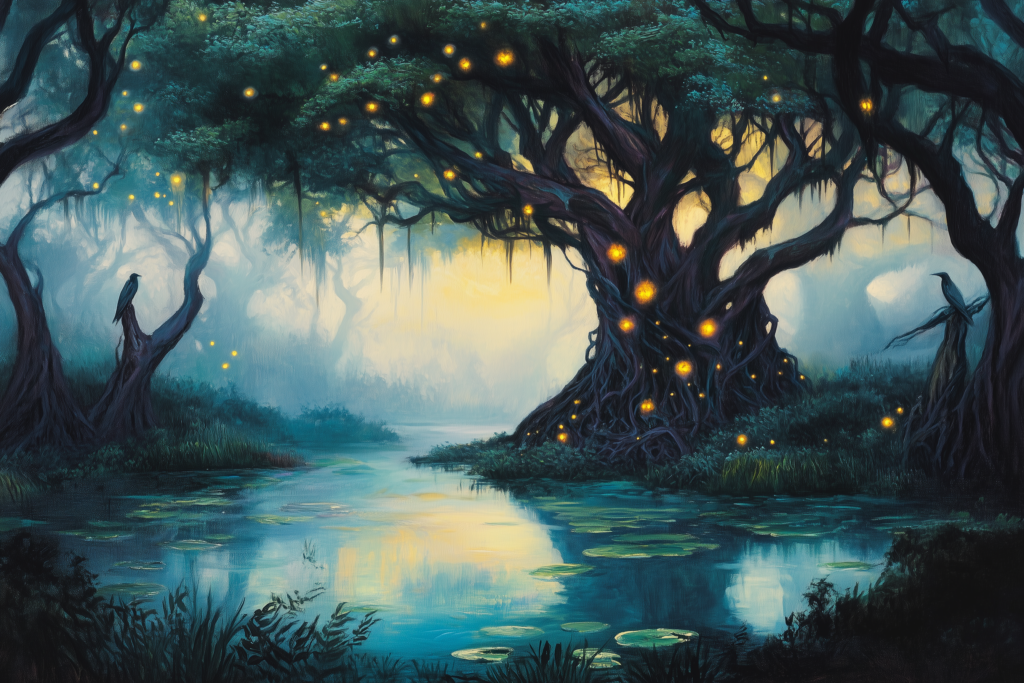
The Whispering Marsh spreads through shallow waterways, reed beds, dark pools and wooded islands. Great swamp trees rise directly from black water, their roots forming natural bridges between patches of firmer ground. Mist is common where cool Duskwild air settles over warmer water.
The whispers that give the marsh its name are mostly the marsh itself: wind through reeds, frogs calling from hidden pools, birds communicating across fog and large animals moving beyond sight. In the Beastlands, travellers sometimes understand more of these sounds than they expected to.
Notable Features
- Reed Maze: dense beds crossed by narrow channels used by animals.
- Blackwater Channels: deep slow waterways beneath overhanging forest.
- Cypress Islands: raised wooded ground providing the safest dry routes.
- Deep Pools: sudden depressions capable of hiding large aquatic animals.
Real-World Inspiration: Okavango wetlands, the Everglades and Congo Basin flooded forests.
Bestiary Inhabitants: Giant Toad · Otter · Jaguar · Giant Owl · Water Elemental
Connections: Lagoon of Mirrors · Tidal Marshes · River of Life
The Coral Labyrinth
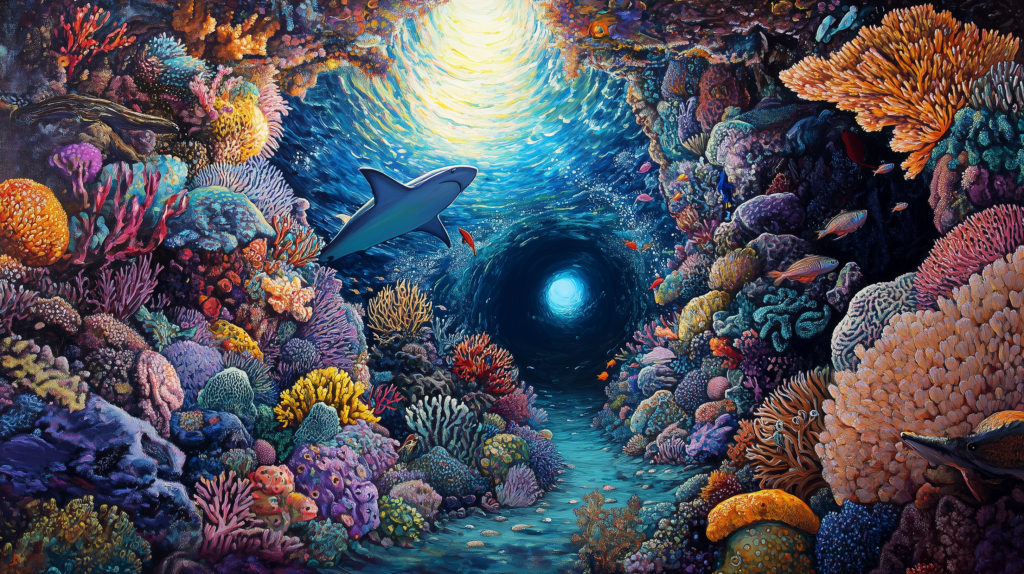
The Coral Labyrinth is an immense reef complex where channels twist between coral walls, pinnacles, blue holes and submerged caves. Duskwild’s coloured twilight penetrates the shallows in bands of violet and blue, while deeper passages become dark enough that even experienced swimmers can lose direction.
The reef is crowded with life. Dolphins use the open channels, giant moray eels occupy crevices and larger predators patrol the outer reef where shallow water drops toward the Threefold Ocean. Strong tides continually alter the easiest routes through the maze.
Notable Features
- Coral Spires: towering reef formations rising almost to the surface.
- Blue Holes: deep circular shafts opening unexpectedly within shallow reef.
- Current Gates: narrow channels through which tidal water moves with tremendous force.
- Reef Caves: submerged passages used as dens and shelters by marine animals.
Real-World Inspiration: Great Barrier Reef, Red Sea reef systems and western Pacific coral channels.
Bestiary Inhabitants: Dolphin · Giant Moray Eel · Orca · Water Elemental
Connections: Lagoon of Mirrors · Tidal Marshes · Threefold Ocean
The Lagoon of Mirrors
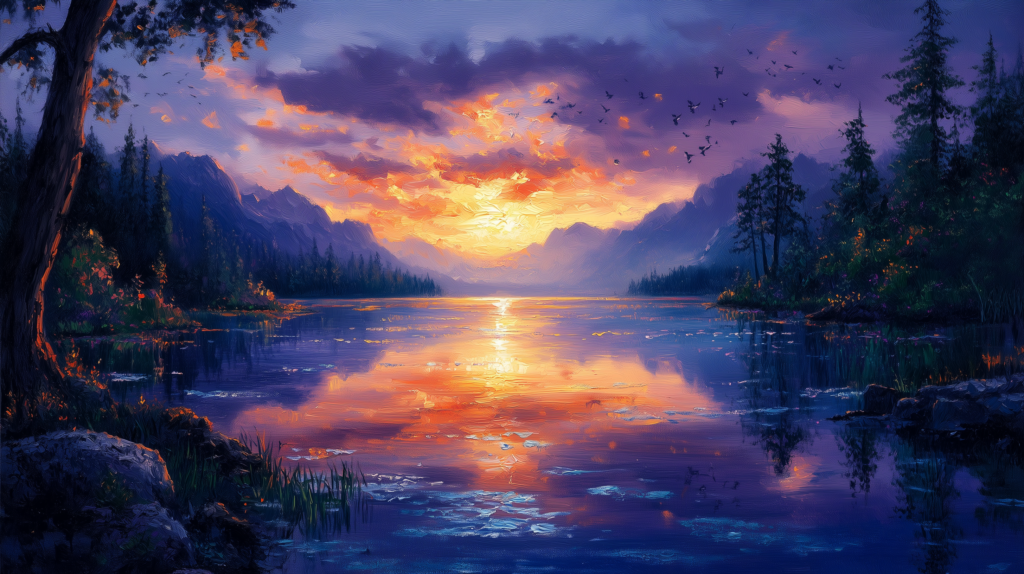
The Lagoon of Mirrors lies in a sheltered hollow where forested slopes and pale cliffs protect the water from most wind. For long periods its surface becomes so still that sky, trees and shoreline appear doubled with almost perfect clarity.
The lagoon has a reputation for omens, but they are rare enough to remain remarkable. A reflection may occasionally show an approaching animal or traveller moments before they reach the shore. Most of the time the water behaves exactly as a quiet lagoon should, making genuine anomalies difficult to dismiss.
Notable Features
- Shimmering Veil: the stillest reach of the lagoon, where reflections remain unusually clear.
- Moonlit Path: pale submerged shelves visible beneath reflected moonlight.
- Mossed Shore: a sheltered woodland margin heavily used by deer, otters and birds.
Real-World Inspiration: Highly reflective mountain lakes, sheltered fjord waters and forest lagoons.
Bestiary Inhabitants: Dolphin · Otter · Giant Owl · Water Elemental
Connections: Coral Labyrinth · Whispering Marsh
Nightwild — The Wild of Holy Night
Scholar name: Karasuthra
Nightwild is the Beastlands beneath stars and moonlight. Mountains, caves, cold ocean, black forest and deep water dominate its geography. Darkness here is natural rather than corrupt. It is simply the half of life that sees without being seen.
Predators depend on patience, scent and silence. Travellers quickly discover that loud voices and glaring artificial light often make them less secure rather than more.
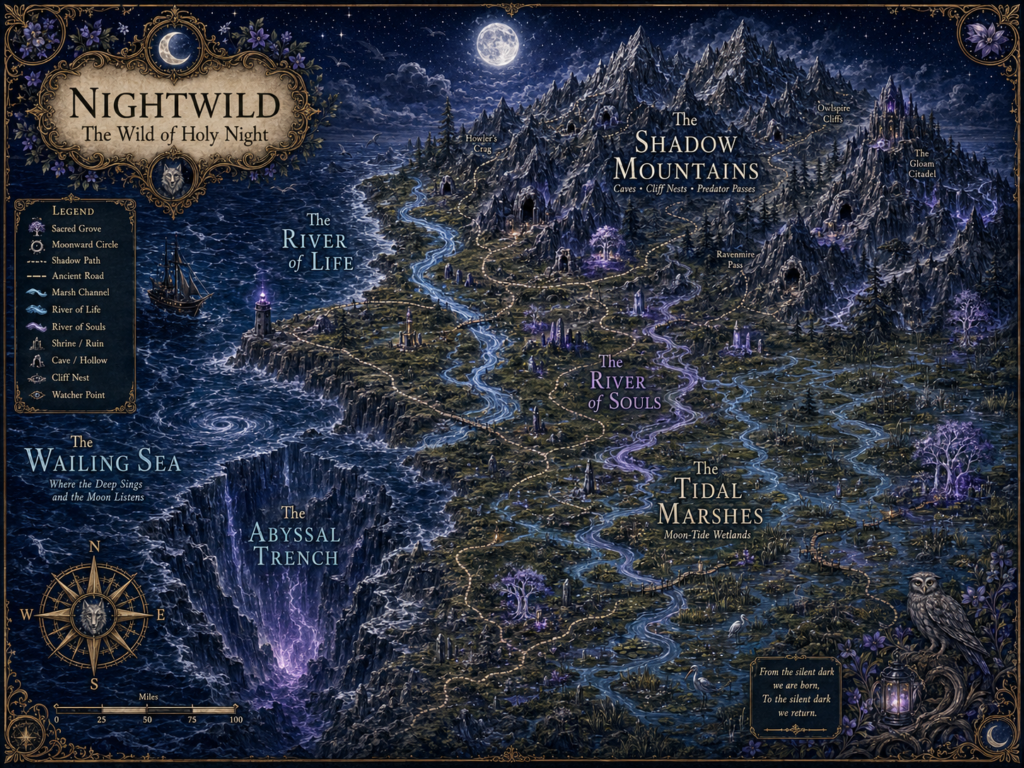
The Shadow Mountains
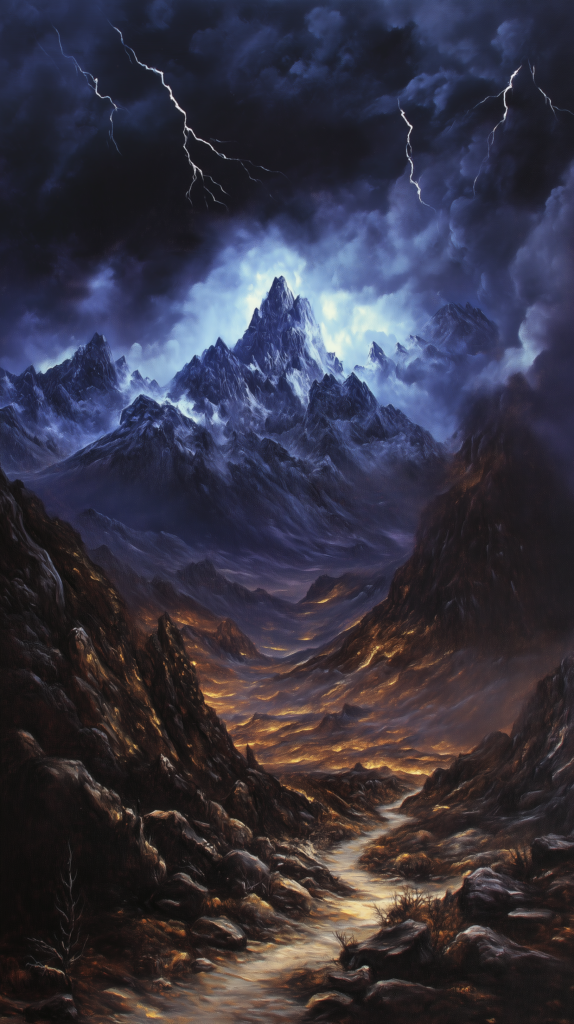
The Shadow Mountains rise beneath a sky crowded with cold stars. Their lower slopes are clothed in dark conifer forest, while higher ground opens into bare ridges, scree fields, snow patches and deep ravines. The name refers to Nightwild’s enduring darkness, not to corruption.
Mist gathers in the valleys and can reduce visibility to a few yards. Wolves follow mountain herds, bears use sheltered caves and cougars move across broken slopes with little warning. On clear nights the high ridges offer extraordinary views across Nightwild, but wind, rockfall and sudden snow can close those routes quickly.
Notable Features
- Mist Ravines: deep valleys where fog gathers and sound carries unpredictably.
- High Ridges: exposed animal routes offering fast but dangerous passage across the range.
- Echoing Caverns: natural cave systems linking otherwise separated valleys.
Real-World Inspiration: Carpathians, Scottish Highlands and high Scandinavian mountain country.
Bestiary Inhabitants: Wolf · Brown Bear · Cougar · Giant Owl
Connections: Thunderhead Pass · Wailing Sea
Adlivun
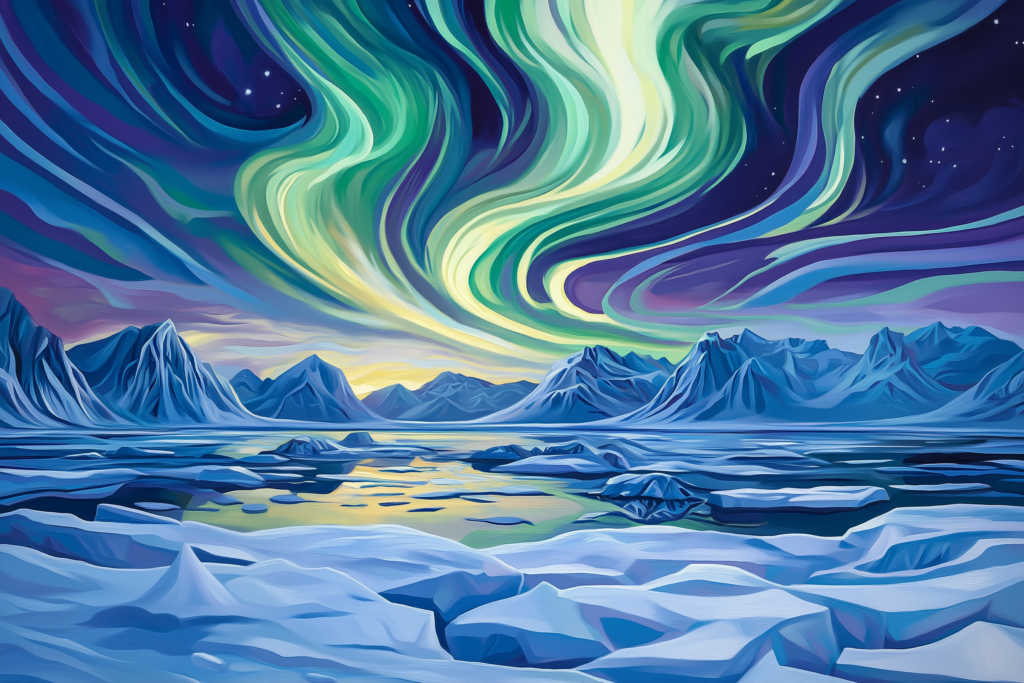
Adlivun occupies the frozen maritime reaches of Nightwild, where sea ice, black water, snow-covered coast and glacier meet beneath stars and aurora. It lies within the influence of Sedna, and marine life is central to the region.
The frozen surface is never entirely still. Leads open between ice floes, pressure ridges rise overnight and whales move through deep channels beneath the ice. Adlivun also touches the passage of animal spirits and therefore lies close in nature to the River of Souls.
Notable Features
- Frozen Sea: a vast field of shifting sea ice crossed by channels of black water.
- Glacial Caverns: blue-white cave systems formed within the coastal ice.
- Aurora: immense curtains of coloured light across the Nightwild sky.
- Deep-Water Shelf: a rich feeding ground where coastal ice gives way to deep ocean.
The Abyssal Trench
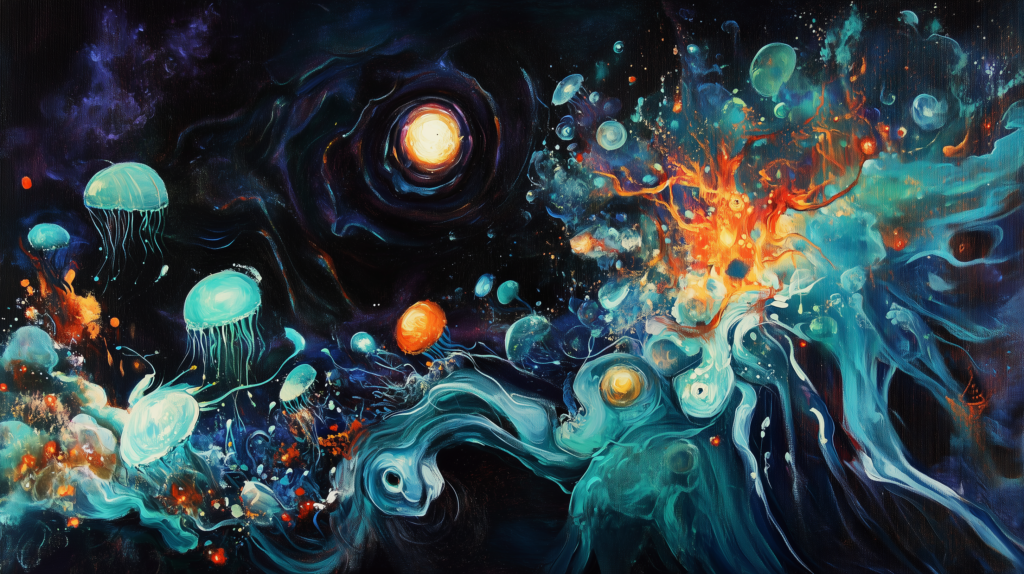
Far beneath Nightwild’s ocean, the seafloor drops into a trench of extraordinary depth. Light disappears rapidly, temperature falls and pressure becomes the defining danger. The upper walls are crossed by whales, sharks and other large marine animals, while deeper waters sustain dense pockets of life around currents and vents.
The trench needs no supernatural corruption to be frightening. Cliffs descend for miles, currents move vertically as well as horizontally and whale calls travel through darkness in ways that make direction difficult to judge.
Notable Features
- Trench Wall: a vast underwater escarpment descending into complete darkness.
- Blackwater Shelf: a broad ledge used by whales and large predators before the final descent.
- Cold Vents: mineral-rich fissures supporting concentrated deep-water life.
- Deep Current: a powerful flow running along the base of the trench.
Real-World Inspiration: Mariana, Tonga and Kermadec trench systems and Earth’s hadal ocean.
Bestiary Inhabitants: Dire Shark / Megalodon · Cachalot · Giant Moray Eel · Orca · Water Elemental
Connections: Threefold Ocean · Wailing Sea
The Wailing Sea
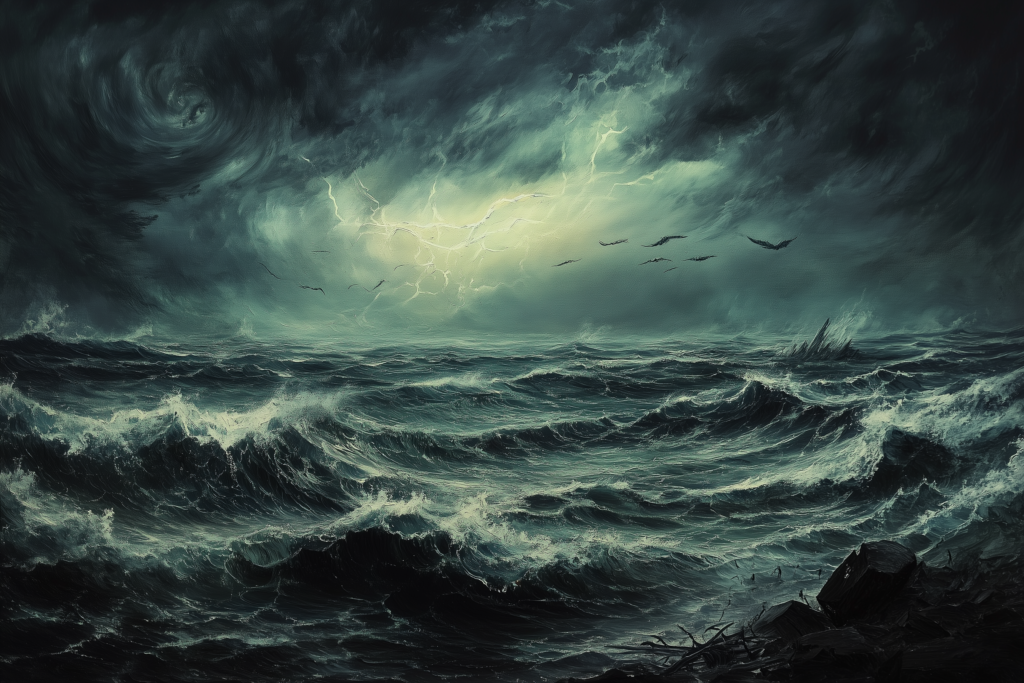
The Wailing Sea is a broad reach of cold Nightwild ocean exposed to powerful winds and long, steep swells. Storm fronts can occupy the horizon for days, while currents carry vessels and swimmers far from their intended course. Jagged islands and submerged reefs make the coastal approaches particularly dangerous.
Its name comes from sound rather than ghosts. Wind passing over wave crests, cliffs and narrow island channels creates a low carrying howl, while whale calls add deeper notes from below. In a storm the combination can resemble distant voices.
Notable Features
- Storm Reaches: exposed water regularly crossed by severe weather.
- High Swells: deep-water wave fields capable of hiding vessels between crests.
- Cold Current: a strong ocean flow leading toward Adlivun.
- Whale Roads: long migration routes followed by several kinds of cetacean.
Real-World Inspiration: North Sea, Bering Sea and the storm-lashed Southern Ocean.
Bestiary Inhabitants: Whale · Blue Whale · Cachalot · Orca · Dire Shark / Megalodon
Connections: Adlivun · Abyssal Trench · Threefold Ocean
The River of Souls
The River of Souls is a dark, slow branch of the Beastlands’ greater waters, most commonly encountered in Nightwild. Animal petitioners follow its banks or move upon its current between places of memory, rest and renewal. Its surface reflects the stars clearly even beneath heavy forest.
The river is not a place of punishment and does not carry a population of damned dead. Its character is quieter than the River of Life because it concerns what has already lived: memory, grief, instinct retained after death and the gradual return of petitioners into the larger pattern of the plane.
Notable Features
- Quiet Reaches: long stretches of slow dark water used by travelling petitioners.
- Petitioner Fords: shallow crossings where living animals and animal souls frequently meet.
- Black-Reed Banks: sheltered river margins crowded with Nightwild birds and smaller animals.
Real-World Inspiration: Dark peat-stained rivers, migratory waterways and mythic river journeys between states of existence.
Bestiary Inhabitants: Animal Petitioners · Giant Owl · Otter · Water Elemental
Connections: Adlivun · River of Life · Threefold Ocean
Cross-Wild Regions — The Living Roads
Regions passing through Sunwild, Duskwild and Nightwild
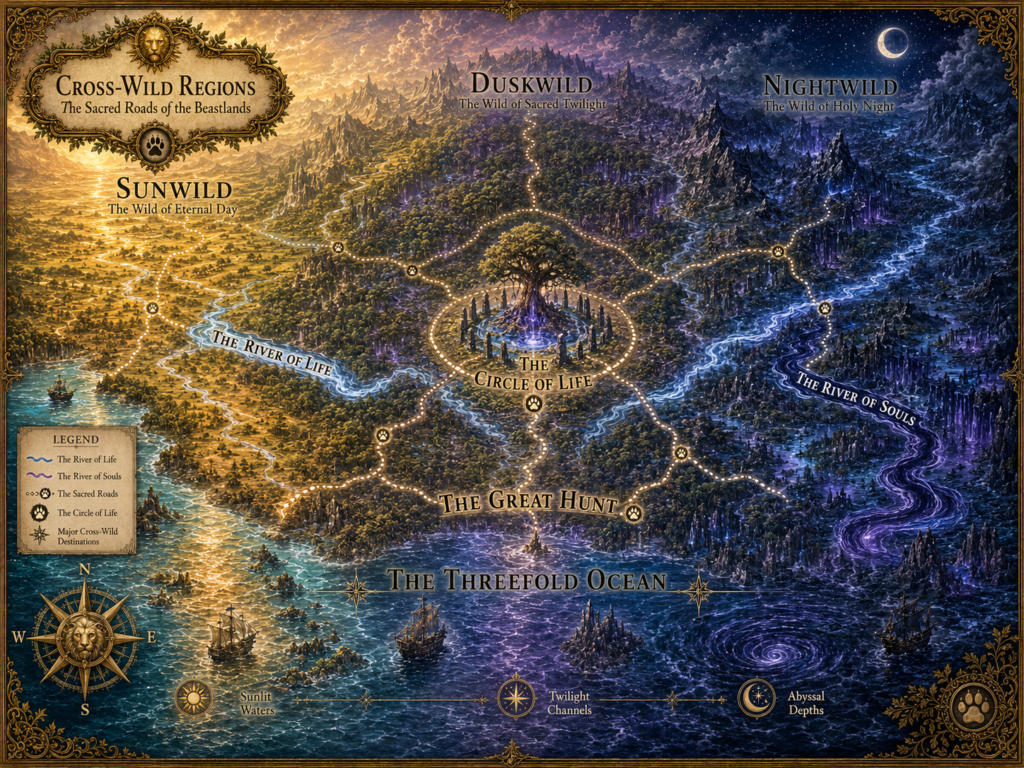
The Cross-Wild Regions are not a fourth layer. They are rivers, seas, landscapes and living patterns that refuse to belong to only one Wild. Their light, weather and inhabitants change as they pass from day through twilight into night.
The River of Life
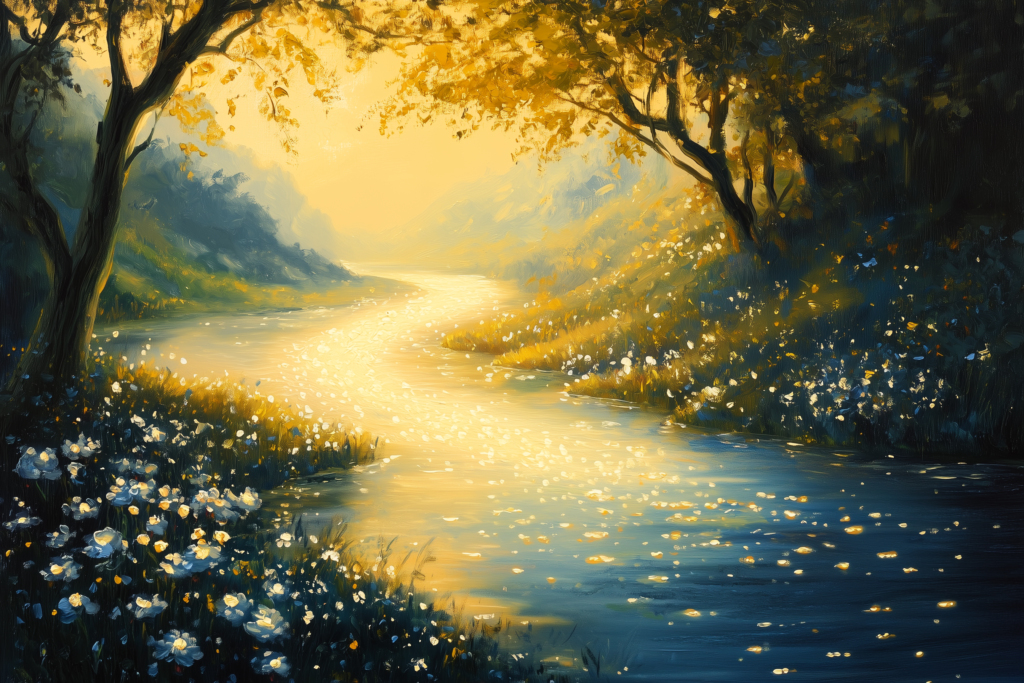
The River of Life is one of the great arteries of the Beastlands. It rises near the Circle of Life and crosses immense distances before reaching the Threefold Ocean. In Sunwild it runs through meadow and woodland; in Duskwild it broadens beneath forest and reed-shadow; beneath Nightwild its dark surface reflects the stars.
The river sustains migrations rather than serving as a universal miracle. Herds gather at its banks, fish and aquatic creatures follow its flow and seasonal floods renew broad grazing grounds. Travellers who learn its tributaries can cross enormous parts of the plane without ever using a road.
Notable Features
- Lotus Reaches: broad upper channels crowded with aquatic plants and nesting animals.
- Great Fords: traditional crossing points used by migrating herds.
- Sacred Pools: quiet side waters where wounded and exhausted animals commonly rest.
- Crystal Bridge: a natural pale-stone span crossing one of the deepest channels.
Real-World Inspiration: Great floodplain rivers, the Okavango’s branching waterways and spring-fed karst rivers.
Bestiary Inhabitants: Otter · Deer · Elk · Dolphin · Water Elemental
Connections: Circle of Life · Crystal Falls · Tidal Marshes · Threefold Ocean
The Great Hunt
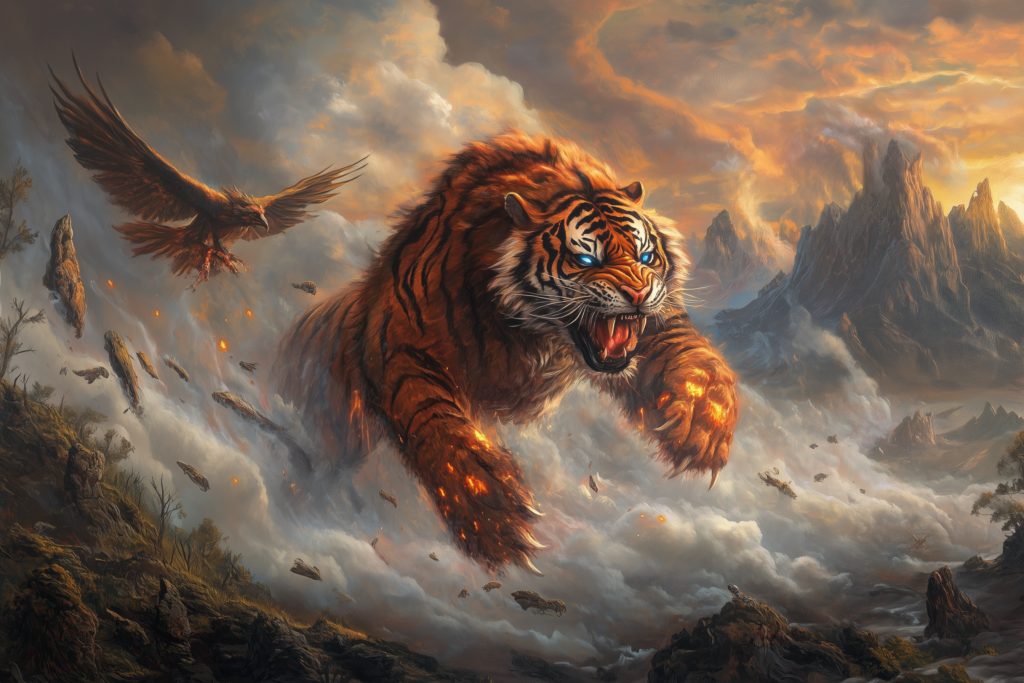
The Great Hunt is less a fixed country than a moving condition of the Beastlands. When the Hunt gathers, ordinary landscape becomes pursuit-ground: forest opens into running country, river crossings appear at critical moments and familiar trails suddenly favour hunter or quarry.
Its defining feature is reversal. A powerful hunter may discover that they have become prey, while apparently helpless quarry may gain exactly the terrain required to escape. Tracking, endurance, restraint, evasion and knowing when to abandon a chase matter as much as the final attack.
Notable Features
- Stag’s Run: a broad chase-route repeatedly used by deer and other swift herd animals.
- Stone Circle: a traditional gathering place marking the beginning or conclusion of ritual hunts.
- Moon Glade: an open clearing most often encountered when the Hunt crosses Duskwild or Nightwild.
Real-World Inspiration: Deer forests, coursing country and long predator-prey chases across grassland and mountain ecosystems.
Bestiary Inhabitants: Dire Wolf · Lion · Cougar · Dire Bear · Giant Eagle
Connections: The Great Hunt can emerge within any of the Three Wilds.
The Circle of Life
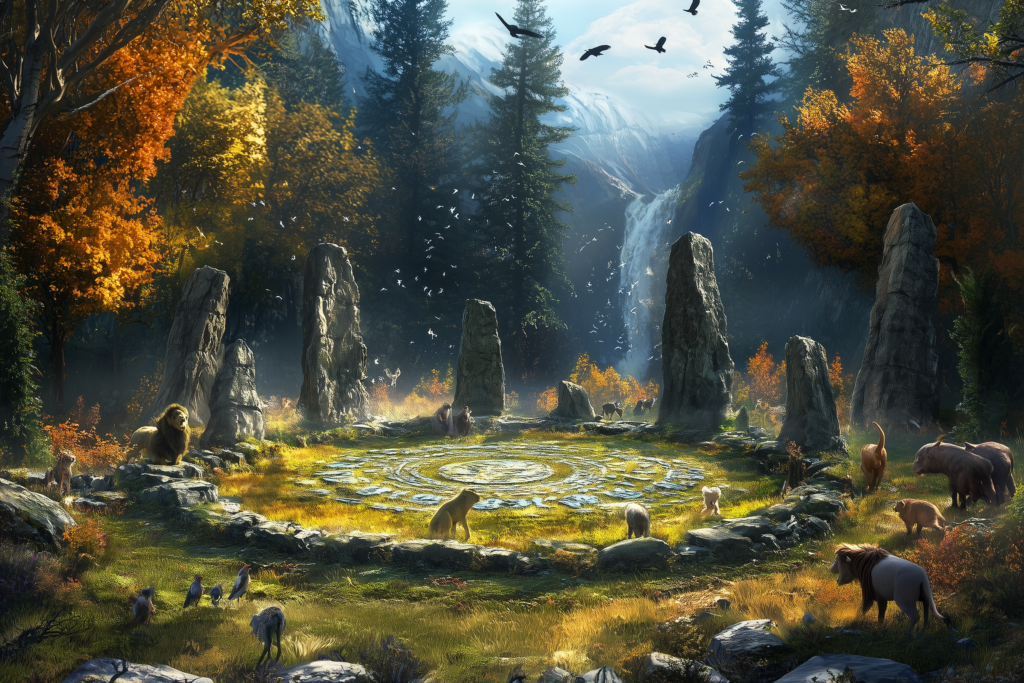
The Circle of Life is a broad convergence where grassland, forest, river meadow and rocky upland meet. Migrations pass through at different times, predators follow the herds and ancient trees stand close to open grazing ground. Birth, feeding, hunting, death, decay and new growth can all be observed within the same region.
No single creature dominates. Herds reshape grassland, predators limit the herds, scavengers clear what remains and fallen trees feed the next generation of forest. The principal headwaters of the River of Life rise among its springs and seasonal channels.
Notable Features
- Heartwood Clearing: a broad natural amphitheatre where forest opens into grassland.
- Riverhead: the main springs and channels feeding the River of Life.
- Primal Arch: a vast natural stone arch used as a landmark by migrating animals and travellers.
The Crystalline Spring
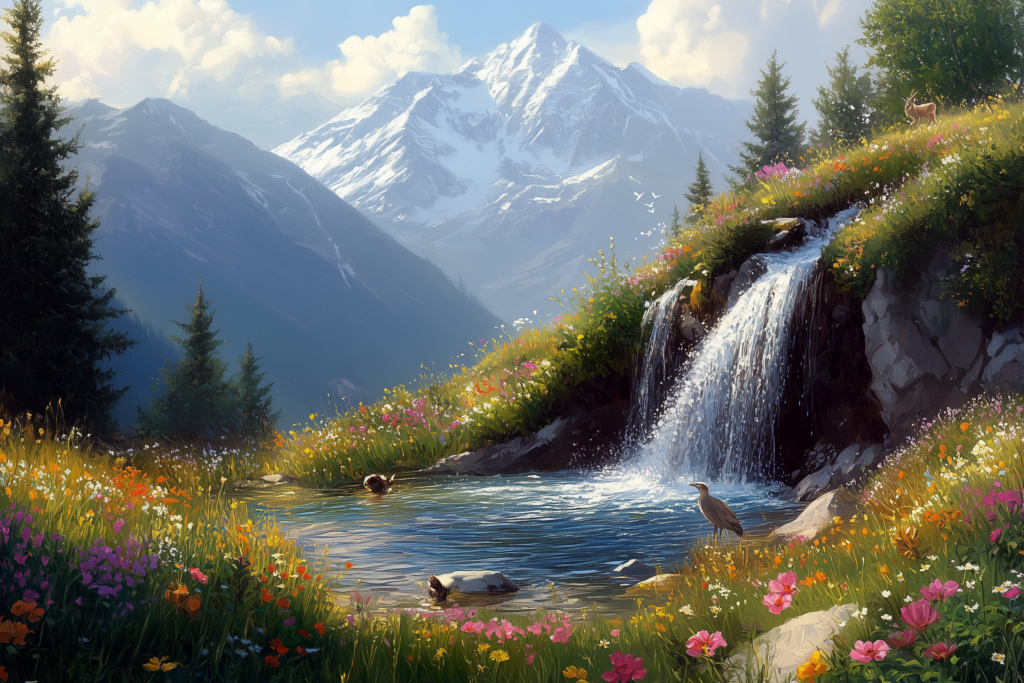
The Crystalline Spring rises in a high green valley beneath mountain cliffs. Snowmelt and underground water emerge through pale stone, filling a sequence of clear pools before descending in small waterfalls. Wildflowers crowd the banks and pine forest climbs the surrounding slopes.
Its defining quality is purity. The water remains cold, clear and fast-moving, supporting mountain animals and feeding several smaller Beastlands rivers. It is a peaceful place without needing to cure every disease, reveal every secret or grant a vision to everyone who drinks from it.
Notable Features
- Upper Spring: the clear source emerging directly from pale mountain rock.
- Cascade Pools: linked basins descending through meadow and pine forest.
- Waterfall Grotto: a shallow cavern behind the lowest major cascade.
Real-World Inspiration: Swiss glacial streams, Icelandic springs and exceptionally clear limestone headwaters.
Bestiary Inhabitants: Deer · Unicorn · Dryad · Eagle · Water Elemental
Connections: River of Life · Thunderhead Pass
The Tidal Marshes
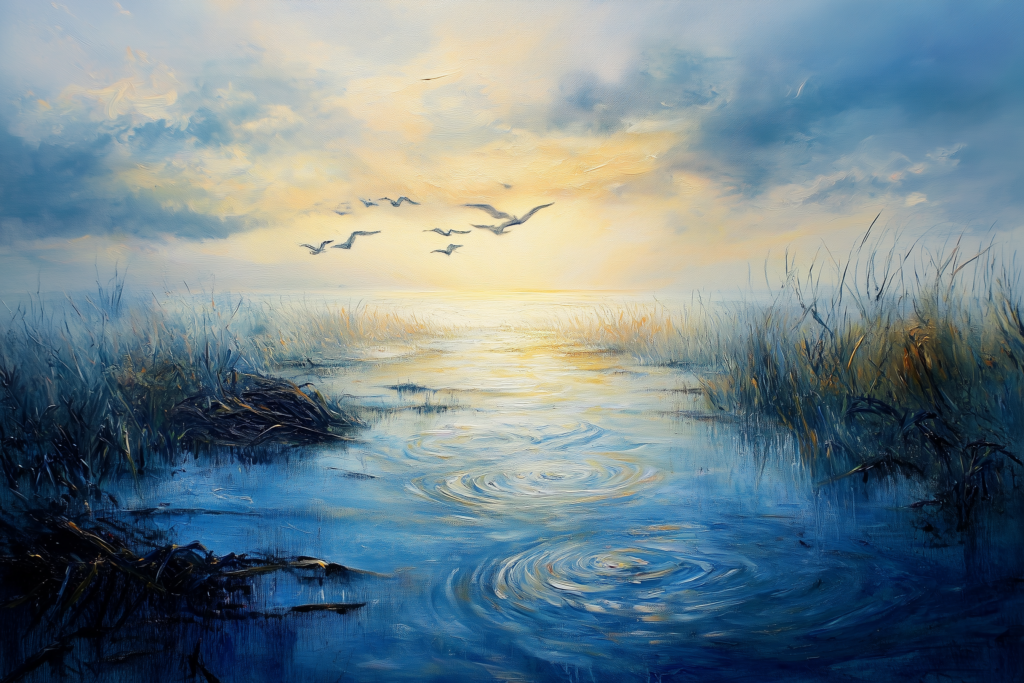
The Tidal Marshes occupy a broad coast where grassland and forest give way to the Threefold Ocean. At high tide much of the region becomes shallow inland sea, leaving only mangroves, reed tops and raised islands above water. At low tide the same country opens into mudflats, sandbars, pools and winding channels.
Navigation changes by the hour. A path crossed on foot may require swimming on the return journey, while channels deep enough for boats can disappear into exposed mud. Migrating creatures arrive during different stages of the tide, making the marsh one of the busiest ecological boundaries on the plane.
Notable Features
- Tidal Channels: shifting waterways connecting marsh and open sea.
- Mangrove Reaches: dense coastal woodland rooted directly in brackish water.
- Great Mudflats: feeding grounds exposed during the lowest tides.
- Singing Pools: tidal basins that produce low tones as water drains through narrow rock openings.
Real-World Inspiration: Bay of Fundy tidal country, the Sundarbans and great coastal marsh systems.
Bestiary Inhabitants: Giant Toad · Otter · Jaguar · Dolphin · Water Elemental
Connections: Roaring Savannah · Whispering Marsh · Coral Labyrinth · Threefold Ocean
The Threefold Ocean
The Threefold Ocean is one continuous sea expressed beneath the different skies of the Beastlands. In Sunwild its shallows are warm and bright; through Duskwild the water deepens beneath violet-blue light; in Nightwild it becomes cold, dark and increasingly immense.
Depth can act like distance. Divers descending through a Sunwild reef may eventually find themselves in Duskwild water without travelling far horizontally, while the deepest channels lead naturally toward Nightwild and the Abyssal Trench. Whales and other migrating marine animals are often the most reliable guides between these waters.
Notable Features
- Sunlit Reaches: warm shallows, islands and open pelagic water beneath Sunwild.
- Twilight Channels: deeper blue-water routes connecting reefs, lagoons and marsh coasts.
- Nightwater Deeps: cold open ocean beneath Nightwild’s stars.
Real-World Inspiration: The ecological progression from tropical reef and continental shelf to open pelagic water and deep ocean.
Bestiary Inhabitants: Dolphin · Whale · Blue Whale · Orca · Giant Moray Eel · Dire Shark / Megalodon
Connections: Coral Labyrinth · Lagoon of Mirrors · Tidal Marshes · Adlivun · Wailing Sea · Abyssal Trench
Inhabitants of the Beastlands
The plane contains immense populations of ordinary animals. A new valley does not require a new species simply because it lies on an Outer Plane. Wolves remain wolves, elephants remain elephants and whales remain whales. The extraordinary element lies in the scale and freedom of their world and in the possibility that an individual may be awakened, celestial or a petitioner.
- Ordinary animals living within immense natural populations.
- Animal petitioners whose afterlife has taken an animal form.
- Awakened animals possessing full intelligence and individual goals.
- Celestial animals associated with sacred paths, realms and powers.
- Nature spirits, including dryads, hamadryads and treants.
- Animal sovereigns, including the Animal Lords.
Travel and Arrival
Gates into the Beastlands usually resemble pieces of wilderness rather than constructed portals: hollow trees, migration trails, moonlit dens, river fords, cliff nests, vine arches or watering places reached after following an animal farther than mortal geography should allow.
Travel within the plane is ecological. Rivers, watersheds, prevailing winds, migration routes, animal tracks and local knowledge are usually more reliable than compass bearings. A herd may carry travellers from Sunwild into Duskwild without any obvious boundary, while a vessel sailing into colder water may discover the stars of Nightwild overhead.
Distance is not entirely fixed. A destination approached by the correct migration route may be reached quickly; the same place sought by marching directly toward it may remain on the horizon for days.
Divine Powers and Animal Sovereigns
Artemis
Artemis holds the Huntress’s Den in Duskwild. Her realm embodies the disciplined hunt, uncultivated wilderness and the distinction between a hunter who respects life and one who kills merely to exercise power.
Sedna
Sedna’s influence is strongest in Adlivun and the frozen seas of Nightwild, where marine life, hunting and the passage of animal spirits meet.
Animal Lords
The Animal Lords are sovereign beings associated with animal kinds and the oldest laws of wild existence. They are individual powers with motives, territories and relationships of their own rather than merely larger versions of ordinary animals.
Running the Beastlands
The Beastlands work best when animals behave like animals rather than waiting to become combat encounters. Predators stalk, test, isolate and retreat. Herd animals flee until cornered or panicked. Parents defend young. Migrating animals care more about reaching water or grazing than about the adventurers standing nearby.
Use the Bestiary First
Let an established creature do the mechanical work and allow the region to provide the extraordinary context. A dire wolf following an elk migration beneath Nightwild’s stars needs no separate regional species. An orca hunting beneath Adlivun’s ice is already distinctive because of where the encounter happens and what the animal is trying to do.
Let Predators Be Predators
A lion killing prey does not violate the plane. Neither does a wolf defending its den or an orca hunting. The moral pressure begins when intelligent creatures introduce torment, waste, extermination or domination for pleasure.
Make Travel Ecological
Give travellers a natural system to understand: follow an elk migration, wait for a tide, locate a ford, watch which birds cross a mountain pass, travel beside whales or ask a treant which route through an old forest is currently open.
Adventure Hooks
The Broken Migration
A great Sunwild herd has stopped moving. Predators gather, grazing country is being damaged and distant watering places remain unused. Nothing obvious blocks the route. The party must travel with the animals and discover what they can sense that the travellers cannot.
The Trophy King
A mortal hunter has discovered a repeatable gate into the Beastlands and begun returning home with trophies. Ordinary animals were only the beginning. The expedition has now brought enchanted cages and intends to capture awakened and celestial creatures alive.
The Animal Power Will Not Wake
One of the Beastlands’ animal sovereigns has fallen into unnatural sleep. Creatures of its kind across several regions abandon migrations, lose instinctive knowledge and behave in ways their neighbours immediately recognise as wrong. The cause lies somewhere along a route crossing all three Wilds.
Historic and Mythic Context
Older planar traditions call the three great divisions of the Beastlands Krigala, Brux and Karasuthra. SpiralWorlds retains these names as outsider and scholarly terminology, while Sunwild, Duskwild and Nightwild serve as the clearer everyday names of the Three Wilds.
The older title Happy Hunting Grounds survives in some planar accounts, but hunting is only one part of the plane. Birth, migration, territory, courtship, predation, death, memory and ecological renewal are equally fundamental to its identity.
The Beastlands draw on the widespread mythic idea of sacred wilderness while keeping specific traditions distinct. Artemis therefore belongs here through her Hellenic identity and Sedna through her own Arctic mythic tradition rather than both being folded into a generic religion of nature.
The plane is ultimately an Upper Plane of wild goodness. Life hunts, flees, feeds, migrates, reproduces, dies and returns. The moral boundary appears where instinct gives way to cruelty, ownership, deliberate waste or domination.
Watch & Listen
The Animal Heaven of Dungeons & Dragons — The Beastlands
The Beastlands and Arborea — Planar Lore
Wilderness Ambience
Explore: Planes of Existence · Elysium · Arborea · Animal Lords · Bestiary
Keep this reference growing
If this page helped with your reading or game, you can support its upkeep or explore the curated books.
Explore the Bookshop — epics, classics and stories behind imagined worlds.