
Giant Toad
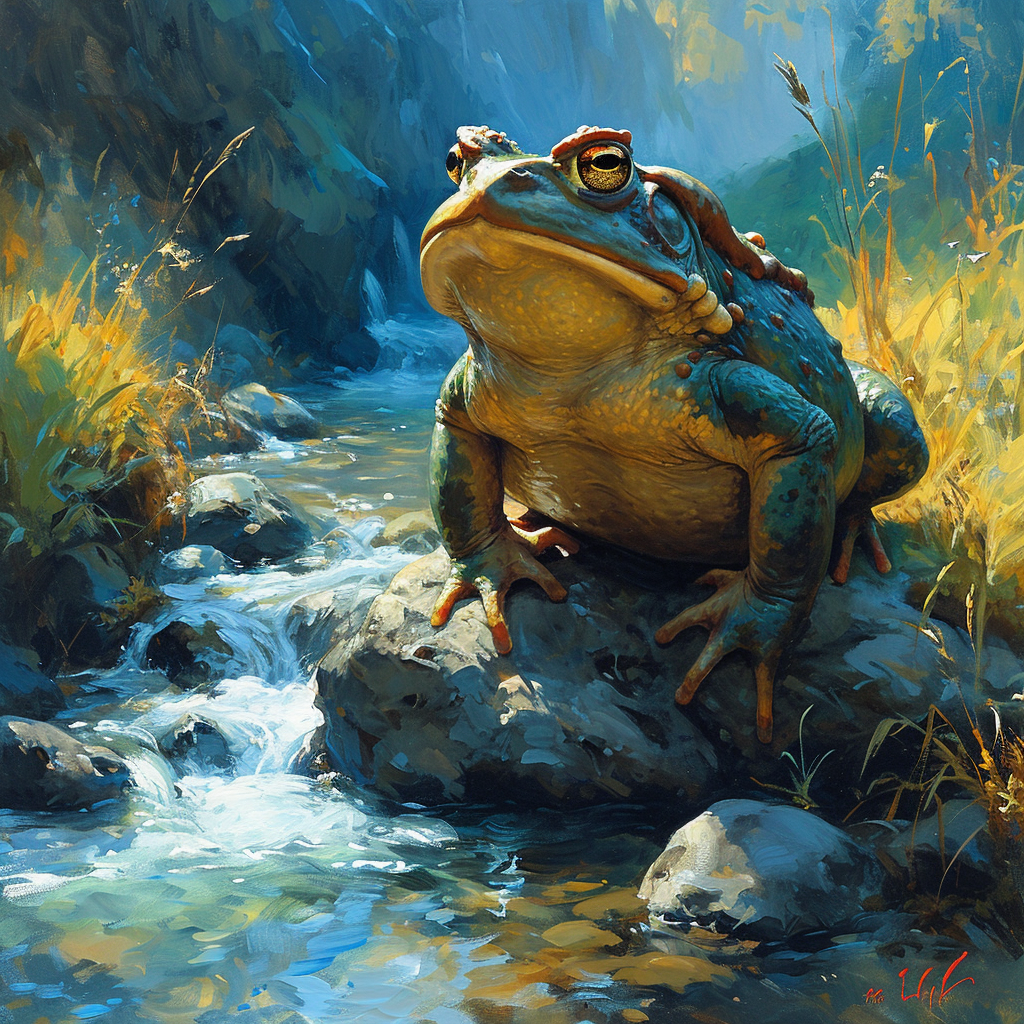
A horse-sized ambush predator whose warty hide carries a debilitating toxin, the giant toad waits in mud, reeds and shadow before engulfing prey in a sudden rush.
Giant Toad at a Glance
Game Statistics
Giant Toad
AC 13 (natural armor)
Initiative +1 (11)
HP 51 (6d10 + 18)
Speed 30 ft., Swim 30 ft.
| STR | DEX | CON | INT | WIS | CHA |
|---|---|---|---|---|---|
| 19 (+4) | 13 (+1) | 16 (+3) | 1 (−5) | 8 (−1) | 6 (−2) |
Skills Perception +1, Stealth +3
Senses Darkvision 60 ft.; Passive Perception 11
Languages None
CR 2 (XP 450; PB +2)
Traits
Amphibious. The toad breathes normally both in air and underwater.
Standing Leap. Without a running start, the toad can make a Long Jump of up to 20 feet or a High Jump of up to 10 feet.
Poisonous Hide. A creature that grapples the toad or hits it with an Unarmed Strike or natural weapon while within 5 feet of it must succeed on a DC 13 Constitution saving throw.
On a failed save, the creature takes 3 (1d6) Poison damage and has the Poisoned condition until the start of the toad’s next turn. A creature makes this saving throw no more than once per turn.
Actions
Bite. Melee Attack Roll: +6, reach 5 ft. Hit: 8 (1d8 + 4) Piercing damage plus 5 (2d4) Poison damage.
If the target is a Medium or smaller creature, it also has the Grappled condition (escape DC 14). While maintaining this grapple, the toad cannot Bite another creature.
Swallow. The toad swallows one Medium or smaller creature it is grappling. The grapple ends. The swallowed creature has the Blinded and Restrained conditions and has Total Cover against attacks and effects originating outside the toad.
At the end of each of the toad’s turns, a swallowed creature takes 10 (3d6) Acid damage.
The toad can hold only one swallowed creature at a time and cannot use Bite while a creature remains inside it.
If the toad takes 15 or more damage during a single turn from the creature inside it, the toad must succeed on a DC 13 Constitution saving throw at the end of that turn or regurgitate the creature.
A regurgitated creature appears Prone in an unoccupied space within 5 feet of the toad.
If the toad dies, a swallowed creature can use 5 feet of movement to crawl from the corpse, entering the nearest available space Prone.
Giant Toad
XP 600
Init +1
Senses low-light vision , scent ; Perception +8
Defense
AC 14, touch 10, flat-footed 13 (+1 Dex, +4 natural, −1 size)
hp 22 (3d8+9)
Fort +6, Ref +6, Will +0
Defensive Abilities poison skin
Offense
Speed 30 ft., swim 15 ft.
Melee bite +5 (1d6+6 plus grab)
Space 10 ft.; Reach 10 ft.
Special Attacks swallow whole (1d4 bludgeoning, AC 12, 2 hp)
Statistics
Str 19, Dex 13, Con 16, Int 1, Wis 8, Cha 6
Base Atk +2; CMB +7 (+11 grapple); CMD 18 (22 vs. trip)
Feats Lightning Reflexes , Skill Focus (Perception)
Skills Acrobatics +5 (+9 jump), Perception +8, Stealth +5, Swim +12; Racial Modifiers +4 Acrobatics (+8 jump), +4 Stealth, +8 Swim
Special Abilities
Poison Skin (Ex). An attacker using an unarmed strike or natural weapon against a giant toad risks direct contact with its toxic skin.
Giant toad skin: contact; Fortitude DC 14; frequency 1/round for 4 rounds; effect 1d2 Wisdom damage; cure 1 successful save.
Ecology
Environment temperate forests, plains or swamps
Organization solitary, pair or knot (3–12)
Treasure none
Giant Toad Animal Companions
Giant toad companions use the giant frog companion progression as their starting framework but do not gain the frog’s specialised tongue or pull abilities. Their distinguishing adaptation is poisonous skin.
Starting Statistics: Size Medium; Speed 30 ft., Swim 30 ft.; AC +1 natural armor; Attack bite (1d6); Str 15, Dex 13, Con 16, Int 1, Wis 9, Cha 6; Special Qualities low-light vision, scent.
4th-Level Advancement: Str +2, Dex +2; gains poison skin and swallow whole.
Giant Toad
Hit Dice 3d8+9 (22 hp)
Initiative +1
Speed 30 ft. (6 squares), swim 20 ft.
Armor Class 14 (−1 size, +1 Dex, +4 natural), touch 10, flat-footed 13
Base Attack/Grapple +2/+10
Attack Bite +5 melee (1d6+6)
Full Attack Bite +5 melee (1d6+6)
Space/Reach 10 ft./10 ft.
Special Attacks improved grab, swallow whole
Special Qualities amphibious, low-light vision , poisonous skin, scent
Saves Fort +6, Ref +6, Will +0
Abilities Str 19, Dex 13, Con 16, Int 1, Wis 8, Cha 6
Skills Hide +5, Jump +9, Listen +1, Spot +2, Swim +12
Feats Lightning Reflexes , Skill Focus (Spot)
Environment Temperate forests, plains and swamps
Organization Solitary, pair or knot (3–12)
Challenge Rating 2
Treasure None
Alignment Always neutral
Advancement 4–6 HD (Large)
Level Adjustment —
Combat
A giant toad waits almost motionless until prey enters striking distance. It then lunges, bites and attempts to seize the victim. Once it establishes a hold, swallowing the captured creature takes priority over attacking additional opponents.
Improved Grab (Ex)
To use this ability, a giant toad must hit a Medium or smaller opponent with its bite attack. It may then attempt to start a grapple without first making a separate touch attack. If it establishes a hold, it can attempt to swallow the opponent.
Swallow Whole (Ex)
A giant toad can attempt to swallow a Medium or smaller creature it already holds by succeeding on a grapple check.
A swallowed creature takes 1d4 points of bludgeoning damage each round.
A trapped creature can cut its way free by dealing 2 points of damage to the toad’s interior (AC 12) with a light slashing or piercing weapon.
Once a creature exits, muscular action closes the opening. Another swallowed creature must cut its own way out.
Poisonous Skin (Ex)
A creature striking the giant toad with an unarmed attack or natural weapon is exposed to contact poison.
Poison: contact; Fortitude DC 14; initial damage 1d2 Wisdom; secondary damage 1d2 Wisdom. The saving throw is Constitution-based.
Amphibious (Ex)
A giant toad can survive and function both on land and underwater.
Skills
A giant toad has a +8 racial bonus on Hide checks, a +4 racial bonus on Jump checks and a +8 racial bonus on Swim checks.
It may take 10 on a Swim check even when distracted or endangered.
GM Quick Use
First Impression
At rest, a giant toad resembles a mound of wet earth, rotting vegetation or lichen-covered stone. Its breathing is slow and almost invisible until its throat suddenly swells.
Opening Move
It waits for one creature to move ahead of the group, then lunges from concealment and attempts to seize that target in its jaws.
Combat Goal
The toad is hunting rather than fighting a battle. It wants to swallow one manageable creature and withdraw rather than remain surrounded.
Morale
A badly injured giant toad normally retreats. An adult guarding eggs, young or a breeding pool may fight with greater persistence.
Useful Terrain
Reeds, muddy banks, flooded ruins, drainage channels, caves, pools and dense undergrowth provide excellent ambush ground.
Warning Signs
Flattened reeds, broad tracks, missing vermin, shed skin, half-digested bones and deep booming croaks often reveal a nearby giant toad.
Appearance and Natural History
The giant toad is a massively enlarged true toad, broad through the body with short, powerful limbs, a wide head and a rough hide covered in irregular warts. Adults can approach the bulk of a horse, although their low, squat stance makes them appear smaller until they move.
Colour varies with habitat. Mossy green, ochre, deep brown, grey-green, rust-red and near-black are all encountered. Broken mottling allows a motionless giant toad to resemble mud, stone, bark or decaying vegetation.
Behind the eyes and across the warty hide lie enlarged poison glands. Rough handling is dangerous. Creatures that bite, claw, punch or grapple a giant toad can expose themselves directly to its toxic secretions.
Although amphibious, mature giant toads are not confined to water. Many spend long periods in damp woodland, grassland, scrub, caves or marsh margins, returning to pools, flooded hollows and slow waterways during breeding periods.
Giant insects, rats, snakes, waterfowl, fish and similarly sized animals form ordinary prey. A sufficiently hungry specimen attempts to consume almost anything it believes will fit into its mouth.
Behaviour
Giant toads conserve energy. A well-fed animal may remain almost completely motionless for hours, moving only its eyes as it watches a trail, pool margin or game path.
When suitable prey enters striking distance, this lethargy vanishes. The toad drives itself forward with its hind limbs, clamps its jaws around the victim and attempts to force the struggling creature into its expandable throat.
The booming territorial and mating calls of adult specimens can carry a considerable distance across still water at night. During breeding periods, several adults may gather around the same pool. Such a gathering is called a knot.
Giant toads do not collect treasure or defend possessions. Objects found near a resting place normally belonged to previous victims or were already present when the animal occupied the site.
Tactics Across Editions
Before Combat
The toad selects a place where camouflage and difficult approach routes allow prey to come close before noticing it. It remains still rather than actively stalking unless hunger forces it to move.
During Combat
It attacks one creature, secures that prey and attempts to swallow it. It does not deliberately spread attacks among several opponents.
Withdrawal
Once badly injured or confronted by prey it cannot subdue, an ordinary giant toad retreats toward water, thick vegetation, deep mud or another protected refuge.
Breeding Season
Adults gathered around a breeding pool tolerate one another unusually well and may become considerably more territorial toward intruders.
Encounter Builder
| Encounter | Composition | Use | Terrain |
|---|---|---|---|
| Roadside Ambush | 1 giant toad | Wilderness threat | The motionless animal resembles a moss-covered boulder beside the road. |
| Breeding Pair | 2 giant toads | Moderate encounter | One animal remains close to the waterline while the other attacks. |
| Knot at the Ford | 3–4 giant toads | Environmental fight | Deep mud and water restrict movement around the crossing. |
| Cellar Toad | 1 giant toad | Dungeon encounter | The animal entered through a flooded drain after consuming the local vermin. |
| Spawn Pool | 2 adults with eggs or young | Territorial encounter | The adults are unusually reluctant to abandon the pool. |
Treasure and Usable Remains
Giant toads do not value coins, jewellery or manufactured objects. Conventional treasure found in their lairs usually belonged to swallowed victims or previous occupants.
The enlarged poison glands can be useful to an experienced herbalist, poisoner, alchemist or natural philosopher. Harvesting them safely requires suitable tools and care; direct contact can expose the collector to the animal’s toxin.
Apothecaries or collectors may also purchase preserved skin, glands, eggs or anatomical specimens in places where giant amphibians are uncommon.
Rumours and Adventure Hooks
- A moss-covered stone beside a millpond appears to change position every night.
- Every rat beneath a manor house disappears before a dog vanishes through the same flooded cellar drain.
- A marsh herbalist will pay handsomely for an intact giant-toad poison gland.
- A knot of giant toads has occupied the only usable ford for several miles.
- A missing courier’s satchel may still be inside the enormous toad that swallowed him on the forest road.
- Villagers believe the booming calls from a nearby pool predict rain. In fact, an unusually large breeding gathering has formed there.
Related SpiralWorlds Rules
Rules Notes and Sources
D&D 5.5e / 2024: SpiralWorlds CR 2 conversion combining the bite, grapple and swallow sequence with the Giant Toad’s poisonous-hide identity.
Pathfinder 1e: the numerical core derives from the Giant Toad presented in Pathfinder Roleplaying Game Bestiary 2. Perception is +8, with racial modifiers of +4 Acrobatics (+8 jump), +4 Stealth and +8 Swim.
D&D 3.5e: SpiralWorlds conversion using 3.5e grapple, poison, skill and swallow-whole conventions.
The Giant Toad has no spellcasting or spell-like abilities, so no spell links are required.
Existing Open Game Content and licensing notices remain subject to the applicable SpiralWorlds licensing material.
Keep this reference growing
If this page helped with your reading or game, you can support its upkeep or explore the curated books.
Explore the Bookshop — epics, classics and stories behind imagined worlds.